Utilizing Your Resources Planning Prevents Wandering and Provides Direction
Jacqueline Collins, President Partnering for Performance 98 Temple Street, Abington, MA 02351 Phone: 781-982-8812  Email:  [email_address] Website:  www.pfpconsult.com Proprietary Statement Partnering for Performance    All Rights Reserved.  This document embodies information that is proprietary. It may not be copied or reproduced in whole or in part or used for other purposes without written permission.
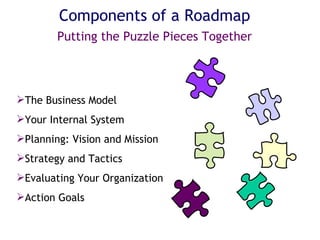
Components of a Roadmap Putting the Puzzle Pieces Together The Business Model Your Internal System Planning: Vision and Mission Strategy and Tactics Evaluating Your Organization Action Goals
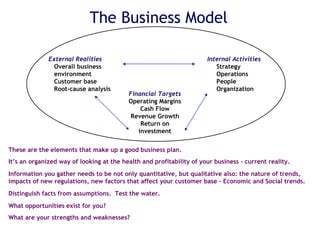
The Business Model These are the elements that make up a good business plan. It’s an organized way of looking at the health and profitability of your business – current reality. Information you gather needs to be not only quantitative, but qualitative also: the nature of trends, impacts of new regulations, new factors that affect your customer base – Economic and Social trends. Distinguish facts from assumptions.  Test the water. What opportunities exist for you? What are your strengths and weaknesses?  External Realities Overall business  environment Customer base Root-cause analysis Internal Activities Strategy Operations People Organization Financial Targets Operating Margins Cash Flow Revenue Growth Return on investment
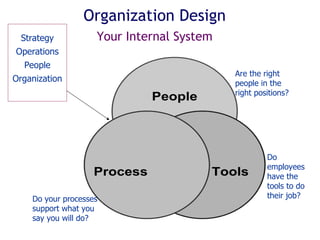
Organization Design Your Internal System Strategy Operations People Organization Are the right people in the right positions? Do your processes support what you say you will do? Do employees have the tools to do their job?
Strategy and Vision Statements Both people and organizations need to establish a  strategic framework  for significant success. This framework consists of: a  vision  for your future, a  mission  that defines what you are doing,  values  that shape your actions, strategies  that zero in on your key success approaches, and, goals  and  action plans  to guide your daily, weekly and monthly actions. Your organization's success and your personal success depend on how well you define and live by each of these important concepts.
Vision Statement A vision is a statement about what you and/or your organization wants to become.  It is the core of your inspiration and motivation . A vision should stretch you and/or your organization’s capabilities and image of itself. It gives shape and direction to the future and answers the question: “Where do we/I want to go. “ Visions range in length from a couple of words to  several pages.
Mission Statement The difference between a mission statement and a vision statement is that a mission statement focuses on the present state while a vision statement focuses on the future. All mission statements broadly describe an organization’s present capabilities, customer focus, activities, and business makeup. A mission statement serves as a baseline for effective business planning.
Strategy Development Where are we now? What do we do well? Where do we need improvement? Where do we want to be? How do we get to where we want to go? What can we offer to the market to differentiate  ourselves? How can we add customer value?  What alternative growth directions should be  considered?  How should they be pursued?
Strategies, Goals and Action Plans Strategies  are the broadly defined four or five key approaches the organization and/or individual will use to accomplish the mission and drive toward the vision.  Goals  and  action plans  flow from each strategy.
SWOT Business Analysis Worksheet Strengths: What advantages does your organization have? What do you do better than anyone else? What unique or lowest-cost resources do you have access to? What do people in your market see as your strengths? How will your strengths get you closer to achieving your vision? Weaknesses: What could you improve? What should you avoid? What are people in your market likely to see as weaknesses? How will your weaknesses hold you back?
SWOT Business Analysis Worksheet Opportunities: Where are the good opportunities facing you? What are the interesting trends you are aware of? Threats: What obstacles do you face? What is your competition doing? Are the required specifications for your job, products, or services changing? Is changing technology threatening your position? Do you have bad debt or cash-flow problems? Could any of your weaknesses threaten your business?
Action Goals Develop a practical business plan of action. How will you achieve your vision and mission? What are your priorities?
What can you do to achieve what you want to achieve?   What is the best solution or combination of solutions? When is the plan to begin? What are check back and completion times (progress evaluation)? What person/persons will be involved? What will each person do? Focus on your top one or two priorities in terms of achieving your vision.  These are your “action goals”. Action Planning
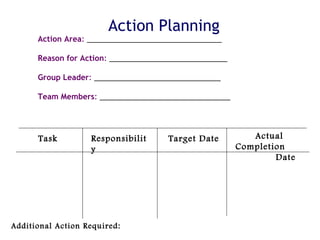
  Action Planning Action Area :  ________________________________ Reason for Action :  ____________________________ Group Leader :  ______________________________ Team Members :  _______________________________ Task Responsibility Target Date Actual Completion  Date Additional Action Required:
Planning Prevents Wandering  and Provides Direction

Utilizing Your Resources by Jacqueline Collins

  • 1.
    Utilizing Your ResourcesPlanning Prevents Wandering and Provides Direction
  • 2.
    Jacqueline Collins, PresidentPartnering for Performance 98 Temple Street, Abington, MA 02351 Phone: 781-982-8812 Email: [email_address] Website: www.pfpconsult.com Proprietary Statement Partnering for Performance  All Rights Reserved. This document embodies information that is proprietary. It may not be copied or reproduced in whole or in part or used for other purposes without written permission.
  • 3.
    Components of aRoadmap Putting the Puzzle Pieces Together The Business Model Your Internal System Planning: Vision and Mission Strategy and Tactics Evaluating Your Organization Action Goals
  • 4.
    The Business ModelThese are the elements that make up a good business plan. It’s an organized way of looking at the health and profitability of your business – current reality. Information you gather needs to be not only quantitative, but qualitative also: the nature of trends, impacts of new regulations, new factors that affect your customer base – Economic and Social trends. Distinguish facts from assumptions. Test the water. What opportunities exist for you? What are your strengths and weaknesses? External Realities Overall business environment Customer base Root-cause analysis Internal Activities Strategy Operations People Organization Financial Targets Operating Margins Cash Flow Revenue Growth Return on investment
  • 5.
    Organization Design YourInternal System Strategy Operations People Organization Are the right people in the right positions? Do your processes support what you say you will do? Do employees have the tools to do their job?
  • 6.
    Strategy and VisionStatements Both people and organizations need to establish a strategic framework for significant success. This framework consists of: a vision for your future, a mission that defines what you are doing, values that shape your actions, strategies that zero in on your key success approaches, and, goals and action plans to guide your daily, weekly and monthly actions. Your organization's success and your personal success depend on how well you define and live by each of these important concepts.
  • 7.
    Vision Statement Avision is a statement about what you and/or your organization wants to become. It is the core of your inspiration and motivation . A vision should stretch you and/or your organization’s capabilities and image of itself. It gives shape and direction to the future and answers the question: “Where do we/I want to go. “ Visions range in length from a couple of words to several pages.
  • 8.
    Mission Statement Thedifference between a mission statement and a vision statement is that a mission statement focuses on the present state while a vision statement focuses on the future. All mission statements broadly describe an organization’s present capabilities, customer focus, activities, and business makeup. A mission statement serves as a baseline for effective business planning.
  • 9.
    Strategy Development Whereare we now? What do we do well? Where do we need improvement? Where do we want to be? How do we get to where we want to go? What can we offer to the market to differentiate ourselves? How can we add customer value? What alternative growth directions should be considered? How should they be pursued?
  • 10.
    Strategies, Goals andAction Plans Strategies are the broadly defined four or five key approaches the organization and/or individual will use to accomplish the mission and drive toward the vision. Goals and action plans flow from each strategy.
  • 11.
    SWOT Business AnalysisWorksheet Strengths: What advantages does your organization have? What do you do better than anyone else? What unique or lowest-cost resources do you have access to? What do people in your market see as your strengths? How will your strengths get you closer to achieving your vision? Weaknesses: What could you improve? What should you avoid? What are people in your market likely to see as weaknesses? How will your weaknesses hold you back?
  • 12.
    SWOT Business AnalysisWorksheet Opportunities: Where are the good opportunities facing you? What are the interesting trends you are aware of? Threats: What obstacles do you face? What is your competition doing? Are the required specifications for your job, products, or services changing? Is changing technology threatening your position? Do you have bad debt or cash-flow problems? Could any of your weaknesses threaten your business?
  • 13.
    Action Goals Developa practical business plan of action. How will you achieve your vision and mission? What are your priorities?
  • 14.
    What can youdo to achieve what you want to achieve?   What is the best solution or combination of solutions? When is the plan to begin? What are check back and completion times (progress evaluation)? What person/persons will be involved? What will each person do? Focus on your top one or two priorities in terms of achieving your vision. These are your “action goals”. Action Planning
  • 15.
      Action PlanningAction Area : ________________________________ Reason for Action : ____________________________ Group Leader : ______________________________ Team Members : _______________________________ Task Responsibility Target Date Actual Completion Date Additional Action Required:
  • 16.
    Planning Prevents Wandering and Provides Direction

Editor's Notes

  • #2 Focus your Energy – be purposeful, don’t le things happen by accident. Think about why you bought or started your business in the first place. Did you just buy yourself a “job?” This is not what owning a business is all about. To grow and prosper you need to work on the business and work less in the business. March 22, 2011 - The Non-Profit Toolbox Mini-Conference Website: www.pfpconsult.com Jacqueline Collins - President Partnering for Performance
  • #3 Opportunities : A good approach is to look at your strengths and ask yourself whether these open up any opportunities. Conversely look at your weaknesses and ask yourself whether you could open up opportunities by eliminating them. Threats : what is happening in the external environment that could threaten your business? Financial, Technological, Culturally, Competively, market saturation? March 22, 2011 - The Non-Profit Toolbox Mini-Conference Website: www.pfpconsult.com Jacqueline Collins - President Partnering for Performance
  • #4 March 22, 2011 - The Non-Profit Toolbox Mini-Conference Website: www.pfpconsult.com Jacqueline Collins - President Partnering for Performance
  • #5 These are the elements that make up a good business plan. It’s an organized way of looking at the health and profitability of your business – current reality. Information you gather needs to be not only quantitative, but qualitative also: the nature of trends, impacts of new regulations, new factors that affect your customer base – Economic and Social trends . Distinguish facts from assumptions . Test the water. March 22, 2011 - The Non-Profit Toolbox Mini-Conference Website: www.pfpconsult.com Jacqueline Collins - President Partnering for Performance
  • #6 Internal system : People, Process, Tools Do your operating activities provide a distinctive experience to your customers? Do your operating activities provide a distinctive experience to your customers? March 22, 2011 - The Non-Profit Toolbox Mini-Conference Website: www.pfpconsult.com Jacqueline Collins - President Partnering for Performance
  • #7 March 22, 2011 - The Non-Profit Toolbox Mini-Conference Website: www.pfpconsult.com Jacqueline Collins - President Partnering for Performance
  • #8 March 22, 2011 - The Non-Profit Toolbox Mini-Conference Website: www.pfpconsult.com Jacqueline Collins - President Partnering for Performance
  • #9 March 22, 2011 - The Non-Profit Toolbox Mini-Conference Website: www.pfpconsult.com Jacqueline Collins - President Partnering for Performance
  • #10 March 22, 2011 - The Non-Profit Toolbox Mini-Conference Website: www.pfpconsult.com Jacqueline Collins - President Partnering for Performance
  • #11 March 22, 2011 - The Non-Profit Toolbox Mini-Conference Website: www.pfpconsult.com Jacqueline Collins - President Partnering for Performance
  • #12 Looking at yourself and your competitors using the SWOT framework will help you craft a strategy that helps you distinguish yourself from your competitors so you can compete successfully in your market. This tool helps you focus on your strengths, minimize threats, and take advantage of opportunities. Strengths : consider this from an internal perspective and from the point of view of your customers. Think about them in relation to your competitors – for example, if all your competitors provide high quality products, then a high quality production process is not a strength in the market, it is a necessity. Weaknesses : this should be considered from an internal and external basis: Do other people seem to perceive weaknesses that you do not see? Are your competitors doing any better than you? March 22, 2011 - The Non-Profit Toolbox Mini-Conference Website: www.pfpconsult.com Jacqueline Collins - President Partnering for Performance
  • #13 Opportunities : A good approach is to look at your strengths and ask yourself whether these open up any opportunities. Conversely look at your weaknesses and ask yourself whether you could open up opportunities by eliminating them. Threats : what is happening in the external environment that could threaten your business? Financial, Technological, Culturally, Competively, market saturation? March 22, 2011 - The Non-Profit Toolbox Mini-Conference Website: www.pfpconsult.com Jacqueline Collins - President Partnering for Performance
  • #15 March 22, 2011 - The Non-Profit Toolbox Mini-Conference Website: www.pfpconsult.com Jacqueline Collins - President Partnering for Performance
  • #16 March 22, 2011 - The Non-Profit Toolbox Mini-Conference Website: www.pfpconsult.com Jacqueline Collins - President Partnering for Performance