Build EXTRAORDINARY
Teams to Fuel Your Business
U
2017
2018
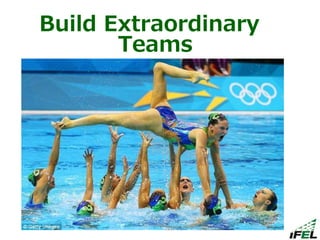
Build Extraordinary
Teams
Compassion for
EXTRAORDINARY Results.
Really?
“Conscious Capitalism?”
EXTRAORDINARY!
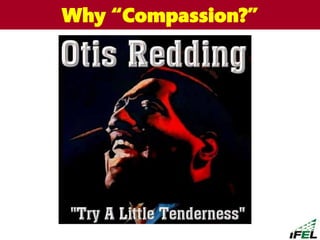
The Chazin GroupThe Chazin GroupWhy “Compassion?”
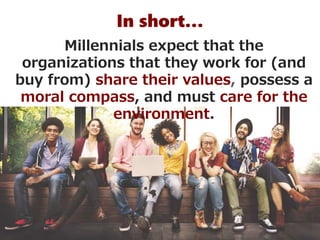
In short…
Millennials expect that the
organizations that they work for (and
buy from) share their values, possess a
moral compass, and must care for the
environment.
• List qualities you want your organization to
be known for, aspire to. DARE TO BE
EXTRAORDINARY!
• Your Brand Attributes – an extraordinary
UVP.
• Define the people you want to work with:
employees, clients, suppliers, contractors,
vendors, the media…everyone!
• Create your ideal employee/client profile.
The Chazin GroupThe Chazin GroupCompassion Starts With You!
Develop an
EXTRAORDINARY
Vision Statement
• Your Vision statement explains what you
want to be/become.
• It’s aspirational. Your Vision should
inspire the hearts of people who work for
you and engage with you. Ex. Norfolk
Southern vision: “Be the safest, most
customer-focused, most successful
transportation company in the world.”
Now that’s…EXTRAORDINARY!
The Chazin GroupThe Chazin GroupYour Vision Statement
Your Mission Statement…
Roadmap to
Extraordinary
• Defines what your organization does/does
not do and who you do it for.
– Ex. U.S. Tennis Association’s mission is
“promote and develop the growth of tennis.”
• Drives everything you do.
• MUST be simple, direct and operative.
You should be able to implement your
mission statement.
The Chazin GroupThe Chazin GroupMission Statement
Ethical Organizations
Gain Extraordinary
Advantage
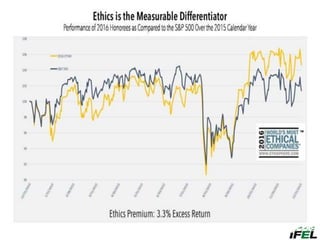
• EthiSphere decade long search to find
the world’s most ETHICAL organizations.
• Universally consistent findings that
EVERY one of the most ethical
organizations outperform their
competitors in the S&P 500 from a
financial performance perspective.
• Being ethical creates lasting competitive
advantage. Consider:
– UPS, Chobhani, KIND, Patagonia, Marriott,
J&J
The Chazin GroupThe Chazin GroupEthics Matter a LOT!
Treat Employees Like
Strategic PARTNERS or
LOSE Them!
• Treat employees like your most loyal
customers and your customers like
employees.
• Employees Are NOT assets to be managed.
• Don’t say you want them to act like they own
your co. Empower them to behave like they do!
• Hire the BEST; NEVER downsize!
• Understand similarities/differences in 5
generations of worker:
– Matures, Boomers, Gen Xers, Millennials/Gen Y,
iGen/Gen Z.
The Chazin GroupThe Chazin GroupEmployees as PARTNERS
• Help employees achieve a higher sense of
purpose. 4-P model.
• Coach/Mentor
• Reward/Recognize
• Train/develop
• Solicit ideas
• Self-managed teams
The Chazin GroupThe Chazin GroupBest Practices
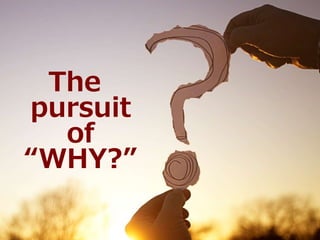
The
pursuit
of
“WHY?”
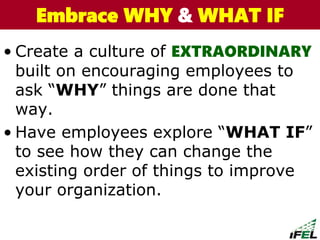
• Create a culture of EXTRAORDINARY
built on encouraging employees to
ask “WHY” things are done that
way.
• Have employees explore “WHAT IF”
to see how they can change the
existing order of things to improve
your organization.
The Chazin GroupThe Chazin GroupEmbrace WHY & WHAT IF
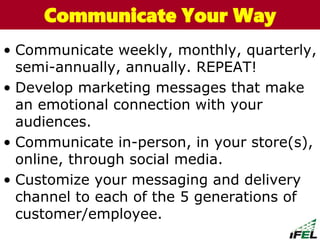
• Communicate weekly, monthly, quarterly,
semi-annually, annually. REPEAT!
• Develop marketing messages that make
an emotional connection with your
audiences.
• Communicate in-person, in your store(s),
online, through social media.
• Customize your messaging and delivery
channel to each of the 5 generations of
customer/employee.
The Chazin GroupThe Chazin GroupCommunicate Your Way
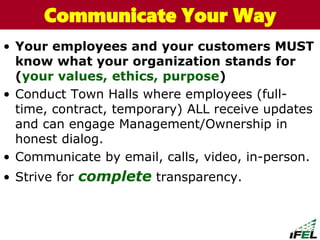
• Your employees and your customers MUST
know what your organization stands for
(your values, ethics, purpose)
• Conduct Town Halls where employees (full-
time, contract, temporary) ALL receive updates
and can engage Management/Ownership in
honest dialog.
• Communicate by email, calls, video, in-person.
• Strive for complete transparency.
The Chazin GroupThe Chazin GroupCommunicate Your Way
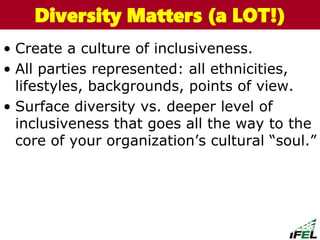
• Create a culture of inclusiveness.
• All parties represented: all ethnicities,
lifestyles, backgrounds, points of view.
• Surface diversity vs. deeper level of
inclusiveness that goes all the way to the
core of your organization’s cultural “soul.”
The Chazin GroupThe Chazin GroupDiversity Matters (a LOT!)
Apply Empathy for
Extraordinary Customer
Relationships
Express Empathy in
Challenging Situations
• Share painful experiences you have in
common.
• Don’t interrupt…LISTEN.
• Express sympathy over specific issues.
• NEVER say “I understand” even if you
(think you) do.
• Use a conversational tone.
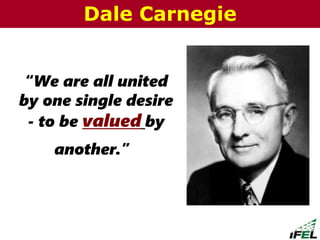
“We are all united
by one single desire
- to be valued by
another.”
Dale Carnegie
Importance of Empathy
• Resolve client anger.
• Reduce client attrition.
• Reduce negative bad press/PR.
• Reduce negative reviews.
• Make your customers feel…VALUED!!!
• BUILD STRONGER RELATIONSHIPS.
Understand customer wants,
needs, desires.
• What customers want vs. what customers
receive.
• Spend time with them at their place.
• Learn their career goals & objectives.
• Achieve a true and meaningful “partnership”.
• Use your products/services as your customer
would.
• Try to contact YOUR Customer Service.
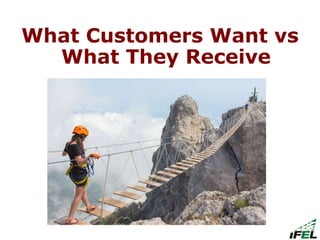
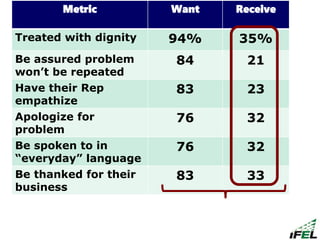
What Customers Want vs
What They Receive
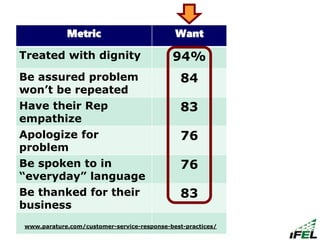
Metric Want
Treated with dignity 94%
Be assured problem
won’t be repeated
84
Have their Rep
empathize
83
Apologize for
problem
76
Be spoken to in
“everyday” language
76
Be thanked for their
business
83
www.parature.com/customer-service-response-best-practices/
Metric Want Receive
Treated with dignity 94% 35%
Be assured problem
won’t be repeated
84 21
Have their Rep
empathize
83 23
Apologize for
problem
76 32
Be spoken to in
“everyday” language
76 32
Be thanked for their
business
83 33
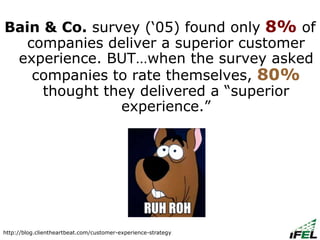
Bain & Co. survey (‘05) found only 8% of
companies deliver a superior customer
experience. BUT…when the survey asked
companies to rate themselves, 80%
thought they delivered a “superior
experience.”
http://blog.clientheartbeat.com/customer-experience-strategy
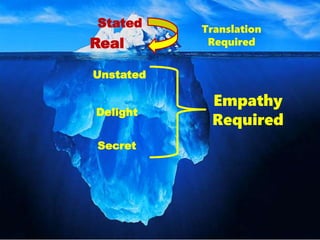
5 levels of
customer need.
Stated
Real
Unstated
Secret
Delight
Translation
Required
Empathy
Required
Your
Business?
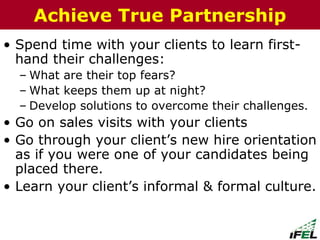
• Spend time with your clients to learn first-
hand their challenges:
– What are their top fears?
– What keeps them up at night?
– Develop solutions to overcome their challenges.
• Go on sales visits with your clients
• Go through your client’s new hire orientation
as if you were one of your candidates being
placed there.
• Learn your client’s informal & formal culture.
The Chazin GroupThe Chazin GroupAchieve True Partnership
Barriers to Empathy
• Lack of EI.
• Career/Work Goal Stressors.
• Work-Life Balance Challenges.
• Inability to “Relate.”
• Lack of Empathy.
• Little Power to Resolve.
Build Extraordinary
Teams
PERFORM
Characteristics of High Performing
Teams
Purpose
Empowerment
Relationships and Communication
Flexibility
Optimal Performance
Recognition and Appreciation
Morale
K. Blanchard, et.al., The One Minute Manager Builds High Performing Teams
Purpose
• Members can describe and are
committed to a common purpose.
• Goals are clear, challenging and relevant
to purpose.
• Strategies for achieving goals are clear.
• Individual roles are clear.
Empowerment
• Members feel a personal and collective
sense of power.
• Members have access to necessary
skills and resources.
• Policies and practices support team
objectives.
• Mutual respect and willingness to help
each other is evident.
Relationships and
Communication
• Members express themselves openly and
honestly.
• Warmth, understanding and acceptance
is expressed.
• Members listen actively to one another
• Differences of opinion.
Flexibility
• Members perform different roles and
functions as needed.
• Members share responsibility for team
facilitation and team development.
• Members are adaptable to changing
demands.
• Various ideas and approaches are
explored.
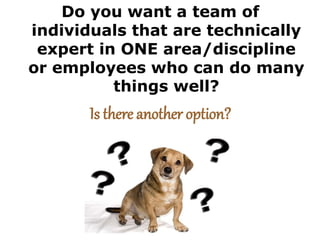
Do you want a team of
individuals that are technically
expert in ONE area/discipline

or employees who can do many
things well?
Is there another option?
Optimal Productivity
• Output is high.
• Quality is excellent.
• Decision making is effective.
• Clear problem-solving process is
apparent.
Reward & Recognition
• Individual contribution are recognized
and appreciated by leader and other
members.
• Team accomplishments are recognized
by members.
• Group members feel respected.
• Team contributions are valued and
recognized by the organization.
Morale
• Individuals feel good about their
membership on the team.
• Individuals are confident and motivated.
• Members have a sense of pride and
satisfaction about their work.
• There is a strong sense of cohesion and
team spirit.
What to observe in groups
• Communication and participation
• Decision-making
• Conflict
• Leadership
• Goals and roles
• Group norms
• Problem solving
• Climate/tone
56
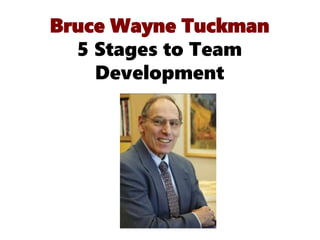
Bruce Wayne Tuckman
5 Stages to Team
Development
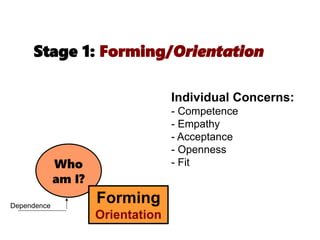
Stage 1: Forming/Orientation
Who
am I?
Forming
Orientation
Dependence
Individual Concerns:
- Competence
- Empathy
- Acceptance
- Openness
- Fit
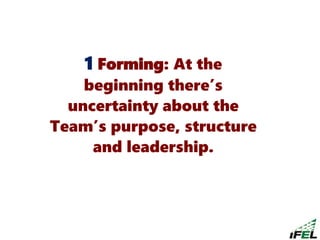
1 Forming: At the
beginning there’s
uncertainty about the
Team’s purpose, structure
and leadership.
60
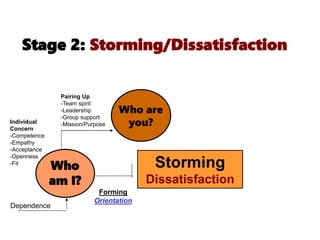
Stage 2: Storming/Dissatisfaction
Who
am I?
Who are
you?
Forming
Orientation
Dependence
Storming
Dissatisfaction
Individual
Concern
-Competence
-Empathy
-Acceptance
-Openness
-Fit
Pairing Up
-Team spirit
-Leadership
-Group support
-Mission/Purpose
2 Storming: Intragroup
conflict arises between
members as they accept the
group but resist its
constraints.
63
64
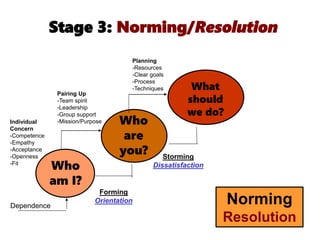
Stage 3: Norming/Resolution
Who
am I?
Who
are
you?
What
should
we do?
Forming
Orientation
Dependence
Storming
Dissatisfaction
Norming
Resolution
Individual
Concern
-Competence
-Empathy
-Acceptance
-Openness
-Fit
Pairing Up
-Team spirit
-Leadership
-Group support
-Mission/Purpose
Planning
-Resources
-Clear goals
-Process
-Techniques
3 Norming: Close relationships
begin to form as the group
comes together with the
shared sense of mission and
purpose.
66
67
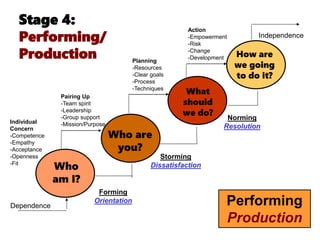
Stage 4:
Performing/
Production
Who
am I?
Who are
you?
What
should
we do?
How are
we going
to do it?
Forming
Orientation
Dependence
Storming
Dissatisfaction
Norming
Resolution
Performing
Production
Independence
Individual
Concern
-Competence
-Empathy
-Acceptance
-Openness
-Fit
Pairing Up
-Team spirit
-Leadership
-Group support
-Mission/Purpose
Planning
-Resources
-Clear goals
-Process
-Techniques
Action
-Empowerment
-Risk
-Change
-Development
4 Performing: The group
focuses on its goals,
mission, and tasks it needs
to complete.
69
5 Adjourning: Members
complete the tasks they were
faced with, and prepare to
disband and move onto new
Teams and new projects.
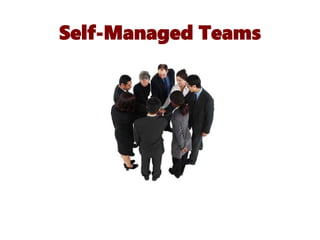
Self-Managed Teams
“The American workplace has evolved from an
industrial to post-Industrial workforce driven by
service, software, technology, and global
competition. With the internet, social media, the
sharing economy, gig “freelance” workplace and a
majority of Millennials overtaking Boomers and
Generation Xers, the compassionate organization is
moving to a “Participation” based-approach to
work.”
Me
• 21st Century workplace demands more
collaboration, work-life balance, and
geographically dispersed teams.
• Rapid change and transformation means
direct reports know more about their
work than their managers.
• Organizations MUST enable their
people to lead themselves!
• Self-leaders define their own work, take
initiative, set priorities, and solve
problems independently.
Self-Leadership
• Workers get together to achieve shared goals
without Mgt interference.
• With the internet, social media, sharing economy,
gig workplace and Millennials overtaking Boomers
and Gen Xers, we need a “Participation” approach
to work.
• @ 80% of companies in the Fortune 1000, 81% of

manufacturing companies use some sort of self-
managed teams.*
• Millennial workers demand the option of managing their
work and own what they work on, how they approach
work, achieving shared goals in a team-driven
environment with minimal external interference.
The Chazin GroupThe Chazin GroupSelf-directed Teams
* Vanessa Urch Druskat, Jane V. Wheeler, “How to lead a self-managing team.” MIT Sloan Mgt Review. July 15, 2004.
76
•Select people that can deliver on
their team roles.
•Provide training to build team
skills (communication,
negotiation, conflict resolution.)
•Foster a strong TEAM dynamic
(we’re in it together.)
•Reward cooperative behavior.
Making Team Players
What this all means
for YOU!
78
• Extraordinary teams ALL share common
characteristics.
• Successful teams have great leadership,
trust, performance, and rewards that
reflect team contributions.
• Successful teams have members who
believe in the team’s capabilities.
• It’s difficult to create team players when
society rewards and promotes individual
behavior.
Extraordinary Team Traits
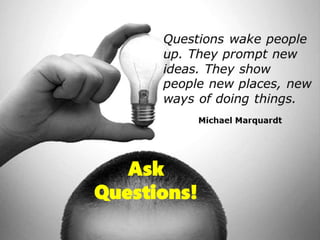
Ask
Questions!
Thank You!
LinkedIn.com/in/ethanchazin
Twitter: @EthanChazin
TheChazinGroup.com
Ethan@TheChazinGroup.com
917.239.5571
201.683.3399
To Contact Ethan

Build extraordinary teams with compassion

  • 1.
    Build EXTRAORDINARY Teams toFuel Your Business U
  • 3.
  • 5.
  • 6.
  • 7.
  • 8.
  • 9.
    The Chazin GroupTheChazin GroupWhy “Compassion?”
  • 10.
    In short… Millennials expectthat the organizations that they work for (and buy from) share their values, possess a moral compass, and must care for the environment.
  • 11.
    • List qualitiesyou want your organization to be known for, aspire to. DARE TO BE EXTRAORDINARY! • Your Brand Attributes – an extraordinary UVP. • Define the people you want to work with: employees, clients, suppliers, contractors, vendors, the media…everyone! • Create your ideal employee/client profile. The Chazin GroupThe Chazin GroupCompassion Starts With You!
  • 12.
  • 13.
    • Your Visionstatement explains what you want to be/become. • It’s aspirational. Your Vision should inspire the hearts of people who work for you and engage with you. Ex. Norfolk Southern vision: “Be the safest, most customer-focused, most successful transportation company in the world.” Now that’s…EXTRAORDINARY! The Chazin GroupThe Chazin GroupYour Vision Statement
  • 14.
  • 15.
    • Defines whatyour organization does/does not do and who you do it for. – Ex. U.S. Tennis Association’s mission is “promote and develop the growth of tennis.” • Drives everything you do. • MUST be simple, direct and operative. You should be able to implement your mission statement. The Chazin GroupThe Chazin GroupMission Statement
  • 16.
  • 17.
    • EthiSphere decadelong search to find the world’s most ETHICAL organizations. • Universally consistent findings that EVERY one of the most ethical organizations outperform their competitors in the S&P 500 from a financial performance perspective. • Being ethical creates lasting competitive advantage. Consider: – UPS, Chobhani, KIND, Patagonia, Marriott, J&J The Chazin GroupThe Chazin GroupEthics Matter a LOT!
  • 19.
    Treat Employees Like StrategicPARTNERS or LOSE Them!
  • 20.
    • Treat employeeslike your most loyal customers and your customers like employees. • Employees Are NOT assets to be managed. • Don’t say you want them to act like they own your co. Empower them to behave like they do! • Hire the BEST; NEVER downsize! • Understand similarities/differences in 5 generations of worker: – Matures, Boomers, Gen Xers, Millennials/Gen Y, iGen/Gen Z. The Chazin GroupThe Chazin GroupEmployees as PARTNERS
  • 21.
    • Help employeesachieve a higher sense of purpose. 4-P model. • Coach/Mentor • Reward/Recognize • Train/develop • Solicit ideas • Self-managed teams The Chazin GroupThe Chazin GroupBest Practices
  • 22.
  • 23.
    • Create aculture of EXTRAORDINARY built on encouraging employees to ask “WHY” things are done that way. • Have employees explore “WHAT IF” to see how they can change the existing order of things to improve your organization. The Chazin GroupThe Chazin GroupEmbrace WHY & WHAT IF
  • 24.
    • Communicate weekly,monthly, quarterly, semi-annually, annually. REPEAT! • Develop marketing messages that make an emotional connection with your audiences. • Communicate in-person, in your store(s), online, through social media. • Customize your messaging and delivery channel to each of the 5 generations of customer/employee. The Chazin GroupThe Chazin GroupCommunicate Your Way
  • 25.
    • Your employeesand your customers MUST know what your organization stands for (your values, ethics, purpose) • Conduct Town Halls where employees (full- time, contract, temporary) ALL receive updates and can engage Management/Ownership in honest dialog. • Communicate by email, calls, video, in-person. • Strive for complete transparency. The Chazin GroupThe Chazin GroupCommunicate Your Way
  • 26.
    • Create aculture of inclusiveness. • All parties represented: all ethnicities, lifestyles, backgrounds, points of view. • Surface diversity vs. deeper level of inclusiveness that goes all the way to the core of your organization’s cultural “soul.” The Chazin GroupThe Chazin GroupDiversity Matters (a LOT!)
  • 27.
    Apply Empathy for ExtraordinaryCustomer Relationships
  • 28.
    Express Empathy in ChallengingSituations • Share painful experiences you have in common. • Don’t interrupt…LISTEN. • Express sympathy over specific issues. • NEVER say “I understand” even if you (think you) do. • Use a conversational tone.
  • 30.
    “We are allunited by one single desire - to be valued by another.” Dale Carnegie
  • 31.
    Importance of Empathy •Resolve client anger. • Reduce client attrition. • Reduce negative bad press/PR. • Reduce negative reviews. • Make your customers feel…VALUED!!! • BUILD STRONGER RELATIONSHIPS.
  • 32.
    Understand customer wants, needs,desires. • What customers want vs. what customers receive. • Spend time with them at their place. • Learn their career goals & objectives. • Achieve a true and meaningful “partnership”. • Use your products/services as your customer would. • Try to contact YOUR Customer Service.
  • 33.
    What Customers Wantvs What They Receive
  • 34.
    Metric Want Treated withdignity 94% Be assured problem won’t be repeated 84 Have their Rep empathize 83 Apologize for problem 76 Be spoken to in “everyday” language 76 Be thanked for their business 83 www.parature.com/customer-service-response-best-practices/
  • 35.
    Metric Want Receive Treatedwith dignity 94% 35% Be assured problem won’t be repeated 84 21 Have their Rep empathize 83 23 Apologize for problem 76 32 Be spoken to in “everyday” language 76 32 Be thanked for their business 83 33
  • 37.
    Bain & Co.survey (‘05) found only 8% of companies deliver a superior customer experience. BUT…when the survey asked companies to rate themselves, 80% thought they delivered a “superior experience.” http://blog.clientheartbeat.com/customer-experience-strategy
  • 40.
  • 41.
  • 42.
  • 43.
    • Spend timewith your clients to learn first- hand their challenges: – What are their top fears? – What keeps them up at night? – Develop solutions to overcome their challenges. • Go on sales visits with your clients • Go through your client’s new hire orientation as if you were one of your candidates being placed there. • Learn your client’s informal & formal culture. The Chazin GroupThe Chazin GroupAchieve True Partnership
  • 44.
    Barriers to Empathy •Lack of EI. • Career/Work Goal Stressors. • Work-Life Balance Challenges. • Inability to “Relate.” • Lack of Empathy. • Little Power to Resolve.
  • 45.
  • 46.
    PERFORM Characteristics of HighPerforming Teams Purpose Empowerment Relationships and Communication Flexibility Optimal Performance Recognition and Appreciation Morale K. Blanchard, et.al., The One Minute Manager Builds High Performing Teams
  • 47.
    Purpose • Members candescribe and are committed to a common purpose. • Goals are clear, challenging and relevant to purpose. • Strategies for achieving goals are clear. • Individual roles are clear.
  • 48.
    Empowerment • Members feela personal and collective sense of power. • Members have access to necessary skills and resources. • Policies and practices support team objectives. • Mutual respect and willingness to help each other is evident.
  • 49.
    Relationships and Communication • Membersexpress themselves openly and honestly. • Warmth, understanding and acceptance is expressed. • Members listen actively to one another • Differences of opinion.
  • 50.
    Flexibility • Members performdifferent roles and functions as needed. • Members share responsibility for team facilitation and team development. • Members are adaptable to changing demands. • Various ideas and approaches are explored.
  • 51.
    Do you wanta team of individuals that are technically expert in ONE area/discipline or employees who can do many things well? Is there another option?
  • 52.
    Optimal Productivity • Outputis high. • Quality is excellent. • Decision making is effective. • Clear problem-solving process is apparent.
  • 53.
    Reward & Recognition •Individual contribution are recognized and appreciated by leader and other members. • Team accomplishments are recognized by members. • Group members feel respected. • Team contributions are valued and recognized by the organization.
  • 54.
    Morale • Individuals feelgood about their membership on the team. • Individuals are confident and motivated. • Members have a sense of pride and satisfaction about their work. • There is a strong sense of cohesion and team spirit.
  • 55.
    What to observein groups • Communication and participation • Decision-making • Conflict • Leadership • Goals and roles • Group norms • Problem solving • Climate/tone
  • 56.
  • 57.
    Bruce Wayne Tuckman 5Stages to Team Development
  • 58.
    Stage 1: Forming/Orientation Who amI? Forming Orientation Dependence Individual Concerns: - Competence - Empathy - Acceptance - Openness - Fit
  • 59.
    1 Forming: Atthe beginning there’s uncertainty about the Team’s purpose, structure and leadership.
  • 60.
  • 61.
    Stage 2: Storming/Dissatisfaction Who amI? Who are you? Forming Orientation Dependence Storming Dissatisfaction Individual Concern -Competence -Empathy -Acceptance -Openness -Fit Pairing Up -Team spirit -Leadership -Group support -Mission/Purpose
  • 62.
    2 Storming: Intragroup conflictarises between members as they accept the group but resist its constraints.
  • 63.
  • 64.
    64 Stage 3: Norming/Resolution Who amI? Who are you? What should we do? Forming Orientation Dependence Storming Dissatisfaction Norming Resolution Individual Concern -Competence -Empathy -Acceptance -Openness -Fit Pairing Up -Team spirit -Leadership -Group support -Mission/Purpose Planning -Resources -Clear goals -Process -Techniques
  • 65.
    3 Norming: Closerelationships begin to form as the group comes together with the shared sense of mission and purpose.
  • 66.
  • 67.
    67 Stage 4: Performing/ Production Who am I? Whoare you? What should we do? How are we going to do it? Forming Orientation Dependence Storming Dissatisfaction Norming Resolution Performing Production Independence Individual Concern -Competence -Empathy -Acceptance -Openness -Fit Pairing Up -Team spirit -Leadership -Group support -Mission/Purpose Planning -Resources -Clear goals -Process -Techniques Action -Empowerment -Risk -Change -Development
  • 68.
    4 Performing: Thegroup focuses on its goals, mission, and tasks it needs to complete.
  • 69.
  • 70.
    5 Adjourning: Members completethe tasks they were faced with, and prepare to disband and move onto new Teams and new projects.
  • 72.
  • 73.
    “The American workplacehas evolved from an industrial to post-Industrial workforce driven by service, software, technology, and global competition. With the internet, social media, the sharing economy, gig “freelance” workplace and a majority of Millennials overtaking Boomers and Generation Xers, the compassionate organization is moving to a “Participation” based-approach to work.” Me
  • 74.
    • 21st Centuryworkplace demands more collaboration, work-life balance, and geographically dispersed teams. • Rapid change and transformation means direct reports know more about their work than their managers. • Organizations MUST enable their people to lead themselves! • Self-leaders define their own work, take initiative, set priorities, and solve problems independently. Self-Leadership
  • 75.
    • Workers gettogether to achieve shared goals without Mgt interference. • With the internet, social media, sharing economy, gig workplace and Millennials overtaking Boomers and Gen Xers, we need a “Participation” approach to work. • @ 80% of companies in the Fortune 1000, 81% of manufacturing companies use some sort of self- managed teams.* • Millennial workers demand the option of managing their work and own what they work on, how they approach work, achieving shared goals in a team-driven environment with minimal external interference. The Chazin GroupThe Chazin GroupSelf-directed Teams * Vanessa Urch Druskat, Jane V. Wheeler, “How to lead a self-managing team.” MIT Sloan Mgt Review. July 15, 2004.
  • 76.
    76 •Select people thatcan deliver on their team roles. •Provide training to build team skills (communication, negotiation, conflict resolution.) •Foster a strong TEAM dynamic (we’re in it together.) •Reward cooperative behavior. Making Team Players
  • 77.
    What this allmeans for YOU!
  • 78.
    78 • Extraordinary teamsALL share common characteristics. • Successful teams have great leadership, trust, performance, and rewards that reflect team contributions. • Successful teams have members who believe in the team’s capabilities. • It’s difficult to create team players when society rewards and promotes individual behavior. Extraordinary Team Traits
  • 79.
  • 80.
  • 82.