CREATING AN EMPLOYER
BRAND TO RECRUIT
TOP TALENT
Rick Baron, MS, SPHR, SHRM-SCP
Principal
rick@rmbaron.com
December 16, 2016
1:00 PM ET to 2:30 ET
Welcome!
• A brand is the set of expectations, memories, stories and relationships that,
taken together, account for a consumer’s decision to choose one product or
service over another.
Seth Godin
• A brand for a company is like a reputation for a person. You earn reputation
by trying to do hard things well.
Jeff Bezos
Branding demands commitment; commitment to continual re-invention;
striking chords with people to stir their emotions; and commitment to
imagination. It is easy to be cynical about such things, much harder to be
successful.”
Sir Richard Branson
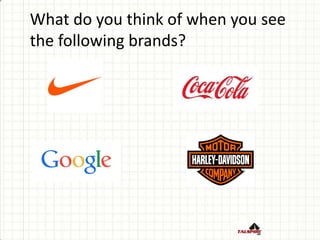
What do you think of when you see
the following brands?
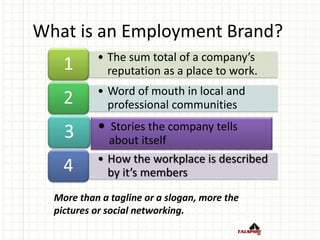
• The sum total of a company’s
reputation as a place to work.1
• Word of mouth in local and
professional communities2
3
• How the workplace is described
by it’s members4
 Stories the company tells
about itself
What is an Employment Brand?
More than a tagline or a slogan, more the
pictures or social networking.
Learning Objectives
• Understand the elements of an effective
employer brand
• Research and implement a compelling
and memorable employer brand
regardless of the type of organization
• “Tell the story of the organization" and
create a "call to action" for potential
candidates and employees
• Establish and deploy our organization's
employment brand
• Understand and use methods in which to
incorporate the employment brand as a
conduit to your organizational culture.
TODAY’S AGENDA
• What is an employer brand?
– The benefits of the brand.
• The elements of an effective employer brand
– Culture, Mission/Vision Considerations
• Steps in which to define and establish your brand
– Market and Research Methods
– Focus Group approaches
– Survey Methods
• Implementing the brand
– Aligning to organizational branding
– Develop strategy and approach
– Buy-in and commitment
• Marketing and outreach uses of your brand
– Developing brand content
– Communicating your brand
• Placement and applications
– Incorporating branding into the employee
lifecycle
• Sustaining and revisiting your brand
• Q&As
Why have an Employment Brand?
•More jobs are becoming available at the same time that fewer
candidates are entering the job market.
•The war for talent is intensifying.
•By having expectations outlined early, before application,
those not buying into the brand will not apply; increasing
recruitment efficiency.
•You need to have a strategic advantage.
•Job seekers are now Job Shoppers.
•Every experience is shared at light speed.
Benefits
•Tells the story of your organization
•Attract the right people to your organization
•Compete on a dimension other than solely
compensation
•Set expectations and improve retention
After all, why should a candidate want to work
for your organization over your competitor?
A survey by Careerealism shows that
80% of job seekers will research an
employer online before applying.
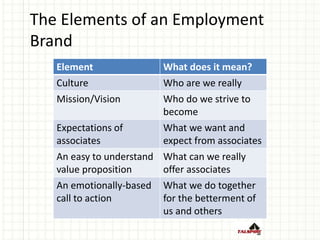
The Elements of an Employment
Brand
Element What does it mean?
Culture Who are we really
Mission/Vision Who do we strive to
become
Expectations of
associates
What we want and
expect from associates
An easy to understand
value proposition
What can we really
offer associates
An emotionally-based
call to action
What we do together
for the betterment of
us and others
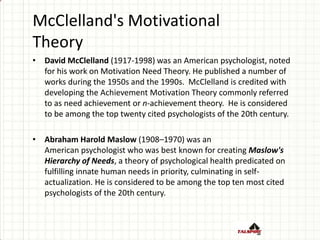
McClelland's Motivational
Theory
• David McClelland (1917-1998) was an American psychologist, noted
for his work on Motivation Need Theory. He published a number of
works during the 1950s and the 1990s. McClelland is credited with
developing the Achievement Motivation Theory commonly referred
to as need achievement or n-achievement theory. He is considered
to be among the top twenty cited psychologists of the 20th century.
• Abraham Harold Maslow (1908–1970) was an
American psychologist who was best known for creating Maslow's
Hierarchy of Needs, a theory of psychological health predicated on
fulfilling innate human needs in priority, culminating in self-
actualization. He is considered to be among the top ten most cited
psychologists of the 20th century.
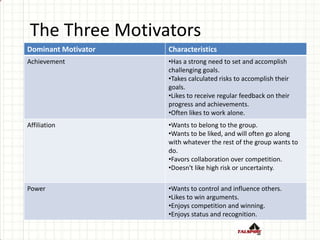
The Three Motivators
Dominant Motivator Characteristics
Achievement •Has a strong need to set and accomplish
challenging goals.
•Takes calculated risks to accomplish their
goals.
•Likes to receive regular feedback on their
progress and achievements.
•Often likes to work alone.
Affiliation •Wants to belong to the group.
•Wants to be liked, and will often go along
with whatever the rest of the group wants to
do.
•Favors collaboration over competition.
•Doesn't like high risk or uncertainty.
Power •Wants to control and influence others.
•Likes to win arguments.
•Enjoys competition and winning.
•Enjoys status and recognition.
STEPS TO DEFINE
AND ESTABLISH
YOUR BRAND
Define the scope, objectives, and
metrics
• Ask the following questions:
– Will the focus be global, national or regional?
– Is this an employer branding project or strategic employer brand?
– Who will lead the effort (Marketing, Talent Acquisition, ECM, HR)
– How or will employer branding fit into organizational strategies
such as marketing, HR, and communications
– What resources are available?
– How engaged will leadership be in the branding?
– How do we define success?
– Is there a budget or resources planned
• Communications Specialist or “Brand Ambassador”
– Will there be a need for new technology
• Social Networking Management (i.e. Hootsuite)
• Mobile App
– Is there a role for “Big Data” analysis?
Considerations before we begin
• What role will change management have in this
effort?
• How will we take a lifestyle approach to our
brand?
– 24/7 nature of the global economy and internet
– Integration of work and home
– Telecommuting and virtual work
• How will diversity incorporate into your
strategy?
• Market and Research Methods
– Focus Groups
• Associate and Leadership
• Alumni
– Surveys
• Recurring Associate Surveys
• Employment Candidate Surveys or Post-Hire
Interviews
– Exit Interviews When designing an
Employment brand for a
Global Organization consider
different cultural preferences
The Data
– Certain patterns or stories will point to who an
organization really is in the mind of others
– Condense the message into several words
• Avoid lengthy statements or re-establishing
mission/vision statements
– Be honest with yourself as to who you are
It’s OK to say that you're hard working
It’s OK to say that you’re a stable work
environment
It’s OK to stay it’s a great place as a stop-over
to your next opportunity
It’s OK to say you’re in it to win
Any opportunity to connect
to the furthering of society
or the globe is especially
important to millennials:
But don’t fake it
Validation and Alignment:
• Share findings with key stakeholders:
– Leadership
– Marketing
• Alignment to marketing brand
– How does the findings align with overall marketing messaging and direction?
– What opportunities exist that connect the existing branding to the employment
branding efforts?
• Secure commitment
– Does your findings and alignment to marketing connect with leaders and
associates?
– Have you considered “test marketing” the brand?
• With current associates
• With employment candidates?
• Determine where the Employment brand will connect with the
organization’s Social Responsibility efforts (if necessary)
Organizational Integration
Considerations
• How will you connect other associate related
programs to your brand?
– Employee Communications
• Leadership introduction/communication
• Reinforcing and Recurring employee communication
vehicles
– Newsletters, E-Mail distribution, Intranet, etc.
– Benefits alignment
– Performance, Compensation, Organizational Events,
Job Descriptions, Goals, Charity work, etc.
Associates can be one of the best
ways to share your brand which is
why it needs to be integrated into
your other HR programs
Development of the Brand:
• Develop messaging
– Short statements and elevator speeches
– Imaging representing the branding
– Engage others in messaging
» Slogan brainstorm sessions
» Employee contests
– Materials to be used
» Marketing kits
• Advertisement-ready logo and images
• Associate success/impact profiles
• Organizational history or key points
• Recruitment advertisement introduction statement
• Templates for letterhead, social networking
postings, business cards, etc.
Sharing and Reinforcing the Brand:
• Establish consistent and persistent sharing of the
brand externally in:
– Social Networking
• LinkedIn, Twitter, Facebook, YouTube Google+, etc.
• How will you connect updates to the brand?
– Stories that align to the brand?
– Application process or selection process?
– Advertisements
– Employee Communications
– Marketing Efforts
– Job Fairs
– Job Fair Giveaways
– Training Materials
– Workplace postings and communication
– Share with customers and others as appropriate
Sharing and Reinforcing the Brand:
• Define how brand will be shared with your associates
• Share reasons for the change with associates and leaders
• Train leaders in the communication and sharing of the brand strategy
• Develop an internal communications strategy for the brand
• Ensure that your leadership and associates have a say and stake in the
brand
• Giveaways and Contests
• Do not neglect other influences to your employment
brand
• Candidate experience
• Employee relations
• Leadership
• Competitive Total Rewards
A great employer brand does
not forgive bad Leadership and
HR Practices; it mocks it. -RB
How did you know if the brand effort
worked?
• Before and after measures
– Retention
– First 90 days of success assessments
• Cost per Hire
• Employee Surveys
– Incumbent and new hire
• Anecdotal information
• Internet feedback
– Comments
– Online feedback (Glassdoor, Indeed, Yelp, etc.)
Revisit and Evolve the Brand
• Repeat all or parts of the process every
several years
– Ensure the message is accurate and relevant as
the organization changes
– Seek to connect the previous brand to the new
brand while making the connection to
stakeholders to reflect progression, not just
change
– Align with organization’s and marketing efforts
Closing
• Employment Branding is a key competitive
edge for your organization
• Not limited to large, for-profit organizations
• Will provide benefit in many aspects as an
employer; not just recruitment
• Is an opportunity to tie organizational
members together towards a common goal
QUESTIONS?
THANK YOU!

Employer Branding1

  • 1.
    CREATING AN EMPLOYER BRANDTO RECRUIT TOP TALENT Rick Baron, MS, SPHR, SHRM-SCP Principal rick@rmbaron.com December 16, 2016 1:00 PM ET to 2:30 ET
  • 2.
  • 3.
    • A brandis the set of expectations, memories, stories and relationships that, taken together, account for a consumer’s decision to choose one product or service over another. Seth Godin • A brand for a company is like a reputation for a person. You earn reputation by trying to do hard things well. Jeff Bezos Branding demands commitment; commitment to continual re-invention; striking chords with people to stir their emotions; and commitment to imagination. It is easy to be cynical about such things, much harder to be successful.” Sir Richard Branson
  • 4.
    What do youthink of when you see the following brands?
  • 5.
    • The sumtotal of a company’s reputation as a place to work.1 • Word of mouth in local and professional communities2 3 • How the workplace is described by it’s members4  Stories the company tells about itself What is an Employment Brand? More than a tagline or a slogan, more the pictures or social networking.
  • 6.
    Learning Objectives • Understandthe elements of an effective employer brand • Research and implement a compelling and memorable employer brand regardless of the type of organization • “Tell the story of the organization" and create a "call to action" for potential candidates and employees • Establish and deploy our organization's employment brand • Understand and use methods in which to incorporate the employment brand as a conduit to your organizational culture.
  • 7.
  • 8.
    • What isan employer brand? – The benefits of the brand. • The elements of an effective employer brand – Culture, Mission/Vision Considerations • Steps in which to define and establish your brand – Market and Research Methods – Focus Group approaches – Survey Methods • Implementing the brand – Aligning to organizational branding – Develop strategy and approach – Buy-in and commitment • Marketing and outreach uses of your brand – Developing brand content – Communicating your brand • Placement and applications – Incorporating branding into the employee lifecycle • Sustaining and revisiting your brand • Q&As
  • 9.
    Why have anEmployment Brand? •More jobs are becoming available at the same time that fewer candidates are entering the job market. •The war for talent is intensifying. •By having expectations outlined early, before application, those not buying into the brand will not apply; increasing recruitment efficiency. •You need to have a strategic advantage. •Job seekers are now Job Shoppers. •Every experience is shared at light speed.
  • 10.
    Benefits •Tells the storyof your organization •Attract the right people to your organization •Compete on a dimension other than solely compensation •Set expectations and improve retention After all, why should a candidate want to work for your organization over your competitor? A survey by Careerealism shows that 80% of job seekers will research an employer online before applying.
  • 11.
    The Elements ofan Employment Brand Element What does it mean? Culture Who are we really Mission/Vision Who do we strive to become Expectations of associates What we want and expect from associates An easy to understand value proposition What can we really offer associates An emotionally-based call to action What we do together for the betterment of us and others
  • 12.
    McClelland's Motivational Theory • DavidMcClelland (1917-1998) was an American psychologist, noted for his work on Motivation Need Theory. He published a number of works during the 1950s and the 1990s. McClelland is credited with developing the Achievement Motivation Theory commonly referred to as need achievement or n-achievement theory. He is considered to be among the top twenty cited psychologists of the 20th century. • Abraham Harold Maslow (1908–1970) was an American psychologist who was best known for creating Maslow's Hierarchy of Needs, a theory of psychological health predicated on fulfilling innate human needs in priority, culminating in self- actualization. He is considered to be among the top ten most cited psychologists of the 20th century.
  • 13.
    The Three Motivators DominantMotivator Characteristics Achievement •Has a strong need to set and accomplish challenging goals. •Takes calculated risks to accomplish their goals. •Likes to receive regular feedback on their progress and achievements. •Often likes to work alone. Affiliation •Wants to belong to the group. •Wants to be liked, and will often go along with whatever the rest of the group wants to do. •Favors collaboration over competition. •Doesn't like high risk or uncertainty. Power •Wants to control and influence others. •Likes to win arguments. •Enjoys competition and winning. •Enjoys status and recognition.
  • 14.
    STEPS TO DEFINE ANDESTABLISH YOUR BRAND
  • 15.
    Define the scope,objectives, and metrics • Ask the following questions: – Will the focus be global, national or regional? – Is this an employer branding project or strategic employer brand? – Who will lead the effort (Marketing, Talent Acquisition, ECM, HR) – How or will employer branding fit into organizational strategies such as marketing, HR, and communications – What resources are available? – How engaged will leadership be in the branding? – How do we define success? – Is there a budget or resources planned • Communications Specialist or “Brand Ambassador” – Will there be a need for new technology • Social Networking Management (i.e. Hootsuite) • Mobile App – Is there a role for “Big Data” analysis?
  • 16.
    Considerations before webegin • What role will change management have in this effort? • How will we take a lifestyle approach to our brand? – 24/7 nature of the global economy and internet – Integration of work and home – Telecommuting and virtual work • How will diversity incorporate into your strategy?
  • 17.
    • Market andResearch Methods – Focus Groups • Associate and Leadership • Alumni – Surveys • Recurring Associate Surveys • Employment Candidate Surveys or Post-Hire Interviews – Exit Interviews When designing an Employment brand for a Global Organization consider different cultural preferences
  • 18.
    The Data – Certainpatterns or stories will point to who an organization really is in the mind of others – Condense the message into several words • Avoid lengthy statements or re-establishing mission/vision statements – Be honest with yourself as to who you are It’s OK to say that you're hard working It’s OK to say that you’re a stable work environment It’s OK to stay it’s a great place as a stop-over to your next opportunity It’s OK to say you’re in it to win Any opportunity to connect to the furthering of society or the globe is especially important to millennials: But don’t fake it
  • 19.
    Validation and Alignment: •Share findings with key stakeholders: – Leadership – Marketing • Alignment to marketing brand – How does the findings align with overall marketing messaging and direction? – What opportunities exist that connect the existing branding to the employment branding efforts? • Secure commitment – Does your findings and alignment to marketing connect with leaders and associates? – Have you considered “test marketing” the brand? • With current associates • With employment candidates? • Determine where the Employment brand will connect with the organization’s Social Responsibility efforts (if necessary)
  • 20.
    Organizational Integration Considerations • Howwill you connect other associate related programs to your brand? – Employee Communications • Leadership introduction/communication • Reinforcing and Recurring employee communication vehicles – Newsletters, E-Mail distribution, Intranet, etc. – Benefits alignment – Performance, Compensation, Organizational Events, Job Descriptions, Goals, Charity work, etc. Associates can be one of the best ways to share your brand which is why it needs to be integrated into your other HR programs
  • 21.
    Development of theBrand: • Develop messaging – Short statements and elevator speeches – Imaging representing the branding – Engage others in messaging » Slogan brainstorm sessions » Employee contests – Materials to be used » Marketing kits • Advertisement-ready logo and images • Associate success/impact profiles • Organizational history or key points • Recruitment advertisement introduction statement • Templates for letterhead, social networking postings, business cards, etc.
  • 22.
    Sharing and Reinforcingthe Brand: • Establish consistent and persistent sharing of the brand externally in: – Social Networking • LinkedIn, Twitter, Facebook, YouTube Google+, etc. • How will you connect updates to the brand? – Stories that align to the brand? – Application process or selection process? – Advertisements – Employee Communications – Marketing Efforts – Job Fairs – Job Fair Giveaways – Training Materials – Workplace postings and communication – Share with customers and others as appropriate
  • 23.
    Sharing and Reinforcingthe Brand: • Define how brand will be shared with your associates • Share reasons for the change with associates and leaders • Train leaders in the communication and sharing of the brand strategy • Develop an internal communications strategy for the brand • Ensure that your leadership and associates have a say and stake in the brand • Giveaways and Contests • Do not neglect other influences to your employment brand • Candidate experience • Employee relations • Leadership • Competitive Total Rewards A great employer brand does not forgive bad Leadership and HR Practices; it mocks it. -RB
  • 24.
    How did youknow if the brand effort worked? • Before and after measures – Retention – First 90 days of success assessments • Cost per Hire • Employee Surveys – Incumbent and new hire • Anecdotal information • Internet feedback – Comments – Online feedback (Glassdoor, Indeed, Yelp, etc.)
  • 25.
    Revisit and Evolvethe Brand • Repeat all or parts of the process every several years – Ensure the message is accurate and relevant as the organization changes – Seek to connect the previous brand to the new brand while making the connection to stakeholders to reflect progression, not just change – Align with organization’s and marketing efforts
  • 26.
    Closing • Employment Brandingis a key competitive edge for your organization • Not limited to large, for-profit organizations • Will provide benefit in many aspects as an employer; not just recruitment • Is an opportunity to tie organizational members together towards a common goal
  • 27.
  • 28.