Building Your Team
Marc Weil
Founder, CTO @
@marcweil
A little about me
 Graduated from RIT with B.S. in Software Engineering
 Coding since I was 9
 First company at age 14
 Previous employee at Apple, Oracle, & RJMetrics
A little about me

 Co-founded CloudMine in Philadelphia
 Currently CTO
CloudMine’s Team
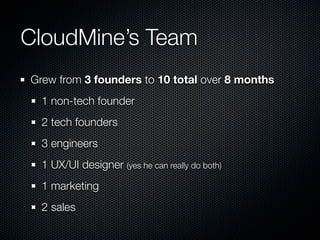
Grew from 3 founders to 10 total over 8 months
  1 non-tech founder
  2 tech founders
  3 engineers
  1 UX/UI designer (yes he can really do both)
  1 marketing
  2 sales
Agenda

When to Grow
The First Hire
Finding Them and Keeping Them
Culture
New vs. Existing Talent
Interns
When should we grow?


Default answer: DON’T
When should we grow?


Unless it hurts. Badly.
When should we grow?


People are your most expensive resource.
When should we grow?


You should always be pegged at 100%.


                 (don’t be lazy)
When should we grow?


In the beginning...
  Your job is to do everything.
When should we grow?


Hiring someone means
firing yourself from their job.


               (with the exception of sales)
When should we grow?


Hire to fill the gaps in your personal skill-set
When should we grow?


Remember: don’t outsource CEO
responsibilities (like fundraising)
When should we grow?


Remember: don’t outsource CEO
responsibilities (or hiring)
When should we grow?


Hiring doesn’t make things easier.
The First Hire


a.k.a. the most important hire
The First Hire


Important questions to ask yourself:
The First Hire
Important questions to ask yourself:
The First Hire
Important questions to ask yourself:
 • Can this person shoulder extra responsibility?
The First Hire
Important questions to ask yourself:
 • Can this person shoulder extra responsibility?
 • Can this person communicate with you?
The First Hire
Important questions to ask yourself:
 • Can this person shoulder extra responsibility?
 • Can this person communicate with you?
 • Does s/he represent the culture you want to create?
The First Hire
Important questions to ask yourself:
 • Can this person shoulder extra responsibility?
 • Can this person communicate with you?
 • Does s/he represent the culture you want to create?
 • Would you want this person evangelizing your
   company?
The First Hire
Important questions to ask yourself:
 • Can this person shoulder extra responsibility?
 • Can this person communicate with you?
 • Does s/he represent the culture you want to create?
 • Would you want this person evangelizing your
   company?
 • Will other people want to work with him/her?
The First Hire


Role is typically developer or designer.
The First Hire


            designer.
The First Hire


This person acts as a cultural seed.
The First Hire


The first hire takes the most risk
of any employee.
The First Hire


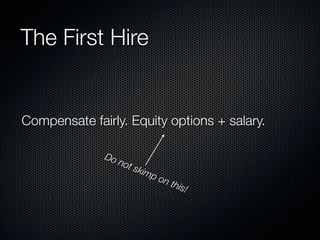
Compensate fairly. Equity options + salary.
The First Hire


Compensate fairly. Equity options + salary.

              Do
                 not s
                       kimp
                              on
                                   this
                                       !
The First Hire


Decide on an equity degradation
function up front.
The First Hire


People decide to work with you based on
the people they will be working with.
The First Hire


The first hire is the first evangelist.
Finding and Keeping Them


Building the team beyond the first hire.
Finding and Keeping Them


Keeping good talent is difficult.
Finding and Keeping Them

The key is keeping your employees
challenged and giving them
creative freedom.
Finding and Keeping Them

3 roles I will cover:
 • Designers
 • Developers
 • Salespeople
Finding and Keeping Them

Designers want...
Finding and Keeping Them

Designers want...
  • to be challenged
Finding and Keeping Them

Designers want...
  • to be challenged
  • to work with people they respect
Finding and Keeping Them

Designers want...
  • to be challenged
  • to work with people they respect
  • to be respected by their peers
Finding and Keeping Them

Designers want...
  • to be challenged
  • to work with people they respect
  • to be respected by their peers
  • to work with people and on problems that inspire
Finding and Keeping Them

Designers must...
Finding and Keeping Them

Designers must...
  • have a variety of design skills
Finding and Keeping Them

Designers must...
  • have a variety of design skills
  • focus on user experience
Finding and Keeping Them

Designers must...
  • have a variety of design skills
  • focus on user experience
  • appreciate constructive criticism
Finding and Keeping Them

Designers must...
  • have a variety of design skills
  • focus on user experience
  • appreciate constructive criticism
  • be flexible and amenable to change
Finding and Keeping Them

Developers want...
Finding and Keeping Them

Developers want...
  • to be challenged technically
Finding and Keeping Them

Developers want...
  • to be challenged technically
  • to work with people they respect
Finding and Keeping Them

Developers want...
  • to be challenged technically
  • to work with people they respect
  • to work with people they can learn from
Finding and Keeping Them

Developers want...
  • to be challenged technically
  • to work with people they respect
  • to work with people they can learn from
  • to feel ownership
Finding and Keeping Them

Developers must...
Finding and Keeping Them

Developers must...
  • be product people
Finding and Keeping Them

Developers must...
  • be product people
  • be able to communicate with other people
Finding and Keeping Them

Developers must...
  • be product people
  • be able to communicate with other people
  • believe in what you are building
Finding and Keeping Them

Developers must...
  • be product people
  • be able to communicate with other people
  • believe in what you are building
  • be flexible and amenable to change
Finding and Keeping Them

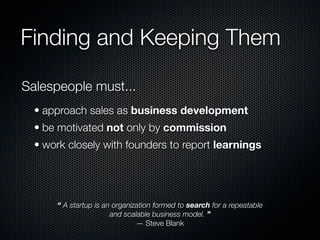
Salespeople must...
Finding and Keeping Them

Salespeople must...
  • approach sales as business development
Finding and Keeping Them

Salespeople must...
  • approach sales as business development
  • be motivated not only by commission
Finding and Keeping Them

Salespeople must...
  • approach sales as business development
  • be motivated not only by commission
  • work closely with founders to report learnings
Finding and Keeping Them

Salespeople must...
  • approach sales as business development
  • be motivated not only by commission
  • work closely with founders to report learnings


      “ A startup is an organization formed to search for a repeatable
                       and scalable business model. ”
                               — Steve Blank
Culture


Team is everything.
Culture
Culture
Team is everything.
Culture
Team is everything.
Team is everything.
Team is everything.
Team is everything.
Team is everything.
Team is everything.
Team is everything.
Team is everything.
Culture


A company’s culture is an extension of the
founders’ personalities.
Culture


Multidisciplinary teams bring challenges.
Culture


Encourage personal and
professional growth.
Culture


Feedback, feedback, feedback.
Culture


Vertical interactions — 1-on-1s.
Horizontal interactions — 360 reviews.
Culture


Discourage overworking.
It leads only to burnout.
Culture


Everything you do or say has a positive or
negative effect on company culture.
New and Existing Talent


A good team has a healthy mix of both.
New and Existing Talent


New talent brings energy, new ideas and
new perspectives.
New and Existing Talent


Existing talent brings stability, best
practices and a variety of experiences.
New and Existing Talent

New talent is...
New and Existing Talent

New talent is...
  • inexperienced
New and Existing Talent

New talent is...
  • inexperienced
  • hungry... starving.
New and Existing Talent

New talent is...
  • inexperienced
  • hungry... starving.
  • raw
New and Existing Talent

New talent is...
  • inexperienced
  • hungry... starving.
  • raw
  • ripe for molding
New and Existing Talent

New talent is...
  • inexperienced
  • hungry... starving.
  • raw
  • ripe for molding
  • relatively inexpensive
New and Existing Talent

New talent is...
  • inexperienced
  • hungry... starving.
  • raw
  • ripe for molding
  • relatively inexpensive
  • risky
New and Existing Talent


Existing talent is undefinable.
New and Existing Talent


Just remember to hire more than just
college students and recent graduates.
Interns


Special unicorns all on their own.
Interns


Think of them as filling a long-term funnel
of full-time employees.
Interns


Opportunity to mold young minds.
Interns


Continuous feed of new ideas and
perspectives.
Interns


Hire for existing skill, but also for potential.
Interns


Always give them a mentor.
Interns


Integrate them into the team.
Interns


Avoid the “intern project”.
Wrapping Up
Wrapping Up
Don’t hire until you have to.
Wrapping Up
Don’t hire until you have to.
Team is everything.
Wrapping Up
Don’t hire until you have to.
Team is everything.
Diversify and challenge.
Wrapping Up
Don’t hire until you have to.
Team is everything.
Diversify and challenge.
Foster a company culture made up of the best parts of
your personality.
Wrapping Up
Don’t hire until you have to.
Team is everything.
Diversify and challenge.
Foster a company culture made up of the best parts of
your personality.
Everything you do and say matters.
Thank you!
@marcweil
marc@cloudmine.me

Building your startup's team

Editor's Notes

  • #2 Presentation aimed at founders of young startups.\nBased on my own personal experiences. YMMV.\n
  • #3 \n
  • #4 Explain CTO.\n
  • #5 Doesn’t count sales advisors. We have 3 of those.\n
  • #6 \n
  • #7 \n
  • #8 \n
  • #9 \n
  • #10 \n
  • #11 \n
  • #12 \n
  • #13 \n
  • #14 \n
  • #15 \n
  • #16 \n
  • #17 \n
  • #18 \n
  • #19 \n
  • #20 \n
  • #21 \n
  • #22 \n
  • #23 \n
  • #24 \n
  • #25 Share anecdote on why a designer should be first hire.\nMention customer-first development (Steve Blank, 4 Steps to the Epiphany)\n
  • #26 IMO, a creative environment (espoused by designers) is more generally applicable and amenable than an engineering-oriented environment.\n
  • #27 \n
  • #28 If you can’t afford the salary, give more equity. Do not skimp.\n2% for first.\n
  • #29 For the later employees. Ex. 2% -> 1% -> 0.75% -> 0.5%\n
  • #30 \n
  • #31 \n
  • #32 \n
  • #33 There’s always another place they can go.\n
  • #34 Development, sales, and design are all fundamentally creative.\n
  • #35 Each is a presentation in its own right.\nKeep this high level.\n
  • #36 Devs can be territorial.\nConstant learning; if not, get rid of them.\n
  • #37 Devs can be territorial.\nConstant learning; if not, get rid of them.\n
  • #38 Devs can be territorial.\nConstant learning; if not, get rid of them.\n
  • #39 Devs can be territorial.\nConstant learning; if not, get rid of them.\n
  • #40 Not just UI design. Print design too.\nUser experience is more than just in the product. This is your brand.\n
  • #41 Not just UI design. Print design too.\nUser experience is more than just in the product. This is your brand.\n
  • #42 Not just UI design. Print design too.\nUser experience is more than just in the product. This is your brand.\n
  • #43 Not just UI design. Print design too.\nUser experience is more than just in the product. This is your brand.\n
  • #44 Devs can be territorial.\nConstant learning; if not, get rid of them.\n
  • #45 Devs can be territorial.\nConstant learning; if not, get rid of them.\n
  • #46 Devs can be territorial.\nConstant learning; if not, get rid of them.\n
  • #47 Devs can be territorial.\nConstant learning; if not, get rid of them.\n
  • #48 Communication with people inside and outside the company.\nOn and off the Internet.\n
  • #49 Communication with people inside and outside the company.\nOn and off the Internet.\n
  • #50 Communication with people inside and outside the company.\nOn and off the Internet.\n
  • #51 Communication with people inside and outside the company.\nOn and off the Internet.\n
  • #52 I don’t actually know what they want.\nTraditional salespeople are for later stage companies.\nShare story of creative sales comp package @ CM.\n
  • #53 I don’t actually know what they want.\nTraditional salespeople are for later stage companies.\nShare story of creative sales comp package @ CM.\n
  • #54 I don’t actually know what they want.\nTraditional salespeople are for later stage companies.\nShare story of creative sales comp package @ CM.\n
  • #55 I don’t actually know what they want.\nTraditional salespeople are for later stage companies.\nShare story of creative sales comp package @ CM.\n
  • #56 \n
  • #57 Easy to remember, becomes difficult in the day-to-day to remember.\n
  • #58 Easy to remember, becomes difficult in the day-to-day to remember.\n
  • #59 Easy to remember, becomes difficult in the day-to-day to remember.\n
  • #60 Easy to remember, becomes difficult in the day-to-day to remember.\n
  • #61 Easy to remember, becomes difficult in the day-to-day to remember.\n
  • #62 Easy to remember, becomes difficult in the day-to-day to remember.\n
  • #63 Easy to remember, becomes difficult in the day-to-day to remember.\n
  • #64 Easy to remember, becomes difficult in the day-to-day to remember.\n
  • #65 \n
  • #66 \n
  • #67 Multidisciplinary teams help with growth.\n
  • #68 \n
  • #69 I have employees asking me for these things.\nThey need to know where they stand.\nDesire personal improvement.\n
  • #70 \n
  • #71 Employees read into your words and actions.\nYou are their partner but also their leader.\n
  • #72 Briefly touch on this.\n
  • #73 Generally...\n
  • #74 Generally....\nAnd that’s not to say existing talent can’t bring new ideas.\n
  • #75 \n
  • #76 \n
  • #77 \n
  • #78 \n
  • #79 \n
  • #80 \n
  • #81 \n
  • #82 It’s all about diversity.\n
  • #83 Briefly touch on this.\n
  • #84 Get ‘em while they’re young.\n
  • #85 They haven’t been jaded yet.\nCan still break bad habits.\n
  • #86 \n
  • #87 Give special weight to potential.\nNot easy.\nFind overall smart people.\n
  • #88 Typically one of the earlier employees who is good at teaching.\n
  • #89 Gives them a sense of identity in the bigger picture.\n
  • #90 Intern projects cause a rift between the intern and the other engineers.\nThe projects are cop-outs.\n
  • #91 \n
  • #92 \n
  • #93 \n
  • #94 \n
  • #95 \n
  • #96 \n