ROSTOW’s Stages of
Growth Development
In partial completion of IR220- HRD @ the National Level
Prof. ROSA MERCADO
By Alfredo V. Primicias III
ROSTOW’s Stages of
Growth Development
In partial completion of IR220- HRD @ the National Level
Prof. ROSA MERCADO
By Alfredo V. Primicias III
TOPICS:
1.Who is Rostow?
2.Stages of Growth Development
3.Criticisms of the Model
ROSTOW’s Stages of
Growth Development
In partial completion of IR220- HRD @ the National Level
Prof. ROSA MERCADO
By Alfredo V. Primicias III
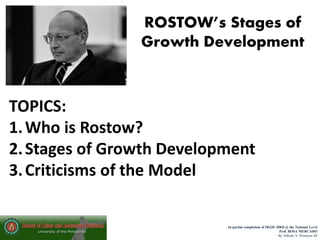
• Walt Whitman Rostow (Oct. 1916- Feb. 2003)
• Economist and Political theorist
• Special Assistant to Pres. Johnson on National Security Affairs
• Political Adviser to Pres. Kennedy
• Shaped US Foreign Policy in SEA in 1960s
• Advocate of Capitalism and Free Enterprise
• Wrote “The Stages of Economic Growth: A Non- Communist Manifesto”
(1960)– the Rostovian Take-Off Model of Economic Growth
• Considered as one of the more structuralist models of economic growth
• Rostow’s model is part of the liberal school of economics
Source: http://en.wikipedia.org/wiki/Walt_Whitman_Rostow
ROSTOW’s Stages of Growth Development
In partial completion of IR220- HRD @ the National Level
Prof. ROSA MERCADO
By Alfredo V. Primicias III
What is it?
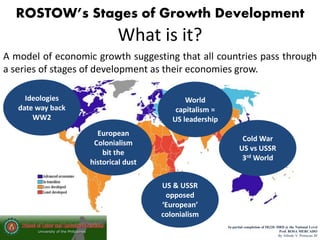
A model of economic growth suggesting that all countries pass through
a series of stages of development as their economies grow.
Ideologies
date way back
WW2
World
capitalism =
US leadership
European
Colonialism
bit the
historical dust
US & USSR
opposed
‘European’
colonialism
Cold War
US vs USSR
3rd World
ROSTOW’s Stages of Growth Development
In partial completion of IR220- HRD @ the National Level
Prof. ROSA MERCADO
By Alfredo V. Primicias III
ROSTOW’s Stages of Growth Development
In partial completion of IR220- HRD @ the National Level
Prof. ROSA MERCADO
By Alfredo V. Primicias III
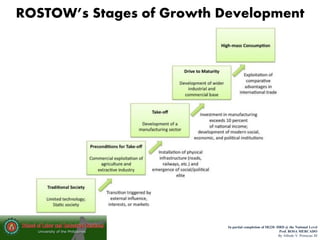
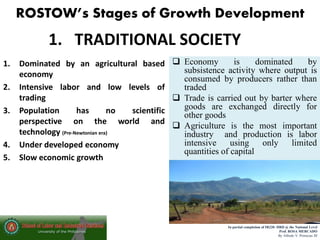
1. TRADITIONAL SOCIETY
1. Dominated by an agricultural based
economy
2. Intensive labor and low levels of
trading
3. Population has no scientific
perspective on the world and
technology (Pre-Newtonian era)
4. Under developed economy
5. Slow economic growth
 Economy is dominated by
subsistence activity where output is
consumed by producers rather than
traded
 Trade is carried out by barter where
goods are exchanged directly for
other goods
 Agriculture is the most important
industry and production is labor
intensive using only limited
quantities of capital
ROSTOW’s Stages of Growth Development
In partial completion of IR220- HRD @ the National Level
Prof. ROSA MERCADO
By Alfredo V. Primicias III
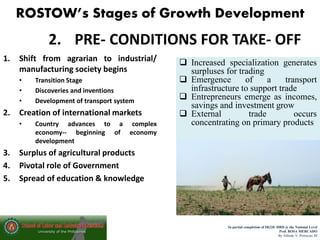
2. PRE- CONDITIONS FOR TAKE- OFF
1. Shift from agrarian to industrial/
manufacturing society begins
• Transition Stage
• Discoveries and inventions
• Development of transport system
2. Creation of international markets
• Country advances to a complex
economy-- beginning of economy
development
3. Surplus of agricultural products
4. Pivotal role of Government
5. Spread of education & knowledge
 Increased specialization generates
surpluses for trading
 Emergence of a transport
infrastructure to support trade
 Entrepreneurs emerge as incomes,
savings and investment grow
 External trade occurs
concentrating on primary products
ROSTOW’s Stages of Growth Development
In partial completion of IR220- HRD @ the National Level
Prof. ROSA MERCADO
By Alfredo V. Primicias III
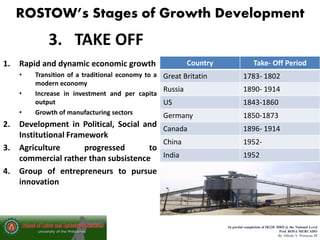
3. TAKE OFF
1. Rapid and dynamic economic growth
• Transition of a traditional economy to a
modern economy
• Increase in investment and per capita
output
• Growth of manufacturing sectors
2. Development in Political, Social and
Institutional Framework
3. Agriculture progressed to
commercial rather than subsistence
4. Group of entrepreneurs to pursue
innovation
 Industrialization increases, with
workers switching from the agricultural
sector to the manufacturing sector
 Economic transitions are accompanied
by the evolution of new political and
social institutions that support the
industrialization
 Growth is self-sustaining as investment
leads to increasing incomes in turn
generating more savings to finance
further investment
Country Take- Off Period
Great Britatin 1783- 1802
Russia 1890- 1914
US 1843-1860
Germany 1850-1873
Canada 1896- 1914
China 1952-
India 1952
ROSTOW’s Stages of Growth Development
In partial completion of IR220- HRD @ the National Level
Prof. ROSA MERCADO
By Alfredo V. Primicias III
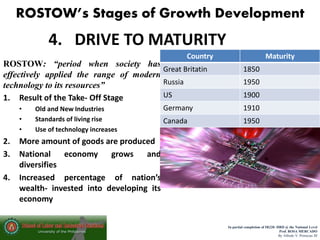
4. DRIVE TO MATURITY
ROSTOW: “period when society has
effectively applied the range of modern
technology to its resources”
1. Result of the Take- Off Stage
• Old and New Industries
• Standards of living rise
• Use of technology increases
2. More amount of goods are produced
3. National economy grows and
diversifies
4. Increased percentage of nation’s
wealth- invested into developing its
economy
 Economy diversifies into new areas
 Technological innovation provides a
diverse range of investment
opportunities
 Economy is producing a wide range of
goods and services with less reliance
on imports
Country Maturity
Great Britatin 1850
Russia 1950
US 1900
Germany 1910
Canada 1950
ROSTOW’s Stages of Growth Development
In partial completion of IR220- HRD @ the National Level
Prof. ROSA MERCADO
By Alfredo V. Primicias III
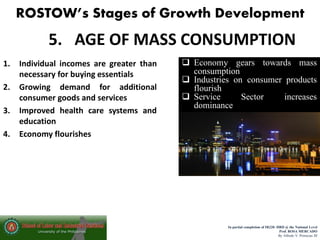
5. AGE OF MASS CONSUMPTION
1. Individual incomes are greater than
necessary for buying essentials
2. Growing demand for additional
consumer goods and services
3. Improved health care systems and
education
4. Economy flourishes
 Economy gears towards mass
consumption
 Industries on consumer products
flourish
 Service Sector increases
dominance
ROSTOW’s Stages of Growth Development
In partial completion of IR220- HRD @ the National Level
Prof. ROSA MERCADO
By Alfredo V. Primicias III
ROSTOW’s Stages of Growth Development
In partial completion of IR220- HRD @ the National Level
Prof. ROSA MERCADO
By Alfredo V. Primicias III
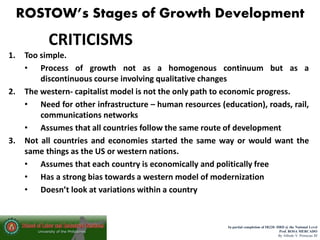
CRITICISMS
1. Too simple.
• Process of growth not as a homogenous continuum but as a
discontinuous course involving qualitative changes
2. The western- capitalist model is not the only path to economic progress.
• Need for other infrastructure – human resources (education), roads, rail,
communications networks
• Assumes that all countries follow the same route of development
3. Not all countries and economies started the same way or would want the
same things as the US or western nations.
• Assumes that each country is economically and politically free
• Has a strong bias towards a western model of modernization
• Doesn’t look at variations within a country

Report Rostow development theory

  • 1.
    ROSTOW’s Stages of GrowthDevelopment In partial completion of IR220- HRD @ the National Level Prof. ROSA MERCADO By Alfredo V. Primicias III
  • 2.
    ROSTOW’s Stages of GrowthDevelopment In partial completion of IR220- HRD @ the National Level Prof. ROSA MERCADO By Alfredo V. Primicias III TOPICS: 1.Who is Rostow? 2.Stages of Growth Development 3.Criticisms of the Model
  • 3.
    ROSTOW’s Stages of GrowthDevelopment In partial completion of IR220- HRD @ the National Level Prof. ROSA MERCADO By Alfredo V. Primicias III • Walt Whitman Rostow (Oct. 1916- Feb. 2003) • Economist and Political theorist • Special Assistant to Pres. Johnson on National Security Affairs • Political Adviser to Pres. Kennedy • Shaped US Foreign Policy in SEA in 1960s • Advocate of Capitalism and Free Enterprise • Wrote “The Stages of Economic Growth: A Non- Communist Manifesto” (1960)– the Rostovian Take-Off Model of Economic Growth • Considered as one of the more structuralist models of economic growth • Rostow’s model is part of the liberal school of economics Source: http://en.wikipedia.org/wiki/Walt_Whitman_Rostow
  • 4.
    ROSTOW’s Stages ofGrowth Development In partial completion of IR220- HRD @ the National Level Prof. ROSA MERCADO By Alfredo V. Primicias III What is it? A model of economic growth suggesting that all countries pass through a series of stages of development as their economies grow. Ideologies date way back WW2 World capitalism = US leadership European Colonialism bit the historical dust US & USSR opposed ‘European’ colonialism Cold War US vs USSR 3rd World
  • 5.
    ROSTOW’s Stages ofGrowth Development In partial completion of IR220- HRD @ the National Level Prof. ROSA MERCADO By Alfredo V. Primicias III
  • 6.
    ROSTOW’s Stages ofGrowth Development In partial completion of IR220- HRD @ the National Level Prof. ROSA MERCADO By Alfredo V. Primicias III 1. TRADITIONAL SOCIETY 1. Dominated by an agricultural based economy 2. Intensive labor and low levels of trading 3. Population has no scientific perspective on the world and technology (Pre-Newtonian era) 4. Under developed economy 5. Slow economic growth  Economy is dominated by subsistence activity where output is consumed by producers rather than traded  Trade is carried out by barter where goods are exchanged directly for other goods  Agriculture is the most important industry and production is labor intensive using only limited quantities of capital
  • 7.
    ROSTOW’s Stages ofGrowth Development In partial completion of IR220- HRD @ the National Level Prof. ROSA MERCADO By Alfredo V. Primicias III 2. PRE- CONDITIONS FOR TAKE- OFF 1. Shift from agrarian to industrial/ manufacturing society begins • Transition Stage • Discoveries and inventions • Development of transport system 2. Creation of international markets • Country advances to a complex economy-- beginning of economy development 3. Surplus of agricultural products 4. Pivotal role of Government 5. Spread of education & knowledge  Increased specialization generates surpluses for trading  Emergence of a transport infrastructure to support trade  Entrepreneurs emerge as incomes, savings and investment grow  External trade occurs concentrating on primary products
  • 8.
    ROSTOW’s Stages ofGrowth Development In partial completion of IR220- HRD @ the National Level Prof. ROSA MERCADO By Alfredo V. Primicias III 3. TAKE OFF 1. Rapid and dynamic economic growth • Transition of a traditional economy to a modern economy • Increase in investment and per capita output • Growth of manufacturing sectors 2. Development in Political, Social and Institutional Framework 3. Agriculture progressed to commercial rather than subsistence 4. Group of entrepreneurs to pursue innovation  Industrialization increases, with workers switching from the agricultural sector to the manufacturing sector  Economic transitions are accompanied by the evolution of new political and social institutions that support the industrialization  Growth is self-sustaining as investment leads to increasing incomes in turn generating more savings to finance further investment Country Take- Off Period Great Britatin 1783- 1802 Russia 1890- 1914 US 1843-1860 Germany 1850-1873 Canada 1896- 1914 China 1952- India 1952
  • 9.
    ROSTOW’s Stages ofGrowth Development In partial completion of IR220- HRD @ the National Level Prof. ROSA MERCADO By Alfredo V. Primicias III 4. DRIVE TO MATURITY ROSTOW: “period when society has effectively applied the range of modern technology to its resources” 1. Result of the Take- Off Stage • Old and New Industries • Standards of living rise • Use of technology increases 2. More amount of goods are produced 3. National economy grows and diversifies 4. Increased percentage of nation’s wealth- invested into developing its economy  Economy diversifies into new areas  Technological innovation provides a diverse range of investment opportunities  Economy is producing a wide range of goods and services with less reliance on imports Country Maturity Great Britatin 1850 Russia 1950 US 1900 Germany 1910 Canada 1950
  • 10.
    ROSTOW’s Stages ofGrowth Development In partial completion of IR220- HRD @ the National Level Prof. ROSA MERCADO By Alfredo V. Primicias III 5. AGE OF MASS CONSUMPTION 1. Individual incomes are greater than necessary for buying essentials 2. Growing demand for additional consumer goods and services 3. Improved health care systems and education 4. Economy flourishes  Economy gears towards mass consumption  Industries on consumer products flourish  Service Sector increases dominance
  • 11.
    ROSTOW’s Stages ofGrowth Development In partial completion of IR220- HRD @ the National Level Prof. ROSA MERCADO By Alfredo V. Primicias III
  • 12.
    ROSTOW’s Stages ofGrowth Development In partial completion of IR220- HRD @ the National Level Prof. ROSA MERCADO By Alfredo V. Primicias III CRITICISMS 1. Too simple. • Process of growth not as a homogenous continuum but as a discontinuous course involving qualitative changes 2. The western- capitalist model is not the only path to economic progress. • Need for other infrastructure – human resources (education), roads, rail, communications networks • Assumes that all countries follow the same route of development 3. Not all countries and economies started the same way or would want the same things as the US or western nations. • Assumes that each country is economically and politically free • Has a strong bias towards a western model of modernization • Doesn’t look at variations within a country