Downloaded 23 times



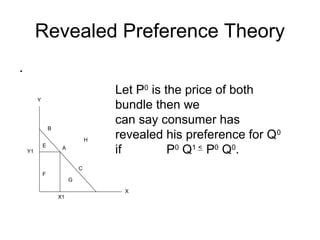

Samuelson developed revealed preference theory in 1948 as an alternative to existing demand theories. Revealed preference theory explains consumer demand based on their actual observed choices between commodity bundles at different price points, rather than assuming consumers have internal utility functions. It deduces utility from behavior. The theory's key assumptions are rationality, consistency, and transitivity of preferences. It holds that a consumer's choice reveals their preference - if they choose bundle A over B, A is revealed to be preferred.


