Quuen'sCollegeBusinessStudies2012
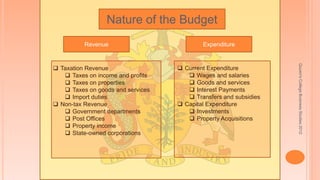
Nature of the Budget
 Taxation Revenue
 Taxes on income and profits
 Taxes on properties
 Taxes on goods and services
 Import duties
 Non-tax Revenue
 Government departments
 Post Offices
 Property income
 State-owned corporations
 Current Expenditure
 Wages and salaries
 Goods and services
 Interest Payments
 Transfers and subsidies
 Capital Expenditure
 Investments
 Property Acquisitions
Revenue Expenditure
1
Quuen'sCollegeBusinessStudies2012
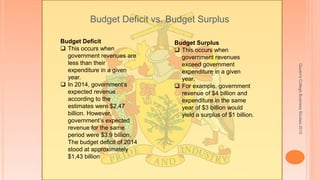
Budget Deficit vs. Budget Surplus
Budget Deficit
 This occurs when
government revenues are
less than their
expenditure in a given
year.
 In 2014, government’s
expected revenue
according to the
estimates were $2.47
billion. However,
government’s expected
revenue for the same
period were $3.9 billion.
The budget deficit of 2014
stood at approximately
$1,43 billion
Budget Surplus
 This occurs when
government revenues
exceed government
expenditure in a given
year.
 For example, government
revenue of $4 billion and
expenditure in the same
year of $3 billion would
yield a surplus of $1 billion.
Quuen'sCollegeBusinessStudies2012
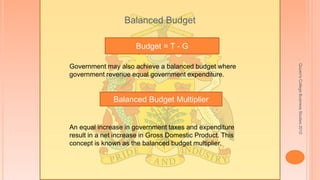
Balanced Budget
Government may also achieve a balanced budget where
government revenue equal government expenditure.
Budget = T - G
Balanced Budget Multiplier
An equal increase in government taxes and expenditure
result in a net increase in Gross Domestic Product. This
concept is known as the balanced budget multiplier.
Quuen'sCollegeBusinessStudies2012
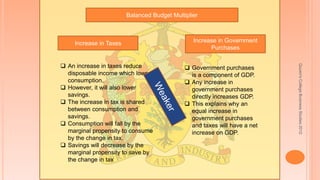
Balanced Budget Multiplier
Increase in Taxes Increase in Government
Purchases
 An increase in taxes reduce
disposable income which lowers
consumption.
 However, it will also lower
savings.
 The increase in tax is shared
between consumption and
savings.
 Consumption will fall by the
marginal propensity to consume
by the change in tax.
 Savings will decrease by the
marginal propensity to save by
the change in tax
 Government purchases
is a component of GDP.
 Any increase in
government purchases
directly increases GDP.
 This explains why an
equal increase in
government purchases
and taxes will have a net
increase on GDP.
Quuen'sCollegeBusinessStudies2012
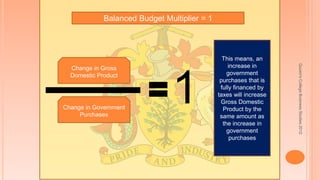
Balanced Budget Multiplier = 1
Change in Gross
Domestic Product
Change in Government
Purchases
1
This means, an
increase in
government
purchases that is
fully financed by
taxes will increase
Gross Domestic
Product by the
same amount as
the increase in
government
purchases
Quuen'sCollegeBusinessStudies2012
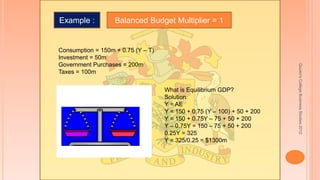
Example : Balanced Budget Multiplier = 1
Consumption = 150m + 0.75 (Y – T)
Investment = 50m
Government Purchases = 200m
Taxes = 100m
What is Equilibrium GDP?
Solution:
Y = AE
Y = 150 + 0.75 (Y – 100) + 50 + 200
Y = 150 + 0.75Y – 75 + 50 + 200
Y – 0.75Y = 150 – 75 + 50 + 200
0.25Y = 325
Y = 325/0.25 = $1300m
Quuen'sCollegeBusinessStudies2012
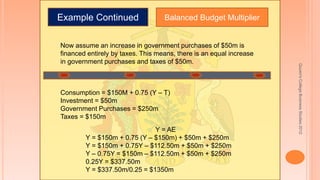
Example Continued Balanced Budget Multiplier
Now assume an increase in government purchases of $50m is
financed entirely by taxes. This means, there is an equal increase
in government purchases and taxes of $50m.
Consumption = $150M + 0.75 (Y – T)
Investment = $50m
Government Purchases = $250m
Taxes = $150m
Y = AE
Y = $150m + 0.75 (Y – $150m) + $50m + $250m
Y = $150m + 0.75Y – $112.50m + $50m + $250m
Y – 0.75Y = $150m – $112.50m + $50m + $250m
0.25Y = $337.50m
Y = $337.50m/0.25 = $1350m
Quuen'sCollegeBusinessStudies2012
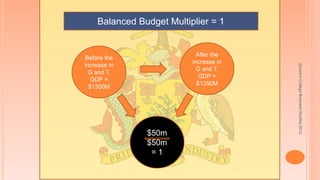
Balanced Budget Multiplier = 1
Before the
increase in
G and T.
GDP =
$1300M
After the
increase in
G and T.
GDP =
$1350M
$50m
$50m
= 1
Quuen'sCollegeBusinessStudies2012
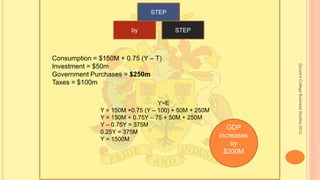
by
STEP
STEP
Consumption = $150M + 0.75 (Y – T)
Investment = $50m
Government Purchases = $250m
Taxes = $100m
Y=E
Y = 150M +0.75 (Y – 100) + 50M + 250M
Y = 150M + 0.75Y – 75 + 50M + 250M
Y – 0.75Y = 375M
0.25Y = 375M
Y = 1500M
GDP
increases
by
$200M
Quuen'sCollegeBusinessStudies2012
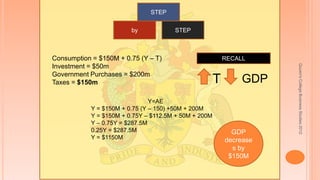
by
STEP
STEP
Consumption = $150M + 0.75 (Y – T)
Investment = $50m
Government Purchases = $200m
Taxes = $150m
RECALL
T GDP
Y=AE
Y = $150M + 0.75 (Y – 150) +50M + 200M
Y = $150M + 0.75Y – $112.5M + 50M + 200M
Y – 0.75Y = $287.5M
0.25Y = $287.5M
Y = $1150M
GDP
decrease
s by
$150M

Balanced Budget Multiplier

  • 1.
    Quuen'sCollegeBusinessStudies2012 Nature of theBudget  Taxation Revenue  Taxes on income and profits  Taxes on properties  Taxes on goods and services  Import duties  Non-tax Revenue  Government departments  Post Offices  Property income  State-owned corporations  Current Expenditure  Wages and salaries  Goods and services  Interest Payments  Transfers and subsidies  Capital Expenditure  Investments  Property Acquisitions Revenue Expenditure 1
  • 2.
    Quuen'sCollegeBusinessStudies2012 Budget Deficit vs.Budget Surplus Budget Deficit  This occurs when government revenues are less than their expenditure in a given year.  In 2014, government’s expected revenue according to the estimates were $2.47 billion. However, government’s expected revenue for the same period were $3.9 billion. The budget deficit of 2014 stood at approximately $1,43 billion Budget Surplus  This occurs when government revenues exceed government expenditure in a given year.  For example, government revenue of $4 billion and expenditure in the same year of $3 billion would yield a surplus of $1 billion.
  • 3.
    Quuen'sCollegeBusinessStudies2012 Balanced Budget Government mayalso achieve a balanced budget where government revenue equal government expenditure. Budget = T - G Balanced Budget Multiplier An equal increase in government taxes and expenditure result in a net increase in Gross Domestic Product. This concept is known as the balanced budget multiplier.
  • 4.
    Quuen'sCollegeBusinessStudies2012 Balanced Budget Multiplier Increasein Taxes Increase in Government Purchases  An increase in taxes reduce disposable income which lowers consumption.  However, it will also lower savings.  The increase in tax is shared between consumption and savings.  Consumption will fall by the marginal propensity to consume by the change in tax.  Savings will decrease by the marginal propensity to save by the change in tax  Government purchases is a component of GDP.  Any increase in government purchases directly increases GDP.  This explains why an equal increase in government purchases and taxes will have a net increase on GDP.
  • 5.
    Quuen'sCollegeBusinessStudies2012 Balanced Budget Multiplier= 1 Change in Gross Domestic Product Change in Government Purchases 1 This means, an increase in government purchases that is fully financed by taxes will increase Gross Domestic Product by the same amount as the increase in government purchases
  • 6.
    Quuen'sCollegeBusinessStudies2012 Example : BalancedBudget Multiplier = 1 Consumption = 150m + 0.75 (Y – T) Investment = 50m Government Purchases = 200m Taxes = 100m What is Equilibrium GDP? Solution: Y = AE Y = 150 + 0.75 (Y – 100) + 50 + 200 Y = 150 + 0.75Y – 75 + 50 + 200 Y – 0.75Y = 150 – 75 + 50 + 200 0.25Y = 325 Y = 325/0.25 = $1300m
  • 7.
    Quuen'sCollegeBusinessStudies2012 Example Continued BalancedBudget Multiplier Now assume an increase in government purchases of $50m is financed entirely by taxes. This means, there is an equal increase in government purchases and taxes of $50m. Consumption = $150M + 0.75 (Y – T) Investment = $50m Government Purchases = $250m Taxes = $150m Y = AE Y = $150m + 0.75 (Y – $150m) + $50m + $250m Y = $150m + 0.75Y – $112.50m + $50m + $250m Y – 0.75Y = $150m – $112.50m + $50m + $250m 0.25Y = $337.50m Y = $337.50m/0.25 = $1350m
  • 8.
    Quuen'sCollegeBusinessStudies2012 Balanced Budget Multiplier= 1 Before the increase in G and T. GDP = $1300M After the increase in G and T. GDP = $1350M $50m $50m = 1
  • 9.
    Quuen'sCollegeBusinessStudies2012 by STEP STEP Consumption = $150M+ 0.75 (Y – T) Investment = $50m Government Purchases = $250m Taxes = $100m Y=E Y = 150M +0.75 (Y – 100) + 50M + 250M Y = 150M + 0.75Y – 75 + 50M + 250M Y – 0.75Y = 375M 0.25Y = 375M Y = 1500M GDP increases by $200M
  • 10.
    Quuen'sCollegeBusinessStudies2012 by STEP STEP Consumption = $150M+ 0.75 (Y – T) Investment = $50m Government Purchases = $200m Taxes = $150m RECALL T GDP Y=AE Y = $150M + 0.75 (Y – 150) +50M + 200M Y = $150M + 0.75Y – $112.5M + 50M + 200M Y – 0.75Y = $287.5M 0.25Y = $287.5M Y = $1150M GDP decrease s by $150M