SILENCE IS AN OCEAN.....
SPEECH IS RIVER......
Presentation Made By
Arivarasan.N
MANAGEMENT ACCOUNTING
SYNOPSIS:
 Budget – definition.
 Importance øf Budgeting.
 Classification øf budgets.
 Master Budgets.
 Preparation øf cash Budget.
 Sales Budget.
 Purchase Budget.
 Material Budget.
 Flexible Budget.
BUDGET - DEFINITION:
A budget is a financial plan for a defined
period, often one year. It may also include
planned sales volumes and revenues, resource
quantities, costs and expenses, assets, liabilities
and cash flows. Companies, governments,
families and other organizations use it to
express strategic plans of activities or events in
measurable terms. The Budget is a description
of a financial plan. It is a list of estimates of
revenues to and expenditures by an agent for a
stated period of time.
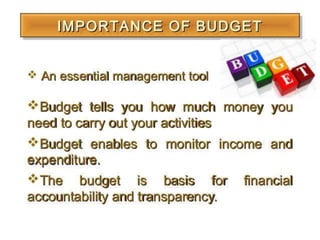
IMPORTANTACNE ØF BUDGETING
CLASSIFICATION ØF BUDGET
 On the Basis of Time
 On the Basis of Function
 On the Basis of Flexibility
 On the Basis of Nature of Business Activity.
 1. On the Basis of Time
 (i) Long-term Budget,
 (ii) Short-term Budget, and
 (iii) Current Budgets.
2.On the Basis of Function:
Budgets for a period may also be classified
according to the functions carried on in a business
concern. The various functions of a business
concern are interrelated. The various forecast of
individual function are coordinated and then
constipated to show the total effect of all the
functions
3.On the Basis of Flexibility:
(i) Fixed Budget and
(ii) Flexible Budget
4.On the Basis of Nature of Business
Activity:
(i) Operating Budgets or Revenue Budgets
(ii) Capital Expenditure Budgets
MasterBudget:
A master budget is an expensive business
strategy that documents expected future sales,
productions levels, purchases, future expenses
incurred, capital investments, and even loads to
be acquired and repaid. In other words, the
master budget includes all other financial
budgets as wells as a budgeted income
statement and balance sheet.
Preparation of Cash Budget:
The following three methods for preparing Cash
Budget
(a) The Receipts and Payments Method
(b) The Adjusted Profit and Loss Method
(c) The Balance Sheet Method.
Sales Budget
A sales budget estimates the sales in units
as well as the estimated earnings from these
sales. Budgeting is important for any business.
Without a budget companies can’t track process
or improve performance . Basically, the sales
budget is what management expects to sell and
the revenues collected from these sales.
Purchases Budget
A purchases budget contains the amount of
inventory that a company must purchase during
each budget period. The amount stated in the
budget is the amount needed to ensure that there
is sufficient inventory on hand to meet customer
orders for products. At the simplest level, the
purchases budget can simply match the exact
number of units expected to be sold in the budget
period.Material budget
Material budgeting refers to the procedure of
preparing material or purchase budget in terms of
quantity and money value of materials to be procured
in a specified time period. Not only does it helps in
estimating the material prices over a period of time, but
also analyses the material requirement.
Flexible Budget
Flexible budget, also called a variable budget,
is financial plan of estimated revenues and
expenses based on the current actual amount of
output. In other words, a flexible budget uses the
revenues and expenses produced in the current
production as a baseline and estimates how the
revenues and expenses will change based on
changes in the output.

Budget and its type

  • 1.
    SILENCE IS ANOCEAN..... SPEECH IS RIVER...... Presentation Made By Arivarasan.N
  • 2.
  • 3.
    SYNOPSIS:  Budget –definition.  Importance øf Budgeting.  Classification øf budgets.  Master Budgets.  Preparation øf cash Budget.  Sales Budget.  Purchase Budget.  Material Budget.  Flexible Budget.
  • 4.
    BUDGET - DEFINITION: Abudget is a financial plan for a defined period, often one year. It may also include planned sales volumes and revenues, resource quantities, costs and expenses, assets, liabilities and cash flows. Companies, governments, families and other organizations use it to express strategic plans of activities or events in measurable terms. The Budget is a description of a financial plan. It is a list of estimates of revenues to and expenditures by an agent for a stated period of time.
  • 5.
  • 6.
    CLASSIFICATION ØF BUDGET On the Basis of Time  On the Basis of Function  On the Basis of Flexibility  On the Basis of Nature of Business Activity.  1. On the Basis of Time  (i) Long-term Budget,  (ii) Short-term Budget, and  (iii) Current Budgets.
  • 7.
    2.On the Basisof Function: Budgets for a period may also be classified according to the functions carried on in a business concern. The various functions of a business concern are interrelated. The various forecast of individual function are coordinated and then constipated to show the total effect of all the functions 3.On the Basis of Flexibility: (i) Fixed Budget and (ii) Flexible Budget
  • 8.
    4.On the Basisof Nature of Business Activity: (i) Operating Budgets or Revenue Budgets (ii) Capital Expenditure Budgets MasterBudget: A master budget is an expensive business strategy that documents expected future sales, productions levels, purchases, future expenses incurred, capital investments, and even loads to be acquired and repaid. In other words, the master budget includes all other financial budgets as wells as a budgeted income statement and balance sheet.
  • 9.
    Preparation of CashBudget: The following three methods for preparing Cash Budget (a) The Receipts and Payments Method (b) The Adjusted Profit and Loss Method (c) The Balance Sheet Method. Sales Budget A sales budget estimates the sales in units as well as the estimated earnings from these sales. Budgeting is important for any business. Without a budget companies can’t track process or improve performance . Basically, the sales budget is what management expects to sell and the revenues collected from these sales.
  • 10.
    Purchases Budget A purchasesbudget contains the amount of inventory that a company must purchase during each budget period. The amount stated in the budget is the amount needed to ensure that there is sufficient inventory on hand to meet customer orders for products. At the simplest level, the purchases budget can simply match the exact number of units expected to be sold in the budget period.Material budget Material budgeting refers to the procedure of preparing material or purchase budget in terms of quantity and money value of materials to be procured in a specified time period. Not only does it helps in estimating the material prices over a period of time, but also analyses the material requirement.
  • 11.
    Flexible Budget Flexible budget,also called a variable budget, is financial plan of estimated revenues and expenses based on the current actual amount of output. In other words, a flexible budget uses the revenues and expenses produced in the current production as a baseline and estimates how the revenues and expenses will change based on changes in the output.