expected
learning
outcomes
After studying Chapter10,
you should be able to:
1. Understand the relationship between financial
planning and control.
3. Enumerate the types of budgets.
2. Know the nature, purposes and limitations of
the budget.
4. Understand and apply the steps in developing a
master budget.
3.
Financial planning involvesmaking projections of sales, income, and
assets based on alternative production and marketing strategies and
then deciding how to meet the forecasted financial requirements. In
the financial planning process, managers should also evaluate plans
and identify changes in operations that would improve results.
Financial control moves on to the implementation phase dealing
with the feedback and adjustment process that is required (a) to
ensure that plans are followed and, (b) to modify existing plans in
response to changes in the operating environment. The process
begins with the specification of the corporate goals, after which
management lays out a series of forecasts and budgets for every
significant area of the firm's activities, as shown in Figure 10-1.
FINANCIAL PLANNING AND CONTROL PROCESS
5.
FINANCIAL FORECASTING
AND BUDGETING
Financialforecasting starts with projecting sales revenues and
production costs. A budget outlines expected expenses for activities
and identifies funding sources. The production budget analyzes
investments in materials, labor, and facilities to meet forecasted sales.
This includes sub-budgets like the materials budget, personnel budget,
and facilities budget. The marketing team also prepares selling and
advertising budgets. Budgets are typically set monthly, comparing
actual results to projections and adjusting if needed.
During planning, these budgets are combined to create a cash budget,
anticipating cash flow needs. If increased sales forecast a cash shortage,
management arranges funding cost-effectively. After forecasting,
projected financial statements are developed and compared to actual
results, helping identify deviations, fix issues, and refine future projections.
Overall, this process helps management avoid cash shortages and boost
profitability.
6.
Budgeting is theact of preparing a budget.
A budget is a financial plan of the resources needed to carry
out tasks and meet financial goals. It is also a quantitative
expression of the goals the organizations wishes to achieve
and the cost of attaining these goals. The use of budgets to
control a firm's activities is known as budgetary control.
BUDGETING
Identify Income Calculate Expenses Set Priorities
7.
THE PURPOSE OFTHE BUDGET
A budget is a description in quantitative - usually monetary - terms of a desired future
result. The process of preparing the budget requires management at all levels to focus
on the future of the business entity. The benefits that may be realized from a budgeting
program are
1. Defining broad objectives and goals and formulating strategies to achieve such objectives;
2. Coordinating the activities of the organization by integrating the plans of the various parts thereby
pulling every one in the same direction;
3. Allocating resources to those parts of the organization where they can be used most effectively;
4. Communicating management's approved plans throughout the organization;
5. Uncovering and preparing for potential bottleneck in the operations before they occur;
6. Motivating managers to achieve the desired results, and
7. Setting a standard or benchmark for evaluating actual performance.
8.
ADVANTAGES AND LIMITATIONSOF BUDGETS
The advantages of budgeting include:
1. It forces planning and exposes situations in which plans of subcomponents are inadequate to
attain the total organization's objectives.
2. It allows a reiterative process to bring the goals of the organization and the subcomponents into
agreement.
3. It provides a means of communicating organization goals down through the organization and
sub-unit operational limitations up though the organization.
4. It provides a basis for financial planning, sub-unit coordination, resource acquisition, inventory
policy, scheduling and output distribution.
5. It provides a basis by which activity can be monitored, with actual results being compared to the
planned results.
9.
ADVANTAGES AND LIMITATIONSOF BUDGETS
The limitations of budgeting are:
1. Budgets tend to oversimplify the real situation and fail to allow for variations in external factors.
They do not reflect qualitative variables.
2. It is difficult to prepare a detailed budget for an organization that has never existed or for a new
division, product, or department of an existing firm.
3. There may be lack of higher and lower management commitment because of lack of
understanding of the fundamentals of budget preparation and utilization.
4. The budget is only a representation of future plans or a means to the goal of profitable activity and
not an end in itself. It may interfere with the supervisor's style of leadership and can therefore stifle
initiative.
5. Budget reports usually emphasize results, not reasons.
10.
TYPES OF BUDGETS
Thetypes of budgets or the major composition of
the master budget are:
1. The Operating Budget
2. The Financial Budget
3. The Capital Investment Budget
11.
A. Operating Budget
1.Budgeted Income Statement
a. Sales budget
b. Production budget
- Materials cost budget
- Direct labor cost budget
- Factory overhead budget
- Inventory levels
2. Cost of Sales budget
3. Selling and Administrative expenses budget
4. Financial expense budget
B. Financial Budget
1. Budgeted Statement of Financial Position
2. Cash budget
3. Budgeted Statement of Sources and Uses of Funds
C. Capital Investment Budget
The following is a simplified subclassification of the above-
mentioned types of budget for a manufacturing firm:
TYPES OF BUDGETS
12.
1. Establish basicgoals and long-range plans for the company.
These will serve as guidelines in the preparation of budget
estimates.
2. Prepare a sales forecast for the budget period.
3. Estimate the cost of goods sold and operating expenses.
4. Determine the effect of budgeted operating results on assets,
liabilities and ownership equity accounts. The cash budget is the
largest part of this step, since changes in many asset and liability
accounts will depend upon the cash flow forecast.
5. Summarize the estimated data in the form of a projected income
statement for the budget period and the projected statement of
financial position as of the end of the budget period.
The major steps in developing a Master Budget may be
outlined as follows:
STEPS IN DEVELOPING A MASTER BUDGET
14.
The sales budgetoutlines what products will be sold, in
what quantities, and at what prices. It serves as the
foundation for all other short-term budgets, triggering a
chain reaction in budget planning. It provides revenue
predictions, helps estimate cash receipts, and informs
budgets for production costs and selling & administrative
expenses. As the keystone of budgeting, its accuracy
directly impacts the entire financial plan.
SALES BUDGET
15.
The sales forecastis made after consideration of the
following factors.
1. Past sales volume
2. General economic and industry conditions
3. Relationship of sales to economic indicators
4. Relative product profitability
5. Market research studies and competition
6. Pricing, advertising and other promotion policies
7. Production capacity
8. Quality of sales force
9. Seasonal variations
10. Long-term sales trends for various products
17.
After the salesbudget has been set, a decision can be made
on the level of production that will be needed for the period to
support sales and the production budget can be set as well.
The production budget becomes a key factor in the
determination of other budgets, including the direct materials
budget, the direct labor budget and the manufacturing
overhead budget. These budgets in turn are needed to assist in
formulating a cash budget.
PRODUCTION BUDGET
18.
Using the datafrom the previously prepared sales
budget as well as the inventory summary information,
the following production budget is developed.
19.
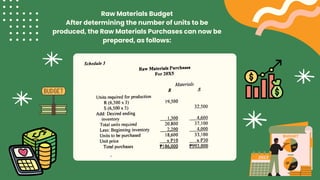
Raw Materials Budget
Afterdetermining the number of units to be
produced, the Raw Materials Purchases can now be
prepared, as follows:
20.
Direct Labor Budget
Thepreliminary data show that the budgeted direct labor cost per
unit produced is P146. This must have been arrived at after
considering such factors as skills level of the workers, labor rate per
hour, time requirement, conditions of union contracts, etc.
21.
Overhead Costs Budget
Studyof past records will show how the cost reacts to
changes in volume or in relation to other factors. Some
overhead items may be projected on the basis of about labor
hours or on materials costs or on machine hours.
24.
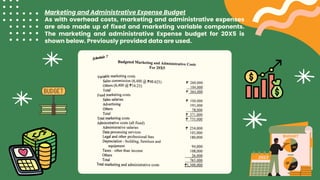
Marketing and AdministrativeExpense Budget
As with overhead costs, marketing and administrative expenses
are also made up of fixed and marketing variable components.
The marketing and administrative Expense budget for 20X5 is
shown below. Previously provided data are used.
25.
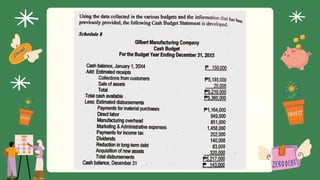
CASH BUDGET
CASH RECEIPTS
Normally,the bulk of a firm's cash receipts come from
customers. The possibility of cash from other sources
(such as additional investments, sales of assets,
borrowings) should likewise be considered when cash
receipts are being budgeted.
Cash Disbursements
Data converted from individual budgets previously illustrated
supply the basic information for the cash disbursements budget.
However, various adjustments and additions will have to be
made when preparing the budget for prepayments, accruals as
well extraneous items (such as the purchase of new equipment,
dividend payment) that do not show up in any of the individual
budgets already Prepared. If the financial policy of the company
requires that a minimum cash balance be maintained at all
times, the cash budget must be altered to accommodate bank
loans and their repayment.
27.
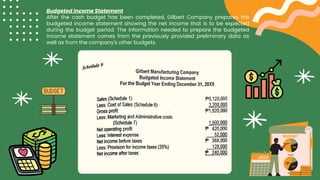
Budgeted Income Statement
Afterthe cash budget has been completed, Gilbert Company prepares the
budgeted income statement showing the net income that is to be expected
during the budget period. The information needed to prepare the budgeted
income statement comes from the previously provided preliminary data as
well as from the company's other budgets.
28.
Budgeted Statement ofFinancial Position
The budgeted statement of financial position is developed by beginning with
the current statement of financial position and adjusting it for the data
contained in the other budgets. Gilbert Company's budgeted statement of
financial position is presented below: