Cost Accounting
Prepared by
Sreevidhya S
Assistant Professor
Dept. of Commerce
NSS College, Pandalam
1
COST – MEANING
Cost means the amount of
expenditure ( actual or notional)
incurred on, or attributable to, a
given thing.
2
 Cost accounting is concerned with recording,
classifying and summarizing costs for
determination of costs of products or
services, planning, controlling and reducing
such costs and furnishing of information to
management for decision making
3
Cost Accounting- Meaning
 “Cost accountancy” as the application of
costing and cost accounting principles, method
and techniques to the science, art and practice
of cost control and the ascertainment of
profitability
4
Definition
 Ascertainment of costs
 Estimation of costs
 Cost control
 Cost reduction
 Determining selling price
 Facilitating preparation of
financial and other statement
 Providing basis for operating
policy
5
2. OBJECTIVES OF COST ACCOUNTING
 COST: Cost means the amount of expenditure incurred on a
particular thing.
 COSTING: Costing means the process of ascertainment of costs.
 COST ACCOUNTING: The application of cost control methods
and the ascertainment of the profitability of activities carried out
or planned”.
 COST CONTROL: Cost control means the control of costs by
management. Following are the aspects or stages of cost control.
 JOB COSTING: It helps in finding out the cost of production of
every order and thus helps in ascertaining profit or loss made out
on its execution. The management can judge the profitability of
each job and decide its future courses of action.
 BATCH COSTING: Batch costing production is done in batches
and each batch consists of a number of units, the determination
of optimum quantity to constitute an economical batch is all the
more important.
6
3. COST TERMINOLOGY
7
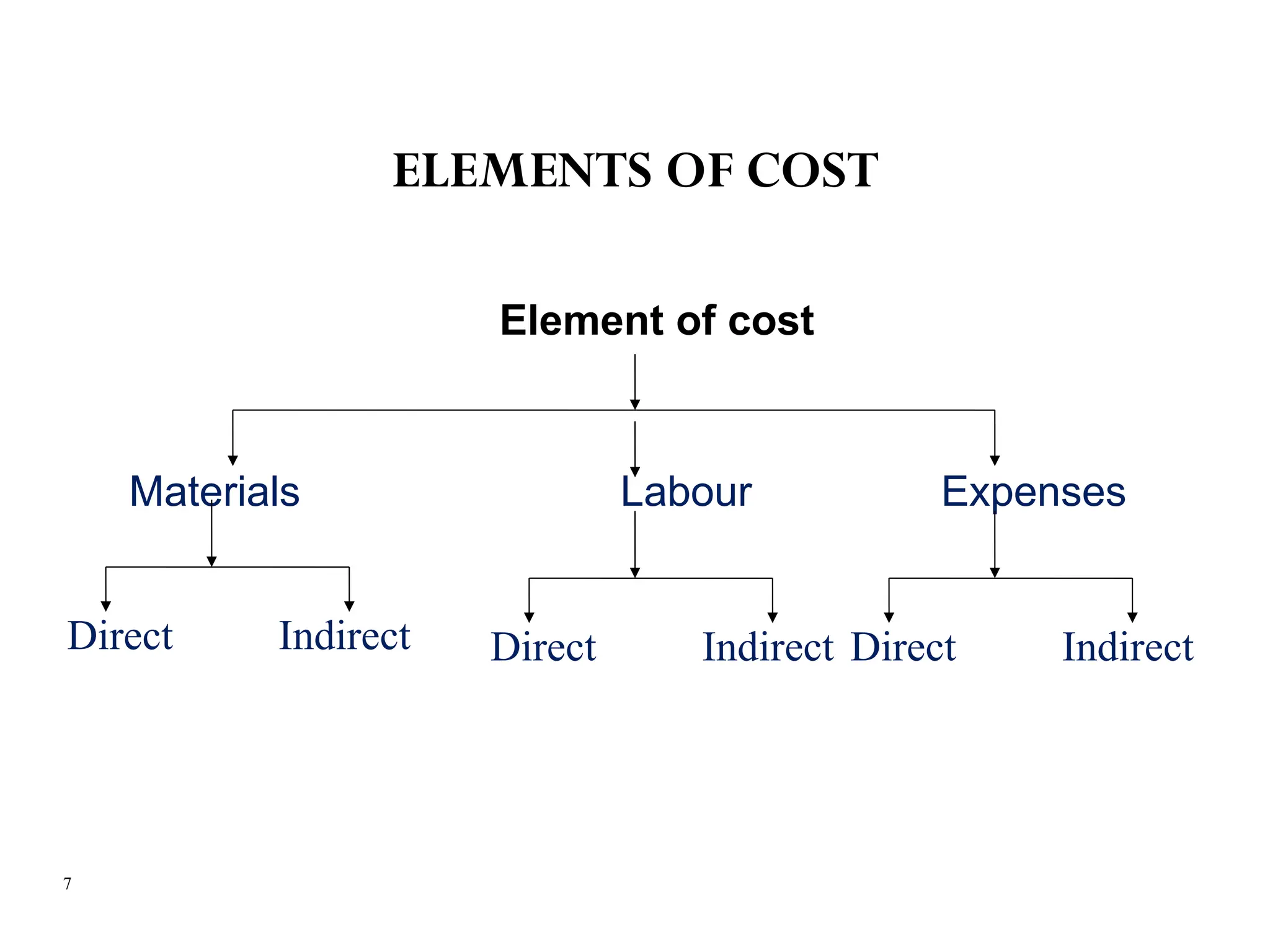
ELEMENTS OF COST
Element of cost
Materials Labour Expenses
Direct Indirect Direct Indirect Direct Indirect
8
MATERIAL: The substance from which
the finished product is made is known
as material.
(a) DIRECT MATERIAL: is one which can
be directly or easily identified in the
product Eg: Timber in furniture, Cloth
in dress, etc.
(b) INDIRECT MATERIAL: one which
cannot be easily identified in the
product.
At factory level – lubricants, oil,
consumables, etc.
At office level – Printing & stationery,
Brooms, Dusters, etc.
At selling & dist. level – Packing
materials, printing & stationery, etc.
9
EXAMPLES OF INDIRECT MATERIAL
10
LABOUR: The human effort required to convert
the materials into finished product is called
labour.
(a) DIRECT LABOUR: is one which can be conveniently
identified or attributed wholly to a particular
job, product or process.
Eg:wages paid to carpenter, fees paid to
tailor,etc.
(b) INDIRECT LABOUR: is one which cannot be
conveniently identified or attributed wholly to a
particular job, product or process.
At factory level – foremen’s salary,
works manager’s salary, gate keeper’s
salary,etc
At office level – Accountant’s salary,
GM’s salary, Manager’s salary, etc.
At selling and dist.level – salesmen
salaries, Logistics manager salary, etc.
11
EXAMPLES OF INDIRECT LABOUR
12
OTHER EXPENSES: are those expenses other
than materials and labour.
DIRECT EXPENSES: are those expenses
which can be directly allocated to
particular job, process or product. Eg :
Excise duty, royalty, special hire
charges,etc.
INDIRECT EXPENSES: are those expenses
which cannot be directly allocated to
particular job, process or product.
At factory level : factory rent, factory
insurance, lighting, etc.
At office level : office rent, office
insurance, office lighting, etc.
At sales & dist.level : advertising, show
room expenses like rent, insurance, etc.
13
Examples of other expenses
Classification On basis of :
Nature
 Function
 Direct & indirect
 Variability
 Controllability
 Normality
 Financial accounting classification
 Time
 Planning and control
 Managerial decision making
14
4. COST CLASSIFICATION
 Materials
 Labor
 Expenses
15
ONTHE BASIS OF NATURE
Manufacturing costs
Commercial costs – ADM and S&D
Costs
ON THE BASIS OF DIRECT AND INDIRECT
Direct costs
Indirect costs
16
ONTHE BASIS OF FUNCTION
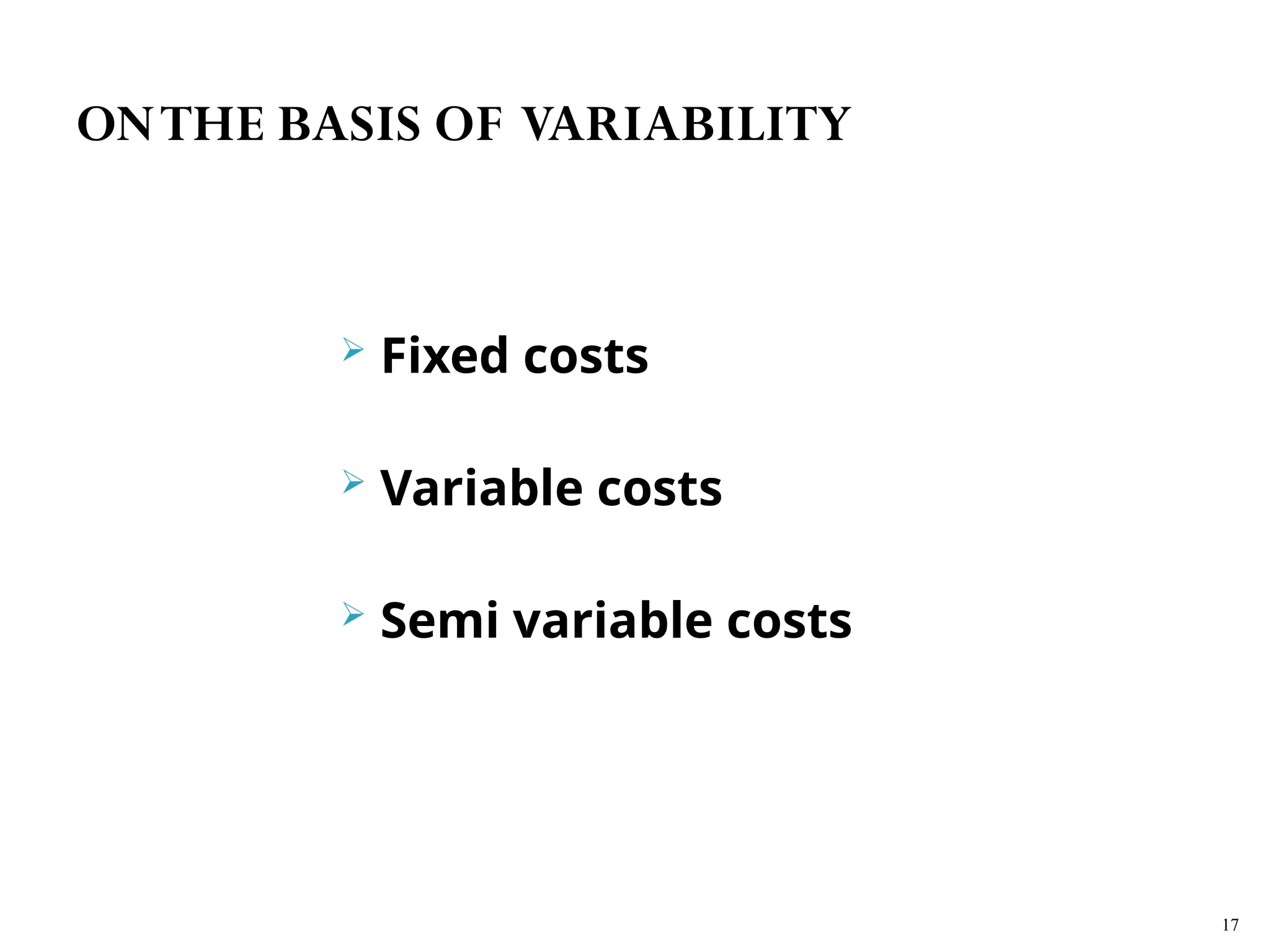
 Fixed costs
 Variable costs
 Semi variable costs
17
ONTHE BASIS OF VARIABILITY
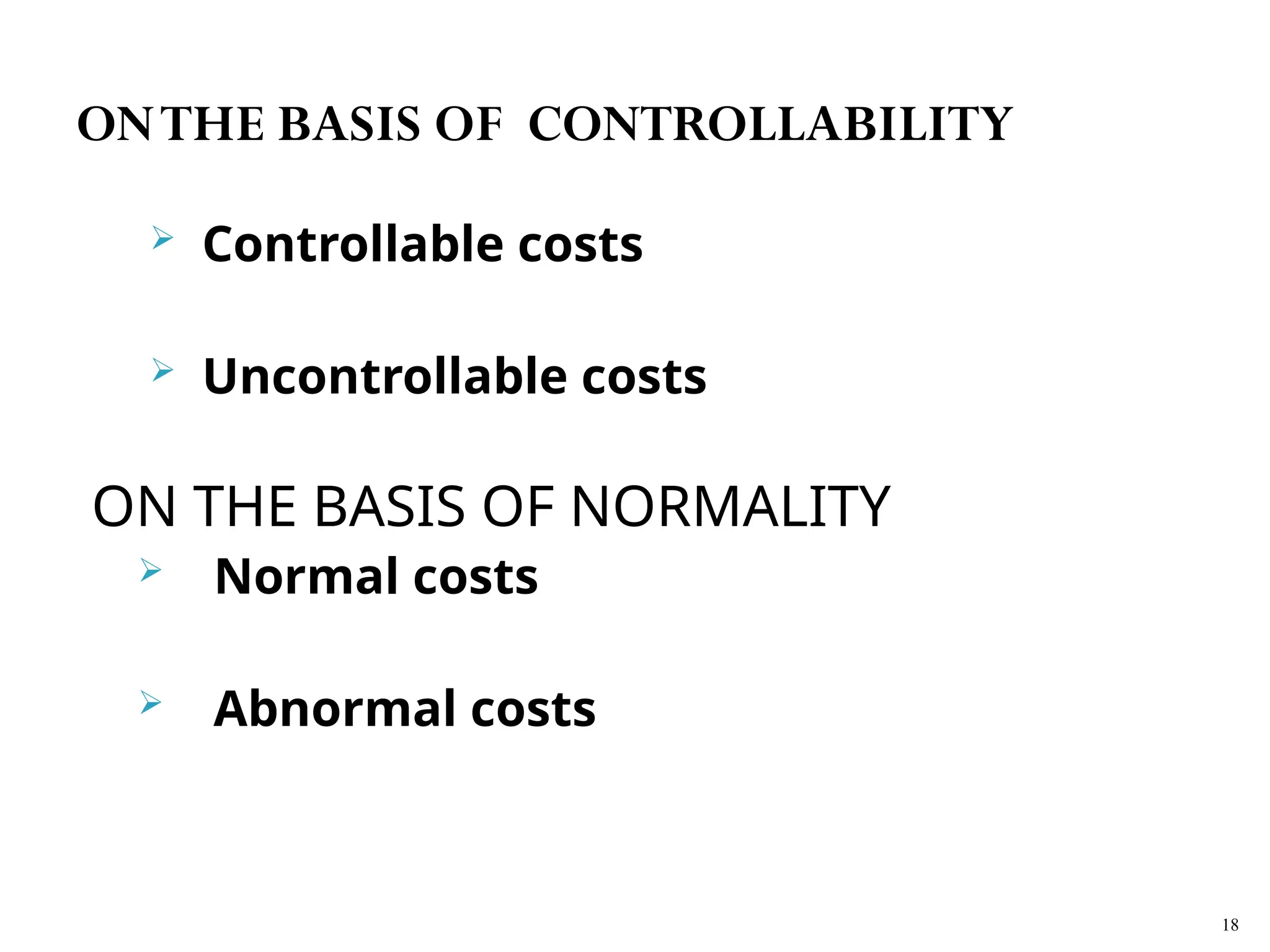
 Controllable costs
 Uncontrollable costs
ON THE BASIS OF NORMALITY
 Normal costs
 Abnormal costs
18
ONTHE BASIS OF CONTROLLABILITY
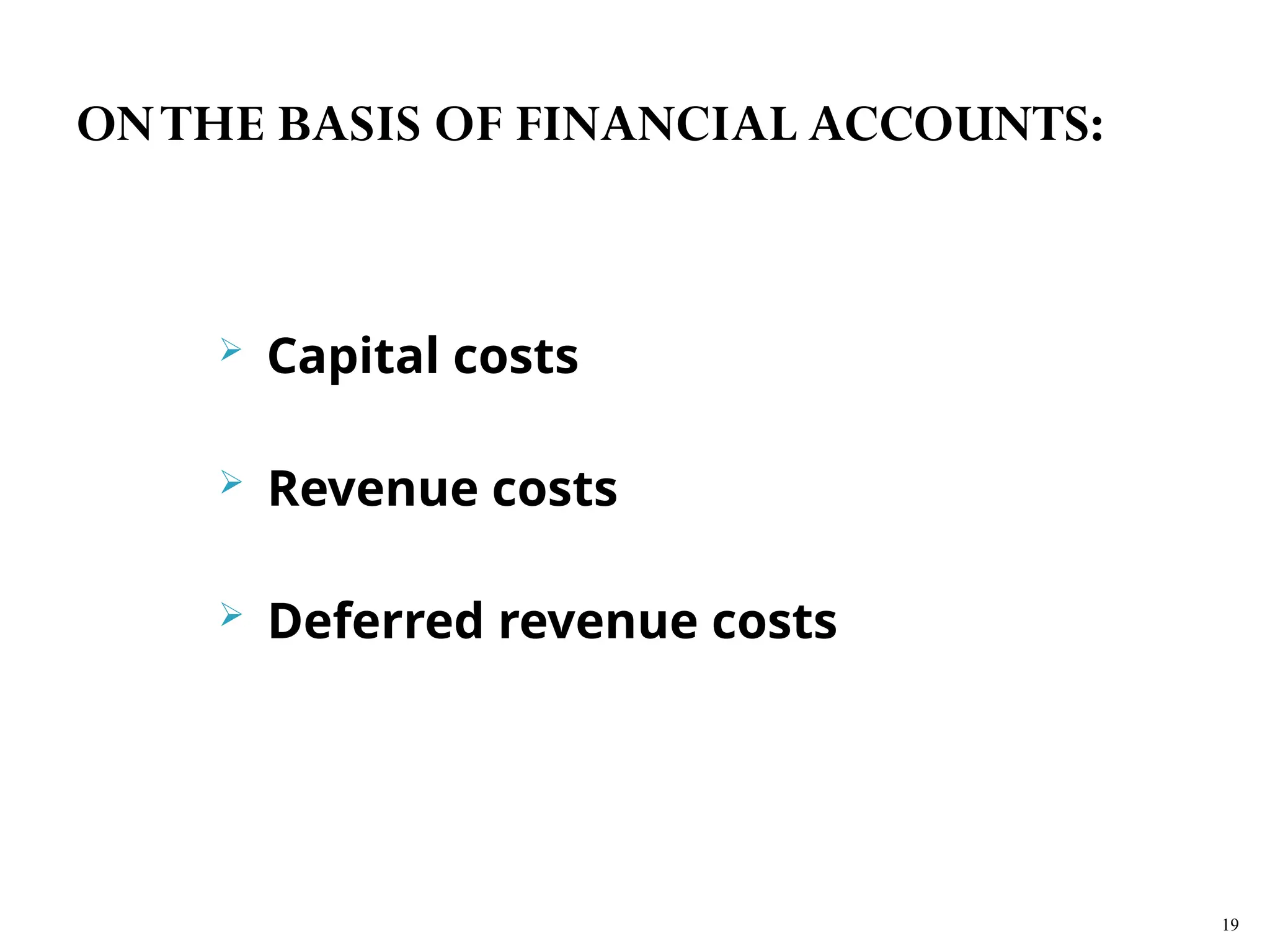
 Capital costs
 Revenue costs
 Deferred revenue costs
19
ONTHE BASIS OF FINANCIAL ACCOUNTS:
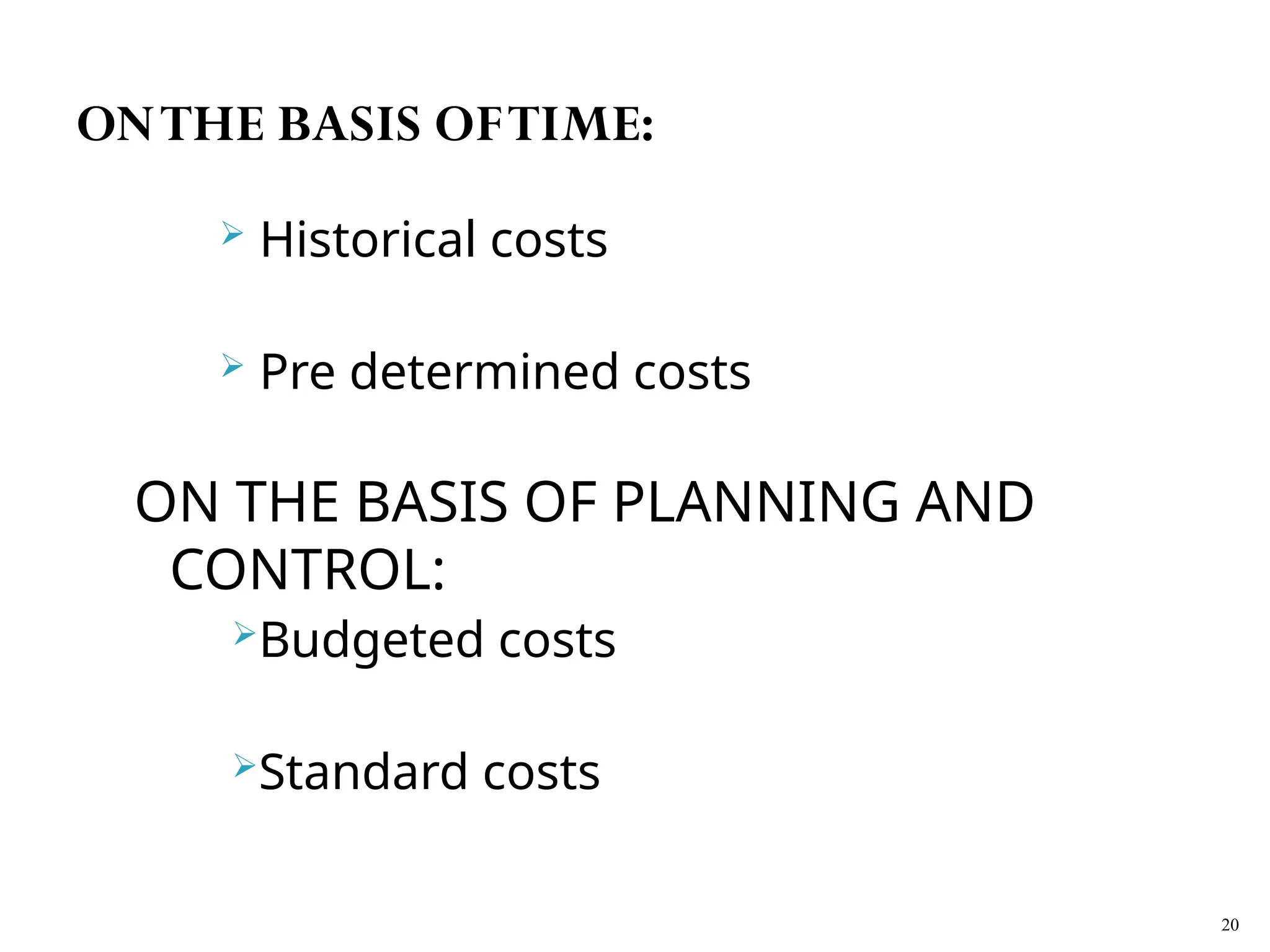
 Historical costs
 Pre determined costs
ON THE BASIS OF PLANNING AND
CONTROL:
Budgeted costs
Standard costs
20
ONTHE BASIS OFTIME:
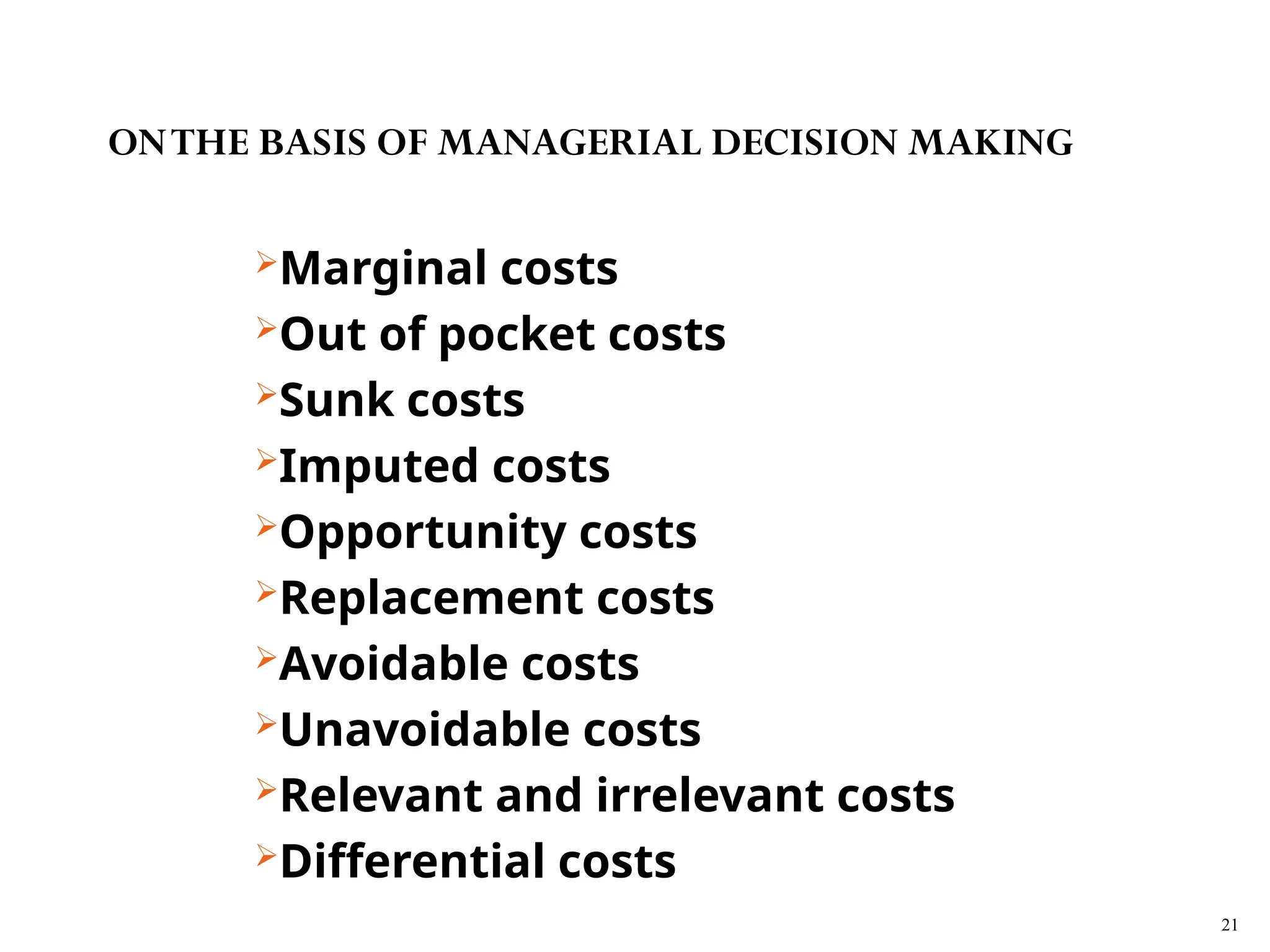
Marginal costs
Out of pocket costs
Sunk costs
Imputed costs
Opportunity costs
Replacement costs
Avoidable costs
Unavoidable costs
Relevant and irrelevant costs
Differential costs
21
ONTHE BASIS OF MANAGERIAL DECISION MAKING
Thank You
22

sreevidhya-Commerce ppt.ppt cost accounting

  • 1.
    Cost Accounting Prepared by SreevidhyaS Assistant Professor Dept. of Commerce NSS College, Pandalam 1
  • 2.
    COST – MEANING Costmeans the amount of expenditure ( actual or notional) incurred on, or attributable to, a given thing. 2
  • 3.
     Cost accountingis concerned with recording, classifying and summarizing costs for determination of costs of products or services, planning, controlling and reducing such costs and furnishing of information to management for decision making 3 Cost Accounting- Meaning
  • 4.
     “Cost accountancy”as the application of costing and cost accounting principles, method and techniques to the science, art and practice of cost control and the ascertainment of profitability 4 Definition
  • 5.
     Ascertainment ofcosts  Estimation of costs  Cost control  Cost reduction  Determining selling price  Facilitating preparation of financial and other statement  Providing basis for operating policy 5 2. OBJECTIVES OF COST ACCOUNTING
  • 6.
     COST: Costmeans the amount of expenditure incurred on a particular thing.  COSTING: Costing means the process of ascertainment of costs.  COST ACCOUNTING: The application of cost control methods and the ascertainment of the profitability of activities carried out or planned”.  COST CONTROL: Cost control means the control of costs by management. Following are the aspects or stages of cost control.  JOB COSTING: It helps in finding out the cost of production of every order and thus helps in ascertaining profit or loss made out on its execution. The management can judge the profitability of each job and decide its future courses of action.  BATCH COSTING: Batch costing production is done in batches and each batch consists of a number of units, the determination of optimum quantity to constitute an economical batch is all the more important. 6 3. COST TERMINOLOGY
  • 7.
    7 ELEMENTS OF COST Elementof cost Materials Labour Expenses Direct Indirect Direct Indirect Direct Indirect
  • 8.
    8 MATERIAL: The substancefrom which the finished product is made is known as material. (a) DIRECT MATERIAL: is one which can be directly or easily identified in the product Eg: Timber in furniture, Cloth in dress, etc. (b) INDIRECT MATERIAL: one which cannot be easily identified in the product.
  • 9.
    At factory level– lubricants, oil, consumables, etc. At office level – Printing & stationery, Brooms, Dusters, etc. At selling & dist. level – Packing materials, printing & stationery, etc. 9 EXAMPLES OF INDIRECT MATERIAL
  • 10.
    10 LABOUR: The humaneffort required to convert the materials into finished product is called labour. (a) DIRECT LABOUR: is one which can be conveniently identified or attributed wholly to a particular job, product or process. Eg:wages paid to carpenter, fees paid to tailor,etc. (b) INDIRECT LABOUR: is one which cannot be conveniently identified or attributed wholly to a particular job, product or process.
  • 11.
    At factory level– foremen’s salary, works manager’s salary, gate keeper’s salary,etc At office level – Accountant’s salary, GM’s salary, Manager’s salary, etc. At selling and dist.level – salesmen salaries, Logistics manager salary, etc. 11 EXAMPLES OF INDIRECT LABOUR
  • 12.
    12 OTHER EXPENSES: arethose expenses other than materials and labour. DIRECT EXPENSES: are those expenses which can be directly allocated to particular job, process or product. Eg : Excise duty, royalty, special hire charges,etc. INDIRECT EXPENSES: are those expenses which cannot be directly allocated to particular job, process or product.
  • 13.
    At factory level: factory rent, factory insurance, lighting, etc. At office level : office rent, office insurance, office lighting, etc. At sales & dist.level : advertising, show room expenses like rent, insurance, etc. 13 Examples of other expenses
  • 14.
    Classification On basisof : Nature  Function  Direct & indirect  Variability  Controllability  Normality  Financial accounting classification  Time  Planning and control  Managerial decision making 14 4. COST CLASSIFICATION
  • 15.
     Materials  Labor Expenses 15 ONTHE BASIS OF NATURE
  • 16.
    Manufacturing costs Commercial costs– ADM and S&D Costs ON THE BASIS OF DIRECT AND INDIRECT Direct costs Indirect costs 16 ONTHE BASIS OF FUNCTION
  • 17.
     Fixed costs Variable costs  Semi variable costs 17 ONTHE BASIS OF VARIABILITY
  • 18.
     Controllable costs Uncontrollable costs ON THE BASIS OF NORMALITY  Normal costs  Abnormal costs 18 ONTHE BASIS OF CONTROLLABILITY
  • 19.
     Capital costs Revenue costs  Deferred revenue costs 19 ONTHE BASIS OF FINANCIAL ACCOUNTS:
  • 20.
     Historical costs Pre determined costs ON THE BASIS OF PLANNING AND CONTROL: Budgeted costs Standard costs 20 ONTHE BASIS OFTIME:
  • 21.
    Marginal costs Out ofpocket costs Sunk costs Imputed costs Opportunity costs Replacement costs Avoidable costs Unavoidable costs Relevant and irrelevant costs Differential costs 21 ONTHE BASIS OF MANAGERIAL DECISION MAKING
  • 22.