Dr Arun Gupta
Director imaging
Deptt
Dr Rakhee Gupta     Contact :
Dr Nitu Narula      Web site : www.spiralctmricentre.com
Dr Ritesh Mahajan   Text references for this presentations :
Dr R K Gandhi       •Musculosketetal MRI ( Kaplan, Helms,
                    Dussault,Anderson,Major)
                    •MRI in orthopaedics and sports medicine
                          ( David W . Stoller)
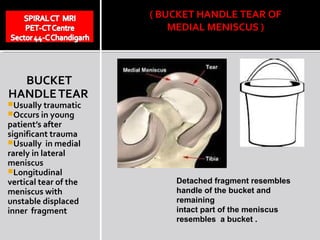
( BUCKET HANDLE TEAR OF
                           MEDIAL MENISCUS )


  BUCKET
HANDLE TEAR
Usually traumatic
Occurs in young
patient’s after
significant trauma
Usually in medial
rarely in lateral
meniscus
Longitudinal
vertical tear of the       Detached fragment resembles
meniscus with              handle of the bucket and
unstable displaced         remaining
inner fragment             intact part of the meniscus
                           resembles a bucket .
 The posterior horn of the medial
   Vertical longitudinal tear is the              meniscus is normally greater in
    commonest bucket handle tear ( 10              height than anterior horn …..
    %).
                                                   Foreshortening of the posterior horn
   Normal width of the body of the
    meniscus is 9mm .                              with no h/o partial menisectomy is
   Sagittal images from the body of the           associated with bucket handle
    meniscus shows bow tie appearance              morphology .
    in at least two consecutive images .          The detached fragment form the
   The bowtie appearance is absent in             body of the medial meniscus can
    the bucket handle tear ( ABSENT                place itself anterior to anterior horn
    BOWTIE SIGN ): (very sensitive for             of the medial meniscus ( Anterior
    assessment of bucket handle tears )            flipped meniscus sign ) .
   The anterior / posterior horn are             The detached fragment can place
       Truncated
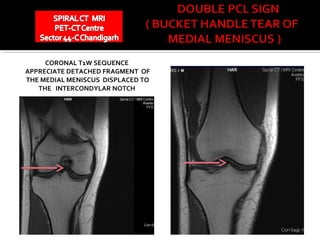
                                                   itself in the intercondylar notch
       Hypoplastic
                                                   ( ventral to PCL ) and this position of
       With or without internal signal change
                                                   the PCL gives double PCL
                                                   appearance ( DOUBLE PCL SIGN )
   Common tear in young patients      Double delta sign : Flipped inner
   Associated with significant         meniscal fragments adjacent
    trauma                                   ( posterior ) to the anterior
   Associated with ACL injury .        horn of the donor site.
   Unstable meniscal fragment         Displaced posterior horn or body
    locks into the intercondylar        flap tear may mimic a bucket
    notch and involves atleast two      handle tear hence true bucket
    third of the meniscal               handle tear is : when third
    circumference .                     structure ( separate from ACL /
   Diagnosis of a bucket handle        PCL) is documented with in
    tear requires identification of     intercondylar notch on more than
    displaced meniscal tissue from      single cross-sectional image .
    posterior to relative anterior       Types of vertical longitudinal tears :
    coronal position .                     Single vertical longitudinal tear
   Double delta sign and / or             Double / triple vertical longitudinal
    double PCL sign are sagittal MR         tear .
                                           Broken bucket handle tears
    findings of a displaced bucket         Displaced bucket handle tear .
    handle tear .
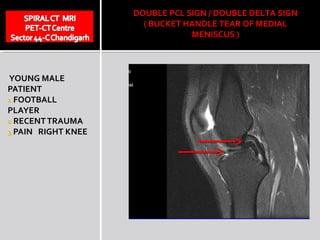
DOUBLE PCL SIGN / DOUBLE DELTA SIGN
                      ( BUCKET HANDLE TEAR OF MEDIAL
                                MENISCUS )


YOUNG MALE
PATIENT
1.FOOTBALL
PLAYER
2.RECENT TRAUMA
3.PAIN RIGHT KNEE
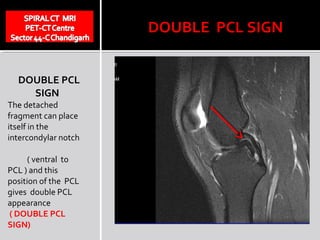
DOUBLE PCL SIGN


  DOUBLE PCL
    SIGN
The detached
fragment can place
itself in the
intercondylar notch

      ( ventral to
PCL ) and this
position of the PCL
gives double PCL
appearance
( DOUBLE PCL
SIGN)
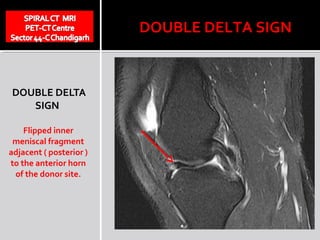
DOUBLE DELTA SIGN


DOUBLE DELTA
   SIGN

    Flipped inner
 meniscal fragment
adjacent ( posterior )
to the anterior horn
 of the donor site.
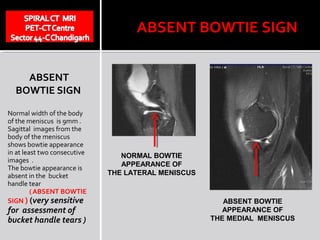
ABSENT BOWTIE SIGN


    ABSENT
  BOWTIE SIGN

Normal width of the body
of the meniscus is 9mm .
Sagittal images from the
body of the meniscus
shows bowtie appearance
in at least two consecutive      NORMAL BOWTIE
images .
                                 APPEARANCE OF
The bowtie appearance is
absent in the bucket          THE LATERAL MENISCUS
handle tear
         ( ABSENT BOWTIE
SIGN ) (very sensitive                                  ABSENT BOWTIE
for assessment of                                       APPEARANCE OF
bucket handle tears )                                THE MEDIAL MENISCUS
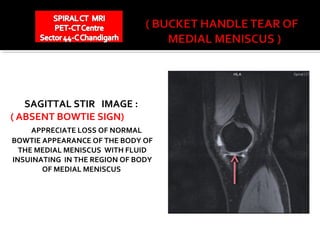
SAGITTAL STIR IMAGE :
( ABSENT BOWTIE SIGN)
     APPRECIATE LOSS OF NORMAL
BOWTIE APPEARANCE OF THE BODY OF
  THE MEDIAL MENISCUS WITH FLUID
INSUINATING IN THE REGION OF BODY
       OF MEDIAL MENISCUS
CORONAL T1W SEQUENCE
APPRECIATE DETACHED FRAGMENT OF
THE MEDIAL MENISCUS DISPLACED TO
   THE INTERCONDYLAR NOTCH
CONSEQUENT CORONAL IMAGES
   ( PRIMARILY POSTERIOR ONES)
   DEPICTING THE DISPLACED
      MENISCAL FRAGMENT

                       Diagnosis of
                          a bucket
                        handle tear
                          requires
                       identification
                        of displaced
                          meniscal
                        tissue from
                        posterior to
                           relative
                          anterior
                           coronal
                         position .
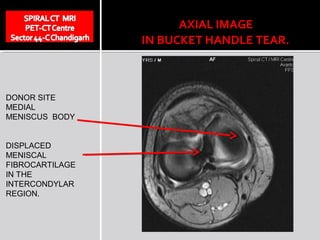
AXIAL IMAGE
                 IN BUCKET HANDLE TEAR.


DONOR SITE
MEDIAL
MENISCUS BODY


DISPLACED
MENISCAL
FIBROCARTILAGE
IN THE
INTERCONDYLAR
REGION.
   Look for the donor site of tear .
   Look for unstable detached meniscal fibro-cartilage fragment.
   Attempt to define meniscal Rim size ( 5mm or more will need
    surgery) .
   Look for signs of chronicity ( deformed twisted morphology)
   Double PCL / Double Delta / absent bowtie signs are to be
    looked for .
   Truncation / hypoplasia / foreshortening of the horns should
    be commented upon.
   Multiple posterior coronal images should display the
    unstable / displaced meniscal fibrocartilage fragment to
    define bucket handle tear morphology and differentiate it
    from other kind of flap tears.

Bucket handle tear

  • 1.
    Dr Arun Gupta Directorimaging Deptt Dr Rakhee Gupta Contact : Dr Nitu Narula Web site : www.spiralctmricentre.com Dr Ritesh Mahajan Text references for this presentations : Dr R K Gandhi •Musculosketetal MRI ( Kaplan, Helms, Dussault,Anderson,Major) •MRI in orthopaedics and sports medicine ( David W . Stoller)
  • 2.
    ( BUCKET HANDLETEAR OF MEDIAL MENISCUS ) BUCKET HANDLE TEAR Usually traumatic Occurs in young patient’s after significant trauma Usually in medial rarely in lateral meniscus Longitudinal vertical tear of the Detached fragment resembles meniscus with handle of the bucket and unstable displaced remaining inner fragment intact part of the meniscus resembles a bucket .
  • 3.
     The posteriorhorn of the medial  Vertical longitudinal tear is the meniscus is normally greater in commonest bucket handle tear ( 10 height than anterior horn ….. %). Foreshortening of the posterior horn  Normal width of the body of the meniscus is 9mm . with no h/o partial menisectomy is  Sagittal images from the body of the associated with bucket handle meniscus shows bow tie appearance morphology . in at least two consecutive images .  The detached fragment form the  The bowtie appearance is absent in body of the medial meniscus can the bucket handle tear ( ABSENT place itself anterior to anterior horn BOWTIE SIGN ): (very sensitive for of the medial meniscus ( Anterior assessment of bucket handle tears ) flipped meniscus sign ) .  The anterior / posterior horn are  The detached fragment can place  Truncated itself in the intercondylar notch  Hypoplastic ( ventral to PCL ) and this position of  With or without internal signal change the PCL gives double PCL appearance ( DOUBLE PCL SIGN )
  • 4.
    Common tear in young patients  Double delta sign : Flipped inner  Associated with significant meniscal fragments adjacent trauma ( posterior ) to the anterior  Associated with ACL injury . horn of the donor site.  Unstable meniscal fragment  Displaced posterior horn or body locks into the intercondylar flap tear may mimic a bucket notch and involves atleast two handle tear hence true bucket third of the meniscal handle tear is : when third circumference . structure ( separate from ACL /  Diagnosis of a bucket handle PCL) is documented with in tear requires identification of intercondylar notch on more than displaced meniscal tissue from single cross-sectional image . posterior to relative anterior  Types of vertical longitudinal tears : coronal position .  Single vertical longitudinal tear  Double delta sign and / or  Double / triple vertical longitudinal double PCL sign are sagittal MR tear .  Broken bucket handle tears findings of a displaced bucket  Displaced bucket handle tear . handle tear .
  • 5.
    DOUBLE PCL SIGN/ DOUBLE DELTA SIGN ( BUCKET HANDLE TEAR OF MEDIAL MENISCUS ) YOUNG MALE PATIENT 1.FOOTBALL PLAYER 2.RECENT TRAUMA 3.PAIN RIGHT KNEE
  • 6.
    DOUBLE PCL SIGN DOUBLE PCL SIGN The detached fragment can place itself in the intercondylar notch ( ventral to PCL ) and this position of the PCL gives double PCL appearance ( DOUBLE PCL SIGN)
  • 7.
    DOUBLE DELTA SIGN DOUBLEDELTA SIGN Flipped inner meniscal fragment adjacent ( posterior ) to the anterior horn of the donor site.
  • 8.
    ABSENT BOWTIE SIGN ABSENT BOWTIE SIGN Normal width of the body of the meniscus is 9mm . Sagittal images from the body of the meniscus shows bowtie appearance in at least two consecutive NORMAL BOWTIE images . APPEARANCE OF The bowtie appearance is absent in the bucket THE LATERAL MENISCUS handle tear ( ABSENT BOWTIE SIGN ) (very sensitive ABSENT BOWTIE for assessment of APPEARANCE OF bucket handle tears ) THE MEDIAL MENISCUS
  • 9.
    SAGITTAL STIR IMAGE: ( ABSENT BOWTIE SIGN) APPRECIATE LOSS OF NORMAL BOWTIE APPEARANCE OF THE BODY OF THE MEDIAL MENISCUS WITH FLUID INSUINATING IN THE REGION OF BODY OF MEDIAL MENISCUS
  • 10.
    CORONAL T1W SEQUENCE APPRECIATEDETACHED FRAGMENT OF THE MEDIAL MENISCUS DISPLACED TO THE INTERCONDYLAR NOTCH
  • 11.
    CONSEQUENT CORONAL IMAGES ( PRIMARILY POSTERIOR ONES) DEPICTING THE DISPLACED MENISCAL FRAGMENT Diagnosis of a bucket handle tear requires identification of displaced meniscal tissue from posterior to relative anterior coronal position .
  • 12.
    AXIAL IMAGE IN BUCKET HANDLE TEAR. DONOR SITE MEDIAL MENISCUS BODY DISPLACED MENISCAL FIBROCARTILAGE IN THE INTERCONDYLAR REGION.
  • 13.
    Look for the donor site of tear .  Look for unstable detached meniscal fibro-cartilage fragment.  Attempt to define meniscal Rim size ( 5mm or more will need surgery) .  Look for signs of chronicity ( deformed twisted morphology)  Double PCL / Double Delta / absent bowtie signs are to be looked for .  Truncation / hypoplasia / foreshortening of the horns should be commented upon.  Multiple posterior coronal images should display the unstable / displaced meniscal fibrocartilage fragment to define bucket handle tear morphology and differentiate it from other kind of flap tears.