Dr Arun Gupta
Director imaging
Dr Rakhee gupta
Dr Vinayak Mittal
Dr Niharika Mahajan
Dr Gaurav Sharma
Dr Ritesh Mahajan
ADVANCED
USG
LOUNGE
ULTRASOUND IMAGE GALLARY
 INTRACAPSULAR RUPTURE OF BREAST
IMPLANT .
 STRANGULATED UMBILICAL HERNIA
 DIVERTICULITIS.
 AGGRESSIVE PERIOSTEAL REACTION ON
USG .
 ECTOPIC FETAL KIDNEY.
 EJACULATORY DUCT CYST.
BREAST IMPLANT RUPTURE
( INTRACAPSULAR)
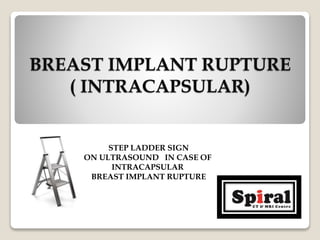
STEP LADDER SIGN
ON ULTRASOUND IN CASE OF
INTRACAPSULAR
BREAST IMPLANT RUPTURE
Breast implant ruptures are a recognized complication of a breast
implant. It can be intra- or extracapsular.
Pathology
After implantation of a silicone or saline breast implant, a fibrous
capsule (scar) forms around the implant shell. Implant ruptures may be
intracapsular(~85%) or extracapsular (~15%) .
Intracapsular rupture
An intracapsular rupture occurs when the shell of the implant ruptures
but the fibrous capsule formed by the breast remains intact. Silicone
does not freely extravasate.This makes it difficult to detect on clinical
exam or mammography. Intracapsular rupture is best seen on MRI.
Extracapsular rupture
An extracapsular rupture can lead to a change in the implant contour
and may be detected on clinical examination or mammography. An
extracapsular rupture implies intracapsular rupture as well.
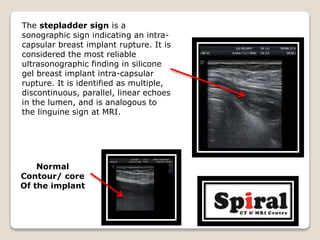
The stepladder sign is a
sonographic sign indicating an intra-
capsular breast implant rupture. It is
considered the most reliable
ultrasonographic finding in silicone
gel breast implant intra-capsular
rupture. It is identified as multiple,
discontinuous, parallel, linear echoes
in the lumen, and is analogous to
the linguine sign at MRI.
Normal
Contour/ core
Of the implant
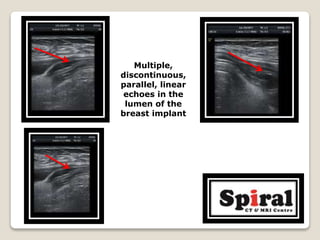
Multiple,
discontinuous,
parallel, linear
echoes in the
lumen of the
breast implant
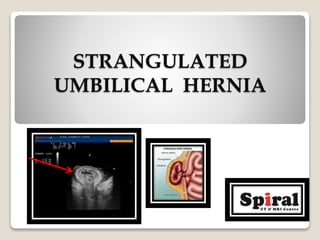
STRANGULATED
UMBILICAL HERNIA
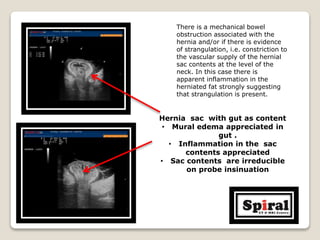
There is a mechanical bowel
obstruction associated with the
hernia and/or if there is evidence
of strangulation, i.e. constriction to
the vascular supply of the hernial
sac contents at the level of the
neck. In this case there is
apparent inflammation in the
herniated fat strongly suggesting
that strangulation is present.
Hernia sac with gut as content
• Mural edema appreciated in
gut .
• Inflammation in the sac
contents appreciated
• Sac contents are irreducible
on probe insinuation
PERIOSTEAL REACTION
ON USG ( AGGRESSIVE)
Periosteal reaction, also known as
a periostitis/periosteitis, is a non
specific radiographic finding that
occurs with periosteal irritation.
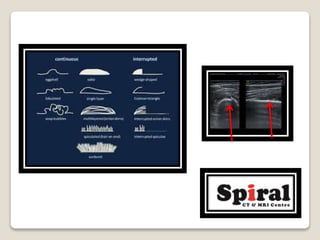
Periosteal reactions may be broadly
characterized as benign or
aggressive, or more specifically
broken down by pattern.
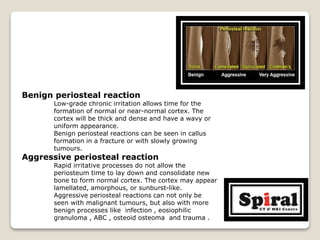
Benign periosteal reaction
Low-grade chronic irritation allows time for the
formation of normal or near-normal cortex. The
cortex will be thick and dense and have a wavy or
uniform appearance.
Benign periosteal reactions can be seen in callus
formation in a fracture or with slowly growing
tumours.
Aggressive periosteal reaction
Rapid irritative processes do not allow the
periosteum time to lay down and consolidate new
bone to form normal cortex. The cortex may appear
lamellated, amorphous, or sunburst-like.
Aggressive periosteal reactions can not only be
seen with malignant tumours, but also with more
benign processes like infection , eosiophilic
granuloma , ABC , osteoid osteoma and trauma .
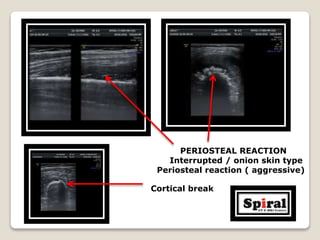
Cortical break
PERIOSTEAL REACTION
Interrupted / onion skin type
Periosteal reaction ( aggressive)
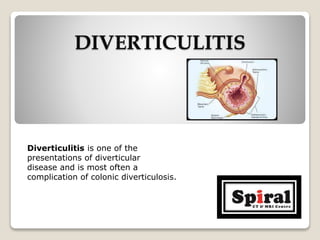
DIVERTICULITIS
Diverticulitis is one of the
presentations of diverticular
disease and is most often a
complication of colonic diverticulosis.
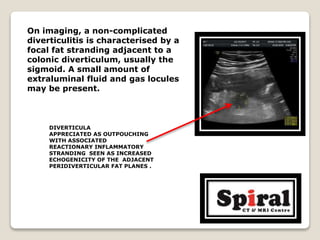
On imaging, a non-complicated
diverticulitis is characterised by a
focal fat stranding adjacent to a
colonic diverticulum, usually the
sigmoid. A small amount of
extraluminal fluid and gas locules
may be present.
DIVERTICULA
APPRECIATED AS OUTPOUCHING
WITH ASSOCIATED
REACTIONARY INFLAMMATORY
STRANDING SEEN AS INCREASED
ECHOGENICITY OF THE ADJACENT
PERIDIVERTICULAR FAT PLANES .
FETAL PELVIC KIDNEY
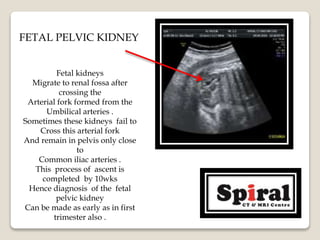
FETAL PELVIC KIDNEY
Fetal kidneys
Migrate to renal fossa after
crossing the
Arterial fork formed from the
Umbilical arteries .
Sometimes these kidneys fail to
Cross this arterial fork
And remain in pelvis only close
to
Common iliac arteries .
This process of ascent is
completed by 10wks
Hence diagnosis of the fetal
pelvic kidney
Can be made as early as in first
trimester also .
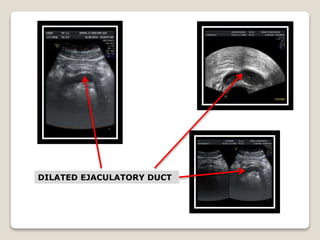
EJACULATORY DUCT
ECTASIA
DILATED EJACULATORY DUCT
REFERENCE
DIAGNOSTIC
ULTRASOUND
FOURTH EDITION
Carol M. Rumack, MD, FACR
J. William Charboneau, MD, FACR
Deborah Levine, MD, FACR
Ultrasound of Congenital
Fetal AnomaliesDifferential
Diagnosis and Prognostic
Indicators
Dario Paladini MD
Head, Fetal Cardiology Unit
Department of Obstetrics and
GynecologyUniversity Federico II
of NaplesNaplesItaly
Paolo Volpe MD
Head, Fetal Medicine Unit
Department of Obstetrics and
GynecologyHospital Di Venere
Bari

Ultrasound image gallery 2016 (2)

  • 1.
    Dr Arun Gupta Directorimaging Dr Rakhee gupta Dr Vinayak Mittal Dr Niharika Mahajan Dr Gaurav Sharma Dr Ritesh Mahajan ADVANCED USG LOUNGE
  • 2.
    ULTRASOUND IMAGE GALLARY INTRACAPSULAR RUPTURE OF BREAST IMPLANT .  STRANGULATED UMBILICAL HERNIA  DIVERTICULITIS.  AGGRESSIVE PERIOSTEAL REACTION ON USG .  ECTOPIC FETAL KIDNEY.  EJACULATORY DUCT CYST.
  • 3.
    BREAST IMPLANT RUPTURE (INTRACAPSULAR) STEP LADDER SIGN ON ULTRASOUND IN CASE OF INTRACAPSULAR BREAST IMPLANT RUPTURE
  • 4.
    Breast implant rupturesare a recognized complication of a breast implant. It can be intra- or extracapsular. Pathology After implantation of a silicone or saline breast implant, a fibrous capsule (scar) forms around the implant shell. Implant ruptures may be intracapsular(~85%) or extracapsular (~15%) . Intracapsular rupture An intracapsular rupture occurs when the shell of the implant ruptures but the fibrous capsule formed by the breast remains intact. Silicone does not freely extravasate.This makes it difficult to detect on clinical exam or mammography. Intracapsular rupture is best seen on MRI. Extracapsular rupture An extracapsular rupture can lead to a change in the implant contour and may be detected on clinical examination or mammography. An extracapsular rupture implies intracapsular rupture as well.
  • 5.
    The stepladder signis a sonographic sign indicating an intra- capsular breast implant rupture. It is considered the most reliable ultrasonographic finding in silicone gel breast implant intra-capsular rupture. It is identified as multiple, discontinuous, parallel, linear echoes in the lumen, and is analogous to the linguine sign at MRI. Normal Contour/ core Of the implant
  • 6.
  • 7.
  • 8.
    There is amechanical bowel obstruction associated with the hernia and/or if there is evidence of strangulation, i.e. constriction to the vascular supply of the hernial sac contents at the level of the neck. In this case there is apparent inflammation in the herniated fat strongly suggesting that strangulation is present. Hernia sac with gut as content • Mural edema appreciated in gut . • Inflammation in the sac contents appreciated • Sac contents are irreducible on probe insinuation
  • 9.
    PERIOSTEAL REACTION ON USG( AGGRESSIVE) Periosteal reaction, also known as a periostitis/periosteitis, is a non specific radiographic finding that occurs with periosteal irritation. Periosteal reactions may be broadly characterized as benign or aggressive, or more specifically broken down by pattern.
  • 10.
    Benign periosteal reaction Low-gradechronic irritation allows time for the formation of normal or near-normal cortex. The cortex will be thick and dense and have a wavy or uniform appearance. Benign periosteal reactions can be seen in callus formation in a fracture or with slowly growing tumours. Aggressive periosteal reaction Rapid irritative processes do not allow the periosteum time to lay down and consolidate new bone to form normal cortex. The cortex may appear lamellated, amorphous, or sunburst-like. Aggressive periosteal reactions can not only be seen with malignant tumours, but also with more benign processes like infection , eosiophilic granuloma , ABC , osteoid osteoma and trauma .
  • 11.
    Cortical break PERIOSTEAL REACTION Interrupted/ onion skin type Periosteal reaction ( aggressive)
  • 13.
    DIVERTICULITIS Diverticulitis is oneof the presentations of diverticular disease and is most often a complication of colonic diverticulosis.
  • 14.
    On imaging, anon-complicated diverticulitis is characterised by a focal fat stranding adjacent to a colonic diverticulum, usually the sigmoid. A small amount of extraluminal fluid and gas locules may be present. DIVERTICULA APPRECIATED AS OUTPOUCHING WITH ASSOCIATED REACTIONARY INFLAMMATORY STRANDING SEEN AS INCREASED ECHOGENICITY OF THE ADJACENT PERIDIVERTICULAR FAT PLANES .
  • 15.
  • 16.
    FETAL PELVIC KIDNEY Fetalkidneys Migrate to renal fossa after crossing the Arterial fork formed from the Umbilical arteries . Sometimes these kidneys fail to Cross this arterial fork And remain in pelvis only close to Common iliac arteries . This process of ascent is completed by 10wks Hence diagnosis of the fetal pelvic kidney Can be made as early as in first trimester also .
  • 17.
  • 18.
  • 19.
    REFERENCE DIAGNOSTIC ULTRASOUND FOURTH EDITION Carol M.Rumack, MD, FACR J. William Charboneau, MD, FACR Deborah Levine, MD, FACR Ultrasound of Congenital Fetal AnomaliesDifferential Diagnosis and Prognostic Indicators Dario Paladini MD Head, Fetal Cardiology Unit Department of Obstetrics and GynecologyUniversity Federico II of NaplesNaplesItaly Paolo Volpe MD Head, Fetal Medicine Unit Department of Obstetrics and GynecologyHospital Di Venere Bari