R.R.KIRUTHIKA
BTH-12-009
ROLE OF
MARKETING INSTITUTIONS
IN
AGRICULTURAL DEVELOPMENT
IN INDIA
MARKETING INSTITUTIONS
 Marketing institutions are business organizations which have come up
to operate the marketing machinery ,including formulation and
implementation of rules.
 They perform one or more of the marketing functions.
 Institutions involved in agricultural marketing involves
Individuals Corporate
Co-operative Government institutions
ROLE OF MARKETING INSTITUTIONS
 The framing of rules and regulations for the protection of the interest
of some sections of the population. These may relate to the grant or
restriction of monopolies, restriction on the activities of traders,
licensing and market regulation.
 Establishment of organizations , to provide services to the farmers for
performing certain marketing functions.
 Promotion of farmers cooperative societies for agricultural marketing
and agro processing.
 Creating of market infrastructure such as storage and
warehousing, transportation and communication facilities, credit
facility, grading and standardization.
 Administration of prices at different levels of marketing –
guaranteeing minimum support prices to producers ,providing
commodities at fair prices to consumers , and fixing the rates of
commission charged by commission of agents.
 Influencing supply and demand by regulating import, internal
procurement and distribution.
INSTITUTIONS
 Public sector institutions
1.Directorate of marketing and Inspection (DMI)
2.Commission for Agricultural Costs and Prices (CACP)
3.Food Corporation of India (FCI)
4.Cotton Corporation of India (CCI)
5.Jute Corporation of India (JCI)
6.Specialized Commodity Boards
7.Others ( CWC, SWC , STC ,APEDA ,MPEDA ,SEPC ,CEPCI ,APMC,
COSAMB ,Research Institutions and Agricultural Universities).
INSTITUTIONS
 Cooperative Sector Institutions
1.National cooperative development Corporation(NCDC)
2. National Agricultural Cooperative Marketing Federation (NAFED)
3.National Cooperative Tobacco Growers Federation (NTGF)
4.National Consumers Cooperative Federation (NCCF)
5.Tribal Cooperative Marketing Federation (TRIFED)
6.Special Commodity Cooperative Marketing Organizations
(Sugarcane, Cotton , milk )
7.State Cooperative Marketing Federations.
FOOD CORPORATION OF INDIA(FCI)
 Jan 1965
 It is one of the largest public sector undertakings in the country.
 Played an important role in transfer of crisis oriented food security into a
stable security system.
 Objectives
1.To procure a sizeable portion of the marketed surplus of food grains at
incentive price from farmers on behalf of the Central and State Government.
2.To make timely releases of the stocks through the public distribution
system so that consumer prices may not rise unduly and unnecessarily.
3.To minimize seasonal price fluctuations and inter-regional price
variations in food commodities by establishing a purchasing and distribution
network.
4.To build up a sizeable buffer stock of cereals to meet the situations
that arise as a result of shortfalls in internal procurement and imports.
DMI (DIRECTORATE OF MARKETING AND
INSPECTION)
 Central Marketing Department,1928 merged with the Inspection Directorate
of the Ministry of the food was renamed as the DMI.
 DMI is assigned the task of implementing the Agricultural Produce (Grading
and Marketing) Act, 1937 ; Cold storage order, 1980 and Meat Food Products
Order, 1973.
 Undertakes programme of market research and surveys, training of market
personnel, extension and publicity.
 Functions – Market Research and Commodity Surveys,
Market Extension,
Statutory Regulation of Markets and Market Practices,
Promotion of Grading and Standardization,
Market Intelligence Cell ,
Training of Market Personnel.
CENTRAL WAREHOUSING CORPORATION
 Founded in 1957 ,Government owned corporation.
 Operates 467 warehouses within the country with 10.3 tonnes capacity.
 Services – foodgrain warehouses, industrial warehousing , custom bonded
warehouses , container freight stations , air cargo complexes.
 Apart from storage and handling , CWC offers services such as in the area of
clearing & forwarding , handling and transportation, procurement &
distribution, disinfestations services , fumigation services, consultancy
services /training for construction of warehouses.
 Function – Warehouse Corporation Act ,1962 .CWC may
- subscribe to the share capital of State warehousing corporation.
- acts as agent of the government for the purpose of purchase, sale ,
storage and distribution of agricultural produce, seeds, manures and
fertilizers, agricultural implements and notified commodities.
Commission for Agricultural Costs and Prices (CACP)
 Set up in 1965 in name of Agricultural Prices Commission(APC) on
recommendations of the food grains price committee headed by Shri
L.K.Jha with the main aim of advising the Government on price policy
of agricultural commodities.
 1980 –CACP-recommending 2 sets of prices MSP and procurement
prices.
 Aims at evolving a balanced and integrated price structure taking into
account of overall needs of the economy and with due regards to the
interest of both the groups.
National Agricultural Cooperative Marketing Federation (NAFED)
 Oct,1958.
 NAFED is an apex organization of marketing cooperatives in the country.
 It deals in procurement, processing, distribution, export and import of
agricultural commodities.
 It is also the central nodal agency for undertaking price support operations for
pulses and oilseeds and market intervention operations for other agricultural
commodities.
 The state level marketing federations and the National Co-operative
Development Corporation are its members.
 Objectives
- To co-ordinate and promote the marketing and trading activities of its
affiliated co-operative institutions.
- To make arrangements for the supply of the agricultural inputs required by
member institutions.
NAFED…..
- To promote inter-state and international trade in agricultural and
other commodities.
- To act as an agent of the government for the purchase, sale,
storage and distribution of agricultural products and inputs.
 Activities: 1. Internal trade
2.Foreign trade-Export and Import of Agricultural
Commodities.
3.Price Support Operations
4.Production and Marketing of Agricultural Inputs
5.Promotional activities
6.Developing Co-operative Marketing of Tribal Produce
7.Settling of Scientific Storage System
TAMILNADU CO-OP MILK PRODUCERS
FEDERATION LIMITED (TCMPF)
 Registered in 1st Feb, 1981 under Diary Development Department.
 Commercial activities such as milk procurement, milk processing,
chilling, packing and sale of milk to consumers .e.g Aavin
 Objectives
1.Assure a remunerative price for the milk produced by the member
through a steady, stable and well organized market support.
2.Distribution of quality of milk and milk produce to the consumers
at reasonable price.
APEDA(AGRICULTURAL AND PROCESSED FOOD PRODUCTS EXPORT
DEVELOPMENT AUTHORITY)
 Under Ministry of Commerce on Feb 13,1986 under the
Agricultural and processed Food Products Export Authority Act,
1985.
 The main responsibility of APEDA is the export promotion of
fruits and vegetable products, meat and meat products, poultry
products, dairy products, confectionary, biscuits and bakery
products, honey, jaggery, sugar and coca products, alcoholic and
non-alcoholic beverages, pickles, chutneys, papads, cereals and
other processed foods.
 It has brought qualitative changes in the agricultural marketing
system and environment and, therefore, has increased the
credence of the agri-business in the products.e.g
 Export of grapes and mangoes from Maharashtra and Karnataka;
strawberry and mushroom from Punjab and Haryana; litchi from
Andhra Pradesh, Uttar Pradesh and Bihar; and cutflowers from
Haryana and Karnataka.
 Objectives:
1.To maximize foreign exchange earnings through increased
agro-exports for providing higher incomes to the farmers
through higher unit value realization.
2. To create employment opportunities in rural areas by
encouraging value added exports of farm products.
3.To implement schemes for providing financial assistance to
improve post-harvest facilities to boost their exports.
SPECIALISED COMMIDITY BOARDS
 They are essentially a producer controlled organization
with government support and authority over a broad range of
functions starting with production, processing and marketing of
the crops.
 Under Ministry of Commerce, Government of India.
 Confined to commercial and plantation crops in India.
 Promote both internal and external trade of the commodity.
 State government has little control over it.
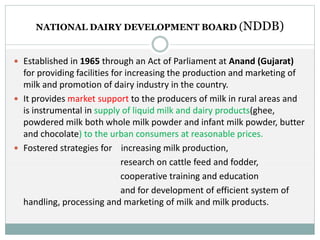
NATIONAL DAIRY DEVELOPMENT BOARD (NDDB)
 Established in 1965 through an Act of Parliament at Anand (Gujarat)
for providing facilities for increasing the production and marketing of
milk and promotion of dairy industry in the country.
 It provides market support to the producers of milk in rural areas and
is instrumental in supply of liquid milk and dairy products(ghee,
powdered milk both whole milk powder and infant milk powder, butter
and chocolate) to the urban consumers at reasonable prices.
 Fostered strategies for increasing milk production,
research on cattle feed and fodder,
cooperative training and education
and for development of efficient system of
handling, processing and marketing of milk and milk products.
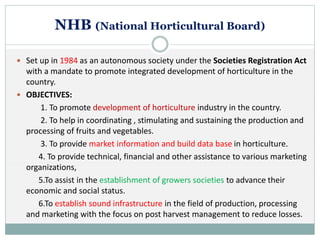
NHB (National Horticultural Board)
 Set up in 1984 as an autonomous society under the Societies Registration Act
with a mandate to promote integrated development of horticulture in the
country.
 OBJECTIVES:
1. To promote development of horticulture industry in the country.
2. To help in coordinating , stimulating and sustaining the production and
processing of fruits and vegetables.
3. To provide market information and build data base in horticulture.
4. To provide technical, financial and other assistance to various marketing
organizations,
5.To assist in the establishment of growers societies to advance their
economic and social status.
6.To establish sound infrastructure in the field of production, processing
and marketing with the focus on post harvest management to reduce losses.
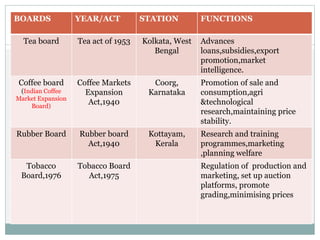
BOARDS YEAR/ACT STATION FUNCTIONS
Tea board Tea act of 1953 Kolkata, West
Bengal
Advances
loans,subsidies,export
promotion,market
intelligence.
Coffee board
(Indian Coffee
Market Expansion
Board)
Coffee Markets
Expansion
Act,1940
Coorg,
Karnataka
Promotion of sale and
consumption,agri
&technological
research,maintaining price
stability.
Rubber Board Rubber board
Act,1940
Kottayam,
Kerala
Research and training
programmes,marketing
,planning welfare
Tobacco
Board,1976
Tobacco Board
Act,1975
Regulation of production and
marketing, set up auction
platforms, promote
grading,minimising prices
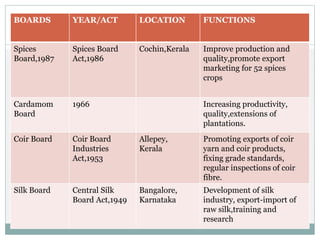
BOARDS YEAR/ACT LOCATION FUNCTIONS
Spices
Board,1987
Spices Board
Act,1986
Cochin,Kerala Improve production and
quality,promote export
marketing for 52 spices
crops
Cardamom
Board
1966 Increasing productivity,
quality,extensions of
plantations.
Coir Board Coir Board
Industries
Act,1953
Allepey,
Kerala
Promoting exports of coir
yarn and coir products,
fixing grade standards,
regular inspections of coir
fibre.
Silk Board Central Silk
Board Act,1949
Bangalore,
Karnataka
Development of silk
industry, export-import of
raw silk,training and
research
TANFED (TAMILNADU COOPERATIVE MARKETING
FEDERATION)
 Functions
1.To identify the agricultural input requirements of the farmers and
arrange for storage and distribution of Fertilizers, Seeds, Pesticides and
agricultural implements through Co-operative outlets.
2.To provide market support to the affiliated member Co-operative
Marketing Societies in procuring, storing and marketing of agricultural
commodities.
3.To provide storage facilities for perishable agricultural commodities
and agro-based products by maintaining cold storage plants.
4.To undertake manufacture of agricultural inputs, distribution of
kerosene, provide mobile telephone services to farmers through
cooperatives.

MARKETING

  • 1.
  • 2.
    MARKETING INSTITUTIONS  Marketinginstitutions are business organizations which have come up to operate the marketing machinery ,including formulation and implementation of rules.  They perform one or more of the marketing functions.  Institutions involved in agricultural marketing involves Individuals Corporate Co-operative Government institutions
  • 3.
    ROLE OF MARKETINGINSTITUTIONS  The framing of rules and regulations for the protection of the interest of some sections of the population. These may relate to the grant or restriction of monopolies, restriction on the activities of traders, licensing and market regulation.  Establishment of organizations , to provide services to the farmers for performing certain marketing functions.  Promotion of farmers cooperative societies for agricultural marketing and agro processing.
  • 4.
     Creating ofmarket infrastructure such as storage and warehousing, transportation and communication facilities, credit facility, grading and standardization.  Administration of prices at different levels of marketing – guaranteeing minimum support prices to producers ,providing commodities at fair prices to consumers , and fixing the rates of commission charged by commission of agents.  Influencing supply and demand by regulating import, internal procurement and distribution.
  • 5.
    INSTITUTIONS  Public sectorinstitutions 1.Directorate of marketing and Inspection (DMI) 2.Commission for Agricultural Costs and Prices (CACP) 3.Food Corporation of India (FCI) 4.Cotton Corporation of India (CCI) 5.Jute Corporation of India (JCI) 6.Specialized Commodity Boards 7.Others ( CWC, SWC , STC ,APEDA ,MPEDA ,SEPC ,CEPCI ,APMC, COSAMB ,Research Institutions and Agricultural Universities).
  • 6.
    INSTITUTIONS  Cooperative SectorInstitutions 1.National cooperative development Corporation(NCDC) 2. National Agricultural Cooperative Marketing Federation (NAFED) 3.National Cooperative Tobacco Growers Federation (NTGF) 4.National Consumers Cooperative Federation (NCCF) 5.Tribal Cooperative Marketing Federation (TRIFED) 6.Special Commodity Cooperative Marketing Organizations (Sugarcane, Cotton , milk ) 7.State Cooperative Marketing Federations.
  • 7.
    FOOD CORPORATION OFINDIA(FCI)  Jan 1965  It is one of the largest public sector undertakings in the country.  Played an important role in transfer of crisis oriented food security into a stable security system.  Objectives 1.To procure a sizeable portion of the marketed surplus of food grains at incentive price from farmers on behalf of the Central and State Government. 2.To make timely releases of the stocks through the public distribution system so that consumer prices may not rise unduly and unnecessarily. 3.To minimize seasonal price fluctuations and inter-regional price variations in food commodities by establishing a purchasing and distribution network. 4.To build up a sizeable buffer stock of cereals to meet the situations that arise as a result of shortfalls in internal procurement and imports.
  • 8.
    DMI (DIRECTORATE OFMARKETING AND INSPECTION)  Central Marketing Department,1928 merged with the Inspection Directorate of the Ministry of the food was renamed as the DMI.  DMI is assigned the task of implementing the Agricultural Produce (Grading and Marketing) Act, 1937 ; Cold storage order, 1980 and Meat Food Products Order, 1973.  Undertakes programme of market research and surveys, training of market personnel, extension and publicity.  Functions – Market Research and Commodity Surveys, Market Extension, Statutory Regulation of Markets and Market Practices, Promotion of Grading and Standardization, Market Intelligence Cell , Training of Market Personnel.
  • 9.
    CENTRAL WAREHOUSING CORPORATION Founded in 1957 ,Government owned corporation.  Operates 467 warehouses within the country with 10.3 tonnes capacity.  Services – foodgrain warehouses, industrial warehousing , custom bonded warehouses , container freight stations , air cargo complexes.  Apart from storage and handling , CWC offers services such as in the area of clearing & forwarding , handling and transportation, procurement & distribution, disinfestations services , fumigation services, consultancy services /training for construction of warehouses.  Function – Warehouse Corporation Act ,1962 .CWC may - subscribe to the share capital of State warehousing corporation. - acts as agent of the government for the purpose of purchase, sale , storage and distribution of agricultural produce, seeds, manures and fertilizers, agricultural implements and notified commodities.
  • 10.
    Commission for AgriculturalCosts and Prices (CACP)  Set up in 1965 in name of Agricultural Prices Commission(APC) on recommendations of the food grains price committee headed by Shri L.K.Jha with the main aim of advising the Government on price policy of agricultural commodities.  1980 –CACP-recommending 2 sets of prices MSP and procurement prices.  Aims at evolving a balanced and integrated price structure taking into account of overall needs of the economy and with due regards to the interest of both the groups.
  • 11.
    National Agricultural CooperativeMarketing Federation (NAFED)  Oct,1958.  NAFED is an apex organization of marketing cooperatives in the country.  It deals in procurement, processing, distribution, export and import of agricultural commodities.  It is also the central nodal agency for undertaking price support operations for pulses and oilseeds and market intervention operations for other agricultural commodities.  The state level marketing federations and the National Co-operative Development Corporation are its members.  Objectives - To co-ordinate and promote the marketing and trading activities of its affiliated co-operative institutions. - To make arrangements for the supply of the agricultural inputs required by member institutions.
  • 12.
    NAFED….. - To promoteinter-state and international trade in agricultural and other commodities. - To act as an agent of the government for the purchase, sale, storage and distribution of agricultural products and inputs.  Activities: 1. Internal trade 2.Foreign trade-Export and Import of Agricultural Commodities. 3.Price Support Operations 4.Production and Marketing of Agricultural Inputs 5.Promotional activities 6.Developing Co-operative Marketing of Tribal Produce 7.Settling of Scientific Storage System
  • 13.
    TAMILNADU CO-OP MILKPRODUCERS FEDERATION LIMITED (TCMPF)  Registered in 1st Feb, 1981 under Diary Development Department.  Commercial activities such as milk procurement, milk processing, chilling, packing and sale of milk to consumers .e.g Aavin  Objectives 1.Assure a remunerative price for the milk produced by the member through a steady, stable and well organized market support. 2.Distribution of quality of milk and milk produce to the consumers at reasonable price.
  • 14.
    APEDA(AGRICULTURAL AND PROCESSEDFOOD PRODUCTS EXPORT DEVELOPMENT AUTHORITY)  Under Ministry of Commerce on Feb 13,1986 under the Agricultural and processed Food Products Export Authority Act, 1985.  The main responsibility of APEDA is the export promotion of fruits and vegetable products, meat and meat products, poultry products, dairy products, confectionary, biscuits and bakery products, honey, jaggery, sugar and coca products, alcoholic and non-alcoholic beverages, pickles, chutneys, papads, cereals and other processed foods.  It has brought qualitative changes in the agricultural marketing system and environment and, therefore, has increased the credence of the agri-business in the products.e.g
  • 15.
     Export ofgrapes and mangoes from Maharashtra and Karnataka; strawberry and mushroom from Punjab and Haryana; litchi from Andhra Pradesh, Uttar Pradesh and Bihar; and cutflowers from Haryana and Karnataka.  Objectives: 1.To maximize foreign exchange earnings through increased agro-exports for providing higher incomes to the farmers through higher unit value realization. 2. To create employment opportunities in rural areas by encouraging value added exports of farm products. 3.To implement schemes for providing financial assistance to improve post-harvest facilities to boost their exports.
  • 16.
    SPECIALISED COMMIDITY BOARDS They are essentially a producer controlled organization with government support and authority over a broad range of functions starting with production, processing and marketing of the crops.  Under Ministry of Commerce, Government of India.  Confined to commercial and plantation crops in India.  Promote both internal and external trade of the commodity.  State government has little control over it.
  • 17.
    NATIONAL DAIRY DEVELOPMENTBOARD (NDDB)  Established in 1965 through an Act of Parliament at Anand (Gujarat) for providing facilities for increasing the production and marketing of milk and promotion of dairy industry in the country.  It provides market support to the producers of milk in rural areas and is instrumental in supply of liquid milk and dairy products(ghee, powdered milk both whole milk powder and infant milk powder, butter and chocolate) to the urban consumers at reasonable prices.  Fostered strategies for increasing milk production, research on cattle feed and fodder, cooperative training and education and for development of efficient system of handling, processing and marketing of milk and milk products.
  • 18.
    NHB (National HorticulturalBoard)  Set up in 1984 as an autonomous society under the Societies Registration Act with a mandate to promote integrated development of horticulture in the country.  OBJECTIVES: 1. To promote development of horticulture industry in the country. 2. To help in coordinating , stimulating and sustaining the production and processing of fruits and vegetables. 3. To provide market information and build data base in horticulture. 4. To provide technical, financial and other assistance to various marketing organizations, 5.To assist in the establishment of growers societies to advance their economic and social status. 6.To establish sound infrastructure in the field of production, processing and marketing with the focus on post harvest management to reduce losses.
  • 19.
    BOARDS YEAR/ACT STATIONFUNCTIONS Tea board Tea act of 1953 Kolkata, West Bengal Advances loans,subsidies,export promotion,market intelligence. Coffee board (Indian Coffee Market Expansion Board) Coffee Markets Expansion Act,1940 Coorg, Karnataka Promotion of sale and consumption,agri &technological research,maintaining price stability. Rubber Board Rubber board Act,1940 Kottayam, Kerala Research and training programmes,marketing ,planning welfare Tobacco Board,1976 Tobacco Board Act,1975 Regulation of production and marketing, set up auction platforms, promote grading,minimising prices
  • 20.
    BOARDS YEAR/ACT LOCATIONFUNCTIONS Spices Board,1987 Spices Board Act,1986 Cochin,Kerala Improve production and quality,promote export marketing for 52 spices crops Cardamom Board 1966 Increasing productivity, quality,extensions of plantations. Coir Board Coir Board Industries Act,1953 Allepey, Kerala Promoting exports of coir yarn and coir products, fixing grade standards, regular inspections of coir fibre. Silk Board Central Silk Board Act,1949 Bangalore, Karnataka Development of silk industry, export-import of raw silk,training and research
  • 21.
    TANFED (TAMILNADU COOPERATIVEMARKETING FEDERATION)  Functions 1.To identify the agricultural input requirements of the farmers and arrange for storage and distribution of Fertilizers, Seeds, Pesticides and agricultural implements through Co-operative outlets. 2.To provide market support to the affiliated member Co-operative Marketing Societies in procuring, storing and marketing of agricultural commodities. 3.To provide storage facilities for perishable agricultural commodities and agro-based products by maintaining cold storage plants. 4.To undertake manufacture of agricultural inputs, distribution of kerosene, provide mobile telephone services to farmers through cooperatives.