By: 
http://admission.edhole.com
Partial Differential Equations 
Definition 
One of the classical partial differential equation of 
mathematical physics is the equation describing 
the conduction of heat in a solid body (Originated 
in the 18th century). And a modern one is the 
space vehicle reentry problem: Analysis of transfer 
and dissipation of heat generated by the friction 
with earth’s atmosphere. 
admission.edhole.com
For example: 
Consider a straight bar with uniform cross-section and 
homogeneous material. We wish to develop a model for 
heat flow through the bar. 
Let u(x,t) be the temperature on a cross section 
located at x and at time t. We shall follow some basic 
principles of physics: 
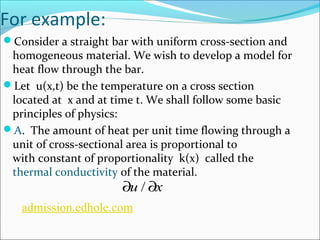
A. The amount of heat per unit time flowing through a 
unit of cross-sectional area is proportional to 
with constant of proportionality k(x) called the 
thermal conductivity of the material. 
¶u / ¶x 
admission.edhole.com
B. Heat flow is always from points of higher 
temperature to points of lower temperature. 
C. The amount of heat necessary to raise the 
temperature of an object of mass “m” by an amount Du 
is a “c(x) m Du”, where c(x) is known as the specific 
heat capacity of the material. 
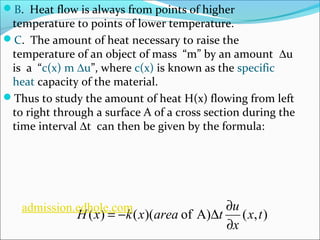
Thus to study the amount of heat H(x) flowing from left 
to right through a surface A of a cross section during the 
time interval Dt can then be given by the formula: 
H x k x area t u 
admission.edhole=.co-m D ¶ 
( ) ( )( of A) (x,t) 
x 

Likewise, at the point x + Dx, we 
have 
Heat flowing from left to right across the plane during 
an time interval Dt is: 
+ D = - + D D ¶ 
( ) ( )( of B) t u (x x,t). 
H x x k x x area + D 
t 
¶ 
If on the interval [x, x+Dx], during time Dt , additional 
heat sources were generated by, say, chemical reactions, 
heater, or electric currents, with energy density Q(x,t), 
then the total change in the heat DE is given by the 
formula: 
admission.edhole.com
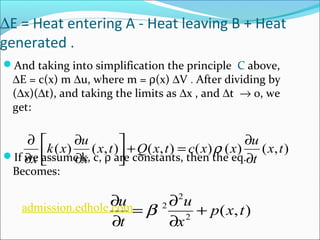
DE = Heat entering A - Heat leaving B + Heat 
generated . 
And taking into simplification the principle C above, 
DE = c(x) m Du, where m = r(x) DV . After dividing by 
(Dx)(Dt), and taking the limits as Dx , and Dt ® 0, we 
get: 
k x u 
x ¶ 
x t Q x t c x x u 
x 
¶ ¶ 
r 
( ) ( , ) ( , ) ( ) ( ) (x,t) 
é 
If we assume k, c, r are constants, then the eq. 
Becomes: 
t 
+ = ¶ úû 
ù 
êë 
¶ 
¶ 
u u 
+ 
( , ) 2 
2 
admission.edhole.¶com b 
= ¶ 
2 p x t 
x 
t 
¶ 

Boundary and Initial conditions 
Remark on boundary conditions and initial condition 
on u(x,t). 
We thus obtain the mathematical model for the heat 
flow in a uniform rod without internal sources (p = 0) 
with homogeneous boundary conditions and initial 
temperature distribution f(x), the follolwing Initial 
Boundary Value Problem: 
admission.edhole.com
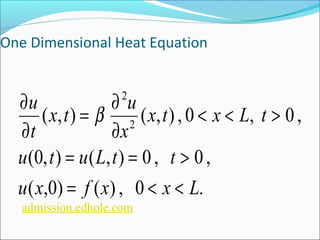
One Dimensional Heat Equation 
2 
x t x L t 
u 
x t u 
t 
< < > 
¶ b 
= ¶ 
( , ) ( , ) , 0 , 0 , 2 
x 
¶ 
¶ 
u t u L t t 
= = > 
(0, ) ( , ) 0 , 0 , 
u x = f x < x < 
L 
( ,0) ( ) , 0 . 
admission.edhole.com
The method of separation of 
variables 
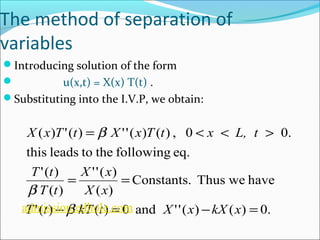
Introducing solution of the form 
 u(x,t) = X(x) T(t) . 
Substituting into the I.V.P, we obtain: 
X x T t X x T t x L, t 
= b 
< < > 
( ) '( ) ''( ) ( ) , 0 0. 
this leads to the following eq. 
Constants. Thus we have 
X x 
''( ) 
= = 
X x 
( ) 
T t 
'( ) 
T t 
( ) 
b 
admission.edhole.com 
T t kT t X x kX x 
- b 
= - = 
'( ) ( ) 0 and ''( ) ( ) 0.
Boundary Conditions 
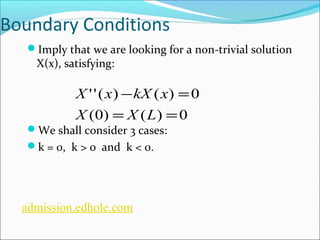
Imply that we are looking for a non-trivial solution 
X(x), satisfying: 
X x kX x 
- = 
''( ) ( ) 0 
X X L 
= = 
(0) ( ) 0 
We shall consider 3 cases: 
k = 0, k > 0 and k < 0. 
admission.edhole.com
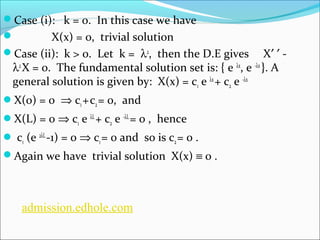
Case (i): k = 0. In this case we have 
 X(x) = 0, trivial solution 
Case (ii): k > 0. Let k = l2, then the D.E gives X¢ ¢ - 
l2 X = 0. The fundamental solution set is: { e lx, e -lx }. A 
general solution is given by: X(x) = c1 e lx + c2 e -lx 
X(0) = 0 Þ c1 + c2 = 0, and 
X(L) = 0 Þ c1 e lL + c2 e -lL = 0 , hence 
 c1 (e 2lL -1) = 0 Þ c1 = 0 and so is c2 = 0 . 
Again we have trivial solution X(x) º 0 . 
admission.edhole.com
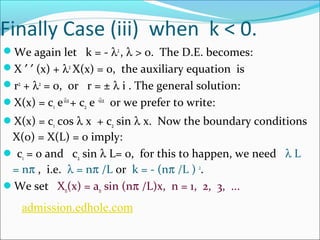
Finally Case (iii) when k < 0. 
We again let k = - l2 , l > 0. The D.E. becomes: 
X ¢ ¢ (x) + l2 X(x) = 0, the auxiliary equation is 
r2 + l2 = 0, or r = ± l i . The general solution: 
X(x) = c1 e ilx + c2 e -ilx or we prefer to write: 
X(x) = c1 cos l x + c2 sin l x. Now the boundary conditions 
X(0) = X(L) = 0 imply: 
 c1 = 0 and c2 sin l L= 0, for this to happen, we need l L 
= np , i.e. l = np /L or k = - (np /L ) 2. 
We set Xn(x) = an sin (np /L)x, n = 1, 2, 3, ... 
admission.edhole.com
admission.edhole.com 
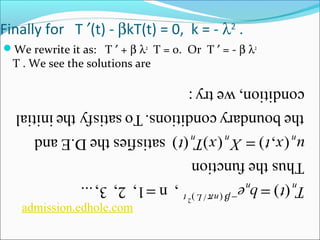
( ) = -b ( p / )2 
, n = 
1, 2, 3, ... T t b e 
n L t 
n n 
Thus the function 
u x t = 
X x T t 
( , ) ( ) ( ) satisfies the D.E and 
n n n 
the boundary conditions. To satisfy the initial 
condition, we try : 
Finally for T ¢(t) - bkT(t) = 0, k = - l2 . 
We rewrite it as: T ¢ + b l2 T = 0. Or T ¢ = - b l2 
T . We see the solutions are
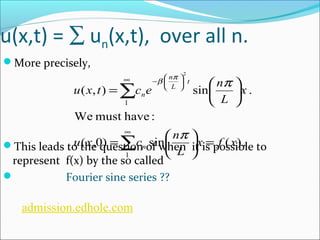
u(x,t) = å un(x,t), over all n. 
More precisely, 
n 
p b p 
ö çè¥ - æ 
u x t c e n 
ö çè 
å 
( , ) sin . 
1 
We must have : 
u x c n 
ö çè 
¥ 
( ,0) sin ( ) . 
This leads to the question of when it is possible to 
represent f(x) by the so 1 
called 
 Fourier sine series ?? 
2 
x f x 
L 
x 
L 
n 
t 
L 
n 
= ÷ø 
= æ 
÷ø 
= æ 
å 
÷ø 
p 
admission.edhole.com
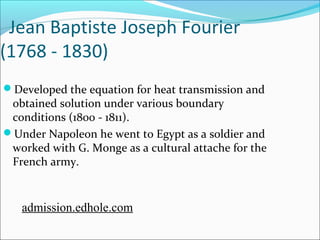
Jean Baptiste Joseph Fourier 
(1768 - 1830) 
Developed the equation for heat transmission and 
obtained solution under various boundary 
conditions (1800 - 1811). 
Under Napoleon he went to Egypt as a soldier and 
worked with G. Monge as a cultural attache for the 
French army. 
admission.edhole.com
Example 
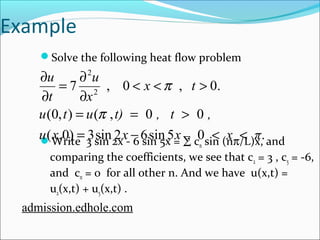
Solve the following heat flow problem 
2 
x t 
u 
< < > 
¶ 
= ¶ 
¶ 
p 
7 , 0 , 0. 2 
x 
u 
t 
¶ 
u (0, t ) = u ( p 
, t) = 0 , t > 
0 
, 
u x = x - x < x < 
π 
( ,0) 3sin 2 6sin 5 , 0 . 
Write 3 sin 2x - 6 sin 5x = å cn sin (np/L)x, and 
comparing the coefficients, we see that c2 = 3 , c5 = -6, 
and cn = 0 for all other n. And we have u(x,t) = 
u2(x,t) + u5(x,t) . 
admission.edhole.com
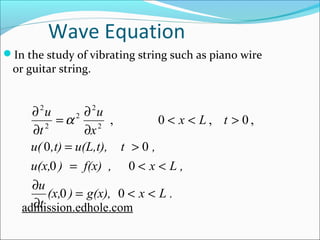
Wave Equation 
In the study of vibrating string such as piano wire 
or guitar string. 
u 
= ¶ 
¶ 
, 0 , 0 , 2 
2 
2 
u( 0 ,t) = u(L,t), t > 
0 
, 
u(x, ) f(x) , x L , 
u 
0 0 
(x, ) g(x), x L . 
t 
x L t 
x 
t 
u 
= < < 
¶ 
¶ 
= < < 
< < > 
¶ 
¶ 
0 0 
2 
2 
a 
admission.edhole.com
Example: 
f(x) = 6 sin 2x + 9 sin 7x - sin 10x , and 
g(x) = 11 sin 9x - 14 sin 15x. 
The solution is of the form: 
t n x 
u x t a n n 
p pa pa + =å¥ 
( , ) [ cos sin ]sin . 
1 L 
L 
t b n 
L 
n 
n 
= 
admission.edhole.com
Reminder: 
TA’s Review session 
Date: July 17 (Tuesday, for all students) 
Time: 10 - 11:40 am 
Room: 304 BH 
admission.edhole.com
Final Exam 
Date: July 19 (Thursday) 
Time: 10:30 - 12:30 pm 
Room: LC-C3 
Covers: all materials 
I will have a review session on Wednesday 
admission.edhole.com
Fourier Series 
For a piecewise continuous function f on [-T,T], we 
have the Fourier series for f: 
x b n 
ö çè 
a n 
ö çèæ + » 
{ cos sin }, 
 
 
where 
2 
1 ( ) , and 
ò 
- 
f x n 
p 
1 ( ) cos ; n 1,2,3, 
ö çè 
ò 
- 
f x n 
1 ( ) sin ; n 1,2,3, 
( ) 
0 
1 
0 
ö çè 
= ÷ø 
= 
= æ 
= ÷ø 
= æ 
÷ø 
æ + ÷ø 
ò 
å 
- 
¥ 
= 
T 
T 
n 
T 
T 
n 
T 
T 
n 
n 
n 
x dx 
T 
T 
b 
x dx 
T 
T 
a 
f x dx 
T 
a 
x 
T 
T 
a 
f x 
p 
p p 
admission.edhole.com
Examples 
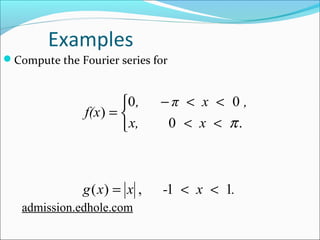
Compute the Fourier series for 
, - π < x < 
, 
0 0 
î í ì < < 
x, x 
f(x 
p 
0 . 
) 
= 
g ( x ) = x , - 1 < x < 
1 
. 
admission.edhole.com
Convergence of Fourier Series 
Pointwise Convegence 
Theorem. If f and f ¢ are piecewise continuous on [ -T, 
T ], then for any x in (-T, T), we have 
a ¥ 
a n x 
þ ý ü 
î í ì 
b n x 
p p 
+ å + f x f x 
0 + - 
2 n 
= 
1 
where the an 
cos sin 1 
n n 
T 
,s and bn 
{ ( ) ( } , 
2 
= + 
T 
,s are given by the previous fomulas. 
It converges to the average value of the left and right 
hand limits of f(x). Remark on x = T, or -T. 
admission.edhole.com
Fourier Sine and Cosine series 
Consider Even and Odd extensions; 
Definition: Let f(x) be piecewise continuous on the 
interval [0,T]. The Fourier cosine series of f(x) on [0,T] 
is: 
a a n T 
æ + ò å¥ 
ö çè 
æ = ÷ø 
and the Fourier sine series is: 
ö çè 
xdx 
f x n 
T 
T 
x a 
T 
n 
n 
n ÷ø 
= 
cos p , 2 ( ) cos p 
0 
2 1 0 
f x n 
b n 
sin , 2 ( ) sin , 
æ ö ò = 
1 0 
n 
= 
1,2,3, 
çè 
å¥ 
ö çè 
÷ø 
æ = ÷ø 
x dx 
T 
T 
x b 
T 
T 
n 
n 
n 
p p 
admission.edhole.com
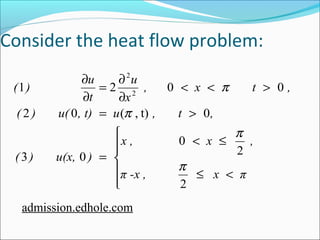
Consider the heat flow problem: 
( ) u 
= ¶ 
¶ 
1 2 0 0 2 
( 2 ) u( 0 , t) = u ( , t) , t > 
0 
, 
ì 
ï ïî 
ïïí 
x , < x £ 
, 
£ < 
= 
< < > 
¶ 
¶ 
π -x , x π 
( ) u(x, ) 
, x t , 
x 
u 
t 
2 
2 
0 
3 0 
2 
p 
p 
p 
p 
admission.edhole.com
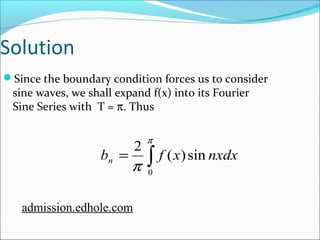
Solution 
Since the boundary condition forces us to consider 
sine waves, we shall expand f(x) into its Fourier 
Sine Series with T = p. Thus 
p 
p 0 
b 2 f (x) sin nxdx n 
= ò 
admission.edhole.com
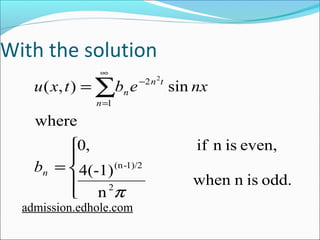
With the solution 
u ( x , t ) b e sin 
nx 
0, if n is even, 
ì 
= 
ïî ïí 
¥ 
= å 
= - 
when n is odd. 
4(-1) 
n 
where 
2 
(n-1)/2 
2 
1 
2 
p 
n 
n t 
n 
n 
b 
admission.edhole.com

Btech admission in india

  • 1.
  • 2.
    Partial Differential Equations Definition One of the classical partial differential equation of mathematical physics is the equation describing the conduction of heat in a solid body (Originated in the 18th century). And a modern one is the space vehicle reentry problem: Analysis of transfer and dissipation of heat generated by the friction with earth’s atmosphere. admission.edhole.com
  • 3.
    For example: Considera straight bar with uniform cross-section and homogeneous material. We wish to develop a model for heat flow through the bar. Let u(x,t) be the temperature on a cross section located at x and at time t. We shall follow some basic principles of physics: A. The amount of heat per unit time flowing through a unit of cross-sectional area is proportional to with constant of proportionality k(x) called the thermal conductivity of the material. ¶u / ¶x admission.edhole.com
  • 4.
    B. Heat flowis always from points of higher temperature to points of lower temperature. C. The amount of heat necessary to raise the temperature of an object of mass “m” by an amount Du is a “c(x) m Du”, where c(x) is known as the specific heat capacity of the material. Thus to study the amount of heat H(x) flowing from left to right through a surface A of a cross section during the time interval Dt can then be given by the formula: H x k x area t u admission.edhole=.co-m D ¶ ( ) ( )( of A) (x,t) x 
  • 5.
    Likewise, at thepoint x + Dx, we have Heat flowing from left to right across the plane during an time interval Dt is: + D = - + D D ¶ ( ) ( )( of B) t u (x x,t). H x x k x x area + D t ¶ If on the interval [x, x+Dx], during time Dt , additional heat sources were generated by, say, chemical reactions, heater, or electric currents, with energy density Q(x,t), then the total change in the heat DE is given by the formula: admission.edhole.com
  • 6.
    DE = Heatentering A - Heat leaving B + Heat generated . And taking into simplification the principle C above, DE = c(x) m Du, where m = r(x) DV . After dividing by (Dx)(Dt), and taking the limits as Dx , and Dt ® 0, we get: k x u x ¶ x t Q x t c x x u x ¶ ¶ r ( ) ( , ) ( , ) ( ) ( ) (x,t) é If we assume k, c, r are constants, then the eq. Becomes: t + = ¶ úû ù êë ¶ ¶ u u + ( , ) 2 2 admission.edhole.¶com b = ¶ 2 p x t x t ¶ 
  • 7.
    Boundary and Initialconditions Remark on boundary conditions and initial condition on u(x,t). We thus obtain the mathematical model for the heat flow in a uniform rod without internal sources (p = 0) with homogeneous boundary conditions and initial temperature distribution f(x), the follolwing Initial Boundary Value Problem: admission.edhole.com
  • 8.
    One Dimensional HeatEquation 2 x t x L t u x t u t < < > ¶ b = ¶ ( , ) ( , ) , 0 , 0 , 2 x ¶ ¶ u t u L t t = = > (0, ) ( , ) 0 , 0 , u x = f x < x < L ( ,0) ( ) , 0 . admission.edhole.com
  • 9.
    The method ofseparation of variables Introducing solution of the form  u(x,t) = X(x) T(t) . Substituting into the I.V.P, we obtain: X x T t X x T t x L, t = b < < > ( ) '( ) ''( ) ( ) , 0 0. this leads to the following eq. Constants. Thus we have X x ''( ) = = X x ( ) T t '( ) T t ( ) b admission.edhole.com T t kT t X x kX x - b = - = '( ) ( ) 0 and ''( ) ( ) 0.
  • 10.
    Boundary Conditions Implythat we are looking for a non-trivial solution X(x), satisfying: X x kX x - = ''( ) ( ) 0 X X L = = (0) ( ) 0 We shall consider 3 cases: k = 0, k > 0 and k < 0. admission.edhole.com
  • 11.
    Case (i): k= 0. In this case we have  X(x) = 0, trivial solution Case (ii): k > 0. Let k = l2, then the D.E gives X¢ ¢ - l2 X = 0. The fundamental solution set is: { e lx, e -lx }. A general solution is given by: X(x) = c1 e lx + c2 e -lx X(0) = 0 Þ c1 + c2 = 0, and X(L) = 0 Þ c1 e lL + c2 e -lL = 0 , hence  c1 (e 2lL -1) = 0 Þ c1 = 0 and so is c2 = 0 . Again we have trivial solution X(x) º 0 . admission.edhole.com
  • 12.
    Finally Case (iii)when k < 0. We again let k = - l2 , l > 0. The D.E. becomes: X ¢ ¢ (x) + l2 X(x) = 0, the auxiliary equation is r2 + l2 = 0, or r = ± l i . The general solution: X(x) = c1 e ilx + c2 e -ilx or we prefer to write: X(x) = c1 cos l x + c2 sin l x. Now the boundary conditions X(0) = X(L) = 0 imply:  c1 = 0 and c2 sin l L= 0, for this to happen, we need l L = np , i.e. l = np /L or k = - (np /L ) 2. We set Xn(x) = an sin (np /L)x, n = 1, 2, 3, ... admission.edhole.com
  • 13.
    admission.edhole.com ( )= -b ( p / )2 , n = 1, 2, 3, ... T t b e n L t n n Thus the function u x t = X x T t ( , ) ( ) ( ) satisfies the D.E and n n n the boundary conditions. To satisfy the initial condition, we try : Finally for T ¢(t) - bkT(t) = 0, k = - l2 . We rewrite it as: T ¢ + b l2 T = 0. Or T ¢ = - b l2 T . We see the solutions are
  • 14.
    u(x,t) = åun(x,t), over all n. More precisely, n p b p ö çè¥ - æ u x t c e n ö çè å ( , ) sin . 1 We must have : u x c n ö çè ¥ ( ,0) sin ( ) . This leads to the question of when it is possible to represent f(x) by the so 1 called  Fourier sine series ?? 2 x f x L x L n t L n = ÷ø = æ ÷ø = æ å ÷ø p admission.edhole.com
  • 15.
    Jean Baptiste JosephFourier (1768 - 1830) Developed the equation for heat transmission and obtained solution under various boundary conditions (1800 - 1811). Under Napoleon he went to Egypt as a soldier and worked with G. Monge as a cultural attache for the French army. admission.edhole.com
  • 16.
    Example Solve thefollowing heat flow problem 2 x t u < < > ¶ = ¶ ¶ p 7 , 0 , 0. 2 x u t ¶ u (0, t ) = u ( p , t) = 0 , t > 0 , u x = x - x < x < π ( ,0) 3sin 2 6sin 5 , 0 . Write 3 sin 2x - 6 sin 5x = å cn sin (np/L)x, and comparing the coefficients, we see that c2 = 3 , c5 = -6, and cn = 0 for all other n. And we have u(x,t) = u2(x,t) + u5(x,t) . admission.edhole.com
  • 17.
    Wave Equation Inthe study of vibrating string such as piano wire or guitar string. u = ¶ ¶ , 0 , 0 , 2 2 2 u( 0 ,t) = u(L,t), t > 0 , u(x, ) f(x) , x L , u 0 0 (x, ) g(x), x L . t x L t x t u = < < ¶ ¶ = < < < < > ¶ ¶ 0 0 2 2 a admission.edhole.com
  • 18.
    Example: f(x) =6 sin 2x + 9 sin 7x - sin 10x , and g(x) = 11 sin 9x - 14 sin 15x. The solution is of the form: t n x u x t a n n p pa pa + =å¥ ( , ) [ cos sin ]sin . 1 L L t b n L n n = admission.edhole.com
  • 19.
    Reminder: TA’s Reviewsession Date: July 17 (Tuesday, for all students) Time: 10 - 11:40 am Room: 304 BH admission.edhole.com
  • 20.
    Final Exam Date:July 19 (Thursday) Time: 10:30 - 12:30 pm Room: LC-C3 Covers: all materials I will have a review session on Wednesday admission.edhole.com
  • 21.
    Fourier Series Fora piecewise continuous function f on [-T,T], we have the Fourier series for f: x b n ö çè a n ö çèæ + » { cos sin },   where 2 1 ( ) , and ò - f x n p 1 ( ) cos ; n 1,2,3, ö çè ò - f x n 1 ( ) sin ; n 1,2,3, ( ) 0 1 0 ö çè = ÷ø = = æ = ÷ø = æ ÷ø æ + ÷ø ò å - ¥ = T T n T T n T T n n n x dx T T b x dx T T a f x dx T a x T T a f x p p p admission.edhole.com
  • 22.
    Examples Compute theFourier series for , - π < x < , 0 0 î í ì < < x, x f(x p 0 . ) = g ( x ) = x , - 1 < x < 1 . admission.edhole.com
  • 23.
    Convergence of FourierSeries Pointwise Convegence Theorem. If f and f ¢ are piecewise continuous on [ -T, T ], then for any x in (-T, T), we have a ¥ a n x þ ý ü î í ì b n x p p + å + f x f x 0 + - 2 n = 1 where the an cos sin 1 n n T ,s and bn { ( ) ( } , 2 = + T ,s are given by the previous fomulas. It converges to the average value of the left and right hand limits of f(x). Remark on x = T, or -T. admission.edhole.com
  • 24.
    Fourier Sine andCosine series Consider Even and Odd extensions; Definition: Let f(x) be piecewise continuous on the interval [0,T]. The Fourier cosine series of f(x) on [0,T] is: a a n T æ + ò å¥ ö çè æ = ÷ø and the Fourier sine series is: ö çè xdx f x n T T x a T n n n ÷ø = cos p , 2 ( ) cos p 0 2 1 0 f x n b n sin , 2 ( ) sin , æ ö ò = 1 0 n = 1,2,3, çè å¥ ö çè ÷ø æ = ÷ø x dx T T x b T T n n n p p admission.edhole.com
  • 25.
    Consider the heatflow problem: ( ) u = ¶ ¶ 1 2 0 0 2 ( 2 ) u( 0 , t) = u ( , t) , t > 0 , ì ï ïî ïïí x , < x £ , £ < = < < > ¶ ¶ π -x , x π ( ) u(x, ) , x t , x u t 2 2 0 3 0 2 p p p p admission.edhole.com
  • 26.
    Solution Since theboundary condition forces us to consider sine waves, we shall expand f(x) into its Fourier Sine Series with T = p. Thus p p 0 b 2 f (x) sin nxdx n = ò admission.edhole.com
  • 27.
    With the solution u ( x , t ) b e sin nx 0, if n is even, ì = ïî ïí ¥ = å = - when n is odd. 4(-1) n where 2 (n-1)/2 2 1 2 p n n t n n b admission.edhole.com