HUMAN RESOURCE
MANAGEMENT
HUMAN RESOURCE
MANAGEMENT
BUSINESS OBJECTIVES
RECRUITMENT
HR PLANNING
JOB DESCRIPTION JOB SPECIFICATION
JOB ANALYSIS
RECRUITMENT
The Process of generating a pool of qualified candidates for
a particular job.
The Process of discovering potential candidates.
OR
RECRUITMENT GOALS
1
Attract the Qualified Applicants.
2
Encourage Unqualified Applicants to self-
select themselves out.
RECRUITMENT IS A TWO
WAY STREET
RECRUITMENT
Organization is Looking
for a Qualified
Applicants
Applicants are Looking
for the Potential
Emplacement
Opportunities
RECRUITMENT PROCESS
ORGANIZATION CANDIDATE
Generate candidate pool via internal
or external recruitment methods
Vacant or New position occurs
Evaluate Candidates via Selection
process
Impress Candidates
Make Offer
Acquire Employment Experience
Receive Education and choose
Occupation
Search for Job Openings
Apply for jobs
Impress Company during Selection
process
Evaluate Jobs and Companies
Accept or Reject Job Offers
SOURCES OF RECRUITMENT
INTERNAL
SOURCES
EXTERNAL
SOURCES
SOURCES OF
RECRUITMENT
Promotions and
Transfers
Job Posting &
Bidding
Employee
Referrals
Re-recruiting former
Employees
INTERNAL
SOURCES
SOURCES OF RECRUITMENT
SOURCES OF RECRUITMENT Cont . . .
INTERNAL SOURCES
ADVANTAGES DISADVANTAGES
 Self-esteem of Promotee
 Better assessment of abilities
 Lower cost for some jobs
 Motivator for good performance
 Causes a succession of
promotions
 Have to hire only at entry level
 Inbreeding
 Possible morale problems of
those not promoted
 Need for management-
Development program
SOURCES OF RECRUITMENT Cont . . .
Schools Colleges &
Universities
Labor
Unions
Media Sources
Employment Agencies
EXTERNAL
SOURCES
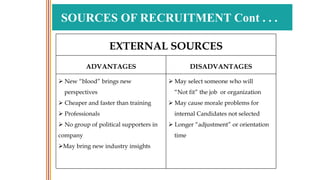
SOURCES OF RECRUITMENT Cont . . .
EXTERNAL SOURCES
ADVANTAGES DISADVANTAGES
 New “blood” brings new
perspectives
 Cheaper and faster than training
 Professionals
 No group of political supporters in
company
May bring new industry insights
 May select someone who will
“Not fit” the job or organization
 May cause morale problems for
internal Candidates not selected
 Longer “adjustment” or orientation
time
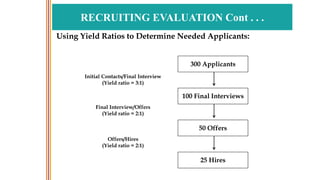
RECRUITING EVALUATION Cont . . .
300 Applicants
100 Final Interviews
50 Offers
25 Hires
Initial Contacts/Final Interview
(Yield ratio = 3:1)
Final Interview/Offers
(Yield ratio = 2:1)
Offers/Hires
(Yield ratio = 2:1)
Using Yield Ratios to Determine Needed Applicants:
SELECTION
The Process of making a “Hire” or “No Hire”
decision regarding each applicant for a job.
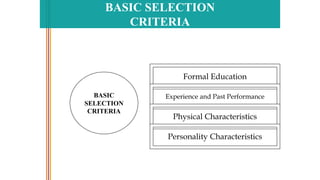
BASIC SELECTION
CRITERIA
BASIC
SELECTION
CRITERIA
Formal Education
Experience and Past Performance
Physical Characteristics
Personality Characteristics
SELECTION METHODS
1. Testing
2. Gathering Information
3. Interviewing
The Three most Common Methods
used are:
SELECTION PROCESS
Initial screening
Completed application
Medical/physical examination if
required (conditional job offer
Comprehensive interview
Employment test
Permanent job offer
Reject Applicant
Background Examination
if required
Conditional job
offer
Passed
Passed
Passed
Passed
Passed
Able to perform
essential elements
of job
Fail to meet minimum
qualification
Failed to complete job
application or failed job
specification
Failed Test
Failed to impress
interviewer and / meet
job expectations
Problem
encountered
Unfit to do essential
elements of job
SELECTION METHODS Cont . . .
Tests measure knowledge, skill,
and ability, as well as other
characteristics, such as personality
traits.
1. TESTING
TESTING TYPES
Cognitive
Ability Test
Integrity
Test
Personality
Test
Drug Test
Physical
Ability Test
Work
Sample
Testing
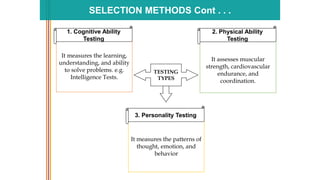
It measures the learning,
understanding, and ability
to solve problems. e.g.
Intelligence Tests.
1. Cognitive Ability
Testing
It measures the patterns of
thought, emotion, and
behavior
3. Personality Testing
It assesses muscular
strength, cardiovascular
endurance, and
coordination.
2. Physical Ability
Testing
SELECTION METHODS Cont . . .
TESTING
TYPES
SELECTION METHODS Cont . . .
It is designed to assess
the likelihood that
applicants will be
dishonest or engage in
illegal activity.
4. Integrity Testing
Normally requires
applicants to provide
required sample that is
tested for illegal
substances.
6. Drug Testing
Measures performance on
some element of the job.
5. Work Sample Testing
TESTING
TYPES
SELECTION METHODS Cont . . .
2. INFORMATION GATHERING:
Common methods for gathering information include
application forms and résumés, biographical data, and
reference checking.
SELECTION METHODS Cont . . .
 Generally ask for information such as
address and phone number, education, work
experience, and special training.
 At the professional-level, similar information
is generally presented in résumés.
Application
Forms and
Résumés
 Historical events that have shaped a
person’s behavior and identity.
Biographical
Data
 Involves contacting an applicant’s previous
employers, teachers, or friends to learn more
about the applicant Issues with reference
checking
Reference
Checking
SELECTION METHODS Cont . . .
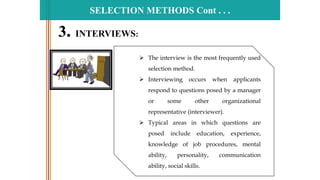
3. INTERVIEWS:
 The interview is the most frequently used
selection method.
 Interviewing occurs when applicants
respond to questions posed by a manager
or some other organizational
representative (interviewer).
 Typical areas in which questions are
posed include education, experience,
knowledge of job procedures, mental
ability, personality, communication
ability, social skills.
SELECTION METHODS Cont . . .
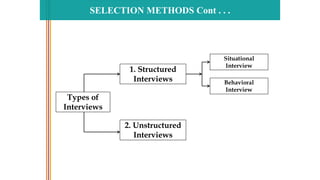
Types of
Interviews
2. Unstructured
Interviews
1. Structured
Interviews
Situational
Interview
Behavioral
Interview
SELECTION METHODS Cont . . .
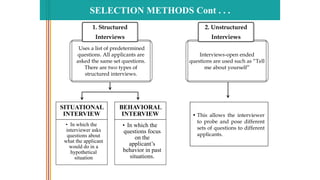
SITUATIONAL
INTERVIEW
• In which the
interviewer asks
questions about
what the applicant
would do in a
hypothetical
situation
BEHAVIORAL
INTERVIEW
• In which the
questions focus
on the
applicant’s
behavior in past
situations.
Uses a list of predetermined
questions. All applicants are
asked the same set questions.
There are two types of
structured interviews.
1. Structured
Interviews
Interviews-open ended
questions are used such as “Tell
me about yourself”
2. Unstructured
Interviews
• This allows the interviewer
to probe and pose different
sets of questions to different
applicants.
THANK YOU

BT8010 : Human resource

  • 1.
  • 2.
    HUMAN RESOURCE MANAGEMENT BUSINESS OBJECTIVES RECRUITMENT HRPLANNING JOB DESCRIPTION JOB SPECIFICATION JOB ANALYSIS
  • 3.
    RECRUITMENT The Process ofgenerating a pool of qualified candidates for a particular job. The Process of discovering potential candidates. OR
  • 4.
    RECRUITMENT GOALS 1 Attract theQualified Applicants. 2 Encourage Unqualified Applicants to self- select themselves out.
  • 5.
    RECRUITMENT IS ATWO WAY STREET RECRUITMENT Organization is Looking for a Qualified Applicants Applicants are Looking for the Potential Emplacement Opportunities
  • 6.
    RECRUITMENT PROCESS ORGANIZATION CANDIDATE Generatecandidate pool via internal or external recruitment methods Vacant or New position occurs Evaluate Candidates via Selection process Impress Candidates Make Offer Acquire Employment Experience Receive Education and choose Occupation Search for Job Openings Apply for jobs Impress Company during Selection process Evaluate Jobs and Companies Accept or Reject Job Offers
  • 7.
  • 8.
    Promotions and Transfers Job Posting& Bidding Employee Referrals Re-recruiting former Employees INTERNAL SOURCES SOURCES OF RECRUITMENT
  • 9.
    SOURCES OF RECRUITMENTCont . . . INTERNAL SOURCES ADVANTAGES DISADVANTAGES  Self-esteem of Promotee  Better assessment of abilities  Lower cost for some jobs  Motivator for good performance  Causes a succession of promotions  Have to hire only at entry level  Inbreeding  Possible morale problems of those not promoted  Need for management- Development program
  • 10.
    SOURCES OF RECRUITMENTCont . . . Schools Colleges & Universities Labor Unions Media Sources Employment Agencies EXTERNAL SOURCES
  • 11.
    SOURCES OF RECRUITMENTCont . . . EXTERNAL SOURCES ADVANTAGES DISADVANTAGES  New “blood” brings new perspectives  Cheaper and faster than training  Professionals  No group of political supporters in company May bring new industry insights  May select someone who will “Not fit” the job or organization  May cause morale problems for internal Candidates not selected  Longer “adjustment” or orientation time
  • 12.
    RECRUITING EVALUATION Cont. . . 300 Applicants 100 Final Interviews 50 Offers 25 Hires Initial Contacts/Final Interview (Yield ratio = 3:1) Final Interview/Offers (Yield ratio = 2:1) Offers/Hires (Yield ratio = 2:1) Using Yield Ratios to Determine Needed Applicants:
  • 13.
    SELECTION The Process ofmaking a “Hire” or “No Hire” decision regarding each applicant for a job.
  • 14.
    BASIC SELECTION CRITERIA BASIC SELECTION CRITERIA Formal Education Experienceand Past Performance Physical Characteristics Personality Characteristics
  • 15.
    SELECTION METHODS 1. Testing 2.Gathering Information 3. Interviewing The Three most Common Methods used are:
  • 16.
    SELECTION PROCESS Initial screening Completedapplication Medical/physical examination if required (conditional job offer Comprehensive interview Employment test Permanent job offer Reject Applicant Background Examination if required Conditional job offer Passed Passed Passed Passed Passed Able to perform essential elements of job Fail to meet minimum qualification Failed to complete job application or failed job specification Failed Test Failed to impress interviewer and / meet job expectations Problem encountered Unfit to do essential elements of job
  • 17.
    SELECTION METHODS Cont. . . Tests measure knowledge, skill, and ability, as well as other characteristics, such as personality traits. 1. TESTING TESTING TYPES Cognitive Ability Test Integrity Test Personality Test Drug Test Physical Ability Test Work Sample Testing
  • 18.
    It measures thelearning, understanding, and ability to solve problems. e.g. Intelligence Tests. 1. Cognitive Ability Testing It measures the patterns of thought, emotion, and behavior 3. Personality Testing It assesses muscular strength, cardiovascular endurance, and coordination. 2. Physical Ability Testing SELECTION METHODS Cont . . . TESTING TYPES
  • 19.
    SELECTION METHODS Cont. . . It is designed to assess the likelihood that applicants will be dishonest or engage in illegal activity. 4. Integrity Testing Normally requires applicants to provide required sample that is tested for illegal substances. 6. Drug Testing Measures performance on some element of the job. 5. Work Sample Testing TESTING TYPES
  • 20.
    SELECTION METHODS Cont. . . 2. INFORMATION GATHERING: Common methods for gathering information include application forms and résumés, biographical data, and reference checking.
  • 21.
    SELECTION METHODS Cont. . .  Generally ask for information such as address and phone number, education, work experience, and special training.  At the professional-level, similar information is generally presented in résumés. Application Forms and Résumés  Historical events that have shaped a person’s behavior and identity. Biographical Data  Involves contacting an applicant’s previous employers, teachers, or friends to learn more about the applicant Issues with reference checking Reference Checking
  • 22.
    SELECTION METHODS Cont. . . 3. INTERVIEWS:  The interview is the most frequently used selection method.  Interviewing occurs when applicants respond to questions posed by a manager or some other organizational representative (interviewer).  Typical areas in which questions are posed include education, experience, knowledge of job procedures, mental ability, personality, communication ability, social skills.
  • 23.
    SELECTION METHODS Cont. . . Types of Interviews 2. Unstructured Interviews 1. Structured Interviews Situational Interview Behavioral Interview
  • 24.
    SELECTION METHODS Cont. . . SITUATIONAL INTERVIEW • In which the interviewer asks questions about what the applicant would do in a hypothetical situation BEHAVIORAL INTERVIEW • In which the questions focus on the applicant’s behavior in past situations. Uses a list of predetermined questions. All applicants are asked the same set questions. There are two types of structured interviews. 1. Structured Interviews Interviews-open ended questions are used such as “Tell me about yourself” 2. Unstructured Interviews • This allows the interviewer to probe and pose different sets of questions to different applicants.
  • 25.