THE PROCESS OF
RECRUITING,
SELECTING, AND
TRAINING
EMPLOYEES
PRE-TEST:
Write “SHEREP” if the statement is true
and “Ene be” if its false.
1.Recruitment is a set of activities designed
to attract qualified applicants for job
position vacancies in an organization.
2.Advertisements can be done through
websites, newspapers, and etc.
3. The hiring process need not to follow
steps.
4. Person analysis involves, for example,
checking of job requirements to find out if
all these are being done to meet company
goals.
5. Task analysis determines who among
the employees need training or retraining.
ANSWER KEY:
1.SHEREP
2.SHEREP
3.Ene be
4.Ene be
5.Ene be
STAFFING:
⇒As defined in the previous discussion
is the Human Resource function of
identifying, attracting, hiring and
retaining people with the necessary
qualifications to fill the responsibilities
of current future jobs in the
organization.
STAFFING
👉🏿 One way to open roles within a
company or organization.
👉🏿Has 2 main
components,recruitment, and selection.
Hiring is similar to staffing in
many ways. Like staffing, it is a
way for a company or
organization to fill open roles in
the roster.
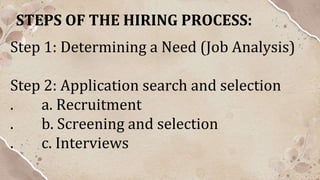
Step 1: Determining a Need (Job Analysis)
Step 2: Application search and selection
. a. Recruitment
. b. Screening and selection
. c. Interviews
STEPS OF THE HIRING PROCESS:
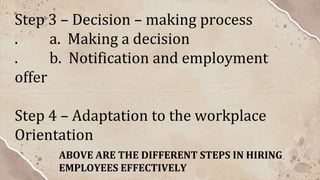
Step 3 – Decision – making process
. a. Making a decision
. b. Notification and employment
offer
Step 4 – Adaptation to the workplace
Orientation
ABOVE ARE THE DIFFERENT STEPS IN HIRING
EMPLOYEES EFFECTIVELY
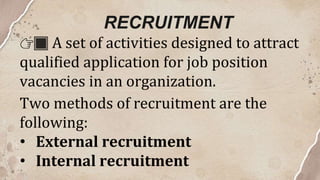
RECRUITMENT
👉🏿 A set of activities designed to attract
qualified application for job position
vacancies in an organization.
Two methods of recruitment are the
following:
• External recruitment
• Internal recruitment
External Recruitment
👉🏿Method considers outside
sources in locating potential
individuals who might want to join
the organization and encouraging
them to apply for actual or
anticipated job vacancies.
The following are methods of external
recruitment:
1. ADVERTISEMENTS
2. UNSOLICITED
APPLICATIONS
3. INTERNET RECRUITING
4. EMPLOYEE REFERRALS
5. EDUCATIONAL
INSTITUTIONS
6. PUBLIC AND PRIVATE
EMPLOYMENT AGENCIES
ADVERTISEMENT
S
– can be done through websites, newspapers,
trade journals, radio, television,billboards,
posters, and emails among others.
Unsolicited Applications
– these are applications from individuals who took the
initiative to apply even though the company did not
indicate that they need a new staff.
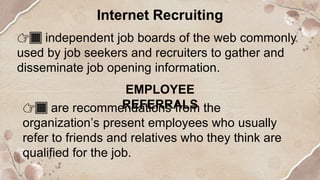
Internet Recruiting
👉🏿 independent job boards of the web commonly
used by job seekers and recruiters to gather and
disseminate job opening information.
EMPLOYEE
REFERRALS
👉🏿 are recommendations from the
organization’s present employees who usually
refer to friends and relatives who they think are
qualified for the job.
Educational Institutions
• these are good sources of young applicants
or new graduates who have formal training but
with very little work experience. For technical
and managerial positions,schools may refer to
some of their alumni who may have the
necessary qualifications needed for the said
job positions.
Public and Private Employment Agencies
•this may also be good sources of
applicants for different types of job
vacancies for they usually offers free
services while private ones charge
fees from both job applicants and
employers soliciting referrals from
them.
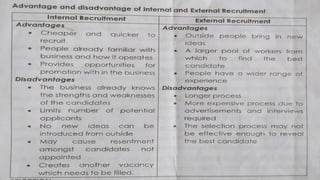
Internal Recruitment
- is a process of filling job
vacancies through promotions or
transfers of employees who are
already part of the organization.
In other words, recruitment is
within the organization.
In simple words, External Recruitment
is looking for prospective applicants from
outside the organization while internal is
from inside. Depending on the need of the
organization, they can have both methods
of recruitment at the same time.
SELECTION
Selection
The process of choosing individuals
who have the required qualifications
to fill the present and expected job
opening.This is the second component
of staffing which includes the
following steps:
1. Establishing the selection criteria - this includes the
citation of the nature and purpose of the job position
which has to be filled. This may include the skills that
the company is looking for in an employee.
2. Requesting applicants to complete the application
form - application forms must be filled by the
applicants with the necessary information that the
company is asking so that it will be easy for managers
to decide whether the applicants meet the minimum
requirements or not.
3. Screening by listing applicants who seem to meet
the set of criteria - this is the time when the
company's human resource team will assess who
among the applicants meet the minimum criteria and
who will proceed to the next step.
4. Screening interview to identify more promising
applicants - this is the time where shortlisted
applicants will undergo a formal interview and will be
assessed more closely if he/she fits the job.
5. Interview by the supervisor/ manager or panel
interviewers - this is when the supervisors/
managers will assess if the applicants are well
oriented with his/her characteristics and abilities
towards the job that he/she is applying for.
6. Verifying information provided by the applicant -
this is done to check if the applicants are not telling
false information to the company.
7. Requesting the applicant to undergo psychological
and physical examination - this is very important
because having a healthy mind and a healthy body is
important for good job performance.
8. Informing the applicant that he or she has been
chosen for the position applied for - this can be done
verbally or in writing by the managers who give the
final decision regarding the applicant's hiring. Final
instructions regarding the company's rules and
regulations for hiring an applicant must be given in
this step.
TRAINING
AND
DEVELOPME
Training refers to learning given by organizations
to it's employees that concentrates on short-term
job performance and acquisition or improvement
of job-related skills.
Development refers to learning given by
organizations to its employees that is geared
toward the individual's acquisition of his/her skills
in preparation for future job appointments and
other responsibilities.
WHY ARE TRAINING AND DEVELOPMENT
IMPORTANT IN ACHIEVING SUCCESS IN
TODAY'S ORGANIZATION?
This is very important for every employee
in an organization to be properly equipped
with the skills and abilities for them to be
capable of meeting the organization's goals.
Organization analysis
-may include the analyses of effects of
downsizing, branching out, conflicts with rival
companies, and others that may require
training or retain personnel.
Task analysis
- involves, for example, checking of job
requirements to find out if all these are being
done to meet company goals.
Person Analysis
- Determines who among the employees
need training or retraining. This is to
avoid spending on the training of
employees who no longer need it.
In conducting training, a training design
must be prepared first . Instructional
objectives that describe the knowledge,
skills, and attitudes that employees must
acquire are included in this design. Trainee
readiness and motivation is also a
consideration in making the design. They
need to refer their design to the trainee's
background knowledge and experiences.
When the design is already complete,
it is time for its implementation. This
may include; on-the-job training,
apprenticeship training, classroom
instruction, audiovisual method,
simulation method, and e-learning.
After implementation then the evaluation will
follow. This is the moment when the training
program will be evaluated by the participants.
Their reactions, their learnings, and their way
of behaving during the training will be gathered
and evaluated.
Employee development is a part of an
organization's career management program and
its goal is to match the individual's development
need with the needs of the organization.
An employee must know himself/herself well,
he/she must be aware of his/her knowledge and
capabilities, value, and interests so that he/she
could also identify the career pathway that
he/she would like to take.
As part of the organization's goal towards it's
employees, it will provide it's employees with
the results of their evaluation, organization's
plans, or direction that may be related to
his/her career path. This is a very good
combination to blend the employee's career
development goals with the organization goals.
QUESTIO
N AND
ANSWER
Answer the following questions and
write it in a ¼ sheet of paper.
1-2. What are the two methods of
Recruitment?
3-8. What are the following methods of
external recruitment?
9-11. What are the three analysis that
must be conducted by the organization
before conducting the training?
12-20. SPELL ME!

( ORG AND MANAGEMENT (GROUP 1).pptx

  • 1.
  • 2.
    PRE-TEST: Write “SHEREP” ifthe statement is true and “Ene be” if its false. 1.Recruitment is a set of activities designed to attract qualified applicants for job position vacancies in an organization. 2.Advertisements can be done through websites, newspapers, and etc.
  • 3.
    3. The hiringprocess need not to follow steps. 4. Person analysis involves, for example, checking of job requirements to find out if all these are being done to meet company goals. 5. Task analysis determines who among the employees need training or retraining.
  • 4.
  • 5.
    STAFFING: ⇒As defined inthe previous discussion is the Human Resource function of identifying, attracting, hiring and retaining people with the necessary qualifications to fill the responsibilities of current future jobs in the organization.
  • 6.
    STAFFING 👉🏿 One wayto open roles within a company or organization. 👉🏿Has 2 main components,recruitment, and selection.
  • 7.
    Hiring is similarto staffing in many ways. Like staffing, it is a way for a company or organization to fill open roles in the roster.
  • 8.
    Step 1: Determininga Need (Job Analysis) Step 2: Application search and selection . a. Recruitment . b. Screening and selection . c. Interviews STEPS OF THE HIRING PROCESS:
  • 9.
    Step 3 –Decision – making process . a. Making a decision . b. Notification and employment offer Step 4 – Adaptation to the workplace Orientation ABOVE ARE THE DIFFERENT STEPS IN HIRING EMPLOYEES EFFECTIVELY
  • 10.
    RECRUITMENT 👉🏿 A setof activities designed to attract qualified application for job position vacancies in an organization. Two methods of recruitment are the following: • External recruitment • Internal recruitment
  • 11.
    External Recruitment 👉🏿Method considersoutside sources in locating potential individuals who might want to join the organization and encouraging them to apply for actual or anticipated job vacancies.
  • 12.
    The following aremethods of external recruitment: 1. ADVERTISEMENTS 2. UNSOLICITED APPLICATIONS 3. INTERNET RECRUITING 4. EMPLOYEE REFERRALS 5. EDUCATIONAL INSTITUTIONS 6. PUBLIC AND PRIVATE EMPLOYMENT AGENCIES
  • 13.
    ADVERTISEMENT S – can bedone through websites, newspapers, trade journals, radio, television,billboards, posters, and emails among others. Unsolicited Applications – these are applications from individuals who took the initiative to apply even though the company did not indicate that they need a new staff.
  • 14.
    Internet Recruiting 👉🏿 independentjob boards of the web commonly used by job seekers and recruiters to gather and disseminate job opening information. EMPLOYEE REFERRALS 👉🏿 are recommendations from the organization’s present employees who usually refer to friends and relatives who they think are qualified for the job.
  • 15.
    Educational Institutions • theseare good sources of young applicants or new graduates who have formal training but with very little work experience. For technical and managerial positions,schools may refer to some of their alumni who may have the necessary qualifications needed for the said job positions.
  • 16.
    Public and PrivateEmployment Agencies •this may also be good sources of applicants for different types of job vacancies for they usually offers free services while private ones charge fees from both job applicants and employers soliciting referrals from them.
  • 17.
    Internal Recruitment - isa process of filling job vacancies through promotions or transfers of employees who are already part of the organization. In other words, recruitment is within the organization.
  • 18.
    In simple words,External Recruitment is looking for prospective applicants from outside the organization while internal is from inside. Depending on the need of the organization, they can have both methods of recruitment at the same time.
  • 20.
  • 21.
    Selection The process ofchoosing individuals who have the required qualifications to fill the present and expected job opening.This is the second component of staffing which includes the following steps:
  • 22.
    1. Establishing theselection criteria - this includes the citation of the nature and purpose of the job position which has to be filled. This may include the skills that the company is looking for in an employee. 2. Requesting applicants to complete the application form - application forms must be filled by the applicants with the necessary information that the company is asking so that it will be easy for managers to decide whether the applicants meet the minimum requirements or not.
  • 23.
    3. Screening bylisting applicants who seem to meet the set of criteria - this is the time when the company's human resource team will assess who among the applicants meet the minimum criteria and who will proceed to the next step. 4. Screening interview to identify more promising applicants - this is the time where shortlisted applicants will undergo a formal interview and will be assessed more closely if he/she fits the job.
  • 24.
    5. Interview bythe supervisor/ manager or panel interviewers - this is when the supervisors/ managers will assess if the applicants are well oriented with his/her characteristics and abilities towards the job that he/she is applying for. 6. Verifying information provided by the applicant - this is done to check if the applicants are not telling false information to the company.
  • 25.
    7. Requesting theapplicant to undergo psychological and physical examination - this is very important because having a healthy mind and a healthy body is important for good job performance. 8. Informing the applicant that he or she has been chosen for the position applied for - this can be done verbally or in writing by the managers who give the final decision regarding the applicant's hiring. Final instructions regarding the company's rules and regulations for hiring an applicant must be given in this step.
  • 26.
  • 27.
    Training refers tolearning given by organizations to it's employees that concentrates on short-term job performance and acquisition or improvement of job-related skills. Development refers to learning given by organizations to its employees that is geared toward the individual's acquisition of his/her skills in preparation for future job appointments and other responsibilities.
  • 28.
    WHY ARE TRAININGAND DEVELOPMENT IMPORTANT IN ACHIEVING SUCCESS IN TODAY'S ORGANIZATION? This is very important for every employee in an organization to be properly equipped with the skills and abilities for them to be capable of meeting the organization's goals.
  • 29.
    Organization analysis -may includethe analyses of effects of downsizing, branching out, conflicts with rival companies, and others that may require training or retain personnel. Task analysis - involves, for example, checking of job requirements to find out if all these are being done to meet company goals.
  • 30.
    Person Analysis - Determineswho among the employees need training or retraining. This is to avoid spending on the training of employees who no longer need it.
  • 31.
    In conducting training,a training design must be prepared first . Instructional objectives that describe the knowledge, skills, and attitudes that employees must acquire are included in this design. Trainee readiness and motivation is also a consideration in making the design. They need to refer their design to the trainee's background knowledge and experiences.
  • 32.
    When the designis already complete, it is time for its implementation. This may include; on-the-job training, apprenticeship training, classroom instruction, audiovisual method, simulation method, and e-learning.
  • 33.
    After implementation thenthe evaluation will follow. This is the moment when the training program will be evaluated by the participants. Their reactions, their learnings, and their way of behaving during the training will be gathered and evaluated.
  • 34.
    Employee development isa part of an organization's career management program and its goal is to match the individual's development need with the needs of the organization. An employee must know himself/herself well, he/she must be aware of his/her knowledge and capabilities, value, and interests so that he/she could also identify the career pathway that he/she would like to take.
  • 35.
    As part ofthe organization's goal towards it's employees, it will provide it's employees with the results of their evaluation, organization's plans, or direction that may be related to his/her career path. This is a very good combination to blend the employee's career development goals with the organization goals.
  • 36.
  • 37.
    Answer the followingquestions and write it in a ¼ sheet of paper. 1-2. What are the two methods of Recruitment? 3-8. What are the following methods of external recruitment? 9-11. What are the three analysis that must be conducted by the organization before conducting the training?
  • 38.