SELECTION
How crucial is selection process?
SELECTION
1
• The Process of making a “Hire” or “No Hire”
decision regarding each applicant for a job.
2
• Selection is the process of choosing qualified
individuals who are available to fill the
positions in organization.
Or
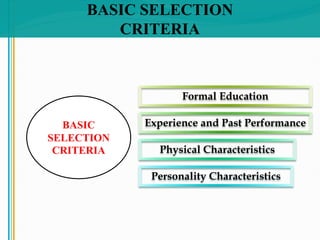
BASIC SELECTION
CRITERIA
BASIC
SELECTION
CRITERIA
Formal Education
Experience and Past Performance
Physical Characteristics
Personality Characteristics
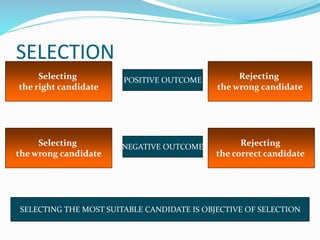
SELECTION
Selecting
the right candidate
Rejecting
the wrong candidate
Selecting
the wrong candidate
Rejecting
the correct candidate
POSITIVE OUTCOME
NEGATIVE OUTCOME
SELECTING THE MOST SUITABLE CANDIDATE IS OBJECTIVE OF SELECTION
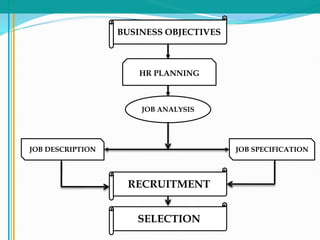
BUSINESS OBJECTIVES
RECRUITMENT
HR PLANNING
JOB DESCRIPTION JOB SPECIFICATION
JOB ANALYSIS
SELECTION
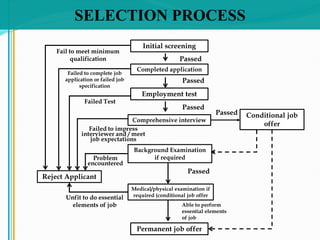
SELECTION PROCESS
Initial screening
Completed application
Medical/physical examination if
required (conditional job offer
Comprehensive interview
Employment test
Permanent job offer
Reject Applicant
Background Examination
if required
Conditional job
offer
Passed
Passed
Passed
Passed
Passed
Able to perform
essential elements
of job
Fail to meet minimum
qualification
Failed to complete job
application or failed job
specification
Failed Test
Failed to impress
interviewer and / meet
job expectations
Problem
encountered
Unfit to do essential
elements of job
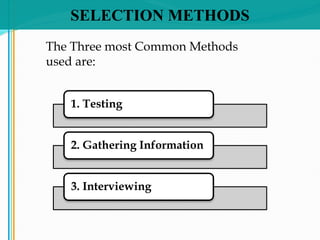
SELECTION METHODS
1. Testing
2. Gathering Information
3. Interviewing
The Three most Common Methods
used are:
SELECTION METHODS Cont . . .
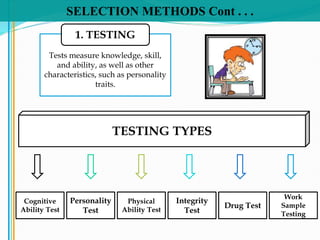
Tests measure knowledge, skill,
and ability, as well as other
characteristics, such as personality
traits.
1. TESTING
TESTING TYPES
Cognitive
Ability Test
Integrity
Test
Personality
Test
Drug Test
Physical
Ability Test
Work
Sample
Testing
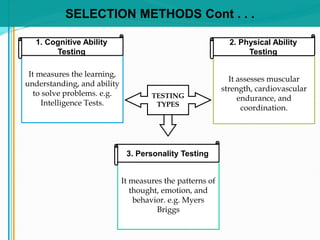
It measures the learning,
understanding, and ability
to solve problems. e.g.
Intelligence Tests.
1. Cognitive Ability
Testing
It measures the patterns of
thought, emotion, and
behavior. e.g. Myers
Briggs
3. Personality Testing
It assesses muscular
strength, cardiovascular
endurance, and
coordination.
2. Physical Ability
Testing
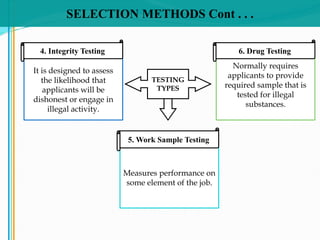
SELECTION METHODS Cont . . .
TESTING
TYPES
SELECTION METHODS Cont . . .
It is designed to assess
the likelihood that
applicants will be
dishonest or engage in
illegal activity.
4. Integrity Testing
Normally requires
applicants to provide
required sample that is
tested for illegal
substances.
6. Drug Testing
Measures performance on
some element of the job.
5. Work Sample Testing
TESTING
TYPES
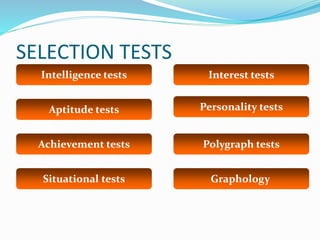
SELECTION TESTS
Intelligence tests
Achievement tests
Interest tests
Aptitude tests
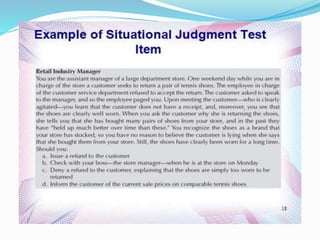
Situational tests
Polygraph tests
Personality tests
Graphology
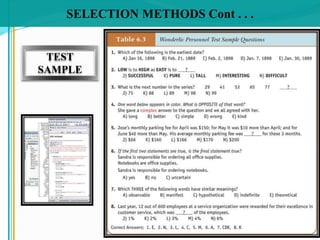
SELECTION METHODS Cont . . .
TEST
SAMPLE
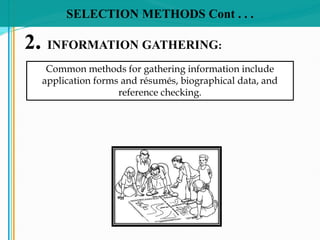
SELECTION METHODS Cont . . .
2. INFORMATION GATHERING:
Common methods for gathering information include
application forms and résumés, biographical data, and
reference checking.
SELECTION METHODS Cont . . .
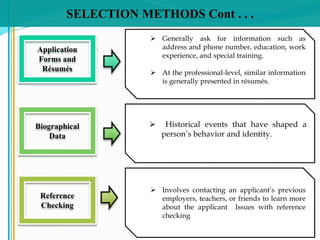
 Generally ask for information such as
address and phone number, education, work
experience, and special training.
 At the professional-level, similar information
is generally presented in résumés.
Application
Forms and
Résumés
 Historical events that have shaped a
person’s behavior and identity.
Biographical
Data
 Involves contacting an applicant’s previous
employers, teachers, or friends to learn more
about the applicant Issues with reference
checking
Reference
Checking
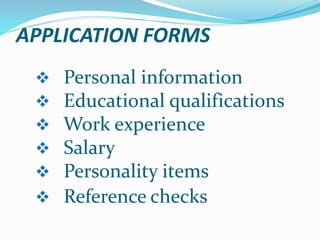
APPLICATION FORMS
 Personal information
 Educational qualifications
 Work experience
 Salary
 Personality items
 Reference checks
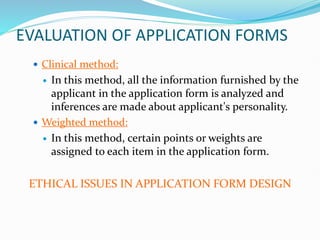
EVALUATION OF APPLICATION FORMS
 Clinical method:
 In this method, all the information furnished by the
applicant in the application form is analyzed and
inferences are made about applicant's personality.
 Weighted method:
 In this method, certain points or weights are
assigned to each item in the application form.
ETHICAL ISSUES IN APPLICATION FORM DESIGN
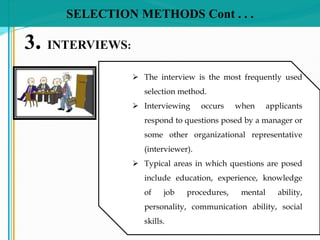
SELECTION METHODS Cont . . .
3. INTERVIEWS:
 The interview is the most frequently used
selection method.
 Interviewing occurs when applicants
respond to questions posed by a manager or
some other organizational representative
(interviewer).
 Typical areas in which questions are posed
include education, experience, knowledge
of job procedures, mental ability,
personality, communication ability, social
skills.
SELECTION METHODS Cont . . .
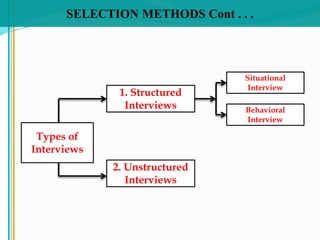
Types of
Interviews
2. Unstructured
Interviews
1. Structured
Interviews
Situational
Interview
Behavioral
Interview
SELECTION METHODS Cont . . .
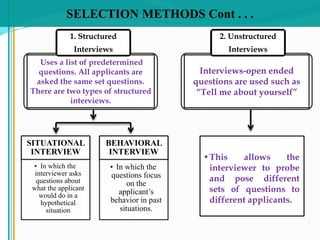
SITUATIONAL
INTERVIEW
• In which the
interviewer asks
questions about
what the applicant
would do in a
hypothetical
situation
BEHAVIORAL
INTERVIEW
• In which the
questions focus
on the
applicant’s
behavior in past
situations.
Uses a list of predetermined
questions. All applicants are
asked the same set questions.
There are two types of structured
interviews.
1. Structured
Interviews
Interviews-open ended
questions are used such as
“Tell me about yourself”
2. Unstructured
Interviews
•This allows the
interviewer to probe
and pose different
sets of questions to
different applicants.
SELECTION METHODS Cont . . .
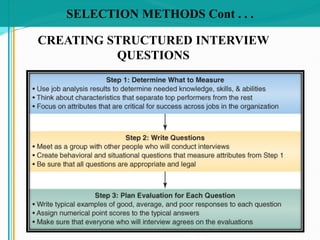
CREATING STRUCTURED INTERVIEW
QUESTIONS
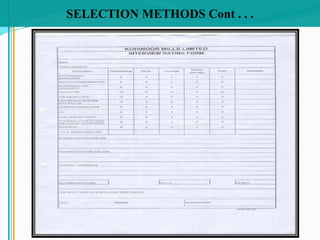
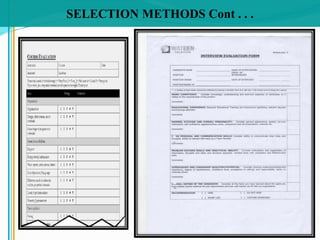
INTERVIEW EVALUATION FORM
SELECTION METHODS Cont . . .
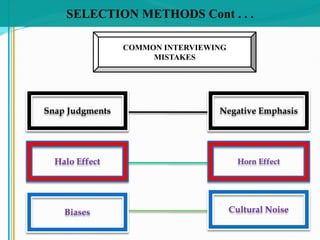
Snap Judgments
Halo Effect
Negative Emphasis
Horn Effect
Biases Cultural Noise
COMMON INTERVIEWING
MISTAKES
SELECTION.pptx

SELECTION.pptx

  • 1.
  • 2.
    How crucial isselection process?
  • 3.
    SELECTION 1 • The Processof making a “Hire” or “No Hire” decision regarding each applicant for a job. 2 • Selection is the process of choosing qualified individuals who are available to fill the positions in organization. Or
  • 4.
    BASIC SELECTION CRITERIA BASIC SELECTION CRITERIA Formal Education Experienceand Past Performance Physical Characteristics Personality Characteristics
  • 5.
    SELECTION Selecting the right candidate Rejecting thewrong candidate Selecting the wrong candidate Rejecting the correct candidate POSITIVE OUTCOME NEGATIVE OUTCOME SELECTING THE MOST SUITABLE CANDIDATE IS OBJECTIVE OF SELECTION
  • 6.
    BUSINESS OBJECTIVES RECRUITMENT HR PLANNING JOBDESCRIPTION JOB SPECIFICATION JOB ANALYSIS SELECTION
  • 7.
    SELECTION PROCESS Initial screening Completedapplication Medical/physical examination if required (conditional job offer Comprehensive interview Employment test Permanent job offer Reject Applicant Background Examination if required Conditional job offer Passed Passed Passed Passed Passed Able to perform essential elements of job Fail to meet minimum qualification Failed to complete job application or failed job specification Failed Test Failed to impress interviewer and / meet job expectations Problem encountered Unfit to do essential elements of job
  • 8.
    SELECTION METHODS 1. Testing 2.Gathering Information 3. Interviewing The Three most Common Methods used are:
  • 9.
    SELECTION METHODS Cont. . . Tests measure knowledge, skill, and ability, as well as other characteristics, such as personality traits. 1. TESTING TESTING TYPES Cognitive Ability Test Integrity Test Personality Test Drug Test Physical Ability Test Work Sample Testing
  • 10.
    It measures thelearning, understanding, and ability to solve problems. e.g. Intelligence Tests. 1. Cognitive Ability Testing It measures the patterns of thought, emotion, and behavior. e.g. Myers Briggs 3. Personality Testing It assesses muscular strength, cardiovascular endurance, and coordination. 2. Physical Ability Testing SELECTION METHODS Cont . . . TESTING TYPES
  • 11.
    SELECTION METHODS Cont. . . It is designed to assess the likelihood that applicants will be dishonest or engage in illegal activity. 4. Integrity Testing Normally requires applicants to provide required sample that is tested for illegal substances. 6. Drug Testing Measures performance on some element of the job. 5. Work Sample Testing TESTING TYPES
  • 12.
    SELECTION TESTS Intelligence tests Achievementtests Interest tests Aptitude tests Situational tests Polygraph tests Personality tests Graphology
  • 13.
    SELECTION METHODS Cont. . . TEST SAMPLE
  • 14.
    SELECTION METHODS Cont. . . 2. INFORMATION GATHERING: Common methods for gathering information include application forms and résumés, biographical data, and reference checking.
  • 15.
    SELECTION METHODS Cont. . .  Generally ask for information such as address and phone number, education, work experience, and special training.  At the professional-level, similar information is generally presented in résumés. Application Forms and Résumés  Historical events that have shaped a person’s behavior and identity. Biographical Data  Involves contacting an applicant’s previous employers, teachers, or friends to learn more about the applicant Issues with reference checking Reference Checking
  • 16.
    APPLICATION FORMS  Personalinformation  Educational qualifications  Work experience  Salary  Personality items  Reference checks
  • 17.
    EVALUATION OF APPLICATIONFORMS  Clinical method:  In this method, all the information furnished by the applicant in the application form is analyzed and inferences are made about applicant's personality.  Weighted method:  In this method, certain points or weights are assigned to each item in the application form. ETHICAL ISSUES IN APPLICATION FORM DESIGN
  • 18.
    SELECTION METHODS Cont. . . 3. INTERVIEWS:  The interview is the most frequently used selection method.  Interviewing occurs when applicants respond to questions posed by a manager or some other organizational representative (interviewer).  Typical areas in which questions are posed include education, experience, knowledge of job procedures, mental ability, personality, communication ability, social skills.
  • 19.
    SELECTION METHODS Cont. . . Types of Interviews 2. Unstructured Interviews 1. Structured Interviews Situational Interview Behavioral Interview
  • 20.
    SELECTION METHODS Cont. . . SITUATIONAL INTERVIEW • In which the interviewer asks questions about what the applicant would do in a hypothetical situation BEHAVIORAL INTERVIEW • In which the questions focus on the applicant’s behavior in past situations. Uses a list of predetermined questions. All applicants are asked the same set questions. There are two types of structured interviews. 1. Structured Interviews Interviews-open ended questions are used such as “Tell me about yourself” 2. Unstructured Interviews •This allows the interviewer to probe and pose different sets of questions to different applicants.
  • 21.
    SELECTION METHODS Cont. . . CREATING STRUCTURED INTERVIEW QUESTIONS
  • 22.
  • 23.
  • 24.
  • 25.
    SELECTION METHODS Cont. . . Snap Judgments Halo Effect Negative Emphasis Horn Effect Biases Cultural Noise COMMON INTERVIEWING MISTAKES