RECRUITMENT
Process of searching for and stimulating the prospective
employees to apply for a right Job.
RECRUITMENT PROCESS
Identify hiring
needs
Prepare Job
Description
Develop and execute
recruitment plan
Screen applications
Forward screened
applications for
selection
EXTERNAL SOURCES
 Campus
 Employment Agencies- Public, Private
 Data Banks
 Casual Applicants
 Trade unions
 Similar/Competitive Organisations
 Mergers and acquisitions
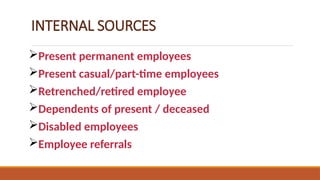
INTERNAL SOURCES
Present permanent employees
Present casual/part-time employees
Retrenched/retired employee
Dependents of present / deceased
Disabled employees
Employee referrals
Modern sources of recruitment
E-recruitment
Sourcing resumes via job portals
Body shopping
Alternatives to recruitment
Part-time employment/ contract employment
Business Process out sourcing
Over time or work sharing
FACTORS EFFECTING RECRUITMENT
Recruiting policy of the organization
HR planning strategy of the Company
Size of the organization
Cost of recruitment
Growth and expansion plans of the organization
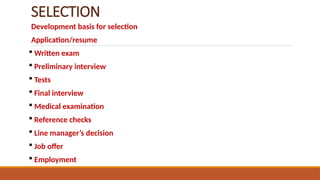
SELECTION
Development basis for selection
Application/resume
 Written exam
 Preliminary interview
 Tests
 Final interview
 Medical examination
 Reference checks
 Line manager’s decision
 Job offer
 Employment
Evaluation of application forms
 Clinical method- psychological inferences ( leadership,emotional
abilities , assertiveness, consistency
 Weighted method-
Biographical method- marital status, family details, hobbies, self
impressions, educational background
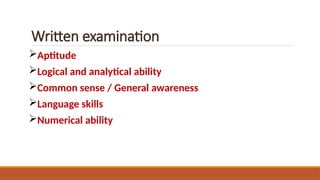
Written examination
Aptitude
Logical and analytical ability
Common sense / General awareness
Language skills
Numerical ability
Types of Selection Tests
Aptitude tests
◦ IQ , EQ, Skill, mechanical aptitude, psychomotor ability, clerical aptitude
Achievement tests
◦ Job knowledge, work sample test
Situational tests
◦ Group discussion, In Basket, role play
Personality tests
◦ TAT , Inkblot test
Interview
Preliminary interview
Final interview
TYPES OF INTERVIEWS
◦ Formal Interview
◦ Planned/ patterned interview
◦ Non Directive interview
◦ Depth interview
◦ Stress interview
◦ Panel interview
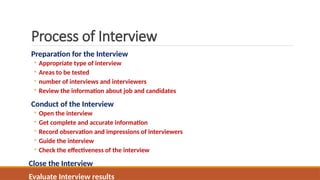
Process of Interview
Preparation for the Interview
◦ Appropriate type of interview
◦ Areas to be tested
◦ number of interviews and interviewers
◦ Review the information about job and candidates
Conduct of the Interview
◦ Open the interview
◦ Get complete and accurate information
◦ Record observation and impressions of interviewers
◦ Guide the interview
◦ Check the effectiveness of the interview
Close the Interview
Evaluate Interview results
Errors in Selection
Mistakes made during the selection process that lead to the hiring of unsuitable candidates or
the rejection of suitable candidates
Bias in assessment
Halo effect
Attribution
Projection
Stereotyping
Use of Inappropriate test/selection tool
Take the candidate on their word
Talk 80% and listen 20%
PLACEMENT
◦ Assigning a position/rank and responsibilities to the selected employee
INDUCTION PROGRAM
◦ the process of welcoming newly recruited employees and supporting them
to adjust to their new roles and working environments.
RETENTION
◦ an organization's ability to hold on to its employees
Strategies for Retention
Objectives of retention
◦ Customer satisfaction
◦ Improved morale
◦ Reduced turnover
◦ Positive work culture
◦ Enhanced productivity
The three R's of retention
◦Respect, Recognition, and Reward
Recruitment & Selection 2025.pptx..........

  • 1.
    RECRUITMENT Process of searchingfor and stimulating the prospective employees to apply for a right Job.
  • 2.
    RECRUITMENT PROCESS Identify hiring needs PrepareJob Description Develop and execute recruitment plan Screen applications Forward screened applications for selection
  • 3.
    EXTERNAL SOURCES  Campus Employment Agencies- Public, Private  Data Banks  Casual Applicants  Trade unions  Similar/Competitive Organisations  Mergers and acquisitions
  • 4.
    INTERNAL SOURCES Present permanentemployees Present casual/part-time employees Retrenched/retired employee Dependents of present / deceased Disabled employees Employee referrals
  • 5.
    Modern sources ofrecruitment E-recruitment Sourcing resumes via job portals Body shopping Alternatives to recruitment Part-time employment/ contract employment Business Process out sourcing Over time or work sharing
  • 6.
    FACTORS EFFECTING RECRUITMENT Recruitingpolicy of the organization HR planning strategy of the Company Size of the organization Cost of recruitment Growth and expansion plans of the organization
  • 7.
    SELECTION Development basis forselection Application/resume  Written exam  Preliminary interview  Tests  Final interview  Medical examination  Reference checks  Line manager’s decision  Job offer  Employment
  • 8.
    Evaluation of applicationforms  Clinical method- psychological inferences ( leadership,emotional abilities , assertiveness, consistency  Weighted method- Biographical method- marital status, family details, hobbies, self impressions, educational background
  • 9.
    Written examination Aptitude Logical andanalytical ability Common sense / General awareness Language skills Numerical ability
  • 10.
    Types of SelectionTests Aptitude tests ◦ IQ , EQ, Skill, mechanical aptitude, psychomotor ability, clerical aptitude Achievement tests ◦ Job knowledge, work sample test Situational tests ◦ Group discussion, In Basket, role play Personality tests ◦ TAT , Inkblot test
  • 11.
    Interview Preliminary interview Final interview TYPESOF INTERVIEWS ◦ Formal Interview ◦ Planned/ patterned interview ◦ Non Directive interview ◦ Depth interview ◦ Stress interview ◦ Panel interview
  • 12.
    Process of Interview Preparationfor the Interview ◦ Appropriate type of interview ◦ Areas to be tested ◦ number of interviews and interviewers ◦ Review the information about job and candidates Conduct of the Interview ◦ Open the interview ◦ Get complete and accurate information ◦ Record observation and impressions of interviewers ◦ Guide the interview ◦ Check the effectiveness of the interview Close the Interview Evaluate Interview results
  • 13.
    Errors in Selection Mistakesmade during the selection process that lead to the hiring of unsuitable candidates or the rejection of suitable candidates Bias in assessment Halo effect Attribution Projection Stereotyping Use of Inappropriate test/selection tool Take the candidate on their word Talk 80% and listen 20%
  • 14.
    PLACEMENT ◦ Assigning aposition/rank and responsibilities to the selected employee INDUCTION PROGRAM ◦ the process of welcoming newly recruited employees and supporting them to adjust to their new roles and working environments. RETENTION ◦ an organization's ability to hold on to its employees
  • 15.
    Strategies for Retention Objectivesof retention ◦ Customer satisfaction ◦ Improved morale ◦ Reduced turnover ◦ Positive work culture ◦ Enhanced productivity The three R's of retention ◦Respect, Recognition, and Reward