BROODING PERIOD
MANAGEMENT IN HOT CLIMATE
Presentation By:
Dr. Abdullah Al Mamun
Designation: MT-Sales
Kazi Farms Group
ID. No. 1940602
objectives
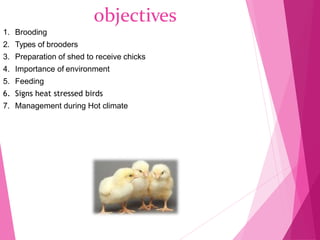
1. Brooding
2. Types of brooders
3. Preparation of shed to receive chicks
4. Importance of environment
5. Feeding
6. Signs heat stressed birds
7. Management during Hot climate
 Brooding is a art and science of rearing baby chicks
 Newly hatched chicks not fully developed
thermoregulatory mechanism
 Takes about 2wks to develop
 They cannot maintain the body temperature
properly for the first few weeks of life
What is Brooding
 Brooding can be classified into natural and
artificial brooding.
 Natural brooding
 Artificial brooding
Types of brooding
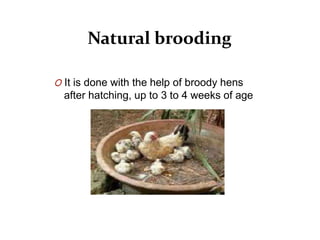
Natural brooding
O It is done with the help of broody hens
after hatching, up to 3 to 4 weeks of age
Artificial Brooding
 In artificial brooding large number of baby chicks are
reared in the absence of broody hen.
 Equipment are used for brooding are called brooders.
Brooder comprises of three elements:
 Heating source
 Reflectors
 Brooder guard
 Heating source may be electrical, gases like natural
gas, LPG and methane, liquid fuel like kerosene
and solid fuel like coal, wood can be used as a
heating material.
DIFFERENT TYPES OF
BROODERS
1. Infra red bulbs
2. Heating coils
3. Gas brooders
4. Kerosene stove
5. Coal/charcoal stove
6. Battery brooders
7. Biogas brooders
Gas brooder
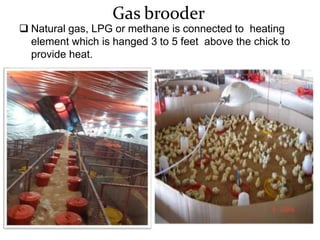
 Natural gas, LPG or methane is connected to heating
element which is hanged 3 to 5 feet above the chick to
provide heat.
Electrical brooder
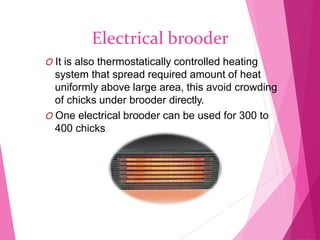
O It is also thermostatically controlled heating
system that spread required amount of heat
uniformly above large area, this avoid crowding
of chicks under brooder directly.
O One electrical brooder can be used for 300 to
400 chicks.
Brooder guard / chickguard
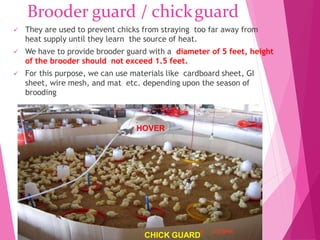
 They are used to prevent chicks from straying too far away from
heat supply until they learn the source of heat.
 We have to provide brooder guard with a diameter of 5 feet, height
of the brooder should not exceed 1.5 feet.
 For this purpose, we can use materials like cardboard sheet, GI
sheet, wire mesh, and mat etc. depending upon the season of
brooding
HOVER
CHICK GUARD
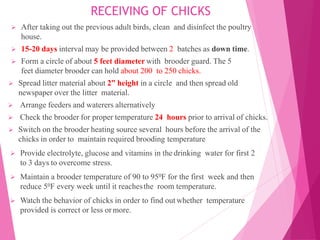
RECEIVING OF CHICKS
 After taking out the previous adult birds, clean and disinfect the poultry
house.
 15-20 days interval may be provided between 2 batches as down time.
 Form a circle of about 5 feet diameter with brooder guard. The 5
feet diameter brooder can hold about 200 to 250 chicks.
 Spread litter material about 2” height in a circle and then spread old
newspaper over the litter material.
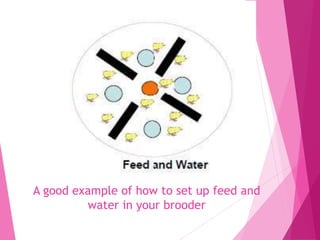
 Arrange feeders and waterers alternatively
 Check the brooder for proper temperature 24 hours prior to arrival of chicks.
 Switch on the brooder heating source several hours before the arrival of the
chicks in order to maintain required brooding temperature
 Provide electrolyte, glucose and vitamins in the drinking water for first 2
to 3 days to overcome stress.
 Maintain a brooder temperature of 90 to 950F for the first week and then
reduce 50F every week until it reachesthe room temperature.
 Watch the behavior of chicks in order to find out whether temperature
provided is correct or less ormore.
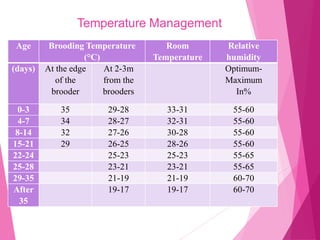
Temperature Management
Age Brooding Temperature
(°C)
Room
Temperature
Relative
humidity
(days) At the edge
of the
brooder
At 2-3m
from the
brooders
Optimum-
Maximum
In%
0-3 35 29-28 33-31 55-60
4-7 34 28-27 32-31 55-60
8-14 32 27-26 30-28 55-60
15-21 29 26-25 28-26 55-60
22-24 25-23 25-23 55-65
25-28 23-21 23-21 55-65
29-35 21-19 21-19 60-70
After
35
19-17 19-17 60-70
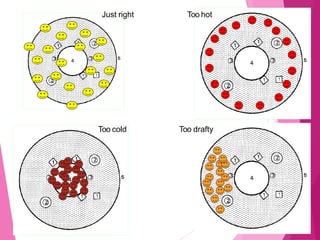
Too draftyToo cold
Too hotJust right
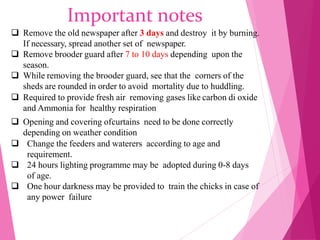
 Remove the old newspaper after 3 days and destroy it by burning.
If necessary, spread another set of newspaper.
 Remove brooder guard after 7 to 10 days depending upon the
season.
 While removing the brooder guard, see that the corners of the
sheds are rounded in order to avoid mortality due to huddling.
 Required to provide fresh air removing gases like carbon di oxide
and Ammonia for healthy respiration
 Opening and covering ofcurtains need to be done correctly
depending on weather condition
 Change the feeders and waterers according to age and
requirement.
 24 hours lighting programme may be adopted during 0-8 days
of age.
 One hour darkness may be provided to train the chicks in case of
any power failure
Important notes
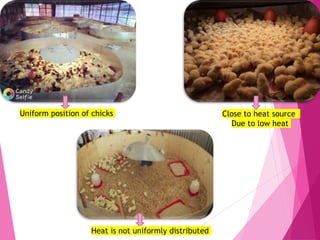
Uniform position of chicks Close to heat source
Due to low heat
Heat is not uniformly distributed
A good example of how to set up feed and
water in your brooder
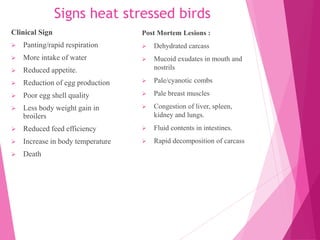
Signs heat stressed birds
Clinical Sign
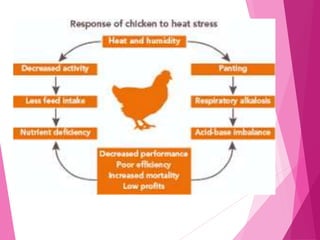
 Panting/rapid respiration
 More intake of water
 Reduced appetite.
 Reduction of egg production
 Poor egg shell quality
 Less body weight gain in
broilers
 Reduced feed efficiency
 Increase in body temperature
 Death
Post Mortem Lesions :
 Dehydrated carcass
 Mucoid exudates in mouth and
nostrils
 Pale/cyanotic combs
 Pale breast muscles
 Congestion of liver, spleen,
kidney and lungs.
 Fluid contents in intestines.
 Rapid decomposition of carcass
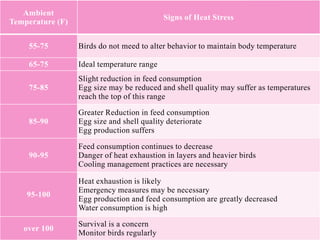
Ambient
Temperature (F)
Signs of Heat Stress
55-75 Birds do not meed to alter behavior to maintain body temperature
65-75 Ideal temperature range
75-85
Slight reduction in feed consumption
Egg size may be reduced and shell quality may suffer as temperatures
reach the top of this range
85-90
Greater Reduction in feed consumption
Egg size and shell quality deteriorate
Egg production suffers
90-95
Feed consumption continues to decrease
Danger of heat exhaustion in layers and heavier birds
Cooling management practices are necessary
95-100
Heat exhaustion is likely
Emergency measures may be necessary
Egg production and feed consumption are greatly decreased
Water consumption is high
over 100
Survival is a concern
Monitor birds regularly
How to combat heat stress
Housing
Management
 Increased air movement over the birds by cooler fans/exhaust to produce a
wind chill effect which will cool birds even without drop in the house
temperature.
Water
Management
 Supply of plenty of clean and cool water (60-70oF) must be ensured during
summer months.
 Use electrolytes in water to control infections through water.
 Cover water tanks with wet gunny bags to avoid direct exposure to sun.
 Increase number of waterers by 25%.
 Increase frequency of watering.
Feed Management  During summer consumption of feed by birds is reduced considerably leading to
reduced body weight, egg production and shell quality.
 Increase the frequency of feeding.
 Do not offer feed during day time in broilers.
 Vitamin C is necessary to maintain integrity of blood vessels.
General
Management
 Litter preferably fresh litter of 2 inches thickness with racking or stirring of litter
2-3 times a day during cool hours is recommended.
 10% extra floor space should be provided in summer.
 Overcrowding of birds should be avoided.
 Provide proper cross ventilation.
 Fans (pedestal, ceiling or exhaust) may be fitted in sheds.
Brooding period management

Brooding period management

  • 1.
    BROODING PERIOD MANAGEMENT INHOT CLIMATE Presentation By: Dr. Abdullah Al Mamun Designation: MT-Sales Kazi Farms Group ID. No. 1940602
  • 2.
    objectives 1. Brooding 2. Typesof brooders 3. Preparation of shed to receive chicks 4. Importance of environment 5. Feeding 6. Signs heat stressed birds 7. Management during Hot climate
  • 3.
     Brooding isa art and science of rearing baby chicks  Newly hatched chicks not fully developed thermoregulatory mechanism  Takes about 2wks to develop  They cannot maintain the body temperature properly for the first few weeks of life What is Brooding
  • 4.
     Brooding canbe classified into natural and artificial brooding.  Natural brooding  Artificial brooding Types of brooding
  • 5.
    Natural brooding O Itis done with the help of broody hens after hatching, up to 3 to 4 weeks of age
  • 6.
    Artificial Brooding  Inartificial brooding large number of baby chicks are reared in the absence of broody hen.  Equipment are used for brooding are called brooders. Brooder comprises of three elements:  Heating source  Reflectors  Brooder guard
  • 7.
     Heating sourcemay be electrical, gases like natural gas, LPG and methane, liquid fuel like kerosene and solid fuel like coal, wood can be used as a heating material.
  • 8.
    DIFFERENT TYPES OF BROODERS 1.Infra red bulbs 2. Heating coils 3. Gas brooders 4. Kerosene stove 5. Coal/charcoal stove 6. Battery brooders 7. Biogas brooders
  • 9.
    Gas brooder  Naturalgas, LPG or methane is connected to heating element which is hanged 3 to 5 feet above the chick to provide heat.
  • 10.
    Electrical brooder O Itis also thermostatically controlled heating system that spread required amount of heat uniformly above large area, this avoid crowding of chicks under brooder directly. O One electrical brooder can be used for 300 to 400 chicks.
  • 11.
    Brooder guard /chickguard  They are used to prevent chicks from straying too far away from heat supply until they learn the source of heat.  We have to provide brooder guard with a diameter of 5 feet, height of the brooder should not exceed 1.5 feet.  For this purpose, we can use materials like cardboard sheet, GI sheet, wire mesh, and mat etc. depending upon the season of brooding HOVER CHICK GUARD
  • 12.
    RECEIVING OF CHICKS After taking out the previous adult birds, clean and disinfect the poultry house.  15-20 days interval may be provided between 2 batches as down time.  Form a circle of about 5 feet diameter with brooder guard. The 5 feet diameter brooder can hold about 200 to 250 chicks.  Spread litter material about 2” height in a circle and then spread old newspaper over the litter material.  Arrange feeders and waterers alternatively  Check the brooder for proper temperature 24 hours prior to arrival of chicks.  Switch on the brooder heating source several hours before the arrival of the chicks in order to maintain required brooding temperature  Provide electrolyte, glucose and vitamins in the drinking water for first 2 to 3 days to overcome stress.  Maintain a brooder temperature of 90 to 950F for the first week and then reduce 50F every week until it reachesthe room temperature.  Watch the behavior of chicks in order to find out whether temperature provided is correct or less ormore.
  • 13.
    Temperature Management Age BroodingTemperature (°C) Room Temperature Relative humidity (days) At the edge of the brooder At 2-3m from the brooders Optimum- Maximum In% 0-3 35 29-28 33-31 55-60 4-7 34 28-27 32-31 55-60 8-14 32 27-26 30-28 55-60 15-21 29 26-25 28-26 55-60 22-24 25-23 25-23 55-65 25-28 23-21 23-21 55-65 29-35 21-19 21-19 60-70 After 35 19-17 19-17 60-70
  • 14.
  • 15.
     Remove theold newspaper after 3 days and destroy it by burning. If necessary, spread another set of newspaper.  Remove brooder guard after 7 to 10 days depending upon the season.  While removing the brooder guard, see that the corners of the sheds are rounded in order to avoid mortality due to huddling.  Required to provide fresh air removing gases like carbon di oxide and Ammonia for healthy respiration  Opening and covering ofcurtains need to be done correctly depending on weather condition  Change the feeders and waterers according to age and requirement.  24 hours lighting programme may be adopted during 0-8 days of age.  One hour darkness may be provided to train the chicks in case of any power failure Important notes
  • 16.
    Uniform position ofchicks Close to heat source Due to low heat Heat is not uniformly distributed
  • 17.
    A good exampleof how to set up feed and water in your brooder
  • 18.
    Signs heat stressedbirds Clinical Sign  Panting/rapid respiration  More intake of water  Reduced appetite.  Reduction of egg production  Poor egg shell quality  Less body weight gain in broilers  Reduced feed efficiency  Increase in body temperature  Death Post Mortem Lesions :  Dehydrated carcass  Mucoid exudates in mouth and nostrils  Pale/cyanotic combs  Pale breast muscles  Congestion of liver, spleen, kidney and lungs.  Fluid contents in intestines.  Rapid decomposition of carcass
  • 20.
    Ambient Temperature (F) Signs ofHeat Stress 55-75 Birds do not meed to alter behavior to maintain body temperature 65-75 Ideal temperature range 75-85 Slight reduction in feed consumption Egg size may be reduced and shell quality may suffer as temperatures reach the top of this range 85-90 Greater Reduction in feed consumption Egg size and shell quality deteriorate Egg production suffers 90-95 Feed consumption continues to decrease Danger of heat exhaustion in layers and heavier birds Cooling management practices are necessary 95-100 Heat exhaustion is likely Emergency measures may be necessary Egg production and feed consumption are greatly decreased Water consumption is high over 100 Survival is a concern Monitor birds regularly
  • 21.
    How to combatheat stress Housing Management  Increased air movement over the birds by cooler fans/exhaust to produce a wind chill effect which will cool birds even without drop in the house temperature. Water Management  Supply of plenty of clean and cool water (60-70oF) must be ensured during summer months.  Use electrolytes in water to control infections through water.  Cover water tanks with wet gunny bags to avoid direct exposure to sun.  Increase number of waterers by 25%.  Increase frequency of watering. Feed Management  During summer consumption of feed by birds is reduced considerably leading to reduced body weight, egg production and shell quality.  Increase the frequency of feeding.  Do not offer feed during day time in broilers.  Vitamin C is necessary to maintain integrity of blood vessels. General Management  Litter preferably fresh litter of 2 inches thickness with racking or stirring of litter 2-3 times a day during cool hours is recommended.  10% extra floor space should be provided in summer.  Overcrowding of birds should be avoided.  Provide proper cross ventilation.  Fans (pedestal, ceiling or exhaust) may be fitted in sheds.