



Business Research Method
An Introduction
W. Rofianto
1-2
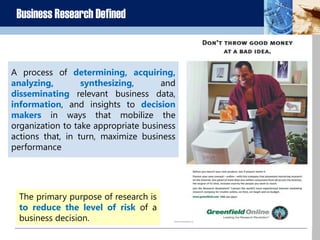
A process of determining, acquiring,
analyzing, synthesizing, and
disseminating relevant business data,
information, and insights to decision
makers in ways that mobilize the
organization to take appropriate business
actions that, in turn, maximize business
performance
Business Research Defined
The primary purpose of research is
to reduce the level of risk of a
business decision.
1-3
Research May Not Be Necessary
Can It Pass These Tests?
 Can information be applied to a critical decision?
 Will the information improve managerial decision making?
 Are sufficient resources available?
Two Categories of Research
Applied Basic (Pure)
1-4
Business research provides
information to guide business
decisions
Business Research Challenge & Opportunity
“Enterprises have long recognized the need to better sense and respond
to business change. What’s different today is that ubiquitous access to
information and real-time communications have fostered an ‘always on’
business culture where decision making has become a ‘just-in-time process.’”
Business Performance Management Forum
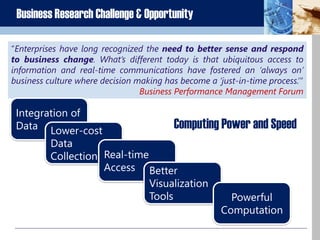
Integration of
Data Lower-cost
Data
Collection Real-time
Access Better
Visualization
Tools Powerful
Computation
Computing Power and Speed
Scientific Method
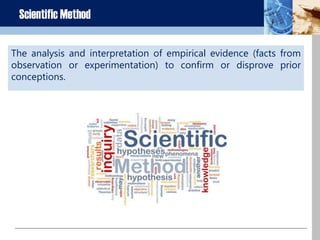
The analysis and interpretation of empirical evidence (facts from
observation or experimentation) to confirm or disprove prior
conceptions.
3-6
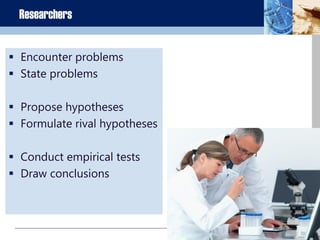
Researchers
 Encounter problems
 State problems
 Propose hypotheses
 Formulate rival hypotheses
 Conduct empirical tests
 Draw conclusions
1-7
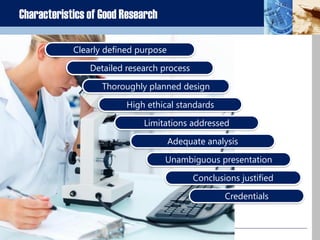
Characteristics of Good Research
Clearly defined purpose
Detailed research process
Thoroughly planned design
High ethical standards
Limitations addressed
Adequate analysis
Unambiguous presentation
Conclusions justified
Credentials
Language of Research
Concept is a bundle of meanings associated with certain concrete,
unambiguous events, objects, conditions, or situations.
Construct is a definition specifically invented to represent an
abstract phenomena for a given research project.
Variable is used as a synonym for the construct being studied.
Operational definition defines a variable in terms of specific
measurement and testing criteria.
Hypothesis is a proposition formulated for empirical testing.
Theory is a set of systematically interrelated concepts, definitions,
and propositions that are advanced to explain or predict
phenomena.
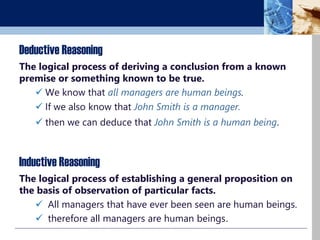
Deductive Reasoning
The logical process of deriving a conclusion from a known
premise or something known to be true.
 We know that all managers are human beings.
 If we also know that John Smith is a manager.
 then we can deduce that John Smith is a human being.
The logical process of establishing a general proposition on
the basis of observation of particular facts.
 All managers that have ever been seen are human beings.
 therefore all managers are human beings.
Inductive Reasoning
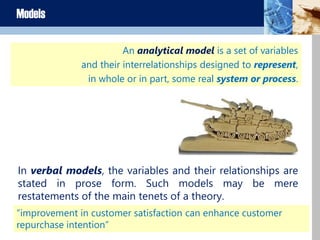
In verbal models, the variables and their relationships are
stated in prose form. Such models may be mere
restatements of the main tenets of a theory.
An analytical model is a set of variables
and their interrelationships designed to represent,
in whole or in part, some real system or process.
“improvement in customer satisfaction can enhance customer
repurchase intention”
Models
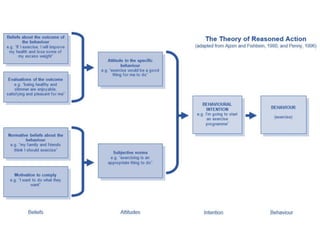
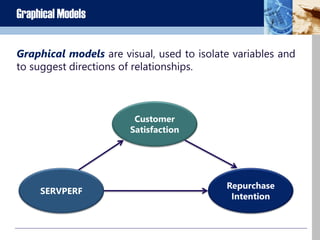
Graphical models are visual, used to isolate variables and
to suggest directions of relationships.
SERVPERF
Graphical Models
Repurchase
Intention
Customer
Satisfaction
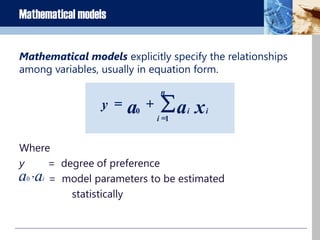

=
+=
n
i
ii xaay
1
0
aa i
,0
Where
y = degree of preference
= model parameters to be estimated
statistically
Mathematical models explicitly specify the relationships
among variables, usually in equation form.
Mathematical models
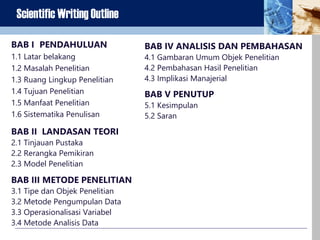
BAB I PENDAHULUAN
1.1 Latar belakang
1.2 Masalah Penelitian
1.3 Ruang Lingkup Penelitian
1.4 Tujuan Penelitian
1.5 Manfaat Penelitian
1.6 Sistematika Penulisan
BAB II LANDASAN TEORI
2.1 Tinjauan Pustaka
2.2 Rerangka Pemikiran
2.3 Model Penelitian
BAB IV ANALISIS DAN PEMBAHASAN
4.1 Gambaran Umum Objek Penelitian
4.2 Pembahasan Hasil Penelitian
4.3 Implikasi Manajerial
BAB III METODE PENELITIAN
3.1 Tipe dan Objek Penelitian
3.2 Metode Pengumpulan Data
3.3 Operasionalisasi Variabel
3.4 Metode Analisis Data
BAB V PENUTUP
5.1 Kesimpulan
5.2 Saran
Scientific Writing Outline
Brm 01 2015
Brm 01 2015
Brm 01 2015
Brm 01 2015
Brm 01 2015
Brm 01 2015

Brm 01 2015

  • 1.
    Business Research Method AnIntroduction W. Rofianto
  • 2.
    1-2 A process ofdetermining, acquiring, analyzing, synthesizing, and disseminating relevant business data, information, and insights to decision makers in ways that mobilize the organization to take appropriate business actions that, in turn, maximize business performance Business Research Defined The primary purpose of research is to reduce the level of risk of a business decision.
  • 3.
    1-3 Research May NotBe Necessary Can It Pass These Tests?  Can information be applied to a critical decision?  Will the information improve managerial decision making?  Are sufficient resources available? Two Categories of Research Applied Basic (Pure)
  • 4.
    1-4 Business research provides informationto guide business decisions Business Research Challenge & Opportunity “Enterprises have long recognized the need to better sense and respond to business change. What’s different today is that ubiquitous access to information and real-time communications have fostered an ‘always on’ business culture where decision making has become a ‘just-in-time process.’” Business Performance Management Forum Integration of Data Lower-cost Data Collection Real-time Access Better Visualization Tools Powerful Computation Computing Power and Speed
  • 5.
    Scientific Method The analysisand interpretation of empirical evidence (facts from observation or experimentation) to confirm or disprove prior conceptions.
  • 6.
    3-6 Researchers  Encounter problems State problems  Propose hypotheses  Formulate rival hypotheses  Conduct empirical tests  Draw conclusions
  • 7.
    1-7 Characteristics of GoodResearch Clearly defined purpose Detailed research process Thoroughly planned design High ethical standards Limitations addressed Adequate analysis Unambiguous presentation Conclusions justified Credentials
  • 8.
    Language of Research Conceptis a bundle of meanings associated with certain concrete, unambiguous events, objects, conditions, or situations. Construct is a definition specifically invented to represent an abstract phenomena for a given research project. Variable is used as a synonym for the construct being studied. Operational definition defines a variable in terms of specific measurement and testing criteria. Hypothesis is a proposition formulated for empirical testing. Theory is a set of systematically interrelated concepts, definitions, and propositions that are advanced to explain or predict phenomena.
  • 10.
    Deductive Reasoning The logicalprocess of deriving a conclusion from a known premise or something known to be true.  We know that all managers are human beings.  If we also know that John Smith is a manager.  then we can deduce that John Smith is a human being. The logical process of establishing a general proposition on the basis of observation of particular facts.  All managers that have ever been seen are human beings.  therefore all managers are human beings. Inductive Reasoning
  • 11.
    In verbal models,the variables and their relationships are stated in prose form. Such models may be mere restatements of the main tenets of a theory. An analytical model is a set of variables and their interrelationships designed to represent, in whole or in part, some real system or process. “improvement in customer satisfaction can enhance customer repurchase intention” Models
  • 12.
    Graphical models arevisual, used to isolate variables and to suggest directions of relationships. SERVPERF Graphical Models Repurchase Intention Customer Satisfaction
  • 13.
     = += n i ii xaay 1 0 aa i ,0 Where y= degree of preference = model parameters to be estimated statistically Mathematical models explicitly specify the relationships among variables, usually in equation form. Mathematical models
  • 14.
    BAB I PENDAHULUAN 1.1Latar belakang 1.2 Masalah Penelitian 1.3 Ruang Lingkup Penelitian 1.4 Tujuan Penelitian 1.5 Manfaat Penelitian 1.6 Sistematika Penulisan BAB II LANDASAN TEORI 2.1 Tinjauan Pustaka 2.2 Rerangka Pemikiran 2.3 Model Penelitian BAB IV ANALISIS DAN PEMBAHASAN 4.1 Gambaran Umum Objek Penelitian 4.2 Pembahasan Hasil Penelitian 4.3 Implikasi Manajerial BAB III METODE PENELITIAN 3.1 Tipe dan Objek Penelitian 3.2 Metode Pengumpulan Data 3.3 Operasionalisasi Variabel 3.4 Metode Analisis Data BAB V PENUTUP 5.1 Kesimpulan 5.2 Saran Scientific Writing Outline