INTRODUCTION
TO
BUSINESS RESEARCH
CHAPTER-1
What is research?
Management research is an unbiased,
structured, and sequential method of enquiry,
directed towards a clear implicit or explicit
business objective. This enquiry might lead to
validating existing postulates or arriving at
new theories and models.
SLIDE 1-1
Types of research
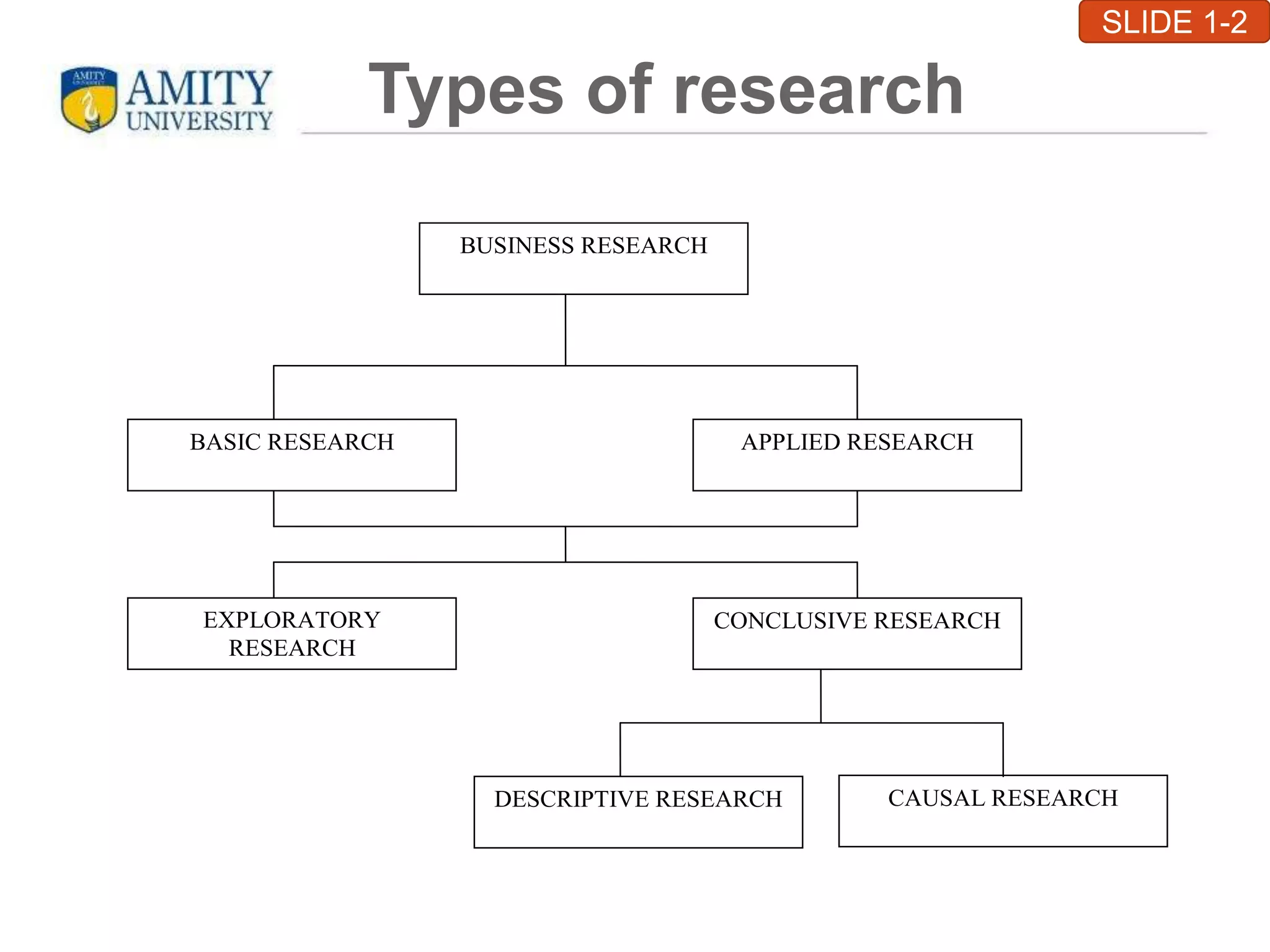
BUSINESS RESEARCH
CONCLUSIVE RESEARCH
DESCRIPTIVE RESEARCH
APPLIED RESEARCH
BASIC RESEARCH
EXPLORATORY
RESEARCH
CAUSAL RESEARCH
SLIDE 1-2
Types of research
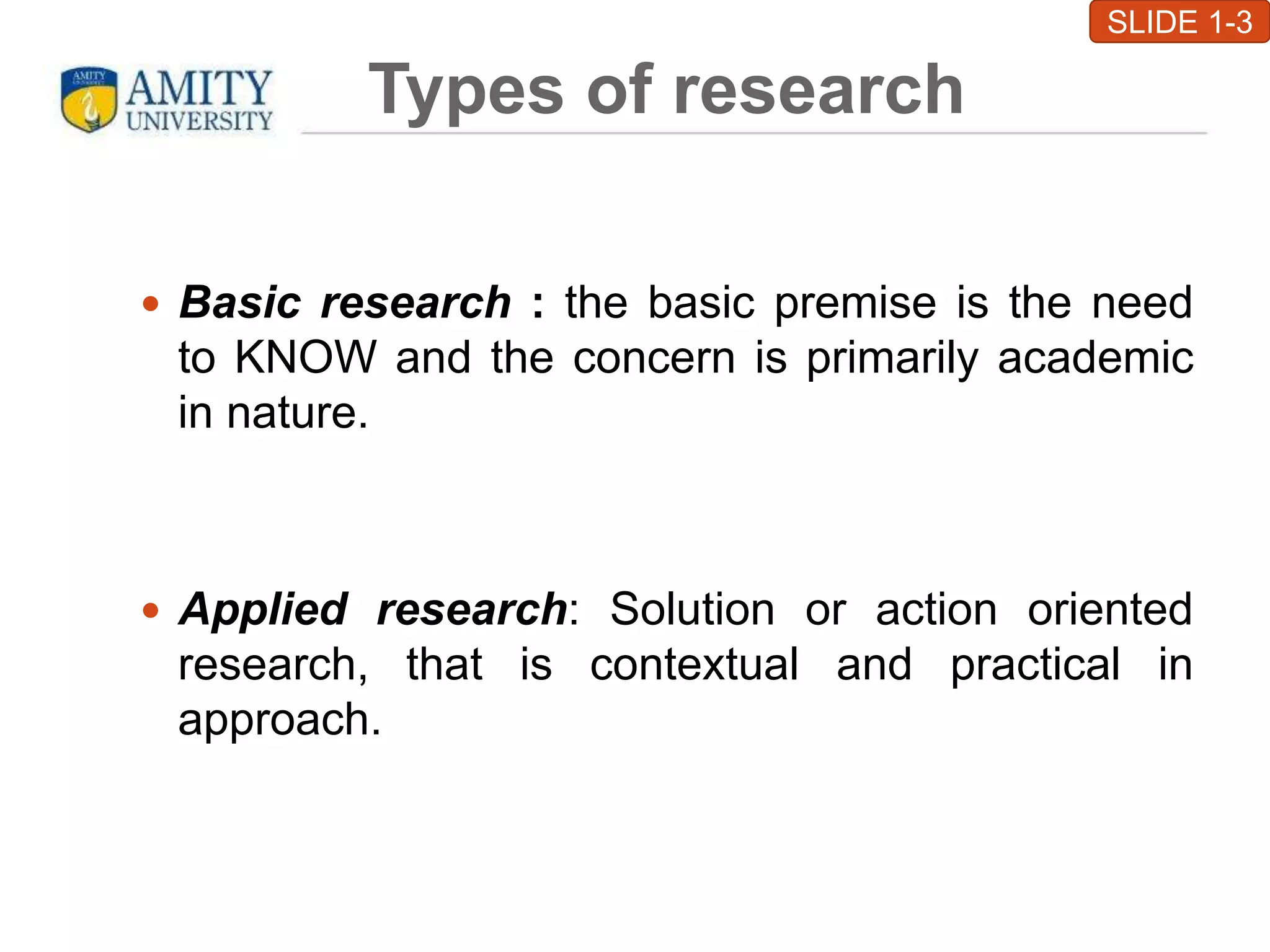
 Basic research : the basic premise is the need
to KNOW and the concern is primarily academic
in nature.
 Applied research: Solution or action oriented
research, that is contextual and practical in
approach.
SLIDE 1-3
Types of research
 Exploratory research is loosely structured and the
basic premise is to provide direction to subsequent,
more structured method of enquiry.
 Conclusive research is structured and definite in
orientation. These studies are usually conducted to
validate formulated hypotheses and specified
relationships.
SLIDE 1-4
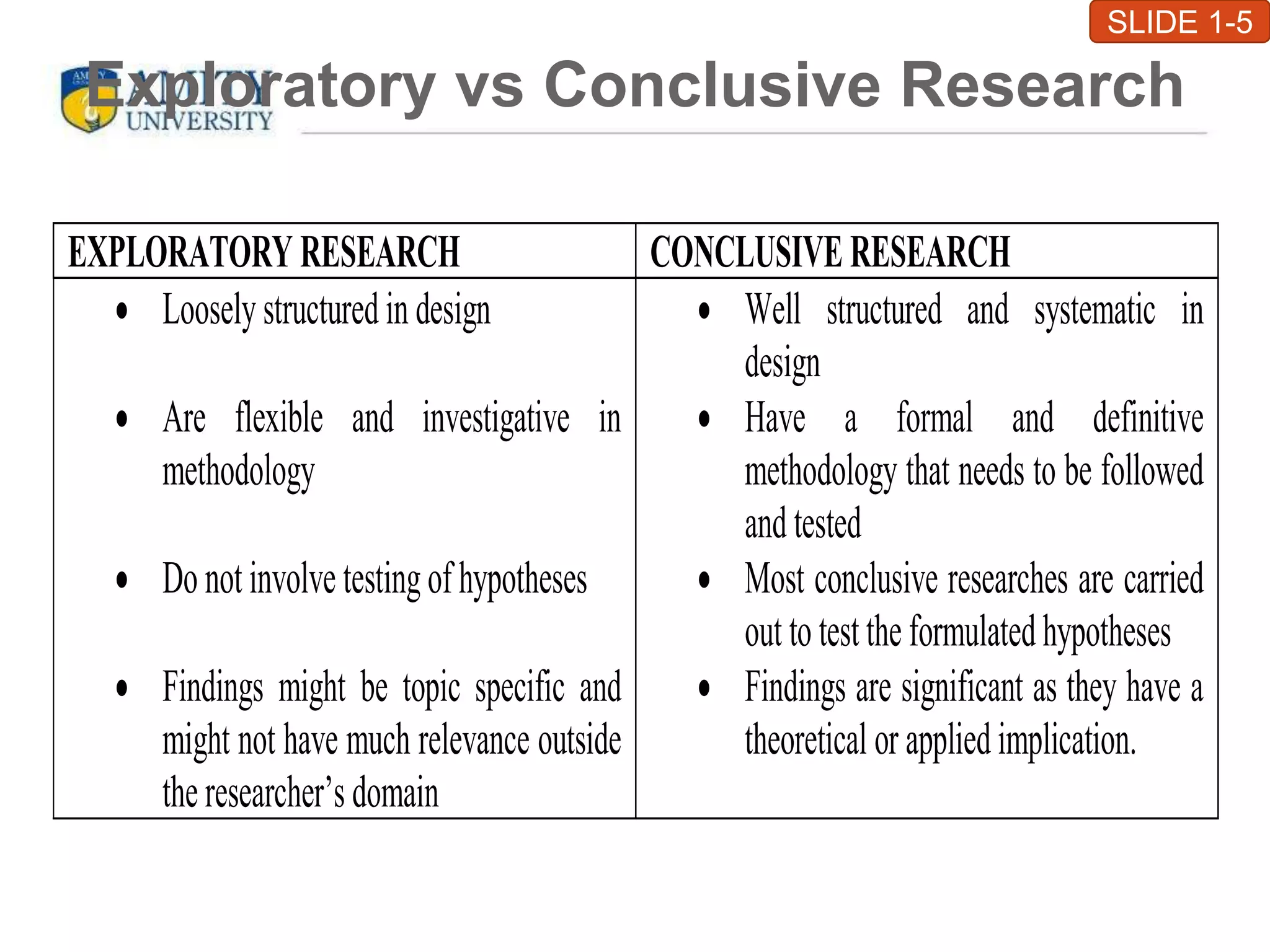
Exploratory vs Conclusive Research
EXPLORATORY RESEARCH CONCLUSIVE RESEARCH
 Loosely structured in design
 Are flexible and investigative in
methodology
 Do not involve testing of hypotheses
 Findings might be topic specific and
might not have much relevance outside
the researcher’s domain
 Well structured and systematic in
design
 Have a formal and definitive
methodology that needs to be followed
and tested
 Most conclusive researches are carried
out to test the formulated hypotheses
 Findings are significant as they have a
theoretical or applied implication.
SLIDE 1-5
Conclusive research
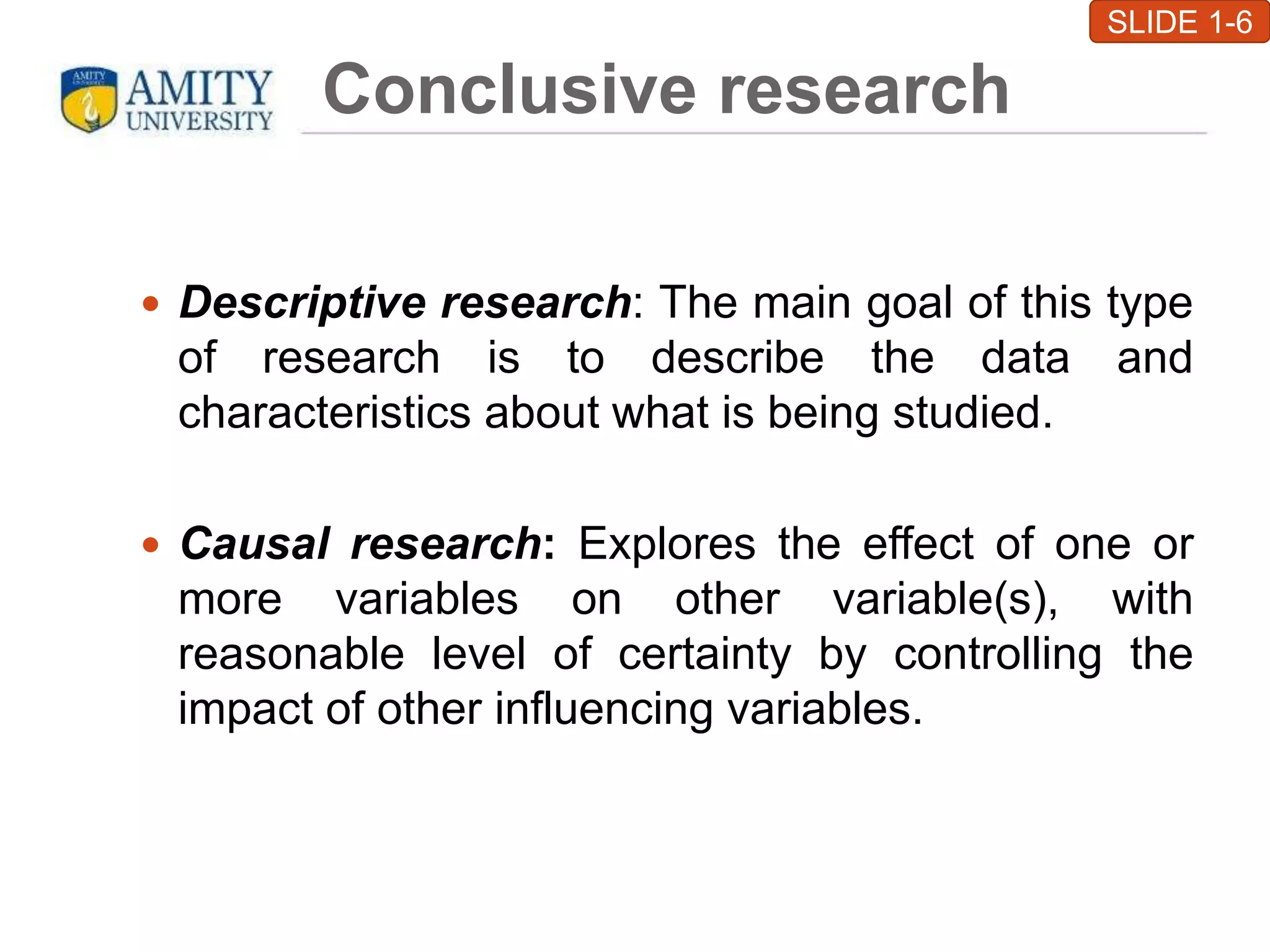
 Descriptive research: The main goal of this type
of research is to describe the data and
characteristics about what is being studied.
 Causal research: Explores the effect of one or
more variables on other variable(s), with
reasonable level of certainty by controlling the
impact of other influencing variables.
SLIDE 1-6
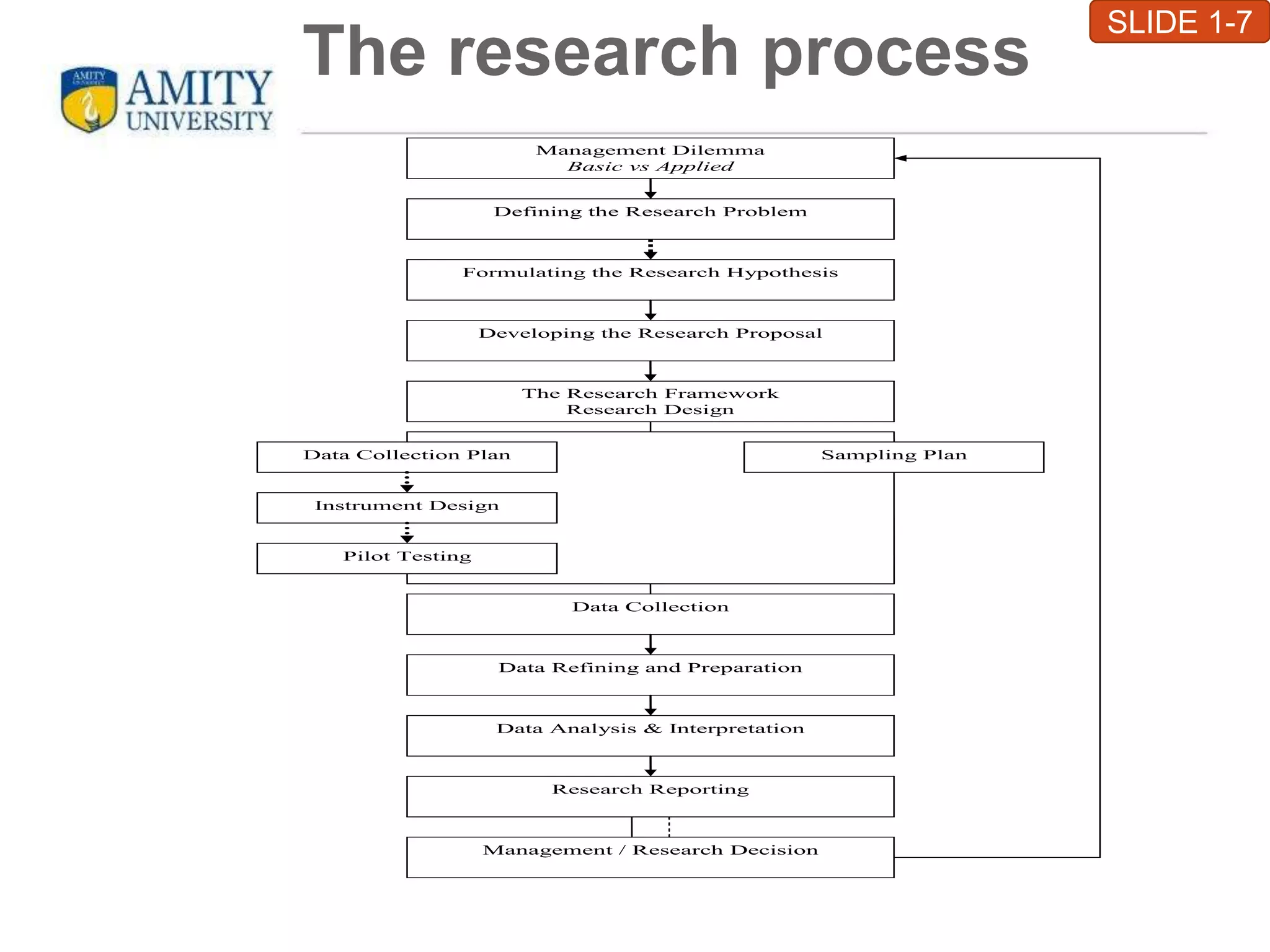
The research process
Management Dilemma
Basic vs Applied
Defining the Research Problem
Formulating the Research Hypothesis
Developing the Research Proposal
Data Collection
The Research Framework
Research Design
Data Collection Plan Sampling Plan
Instrument Design
Pilot Testing
Data Analysis & Interpretation
Research Reporting
Management / Research Decision
Data Refining and Preparation
SLIDE 1-7
The research process
 The management decision problem
 Defining the research problem
 Formulation of the working hypotheses
 Construction of the research proposal
SLIDE 1-8
The research process
 Formulating the research design
 Sampling considerations
 Collecting the data for the study
 Data analysis and interpretation of findings
SLIDE 1-9
Research applications in marketing
 Market & consumer analysis
 Product research
 Pricing research
 Promotional research
 Place research
SLIDE 1-10
Research applications in finance
 Asset pricing, capital markets and corporate finance
 Financial derivatives and credit risk modeling research
 Market-based accounting research
 Auditing and accountability
 Other areas: financial forecasting, behavioural finance,
volatility analysis
SLIDE 1-11
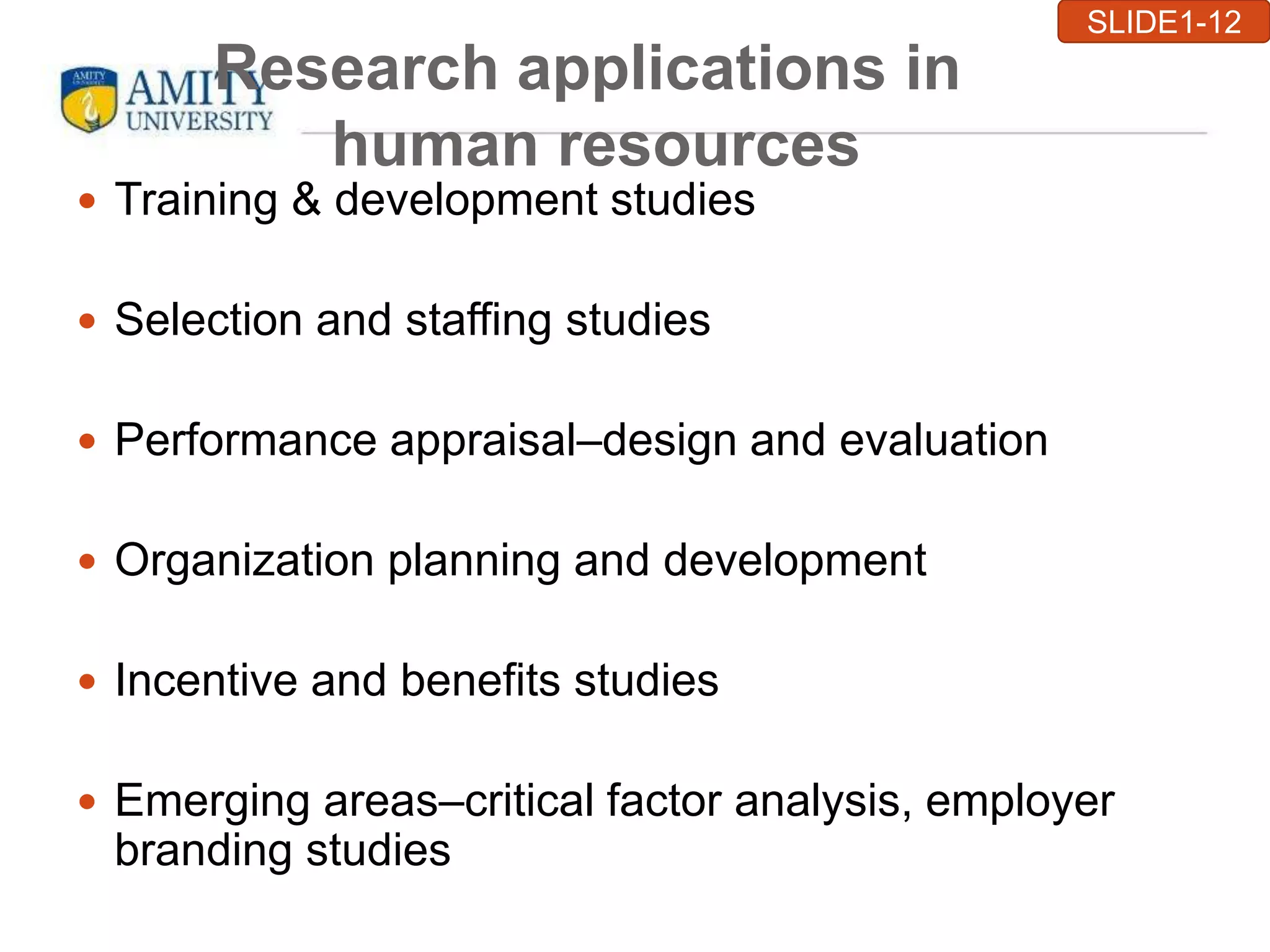
Research applications in
human resources
 Training & development studies
 Selection and staffing studies
 Performance appraisal–design and evaluation
 Organization planning and development
 Incentive and benefits studies
 Emerging areas–critical factor analysis, employer
branding studies
SLIDE1-12
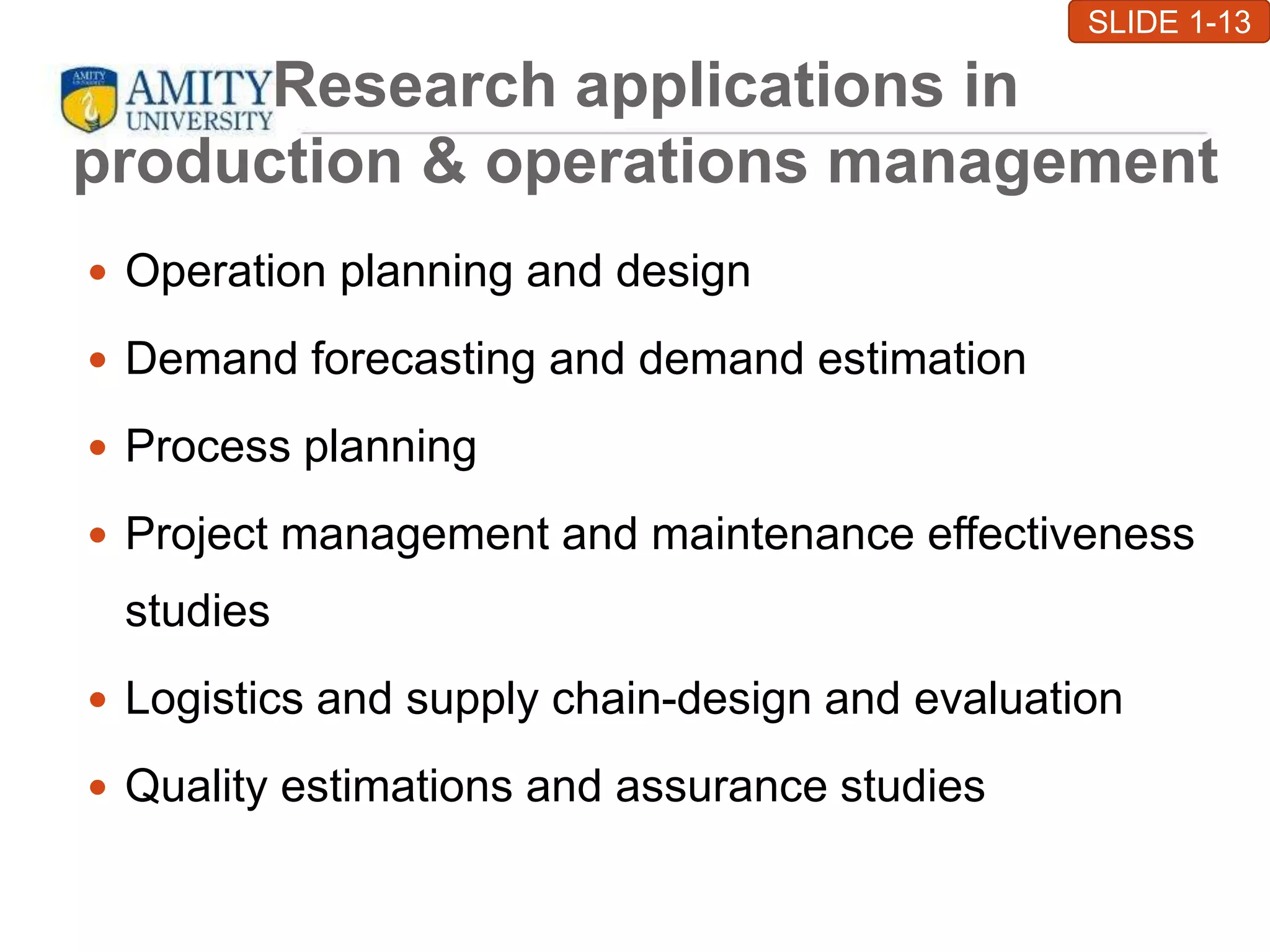
Research applications in
production & operations management
 Operation planning and design
 Demand forecasting and demand estimation
 Process planning
 Project management and maintenance effectiveness
studies
 Logistics and supply chain-design and evaluation
 Quality estimations and assurance studies
SLIDE 1-13
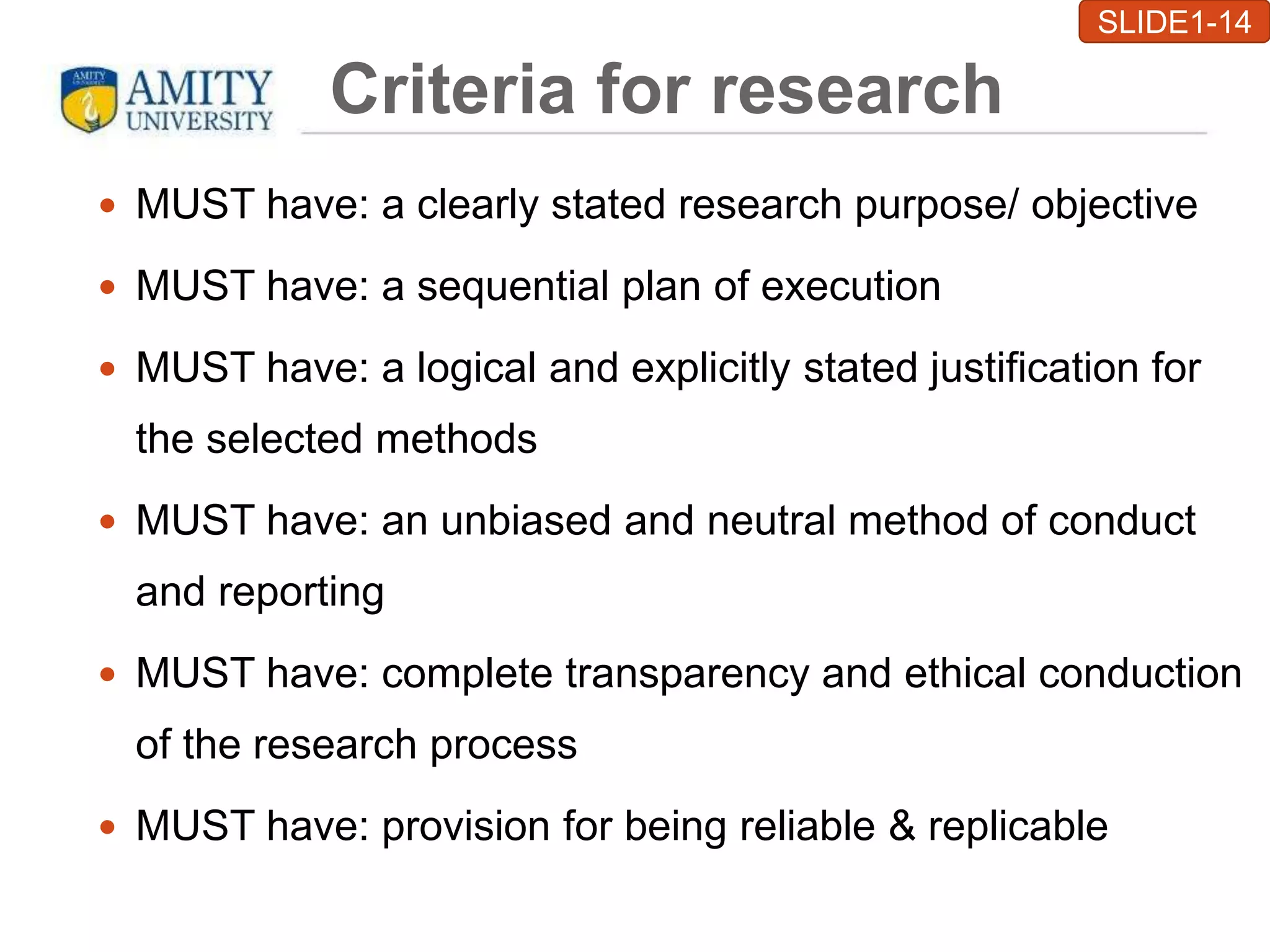
Criteria for research
 MUST have: a clearly stated research purpose/ objective
 MUST have: a sequential plan of execution
 MUST have: a logical and explicitly stated justification for
the selected methods
 MUST have: an unbiased and neutral method of conduct
and reporting
 MUST have: complete transparency and ethical conduction
of the research process
 MUST have: provision for being reliable & replicable
SLIDE1-14
END OF CHAPTER

Chapter 1 Introduction.pptx

  • 1.
  • 2.
    What is research? Managementresearch is an unbiased, structured, and sequential method of enquiry, directed towards a clear implicit or explicit business objective. This enquiry might lead to validating existing postulates or arriving at new theories and models. SLIDE 1-1
  • 3.
    Types of research BUSINESSRESEARCH CONCLUSIVE RESEARCH DESCRIPTIVE RESEARCH APPLIED RESEARCH BASIC RESEARCH EXPLORATORY RESEARCH CAUSAL RESEARCH SLIDE 1-2
  • 4.
    Types of research Basic research : the basic premise is the need to KNOW and the concern is primarily academic in nature.  Applied research: Solution or action oriented research, that is contextual and practical in approach. SLIDE 1-3
  • 5.
    Types of research Exploratory research is loosely structured and the basic premise is to provide direction to subsequent, more structured method of enquiry.  Conclusive research is structured and definite in orientation. These studies are usually conducted to validate formulated hypotheses and specified relationships. SLIDE 1-4
  • 6.
    Exploratory vs ConclusiveResearch EXPLORATORY RESEARCH CONCLUSIVE RESEARCH  Loosely structured in design  Are flexible and investigative in methodology  Do not involve testing of hypotheses  Findings might be topic specific and might not have much relevance outside the researcher’s domain  Well structured and systematic in design  Have a formal and definitive methodology that needs to be followed and tested  Most conclusive researches are carried out to test the formulated hypotheses  Findings are significant as they have a theoretical or applied implication. SLIDE 1-5
  • 7.
    Conclusive research  Descriptiveresearch: The main goal of this type of research is to describe the data and characteristics about what is being studied.  Causal research: Explores the effect of one or more variables on other variable(s), with reasonable level of certainty by controlling the impact of other influencing variables. SLIDE 1-6
  • 8.
    The research process ManagementDilemma Basic vs Applied Defining the Research Problem Formulating the Research Hypothesis Developing the Research Proposal Data Collection The Research Framework Research Design Data Collection Plan Sampling Plan Instrument Design Pilot Testing Data Analysis & Interpretation Research Reporting Management / Research Decision Data Refining and Preparation SLIDE 1-7
  • 9.
    The research process The management decision problem  Defining the research problem  Formulation of the working hypotheses  Construction of the research proposal SLIDE 1-8
  • 10.
    The research process Formulating the research design  Sampling considerations  Collecting the data for the study  Data analysis and interpretation of findings SLIDE 1-9
  • 11.
    Research applications inmarketing  Market & consumer analysis  Product research  Pricing research  Promotional research  Place research SLIDE 1-10
  • 12.
    Research applications infinance  Asset pricing, capital markets and corporate finance  Financial derivatives and credit risk modeling research  Market-based accounting research  Auditing and accountability  Other areas: financial forecasting, behavioural finance, volatility analysis SLIDE 1-11
  • 13.
    Research applications in humanresources  Training & development studies  Selection and staffing studies  Performance appraisal–design and evaluation  Organization planning and development  Incentive and benefits studies  Emerging areas–critical factor analysis, employer branding studies SLIDE1-12
  • 14.
    Research applications in production& operations management  Operation planning and design  Demand forecasting and demand estimation  Process planning  Project management and maintenance effectiveness studies  Logistics and supply chain-design and evaluation  Quality estimations and assurance studies SLIDE 1-13
  • 15.
    Criteria for research MUST have: a clearly stated research purpose/ objective  MUST have: a sequential plan of execution  MUST have: a logical and explicitly stated justification for the selected methods  MUST have: an unbiased and neutral method of conduct and reporting  MUST have: complete transparency and ethical conduction of the research process  MUST have: provision for being reliable & replicable SLIDE1-14
  • 16.