Business
Research Methods

Chapter 1:
Business Research - Introduction
Business Research Defined
Business research is defined as the
systematic and objective process of
generating information for aid in
making business decisions.
Scope of Business Research
• Used to solve operational and planning
problems - Mktg, HR, Finance, Prod’n
• Major forms of Research –
• Mkt research – understanding mktg
environment
• Operations Research – use of mathematical,
logical and analytical methods to find
optimal solutions
• Motivational research – Why employees,
consumers behave in a particular way
Business Research
• Research information is neither intuitive nor
haphazardly gathered.
• Literally, research (re-search) -“search
again”
• Business research must be objective
• Detached and impersonal rather than biased
• It facilitates the managerial decision process
for all aspects of a business.
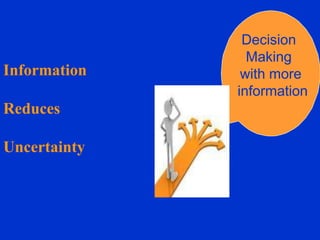
Information
Reduces

Uncertainty

Decision
Making
with more
information
“It ain’t the things we don’t know
that gets us in trouble. It’s the
things we know that ain’t so.”
Artemus Ward
Business Research Types
Basic research
Applied research
Basic Research
Refers to focused, systematic study or investigation
undertaken to discover new knowledge or interpretations
and establish facts or principles in a particular field

• Attempts to expand the limits of knowledge.
• Not directly involved in the solution to a
pragmatic problem.
Basic Research Example
• Law of demand and supply, theory of price
• Is executive success correlated with high
need for achievement?
• Are members of highly cohesive work
groups more satisfied than members of less
cohesive work groups?
• Understanding consumer buying process,
consumer learning process
• Do consumers experience cognitive
dissonance in low-involvement situations?
"The secret of success is to know something
nobody else knows. "
Aristotle Onassis
Applied Research
• Conducted when a decision must be made
about a specific real-life problem
Applied Research Examples
• Should McDonalds add Italian pasta dinners
to its menu?
• Business research told McDonald’s it
should not?
• Should Procter & Gamble increase or
decrease the price of ARIEL?
• Examining consumer response to a loyalty
program
Scientific Method
• The analysis and interpretation of empirical
evidence (facts from observation or
experimentation) to confirm or disprove
prior conceptions.
The Decision-making Process
Associated with the Development
and Implementation of a Strategy
• Identifying problems and opportunities
• Diagnosis and assessment
• Selecting and implementing a course of
action
• Evaluating the course of action
Evaluation Research
• Evaluation research is the formal, objective
measurement and appraisal of the extent to
which a given activity, project, or program
has achieved its objectives.
Performance-monitoring
Research
• Research that regularly provides feedback
for evaluation and control
• Indicates things are or are not going as
planned
• Research may be required to explain why
something “went wrong”
Total Quality Management
(TQM)
• A business philosophy that embodies the
belief that the management process must
focus on integrating customer-driven
quality throughout the organization.
TQM
• Stresses continuous improvement of
product quality and service.
• Managers improve durability and enhance
features as the product ages.
• Managers strive to improve delivery and
other services to keep their companies
competitive
Business Research decision
•
•
•
•
•

Time constraints
Availability of data
Resource constraints
Nature of the decision
Benefits versus costs
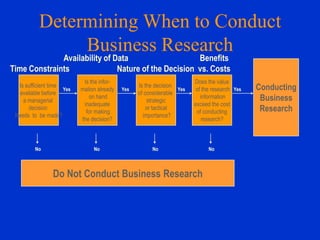
Determining When to Conduct
Business Research

Availability of Data
Benefits
Time Constraints
Nature of the Decision vs. Costs
Is sufficient time
Yes
available before
a managerial
decision
Needs to be made?

No

Is the information already
on hand
inadequate
for making
the decision?

No

Yes

Is the decision
Yes
of considerable
strategic
or tactical
importance?

Does the value
of the research Yes
information
exceed the cost
of conducting
research?

No

Do Not Conduct Business Research

No

Conducting
Business
Research
Value versus Costs
• Potential Value of a Business Research
Effort Should Exceed Its Estimated Costs
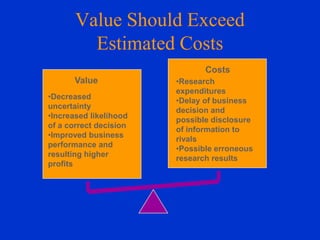
Value Should Exceed
Estimated Costs
Costs

Value
•Decreased
uncertainty
•Increased likelihood
of a correct decision
•Improved business
performance and
resulting higher
profits

•Research
expenditures
•Delay of business
decision and
possible disclosure
of information to
rivals
•Possible erroneous
research results
Major Topics for Research in
Business
• General Business Conditions and Corporate
Research
• Financial and Accounting Research
• Management and Organizational Behavior
Research
• Sales and Marketing Research
• Information Systems Research
• Corporate Responsibility Research
Cross-functional Teams
• Cross-functional teams are composed of
individuals from various organizational
departments such as engineering,
production, finance, and marketing who
share a common purpose.
Business Research in the 21st
Century
• Increased globalization
• Growth of the Internet and other
information technologies
Global Research
• Business Research is increasingly global
• Market knowledge is essential
• A.C. Nielsen - more that 67% international
business
Global Business Research
• General information about country economic conditions and political climate
• Cultural and consumer factors
• Market and competitive conditions demand estimation
The Internet
Is Transforming Society
• Time is collapsing.
• Distance is no longer an obstacle.
• Crossing oceans is only a mouse click
away.
• People are connected 24 hours a day, seven
days a week.
• "Instantaneous" information is available.
Internet Research
• Seeking facts and figures about an issue
• Surveys on Web sites

Introduction to research sukanya

  • 1.
  • 2.
    Business Research Defined Businessresearch is defined as the systematic and objective process of generating information for aid in making business decisions.
  • 3.
    Scope of BusinessResearch • Used to solve operational and planning problems - Mktg, HR, Finance, Prod’n • Major forms of Research – • Mkt research – understanding mktg environment • Operations Research – use of mathematical, logical and analytical methods to find optimal solutions • Motivational research – Why employees, consumers behave in a particular way
  • 4.
    Business Research • Researchinformation is neither intuitive nor haphazardly gathered. • Literally, research (re-search) -“search again” • Business research must be objective • Detached and impersonal rather than biased • It facilitates the managerial decision process for all aspects of a business.
  • 5.
  • 6.
    “It ain’t thethings we don’t know that gets us in trouble. It’s the things we know that ain’t so.” Artemus Ward
  • 7.
    Business Research Types Basicresearch Applied research
  • 8.
    Basic Research Refers tofocused, systematic study or investigation undertaken to discover new knowledge or interpretations and establish facts or principles in a particular field • Attempts to expand the limits of knowledge. • Not directly involved in the solution to a pragmatic problem.
  • 9.
    Basic Research Example •Law of demand and supply, theory of price • Is executive success correlated with high need for achievement? • Are members of highly cohesive work groups more satisfied than members of less cohesive work groups? • Understanding consumer buying process, consumer learning process • Do consumers experience cognitive dissonance in low-involvement situations?
  • 10.
    "The secret ofsuccess is to know something nobody else knows. " Aristotle Onassis
  • 11.
    Applied Research • Conductedwhen a decision must be made about a specific real-life problem
  • 12.
    Applied Research Examples •Should McDonalds add Italian pasta dinners to its menu? • Business research told McDonald’s it should not? • Should Procter & Gamble increase or decrease the price of ARIEL? • Examining consumer response to a loyalty program
  • 13.
    Scientific Method • Theanalysis and interpretation of empirical evidence (facts from observation or experimentation) to confirm or disprove prior conceptions.
  • 14.
    The Decision-making Process Associatedwith the Development and Implementation of a Strategy • Identifying problems and opportunities • Diagnosis and assessment • Selecting and implementing a course of action • Evaluating the course of action
  • 15.
    Evaluation Research • Evaluationresearch is the formal, objective measurement and appraisal of the extent to which a given activity, project, or program has achieved its objectives.
  • 16.
    Performance-monitoring Research • Research thatregularly provides feedback for evaluation and control • Indicates things are or are not going as planned • Research may be required to explain why something “went wrong”
  • 17.
    Total Quality Management (TQM) •A business philosophy that embodies the belief that the management process must focus on integrating customer-driven quality throughout the organization.
  • 18.
    TQM • Stresses continuousimprovement of product quality and service. • Managers improve durability and enhance features as the product ages. • Managers strive to improve delivery and other services to keep their companies competitive
  • 19.
    Business Research decision • • • • • Timeconstraints Availability of data Resource constraints Nature of the decision Benefits versus costs
  • 20.
    Determining When toConduct Business Research Availability of Data Benefits Time Constraints Nature of the Decision vs. Costs Is sufficient time Yes available before a managerial decision Needs to be made? No Is the information already on hand inadequate for making the decision? No Yes Is the decision Yes of considerable strategic or tactical importance? Does the value of the research Yes information exceed the cost of conducting research? No Do Not Conduct Business Research No Conducting Business Research
  • 21.
    Value versus Costs •Potential Value of a Business Research Effort Should Exceed Its Estimated Costs
  • 22.
    Value Should Exceed EstimatedCosts Costs Value •Decreased uncertainty •Increased likelihood of a correct decision •Improved business performance and resulting higher profits •Research expenditures •Delay of business decision and possible disclosure of information to rivals •Possible erroneous research results
  • 23.
    Major Topics forResearch in Business • General Business Conditions and Corporate Research • Financial and Accounting Research • Management and Organizational Behavior Research • Sales and Marketing Research • Information Systems Research • Corporate Responsibility Research
  • 24.
    Cross-functional Teams • Cross-functionalteams are composed of individuals from various organizational departments such as engineering, production, finance, and marketing who share a common purpose.
  • 25.
    Business Research inthe 21st Century • Increased globalization • Growth of the Internet and other information technologies
  • 26.
    Global Research • BusinessResearch is increasingly global • Market knowledge is essential • A.C. Nielsen - more that 67% international business
  • 27.
    Global Business Research •General information about country economic conditions and political climate • Cultural and consumer factors • Market and competitive conditions demand estimation
  • 28.
    The Internet Is TransformingSociety • Time is collapsing. • Distance is no longer an obstacle. • Crossing oceans is only a mouse click away. • People are connected 24 hours a day, seven days a week. • "Instantaneous" information is available.
  • 29.
    Internet Research • Seekingfacts and figures about an issue • Surveys on Web sites