God, Gold, &
Glory
An Introduction to Empire
Building
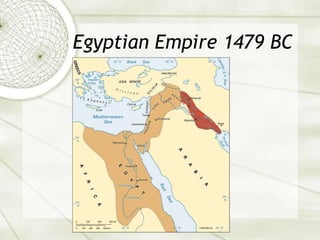
Egyptian Empire 1479 BC
Greek Empire 323 BC
Roman Empire 271 AD
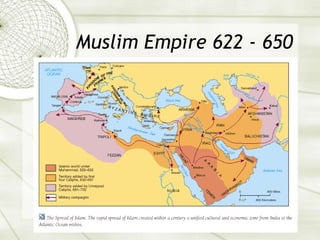
Muslim Empire 622 - 650
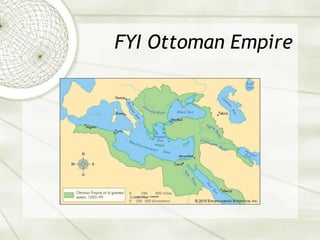
FYI Ottoman Empire
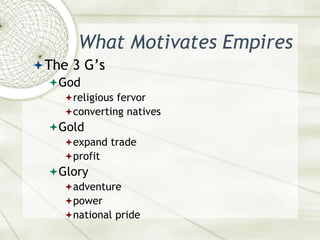
What Motivates Empires
The 3 G’s
God
religious fervor
converting natives
Gold
expand trade
profit
Glory
adventure
power
national pride
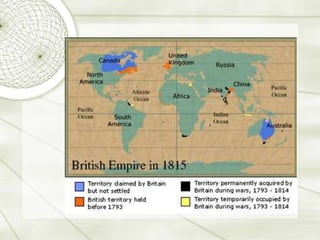
The 1st British Empire 1763
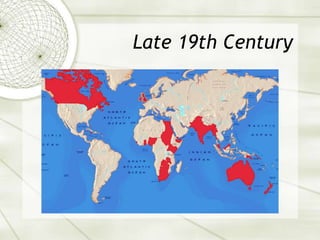
Late 19th Century
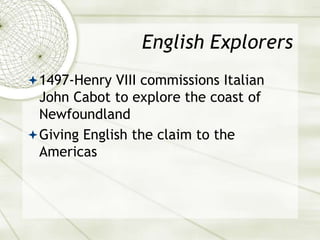
English Explorers
1497-Henry VIII commissions Italian
John Cabot to explore the coast of
Newfoundland
Giving English the claim to the
Americas
English Colonial Expansion
Beginnings of the
British Empire
John Cabot
1497-98
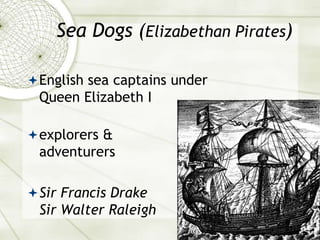
Sea Dogs (Elizabethan Pirates)
English sea captains under
Queen Elizabeth I
explorers &
adventurers
Sir Francis Drake
Sir Walter Raleigh
Piracy
1500’s English sea captains harass the
Portuguese and Spanish—become
Privateers or Pirates
1580’s Francis Drake-1st Englishman to
circumnavigate the globe was also a
pirate
1550-1850 the English crown gave
permits for pirates to operate on high
seas.
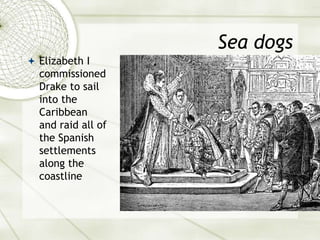
Sea dogs
 Elizabeth I
commissioned
Drake to sail
into the
Caribbean
and raid all of
the Spanish
settlements
along the
coastline
The Spanish Armada was assembled by
Spain to end British piracy but failed.
Pirates were celebrated as heroes
the Spanish Armada considered as an
instrument of Catholic repression.
Territories
Beginnings of the
British Empire
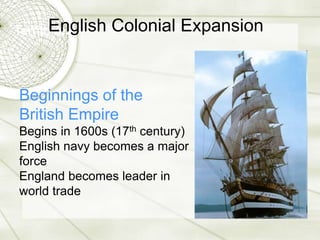
Begins in 1600s (17th century)
English navy becomes a major
force
England becomes leader in
world trade
English Colonial Expansion
Early settlements in America
1606- The Virginia Co. of London—sent
expeditions to America to search for
gold and silver
The following year the Co. founded the
1st permanent English settlement-
Jamestown
A group of religious dissenters -Pilgrims
founded a second colony Plymouth—
present day Massachusetts
The British in America
England was slow to establish colonies in America.
English Colonial Expansion
Jamestown 1607
English Colonial Expansion
Plymouth 1620
British East India Company 1600-1708
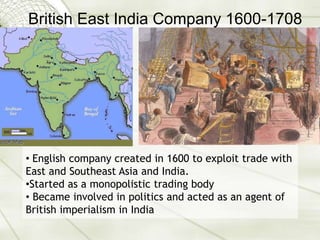
• English company created in 1600 to exploit trade with
East and Southeast Asia and India.
•Started as a monopolistic trading body
• Became involved in politics and acted as an agent of
British imperialism in India
English Colonial Expansion
Settled on the island of Jamaica (1655)
Bahamas (1648), and Barbados (1627)
1640-English introduce sugarcane
plantations to the island
Worked by slave labor
Made 3x’s more profit than tobacco
Slave Trade
In the 1600’s the colonies of the
America’s based their economies on
agricultural products that required
intensive labor
Sugar, tobacco, coffee, and mining
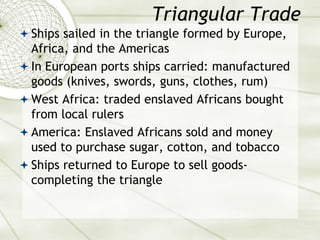
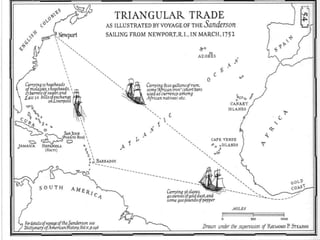
Triangular Trade
 Ships sailed in the triangle formed by Europe,
Africa, and the Americas
 In European ports ships carried: manufactured
goods (knives, swords, guns, clothes, rum)
 West Africa: traded enslaved Africans bought
from local rulers
 America: Enslaved Africans sold and money
used to purchase sugar, cotton, and tobacco
 Ships returned to Europe to sell goods-
completing the triangle
Sugar
• In colonies, British soon discovered
furs, tobacco, fish and potatoes and
mainly SUGAR
• Sugar made colonisation worthwhile.
• However, it required labor: Slaves.
An Empire of Trade
 British now drank tea with sugar.
 Tea brought from China by the East India
Company, who paid for it with opium grown
in India.
 Sugar grown in the British West Indies and
Southern States of America on plantations
owned by British emigrants and worked by
slaves
 Slaves bought by British merchants in Africa
and paid for with British manufactured
products – such as cooking pots, or guns.
In 1686 alone British colonies shipped
goods worth over £1 million to London.
 Exports to the colonies consisted
mainly of woollen textiles;
Imports included sugar, and other
addictive products such as tobacco and
coffee.
Coming next
Mercantilism Regulations
Colonists’ Resistance
Independance war

British Empire - Introductory chapter

  • 1.
    God, Gold, & Glory AnIntroduction to Empire Building
  • 2.
  • 3.
  • 4.
  • 5.
  • 6.
  • 7.
    What Motivates Empires The3 G’s God religious fervor converting natives Gold expand trade profit Glory adventure power national pride
  • 8.
    The 1st BritishEmpire 1763
  • 10.
  • 11.
    English Explorers 1497-Henry VIIIcommissions Italian John Cabot to explore the coast of Newfoundland Giving English the claim to the Americas
  • 12.
    English Colonial Expansion Beginningsof the British Empire John Cabot 1497-98
  • 13.
    Sea Dogs (ElizabethanPirates) English sea captains under Queen Elizabeth I explorers & adventurers Sir Francis Drake Sir Walter Raleigh
  • 14.
    Piracy 1500’s English seacaptains harass the Portuguese and Spanish—become Privateers or Pirates 1580’s Francis Drake-1st Englishman to circumnavigate the globe was also a pirate 1550-1850 the English crown gave permits for pirates to operate on high seas.
  • 15.
    Sea dogs  ElizabethI commissioned Drake to sail into the Caribbean and raid all of the Spanish settlements along the coastline
  • 16.
    The Spanish Armadawas assembled by Spain to end British piracy but failed. Pirates were celebrated as heroes the Spanish Armada considered as an instrument of Catholic repression.
  • 17.
    Territories Beginnings of the BritishEmpire Begins in 1600s (17th century) English navy becomes a major force England becomes leader in world trade English Colonial Expansion
  • 18.
    Early settlements inAmerica 1606- The Virginia Co. of London—sent expeditions to America to search for gold and silver The following year the Co. founded the 1st permanent English settlement- Jamestown A group of religious dissenters -Pilgrims founded a second colony Plymouth— present day Massachusetts
  • 19.
    The British inAmerica England was slow to establish colonies in America. English Colonial Expansion Jamestown 1607
  • 20.
  • 21.
    British East IndiaCompany 1600-1708 • English company created in 1600 to exploit trade with East and Southeast Asia and India. •Started as a monopolistic trading body • Became involved in politics and acted as an agent of British imperialism in India
  • 22.
    English Colonial Expansion Settledon the island of Jamaica (1655) Bahamas (1648), and Barbados (1627) 1640-English introduce sugarcane plantations to the island Worked by slave labor Made 3x’s more profit than tobacco
  • 23.
    Slave Trade In the1600’s the colonies of the America’s based their economies on agricultural products that required intensive labor Sugar, tobacco, coffee, and mining
  • 24.
    Triangular Trade  Shipssailed in the triangle formed by Europe, Africa, and the Americas  In European ports ships carried: manufactured goods (knives, swords, guns, clothes, rum)  West Africa: traded enslaved Africans bought from local rulers  America: Enslaved Africans sold and money used to purchase sugar, cotton, and tobacco  Ships returned to Europe to sell goods- completing the triangle
  • 26.
    Sugar • In colonies,British soon discovered furs, tobacco, fish and potatoes and mainly SUGAR • Sugar made colonisation worthwhile. • However, it required labor: Slaves.
  • 27.
    An Empire ofTrade  British now drank tea with sugar.  Tea brought from China by the East India Company, who paid for it with opium grown in India.  Sugar grown in the British West Indies and Southern States of America on plantations owned by British emigrants and worked by slaves  Slaves bought by British merchants in Africa and paid for with British manufactured products – such as cooking pots, or guns.
  • 28.
    In 1686 aloneBritish colonies shipped goods worth over £1 million to London.  Exports to the colonies consisted mainly of woollen textiles; Imports included sugar, and other addictive products such as tobacco and coffee.
  • 29.