European Exploration 
10/4/13
What did Europe want? 
European countries explored 
the world for 3 reasons… 
 spread Christianity 
 gain territory 
 get rich
Portugal’s Empire
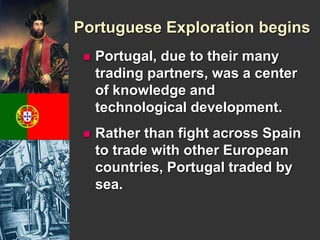
Portuguese Exploration begins 
 Portugal was a good base for 
sailors because… 
 It has a lot of shoreline 
 It had many harbors/ports 
 Many rivers to travel on that 
flowed westward to the 
Atlantic Ocean.
Portuguese Exploration begins 
 Portugal, due to their many 
trading partners, was a center 
of knowledge and 
technological development. 
 Rather than fight across Spain 
to trade with other European 
countries, Portugal traded by 
sea.
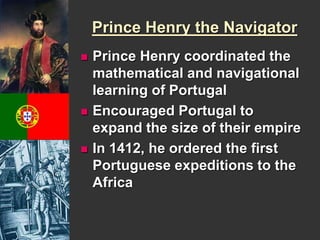
Prince Henry the Navigator 
 Prince Henry coordinated the 
mathematical and navigational 
learning of Portugal 
 Encouraged Portugal to 
expand the size of their empire 
 In 1412, he ordered the first 
Portuguese expeditions to the 
Africa
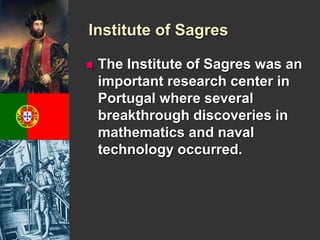
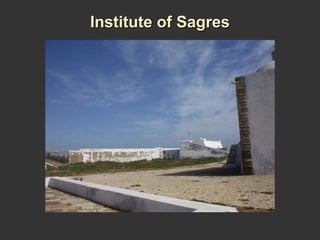
Institute of Sagres 
 The Institute of Sagres was an 
important research center in 
Portugal where several 
breakthrough discoveries in 
mathematics and naval 
technology occurred.
Institute of Sagres
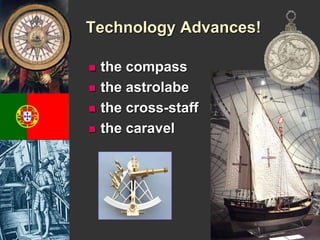
Technology Advances! 
 the compass 
 the astrolabe 
 the cross-staff 
 the caravel
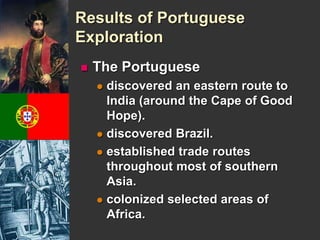
Results of Portuguese 
Exploration 
 The Portuguese 
 discovered an eastern route to 
India (around the Cape of Good 
Hope). 
 discovered Brazil. 
 established trade routes 
throughout most of southern 
Asia. 
 colonized selected areas of 
Africa.
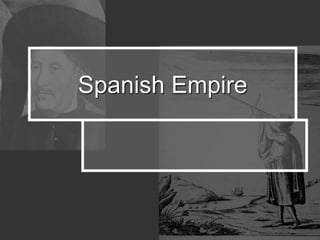
Spanish Empire
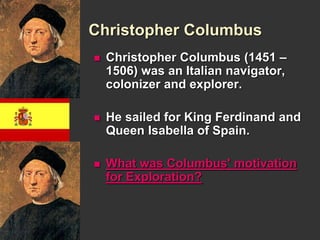
Christopher Columbus 
 Christopher Columbus (1451 – 
1506) was an Italian navigator, 
colonizer and explorer. 
 He sailed for King Ferdinand and 
Queen Isabella of Spain. 
 What was Columbus' motivation 
for Exploration?
Christopher Columbus 
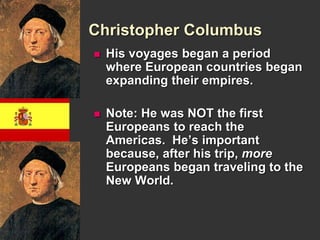
 His voyages began a period 
where European countries began 
expanding their empires. 
 Note: He was NOT the first 
Europeans to reach the 
Americas. He’s important 
because, after his trip, more 
Europeans began traveling to the 
New World.
Christopher Columbus 
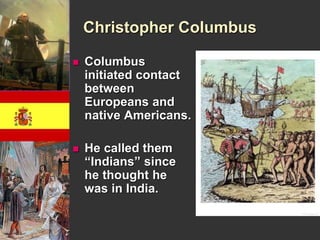
 Columbus 
initiated contact 
between 
Europeans and 
native Americans. 
 He called them 
“Indians” since 
he thought he 
was in India.
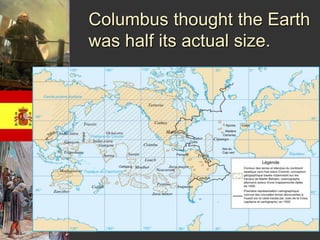
Columbus thought the Earth 
was half its actual size.
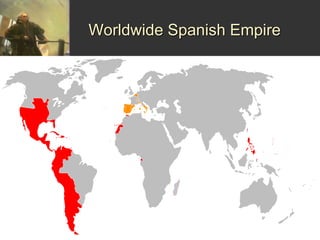
Worldwide Spanish Empire
Conquistadors 
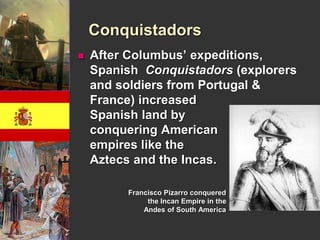
 After Columbus’ expeditions, 
Spanish Conquistadors (explorers 
and soldiers from Portugal & 
France) increased 
Spanish land by 
conquering American 
empires like the 
Aztecs and the Incas. 
Francisco Pizarro conquered 
the Incan Empire in the 
Andes of South America
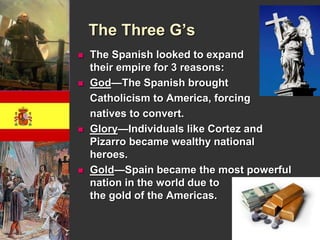
The Three G’s 
 The Spanish looked to expand 
their empire for 3 reasons: 
 God—The Spanish brought 
Catholicism to America, forcing 
natives to convert. 
 Glory—Individuals like Cortez and 
Pizarro became wealthy national 
heroes. 
 Gold—Spain became the most powerful 
nation in the world due to 
the gold of the Americas.
British Empire 
AKA English Empire
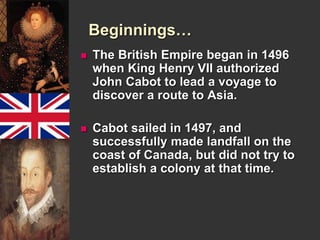
Beginnings… 
 The British Empire began in 1496 
when King Henry VII authorized 
John Cabot to lead a voyage to 
discover a route to Asia. 
 Cabot sailed in 1497, and 
successfully made landfall on the 
coast of Canada, but did not try to 
establish a colony at that time.
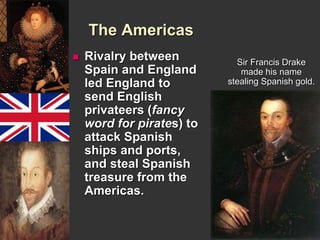
The Americas 
 Rivalry between 
Spain and England 
led England to 
send English 
privateers (fancy 
word for pirates) to 
attack Spanish 
ships and ports, 
and steal Spanish 
treasure from the 
Americas. 
Sir Francis Drake 
made his name 
stealing Spanish gold.
British America - 1750 
 In 1607, Jamestown became 
England’s first colony. 
 It eventually became the Colony 
of Virginia, the first of the 13 
colonies. 
 Soon, the Caribbean became 
England's most important 
colonies due to sugar plantations.
The Sun Never Sets on the 
British Empire… 
 Eventually, after colonizing 
parts of Africa and Asia, the 
British Empire became the 
largest empire in history.
The Sun Never Sets on the 
British Empire… 
 At the peak of its power, it was 
often said that “The sun never 
sets on the British Empire" 
because it was so big that the 
sun was always shining on at 
least one of its many colonies.
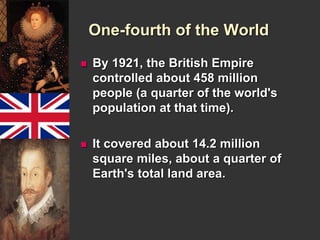
One-fourth of the World 
 By 1921, the British Empire 
controlled about 458 million 
people (a quarter of the world's 
population at that time). 
 It covered about 14.2 million 
square miles, about a quarter of 
Earth's total land area.
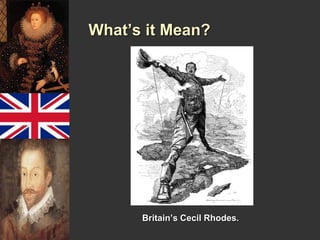
What’s it Mean? 
Britain’s Cecil Rhodes.
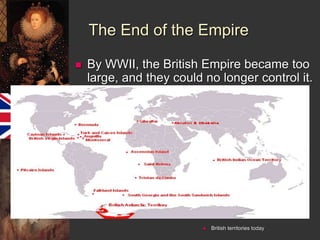
The End of the Empire 
 By WWII, the British Empire became too 
large, and they could no longer control it. 
 British territories today
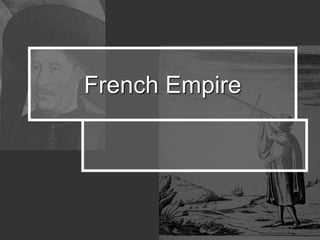
French Empire
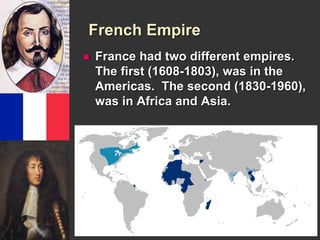
French Empire 
 France had two different empires. 
The first (1608-1803), was in the 
Americas. The second (1830-1960), 
was in Africa and Asia.
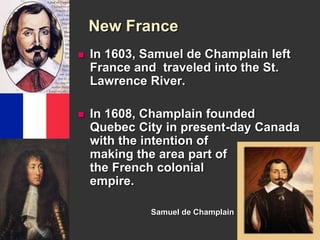
New France 
 In 1603, Samuel de Champlain left 
France and traveled into the St. 
Lawrence River. 
 In 1608, Champlain founded 
Quebec City in present-day Canada 
with the intention of 
making the area part of 
the French colonial 
empire. 
Samuel de Champlain
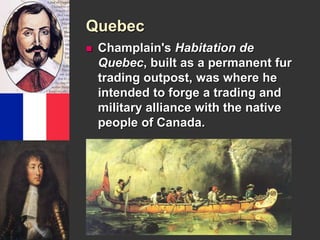
Quebec 
 Champlain's Habitation de 
Quebec, built as a permanent fur 
trading outpost, was where he 
intended to forge a trading and 
military alliance with the native 
people of Canada.
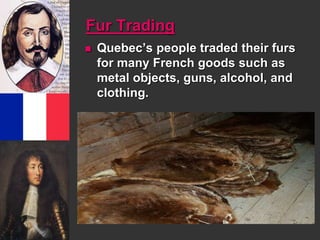
Fur Trading 
 Quebec’s people traded their furs 
for many French goods such as 
metal objects, guns, alcohol, and 
clothing.
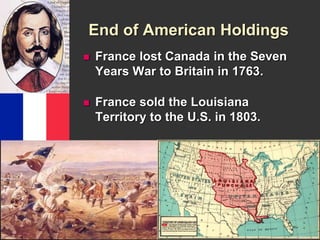
End of American Holdings 
 France lost Canada in the Seven 
Years War to Britain in 1763. 
 France sold the Louisiana 
Territory to the U.S. in 1803.
Dutch Empire
Background 
 In the late 1500s, the Dutch 
enjoyed one of the highest 
standards of living. 
 They grew rich through trade. 
 By this time, they had thrown off 
Spanish control and began a 
period of rapid expansion.
Why explore? 
 The Netherlands is small, with 
little room for farming or 
manufacturing. 
 The Dutch had 4 goals for 
their exploration…
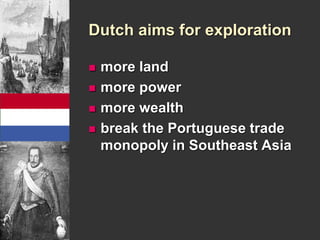
Dutch aims for exploration 
 more land 
 more power 
 more wealth 
 break the Portuguese trade 
monopoly in Southeast Asia
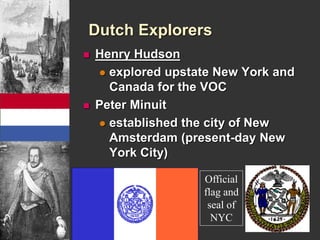
Dutch Explorers 
 Henry Hudson 
 explored upstate New York and 
Canada for the VOC 
 Peter Minuit 
 established the city of New 
Amsterdam (present-day New 
York City) 
Official 
flag and 
seal of 
NYC
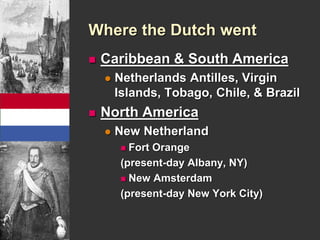
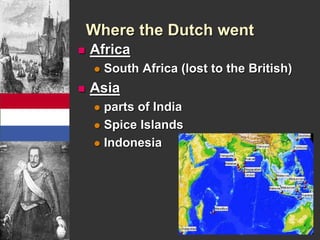
Where the Dutch went 
 Caribbean & South America 
 Netherlands Antilles, Virgin 
Islands, Tobago, Chile, & Brazil 
 North America 
 New Netherland 
 Fort Orange 
(present-day Albany, NY) 
 New Amsterdam 
(present-day New York City)
Where the Dutch went 
 Africa 
 South Africa (lost to the British) 
 Asia 
 parts of India 
 Spice Islands 
 Indonesia
Benefits for the Dutch 
 removed power from rival 
states (especially Portugal) 
 huge economic boost 
(especially from the spice 
trade) 
 land for agriculture

European Exploration

  • 1.
  • 2.
    What did Europewant? European countries explored the world for 3 reasons…  spread Christianity  gain territory  get rich
  • 3.
  • 4.
    Portuguese Exploration begins  Portugal was a good base for sailors because…  It has a lot of shoreline  It had many harbors/ports  Many rivers to travel on that flowed westward to the Atlantic Ocean.
  • 5.
    Portuguese Exploration begins  Portugal, due to their many trading partners, was a center of knowledge and technological development.  Rather than fight across Spain to trade with other European countries, Portugal traded by sea.
  • 6.
    Prince Henry theNavigator  Prince Henry coordinated the mathematical and navigational learning of Portugal  Encouraged Portugal to expand the size of their empire  In 1412, he ordered the first Portuguese expeditions to the Africa
  • 7.
    Institute of Sagres  The Institute of Sagres was an important research center in Portugal where several breakthrough discoveries in mathematics and naval technology occurred.
  • 8.
  • 9.
    Technology Advances! the compass  the astrolabe  the cross-staff  the caravel
  • 10.
    Results of Portuguese Exploration  The Portuguese  discovered an eastern route to India (around the Cape of Good Hope).  discovered Brazil.  established trade routes throughout most of southern Asia.  colonized selected areas of Africa.
  • 11.
  • 12.
    Christopher Columbus Christopher Columbus (1451 – 1506) was an Italian navigator, colonizer and explorer.  He sailed for King Ferdinand and Queen Isabella of Spain.  What was Columbus' motivation for Exploration?
  • 13.
    Christopher Columbus His voyages began a period where European countries began expanding their empires.  Note: He was NOT the first Europeans to reach the Americas. He’s important because, after his trip, more Europeans began traveling to the New World.
  • 14.
    Christopher Columbus Columbus initiated contact between Europeans and native Americans.  He called them “Indians” since he thought he was in India.
  • 15.
    Columbus thought theEarth was half its actual size.
  • 16.
  • 17.
    Conquistadors  AfterColumbus’ expeditions, Spanish Conquistadors (explorers and soldiers from Portugal & France) increased Spanish land by conquering American empires like the Aztecs and the Incas. Francisco Pizarro conquered the Incan Empire in the Andes of South America
  • 18.
    The Three G’s  The Spanish looked to expand their empire for 3 reasons:  God—The Spanish brought Catholicism to America, forcing natives to convert.  Glory—Individuals like Cortez and Pizarro became wealthy national heroes.  Gold—Spain became the most powerful nation in the world due to the gold of the Americas.
  • 19.
    British Empire AKAEnglish Empire
  • 20.
    Beginnings…  TheBritish Empire began in 1496 when King Henry VII authorized John Cabot to lead a voyage to discover a route to Asia.  Cabot sailed in 1497, and successfully made landfall on the coast of Canada, but did not try to establish a colony at that time.
  • 21.
    The Americas Rivalry between Spain and England led England to send English privateers (fancy word for pirates) to attack Spanish ships and ports, and steal Spanish treasure from the Americas. Sir Francis Drake made his name stealing Spanish gold.
  • 22.
    British America -1750  In 1607, Jamestown became England’s first colony.  It eventually became the Colony of Virginia, the first of the 13 colonies.  Soon, the Caribbean became England's most important colonies due to sugar plantations.
  • 23.
    The Sun NeverSets on the British Empire…  Eventually, after colonizing parts of Africa and Asia, the British Empire became the largest empire in history.
  • 24.
    The Sun NeverSets on the British Empire…  At the peak of its power, it was often said that “The sun never sets on the British Empire" because it was so big that the sun was always shining on at least one of its many colonies.
  • 25.
    One-fourth of theWorld  By 1921, the British Empire controlled about 458 million people (a quarter of the world's population at that time).  It covered about 14.2 million square miles, about a quarter of Earth's total land area.
  • 26.
    What’s it Mean? Britain’s Cecil Rhodes.
  • 27.
    The End ofthe Empire  By WWII, the British Empire became too large, and they could no longer control it.  British territories today
  • 28.
  • 29.
    French Empire France had two different empires. The first (1608-1803), was in the Americas. The second (1830-1960), was in Africa and Asia.
  • 30.
    New France In 1603, Samuel de Champlain left France and traveled into the St. Lawrence River.  In 1608, Champlain founded Quebec City in present-day Canada with the intention of making the area part of the French colonial empire. Samuel de Champlain
  • 31.
    Quebec  Champlain'sHabitation de Quebec, built as a permanent fur trading outpost, was where he intended to forge a trading and military alliance with the native people of Canada.
  • 32.
    Fur Trading Quebec’s people traded their furs for many French goods such as metal objects, guns, alcohol, and clothing.
  • 33.
    End of AmericanHoldings  France lost Canada in the Seven Years War to Britain in 1763.  France sold the Louisiana Territory to the U.S. in 1803.
  • 34.
  • 35.
    Background  Inthe late 1500s, the Dutch enjoyed one of the highest standards of living.  They grew rich through trade.  By this time, they had thrown off Spanish control and began a period of rapid expansion.
  • 36.
    Why explore? The Netherlands is small, with little room for farming or manufacturing.  The Dutch had 4 goals for their exploration…
  • 37.
    Dutch aims forexploration  more land  more power  more wealth  break the Portuguese trade monopoly in Southeast Asia
  • 38.
    Dutch Explorers Henry Hudson  explored upstate New York and Canada for the VOC  Peter Minuit  established the city of New Amsterdam (present-day New York City) Official flag and seal of NYC
  • 39.
    Where the Dutchwent  Caribbean & South America  Netherlands Antilles, Virgin Islands, Tobago, Chile, & Brazil  North America  New Netherland  Fort Orange (present-day Albany, NY)  New Amsterdam (present-day New York City)
  • 40.
    Where the Dutchwent  Africa  South Africa (lost to the British)  Asia  parts of India  Spice Islands  Indonesia
  • 41.
    Benefits for theDutch  removed power from rival states (especially Portugal)  huge economic boost (especially from the spice trade)  land for agriculture