India Before the  British Raj
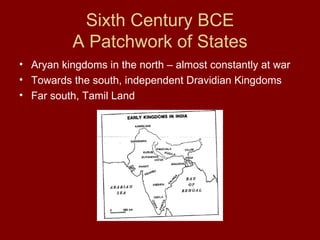
Sixth Century BCE A Patchwork of States Aryan kingdoms in the north – almost constantly at war Towards the south, independent Dravidian Kingdoms Far south, Tamil Land
Fourth Century BCE Greek conquest Alexander the Great was the first ruler that we know of who tried to unite all Indians under one government Alexander encountered elephants for the first time, he had to change his battle plans Alexander crushed one Indian prince after another and encouraged intermarriage between his troops and the Indians Eventually Alexander’s men mutinied, they had travelled thousands of kilometres and were afraid of tales of fierce peoples and beasts in unknown lands While he did not achieve all his aims, Alexander showed the weakness of a country divided into petty states
4th Century BCE – 2 nd  Century BCE Mauryan Empire Led by Chandraguptya Maurya According to legend, he visited Alexander and asked how he could acquire a kingdom of his own He attacked some of the garrisons left by Alexander He became king of Magadha Within a decade he was the master of the Punjab and Indus Valley At the height of his power, Chandragupta controlled 80% of India He became extremely wealthy He developed bureaucracy, irrigation, road networks and standing army
Looking at the evidence “ With increasing strength, make war; when you have a clear advantage over a neighbour, march against him; do not disturb the customs of a newly conquered people… Government is the science of punishment”
Ashoka during the Mauryan Empire Grandson of Chandragupta After a bloody invasion into Kalinga, Ashoka became a devout Buddhist His edicts were carved into pillars and rocks around India “ All men are my children and just as I desire for my children that they may enjoy every kind of prosperity and happiness, both in this world and the next, so also I desire the same for all men” He established hospitals and schools, free rest houses, inns, kitchens and wells India became fragmented soon after Ashoka’s death
320-535 CE Gupta Empire Founded by Chandragupta I (not known if he was related to Chandragupta Maurya) Height of power under Chandragupta II He became a peace loving ruler like Ashoka Empire declined when the White Huns invaded – terrorised India India was again divided
Muslim conquest After the Huns, Arabs were next invaders Fanatically devout – launched a holy war in 632 CE after the death of Muhammad Mainly dominated the north-west India, converting many Hindus and Buddhists to Islam Several brutal battles with Hindus
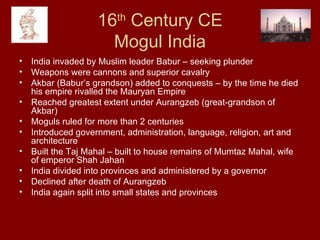
16 th  Century CE Mogul India India invaded by Muslim leader Babur – seeking plunder Weapons were cannons and superior cavalry Akbar (Babur’s grandson) added to conquests – by the time he died his empire rivalled the Mauryan Empire Reached greatest extent under Aurangzeb (great-grandson of Akbar)  Moguls ruled for more than 2 centuries Introduced government, administration, language, religion, art and architecture Built the Taj Mahal – built to house remains of Mumtaz Mahal, wife of emperor Shah Jahan India divided into provinces and administered by a governor Declined after death of Aurangzeb India again split into small states and provinces
 

India before the british raj

  • 1.
    India Before the British Raj
  • 2.
    Sixth Century BCEA Patchwork of States Aryan kingdoms in the north – almost constantly at war Towards the south, independent Dravidian Kingdoms Far south, Tamil Land
  • 3.
    Fourth Century BCEGreek conquest Alexander the Great was the first ruler that we know of who tried to unite all Indians under one government Alexander encountered elephants for the first time, he had to change his battle plans Alexander crushed one Indian prince after another and encouraged intermarriage between his troops and the Indians Eventually Alexander’s men mutinied, they had travelled thousands of kilometres and were afraid of tales of fierce peoples and beasts in unknown lands While he did not achieve all his aims, Alexander showed the weakness of a country divided into petty states
  • 4.
    4th Century BCE– 2 nd Century BCE Mauryan Empire Led by Chandraguptya Maurya According to legend, he visited Alexander and asked how he could acquire a kingdom of his own He attacked some of the garrisons left by Alexander He became king of Magadha Within a decade he was the master of the Punjab and Indus Valley At the height of his power, Chandragupta controlled 80% of India He became extremely wealthy He developed bureaucracy, irrigation, road networks and standing army
  • 5.
    Looking at theevidence “ With increasing strength, make war; when you have a clear advantage over a neighbour, march against him; do not disturb the customs of a newly conquered people… Government is the science of punishment”
  • 6.
    Ashoka during theMauryan Empire Grandson of Chandragupta After a bloody invasion into Kalinga, Ashoka became a devout Buddhist His edicts were carved into pillars and rocks around India “ All men are my children and just as I desire for my children that they may enjoy every kind of prosperity and happiness, both in this world and the next, so also I desire the same for all men” He established hospitals and schools, free rest houses, inns, kitchens and wells India became fragmented soon after Ashoka’s death
  • 7.
    320-535 CE GuptaEmpire Founded by Chandragupta I (not known if he was related to Chandragupta Maurya) Height of power under Chandragupta II He became a peace loving ruler like Ashoka Empire declined when the White Huns invaded – terrorised India India was again divided
  • 8.
    Muslim conquest Afterthe Huns, Arabs were next invaders Fanatically devout – launched a holy war in 632 CE after the death of Muhammad Mainly dominated the north-west India, converting many Hindus and Buddhists to Islam Several brutal battles with Hindus
  • 9.
    16 th Century CE Mogul India India invaded by Muslim leader Babur – seeking plunder Weapons were cannons and superior cavalry Akbar (Babur’s grandson) added to conquests – by the time he died his empire rivalled the Mauryan Empire Reached greatest extent under Aurangzeb (great-grandson of Akbar) Moguls ruled for more than 2 centuries Introduced government, administration, language, religion, art and architecture Built the Taj Mahal – built to house remains of Mumtaz Mahal, wife of emperor Shah Jahan India divided into provinces and administered by a governor Declined after death of Aurangzeb India again split into small states and provinces
  • 10.

Editor's Notes

  • #6 Quote comes from Arthashastra, a manual on politics written by Chandragupta’s advisor Kautilya. Picture is a painting showing Chandragupta receiving his morning salute from his bodyguard of women soldiers. Questions: What can you tell about the nature of Chandragupta’s government from this quote? – Ruled with an iron fist. Secret police force – those whose loyalty was suspected were tortured and killed. Why would Kautilya advise Chandragupta not to disturb the customs of a newly conquered people?
  • #7 Regarding the quote - How do the attitudes of Chandragupta and Ashoka differ?
  • #10 Forced conversions to Islam Akbar married a Hindu and invited debate between the followers of the major religions. He tried to found a new religion that would unite all the religions of India but failed to attract followers. Taj Mahal – 20,000 craftsmen and labourers worked for 22 years to complete the building.