Breech presentation
by DR THENMOLEE SUBRAMONIE
• The definition of breech
presentation is when the
buttocks, foot or feet are
presenting instead of the head
classifications
• Frank breech where the hips are flexed and
legs extended
• Complete breech where the hips and knees
are flexed and the feet are not below the level
of the fetal buttocks
• Footling breech where one or both feet are
presenting as the lowest part of the fetus
Associations and
Causes
Maternal factors
• Polyhydraminos
• Uterine anomalies (bicornuate, septate)
• Space occupying lesions (e.g fibroids)
• Placental abnormalities (praevia, cornual)
• Multiparity (in particular grand multips)
Fetal factors
• Prematurity
• Fetal anomalies (e.g
neurological, hydrocephalus, anenecephaly)
• Multiple pregnancy
• Fetal death
• Short umbilical cord
• The incidence of breech presentation
decreases from about 20% at 28 weeks of
gestation to 3–4% at term, as most babies
turn spontaneously to the cephalic
presentation
What information should be given
to women with breech
presentation regarding mode of
delivery?
Term Breech Trial 2000
• trials with 2396 participant
• Caesarean delivery 1060/1169 (91%) of those
women allocated to planned caesarean
section
• 550/1227 (45%) of allocated to a vaginal
delivery protocol
• Perinatal or neonatal death(excluding fatal
anomalies) or short-term neonatal morbidity
was reduced with a policy of planned
CS(RR 0.33, 95% CI 0.19–0.56) and perinatal or
neonatal death alone (excluding fatal
anomalies) was reduced with a policy of
planned caesarean section (RR 0.29, 95% CI
0.10–0.86)
• After excluding ,perinatal mortality, neonatal
mortality or serious neonatal morbidity with
planned caesarean section compared with
planned vaginal birth was 16/1006 (1.6%)
compared with 23/704 (3.3%) (RR 0.49; CI
0.26–0.91); P = 0.02).
adverse perinatal outcome was lowest with
prelabour caesarean section and increased
with caesarean section in labour
• In the latter study, of the 2526 women with
planned vaginal deliveries, 1796 delivered
vaginally (71%)
• The rate of neonatal morbidity or death was
considerably lower than the 5% in the Term
Breech Trial (1.60%; 95% CI 1.14–2.17), and
not significantly different from the planned
caesarean section group
• death or neurodevelopmental delayat age 2
years, was similar between the two groups.
Summary of TBT
• lower rates of perinatal and neonatal death
• lower rates of short term neonatal morbidity
or perinatal death
• fewer 5 minutes Apgar scores <7
• lower risk of adverse perinatal outcomes
• small increase in the short term maternal
morbidity
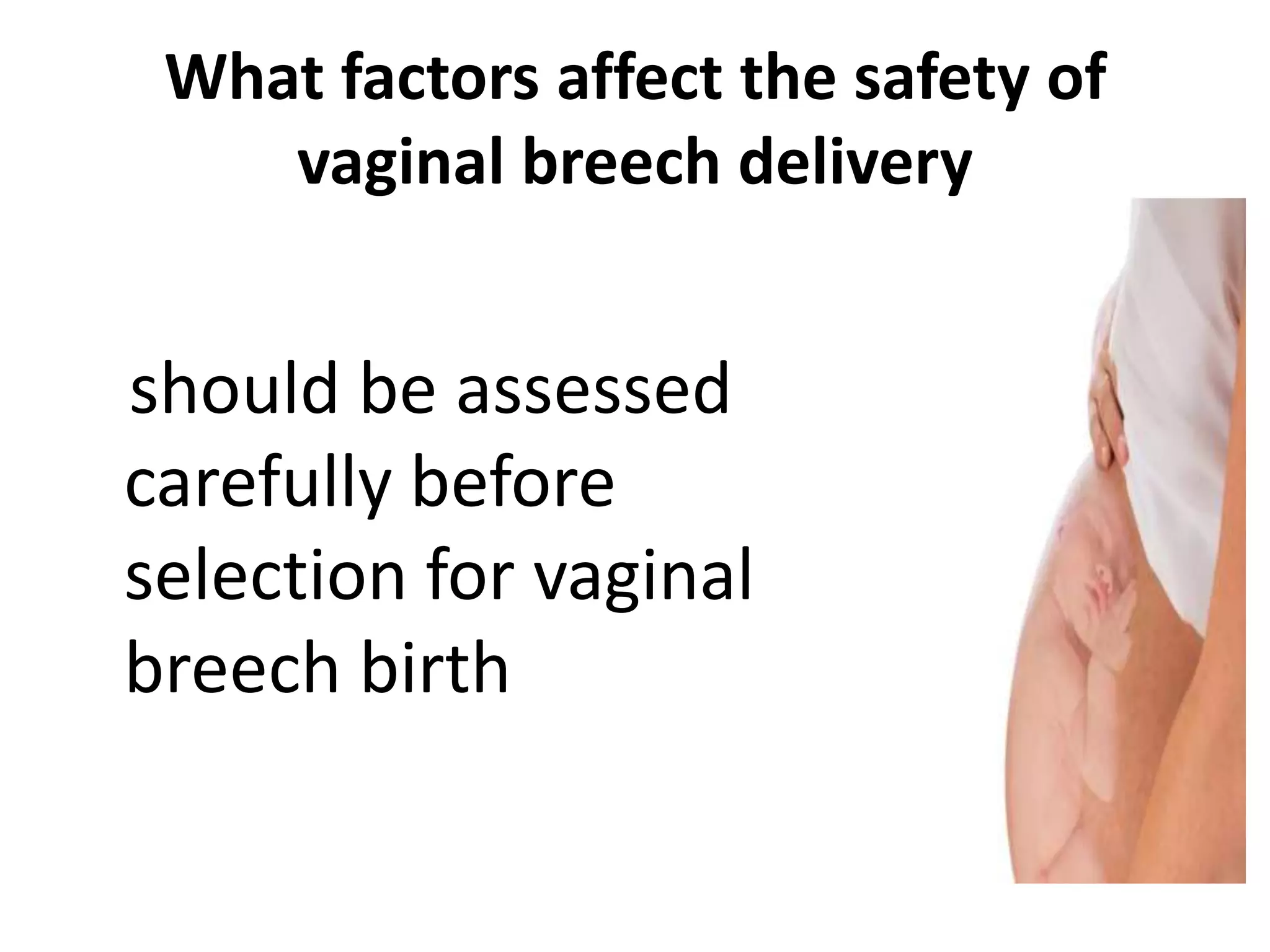
What factors affect the safety of
vaginal breech delivery
should be assessed
carefully before
selection for vaginal
breech birth
unfavourable for vaginal breech birth
• ● other contraindications to vaginal birth (e.g. placenta
praevia, compromised fetal condition)
• ● clinically inadequate pelvis
• ● footling or kneeling breech presentation
• ● large baby (usually defined as larger than 3800 g)
• ● growth-restricted baby (usually defined as smaller than 2000 g)
• ● Hyperextended fetal neck in labour (diagnosed with ultrasound or X-ray
where ultrasound is not available)
• ● lack of presence of a clinician trained in vaginal breech delivery
• ● previous caesarean section.
Intrapartum management
• should take place in a hospital with facilities
for emergency caesarean section
• Labour induction for breech presentation may
be considered if individual circumstances are
favourable
• Labour augmentation is not recommended
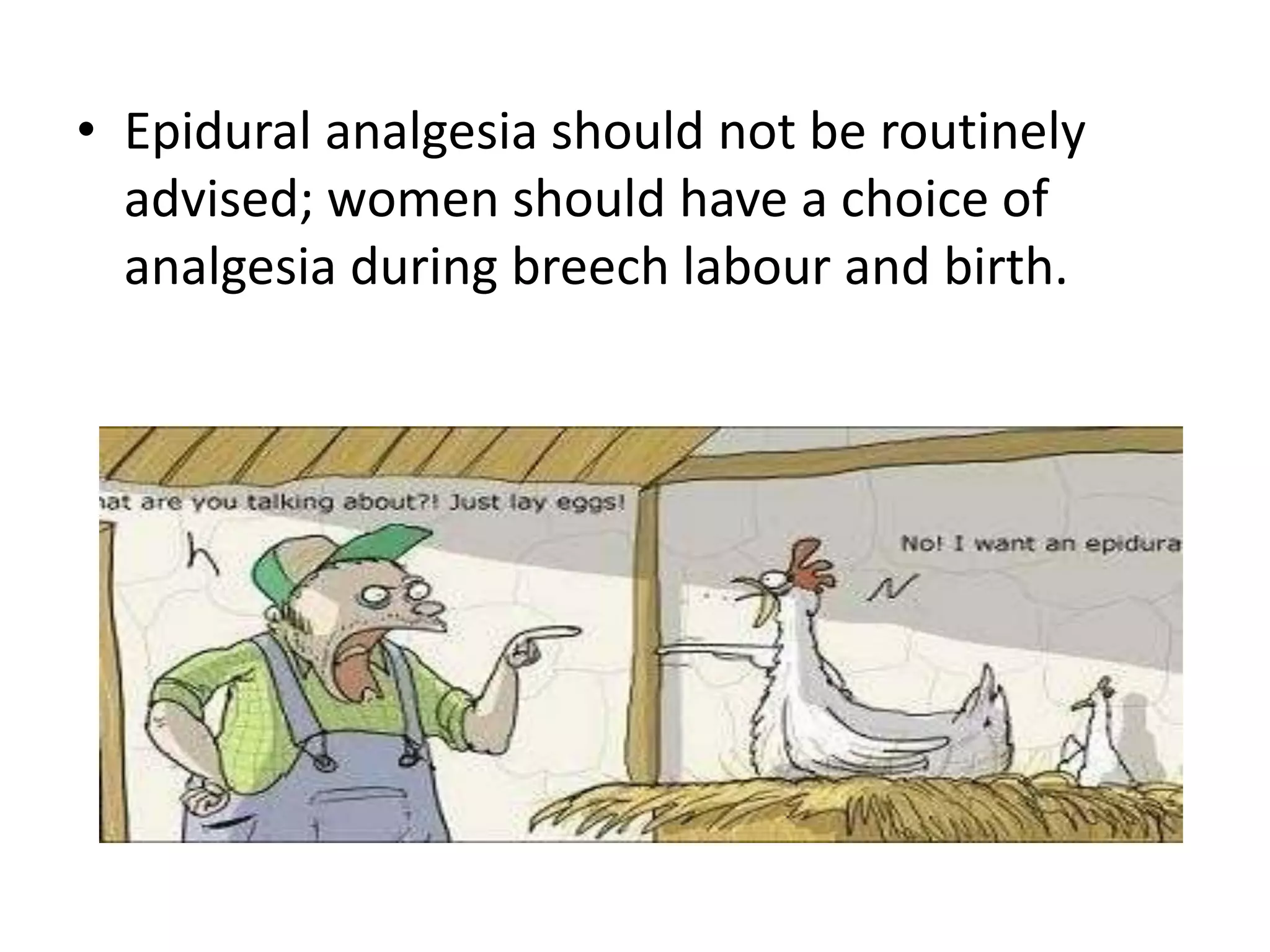
• Epidural analgesia should not be routinely
advised; women should have a choice of
analgesia during breech labour and birth.
• Continous electronic fetal heart rate
monitoring should be offered to women with
a breech presentation in labour.
• Fetal blood sampling from the buttocks during
labour is not advised.
• Caesarean section should be considered if
there is delay in the descent of the breech at
any stage in the second stage of labour.
• Episiotomy should be performed when
indicated to facilitate delivery.
• Three types of vaginal breech deliveries
Spontaneous breech delivery
Assisted breech delivery
Total breech extraction
Total breech extraction
• only with 2nd non
vextex twin delivery
• procedure in which the
infant's feet are grasped
by the operator and the
fetus is extracted from
the uterine cavity
through the vagina.
ECV
• External cephalic version (ECV) is the
transabdominal manual rotation of the fetus into
a cephalic presentation.
• after ECV successful rate 35-86%
• breech presentation at term, after ECV 1 - 1.5%
• indications for urgent caesarean after ECV 1 - 3%
• The risk of intrauterine death of foetus after ECV
is about 0.0001%
contraindication to ECV
• preterm
• Multiple pregnancy
• significant third trimester bleeding
• IUGR,
• oligohydramnion
• PROM
• PIH
• nonreassuring foetal monitoring patterns
• all contraindications to vaginal birth are
concerned to execute ECV
Risk of ECV
• umbilical cord entanglement
• abruptio placenta
• premature rupture of the membranes (PROM)
• severe maternal discomfort
THANK
YOU

Breech presentataion

  • 1.
    Breech presentation by DRTHENMOLEE SUBRAMONIE
  • 2.
    • The definitionof breech presentation is when the buttocks, foot or feet are presenting instead of the head
  • 3.
    classifications • Frank breechwhere the hips are flexed and legs extended • Complete breech where the hips and knees are flexed and the feet are not below the level of the fetal buttocks • Footling breech where one or both feet are presenting as the lowest part of the fetus
  • 5.
  • 6.
    Maternal factors • Polyhydraminos •Uterine anomalies (bicornuate, septate) • Space occupying lesions (e.g fibroids) • Placental abnormalities (praevia, cornual) • Multiparity (in particular grand multips)
  • 7.
    Fetal factors • Prematurity •Fetal anomalies (e.g neurological, hydrocephalus, anenecephaly) • Multiple pregnancy • Fetal death • Short umbilical cord
  • 8.
    • The incidenceof breech presentation decreases from about 20% at 28 weeks of gestation to 3–4% at term, as most babies turn spontaneously to the cephalic presentation
  • 9.
    What information shouldbe given to women with breech presentation regarding mode of delivery?
  • 10.
    Term Breech Trial2000 • trials with 2396 participant • Caesarean delivery 1060/1169 (91%) of those women allocated to planned caesarean section • 550/1227 (45%) of allocated to a vaginal delivery protocol
  • 11.
    • Perinatal orneonatal death(excluding fatal anomalies) or short-term neonatal morbidity was reduced with a policy of planned CS(RR 0.33, 95% CI 0.19–0.56) and perinatal or neonatal death alone (excluding fatal anomalies) was reduced with a policy of planned caesarean section (RR 0.29, 95% CI 0.10–0.86)
  • 12.
    • After excluding,perinatal mortality, neonatal mortality or serious neonatal morbidity with planned caesarean section compared with planned vaginal birth was 16/1006 (1.6%) compared with 23/704 (3.3%) (RR 0.49; CI 0.26–0.91); P = 0.02).
  • 13.
    adverse perinatal outcomewas lowest with prelabour caesarean section and increased with caesarean section in labour
  • 14.
    • In thelatter study, of the 2526 women with planned vaginal deliveries, 1796 delivered vaginally (71%) • The rate of neonatal morbidity or death was considerably lower than the 5% in the Term Breech Trial (1.60%; 95% CI 1.14–2.17), and not significantly different from the planned caesarean section group
  • 15.
    • death orneurodevelopmental delayat age 2 years, was similar between the two groups.
  • 16.
    Summary of TBT •lower rates of perinatal and neonatal death • lower rates of short term neonatal morbidity or perinatal death • fewer 5 minutes Apgar scores <7 • lower risk of adverse perinatal outcomes • small increase in the short term maternal morbidity
  • 17.
    What factors affectthe safety of vaginal breech delivery should be assessed carefully before selection for vaginal breech birth
  • 18.
    unfavourable for vaginalbreech birth • ● other contraindications to vaginal birth (e.g. placenta praevia, compromised fetal condition) • ● clinically inadequate pelvis • ● footling or kneeling breech presentation • ● large baby (usually defined as larger than 3800 g) • ● growth-restricted baby (usually defined as smaller than 2000 g) • ● Hyperextended fetal neck in labour (diagnosed with ultrasound or X-ray where ultrasound is not available) • ● lack of presence of a clinician trained in vaginal breech delivery • ● previous caesarean section.
  • 19.
    Intrapartum management • shouldtake place in a hospital with facilities for emergency caesarean section • Labour induction for breech presentation may be considered if individual circumstances are favourable • Labour augmentation is not recommended
  • 20.
    • Epidural analgesiashould not be routinely advised; women should have a choice of analgesia during breech labour and birth.
  • 21.
    • Continous electronicfetal heart rate monitoring should be offered to women with a breech presentation in labour. • Fetal blood sampling from the buttocks during labour is not advised.
  • 22.
    • Caesarean sectionshould be considered if there is delay in the descent of the breech at any stage in the second stage of labour. • Episiotomy should be performed when indicated to facilitate delivery.
  • 23.
    • Three typesof vaginal breech deliveries Spontaneous breech delivery Assisted breech delivery Total breech extraction
  • 24.
    Total breech extraction •only with 2nd non vextex twin delivery • procedure in which the infant's feet are grasped by the operator and the fetus is extracted from the uterine cavity through the vagina.
  • 25.
    ECV • External cephalicversion (ECV) is the transabdominal manual rotation of the fetus into a cephalic presentation. • after ECV successful rate 35-86% • breech presentation at term, after ECV 1 - 1.5% • indications for urgent caesarean after ECV 1 - 3% • The risk of intrauterine death of foetus after ECV is about 0.0001%
  • 27.
    contraindication to ECV •preterm • Multiple pregnancy • significant third trimester bleeding • IUGR, • oligohydramnion • PROM • PIH • nonreassuring foetal monitoring patterns • all contraindications to vaginal birth are concerned to execute ECV
  • 28.
    Risk of ECV •umbilical cord entanglement • abruptio placenta • premature rupture of the membranes (PROM) • severe maternal discomfort
  • 29.