




BREAST FEEDING
Dr KM Parakrama
Registrar in Paediatrics
NICU TH-Mahamodara
13th May 2020
Contents
• Introduction
• Positioning and Attachment
• Breast feeding positions
• Indicators of successful breast feeding
• Contraindications
• Breast conditions- Nipple conditions
Breast conditions
• Barriers For Breastfeeding
• Breastfeeding counselling
INTRODUCTION
• According to WHO & AAP Breastfeeding is
the normal way of providing young infants with
the nutrients
• Needed for healthy growth and development.
• Breastfeeding helps defend against infections,
• prevent allergies, and
• protect against a number of chronic conditions.
ANATOMY AND PHYSIOLOGY
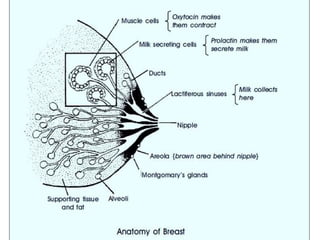
• The breast consists of glandular tissue and supporting
tissue and fat.
• Milk is secreted by the glands and travels through
tubules which drain into lactiferous sinuses.
• The sinuses which store small quantities of milk, lie
below the areola.
• They open out on to the nipple through lactiferous ducts.
• The thin layer of muscle (myo-epithelium) surrounds
each gland.
• The contraction of these muscles causes ejection of milk
from the glands.
4
31.07.201
6
Breast
Feeding
5
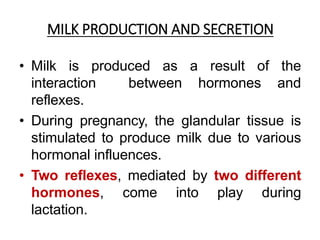
MILK PRODUCTION AND SECRETION
• Milk is produced as a result of the
interaction between hormones and
reflexes.
• During pregnancy, the glandular tissue is
stimulated to produce milk due to various
hormonal influences.
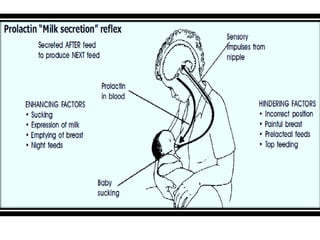
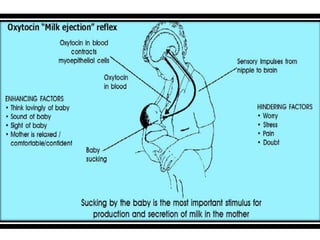
• Two reflexes, mediated by two different
hormones, come into play during
lactation.
Positioning and
Attachment
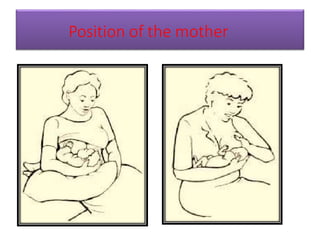
Position of the mother
Proper position of baby while
breastfeeding includes
1. Supporting whole of baby’s body.
2. Ensurebaby’s head, neck and back are in
same plane.
3. Entire baby’s body should face mother.
4. Baby’sabdomen touches mother’s abdomen.
• Correct positioning will ensure effective
sucking and prevent sore nipples and breast
engorgement.
35
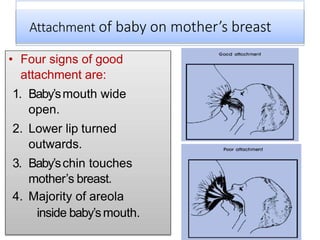
Attachment of baby on mother’s breast
• Four signs of good
attachment are:
1. Baby’smouth wide
open.
2. Lower lip turned
outwards.
3. Baby’schin touches
mother’s breast.
4. Majority of areola
inside baby’smouth.
Indicators of good attachment
and positioning:
• mouth wide open
• less areola visible underneath the chin
than above the nipple
• chin touching the breast, lower lip
rolled down, and nose free
• no pain.
Rules of breast
feeding
Breastfeeding Positions
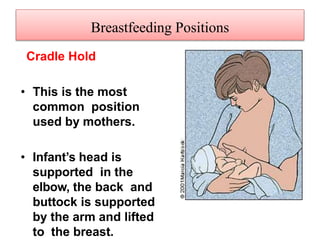
Cradle Hold
• This is the most
common position
used by mothers.
• Infant’s head is
supported in the
elbow, the back and
buttock is supported
by the arm and lifted
to the breast.
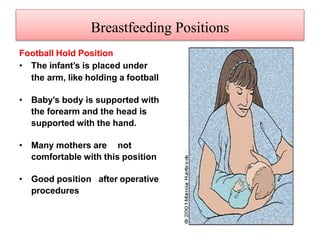
Football Hold Position
• The infant’s is placed under
the arm, like holding a football
• Baby’s body is supported with
the forearm and the head is
supported with the hand.
• Many mothers are not
comfortable with this position
• Good position after operative
procedures
Breastfeeding Positions
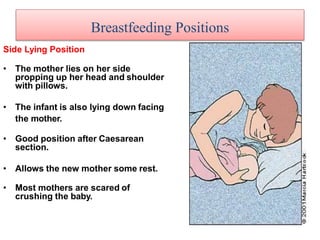
Side Lying Position
• The mother lies on her side
propping up her head and shoulder
with pillows.
• The infant is also lying down facing
the mother.
• Good position after Caesarean
section.
• Allows the new mother some rest.
• Most mothers are scared of
crushing the baby.
Breastfeeding Positions
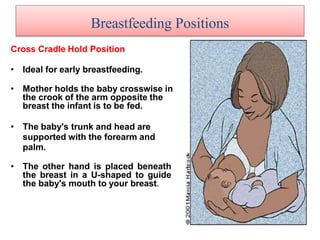
Cross Cradle Hold Position
• Ideal for early breastfeeding.
• Mother holds the baby crosswise in
the crook of the arm opposite the
breast the infant is to be fed.
• The baby's trunk and head are
supported with the forearm and
palm.
• The other hand is placed beneath
the breast in a U-shaped to guide
the baby's mouth to your breast.
Breastfeeding Positions
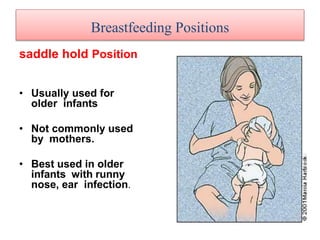
saddle hold Position
• Usually used for
older infants
• Not commonly used
by mothers.
• Best used in older
infants with runny
nose, ear infection.
Breastfeeding Positions
 Indicators of successful feeding in babies:
• Sustained rhythmic suck
• Relaxed arms and hands
• Moist mouth
• Regular soaked/heavy nappies, about 6-8 wet
diapers in a 24 hour.
• Average daily weight gain of 20 -40g.
• Go to sleep and comfort after feeding.
 Indicators of successful breastfeeding in women:
• Breast softening
• No compression of the nipple at the end of the feed
• Woman feels relaxed and sleepy.
CONTRAINDICATIONS FOR BREAST FEEDING
Infants : galactosemia
Mothers:
 Mothers infected with HIV ?
 Confirmed or suspected Ebola virus disease
 Infected with T cell lymphotrophic virus type 1 or 2
.
 TEMPORARILY SHOUD NOT BF OR EBM
 Mothers taking any of the following medications:
radioactive isotopes,
 Cancer chemotherapy agents, such as antimetabolites, and
 Illegal drugs.
 Untreated brucellosis
 Active HSV in breast
 SHOULD NOT BF CAN GIVE EBM
 Untreated active TB ( can BF after 2 weeks of Rx and
documented not to be contagious)
 Active varicella
BREAST CONDITIONS
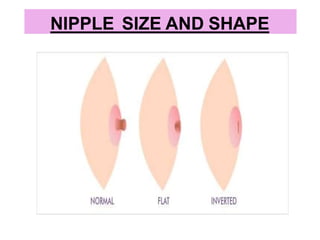
NIPPLE SIZE AND SHAPE
FLATNIPPLESAND PROTRACTILITY
 Nipples become protractile /stretchy during pregnancy
 No need to diagnose or treat flat/inverted nipple during
pregnancy
 Makes woman feel that her breasts are not right for BF
 Protractility improves during pregnancy and after delivery
May look flat but baby is able to suckle
 Build her confidence and provide support.
 Attachment and avoiding artificial teats and pacifiers
assist BFto establish.
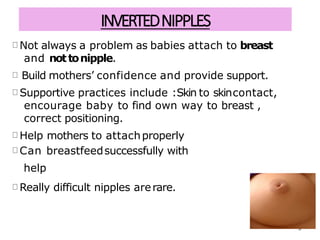
INVERTEDNIPPLES
Not always a problem as babies attach to breast
and nottonipple.
Build mothers’ confidence and provide support.
Supportive practices include :Skin to skincontact,
encourage baby to find own way to breast ,
correct positioning.
Help mothers to attachproperly
Can breastfeedsuccessfully with
help
Really difficult nipples arerare.
9
ManagementofFlatandInvertedNipples
• Antenatal treatment
—Probably nothelpful
• Soonafter delivery
—
—
—
—
—
—Buildmother’sconfidence
Explainbaby sucks fromBREASTnotnipple
Letbaby explore breast, skin-to-skin
Help mothertoposition herbaby
Trydifferentpositions
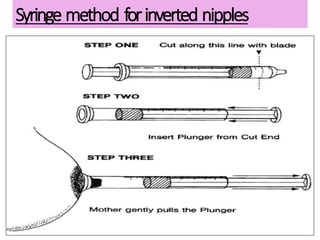
Help hertomake nipple stand outmore- Usesyringe, pump,
massage
• Forfirstweek ortwoifbaby notsuckle effectively
—Expressbreastmilk
— feed withcup
— Expressintobaby’s mouth
Syringe method forinverted nipples
LONGORBIGNIPPLES
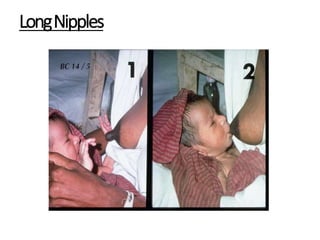
May cause difficulties
baby does not take breast far enough back into
mouth
likely to suck only nipple and not taking breast
with the lactiferous sinuses intomouth.
Be ready to help mother with BF technique
help mother to position and attach correctly
LongNipples
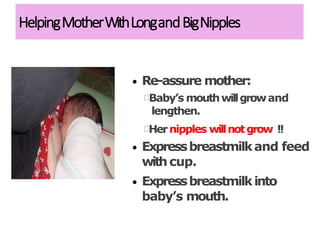
HelpingMotherWithLongandBigNipples
• Re-assure mother:
Baby’s mouthwillgrowand
lengthen.
Hernipples willnotgrow !!
• Expressbreastmilkand feed
withcup.
• Expressbreastmilkinto
baby’s mouth.
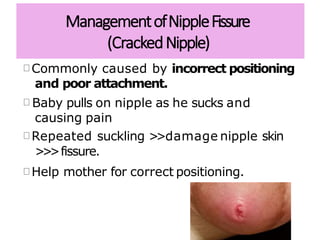
ManagementofNippleFissure
(CrackedNipple)
Commonly caused by incorrect positioning
and poor attachment.
Baby pulls on nipple as he sucks and
causing pain
Repeated suckling >>damage nipple skin
>>>fissure.
Help mother for correct positioning.
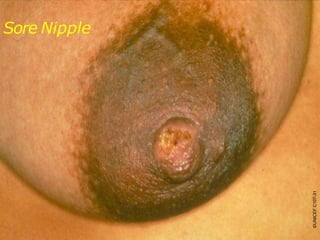
UNICEF/WHO Breastfeeding Promotion and Support in a Baby-Friendly Hospital – 20 hour Course 2006
Sore Nipple
©UNICEFC107-31
SORENIPPLES
Breastfeeding shouldn’t hurt
Some find nipples slightly tender at
beginning of feed for few days but
usualy disappears in a few days
• Most causes of nipple soreness are
simple and avoidable
• Ensure all maternity staff know how to
help mothers get babies attached to
breasts
Ifbabies are well attached
Most mothers do not get sore nipples
18
Causes of sore nipple:
• Poor attachment
• Baby is pulled off breast to end feed
• Breast pump ( cause stretching of
nipple)
• Candida (from baby’s mouth) infection
of nipple
• Infant’s tongue tie causing friction on
nipple.
• Ask mother to describe what she feels:
—Pain at startof a feed that fades when
baby lets go, is most likely related to
attachment.
—Pain thatgets worseduring feed and
continues afterfeed has finished, often
describe as burning/stabbing ismore
likely caused by Candida Albicans.
• Look at nipples and breast
— Broken skin is usually caused by poor attachment.
— Skinisred, shiny,itchy, flaky withloss
pigmentation often seen with Candida.
— Candida and trauma from poor attachment can
exists together.
— nipple can have eczema, dermatitis and other
skin condition.
Observationandhistorytaking forsorenipples
• Observe a complete breastfeeding
• Check how the baby :
—goes tobreast
—Attachment
—Suckling
—Notice how mother ends feed
—Observe what nipples look like at end
of feed
22
ManagementofSoreNipples
Reassurance
sore nipples can be healed and prevented in
future
Treat cause ofsore nipples
Suggest comfort measures while nipplehealing
TreatCause:
•
•
Help mother to improve attachment and positioning
Show mother how to feed in different feeding
position
Treat Candida both on mother and baby
If baby had tongue tie –refer for treatment
•
•
23
• .
24
Suggestcomfortmeasures
While nipples are healing:-
• Apply expressed breast milk tonipples
after feed.
• Begin each breastfeed on least sore
nipple
• Gently remove baby if baby begin to fall
asleep at breast.
• Wash nipples only once a day.
• Avoid using soap on nipples, as it
removes natural oils.
Whatdonothelp
DO NOTstop breastfeeding torest
nipple.
DO NOTlimit frequency or lengthof
breastfeeds.
DO NOTapply any substancesto
nipple.
DO NOTuse nipple shield.
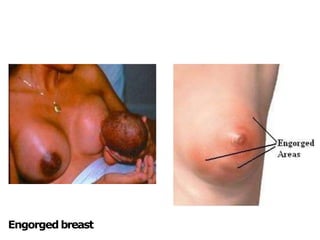
Engorged breast
COMMONBREASTPROBLEMS
1. Breast engorgement
2.Block duct and mastitis
3. Breast abscess
4.Candidiasis
UNICEFC-107-19
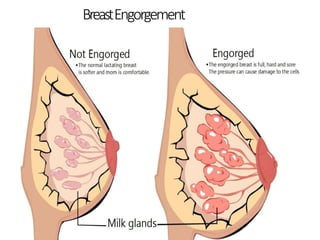
BreastEngorgement
12/3
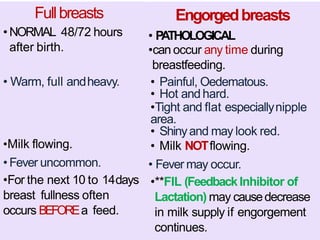
Fullbreasts
• NORMAL 48/72 hours
after birth.
• Warm, full andheavy.
•Milk flowing.
• Fever uncommon.
•For the next 10 to 14days
breast fullness often
occurs BEFOREa feed.
Engorgedbreasts
• PATHOLOGICAL
•can occur any time during
breastfeeding.
• Painful, Oedematous.
• Hot andhard.
•Tight and flat especiallynipple
area.
• Shinyand may look red.
• Milk NOTflowing.
• Fever may occur.
•**FIL (FeedbackInhibitor of
Lactation) may causedecrease
in milk supply if engorgement
continues.
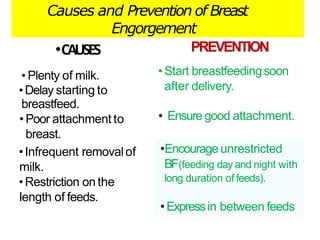
Causes and Prevention of Breast
Engorgement
•CAUSES
• Plenty of milk.
• Delay starting to
breastfeed.
• Poor attachment to
breast.
•Infrequent removalof
milk.
•Restriction on the
length of feeds.
PREVENTION
• Start breastfeedingsoon
after delivery.
• Ensuregood attachment.
•Encourage unrestricted
BF(feeding day and night with
long duration of feeds).
• Expressin between feeds
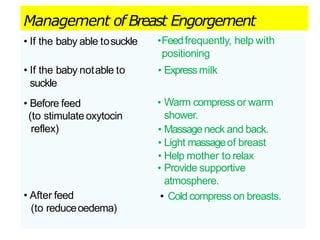
Management of Breast Engorgement
• If the baby able tosuckle
• If the baby notable to
suckle
• Before feed
(to stimulateoxytocin
reflex)
• After feed
(to reduceoedema)
•Feedfrequently, help with
positioning
• Express milk
• Warm compress or warm
shower.
• Massageneck and back.
• Light massageof breast
• Help mother to relax
• Provide supportive
atmosphere.
• Cold compress on breasts.
RELIEFOF ENGORGEMENT
• Removing milk from breast willrelieve
engorgement.
• This will:
• Relieve mother’s discomfort.
• Prevent mastitis and abscessformation.
• Help to ensure continued production of milk.
• Enable baby to receive breastmilk.
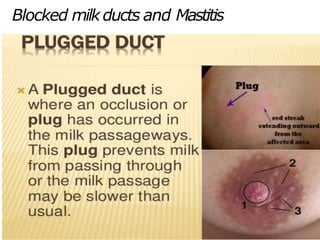
Blocked milkducts and Mastitis
Symptoms of blocked duct and
mastitis
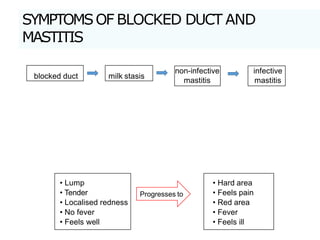
blocked duct milk stasis
non-infective
mastitis
infective
mastitis
• Lump
• Tender
• Localised redness
• No fever
• Feels well
• Hard area
• Feels pain
• Red area
• Fever
• Feels ill
Progresses to
SYMPTOMSOF BLOCKED DUCT AND
MASTITIS
MANAGEMENT OF BLOCKED DUCTS,
MASTITIS
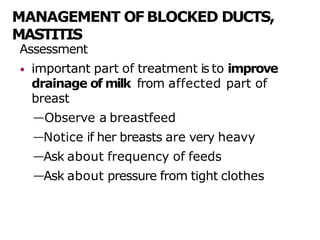
Assessment
• important part of treatment is to improve
drainage of milk from affected part of
breast
—Observe a breastfeed
—Notice if her breasts are very heavy
—Ask about frequency of feeds
—Ask about pressure from tight clothes
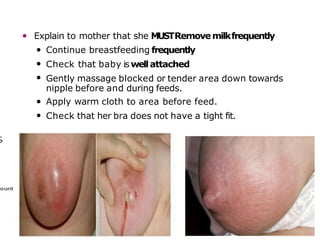
• Explain to mother that she MUSTRemovemilkfrequently
•
•
•
Continue breastfeeding frequently
Check that baby iswellattached
Gently massage blocked or tender area down towards
nipple before and during feeds.
Apply warm cloth to area before feed.
Check that her bra does not have a tight fit.
•
•
38
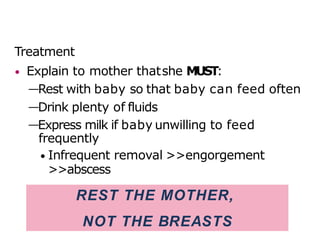
Treatment
• Explain to mother thatshe MUST:
—Rest with baby so that baby can feed often
—Drink plenty of fluids
—Express milk if baby unwilling to feed
frequently
• Infrequent removal >>engorgement
>>abscess
REST THE MOTHER,
NOT THE BREASTS
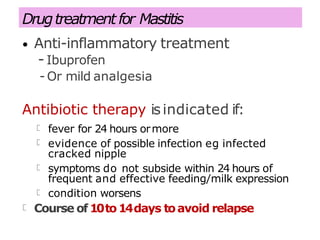
Drugtreatment for Mastitis
• Anti-inflammatory treatment
- Ibuprofen
- Or mild analgesia
Antibiotic therapy isindicated if:
fever for 24 hours ormore
evidence of possible infection eg infected
cracked nipple
symptoms do not subside within 24 hours of
frequent and effective feeding/milk expression
condition worsens
Course of10to14days toavoid relapse
BREASTABSCESS
A collection of pus forms in part of breast.
May result fr untreated mastitis
painful swelling
Needs surgical incision ( I&D ) andantibiotic
Continue breastfeedingif
incision far from areola and does not interfere BF
mother tolerate pain
otherwise express milk from affected side
Continue BFfrom unaffected breast
Good management of mastitis should be
preventive
CANDIDAINFECTION
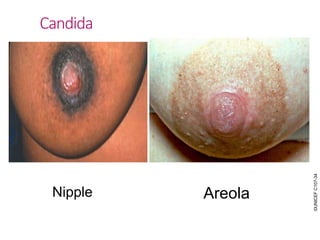
Can make skin sore, shiny, red and itchy
Often follow antibiotic use to treat
mastitis/other infections
May be due to/cause baby’s oral thrush
Describe burning/stinging pain which
continues after feed
Candida
©UNICEFC107-34
AreolaNipple
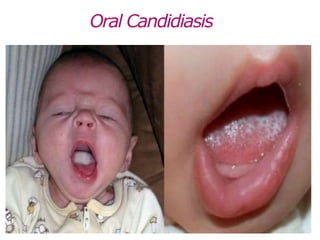
Oral Candidiasis
SIGNSAND TREATMENTFOR THRUSH
•Nystatincream100,000 IU/g
•Applytomother’slesions4x/day,after breastfeedand
• continuetill 7daysafter lesionhealed
Signs Treatment
• Skinlooks red, shinyand
flaky . Nipplesand
areola may lose
pigmentation/ look
normal /red
• Nipples remain sore
between feeds for
prolonged time despite
correct attachment.
• Nystatin suspension100,000
1U/ml:
• Apply 1 ml by dropperto
child’s mouth 4x/dayafter
breastfeed.
BARRIERS TO BREASTFEEDING
• Individual: Inadequate knowledge,
embarrassment, social , negative perceptions
• Interpersonal: Lack of support from partner
and family, perceived threat to father-child
bond
• Institutional: Return to work or school,
lack of workplace facilities, unsupportive
health care environments
• Community: discomfort about nursing in
public
• Policy: aggressive marketing by formula
companies
COUNSELLING
Non-verbal Communication
63
•KEEPyourhead level
•Removebarriers- desk/folders
•Payattention to mother -Avoid getting distracted
•Taketime without hurrying– don’t look at your watch
•Onlytouch in appropriate way (hand/arm)
•Don’t touchher breasts/baby without permission
64
•
Askopen questions
Openquestionsusuallystart with "How?
What?When?Where? Why?"
•
•
•
Eg."How are you feeding your baby?“
Youneed to assessthesituation/difficulty
Askquestionsthat encouragesthe mother to
talk
Closequestionsdonot givemuch info
– Start with “Areyou?Didyou?Hasthe baby?
– Sometimessuggestthe “correct” answer
65
Useresponsesandgestureswhichshow
interest to Encouragemother to talk
• Showwe are interested in what mother is
saying
• Useresponsessuch as
–
–
Nodding/smiling
Simpleresponseeg“Uh““Hmm”, “Goon…”
• Reflectbackwhat the mother issaying
– Canhelp clarify the mother’s statement
• Mix reflecting backwith otherresponses
Empathise
• Showyouunderstandher feelings
• Lookingat it from HERpoint ofview
• VsSympathy
• Emphatisewith her goodfeelingstoo, not
just bad feelings
• Findout how shefeelsabout the situation
• Askfor morefacts 12
67
Avoidjudging words
• Judgingwordsinclude:right, wrong,well,
bad, good,problem
• Canmakeawoman feel
–
–
like sheis wrong
Somethingwrongwith the baby
68
• Goodcommunicationskillshelp mother to feel
goodandconfident to carryout her decisions
• Tohelp her build confidence:Acceptwhat a
mother thinksandfeels Recogniseand
acknowledgewhat isright Givepractical help
Providerelevant information usingsuitable
language
Make oneor two suggestions.
Acceptwhat amother thinksand feels
69
•
•
•
•
Acceptancewithout disagreeing Does
not meanwe agreesheis right
Acceptwhat she issaying,
givecorrectinfo later
Helpsmother to trust youandencourages
her to continuethe conversation
70
Recognizeandacknowledgewhatis right
• Recognizeandpraisewhat mother andbaby
are achieving
– Tell mother how well babyis attaching
– Point out how cleverthe babyisin
detachinghimselfafter feed
71
Givepractical help
• Milk will flow better if motheris
comfortable
–
–
Offer another pillow
Offer to holdbabywhile shegoesto
wash
• May needclear practical help e.ghow to
expressmilk
Provide relevant information usingsuitable
language
72
•
•
•
Findout what sheneedsto knowat this
time
Usesuitable wordsthat mother
understands
Donot overwhelmher with information
Make suggestions,not COMMANDS
Provide choices and let her decide
Do not tell her what she should do
Limitsuggestionsto 1 or 2
Scenario..
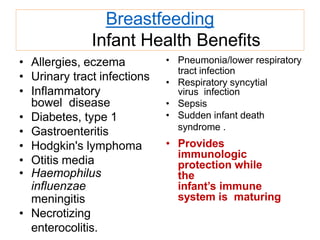
Breastfeeding
Infant Health Benefits
• Allergies, eczema
• Urinary tract infections
• Inflammatory
bowel disease
• Diabetes, type 1
• Gastroenteritis
• Hodgkin's lymphoma
• Otitis media
• Haemophilus
influenzae
meningitis
• Necrotizing
enterocolitis.
• Pneumonia/lower respiratory
tract infection
• Respiratory syncytial
virus infection
• Sepsis
• Sudden infant death
syndrome .
• Provides
immunologic
protection while
the
infant’s immune
system is maturing

Breastfeeding

  • 1.
    BREAST FEEDING Dr KMParakrama Registrar in Paediatrics NICU TH-Mahamodara 13th May 2020
  • 2.
    Contents • Introduction • Positioningand Attachment • Breast feeding positions • Indicators of successful breast feeding • Contraindications • Breast conditions- Nipple conditions Breast conditions • Barriers For Breastfeeding • Breastfeeding counselling
  • 3.
    INTRODUCTION • According toWHO & AAP Breastfeeding is the normal way of providing young infants with the nutrients • Needed for healthy growth and development. • Breastfeeding helps defend against infections, • prevent allergies, and • protect against a number of chronic conditions.
  • 4.
    ANATOMY AND PHYSIOLOGY •The breast consists of glandular tissue and supporting tissue and fat. • Milk is secreted by the glands and travels through tubules which drain into lactiferous sinuses. • The sinuses which store small quantities of milk, lie below the areola. • They open out on to the nipple through lactiferous ducts. • The thin layer of muscle (myo-epithelium) surrounds each gland. • The contraction of these muscles causes ejection of milk from the glands. 4
  • 5.
  • 6.
    MILK PRODUCTION ANDSECRETION • Milk is produced as a result of the interaction between hormones and reflexes. • During pregnancy, the glandular tissue is stimulated to produce milk due to various hormonal influences. • Two reflexes, mediated by two different hormones, come into play during lactation.
  • 9.
  • 11.
  • 12.
    Proper position ofbaby while breastfeeding includes 1. Supporting whole of baby’s body. 2. Ensurebaby’s head, neck and back are in same plane. 3. Entire baby’s body should face mother. 4. Baby’sabdomen touches mother’s abdomen. • Correct positioning will ensure effective sucking and prevent sore nipples and breast engorgement. 35
  • 13.
    Attachment of babyon mother’s breast • Four signs of good attachment are: 1. Baby’smouth wide open. 2. Lower lip turned outwards. 3. Baby’schin touches mother’s breast. 4. Majority of areola inside baby’smouth.
  • 14.
    Indicators of goodattachment and positioning: • mouth wide open • less areola visible underneath the chin than above the nipple • chin touching the breast, lower lip rolled down, and nose free • no pain. Rules of breast feeding
  • 15.
    Breastfeeding Positions Cradle Hold •This is the most common position used by mothers. • Infant’s head is supported in the elbow, the back and buttock is supported by the arm and lifted to the breast.
  • 16.
    Football Hold Position •The infant’s is placed under the arm, like holding a football • Baby’s body is supported with the forearm and the head is supported with the hand. • Many mothers are not comfortable with this position • Good position after operative procedures Breastfeeding Positions
  • 17.
    Side Lying Position •The mother lies on her side propping up her head and shoulder with pillows. • The infant is also lying down facing the mother. • Good position after Caesarean section. • Allows the new mother some rest. • Most mothers are scared of crushing the baby. Breastfeeding Positions
  • 18.
    Cross Cradle HoldPosition • Ideal for early breastfeeding. • Mother holds the baby crosswise in the crook of the arm opposite the breast the infant is to be fed. • The baby's trunk and head are supported with the forearm and palm. • The other hand is placed beneath the breast in a U-shaped to guide the baby's mouth to your breast. Breastfeeding Positions
  • 19.
    saddle hold Position •Usually used for older infants • Not commonly used by mothers. • Best used in older infants with runny nose, ear infection. Breastfeeding Positions
  • 20.
     Indicators ofsuccessful feeding in babies: • Sustained rhythmic suck • Relaxed arms and hands • Moist mouth • Regular soaked/heavy nappies, about 6-8 wet diapers in a 24 hour. • Average daily weight gain of 20 -40g. • Go to sleep and comfort after feeding.  Indicators of successful breastfeeding in women: • Breast softening • No compression of the nipple at the end of the feed • Woman feels relaxed and sleepy.
  • 21.
    CONTRAINDICATIONS FOR BREASTFEEDING Infants : galactosemia Mothers:  Mothers infected with HIV ?  Confirmed or suspected Ebola virus disease  Infected with T cell lymphotrophic virus type 1 or 2 .
  • 22.
     TEMPORARILY SHOUDNOT BF OR EBM  Mothers taking any of the following medications: radioactive isotopes,  Cancer chemotherapy agents, such as antimetabolites, and  Illegal drugs.  Untreated brucellosis  Active HSV in breast  SHOULD NOT BF CAN GIVE EBM  Untreated active TB ( can BF after 2 weeks of Rx and documented not to be contagious)  Active varicella
  • 23.
  • 24.
  • 25.
    FLATNIPPLESAND PROTRACTILITY  Nipplesbecome protractile /stretchy during pregnancy  No need to diagnose or treat flat/inverted nipple during pregnancy  Makes woman feel that her breasts are not right for BF  Protractility improves during pregnancy and after delivery May look flat but baby is able to suckle  Build her confidence and provide support.  Attachment and avoiding artificial teats and pacifiers assist BFto establish.
  • 26.
    INVERTEDNIPPLES Not always aproblem as babies attach to breast and nottonipple. Build mothers’ confidence and provide support. Supportive practices include :Skin to skincontact, encourage baby to find own way to breast , correct positioning. Help mothers to attachproperly Can breastfeedsuccessfully with help Really difficult nipples arerare. 9
  • 27.
    ManagementofFlatandInvertedNipples • Antenatal treatment —Probablynothelpful • Soonafter delivery — — — — — —Buildmother’sconfidence Explainbaby sucks fromBREASTnotnipple Letbaby explore breast, skin-to-skin Help mothertoposition herbaby Trydifferentpositions Help hertomake nipple stand outmore- Usesyringe, pump, massage • Forfirstweek ortwoifbaby notsuckle effectively —Expressbreastmilk — feed withcup — Expressintobaby’s mouth
  • 28.
  • 29.
    LONGORBIGNIPPLES May cause difficulties babydoes not take breast far enough back into mouth likely to suck only nipple and not taking breast with the lactiferous sinuses intomouth. Be ready to help mother with BF technique help mother to position and attach correctly
  • 30.
  • 31.
    HelpingMotherWithLongandBigNipples • Re-assure mother: Baby’smouthwillgrowand lengthen. Hernipples willnotgrow !! • Expressbreastmilkand feed withcup. • Expressbreastmilkinto baby’s mouth.
  • 32.
    ManagementofNippleFissure (CrackedNipple) Commonly caused byincorrect positioning and poor attachment. Baby pulls on nipple as he sucks and causing pain Repeated suckling >>damage nipple skin >>>fissure. Help mother for correct positioning.
  • 33.
    UNICEF/WHO Breastfeeding Promotionand Support in a Baby-Friendly Hospital – 20 hour Course 2006 Sore Nipple ©UNICEFC107-31
  • 34.
    SORENIPPLES Breastfeeding shouldn’t hurt Somefind nipples slightly tender at beginning of feed for few days but usualy disappears in a few days • Most causes of nipple soreness are simple and avoidable • Ensure all maternity staff know how to help mothers get babies attached to breasts Ifbabies are well attached Most mothers do not get sore nipples 18
  • 35.
    Causes of sorenipple: • Poor attachment • Baby is pulled off breast to end feed • Breast pump ( cause stretching of nipple) • Candida (from baby’s mouth) infection of nipple • Infant’s tongue tie causing friction on nipple.
  • 36.
    • Ask motherto describe what she feels: —Pain at startof a feed that fades when baby lets go, is most likely related to attachment. —Pain thatgets worseduring feed and continues afterfeed has finished, often describe as burning/stabbing ismore likely caused by Candida Albicans.
  • 37.
    • Look atnipples and breast — Broken skin is usually caused by poor attachment. — Skinisred, shiny,itchy, flaky withloss pigmentation often seen with Candida. — Candida and trauma from poor attachment can exists together. — nipple can have eczema, dermatitis and other skin condition.
  • 38.
    Observationandhistorytaking forsorenipples • Observea complete breastfeeding • Check how the baby : —goes tobreast —Attachment —Suckling —Notice how mother ends feed —Observe what nipples look like at end of feed 22
  • 39.
    ManagementofSoreNipples Reassurance sore nipples canbe healed and prevented in future Treat cause ofsore nipples Suggest comfort measures while nipplehealing TreatCause: • • Help mother to improve attachment and positioning Show mother how to feed in different feeding position Treat Candida both on mother and baby If baby had tongue tie –refer for treatment • • 23
  • 40.
  • 41.
    Suggestcomfortmeasures While nipples arehealing:- • Apply expressed breast milk tonipples after feed. • Begin each breastfeed on least sore nipple • Gently remove baby if baby begin to fall asleep at breast. • Wash nipples only once a day. • Avoid using soap on nipples, as it removes natural oils.
  • 42.
    Whatdonothelp DO NOTstop breastfeedingtorest nipple. DO NOTlimit frequency or lengthof breastfeeds. DO NOTapply any substancesto nipple. DO NOTuse nipple shield.
  • 43.
  • 44.
    COMMONBREASTPROBLEMS 1. Breast engorgement 2.Blockduct and mastitis 3. Breast abscess 4.Candidiasis
  • 45.
  • 46.
    Fullbreasts • NORMAL 48/72hours after birth. • Warm, full andheavy. •Milk flowing. • Fever uncommon. •For the next 10 to 14days breast fullness often occurs BEFOREa feed. Engorgedbreasts • PATHOLOGICAL •can occur any time during breastfeeding. • Painful, Oedematous. • Hot andhard. •Tight and flat especiallynipple area. • Shinyand may look red. • Milk NOTflowing. • Fever may occur. •**FIL (FeedbackInhibitor of Lactation) may causedecrease in milk supply if engorgement continues.
  • 47.
    Causes and Preventionof Breast Engorgement •CAUSES • Plenty of milk. • Delay starting to breastfeed. • Poor attachment to breast. •Infrequent removalof milk. •Restriction on the length of feeds. PREVENTION • Start breastfeedingsoon after delivery. • Ensuregood attachment. •Encourage unrestricted BF(feeding day and night with long duration of feeds). • Expressin between feeds
  • 48.
    Management of BreastEngorgement • If the baby able tosuckle • If the baby notable to suckle • Before feed (to stimulateoxytocin reflex) • After feed (to reduceoedema) •Feedfrequently, help with positioning • Express milk • Warm compress or warm shower. • Massageneck and back. • Light massageof breast • Help mother to relax • Provide supportive atmosphere. • Cold compress on breasts.
  • 49.
    RELIEFOF ENGORGEMENT • Removingmilk from breast willrelieve engorgement. • This will: • Relieve mother’s discomfort. • Prevent mastitis and abscessformation. • Help to ensure continued production of milk. • Enable baby to receive breastmilk.
  • 50.
  • 51.
    Symptoms of blockedduct and mastitis blocked duct milk stasis non-infective mastitis infective mastitis • Lump • Tender • Localised redness • No fever • Feels well • Hard area • Feels pain • Red area • Fever • Feels ill Progresses to SYMPTOMSOF BLOCKED DUCT AND MASTITIS
  • 52.
    MANAGEMENT OF BLOCKEDDUCTS, MASTITIS Assessment • important part of treatment is to improve drainage of milk from affected part of breast —Observe a breastfeed —Notice if her breasts are very heavy —Ask about frequency of feeds —Ask about pressure from tight clothes
  • 53.
    • Explain tomother that she MUSTRemovemilkfrequently • • • Continue breastfeeding frequently Check that baby iswellattached Gently massage blocked or tender area down towards nipple before and during feeds. Apply warm cloth to area before feed. Check that her bra does not have a tight fit. • • 38
  • 54.
    Treatment • Explain tomother thatshe MUST: —Rest with baby so that baby can feed often —Drink plenty of fluids —Express milk if baby unwilling to feed frequently • Infrequent removal >>engorgement >>abscess REST THE MOTHER, NOT THE BREASTS
  • 55.
    Drugtreatment for Mastitis •Anti-inflammatory treatment - Ibuprofen - Or mild analgesia Antibiotic therapy isindicated if: fever for 24 hours ormore evidence of possible infection eg infected cracked nipple symptoms do not subside within 24 hours of frequent and effective feeding/milk expression condition worsens Course of10to14days toavoid relapse
  • 56.
    BREASTABSCESS A collection ofpus forms in part of breast. May result fr untreated mastitis painful swelling Needs surgical incision ( I&D ) andantibiotic Continue breastfeedingif incision far from areola and does not interfere BF mother tolerate pain otherwise express milk from affected side Continue BFfrom unaffected breast Good management of mastitis should be preventive
  • 57.
    CANDIDAINFECTION Can make skinsore, shiny, red and itchy Often follow antibiotic use to treat mastitis/other infections May be due to/cause baby’s oral thrush Describe burning/stinging pain which continues after feed
  • 58.
  • 59.
  • 60.
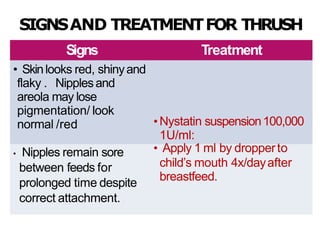
    SIGNSAND TREATMENTFOR THRUSH •Nystatincream100,000IU/g •Applytomother’slesions4x/day,after breastfeedand • continuetill 7daysafter lesionhealed Signs Treatment • Skinlooks red, shinyand flaky . Nipplesand areola may lose pigmentation/ look normal /red • Nipples remain sore between feeds for prolonged time despite correct attachment. • Nystatin suspension100,000 1U/ml: • Apply 1 ml by dropperto child’s mouth 4x/dayafter breastfeed.
  • 61.
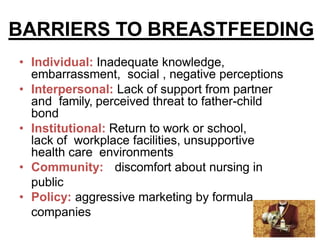
    BARRIERS TO BREASTFEEDING •Individual: Inadequate knowledge, embarrassment, social , negative perceptions • Interpersonal: Lack of support from partner and family, perceived threat to father-child bond • Institutional: Return to work or school, lack of workplace facilities, unsupportive health care environments • Community: discomfort about nursing in public • Policy: aggressive marketing by formula companies
  • 62.
  • 63.
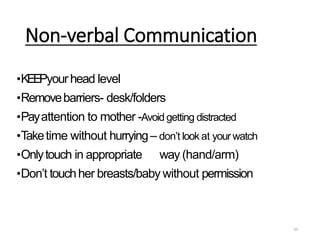
    Non-verbal Communication 63 •KEEPyourhead level •Removebarriers-desk/folders •Payattention to mother -Avoid getting distracted •Taketime without hurrying– don’t look at your watch •Onlytouch in appropriate way (hand/arm) •Don’t touchher breasts/baby without permission
  • 64.
    64 • Askopen questions Openquestionsusuallystart with"How? What?When?Where? Why?" • • • Eg."How are you feeding your baby?“ Youneed to assessthesituation/difficulty Askquestionsthat encouragesthe mother to talk Closequestionsdonot givemuch info – Start with “Areyou?Didyou?Hasthe baby? – Sometimessuggestthe “correct” answer
  • 65.
    65 Useresponsesandgestureswhichshow interest to Encouragemotherto talk • Showwe are interested in what mother is saying • Useresponsessuch as – – Nodding/smiling Simpleresponseeg“Uh““Hmm”, “Goon…” • Reflectbackwhat the mother issaying – Canhelp clarify the mother’s statement • Mix reflecting backwith otherresponses
  • 66.
    Empathise • Showyouunderstandher feelings •Lookingat it from HERpoint ofview • VsSympathy • Emphatisewith her goodfeelingstoo, not just bad feelings • Findout how shefeelsabout the situation • Askfor morefacts 12
  • 67.
    67 Avoidjudging words • Judgingwordsinclude:right,wrong,well, bad, good,problem • Canmakeawoman feel – – like sheis wrong Somethingwrongwith the baby
  • 68.
    68 • Goodcommunicationskillshelp motherto feel goodandconfident to carryout her decisions • Tohelp her build confidence:Acceptwhat a mother thinksandfeels Recogniseand acknowledgewhat isright Givepractical help Providerelevant information usingsuitable language Make oneor two suggestions.
  • 69.
    Acceptwhat amother thinksandfeels 69 • • • • Acceptancewithout disagreeing Does not meanwe agreesheis right Acceptwhat she issaying, givecorrectinfo later Helpsmother to trust youandencourages her to continuethe conversation
  • 70.
    70 Recognizeandacknowledgewhatis right • Recognizeandpraisewhatmother andbaby are achieving – Tell mother how well babyis attaching – Point out how cleverthe babyisin detachinghimselfafter feed
  • 71.
    71 Givepractical help • Milkwill flow better if motheris comfortable – – Offer another pillow Offer to holdbabywhile shegoesto wash • May needclear practical help e.ghow to expressmilk
  • 72.
    Provide relevant informationusingsuitable language 72 • • • Findout what sheneedsto knowat this time Usesuitable wordsthat mother understands Donot overwhelmher with information Make suggestions,not COMMANDS Provide choices and let her decide Do not tell her what she should do Limitsuggestionsto 1 or 2
  • 73.
  • 74.
    Breastfeeding Infant Health Benefits •Allergies, eczema • Urinary tract infections • Inflammatory bowel disease • Diabetes, type 1 • Gastroenteritis • Hodgkin's lymphoma • Otitis media • Haemophilus influenzae meningitis • Necrotizing enterocolitis. • Pneumonia/lower respiratory tract infection • Respiratory syncytial virus infection • Sepsis • Sudden infant death syndrome . • Provides immunologic protection while the infant’s immune system is maturing