Why breastfeed?
Answer:
Because breastfeeding is
B.R.E.A.S.T.F.E.E.D.I.N.G.!
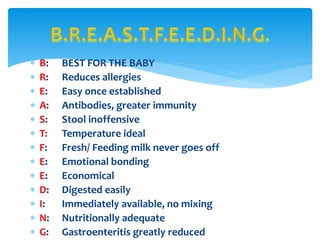
 B: BEST FOR THE BABY
 R: Reduces allergies
 E: Easy once established
 A: Antibodies, greater immunity
 S: Stool inoffensive
 T: Temperature ideal
 F: Fresh/ Feeding milk never goes off
 E: Emotional bonding
 E: Economical
 D: Digested easily
 I: Immediately available, no mixing
 N: Nutritionally adequate
 G: Gastroenteritis greatly reduced
 Breastfeeding is good for you, too, and may
help you to lose weight. In the long term, it
also helps to:lower your risk of breast cancer
 protect against ovarian cancer before the
menopause
 reduce your risk of developing type 2 diabetes
 Turn your baby's whole body toward you, chest to
chest.
 Touch her upper lip with your nipple, and, when she
opens her mouth wide, pull her onto your breast,
holding your breast for support.
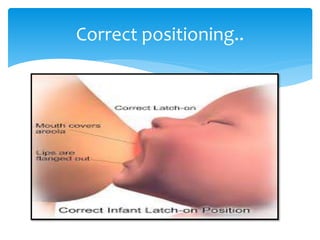
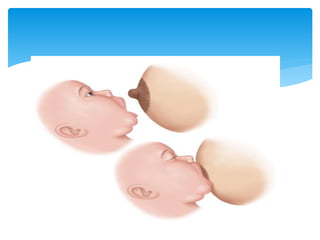
 Her mouth should cover not just the nipple but as
much of the areola (the darker part surrounding it) as
possible. Her mouth should cover a big part of the
areola below the nipple, and your nipple should be far
back in your baby's mouth.
 If latch-on hurts, break the suction (by
inserting your little finger between your
baby's gums and your breast) and try again.
Once your baby latches on properly, she'll do
the rest.
Correct positioning..
 Frequently. The more you nurse, the more milk you'll produce.
Nursing eight to 12 times every 24 hours is pretty much on
target.
 According to guidelines from the American Academy of
Pediatrics (AAP), rather than nursing according to a rigid
schedule, you should nurse your newborn whenever she
shows early signs of hunger, such as increased alertness or
activity, mouthing, or rooting around for your nipple. Crying is
a late sign of hunger – ideally, you should start feeding your
baby before she starts crying.
How often you should nurse?
 During the first few days, you may have to
gently wake your baby to begin nursing, and
she may fall asleep again mid-feeding.
 To make sure your baby's eating often
enough, wake her up if it's been four hours
since your last nursing session.
 The Department of Health recommends that your baby has
only breastmilk for the first six months of her life. It also
recommends that you carry on breastfeeding after your
baby has started on solid foods, until the end of her first
year and beyond, if you'd like to.
Continuing to breastfeed while introducing solid foods to
your baby may benefit her immune system. She may also be
less likely to develop health conditions such as coeliac
disease and type 1 diabetes.
http://www.babycentre.co.uk/a613/breastfeeding-for-beginners#ixzz2tq871Dq2
How long will I be breastfeeding for?
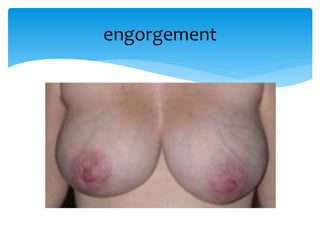
 ENGORGEMENT
Engorgement refers to swelling within the breast tissue,
which can be painful. In some women with engorgement,
the breasts become firm, flushed, warm to the touch, and
feel as if they are throbbing. Some women develop a slight
fever (eg, less than 101ºF or 38.3ºC).
The best treatment for engorgement is to empty the
breasts frequently and completely by breastfeeding.
Breast pump — It is also possible to use a breast pump to
relieve engorgement, although you should not pump for
more than about two to five minutes, as this could
stimulate even more milk production.
Common breastfeeding problems
 Cold pack or showers
 Massage — Massaging the breast gently prior to a
feeding may promote milk flow and help to soften
the breast. Using the fingertips, gently knead the
breast in a circular motion, working from the chest
wall and moving towards the nipple.
 Pain medications — Acetaminophen (Tylenol®) or
ibuprofen (Advil®, Motrin®) are safe to take while
breastfeeding and may be effective in treating the
discomfort related to engorgement.
engorgement
 SORE OR PAINFUL NIPPLES
 ●Nipple ointment — A topical ointment may be
recommended for treatment of sore nipples. One
combination treatment includes a mixture of an
antibiotic ointment, steroid ointment, and antifungal
powder, known as "All Purpose Nipple Ointment"
(APNO). A thin layer of the ointment is applied to the
nipples after feeding . The ointment does not need to be
wiped off before nursing.
 ●Moist healing — Moisture may help sore nipples to
heal. A purified lanolin (eg, Lansinoh, Purelan) or
hydrogel dressing (eg, Comfortgels, Soothies) may be
applied after feeding; these are available without a
prescription in some pharmacies.
 PLUGGED DUCTS
 Plugged ducts are areas in the breast where the flow
of milk is blocked, usually by plugs of skin cells and
milk. As the milk duct fills and stretches, the
surrounding breast tissue becomes tender. Signs of a
plugged duct include a tender or reddened lump in
the breast. This usually occurs in one breast, develops
gradually, and the discomfort is mild. Fever is not a
typical sign of a plugged duct. Repeated episodes of
plugged ducts can lead to the development of a
galactocele, an enlarged area containing a thick,
creamy, cheesy, or oily material within the duct
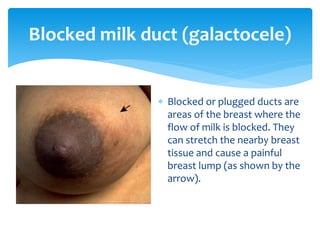
 Blocked or plugged ducts are
areas of the breast where the
flow of milk is blocked. They
can stretch the nearby breast
tissue and cause a painful
breast lump (as shown by the
arrow).
Blocked milk duct (galactocele)
 Treatment of a plugged duct includes frequent and
complete emptying of the breast. Nursing from the
affected side first may help to more fully empty that
breast and begin the flow of milk. Positioning the
infant with the nose pointed toward the plugged area
may facilitate drainage of the affected area. Massage
and a warm shower often promote milk release.
Plugged ducts that do not resolve within 72 hours
should be evaluated by a healthcare provider
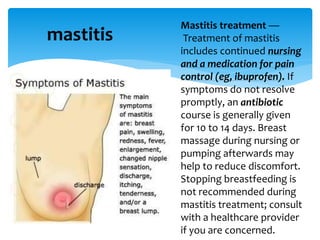
mastitis
Mastitis treatment —
Treatment of mastitis
includes continued nursing
and a medication for pain
control (eg, ibuprofen). If
symptoms do not resolve
promptly, an antibiotic
course is generally given
for 10 to 14 days. Breast
massage during nursing or
pumping afterwards may
help to reduce discomfort.
Stopping breastfeeding is
not recommended during
mastitis treatment; consult
with a healthcare provider
if you are concerned.
 Women who have Raynaud phenomenon or unusual cold
sensitivity may develop a narrowing (constriction) of the
blood vessels of the nipple related to breastfeeding. This
can cause the nipple to become painful and whitened
(blanched) during, immediately after, and between
feedings. Some women have a two-part color change
(white and blue) while others have a three-color change
(white, blue, and red) of Raynaud phenomenon
NIPPLE COLOR CHANGES
 Management — Measures to alleviate blood vessel
constriction include the following:
 ●Increase the air temperature and wear warm
clothing. Reusable wool breast pads may be helpful.
 ●Apply a warm compress just before and after
nursing.
 ●Stop smoking.
 ●Avoid medications that constrict blood vessels (eg,
pseudoephedrine, a decongestant)
 http://www.uptodate.com/contents/common-
breastfeeding-problems-beyond-the-basics
Source:
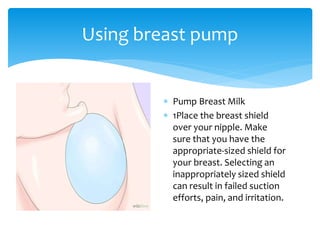
 Pump Breast Milk
 1Place the breast shield
over your nipple. Make
sure that you have the
appropriate-sized shield for
your breast. Selecting an
inappropriately sized shield
can result in failed suction
efforts, pain, and irritation.
Using breast pump
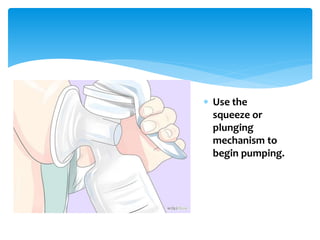
 Use the
squeeze or
plunging
mechanism to
begin pumping.
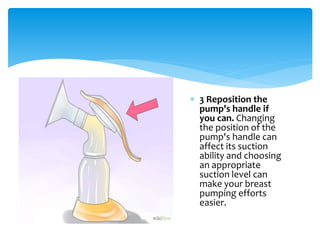
 3 Reposition the
pump's handle if
you can. Changing
the position of the
pump's handle can
affect its suction
ability and choosing
an appropriate
suction level can
make your breast
pumping efforts
easier.
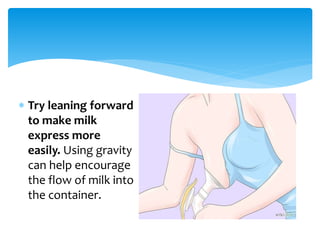
 Try leaning forward
to make milk
express more
easily. Using gravity
can help encourage
the flow of milk into
the container.
 It is generally accepted that you can refrigerate breast
milk for three to five days and freeze it for three to
six months.
Don't freeze milk you plan to use within three to five
days because freezing destroys some of the
antibodies. (However, frozen breast milk is still
healthier than formula.) You can keep milk that's been
frozen and thawed in the refrigerator for up to 24
hours, but don't refreeze it.
How long does breast milk stay
fresh?
 But in reality there are no absolute guidelines
for breast milk storage. The many variables
include the type of freezer you have and how
well it works. A separate deep freezer unit
will keep milk fresh longer because you
generally don't open it as frequently as you
do a freezer / refrigerator unit.
You can provide the best for your
children, start at their birth and
continue to do so.

211337749-Breastfeeding.powerpoint presentation

  • 2.
    Why breastfeed? Answer: Because breastfeedingis B.R.E.A.S.T.F.E.E.D.I.N.G.!
  • 3.
     B: BESTFOR THE BABY  R: Reduces allergies  E: Easy once established  A: Antibodies, greater immunity  S: Stool inoffensive  T: Temperature ideal  F: Fresh/ Feeding milk never goes off  E: Emotional bonding  E: Economical  D: Digested easily  I: Immediately available, no mixing  N: Nutritionally adequate  G: Gastroenteritis greatly reduced
  • 4.
     Breastfeeding isgood for you, too, and may help you to lose weight. In the long term, it also helps to:lower your risk of breast cancer  protect against ovarian cancer before the menopause  reduce your risk of developing type 2 diabetes
  • 5.
     Turn yourbaby's whole body toward you, chest to chest.  Touch her upper lip with your nipple, and, when she opens her mouth wide, pull her onto your breast, holding your breast for support.  Her mouth should cover not just the nipple but as much of the areola (the darker part surrounding it) as possible. Her mouth should cover a big part of the areola below the nipple, and your nipple should be far back in your baby's mouth.
  • 6.
     If latch-onhurts, break the suction (by inserting your little finger between your baby's gums and your breast) and try again. Once your baby latches on properly, she'll do the rest.
  • 7.
  • 9.
     Frequently. Themore you nurse, the more milk you'll produce. Nursing eight to 12 times every 24 hours is pretty much on target.  According to guidelines from the American Academy of Pediatrics (AAP), rather than nursing according to a rigid schedule, you should nurse your newborn whenever she shows early signs of hunger, such as increased alertness or activity, mouthing, or rooting around for your nipple. Crying is a late sign of hunger – ideally, you should start feeding your baby before she starts crying. How often you should nurse?
  • 10.
     During thefirst few days, you may have to gently wake your baby to begin nursing, and she may fall asleep again mid-feeding.  To make sure your baby's eating often enough, wake her up if it's been four hours since your last nursing session.
  • 11.
     The Departmentof Health recommends that your baby has only breastmilk for the first six months of her life. It also recommends that you carry on breastfeeding after your baby has started on solid foods, until the end of her first year and beyond, if you'd like to. Continuing to breastfeed while introducing solid foods to your baby may benefit her immune system. She may also be less likely to develop health conditions such as coeliac disease and type 1 diabetes. http://www.babycentre.co.uk/a613/breastfeeding-for-beginners#ixzz2tq871Dq2 How long will I be breastfeeding for?
  • 12.
     ENGORGEMENT Engorgement refersto swelling within the breast tissue, which can be painful. In some women with engorgement, the breasts become firm, flushed, warm to the touch, and feel as if they are throbbing. Some women develop a slight fever (eg, less than 101ºF or 38.3ºC). The best treatment for engorgement is to empty the breasts frequently and completely by breastfeeding. Breast pump — It is also possible to use a breast pump to relieve engorgement, although you should not pump for more than about two to five minutes, as this could stimulate even more milk production. Common breastfeeding problems
  • 13.
     Cold packor showers  Massage — Massaging the breast gently prior to a feeding may promote milk flow and help to soften the breast. Using the fingertips, gently knead the breast in a circular motion, working from the chest wall and moving towards the nipple.  Pain medications — Acetaminophen (Tylenol®) or ibuprofen (Advil®, Motrin®) are safe to take while breastfeeding and may be effective in treating the discomfort related to engorgement.
  • 14.
  • 15.
     SORE ORPAINFUL NIPPLES  ●Nipple ointment — A topical ointment may be recommended for treatment of sore nipples. One combination treatment includes a mixture of an antibiotic ointment, steroid ointment, and antifungal powder, known as "All Purpose Nipple Ointment" (APNO). A thin layer of the ointment is applied to the nipples after feeding . The ointment does not need to be wiped off before nursing.
  • 16.
     ●Moist healing— Moisture may help sore nipples to heal. A purified lanolin (eg, Lansinoh, Purelan) or hydrogel dressing (eg, Comfortgels, Soothies) may be applied after feeding; these are available without a prescription in some pharmacies.
  • 17.
     PLUGGED DUCTS Plugged ducts are areas in the breast where the flow of milk is blocked, usually by plugs of skin cells and milk. As the milk duct fills and stretches, the surrounding breast tissue becomes tender. Signs of a plugged duct include a tender or reddened lump in the breast. This usually occurs in one breast, develops gradually, and the discomfort is mild. Fever is not a typical sign of a plugged duct. Repeated episodes of plugged ducts can lead to the development of a galactocele, an enlarged area containing a thick, creamy, cheesy, or oily material within the duct
  • 18.
     Blocked orplugged ducts are areas of the breast where the flow of milk is blocked. They can stretch the nearby breast tissue and cause a painful breast lump (as shown by the arrow). Blocked milk duct (galactocele)
  • 19.
     Treatment ofa plugged duct includes frequent and complete emptying of the breast. Nursing from the affected side first may help to more fully empty that breast and begin the flow of milk. Positioning the infant with the nose pointed toward the plugged area may facilitate drainage of the affected area. Massage and a warm shower often promote milk release. Plugged ducts that do not resolve within 72 hours should be evaluated by a healthcare provider
  • 20.
    mastitis Mastitis treatment — Treatmentof mastitis includes continued nursing and a medication for pain control (eg, ibuprofen). If symptoms do not resolve promptly, an antibiotic course is generally given for 10 to 14 days. Breast massage during nursing or pumping afterwards may help to reduce discomfort. Stopping breastfeeding is not recommended during mastitis treatment; consult with a healthcare provider if you are concerned.
  • 21.
     Women whohave Raynaud phenomenon or unusual cold sensitivity may develop a narrowing (constriction) of the blood vessels of the nipple related to breastfeeding. This can cause the nipple to become painful and whitened (blanched) during, immediately after, and between feedings. Some women have a two-part color change (white and blue) while others have a three-color change (white, blue, and red) of Raynaud phenomenon NIPPLE COLOR CHANGES
  • 22.
     Management —Measures to alleviate blood vessel constriction include the following:  ●Increase the air temperature and wear warm clothing. Reusable wool breast pads may be helpful.  ●Apply a warm compress just before and after nursing.  ●Stop smoking.  ●Avoid medications that constrict blood vessels (eg, pseudoephedrine, a decongestant)
  • 23.
  • 24.
     Pump BreastMilk  1Place the breast shield over your nipple. Make sure that you have the appropriate-sized shield for your breast. Selecting an inappropriately sized shield can result in failed suction efforts, pain, and irritation. Using breast pump
  • 25.
     Use the squeezeor plunging mechanism to begin pumping.
  • 26.
     3 Repositionthe pump's handle if you can. Changing the position of the pump's handle can affect its suction ability and choosing an appropriate suction level can make your breast pumping efforts easier.
  • 27.
     Try leaningforward to make milk express more easily. Using gravity can help encourage the flow of milk into the container.
  • 28.
     It isgenerally accepted that you can refrigerate breast milk for three to five days and freeze it for three to six months. Don't freeze milk you plan to use within three to five days because freezing destroys some of the antibodies. (However, frozen breast milk is still healthier than formula.) You can keep milk that's been frozen and thawed in the refrigerator for up to 24 hours, but don't refreeze it. How long does breast milk stay fresh?
  • 29.
     But inreality there are no absolute guidelines for breast milk storage. The many variables include the type of freezer you have and how well it works. A separate deep freezer unit will keep milk fresh longer because you generally don't open it as frequently as you do a freezer / refrigerator unit.
  • 30.
    You can providethe best for your children, start at their birth and continue to do so.