BREASTFEEDING
Presented by
Deeksha dhiman
MD 1st year
PG dept. Of Balroga
Definition of breastfeeding
 Breast feeding is the feeding of an infant
or young child with breast milk directly
from female human breasts (i.e.Via
lactation) not from a baby bottle or other
container.
Anatomy of Breast
 The breast is made up of glandular tissue, supporting
tissue, fat.
 The glandular tissue consists of small clusters of sac like
spaces which produce milk.
 Each sac is lined by network of myoepithelial cells that
propel the milk into lactiferous ducts towards nipple.
 Before reaching the nipple , the ducts widen to form
lactiferous sinuses which store milk.
 The areola and nipples are extremely sensitive as they
are supplied by a rich network of nerve endings.
 Areola contains small swelling of glands which produce
an oily fluid to keep the nipple skin soft.
 Lactiferous sinuses lie beneath the areola, a
baby must suck at the nipple and the areola.
 Gum line of the baby should rest at the
junction of areola and rest of the breast tissue
in order to express the milk stored in the
lactiferous sinuses.
Anatomy of breast
PHYSIOLOGY
 Lactogenesis is a complex phenomenon
involving many hormones and reflexes .Two
hormones are most important , Prolactin and
Oxytocin.
 Prolactin reflex (milk secretion reflex) – when the
baby sucks, the nerve ending in nipple carry
impulse to anterior pituitary which in turn
release prolactin and that acts on the alveolar
glands in the breast to stimulate milk secretion.
Prolactin is produced during night time, hence
breastfeeding during night is very important for
maintenance of this reflex.
 Oxytocin reflex (milk ejection reflex)
Oxytocin is a hormone produced by the
posterior pituitary. It is responsible for
ejection of milk from the glands into the
lactiferous sinuses.
This reflex is affected by the mother’s
emotions,a relaxed, confident attitude
helps the milk ejection reflex. On the
other hand , tension and lack of
confidence hinders the milk flow.
Types of Breast Milk
COLOSTRUM TRANSITIONAL MILK
 Is milk secreted during first
week after delivery
 Yellow , thick has more
antibodies and WBC
 Secreted in small quantity
 High protein
 Never be discarded
 Milk secreted during two
weeks
 Contain immunoglobulin
and low protein content
 Increase fat and sugar
content
MATURE MILK PRETERM MILK
 Follows transitional milk
 More thinner and watery
 Contains all essential
nutrients for growth of the
baby
 Is breast milk of a mother
who delivers prematurely
 High quantity proteins,
sodium ,iron and
immunoglobulins.
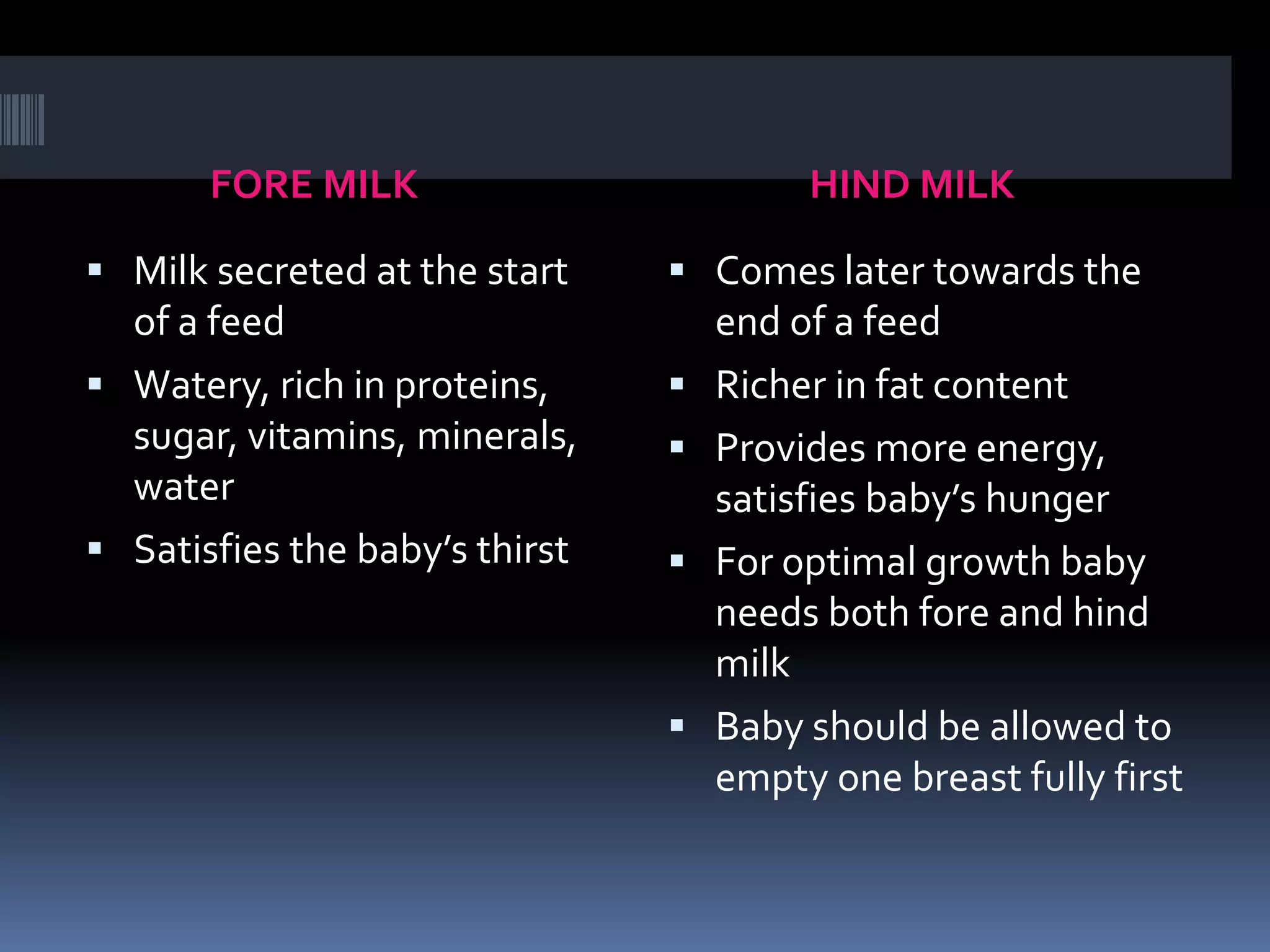
FORE MILK HIND MILK
 Milk secreted at the start
of a feed
 Watery, rich in proteins,
sugar, vitamins, minerals,
water
 Satisfies the baby’s thirst
 Comes later towards the
end of a feed
 Richer in fat content
 Provides more energy,
satisfies baby’s hunger
 For optimal growth baby
needs both fore and hind
milk
 Baby should be allowed to
empty one breast fully first
STORAGE OF BREAST MILK
 Human milk can be stored at room temperature for 6-8
hours
 Expressed milk can be stored in an insulated cooler bag
with ice packs for 24 hours
 Breast milk can be stored in the refrigerator for about 5
days at about 40 degree F
 It can also be kept in a freezer compartment of a fridge
for upto 2 weeks at 0-5 F
 It can be stored in a deep freezer for about 3- 12 months
PREPARATION FOR SUCCESSFUL BREASTFEEDING
Technique of breastfeeding
 Positioning
o Position of the mother –
Mother can assume any position that is comfortable to her
and the baby.
Mothers back should be well supported and she should not be
leaning on her baby.
o Position of the baby –
Baby’s whole body is supported not just neck and shoulders.
Baby’s head and body are in one line without any twist in the
neck.
Baby’s body turned towards the mother.
Baby’s nose is at the level of the nipple.
 Attachment [ Latching ]
Signs of good attachment
• The baby’s mouth is wide open.
• Most of the nipple and areola in the mouth, only upper
areola visible, not the lower one.
• The baby’s chin touches the breast.
• The baby’s lower lip is everted.
• Baby’s suckles slowly and pauses in between to swallow.
• Baby’s cheeks are full and not hollow or retracting during
sucking.
SIGNS OF EFFECTIVE BREASTFEEDING
 Frequent feedings 8-12 times daily
 Intermittent episodes of rhythmic suckling with audible
swallows should be heard while the infant is nursing
 Infant should have about 6-8 wet diapers in a 24 hour
period once breastfeeding is established
 Infant should have minimum of 3-4 bowel movements
every 24 hours
 Stools should be soft and yellow after day 3
 Average daily weight gain of 15-30 g
 Infant has regained daily birth weight by 10 th day of life.
Factors which reduce milk
production are
 Using dummies, pacifiers and bottles not only
interfere with breastfeeding but also predispose
the baby to diarrhoea.
 Giving supplements such as sugar water, grape
water, honey, breast milk substitutes or formula.
 Painful breast conditions like sore or cracked
nipples and engorged breast.
 Lack of night feeding, as the prolactin reflex is
not adequetely stimulated.
 Inadequate emptying of breasts.
ADVANTAGES OF BREASTFEEDING TO
CHILD
1. COMPLETE NUTRITION
 Contains most suitable protein and fat rich in
essential fatty acids like linoleic acid and
linolenic acid
 More lactose than other milk
 Offers enough vitamins, iron and water and
has correct proportion of salt, calcium and
phosphate.
 Special enzyme lipase helps in proper
digestion of fat
2. Cover against infection
Has anti-infective factors
• Immunoglobulins (IgA)
• Lactoferrin
• Lysosymes
• Cells (T and B lymphocytes)
• Antiviral factor
ADVANTAGES OF BREASTFEEDING TO
MOTHER
 Convenient
 Cheaper than artificial milk
 Helps in expulsion of placenta and minimizes risk of PPH
 Calming effect
 Contour of body come back to normal
 Protection against pregnency due to lactational
amenorrhoea
 Effective way of shedding extra weight that mother has
gained during pregnency.
ADVANTAGES TO BOTH MOTHER AND CHILD
 Develop a close loving bond
 Child spacing
 Cost benefits
CONTRAINDICATIONS TO BREAST FEEDING
 HIV infection
 ActiveTuberculosis
 Herpes lesion on mothers breast
 Mothers on certain medications like anticancer therapy,
radioactive isotope.
ISSUES IN BREASTFEEDING
 INVERTED/FLAT NIPPLES
 SORE NIPPLES
 BREAST ENGORGEMENT
 BREAST ABSCESS
 NOT ENOUGH MILK
Problems in breastfeeding
 Inverted nipples
 Inverted or retract nipples make attachment to breast
difficult.
 These should be diagnosed in anti natal period
 The nipple is manually everted, stretched and rolled out
several times a day. A plastic syringe is used to draw out
to correct the problem.
 Breast engorgement –
 If feeding is delayed or infrequent or baby is not well
positioned at the breast, the milk accumulates in the
alveoli. Such a breast become swollen, hard, warm and
painful and is termed as engorged breast.
 Treatment consists of local warm water packs, breast
massage, analgesic to relieve the pain.
 Breast abscess
If a congested engorged breast, cracked nipple, blocked
duct, mastitis are not treated in the early stages, breast
abscess formation can occur.
Treatment includes antibiotics and analgesics.
Breastfeeding must be continued.
composition of BreastMilk
 Nutritional superiority – contains all nutrients a baby needs for
normal growth and development.
 Carbohydrates – Lactose is present in a very high
concentration ( 6-7 g/dl )
 Proteins-The protein content is low ( 0.9- 1.1 g/dl)
 Fats – Rich in polyunsaturated fatty acids.
 Vitamins and minerals – Quantity and bioavailability is
sufficient to meet the needs of the baby during first 6 months
of life.
 Water and electrolytes – Breast milk has a water content of 88
% .
 Immunological superiority – It contains IgA, macrophages,
lymphocytes, lactoferrin, lysozyme, bifidus factor.
 Protection against other illness – Breastfed babies have a
lower risk of allergy, ear infections, orthodontic
problems, diabetes, heart disease and lymphoma in later
life.
 Mental growth – Breastfed babies had a higher IQ than
those babies who were given other forms of milk.
 Benefits to mother – helps uterine involution, reducing
chances of postpartum hemorrhage, protection against
pregnency due to lactational amenorrhea, reduces the
risk of cancer of breast and ovary, effective way of
shedding extra weight that mother has gained during
pregnency.
Some queries related to breastfeeding
 Should i feed water along with breastmilk ?
There is no need to give water and any other fluid except
breast milk as water content in milk is optimum for
growth and nutrition.
 How long should a mother breastfeed ?
The American Academy of Pediatrics recommends that
breastfeeding continue for atleast 12 months, and
therefore as long as the baby and mother desire.The
world health organisation recommends breastfeeding
upto 2 years of age or beyond.
 Should mothers who smoke breastfeed ?
AAP recognizes pregnency and lactation as two ideal
times to promote smoking cessation, but does not
indicate that mothers who smoke should not breastfeed.
BREASTFEEDING IS MUST
 Good for the baby
 Good for the mother
 Good for the nation
THANK YOU

breastfeeding.pptx

  • 1.
  • 2.
    Definition of breastfeeding Breast feeding is the feeding of an infant or young child with breast milk directly from female human breasts (i.e.Via lactation) not from a baby bottle or other container.
  • 3.
    Anatomy of Breast The breast is made up of glandular tissue, supporting tissue, fat.  The glandular tissue consists of small clusters of sac like spaces which produce milk.  Each sac is lined by network of myoepithelial cells that propel the milk into lactiferous ducts towards nipple.  Before reaching the nipple , the ducts widen to form lactiferous sinuses which store milk.  The areola and nipples are extremely sensitive as they are supplied by a rich network of nerve endings.  Areola contains small swelling of glands which produce an oily fluid to keep the nipple skin soft.
  • 4.
     Lactiferous sinuseslie beneath the areola, a baby must suck at the nipple and the areola.  Gum line of the baby should rest at the junction of areola and rest of the breast tissue in order to express the milk stored in the lactiferous sinuses.
  • 5.
  • 7.
    PHYSIOLOGY  Lactogenesis isa complex phenomenon involving many hormones and reflexes .Two hormones are most important , Prolactin and Oxytocin.  Prolactin reflex (milk secretion reflex) – when the baby sucks, the nerve ending in nipple carry impulse to anterior pituitary which in turn release prolactin and that acts on the alveolar glands in the breast to stimulate milk secretion. Prolactin is produced during night time, hence breastfeeding during night is very important for maintenance of this reflex.
  • 9.
     Oxytocin reflex(milk ejection reflex) Oxytocin is a hormone produced by the posterior pituitary. It is responsible for ejection of milk from the glands into the lactiferous sinuses. This reflex is affected by the mother’s emotions,a relaxed, confident attitude helps the milk ejection reflex. On the other hand , tension and lack of confidence hinders the milk flow.
  • 11.
    Types of BreastMilk COLOSTRUM TRANSITIONAL MILK  Is milk secreted during first week after delivery  Yellow , thick has more antibodies and WBC  Secreted in small quantity  High protein  Never be discarded  Milk secreted during two weeks  Contain immunoglobulin and low protein content  Increase fat and sugar content
  • 12.
    MATURE MILK PRETERMMILK  Follows transitional milk  More thinner and watery  Contains all essential nutrients for growth of the baby  Is breast milk of a mother who delivers prematurely  High quantity proteins, sodium ,iron and immunoglobulins.
  • 13.
    FORE MILK HINDMILK  Milk secreted at the start of a feed  Watery, rich in proteins, sugar, vitamins, minerals, water  Satisfies the baby’s thirst  Comes later towards the end of a feed  Richer in fat content  Provides more energy, satisfies baby’s hunger  For optimal growth baby needs both fore and hind milk  Baby should be allowed to empty one breast fully first
  • 14.
    STORAGE OF BREASTMILK  Human milk can be stored at room temperature for 6-8 hours  Expressed milk can be stored in an insulated cooler bag with ice packs for 24 hours  Breast milk can be stored in the refrigerator for about 5 days at about 40 degree F  It can also be kept in a freezer compartment of a fridge for upto 2 weeks at 0-5 F  It can be stored in a deep freezer for about 3- 12 months
  • 15.
  • 16.
    Technique of breastfeeding Positioning o Position of the mother – Mother can assume any position that is comfortable to her and the baby. Mothers back should be well supported and she should not be leaning on her baby. o Position of the baby – Baby’s whole body is supported not just neck and shoulders. Baby’s head and body are in one line without any twist in the neck. Baby’s body turned towards the mother. Baby’s nose is at the level of the nipple.
  • 17.
     Attachment [Latching ] Signs of good attachment • The baby’s mouth is wide open. • Most of the nipple and areola in the mouth, only upper areola visible, not the lower one. • The baby’s chin touches the breast. • The baby’s lower lip is everted. • Baby’s suckles slowly and pauses in between to swallow. • Baby’s cheeks are full and not hollow or retracting during sucking.
  • 18.
    SIGNS OF EFFECTIVEBREASTFEEDING  Frequent feedings 8-12 times daily  Intermittent episodes of rhythmic suckling with audible swallows should be heard while the infant is nursing  Infant should have about 6-8 wet diapers in a 24 hour period once breastfeeding is established  Infant should have minimum of 3-4 bowel movements every 24 hours  Stools should be soft and yellow after day 3  Average daily weight gain of 15-30 g  Infant has regained daily birth weight by 10 th day of life.
  • 19.
    Factors which reducemilk production are  Using dummies, pacifiers and bottles not only interfere with breastfeeding but also predispose the baby to diarrhoea.  Giving supplements such as sugar water, grape water, honey, breast milk substitutes or formula.  Painful breast conditions like sore or cracked nipples and engorged breast.  Lack of night feeding, as the prolactin reflex is not adequetely stimulated.  Inadequate emptying of breasts.
  • 20.
    ADVANTAGES OF BREASTFEEDINGTO CHILD 1. COMPLETE NUTRITION  Contains most suitable protein and fat rich in essential fatty acids like linoleic acid and linolenic acid  More lactose than other milk  Offers enough vitamins, iron and water and has correct proportion of salt, calcium and phosphate.  Special enzyme lipase helps in proper digestion of fat
  • 21.
    2. Cover againstinfection Has anti-infective factors • Immunoglobulins (IgA) • Lactoferrin • Lysosymes • Cells (T and B lymphocytes) • Antiviral factor
  • 22.
    ADVANTAGES OF BREASTFEEDINGTO MOTHER  Convenient  Cheaper than artificial milk  Helps in expulsion of placenta and minimizes risk of PPH  Calming effect  Contour of body come back to normal  Protection against pregnency due to lactational amenorrhoea  Effective way of shedding extra weight that mother has gained during pregnency.
  • 23.
    ADVANTAGES TO BOTHMOTHER AND CHILD  Develop a close loving bond  Child spacing  Cost benefits
  • 24.
    CONTRAINDICATIONS TO BREASTFEEDING  HIV infection  ActiveTuberculosis  Herpes lesion on mothers breast  Mothers on certain medications like anticancer therapy, radioactive isotope.
  • 25.
    ISSUES IN BREASTFEEDING INVERTED/FLAT NIPPLES  SORE NIPPLES  BREAST ENGORGEMENT  BREAST ABSCESS  NOT ENOUGH MILK
  • 26.
    Problems in breastfeeding Inverted nipples  Inverted or retract nipples make attachment to breast difficult.  These should be diagnosed in anti natal period  The nipple is manually everted, stretched and rolled out several times a day. A plastic syringe is used to draw out to correct the problem.
  • 27.
     Breast engorgement–  If feeding is delayed or infrequent or baby is not well positioned at the breast, the milk accumulates in the alveoli. Such a breast become swollen, hard, warm and painful and is termed as engorged breast.  Treatment consists of local warm water packs, breast massage, analgesic to relieve the pain.
  • 28.
     Breast abscess Ifa congested engorged breast, cracked nipple, blocked duct, mastitis are not treated in the early stages, breast abscess formation can occur. Treatment includes antibiotics and analgesics. Breastfeeding must be continued.
  • 29.
    composition of BreastMilk Nutritional superiority – contains all nutrients a baby needs for normal growth and development.  Carbohydrates – Lactose is present in a very high concentration ( 6-7 g/dl )  Proteins-The protein content is low ( 0.9- 1.1 g/dl)  Fats – Rich in polyunsaturated fatty acids.  Vitamins and minerals – Quantity and bioavailability is sufficient to meet the needs of the baby during first 6 months of life.  Water and electrolytes – Breast milk has a water content of 88 % .  Immunological superiority – It contains IgA, macrophages, lymphocytes, lactoferrin, lysozyme, bifidus factor.
  • 30.
     Protection againstother illness – Breastfed babies have a lower risk of allergy, ear infections, orthodontic problems, diabetes, heart disease and lymphoma in later life.  Mental growth – Breastfed babies had a higher IQ than those babies who were given other forms of milk.  Benefits to mother – helps uterine involution, reducing chances of postpartum hemorrhage, protection against pregnency due to lactational amenorrhea, reduces the risk of cancer of breast and ovary, effective way of shedding extra weight that mother has gained during pregnency.
  • 31.
    Some queries relatedto breastfeeding  Should i feed water along with breastmilk ? There is no need to give water and any other fluid except breast milk as water content in milk is optimum for growth and nutrition.  How long should a mother breastfeed ? The American Academy of Pediatrics recommends that breastfeeding continue for atleast 12 months, and therefore as long as the baby and mother desire.The world health organisation recommends breastfeeding upto 2 years of age or beyond.
  • 32.
     Should motherswho smoke breastfeed ? AAP recognizes pregnency and lactation as two ideal times to promote smoking cessation, but does not indicate that mothers who smoke should not breastfeed.
  • 33.
    BREASTFEEDING IS MUST Good for the baby  Good for the mother  Good for the nation
  • 34.