BY –TRIPTI
INTRODUCTION
Puerperium is the period
following childbirth
during which the body
tissues, specially the pelvic
organs revert back
approximately to the pre-
pregnant state both
anatomically and
physiologically.
According to D. C. Dutta
Postnatal care includes systematic examination of the
mother and baby and appropriate advice given to mother
during post-partum period.
According to NadineM. Jacobson
Postpartum care encompasses management of
the mother, newborn, and infant during the
postpartum period. The period usually is
considered to be the first few days after delivery,
but technically it includes the six week period
after childbirth up to the mother’s postpartum
check-up with her health care provider.
HISTORY TAKING
Identification data
Present obstetric history- nausea,vaginal
bleeding,urin frequency.
Past obstetric history-no.of child,
complication of previous preg, miscarriage
Family history
Medical / surgical history
Personal history
Menstrual history
Contraception
psychological
General examination
Mental status
Skin condition
Head
Eyes
Ear
Nose
Mouth, pharynx and throat
Neck chest
Breast
Abdomen
Perineum , lochia , cervix , vagina , bladder
, bowel
Extremities
Nails
BUBBLEHE
The nurse should follow an organised
method when examining the post partum
client , which provides a consistent ,
quality approach to nursing care .The
acronyms , “BUBBLEHE” can serve a
helpful reminder of the elements in a
postpartum assessment .
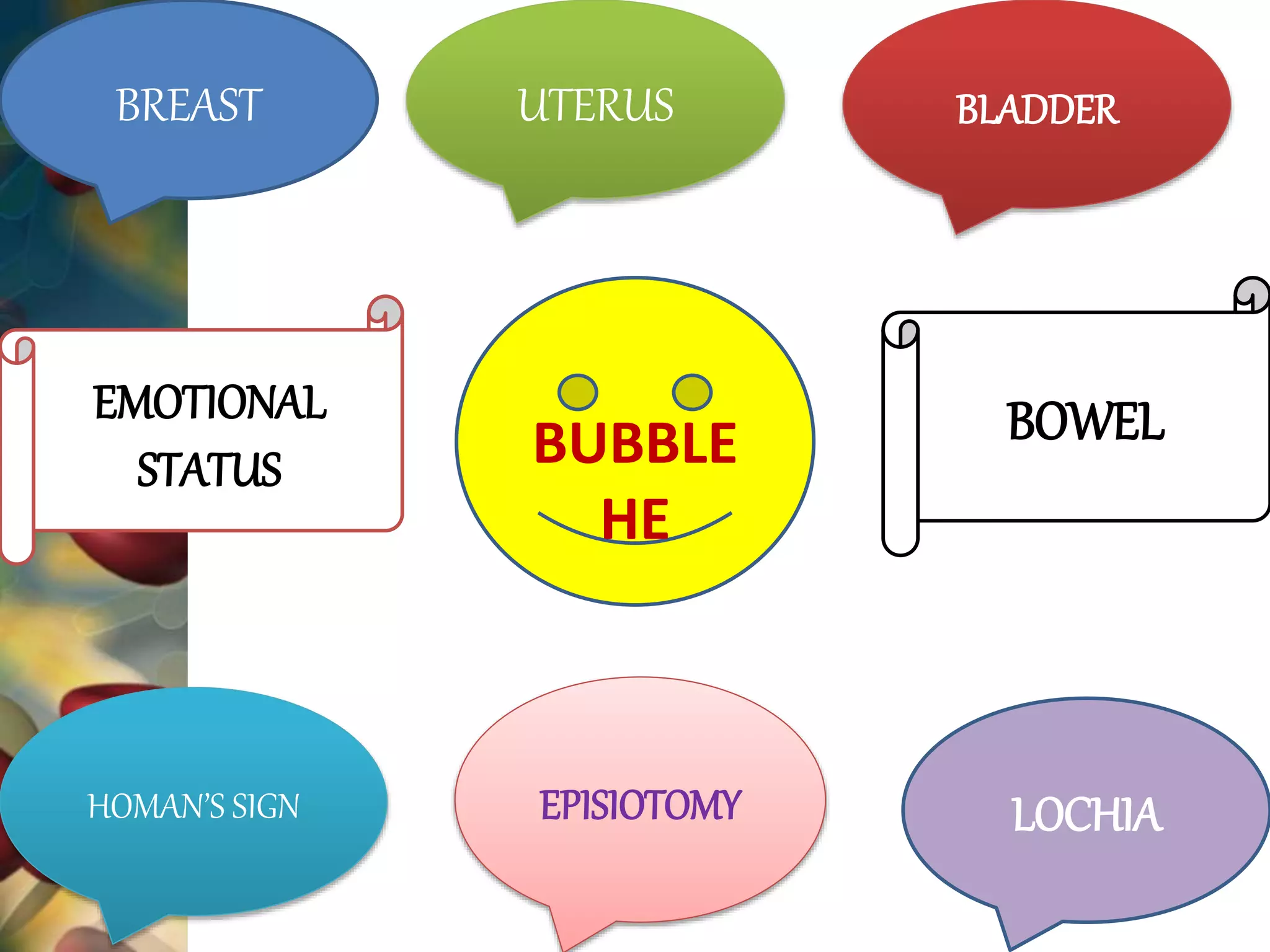
BREAST UTERUS BLADDER
EMOTIONAL
STATUS
BOWEL
HOMAN’S SIGN EPISIOTOMY LOCHIA
BUBBLE
HE
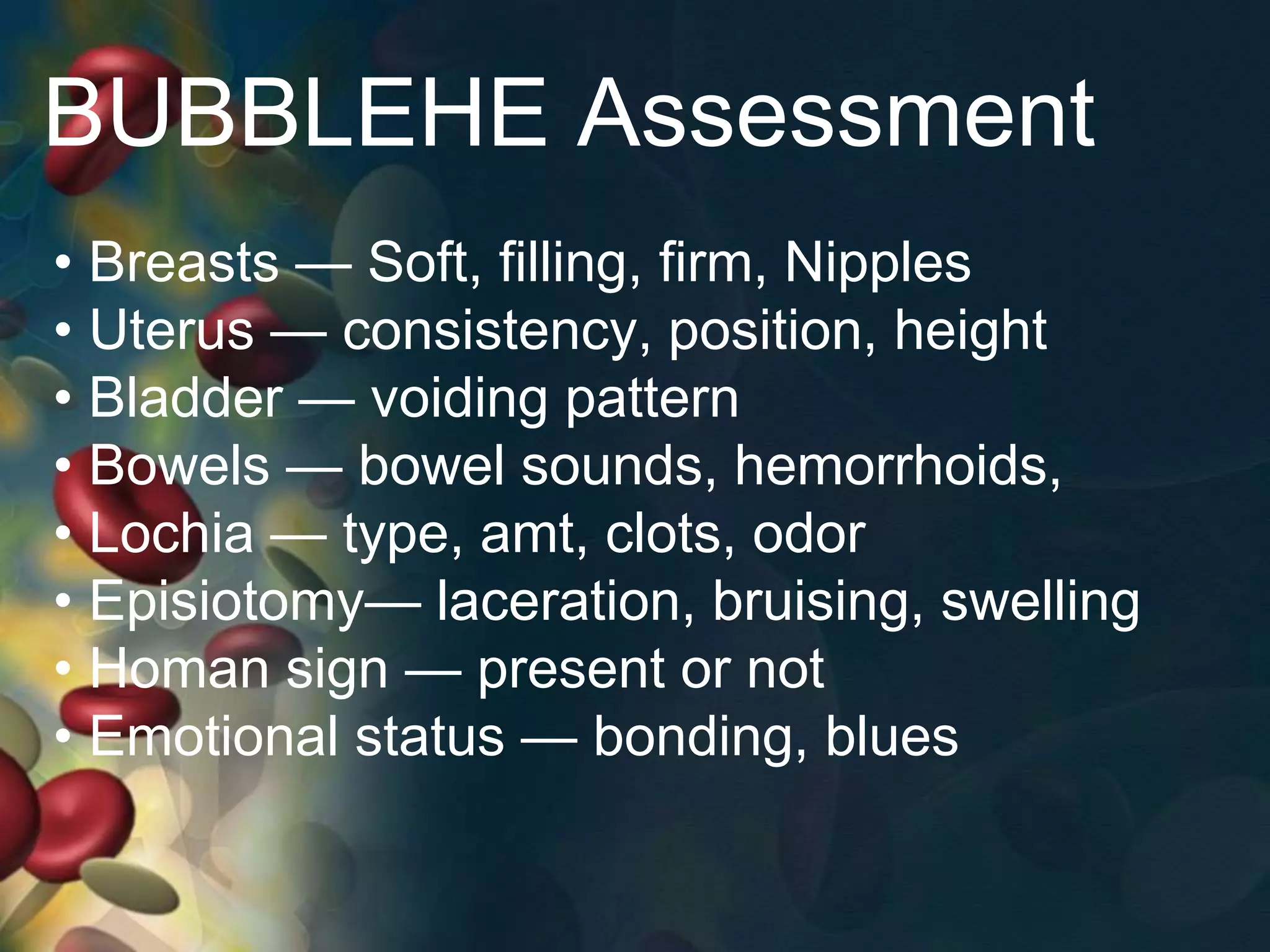
BUBBLEHE Assessment
• Breasts — Soft, filling, firm, Nipples
• Uterus — consistency, position, height
• Bladder — voiding pattern
• Bowels — bowel sounds, hemorrhoids,
• Lochia — type, amt, clots, odor
• Episiotomy— laceration, bruising, swelling
• Homan sign — present or not
• Emotional status — bonding, blues
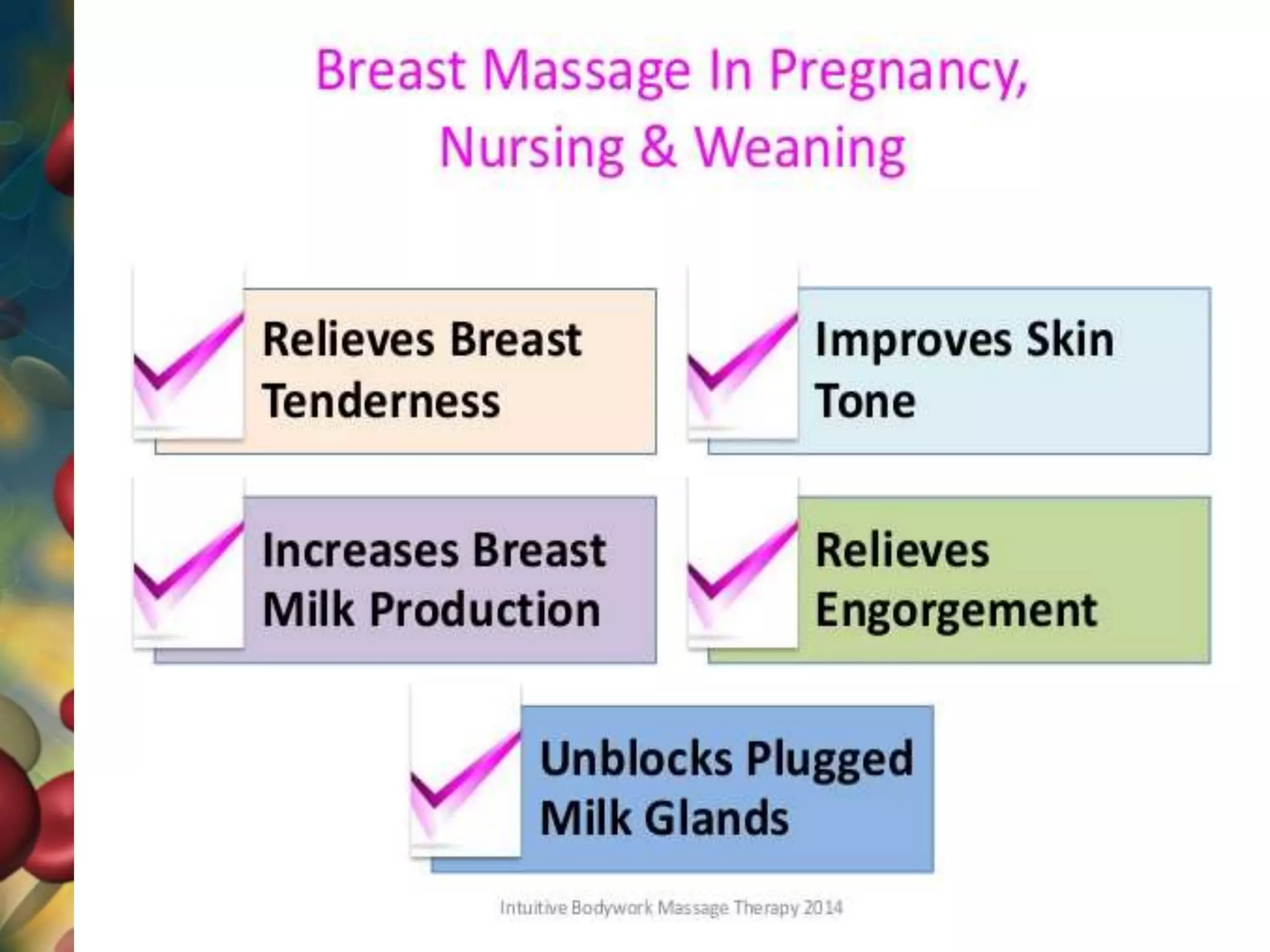
•Breast
•On palpation after delivery , breast
usually are enlarged , soft and warm and
contain only small amount of colostrums .
•The mother may be experience breast
engorgement , which may begin as a
tingling sensation in her breast , 2-4 days
after delivery
•Milk is released through infant sucking ,
manual expression , or pumping
•Analgesic given if breast pain occur .
•Provide cabbage leaves to reduce pain
&swelling.
•Uterus :-
•Size, Weight , location and firmness
•Immediately after delivery , the uterus begins the
process of involution or reduction in size.
•The uterus weight about 100 g , measuring.
•At the end of 6th week weighs 50-100g.
•A bulky uterus may indicate the presence of blood
clots or retained placental beats or also due to a full
rectum . ,
•Tenderness of the uterus suggest infection .
•Normally uterus should be contracted ,hard and not
painful if touched. the height of uterus should be
measured
•After the 1st postpartum day ,the fundus involute 1-2
cm. Per day.
•Management of Bleeding
•After delivery of the placenta 20 to 30 units of
oxytocin often is added to the intravenous solution .
•Or can administering oxytocin intra muscular 10
units .
•Initiating early breast feeding or performing nipple
stimulation is employed .
•If remains boggy than despite massage and oxytocin
administration or if bleeding continue than
pharmacological agent start :-
•Methargin (0.25 mg)IM
•Prostaglandin which can be given when methargin
can not stop bleeding or contraindicated .
Uterine pain
•The key to effective relief from
after birth pain is an empty bladder .
•Once the bladder is empty, the
woman may lie prone with a pillow
under her lower abdomen , which
keeps it contracted and thus
eliminate after birth pain .
•Analgesic can be effective .
•In the immediate postpartum period, the
bladder is congested , edematous and
hypotonic from the effect of labour .
•After delivery , the client should urinate
within 4 hours , at least 300 ml , with
completely emptying the bladder .
•After delivery within 24 hour cause diuresis
up to 3000 ml per day occurs in the first 2 to 3
days .
•Should be noted and informed to the physician
.
•Straight catheterization must be done .
Bladder
Bowels
•Following vaginal delivery , bowel movement
normally occurs after 2 to 3 days .when gastric
motility does not return by 2-3 days ,
constipation occur .
•The client should be encouraged to drink
should be 6to 8 glasses of fluid daily ,eat a high
fiber diet (whole grains , legumes , vegetable
and fruits )
•Sitz bath
•Enema may be given
•Stool softner dulcolax , topical ointment etc.
•Lochia
•when the bleeding is heavy, ensure that
the source of bleeding , it may be
laceration .
•Saturation of vaginal pad with in 15- 30
min.
•CBC may indicate 1.0 to 1.5 g/dl
decrease in Hb level.
•Episiotomy
•An episiotomy is the surgical incision made to enlarge the
vaginal opening for delivery of the baby’s head .
•Care of the vulva includes applying ice packs to the perineum
for the first 24 hour.
•Should not be applied to the directly to the skin , should be
wrapped with an absorbent disposable type of covering .
•After the first 24 hour following delivery . a sitz bath with
warm water may be used .
•The client should be taught perineal hygiene . including daily
wash with warm water and mild soap.
•The perineum should be cleaned after each voiding .
•Perineal pad frequently changes after each voiding , removing
pad from front to back , and hand washing will help decrease
the risk of infection .
•To perform perineal exercises such as kegel exercise .
Homan’s sign
•Assessment of homan’s sign must be done for
all postpartum cliens,to check for presence of
thrombophlebitis .
•Should be perform leg exercise, to teach the
client to flex and extends the both leg and feet
alternatively .
•Keeping the leg uncrossed while seated.
•Not flexing the leg at groin .
•Resting the leg without putting pressure on the
back of the knees.
•Wearing support hose and antiembolism
stocking .
•Padding pressure points during lithotomy
position .
•Emotional status
•The immediate postpartum period is an
emotional roller coaster , and almost any
emotion may be observed .
•They may also be exhausted and need
sleep and rest to restore their bodies to
health .
•In this “taking in phase” mother wish to
meet their own rest and nutritional needs
before focusing their energy on newborns.
•They want to relieve the experience by
talking about the process of labour and
delivery.
Guidance and instruction in preparation for home
care :-
Following normal delivery,
mothers are discharged on the 2nd and 3rd
post partum day , the midwife must
appraise the mother needs for instruction
and guidance for the care of :-
•self
•baby
•self in relations to others
•Sibling and husband.
•Family planning
•Resumption of sexual intercourse
after six weeks,
Myths and fact related to postnatal diet
1. Myths:-recommendation of eating bland food like
khichdi during postpartum period.
Fact:- bland food like khichdi,rice etc are easily digested as
well as the it provides immediate energy to the mother for
day to day activities.
2. myths:-eating extra ghee(butter)helps recover faster,
strengthens joints.
fact:-a mother’s baby already has enough fat reserves that it
gathered during pregnancy. increase the intake of ghee will
lead to weight gain in the postpartum period. instead of
eating ghee laden dry fruits laddoos, drinking a glass of
milk dry fruits in it.
3. Myths:- more the milk the mother drinks, more the
milk she will make
Fact:- there is no scientific evidence confirming the above
claim. instead a balanced diet of rich in protein, minerals
and vita. will help increase breast milk supply.
4. myth:-avoid eating spicy food.
fact:- even though spicy food does affect the flavor of
breast milk slightly; unless the baby seems uncomfortable
or fussy after a feed, it’s ok to eat spicy food.
5. Myth: drinking carom(ajwain) help to digest and speed
up recovery.
fact:-even though there is no scientific evidence in support
of the claim, there is no harm, observed in having it.
provided you have a nutritious diet along with this.
6.Myth: breastfeeding moms can’t have their
morning coffee.
Fact: coffee contains caffeine, which if limited
moderate amounts has been proven to be harmful,
even though over dose of caffeine may cause related
issues.
7.myth:Skip the “gassy "food like broccoli,
cabbage etc.
fact: cabbage, broccoli and many other vegetables
are super foods and a mother needs all the super
nutrients she can get as her body works to produce
milk for the baby.
8.myth:breastfeeding moms require
special vitamin supplements.
Fact: the best source of nutrient for the baby
mother is a varied.
9.myth: eating yogurt by nursing mother
causes infant diarrhea indigestion and gas.
Fact: yogurt is a known pro-biotic and source
of calcium and it is condition like, diarrhea,
indigestion and acidity
POSTNATAL ASSESSMENT

POSTNATAL ASSESSMENT

  • 1.
  • 2.
    INTRODUCTION Puerperium is theperiod following childbirth during which the body tissues, specially the pelvic organs revert back approximately to the pre- pregnant state both anatomically and physiologically.
  • 3.
    According to D.C. Dutta Postnatal care includes systematic examination of the mother and baby and appropriate advice given to mother during post-partum period. According to NadineM. Jacobson Postpartum care encompasses management of the mother, newborn, and infant during the postpartum period. The period usually is considered to be the first few days after delivery, but technically it includes the six week period after childbirth up to the mother’s postpartum check-up with her health care provider.
  • 4.
    HISTORY TAKING Identification data Presentobstetric history- nausea,vaginal bleeding,urin frequency. Past obstetric history-no.of child, complication of previous preg, miscarriage Family history Medical / surgical history Personal history Menstrual history Contraception psychological
  • 5.
    General examination Mental status Skincondition Head Eyes Ear Nose Mouth, pharynx and throat Neck chest Breast Abdomen Perineum , lochia , cervix , vagina , bladder , bowel Extremities Nails
  • 7.
    BUBBLEHE The nurse shouldfollow an organised method when examining the post partum client , which provides a consistent , quality approach to nursing care .The acronyms , “BUBBLEHE” can serve a helpful reminder of the elements in a postpartum assessment .
  • 8.
  • 9.
    BUBBLEHE Assessment • Breasts— Soft, filling, firm, Nipples • Uterus — consistency, position, height • Bladder — voiding pattern • Bowels — bowel sounds, hemorrhoids, • Lochia — type, amt, clots, odor • Episiotomy— laceration, bruising, swelling • Homan sign — present or not • Emotional status — bonding, blues
  • 10.
    •Breast •On palpation afterdelivery , breast usually are enlarged , soft and warm and contain only small amount of colostrums . •The mother may be experience breast engorgement , which may begin as a tingling sensation in her breast , 2-4 days after delivery •Milk is released through infant sucking , manual expression , or pumping •Analgesic given if breast pain occur . •Provide cabbage leaves to reduce pain &swelling.
  • 14.
    •Uterus :- •Size, Weight, location and firmness •Immediately after delivery , the uterus begins the process of involution or reduction in size. •The uterus weight about 100 g , measuring. •At the end of 6th week weighs 50-100g. •A bulky uterus may indicate the presence of blood clots or retained placental beats or also due to a full rectum . , •Tenderness of the uterus suggest infection . •Normally uterus should be contracted ,hard and not painful if touched. the height of uterus should be measured •After the 1st postpartum day ,the fundus involute 1-2 cm. Per day.
  • 15.
    •Management of Bleeding •Afterdelivery of the placenta 20 to 30 units of oxytocin often is added to the intravenous solution . •Or can administering oxytocin intra muscular 10 units . •Initiating early breast feeding or performing nipple stimulation is employed . •If remains boggy than despite massage and oxytocin administration or if bleeding continue than pharmacological agent start :- •Methargin (0.25 mg)IM •Prostaglandin which can be given when methargin can not stop bleeding or contraindicated .
  • 16.
    Uterine pain •The keyto effective relief from after birth pain is an empty bladder . •Once the bladder is empty, the woman may lie prone with a pillow under her lower abdomen , which keeps it contracted and thus eliminate after birth pain . •Analgesic can be effective .
  • 17.
    •In the immediatepostpartum period, the bladder is congested , edematous and hypotonic from the effect of labour . •After delivery , the client should urinate within 4 hours , at least 300 ml , with completely emptying the bladder . •After delivery within 24 hour cause diuresis up to 3000 ml per day occurs in the first 2 to 3 days . •Should be noted and informed to the physician . •Straight catheterization must be done . Bladder
  • 18.
    Bowels •Following vaginal delivery, bowel movement normally occurs after 2 to 3 days .when gastric motility does not return by 2-3 days , constipation occur . •The client should be encouraged to drink should be 6to 8 glasses of fluid daily ,eat a high fiber diet (whole grains , legumes , vegetable and fruits ) •Sitz bath •Enema may be given •Stool softner dulcolax , topical ointment etc.
  • 19.
    •Lochia •when the bleedingis heavy, ensure that the source of bleeding , it may be laceration . •Saturation of vaginal pad with in 15- 30 min. •CBC may indicate 1.0 to 1.5 g/dl decrease in Hb level.
  • 21.
    •Episiotomy •An episiotomy isthe surgical incision made to enlarge the vaginal opening for delivery of the baby’s head . •Care of the vulva includes applying ice packs to the perineum for the first 24 hour. •Should not be applied to the directly to the skin , should be wrapped with an absorbent disposable type of covering . •After the first 24 hour following delivery . a sitz bath with warm water may be used . •The client should be taught perineal hygiene . including daily wash with warm water and mild soap. •The perineum should be cleaned after each voiding . •Perineal pad frequently changes after each voiding , removing pad from front to back , and hand washing will help decrease the risk of infection . •To perform perineal exercises such as kegel exercise .
  • 24.
    Homan’s sign •Assessment ofhoman’s sign must be done for all postpartum cliens,to check for presence of thrombophlebitis . •Should be perform leg exercise, to teach the client to flex and extends the both leg and feet alternatively . •Keeping the leg uncrossed while seated. •Not flexing the leg at groin . •Resting the leg without putting pressure on the back of the knees. •Wearing support hose and antiembolism stocking . •Padding pressure points during lithotomy position .
  • 26.
    •Emotional status •The immediatepostpartum period is an emotional roller coaster , and almost any emotion may be observed . •They may also be exhausted and need sleep and rest to restore their bodies to health . •In this “taking in phase” mother wish to meet their own rest and nutritional needs before focusing their energy on newborns. •They want to relieve the experience by talking about the process of labour and delivery.
  • 27.
    Guidance and instructionin preparation for home care :- Following normal delivery, mothers are discharged on the 2nd and 3rd post partum day , the midwife must appraise the mother needs for instruction and guidance for the care of :- •self •baby •self in relations to others
  • 30.
    •Sibling and husband. •Familyplanning •Resumption of sexual intercourse after six weeks,
  • 31.
    Myths and factrelated to postnatal diet 1. Myths:-recommendation of eating bland food like khichdi during postpartum period. Fact:- bland food like khichdi,rice etc are easily digested as well as the it provides immediate energy to the mother for day to day activities. 2. myths:-eating extra ghee(butter)helps recover faster, strengthens joints. fact:-a mother’s baby already has enough fat reserves that it gathered during pregnancy. increase the intake of ghee will lead to weight gain in the postpartum period. instead of eating ghee laden dry fruits laddoos, drinking a glass of milk dry fruits in it.
  • 32.
    3. Myths:- morethe milk the mother drinks, more the milk she will make Fact:- there is no scientific evidence confirming the above claim. instead a balanced diet of rich in protein, minerals and vita. will help increase breast milk supply. 4. myth:-avoid eating spicy food. fact:- even though spicy food does affect the flavor of breast milk slightly; unless the baby seems uncomfortable or fussy after a feed, it’s ok to eat spicy food. 5. Myth: drinking carom(ajwain) help to digest and speed up recovery. fact:-even though there is no scientific evidence in support of the claim, there is no harm, observed in having it. provided you have a nutritious diet along with this.
  • 33.
    6.Myth: breastfeeding momscan’t have their morning coffee. Fact: coffee contains caffeine, which if limited moderate amounts has been proven to be harmful, even though over dose of caffeine may cause related issues. 7.myth:Skip the “gassy "food like broccoli, cabbage etc. fact: cabbage, broccoli and many other vegetables are super foods and a mother needs all the super nutrients she can get as her body works to produce milk for the baby.
  • 34.
    8.myth:breastfeeding moms require specialvitamin supplements. Fact: the best source of nutrient for the baby mother is a varied. 9.myth: eating yogurt by nursing mother causes infant diarrhea indigestion and gas. Fact: yogurt is a known pro-biotic and source of calcium and it is condition like, diarrhea, indigestion and acidity