Introduction
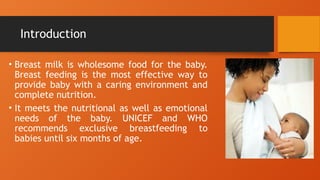
• Breast milkis wholesome food for the baby.
Breast feeding is the most effective way to
provide baby with a caring environment and
complete nutrition.
• It meets the nutritional as well as emotional
needs of the baby. UNICEF and WHO
recommends exclusive breastfeeding to
babies until six months of age.
3.
Physiology of Lactation
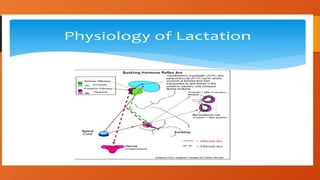
•Human milk is produced due to interaction between
hormones and reflexes. During pregnancy, the glandular
tissue of breast is stimulated to produce milk due to
hormones- oxytocin and prolactin. Also two reflexes
mediated by these hormones come into play.
4.
Milk Secretion Reflex(Prolactin Reflex):
• Prolactin produced by anterior pituitary gland is
responsible for milk secretion by alveolar cells of breast.
When the baby sucks, the nerve endings in the nipple
carry message to anterior pituitary which in turn releases
prolactin. This cycle from stimulation to secretion is
called 'milk secretion reflex or prolactin reflex’.
6.
Milk ejection Reflex(Oxytocin Reflex):
• Oxytocin produced by posterior pituitary is responsible
for contraction of breast tissue leading to ejection of
milk from the gland into the lactiferous sinuses and
ducts. This hormone is produced in response to
stimulation of nerve endings in the nipple by suckling as
well as by the thought, sight or sound of the baby. Since
this reflex is affected by mother's emotions, a relaxed
and confident attitude helps in "milk ejection".
7.
Types of BreastMilk
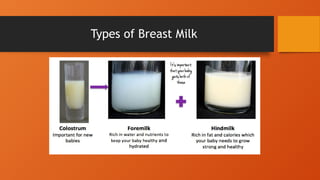
• The composition of breast milk varies at different stages of post natal
period, to suit the needs of the baby.
1. Colostrum: It is the milk secreted during the first three days after delivery.
It is thick and yellow in color and rich in antibodies and Vitamin A,D,E and
K.
2. Transitional Milk: It is the milk secreted during the next two weeks. The
immunoglobulin and protein content decreases while fat and sugar
increases.
3. Mature Milk: It follows transitional milk. It is thinner and watery but has all
nutrients for optimum growth of baby
Types of BreastMilk
4. Fore Milk: It is rich in proteins, sugar, vitamins and water.
Starting Of Reguler B.F. watery.
5. Hind Milk: It comes later, towards the end of a feed and is rich
in fat and energy and satisfies the baby's hunger.
10.
Initiation of breastfeeding
• Breast feeding should be started within first half an hour
to one hour of birth or as soon as possible after normal
delivery whereas in case of caesarean section delivery,
within 4 hours.
• Rooming in and bedding- In should be done with mother
and baby to prevent separation and promote breast
feeding.
11.
Technique of BreastFeeding
A. Position of mother and baby
B. Latching or attachment of baby to the breast.
12.
A. Position ofmother and baby
1. Help the mother to get into a comfortable and relaxed position-sitting
or lying down.
2. Explain the mother to hold the baby, keeping in mind the 4 key points
• Head and body of baby should be straight.
• The baby's nose should be opposite to the nipple.
• Baby's body should be close to her body.
• Whole body of the baby must be supported.
3. Mother should than support her breast with her fingers flat against her
chest wall under her breast.
13.
B. Latching orattachment of baby to the breast
After proper positioning, the baby's check is touched with the nipple.
Due to rooting reflex, baby quickly turns his face towards the breast
and starts sucking. The baby sucks, pauses and suck again.
14.
Signs of Goodattachment
• Baby's mouth is wide open.
• Baby's chin touches the breast.
• Much of the areola is not visible as it is
in the baby's mouth.
• Baby's cheeks are full and not hollow.
15.
Signs of PoorAttachment
• Only the nipple is in the baby's mouth not the areola.
• The baby's tongue is back inside his mouth and cannot
reach the ducts to press on them.
• Suckling with poor attachment may be uncomfortable or
painful for the mother
16.
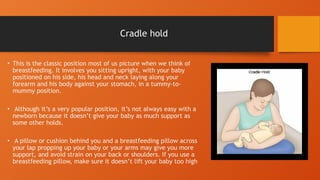
Cradle hold
• Thisis the classic position most of us picture when we think of
breastfeeding. It involves you sitting upright, with your baby
positioned on his side, his head and neck laying along your
forearm and his body against your stomach, in a tummy-to-
mummy position.
• Although it’s a very popular position, it’s not always easy with a
newborn because it doesn’t give your baby as much support as
some other holds.
• A pillow or cushion behind you and a breastfeeding pillow across
your lap propping up your baby or your arms may give you more
support, and avoid strain on your back or shoulders. If you use a
breastfeeding pillow, make sure it doesn’t lift your baby too high
17.
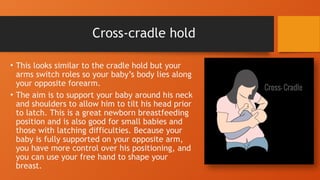
Cross-cradle hold
• Thislooks similar to the cradle hold but your
arms switch roles so your baby’s body lies along
your opposite forearm.
• The aim is to support your baby around his neck
and shoulders to allow him to tilt his head prior
to latch. This is a great newborn breastfeeding
position and is also good for small babies and
those with latching difficulties. Because your
baby is fully supported on your opposite arm,
you have more control over his positioning, and
you can use your free hand to shape your
breast.
18.
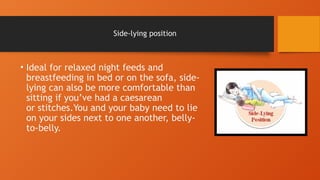
Side-lying position
• Idealfor relaxed night feeds and
breastfeeding in bed or on the sofa, side-
lying can also be more comfortable than
sitting if you’ve had a caesarean
or stitches.You and your baby need to lie
on your sides next to one another, belly-
to-belly.
19.
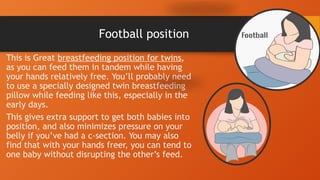
Football position
This isGreat breastfeeding position for twins,
as you can feed them in tandem while having
your hands relatively free. You’ll probably need
to use a specially designed twin breastfeeding
pillow while feeding like this, especially in the
early days.
This gives extra support to get both babies into
position, and also minimizes pressure on your
belly if you’ve had a c-section. You may also
find that with your hands freer, you can tend to
one baby without disrupting the other’s feed.
20.
Advantages of mother
•Breast feeding is ideal for the neonates. It has several
advantages both for the baby and mother.
21.
Nutritive value
• Itis a wholesome food for the baby as it contains all the nutrients that a
baby needs in fir6 months of life for optimum growth and development.
• Proteins: Human milk has low protein (0.7gm/dl) than cow's milk (3.5g/dl)
which lowers the solute load on kidneys of baby. Also human milk protein
mainly (lactalbumin) is more easily digested than cow's milk protein
(Casein).
• Fat: Higher content of mono unsaturated fatty acids especially linoleic acid
in human milk promotes brain growth and protects individuals from
atherosclerosis in later life.
• Minerals: Human milk contains a smaller but more balanced proportion of
calcium and phosphorous as compared to cow's milk.
22.
Lowers Risk ofInfection
• Human milk contains high level of lysozyme and IgA which offers
protection to the baby against several viral and bacterial
diseases.
• Breast milk especially colostrum contains numerous host defense
factors like macrophages, granulocytes, T and B lymphocytes.
Lactoferrin present in breast milk protects the baby from enteric
infections. Para-amino- benzoic acid (PABA) present in breast
milk protects the baby from malaria.
23.
Protects From Allergy
•Higher concentration of secretory IgA in breast milk lowers the
risk of milk allergy to the baby so it is the safest food for the
baby.
24.
Therapeutic Effect
• Breastfeeding protects the baby from E. coli infection due to
high levels of bifid us factor in it. Lactoferrin present in breast
milk protects the baby from enteric infections.
• It protects the baby from neonatal hypocalcemia and tetany (due
to its ideal calcium and phosphorous ratio). Also, exclusively
breast fed infants are at lower risk of developing diabetes
mellitus, childhood lymphomas, liver diseases and bronchial
asthma later in life.
25.
Physiological Adaptation
• Mother'smilk is very suitable for the baby. Milk of mother who
has delivered a preterm baby is different from milk of term
baby's mother. Preterm mother's milk contains more energy,
protein, fat, sodium, zinc, anti-infective factors and
macrophages and has lower lactose, calcium and phosphorous
content.
26.
Economic Factors
• Breastmilk is available free of cost for the baby. Also it is safe
and free from any contamination so there is no risk of infection
to the baby. This ultimately reduces the cost of hospitalization
and economic burden of illness on family.
27.
Emotional Bonding
Breast feedingpromotes emotional and physical bonding between
the mother and the baby. This leads to better child and mother
relationship and fewer behavioral problems in children.
28.
Advantages for Mother
1.Lactation suppresses ovulation in mothers who give exclusive
breast feeding to their infants and serves as a natural
contraceptive.
2. Breast feeding lowers the risk of ovarian and breast cancer.
3. Breast feeding is convenient for the mother as she is not required
to clean the bottle and prepare milk whenever she feeds the baby.
4. Breast feeding the baby helps mother lose extra weight that she
had put during pregnancy.
5. Breast feeding promotes involution of uterus, thus brings back the
mother in shape after delivery.
29.
Exclusive Breast Feeding
•Exclusive breast feeding means feeding baby with breast milk
soon after birth and continuing it until 6 months without giving
baby any other food. The baby is given only breast milk and
nothing else whenever the baby is hungry.
30.
Contraindication
1. Psychological Factors:
Shock,strong pain, anger, anxiety or worry can affect let down
reflex So the mother should be encouraged and supported to be calm,
relaxed and have a positive attitude while breast feeding.
2. Early Breast Engorgement:
During and immediately after delivery, breast may be felt full and
uncomfortable. Some mothers get hard, engorged and painful breast
which makes feeding the baby difficult. This problem can be solved by
application of warm compress to breast and then expressing excess milk.
31.
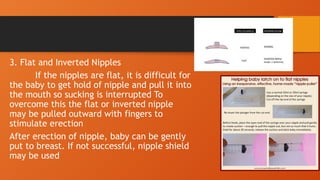
3. Flat andInverted Nipples
If the nipples are flat, it is difficult for
the baby to get hold of nipple and pull it into
the mouth so sucking is interrupted To
overcome this the flat or inverted nipple
may be pulled outward with fingers to
stimulate erection
After erection of nipple, baby can be gently
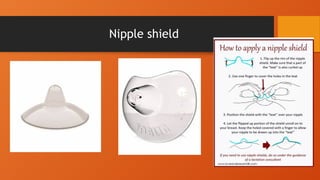
put to breast. If not successful, nipple shield
may be used
32.
4. Sore Nipple:
• Nipples may be sore because of faulty sucking technique such as baby
taking an insufficient amount of areola into mouth while feeding.
Nipples may become sore due to long periods of vigorous sucking,
• sucking in bad position, engorged breast and oral thrush of baby. This
can be prevented by teaching the mother about proper breast feeding
technique during antenatal period
• Mothers should decrease the length of feeding and increase the
frequency of feeding Also mothers should avoid the use of soap on breast
as it causes drying Any emollient like Vaseline or edible oil should be
applied on the nipples after feeding the baby.










![ONFH[AVN HIP] -TRIPLE REGIME -A NOVAL SURGICAL CONCEPT .pptx](https://cdn.slidesharecdn.com/ss_thumbnails/onfhavnhip2026koaconcalicutdrgokuldevdrmashraf-260210064517-213ec005-thumbnail.jpg?width=640&height=640&fit=bounds)

