BREAST FEEDING
STEFFY THOMAS
PHYSICIAN ASSISSTANT
"The more we know about
human breast milk the
more we discover about its
value in human nutrition
and development”.
INTRODUCTION
“A newborn has only three demands” :
They are warmth in the arms of its mother, food from
her breasts and security in the knowledge of her
presence.
Breastfeeding satisfies all three” . [Grantly Dick Read]
WHY EMPHASIZE ON BREAST FEEDING???
When Indian women breast feed without exception
• 25% do not initiate within 24 hrs
• 50% discard colostrums
• 75% give prelacteal feeding Many women believe they
do not have sufficient milk & indulge in top milk feeding
BREASTFEEDING
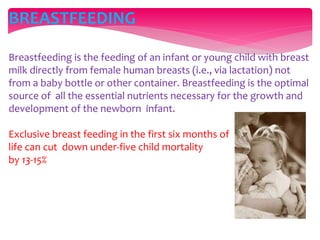
Breastfeeding is the feeding of an infant or young child with breast
milk directly from female human breasts (i.e., via lactation) not
from a baby bottle or other container. Breastfeeding is the optimal
source of all the essential nutrients necessary for the growth and
development of the newborn infant.
Exclusive breast feeding in the first six months of
life can cut down under-five child mortality
by 13-15%
EXCLUSIVE BREAST FEEDING
•WHO AND UNICEF defined as Breast feeding for the first six months
•Not even H2O
•No pre‐lacteal feeds.
•No formula feeds.
But allows infants to receive ORS, Vitamins & mineral drops /syrups, medicines
WHO RECOMMENDATIONS
• Exclusive breast feeding until 6 months of age
• Introduce complimentary foods with continued breastfeeding
• Optimum to breastfeed for 2 years or Longer
PRELACTEAL FEEDING
Any food provided to newborn before the initiation of mothers breast feeding is
considered to be a prelacteal feed. It is still traditional .
In india,it includes-ghee, honey, sugar, gold crust , unboiled cow/goat milk,
jaggery is given to children over the period of starvation until lactation begins
given by unsterilized spoons/cotton.
HAZARDS
• Diverts mother and child from breast feeding immediately after delivery when
the sucking reflex is enhanced
• Increases risk of sepsis
8
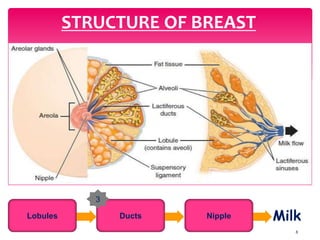
STRUCTURE OF BREAST
MilkLobules Ducts Nipple
3
PHYSIOLOGY OF LACTATION
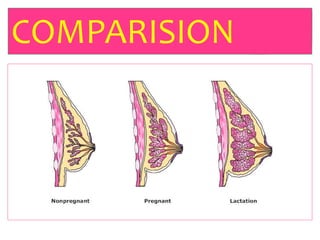
COMPARISION
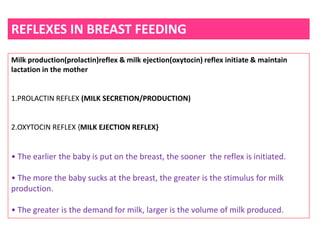
REFLEXES IN BREAST FEEDING
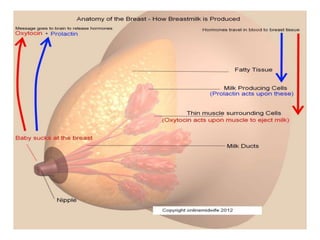
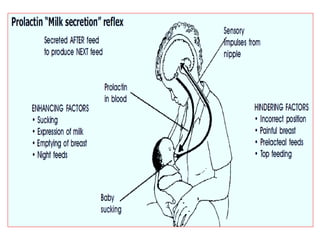
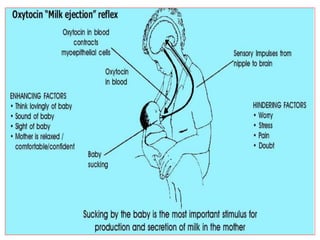
Milk production(prolactin)reflex & milk ejection(oxytocin) reflex initiate & maintain
lactation in the mother
1.PROLACTIN REFLEX (MILK SECRETION/PRODUCTION)
2.OXYTOCIN REFLEX {MILK EJECTION REFLEX}
• The earlier the baby is put on the breast, the sooner the reflex is initiated.
• The more the baby sucks at the breast, the greater is the stimulus for milk
production.
• The greater is the demand for milk, larger is the volume of milk produced.
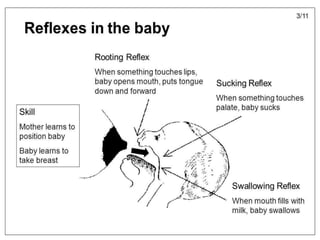
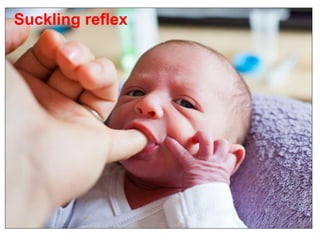
Suckling reflex
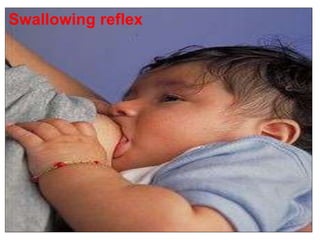
Swallowing reflex
FACTORS DECREASING MILK PRODUCTION
• Dummies, pacifiers, bottles.
• Giving prelacteal feeds.
• Painful breast conditions like sore or cracked nipple & congested breast.
• Lack of night feeding interfering prolactin production.
TYPES OF BREAST MILK
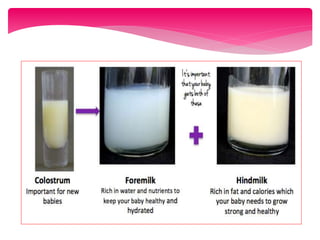
1.COLOSTRUM:
• During the first two or three days after delivery thick and yellowish fluid is secreted from the mammary
gland. This differs from the regular milk and is called colostrum/ or Early Milk.
• It is secreted in small quantity of about 10-40 ml.
• Even in small amounts ,it is enough to feed the newborn baby and help’s a baby to pass his or her first
stool
• Recommended by WHO as the perfect food for the newborn and feeding should be initiated within the
first hour after birth
• It is rich in protein especially in Ab, vit, minerals, but very low in fat which is for easy digestion
compared to mature breast milk. Concentration of arachiodonic acid and docosa hexaenoic acid (DHA) as
percent of total fatty acids is higher in colostrum than mature milk.
2.TRANSITIONAL MILK:
• During the next two weeks, the milk increases in quantity and changes in appearance and composition
and this is called transitional milk
• Secreted after 3‐4days up to 2weeks.
• Rich in fat & sugar content
TYPES OF BREAST MILK
3.MATURE MILK:
The milk which replaces the transitional milk after 2 weeks of lactation until the termination of the
breastfeeding.
• Thinner & watery.
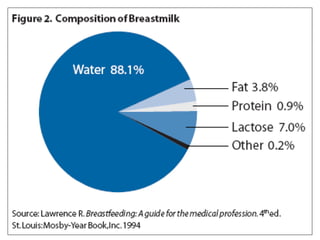
• Contains all essential nutrients.
1.FORE MILK:
The milk that comes at the start of a feed is called foremilk. Foremilk which is watery has a low level of fat
and is high in lactose sugar, protein, vitamins, minerals and water. It satisfies the baby thirst.
2.HIND MILK:
Hind milk which comes later towards the end of a feed is richer in fat, it satisfies the baby’s hunger and
supplies more energy than foremilk.
 Babies who are fed fore and hind milk sleep well and grow healthy
 The baby should therefore be allowed to empty one breast.
 The second breast should be offered after emptying the first.
ADVANTAGES OF BREAST MILK
BABY
PERFECT FOOD FOR INFANTS
Easily digested and well absorbed
Protects against infection and allergies
Promotes emotion bonding b/w Baby and mother
Better brain growth
EHANCES IMMUNE SYSTEM
PROVIDES ADEQUATE H2O FOR HYDRATION
PROVIDES SUPERIOR NUTRITION FOR OPTIMUM GROWTH
RICH IN ALL NUTRIENTS, BABY
NEEDS[CHO,F,P,M,V]
REDUCE RISK OFCHILDHOOD CANCER
MOTHER
PROTECTS MOTHERS HEALTH
HELPS DELAY A NEW PREGNANCY
HELPS A MOTHER RETURN TO PRE-PREGNANCY WEIGHT
[BURN OFF EXTRA FAT ACCULUMATED DURING PREGNANCY]
REDUCE THE RISK OF BREAST AND OVARIAN CANCER
REPLENISHES CA LEVELS DURING LACTATION
DELAYS M.CYCLE / VOL OF B.FLOW DURING M.CYCLE
REDUCES THE RISK OF UTERINE BLEEDING AND HELPS THE
UTERUS TO RETURN TO ITS PREVIOUS SIZE
FAMILY
&
SOCIETY
Saves money [More economical than Artificial feed]
Promotes family planning
Decreases need for hospitalization of children's
Reduces Infant mortality
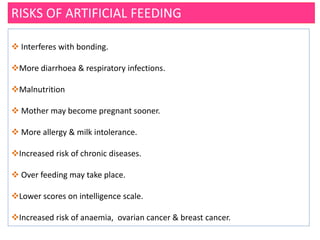
RISKS OF ARTIFICIAL FEEDING
 Interferes with bonding.
More diarrhoea & respiratory infections.
Malnutrition
 Mother may become pregnant sooner.
 More allergy & milk intolerance.
Increased risk of chronic diseases.
 Over feeding may take place.
Lower scores on intelligence scale.
Increased risk of anaemia, ovarian cancer & breast cancer.
BURPING
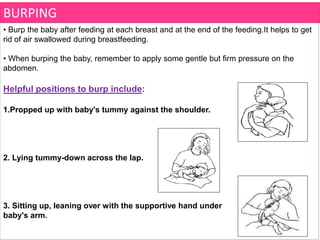
• Burp the baby after feeding at each breast and at the end of the feeding.It helps to get
rid of air swallowed during breastfeeding.
• When burping the baby, remember to apply some gentle but firm pressure on the
abdomen.
Helpful positions to burp include:
1.Propped up with baby's tummy against the shoulder.
2. Lying tummy-down across the lap.
3. Sitting up, leaning over with the supportive hand under
baby's arm.
INITIATION OF BREAST FEEDING
• As early as possible breast feeding has to be initiated in both normal and LSCS delivery
within one hour of life
• After birth‐baby is biologically ready & initiation is easy, Later on baby goes to prolonged
sleep and hence its difficult.
• Rooming in and bedding should be done with mother and baby to prevent separation
and promote breast feeding.
• Frequency – 2‐3 hourly / 8 -12 feeds per day /demand feeding.
• Duration – exclusive breast feeding for 6 months.
• Time for each feed : 15‐20 minutes
• On an average 650 to 850 ml milk is produced per day.
HOW OFTEN TO BREASTFEED?
• Breastfeeding must be on demand
•Atleast 8 times a day
• Babies feed with different frequencies and take different amounts of milk at each feed
• No timetable for breastfeeding
• Allow sucking until he/she spontaneously releases the
nipple.
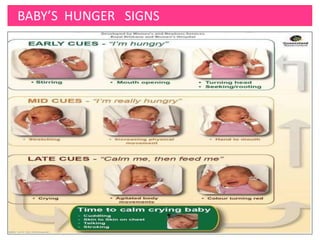
BABY’S HUNGER SIGNS
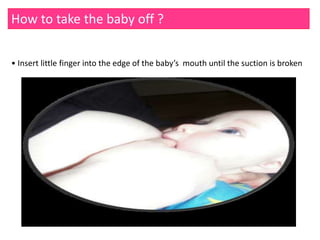
How to take the baby off ?
• Insert little finger into the edge of the baby’s mouth until the suction is broken
How to know if your baby is getting enough Breast
milk?
• You feel : your breast being pulled with NO PAIN
• You hear : your baby swallowing
• You see : a wide open mouth curled out lips chin pressed into your breast sucking and
swallowing
• He is contented for 1-2 hours after a feed
• He passes clear dilute urine 6-8 times a day
• He passes bright yellow watery stools 5-6 times a day
• He sleeps well for 2 to 3 hours after feed
• Weight gain
The new born may lose 7 % in the first 3 days
Should return to their birth weight by 10 days of age/2 weeks
Should gain at least 20-35 grs a day in the first 3-4 months of age
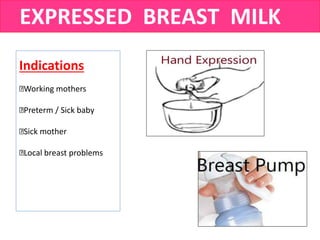
Indications
Working mothers
Preterm / Sick baby
Sick mother
Local breast problems
EXPRESSED BREAST MILK
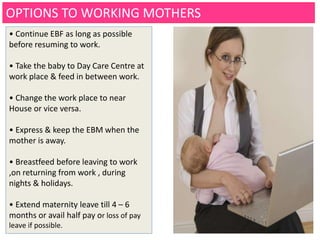
OPTIONS TO WORKING MOTHERS
• Continue EBF as long as possible
before resuming to work.
• Take the baby to Day Care Centre at
work place & feed in between work.
• Change the work place to near
House or vice versa.
• Express & keep the EBM when the
mother is away.
• Breastfeed before leaving to work
,on returning from work , during
nights & holidays.
• Extend maternity leave till 4 – 6
months or avail half pay or loss of pay
leave if possible.
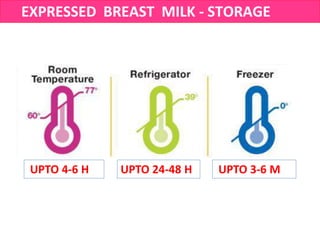
EXPRESSED BREAST MILK - STORAGE
UPTO 4-6 H UPTO 24-48 H UPTO 3-6 M
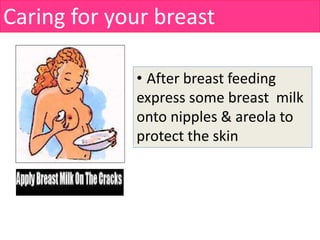
Caring for your breast
• After breast feeding
express some breast milk
onto nipples & areola to
protect the skin
TECHNIQUE OF BREASTFEEDING
How to breastfeed?:
Wash hands,
Be comfortable,
Relay Your shoulders.
• Head and body in straight line
• Whole body supported[Baby’s body turned
towards the mother]
• Nose to nipple
• Tummy to tummy [Baby’s body touching
mother’s abdomen]
• Support your breast. Thumb is on top and
fingers are below the breast
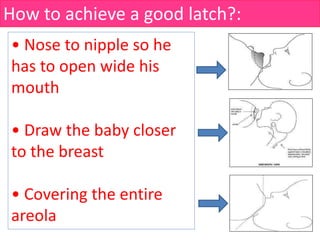
How to achieve a good latch?:
• Nose to nipple so he
has to open wide his
mouth
• Draw the baby closer
to the breast
• Covering the entire
areola
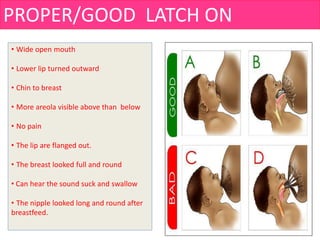
PROPER/GOOD LATCH ON
• Wide open mouth
• Lower lip turned outward
• Chin to breast
• More areola visible above than below
• No pain
• The lip are flanged out.
• The breast looked full and round
• Can hear the sound suck and swallow
• The nipple looked long and round after
breastfeed.
Breastfeeding Positions
GALACTOGOGUES
Galactogogues are herbs or medications used to stimulate an increase in milk
production.
They may be used to treat low milk supply
There is no ideal galactogogue
Chlorpromazine and metoclopromide- 10 mg 3 times daily for 7 days. It Increases
the blood volume by increasing prolactin level
Self confidence, freedom from anxiety, soothing environment with vigorously
sucking by an active baby are the most effective pre-requisites for successful
establishment of lactation
BREASTFEEDING
FOUNDATION OF LIFE
THANK U ONE AND ALL

Breast Feeding

  • 1.
  • 2.
    "The more weknow about human breast milk the more we discover about its value in human nutrition and development”. INTRODUCTION
  • 3.
    “A newborn hasonly three demands” : They are warmth in the arms of its mother, food from her breasts and security in the knowledge of her presence. Breastfeeding satisfies all three” . [Grantly Dick Read]
  • 4.
    WHY EMPHASIZE ONBREAST FEEDING??? When Indian women breast feed without exception • 25% do not initiate within 24 hrs • 50% discard colostrums • 75% give prelacteal feeding Many women believe they do not have sufficient milk & indulge in top milk feeding
  • 5.
    BREASTFEEDING Breastfeeding is thefeeding of an infant or young child with breast milk directly from female human breasts (i.e., via lactation) not from a baby bottle or other container. Breastfeeding is the optimal source of all the essential nutrients necessary for the growth and development of the newborn infant. Exclusive breast feeding in the first six months of life can cut down under-five child mortality by 13-15%
  • 6.
    EXCLUSIVE BREAST FEEDING •WHOAND UNICEF defined as Breast feeding for the first six months •Not even H2O •No pre‐lacteal feeds. •No formula feeds. But allows infants to receive ORS, Vitamins & mineral drops /syrups, medicines WHO RECOMMENDATIONS • Exclusive breast feeding until 6 months of age • Introduce complimentary foods with continued breastfeeding • Optimum to breastfeed for 2 years or Longer
  • 7.
    PRELACTEAL FEEDING Any foodprovided to newborn before the initiation of mothers breast feeding is considered to be a prelacteal feed. It is still traditional . In india,it includes-ghee, honey, sugar, gold crust , unboiled cow/goat milk, jaggery is given to children over the period of starvation until lactation begins given by unsterilized spoons/cotton. HAZARDS • Diverts mother and child from breast feeding immediately after delivery when the sucking reflex is enhanced • Increases risk of sepsis
  • 8.
  • 10.
  • 11.
  • 12.
    REFLEXES IN BREASTFEEDING Milk production(prolactin)reflex & milk ejection(oxytocin) reflex initiate & maintain lactation in the mother 1.PROLACTIN REFLEX (MILK SECRETION/PRODUCTION) 2.OXYTOCIN REFLEX {MILK EJECTION REFLEX} • The earlier the baby is put on the breast, the sooner the reflex is initiated. • The more the baby sucks at the breast, the greater is the stimulus for milk production. • The greater is the demand for milk, larger is the volume of milk produced.
  • 18.
  • 19.
  • 20.
    FACTORS DECREASING MILKPRODUCTION • Dummies, pacifiers, bottles. • Giving prelacteal feeds. • Painful breast conditions like sore or cracked nipple & congested breast. • Lack of night feeding interfering prolactin production.
  • 21.
    TYPES OF BREASTMILK 1.COLOSTRUM: • During the first two or three days after delivery thick and yellowish fluid is secreted from the mammary gland. This differs from the regular milk and is called colostrum/ or Early Milk. • It is secreted in small quantity of about 10-40 ml. • Even in small amounts ,it is enough to feed the newborn baby and help’s a baby to pass his or her first stool • Recommended by WHO as the perfect food for the newborn and feeding should be initiated within the first hour after birth • It is rich in protein especially in Ab, vit, minerals, but very low in fat which is for easy digestion compared to mature breast milk. Concentration of arachiodonic acid and docosa hexaenoic acid (DHA) as percent of total fatty acids is higher in colostrum than mature milk. 2.TRANSITIONAL MILK: • During the next two weeks, the milk increases in quantity and changes in appearance and composition and this is called transitional milk • Secreted after 3‐4days up to 2weeks. • Rich in fat & sugar content
  • 22.
    TYPES OF BREASTMILK 3.MATURE MILK: The milk which replaces the transitional milk after 2 weeks of lactation until the termination of the breastfeeding. • Thinner & watery. • Contains all essential nutrients. 1.FORE MILK: The milk that comes at the start of a feed is called foremilk. Foremilk which is watery has a low level of fat and is high in lactose sugar, protein, vitamins, minerals and water. It satisfies the baby thirst. 2.HIND MILK: Hind milk which comes later towards the end of a feed is richer in fat, it satisfies the baby’s hunger and supplies more energy than foremilk.  Babies who are fed fore and hind milk sleep well and grow healthy  The baby should therefore be allowed to empty one breast.  The second breast should be offered after emptying the first.
  • 25.
    ADVANTAGES OF BREASTMILK BABY PERFECT FOOD FOR INFANTS Easily digested and well absorbed Protects against infection and allergies Promotes emotion bonding b/w Baby and mother Better brain growth EHANCES IMMUNE SYSTEM PROVIDES ADEQUATE H2O FOR HYDRATION PROVIDES SUPERIOR NUTRITION FOR OPTIMUM GROWTH RICH IN ALL NUTRIENTS, BABY NEEDS[CHO,F,P,M,V] REDUCE RISK OFCHILDHOOD CANCER MOTHER PROTECTS MOTHERS HEALTH HELPS DELAY A NEW PREGNANCY HELPS A MOTHER RETURN TO PRE-PREGNANCY WEIGHT [BURN OFF EXTRA FAT ACCULUMATED DURING PREGNANCY] REDUCE THE RISK OF BREAST AND OVARIAN CANCER REPLENISHES CA LEVELS DURING LACTATION DELAYS M.CYCLE / VOL OF B.FLOW DURING M.CYCLE REDUCES THE RISK OF UTERINE BLEEDING AND HELPS THE UTERUS TO RETURN TO ITS PREVIOUS SIZE FAMILY & SOCIETY Saves money [More economical than Artificial feed] Promotes family planning Decreases need for hospitalization of children's Reduces Infant mortality
  • 26.
    RISKS OF ARTIFICIALFEEDING  Interferes with bonding. More diarrhoea & respiratory infections. Malnutrition  Mother may become pregnant sooner.  More allergy & milk intolerance. Increased risk of chronic diseases.  Over feeding may take place. Lower scores on intelligence scale. Increased risk of anaemia, ovarian cancer & breast cancer.
  • 27.
    BURPING • Burp thebaby after feeding at each breast and at the end of the feeding.It helps to get rid of air swallowed during breastfeeding. • When burping the baby, remember to apply some gentle but firm pressure on the abdomen. Helpful positions to burp include: 1.Propped up with baby's tummy against the shoulder. 2. Lying tummy-down across the lap. 3. Sitting up, leaning over with the supportive hand under baby's arm.
  • 28.
    INITIATION OF BREASTFEEDING • As early as possible breast feeding has to be initiated in both normal and LSCS delivery within one hour of life • After birth‐baby is biologically ready & initiation is easy, Later on baby goes to prolonged sleep and hence its difficult. • Rooming in and bedding should be done with mother and baby to prevent separation and promote breast feeding. • Frequency – 2‐3 hourly / 8 -12 feeds per day /demand feeding. • Duration – exclusive breast feeding for 6 months. • Time for each feed : 15‐20 minutes • On an average 650 to 850 ml milk is produced per day.
  • 29.
    HOW OFTEN TOBREASTFEED? • Breastfeeding must be on demand •Atleast 8 times a day • Babies feed with different frequencies and take different amounts of milk at each feed • No timetable for breastfeeding • Allow sucking until he/she spontaneously releases the nipple.
  • 30.
  • 31.
    How to takethe baby off ? • Insert little finger into the edge of the baby’s mouth until the suction is broken
  • 32.
    How to knowif your baby is getting enough Breast milk? • You feel : your breast being pulled with NO PAIN • You hear : your baby swallowing • You see : a wide open mouth curled out lips chin pressed into your breast sucking and swallowing • He is contented for 1-2 hours after a feed • He passes clear dilute urine 6-8 times a day • He passes bright yellow watery stools 5-6 times a day • He sleeps well for 2 to 3 hours after feed • Weight gain The new born may lose 7 % in the first 3 days Should return to their birth weight by 10 days of age/2 weeks Should gain at least 20-35 grs a day in the first 3-4 months of age
  • 33.
    Indications Working mothers Preterm /Sick baby Sick mother Local breast problems EXPRESSED BREAST MILK
  • 34.
    OPTIONS TO WORKINGMOTHERS • Continue EBF as long as possible before resuming to work. • Take the baby to Day Care Centre at work place & feed in between work. • Change the work place to near House or vice versa. • Express & keep the EBM when the mother is away. • Breastfeed before leaving to work ,on returning from work , during nights & holidays. • Extend maternity leave till 4 – 6 months or avail half pay or loss of pay leave if possible.
  • 35.
    EXPRESSED BREAST MILK- STORAGE UPTO 4-6 H UPTO 24-48 H UPTO 3-6 M
  • 36.
    Caring for yourbreast • After breast feeding express some breast milk onto nipples & areola to protect the skin
  • 37.
  • 38.
    How to breastfeed?: Washhands, Be comfortable, Relay Your shoulders. • Head and body in straight line • Whole body supported[Baby’s body turned towards the mother] • Nose to nipple • Tummy to tummy [Baby’s body touching mother’s abdomen] • Support your breast. Thumb is on top and fingers are below the breast
  • 39.
    How to achievea good latch?: • Nose to nipple so he has to open wide his mouth • Draw the baby closer to the breast • Covering the entire areola
  • 40.
    PROPER/GOOD LATCH ON •Wide open mouth • Lower lip turned outward • Chin to breast • More areola visible above than below • No pain • The lip are flanged out. • The breast looked full and round • Can hear the sound suck and swallow • The nipple looked long and round after breastfeed.
  • 41.
  • 43.
    GALACTOGOGUES Galactogogues are herbsor medications used to stimulate an increase in milk production. They may be used to treat low milk supply There is no ideal galactogogue Chlorpromazine and metoclopromide- 10 mg 3 times daily for 7 days. It Increases the blood volume by increasing prolactin level Self confidence, freedom from anxiety, soothing environment with vigorously sucking by an active baby are the most effective pre-requisites for successful establishment of lactation
  • 45.
  • 46.
    THANK U ONEAND ALL