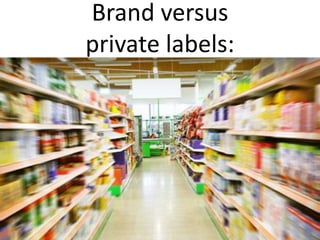
Brand versus
private labels:
What are private labels?
Private Labels are Retailers own, control,
and exclusively sell store brands
Private Label are a ‘Good Alternative’ to
Other Brands, Offering the Same Quality &
Value
Private labels are regarded as good Value
for Money, and Quality on Par with the Big
Brands.
TYPES OF PRIVATE LABELS
Store brands - The retailer's name is
very evident on the packaging.
Store sub-brands - Products where the
retailer's name is low-key on the
packaging.
Umbrella branding - A generic brand,
independent from the name of the
retailer.
Threat posses by private label
Improved quality of private label product
Private label quality levels are much higher than ever
before and they are more consistent in categories
historically characterised by little product innovation
Development of premium private
label brand
European supermarket’s success
In European supermarkets higher private label sales
result in higher average pretax profit
Emergence of new channels
Mass merchandisers , warehouses clubs and other
channels account for a growing percentage of sales of dry
groceries, household cleaning products etc
What drives private-label shares
Product category characteristics: the product is
inexpensive, easy, low risk purchase for the
consumer
New product activities: national brands are
offered in few varieties , enabling a private label
with a narrow line to represent a clear
alternative to the consumer
Private label characteristics: private label
goods have been available to consumer for
many years , distribution is well developed.
Price and promotion factor: retail gross
margins in the product category are
relatively high
Strength of brands
Purchase process favours brand
name products
Brand names simplifies the selection process in
cluttered product categories
Brand name have solid foundation
The strongest national brands have built their consumer
equities over decades of advertising and through delivery
of consistent quality
Brand strength parallels the
strength of the economy
As economy emerges from recession manufacturers
of national brands have increased advertising and
won back consumers who turned to private labels
National brands have value for retailers
When a store does not carry a popular brand
consumer are put off and may switch stores
If you don’t , don’t start
For manufacturers seeking only to
use excess capacity , private label
production can eventually become a
narcotic
Evaluating private label
business
To evaluate the effect on the business as a whole and
to keep private label operation under control
following steps must be taken
•Conduct a private label audit
•Calculate private label
profitability on both a full coast
and marginal coast basis
•Examine the impact of private
labels on the market share of
your national brand
•Finally, close excess capacity
Winning strategies
National brands manufacturers
should take the following steps
to stem any further share gains
by private labels
Invest in brand equities
National brands manufacturers should
focus on their brand first and make it as
strong as possible
Innovate wisely
Too many line extensions confuse consumer , trade
and sales force and reduce the manufacturers
credibility with the trade as an expert on the category
Use fighting brands sparingly
Managers should be vary of launching fighting brands
, fighting brands rarely makes money
Build trade relationship
The best consumer goods companies should know
more about their consumer and their categories
than any private label
Manage the price spread
Private label sales are twice as sensitive as
national brands to change in the price gap
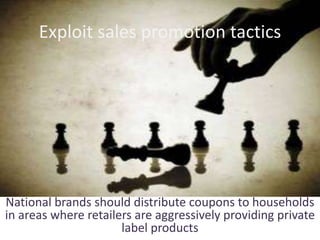
Exploit sales promotion tactics
National brands should distribute coupons to households
in areas where retailers are aggressively providing private
label products
Manage each category
Each product must be treated different from other as
the price and relative profitability is different
Use category profit pools as a
performance measure
Calculate the total profit for all participants in a category
segment and then attributed percentage of the total to
the companies competing within the category
Take private label seriously
Every national brand marketing plan should include a
section on how to limit the encroachment of private
labels
Private Label Growth in India
. In India there is a growing trend towards
acceptance of private label brands and thus
their penetration is on the rise especially in the
apparel, consumer durables, home care and
FMCG segments. India is still an under-branded
country and in each category there is still a lot of
scope for growth, this is where the private label
comes in and the story is looking good so far.
Few success stories of private
labels
For instance, Future Group has already tasted the
success with its Tasty Treat brand which is just behind
Frito Lay in the potato chips segment. Its Care Mate in
the baby diaper segment has left behind Huggies in
the in-store sales. At Spencers, diapers and agarbattis
sell more than market leaders across the store chain.
PRIVATE LABEL BRANDS IN INDIAN RETAIL
Reliance Retail
Reliance Select
Reliance Value
Dairy Pure (dairy Products)
Future Group
Tasty Treat(Processed Food)
Sach (Toothpaste)
Ektaa (Community Food)
Premium Harvest (Staples)
Fresh n Pure (Dairy Products)
Cleanmate (Homecare)
Caremate (Personal Hygine)
Aditya Birla Retail
More(Staples)
Blue Earth(Apparels)
True(Footwear)
Big bazaar
Big Bazaar currently has seven different private labels including Tasty Treat,
Fresh & Pure, Care Mate, Clean Mate, Quit, Wow and Maniarrs, offering 47
different product lines. Food Bazaar undertakes below-the-line in-store
promotions such as attractive dangle.
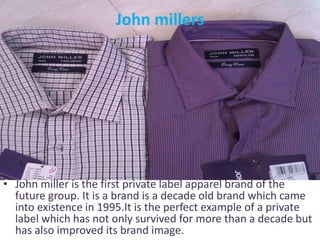
John millers
• John miller is the first private label apparel brand of the
future group. It is a brand is a decade old brand which came
into existence in 1995.It is the perfect example of a private
label which has not only survived for more than a decade but
has also improved its brand image.
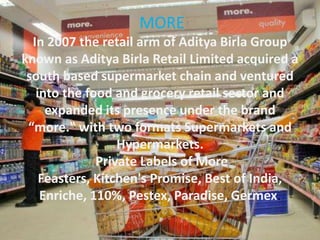
MORE
In 2007 the retail arm of Aditya Birla Group
known as Aditya Birla Retail Limited acquired a
south based supermarket chain and ventured
into the food and grocery retail sector and
expanded its presence under the brand
“more.‟ with two formats Supermarkets and
Hypermarkets.
Private Labels of More
Feasters, Kitchen's Promise, Best of India,
Enriche, 110%, Pestex, Paradise, Germex.
CONCLUSION
The growth of private labels in the Indian retail
industry is inevitable but retailers do need to
keep a few things in mind. Promotion of own
label and allocation of large shelf space at the
expense of well-marketed national brands can
depress the overall size and value of the
category while on the other hand, joining hands
with them and following principles of category
management can create a win-win situations for
both
Disclaimer
Created by Abhishek Sirohi HBTI
Kanpur during an internship by prof
Sameer Mathur IIML.
www.iiminternship.com
Brandversusprivatelabel

Brandversusprivatelabel

  • 1.
  • 2.
  • 3.
    Private Labels areRetailers own, control, and exclusively sell store brands Private Label are a ‘Good Alternative’ to Other Brands, Offering the Same Quality & Value Private labels are regarded as good Value for Money, and Quality on Par with the Big Brands.
  • 4.
    TYPES OF PRIVATELABELS Store brands - The retailer's name is very evident on the packaging. Store sub-brands - Products where the retailer's name is low-key on the packaging. Umbrella branding - A generic brand, independent from the name of the retailer.
  • 5.
    Threat posses byprivate label
  • 6.
    Improved quality ofprivate label product Private label quality levels are much higher than ever before and they are more consistent in categories historically characterised by little product innovation
  • 7.
    Development of premiumprivate label brand
  • 8.
    European supermarket’s success InEuropean supermarkets higher private label sales result in higher average pretax profit
  • 9.
    Emergence of newchannels Mass merchandisers , warehouses clubs and other channels account for a growing percentage of sales of dry groceries, household cleaning products etc
  • 10.
    What drives private-labelshares Product category characteristics: the product is inexpensive, easy, low risk purchase for the consumer New product activities: national brands are offered in few varieties , enabling a private label with a narrow line to represent a clear alternative to the consumer
  • 11.
    Private label characteristics:private label goods have been available to consumer for many years , distribution is well developed. Price and promotion factor: retail gross margins in the product category are relatively high
  • 12.
  • 13.
    Purchase process favoursbrand name products Brand names simplifies the selection process in cluttered product categories
  • 14.
    Brand name havesolid foundation The strongest national brands have built their consumer equities over decades of advertising and through delivery of consistent quality
  • 15.
    Brand strength parallelsthe strength of the economy As economy emerges from recession manufacturers of national brands have increased advertising and won back consumers who turned to private labels
  • 16.
    National brands havevalue for retailers When a store does not carry a popular brand consumer are put off and may switch stores
  • 17.
    If you don’t, don’t start For manufacturers seeking only to use excess capacity , private label production can eventually become a narcotic
  • 18.
    Evaluating private label business Toevaluate the effect on the business as a whole and to keep private label operation under control following steps must be taken
  • 19.
    •Conduct a privatelabel audit •Calculate private label profitability on both a full coast and marginal coast basis •Examine the impact of private labels on the market share of your national brand •Finally, close excess capacity
  • 20.
    Winning strategies National brandsmanufacturers should take the following steps to stem any further share gains by private labels
  • 21.
    Invest in brandequities National brands manufacturers should focus on their brand first and make it as strong as possible
  • 22.
    Innovate wisely Too manyline extensions confuse consumer , trade and sales force and reduce the manufacturers credibility with the trade as an expert on the category
  • 23.
    Use fighting brandssparingly Managers should be vary of launching fighting brands , fighting brands rarely makes money
  • 24.
    Build trade relationship Thebest consumer goods companies should know more about their consumer and their categories than any private label
  • 25.
    Manage the pricespread Private label sales are twice as sensitive as national brands to change in the price gap
  • 26.
    Exploit sales promotiontactics National brands should distribute coupons to households in areas where retailers are aggressively providing private label products
  • 27.
    Manage each category Eachproduct must be treated different from other as the price and relative profitability is different
  • 28.
    Use category profitpools as a performance measure Calculate the total profit for all participants in a category segment and then attributed percentage of the total to the companies competing within the category
  • 29.
    Take private labelseriously Every national brand marketing plan should include a section on how to limit the encroachment of private labels
  • 30.
    Private Label Growthin India . In India there is a growing trend towards acceptance of private label brands and thus their penetration is on the rise especially in the apparel, consumer durables, home care and FMCG segments. India is still an under-branded country and in each category there is still a lot of scope for growth, this is where the private label comes in and the story is looking good so far.
  • 31.
    Few success storiesof private labels For instance, Future Group has already tasted the success with its Tasty Treat brand which is just behind Frito Lay in the potato chips segment. Its Care Mate in the baby diaper segment has left behind Huggies in the in-store sales. At Spencers, diapers and agarbattis sell more than market leaders across the store chain.
  • 33.
    PRIVATE LABEL BRANDSIN INDIAN RETAIL Reliance Retail Reliance Select Reliance Value Dairy Pure (dairy Products) Future Group Tasty Treat(Processed Food) Sach (Toothpaste) Ektaa (Community Food) Premium Harvest (Staples) Fresh n Pure (Dairy Products) Cleanmate (Homecare) Caremate (Personal Hygine) Aditya Birla Retail More(Staples) Blue Earth(Apparels) True(Footwear)
  • 34.
    Big bazaar Big Bazaarcurrently has seven different private labels including Tasty Treat, Fresh & Pure, Care Mate, Clean Mate, Quit, Wow and Maniarrs, offering 47 different product lines. Food Bazaar undertakes below-the-line in-store promotions such as attractive dangle.
  • 35.
    John millers • Johnmiller is the first private label apparel brand of the future group. It is a brand is a decade old brand which came into existence in 1995.It is the perfect example of a private label which has not only survived for more than a decade but has also improved its brand image.
  • 36.
    MORE In 2007 theretail arm of Aditya Birla Group known as Aditya Birla Retail Limited acquired a south based supermarket chain and ventured into the food and grocery retail sector and expanded its presence under the brand “more.‟ with two formats Supermarkets and Hypermarkets. Private Labels of More Feasters, Kitchen's Promise, Best of India, Enriche, 110%, Pestex, Paradise, Germex.
  • 37.
    CONCLUSION The growth ofprivate labels in the Indian retail industry is inevitable but retailers do need to keep a few things in mind. Promotion of own label and allocation of large shelf space at the expense of well-marketed national brands can depress the overall size and value of the category while on the other hand, joining hands with them and following principles of category management can create a win-win situations for both
  • 38.
    Disclaimer Created by AbhishekSirohi HBTI Kanpur during an internship by prof Sameer Mathur IIML. www.iiminternship.com