November 2011

                                            KNOWLEDGE


CEE Private Label
Trends and opportunities


                           See further, deliver more
Introduction
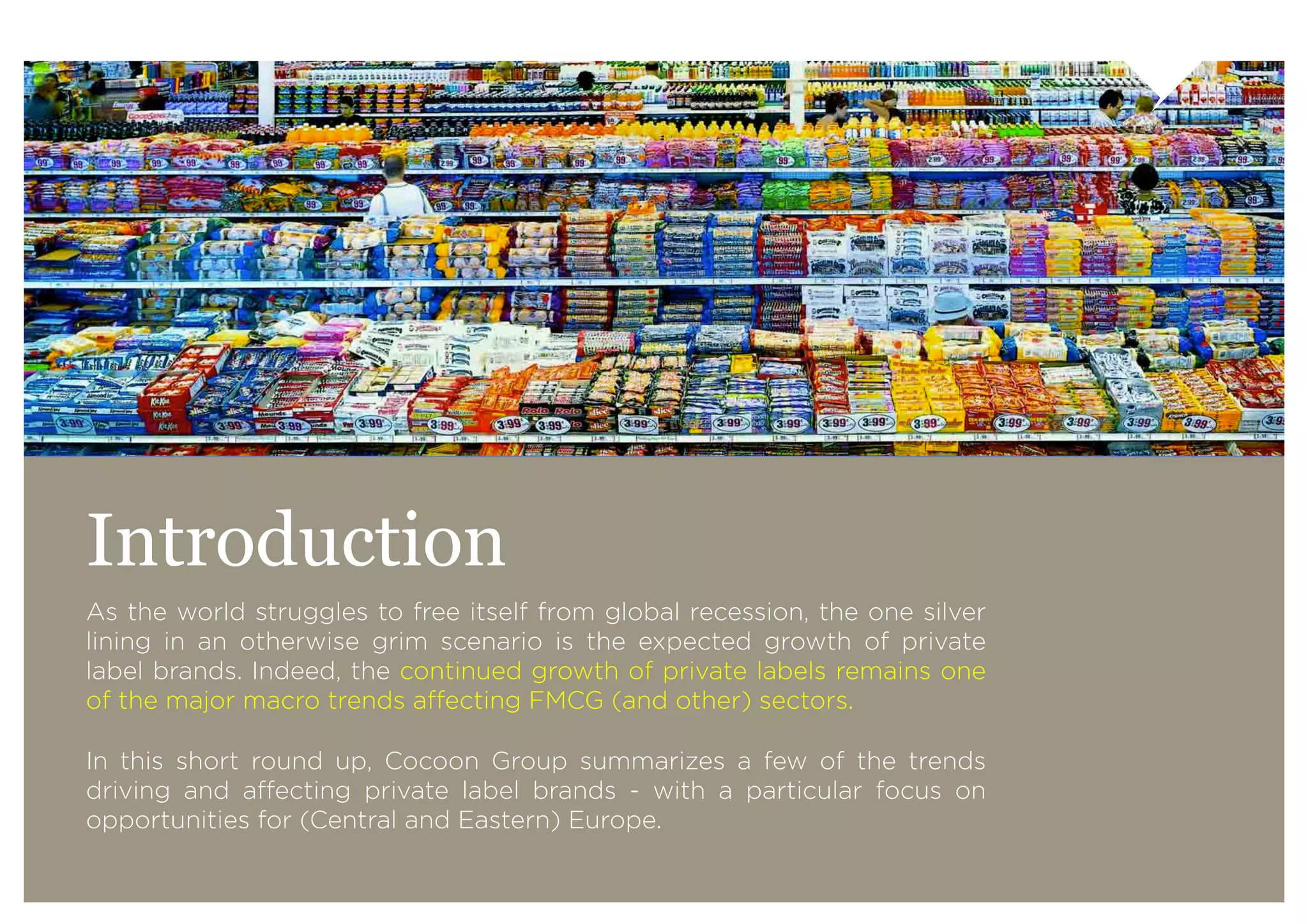
As the world struggles to free itself from global recession, the one silver
lining in an otherwise grim scenario is the expected growth of private
label brands. Indeed, the continued growth of private labels remains one
of the major macro trends affecting FMCG (and other) sectors.

In this short round up, Cocoon Group summarizes a few of the trends
driving and affecting private label brands - with a particular focus on
opportunities for (Central and Eastern) Europe.
10 Opportunities and trends
Opportunities                                Trends
Our report begins with a round up of six     In addition to the 6 PL growth
major opportunities for retailers to grow    opportunities, we’ve spotted these 4
their private label portfolio, listed        other trends which are affecting
according to accessibility.                  retailers around the world and around
                                             Europe.
While ranking these opportunities, we
take into account the cost of entry,
consumer trends, retailer credibility, and
inherent barriers to entry.

1 Value                                      7 Collaboration
2 Buy Local                                  8 Leaving home
3 Bio/Organic                                9 Design
4 Premium                                    10 Foreign leadership
5 Niche and Specialty
6 The Muddled Middle
_Opportunities


  1. Value
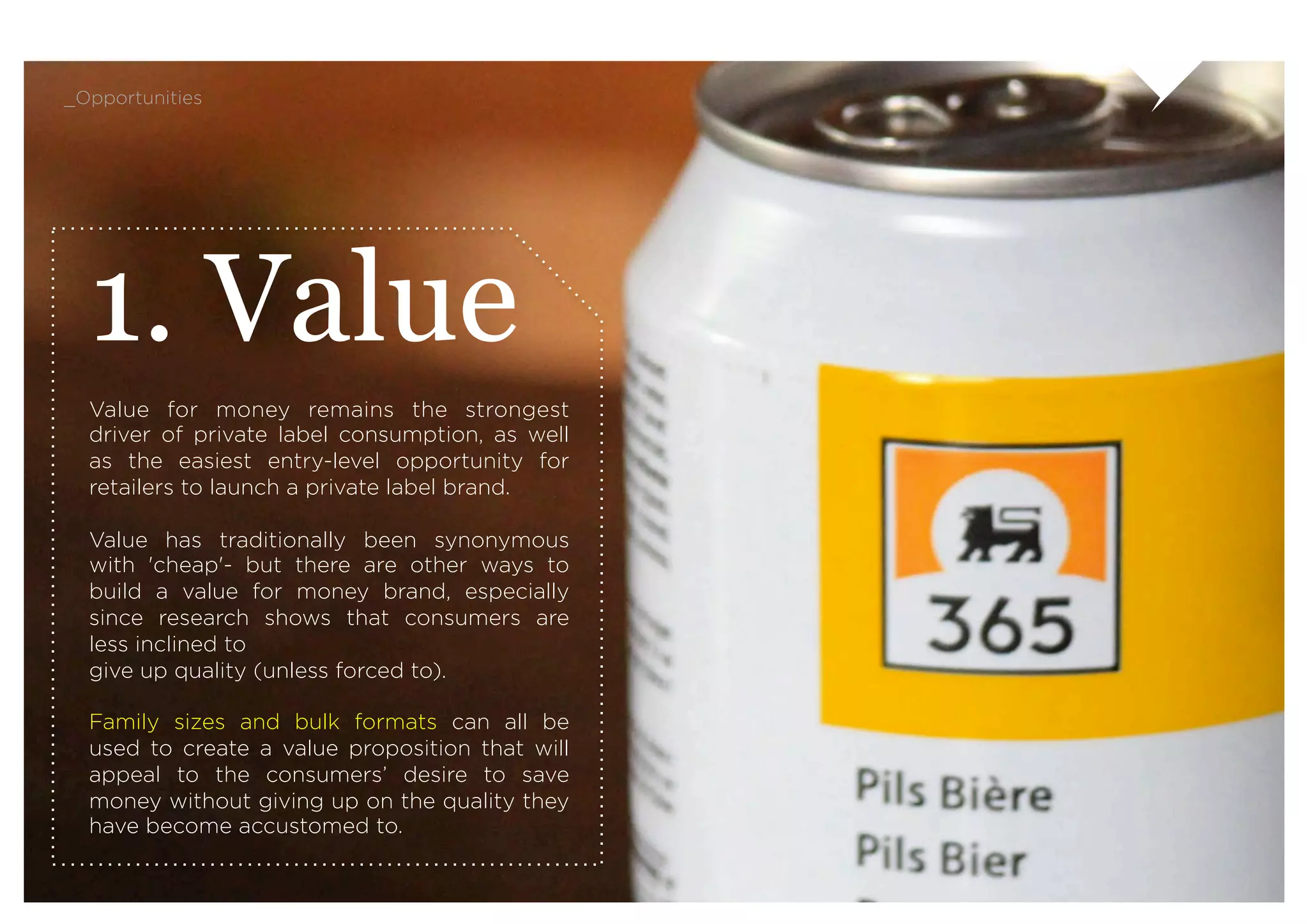
  Value for money remains the strongest
  driver of private label consumption, as well
  as the easiest entry-level opportunity for
  retailers to launch a private label brand.
   
  Value has traditionally been synonymous
  with 'cheap'- but there are other ways to
  build a value for money brand, especially
  since research shows that consumers are
  less inclined to
  give up quality (unless forced to).

  Family sizes and bulk formats can all be
  used to create a value proposition that will
  appeal to the consumers’ desire to save
  money without giving up on the quality they
  have become accustomed to.
_Opportunities


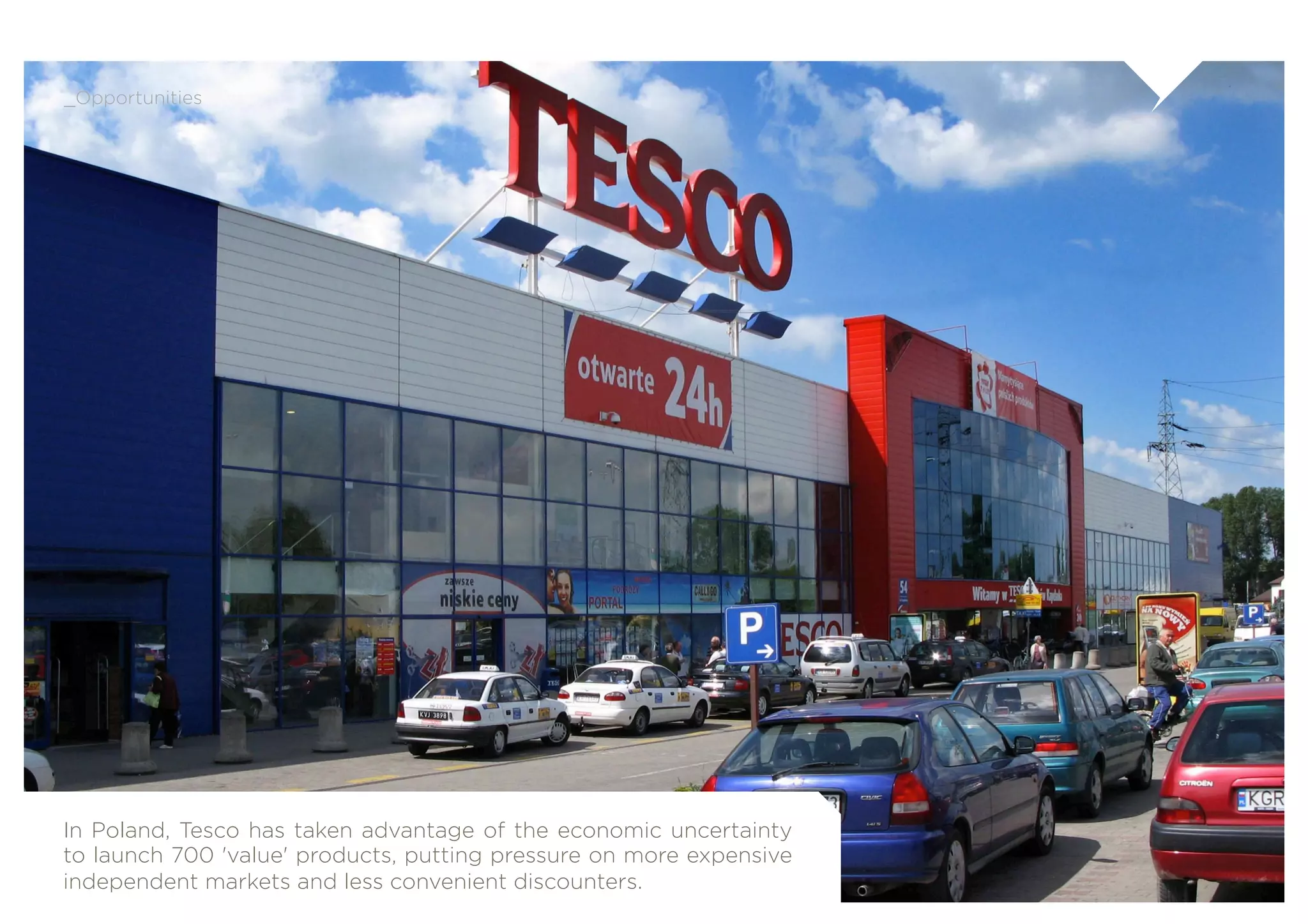
In Poland, Tesco has taken advantage of the economic uncertainty
to launch 700 'value' products, putting pressure on more expensive
independent markets and less convenient discounters.
_Opportunities


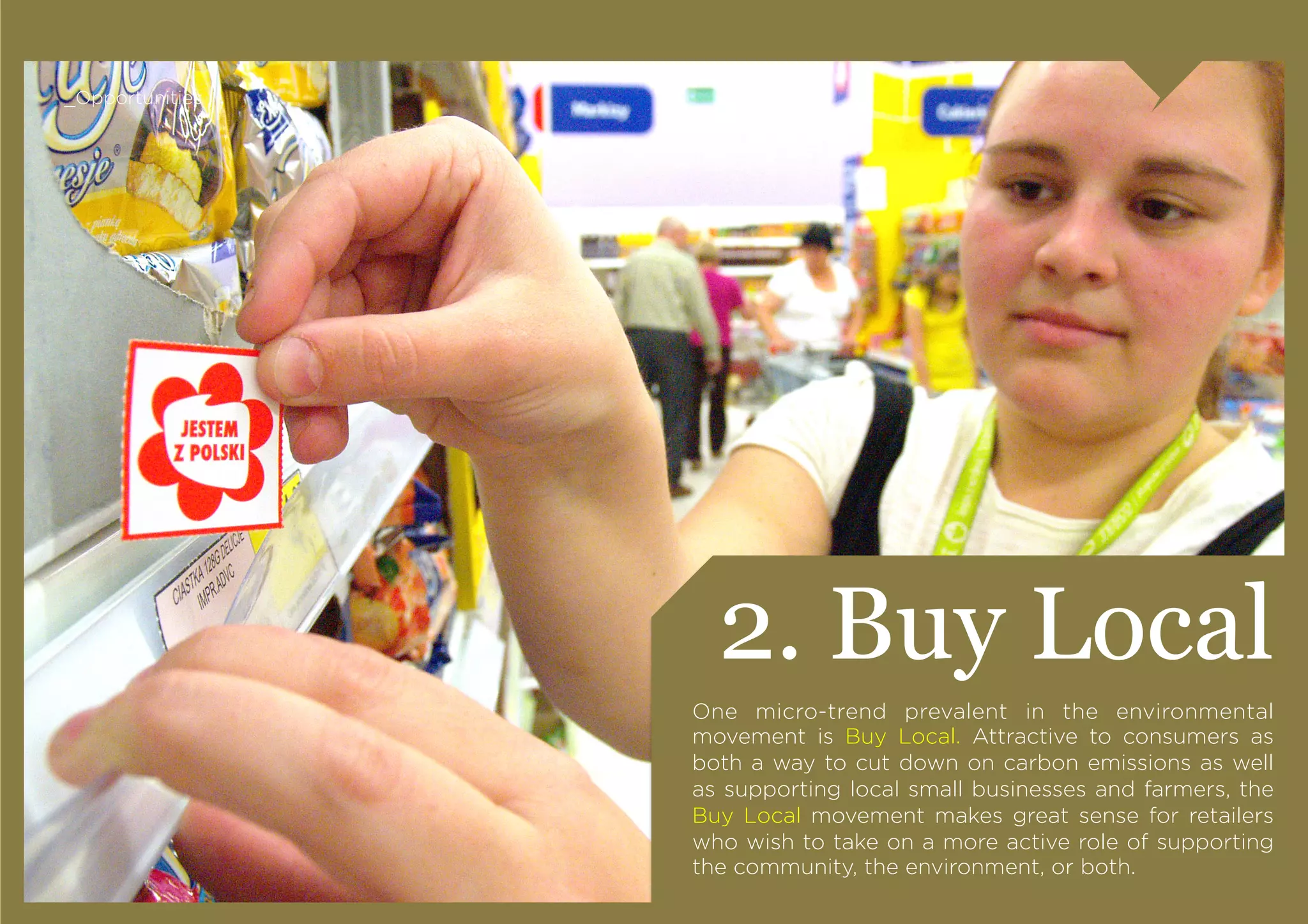
                   2. Buy Local
                 One micro-trend prevalent in the environmental
                 movement is Buy Local. Attractive to consumers as
                 both a way to cut down on carbon emissions as well
                 as supporting local small businesses and farmers, the
                 Buy Local movement makes great sense for retailers
                 who wish to take on a more active role of supporting
                 the community, the environment, or both.
_Opportunities


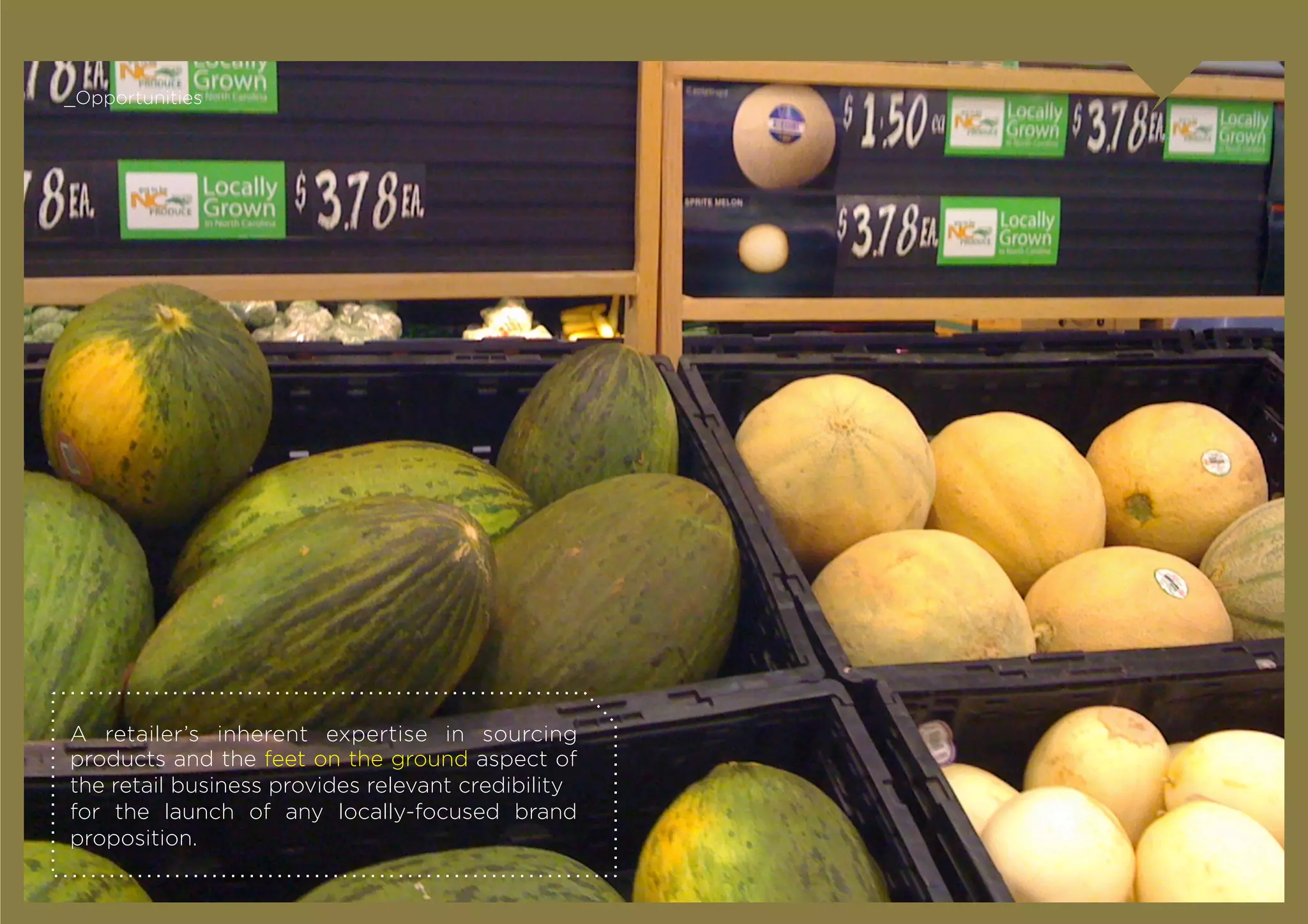
A retailer’s inherent expertise in sourcing
products and the feet on the ground aspect of
the retail business provides relevant credibility
for the launch of any locally-focused brand
proposition.
_Opportunities


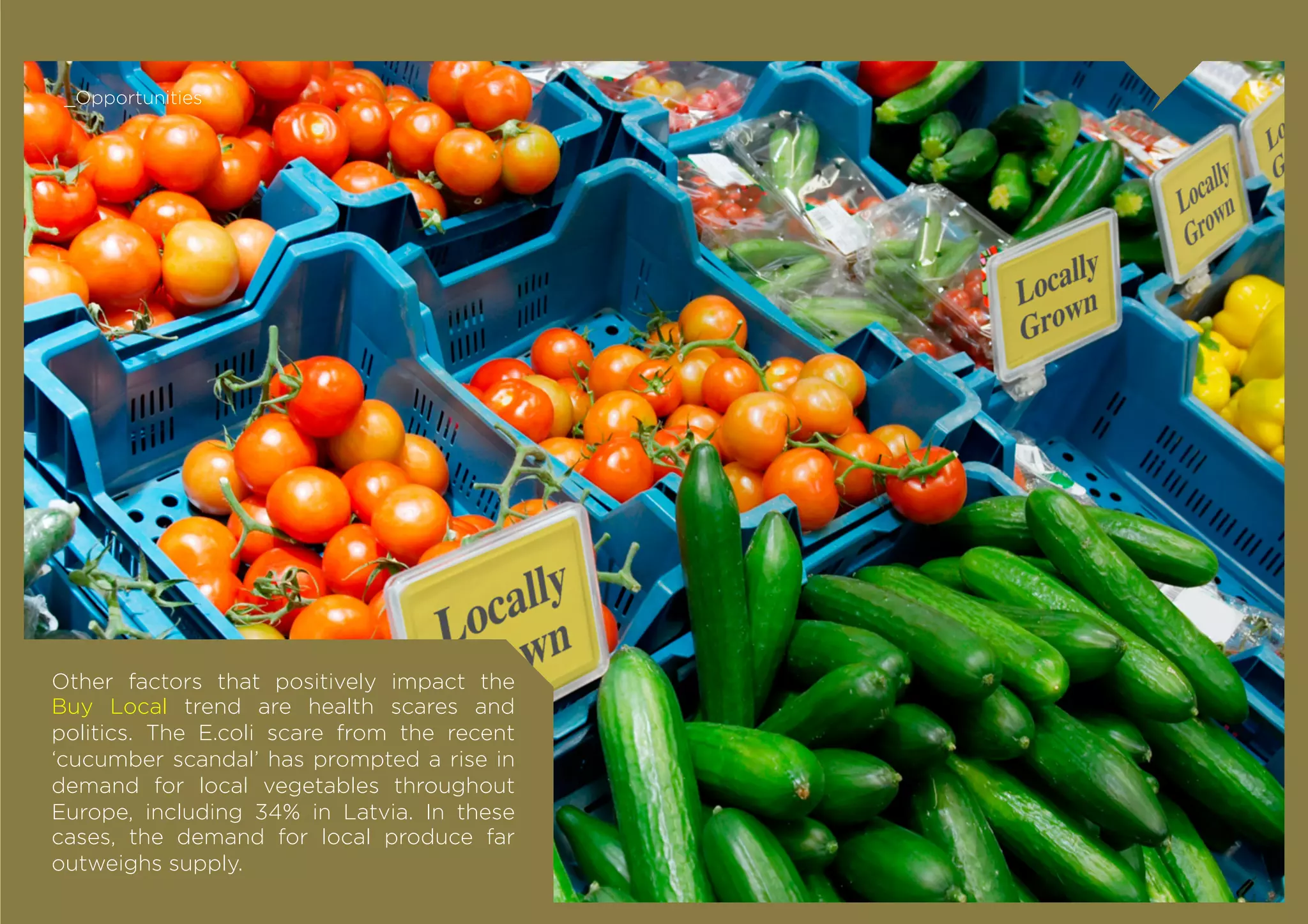
Other factors that positively impact the
Buy Local trend are health scares and
politics. The E.coli scare from the recent
‘cucumber scandal’ has prompted a rise in
demand for local vegetables throughout
Europe, including 34% in Latvia. In these
cases, the demand for local produce far
outweighs supply.
_Opportunities


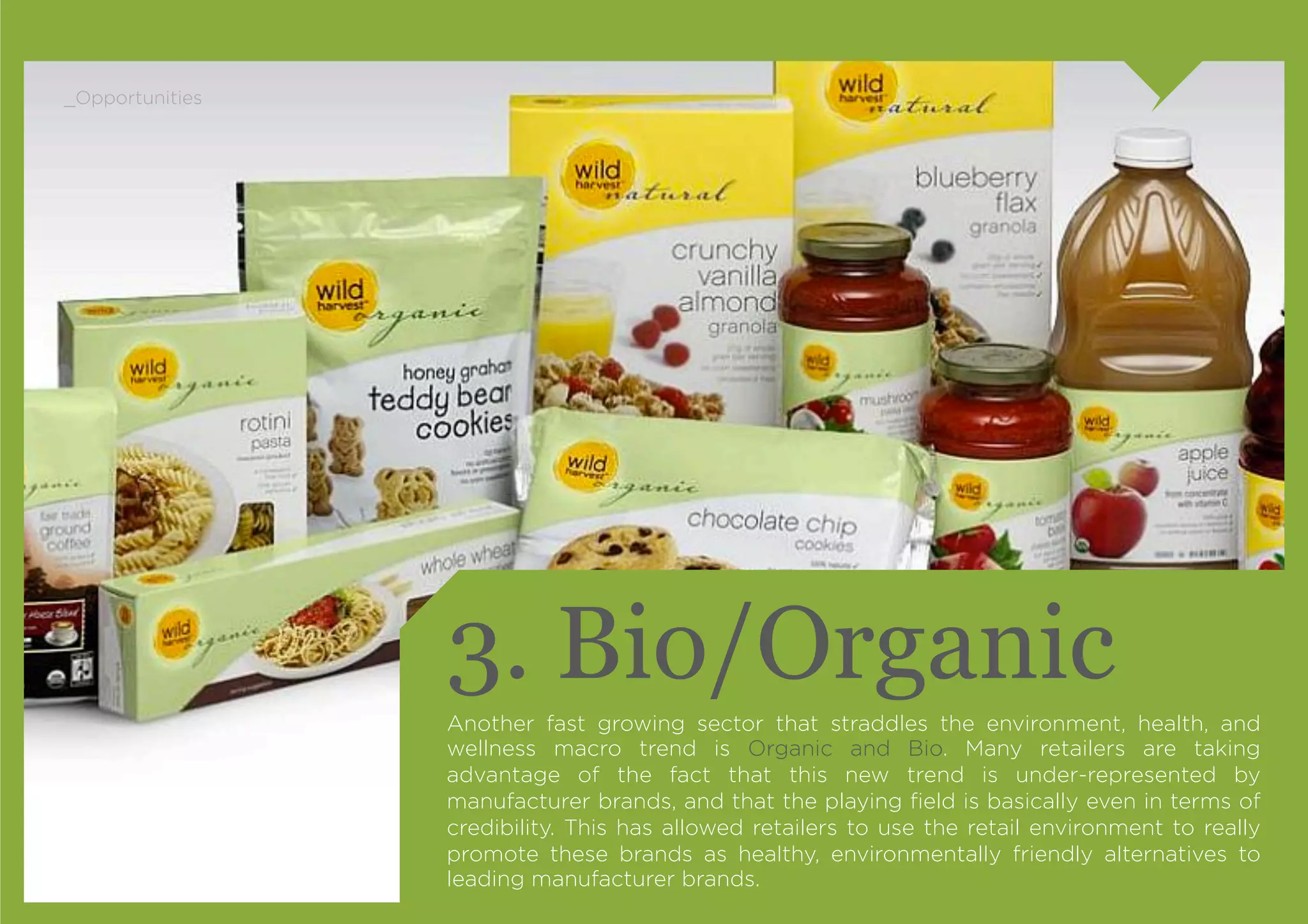
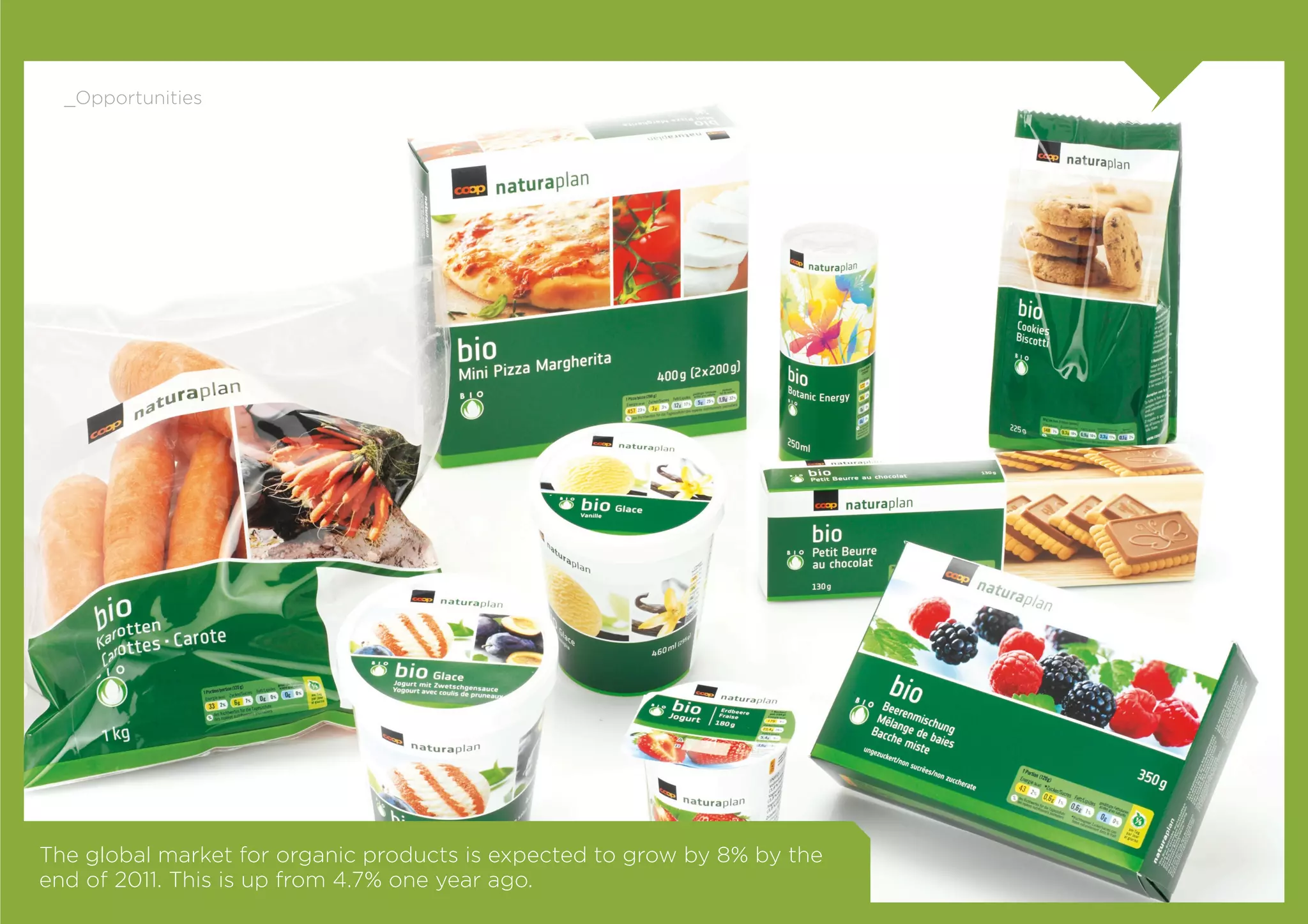
                 3. Bio/Organic
                 Another fast growing sector that straddles the environment, health, and
                 wellness macro trend is Organic and Bio. Many retailers are taking
                 advantage of the fact that this new trend is under-represented by
                 manufacturer brands, and that the playing field is basically even in terms of
                 credibility. This has allowed retailers to use the retail environment to really
                 promote these brands as healthy, environmentally friendly alternatives to
                 leading manufacturer brands.
_Opportunities


The global market for organic products is expected to grow by 8% by the
end of 2011. This is up from 4.7% one year ago.
_Opportunities


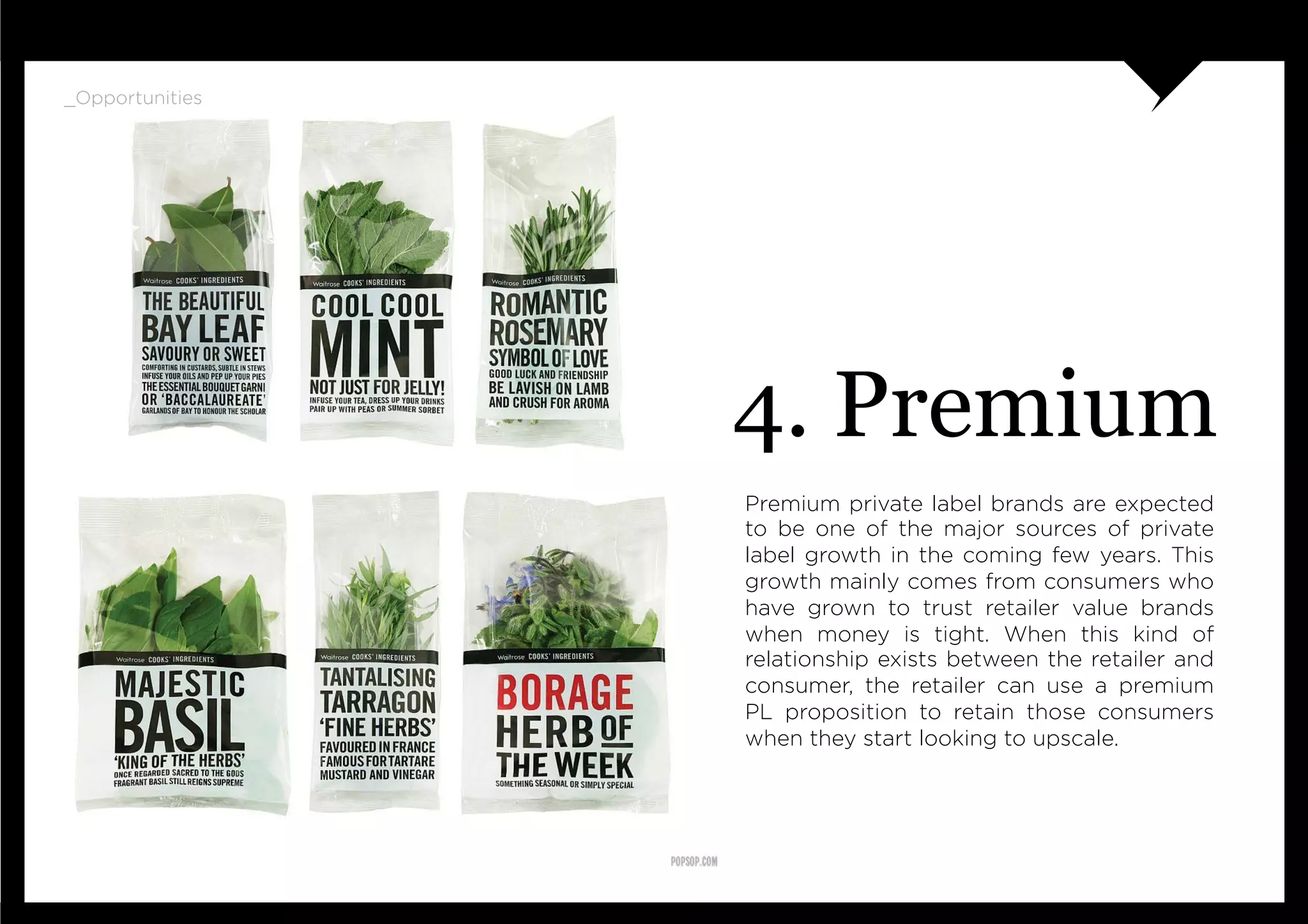
                 4. Premium
                 Premium private label brands are expected
                 to be one of the major sources of private
                 label growth in the coming few years. This
                 growth mainly comes from consumers who
                 have grown to trust retailer value brands
                 when money is tight. When this kind of
                 relationship exists between the retailer and
                 consumer, the retailer can use a premium
                 PL proposition to retain those consumers
                 when they start looking to upscale.
_Opportunities


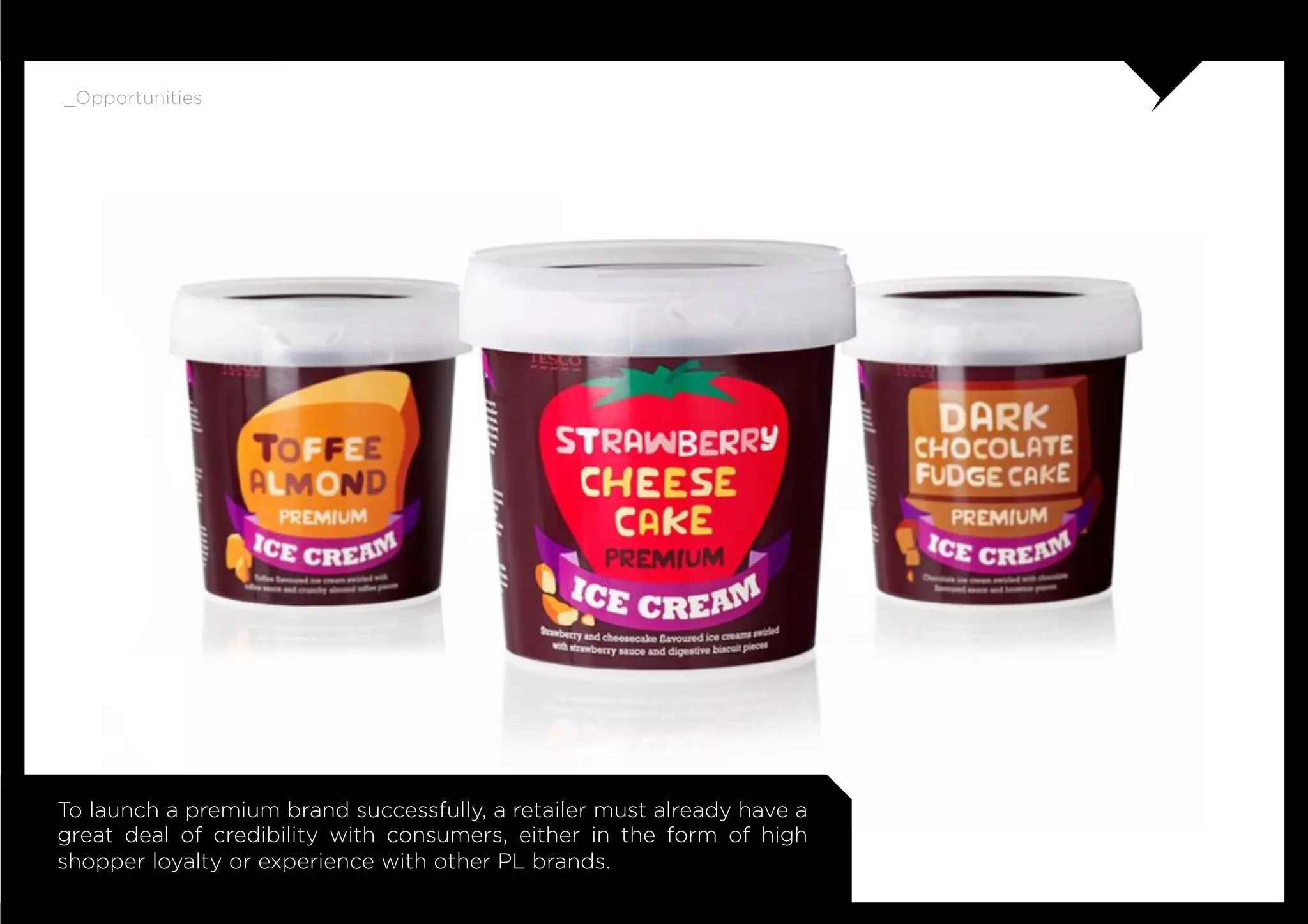
To launch a premium brand successfully, a retailer must already have a
great deal of credibility with consumers, either in the form of high
shopper loyalty or experience with other PL brands.
_Opportunities


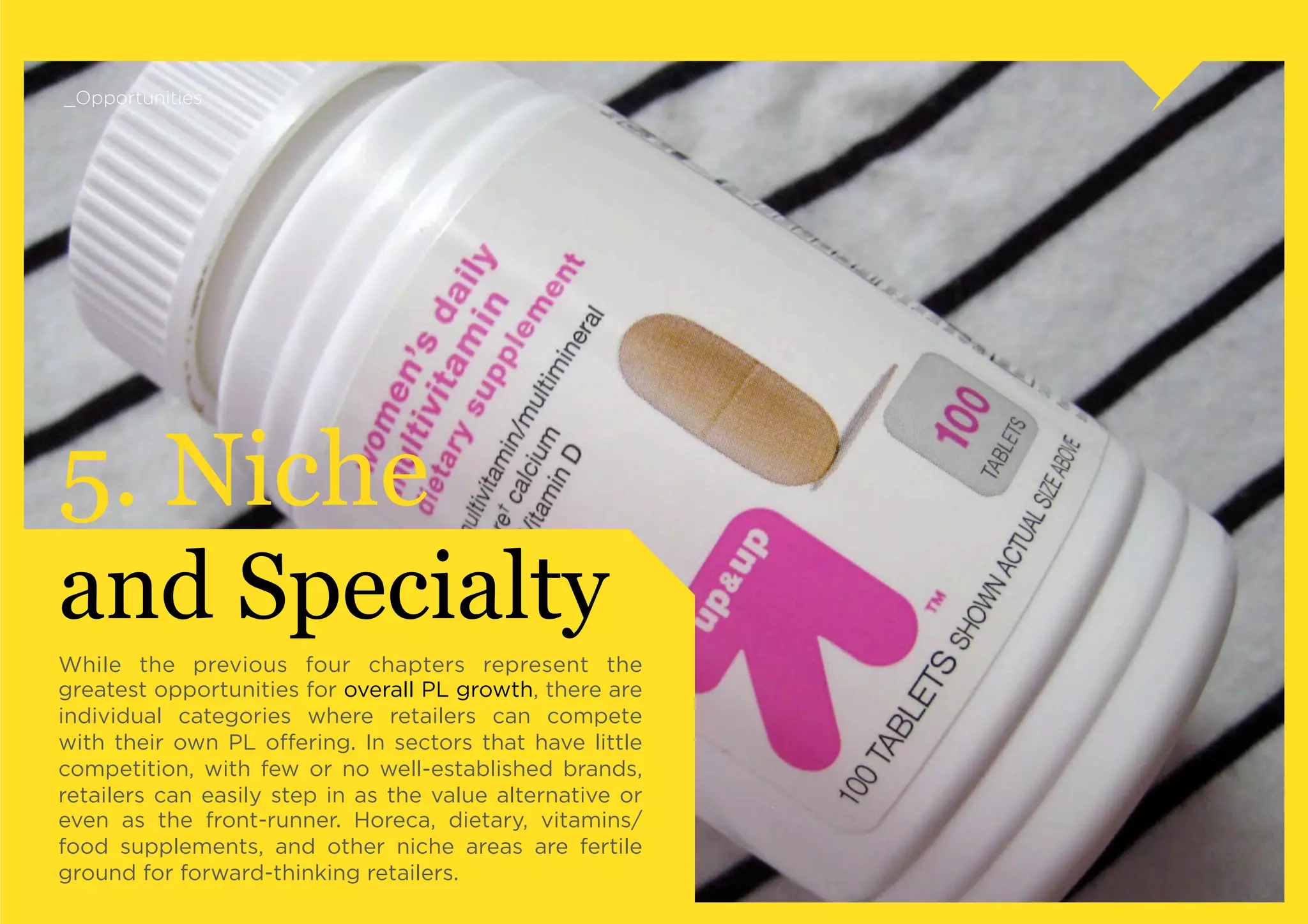
5. Niche
and Specialty
While the previous four chapters represent the
greatest opportunities for overall PL growth, there are
individual categories where retailers can compete
with their own PL offering. In sectors that have little
competition, with few or no well-established brands,
retailers can easily step in as the value alternative or
even as the front-runner. Horeca, dietary, vitamins/
food supplements, and other niche areas are fertile
ground for forward-thinking retailers.
_Opportunities


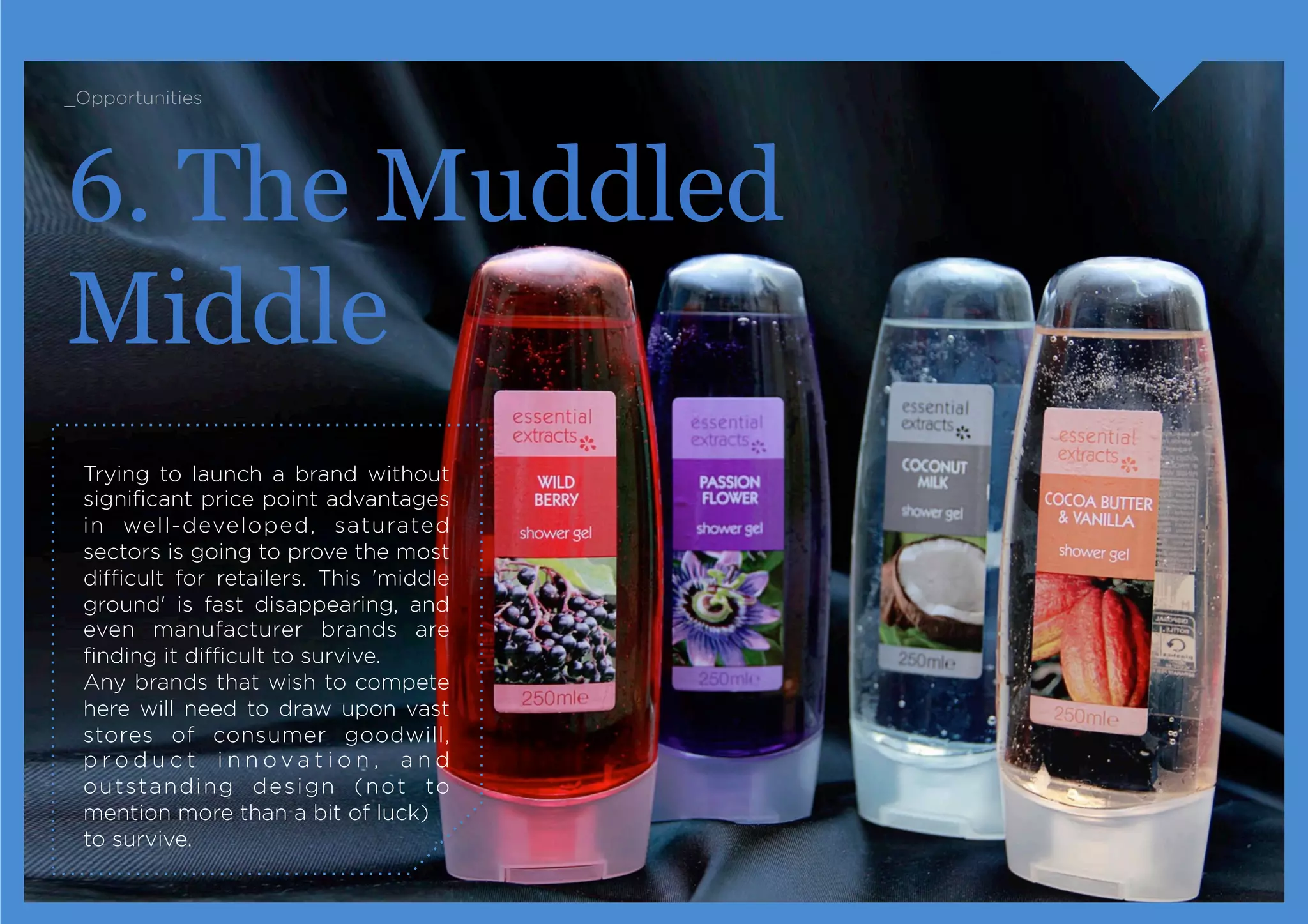
6. The Muddled
Middle
 Trying to launch a brand without
 significant price point advantages
 in well-developed, saturated
 sectors is going to prove the most
 difficult for retailers. This 'middle
 ground' is fast disappearing, and
 even manufacturer brands are
 finding it difficult to survive.
 Any brands that wish to compete
 here will need to draw upon vast
 stores of consumer goodwill,
 product innovation, and
 outstanding design (not to
 mention more than a bit of luck)
 to survive.
_Trends


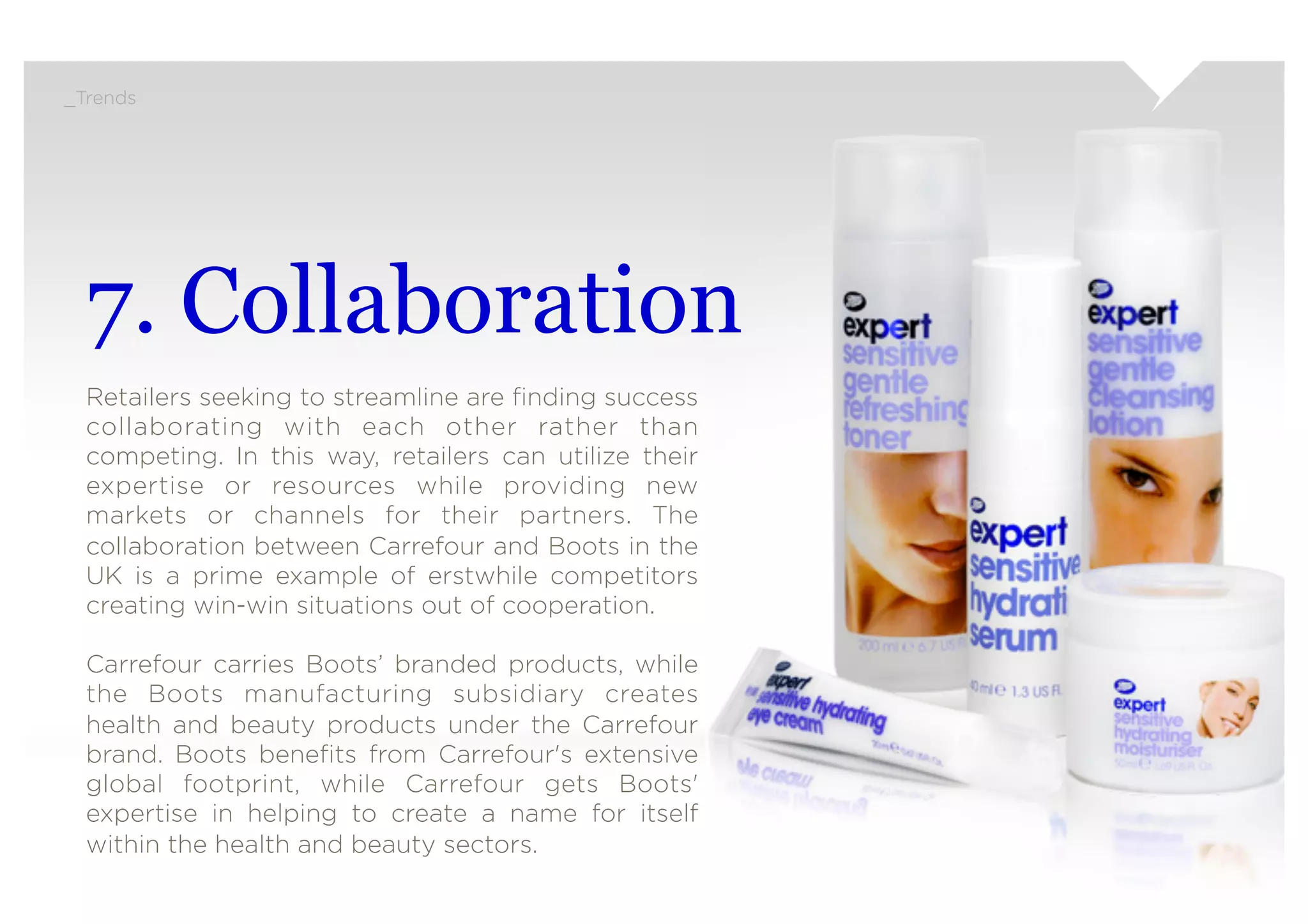
  7. Collaboration
  Retailers seeking to streamline are finding success
  collaborating with each other rather than
  competing. In this way, retailers can utilize their
  expertise or resources while providing new
  markets or channels for their partners. The
  collaboration between Carrefour and Boots in the
  UK is a prime example of erstwhile competitors
  creating win-win situations out of cooperation.
   
  Carrefour carries Boots’ branded products, while
  the Boots manufacturing subsidiary creates
  health and beauty products under the Carrefour
  brand. Boots benefits from Carrefour's extensive
  global footprint, while Carrefour gets Boots'
  expertise in helping to create a name for itself
  within the health and beauty sectors.
_Trends


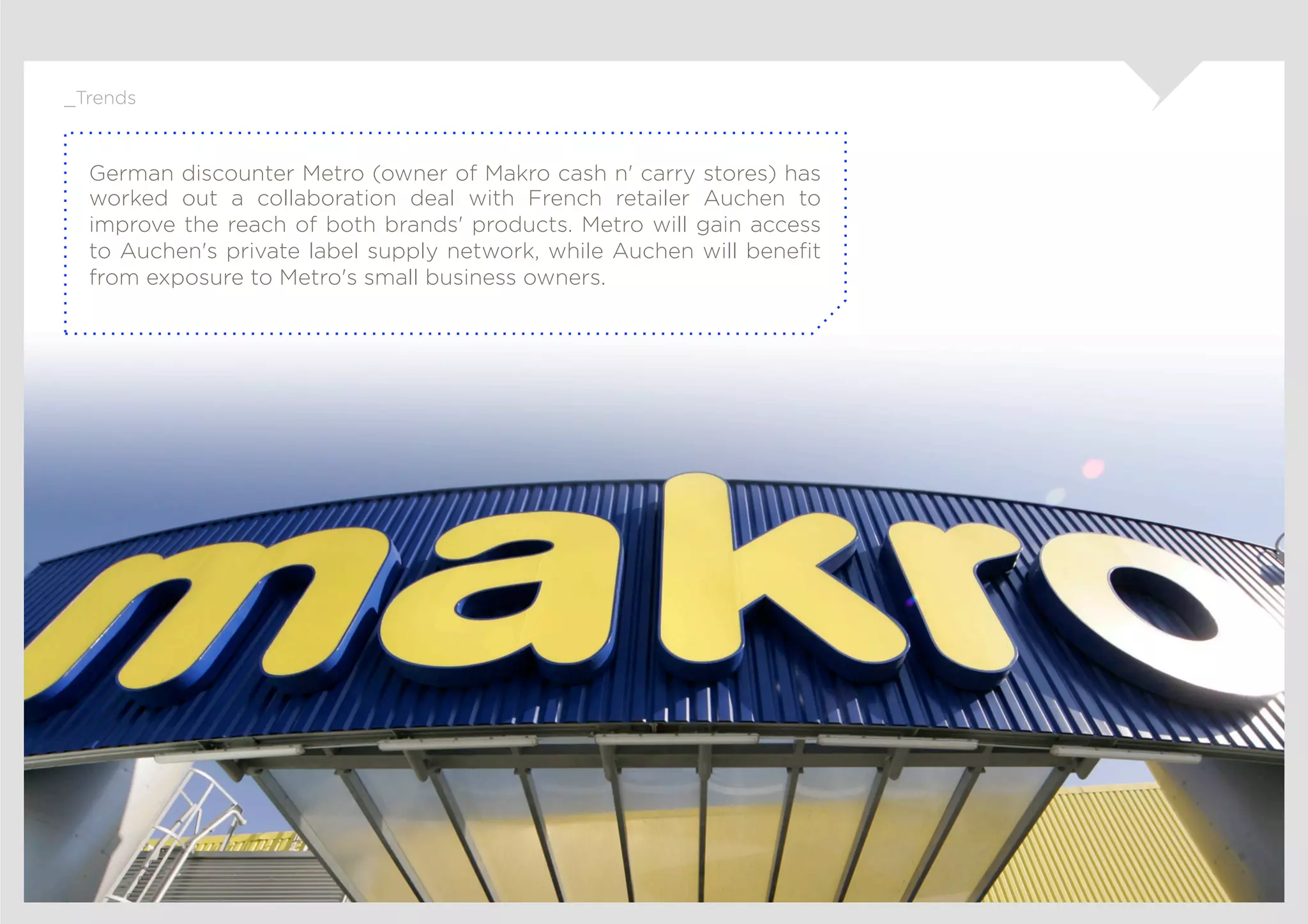
  German discounter Metro (owner of Makro cash n' carry stores) has
  worked out a collaboration deal with French retailer Auchen to
  improve the reach of both brands' products. Metro will gain access
  to Auchen's private label supply network, while Auchen will benefit
  from exposure to Metro's small business owners.
_Trends


                                                                 8. Leaving
                                                                      home

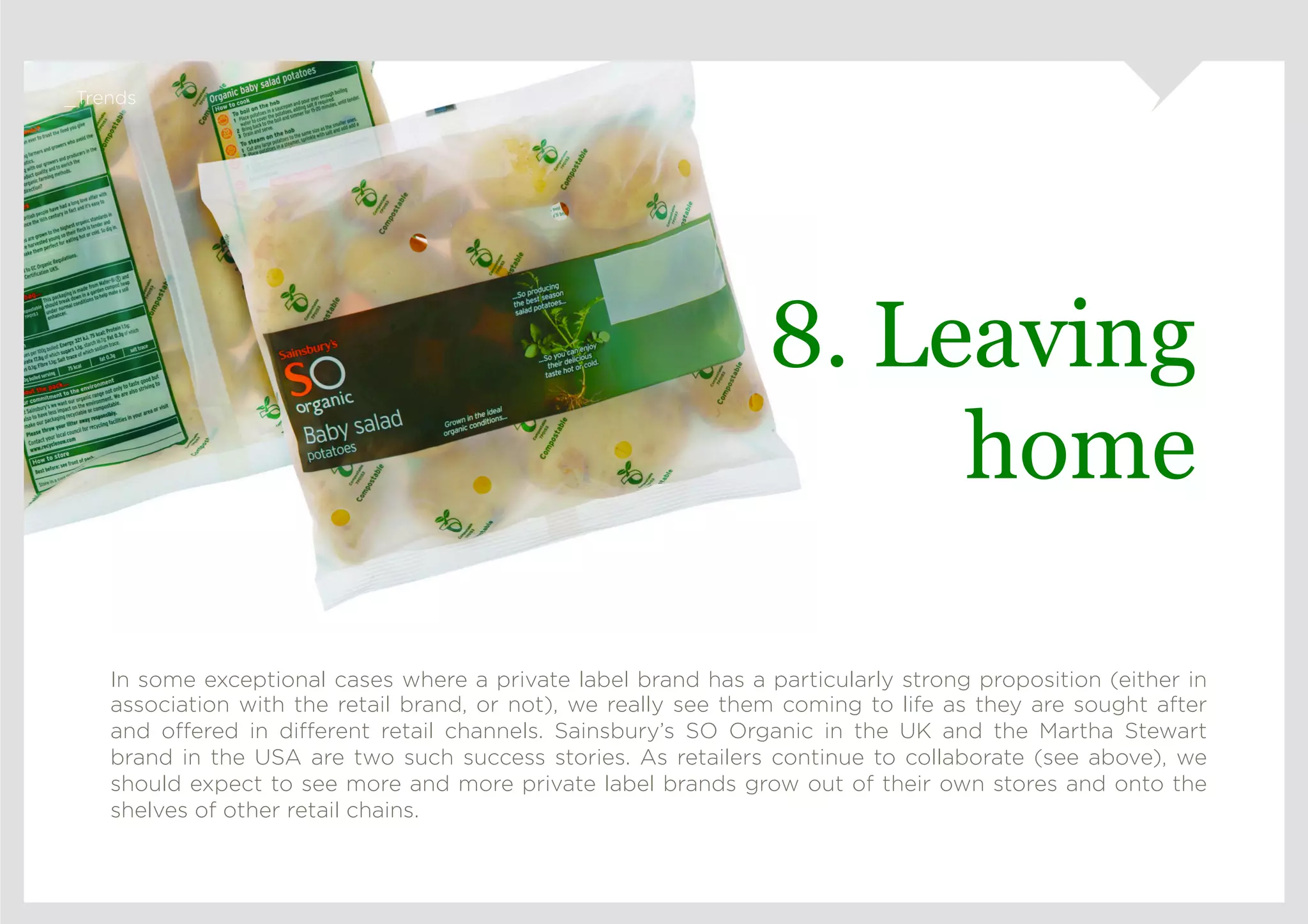
    In some exceptional cases where a private label brand has a particularly strong proposition (either in
    association with the retail brand, or not), we really see them coming to life as they are sought after
    and offered in different retail channels. Sainsbury’s SO Organic in the UK and the Martha Stewart
    brand in the USA are two such success stories. As retailers continue to collaborate (see above), we
    should expect to see more and more private label brands grow out of their own stores and onto the
    shelves of other retail chains.
_Trends


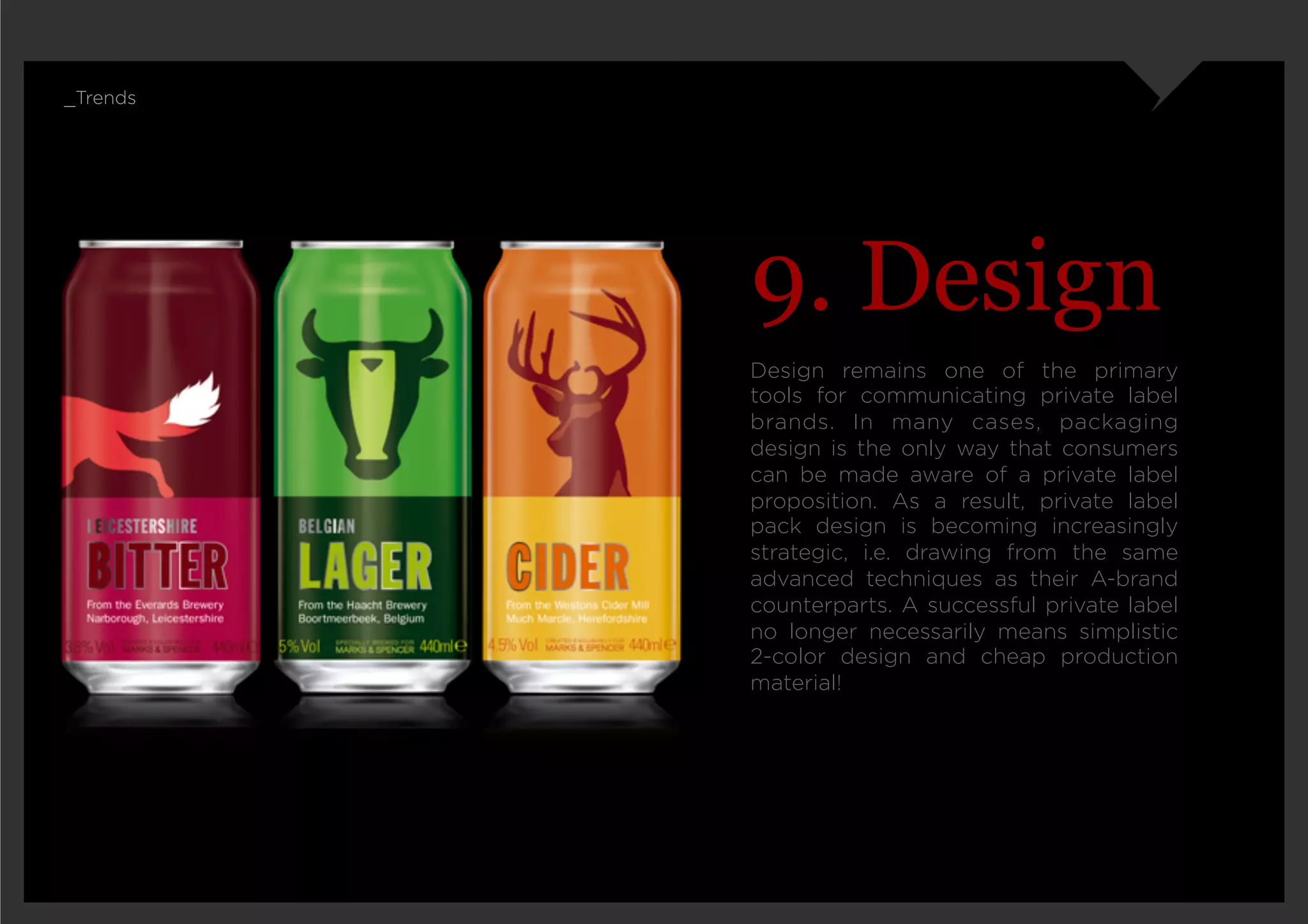
          9. Design
          Design remains one of the primary
          tools for communicating private label
          brands. In many cases, packaging
          design is the only way that consumers
          can be made aware of a private label
          proposition. As a result, private label
          pack design is becoming increasingly
          strategic, i.e. drawing from the same
          advanced techniques as their A-brand
          counterparts. A successful private label
          no longer necessarily means simplistic
          2-color design and cheap production
          material!
_Trends


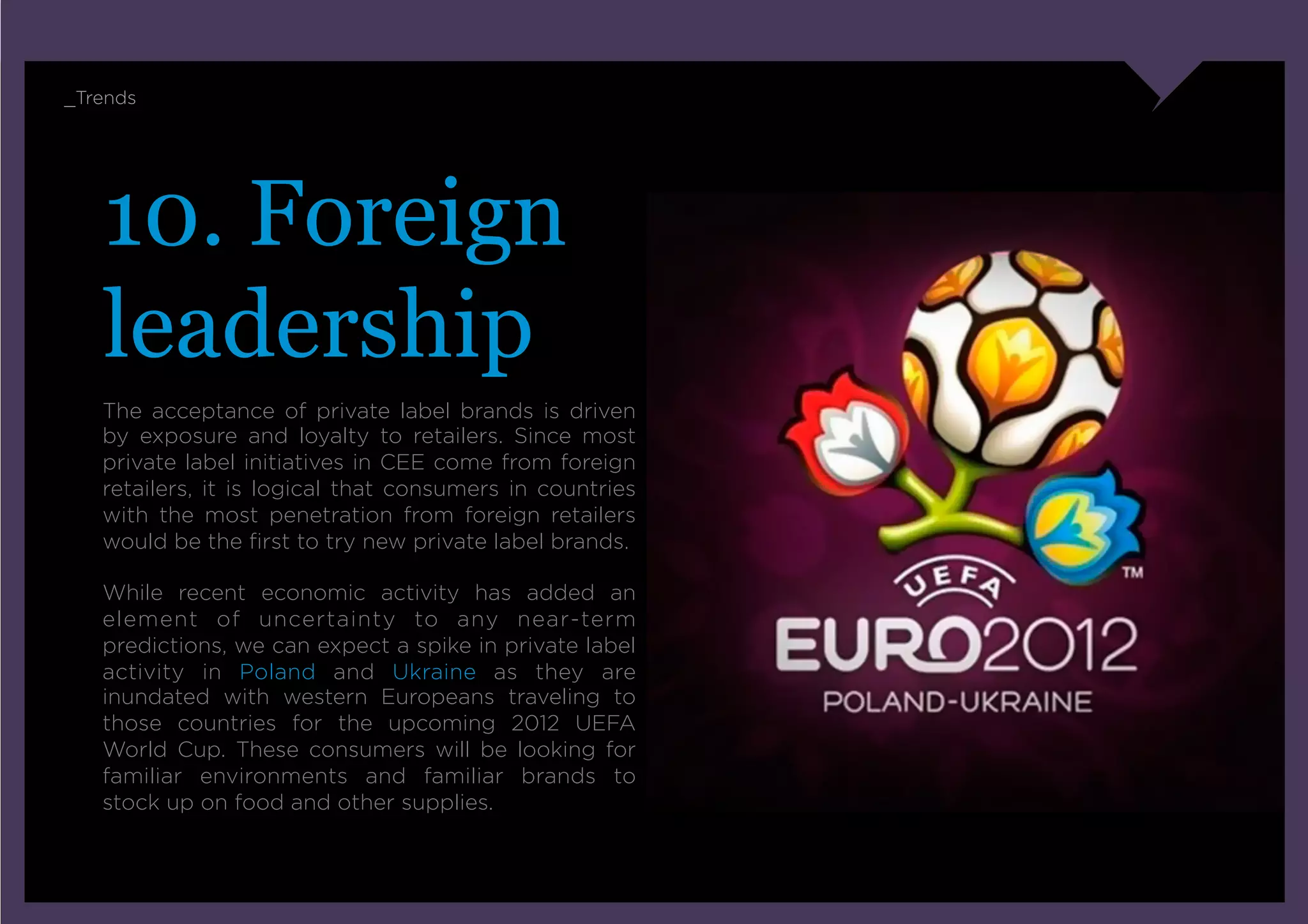
   10. Foreign
   leadership
   The acceptance of private label brands is driven
   by exposure and loyalty to retailers. Since most
   private label initiatives in CEE come from foreign
   retailers, it is logical that consumers in countries
   with the most penetration from foreign retailers
   would be the first to try new private label brands.

   While recent economic activity has added an
   element of uncertainty to any near-term
   predictions, we can expect a spike in private label
   activity in Poland and Ukraine as they are
   inundated with western Europeans traveling to
   those countries for the upcoming 2012 UEFA
   World Cup. These consumers will be looking for
   familiar environments and familiar brands to
   stock up on food and other supplies.
_Trends


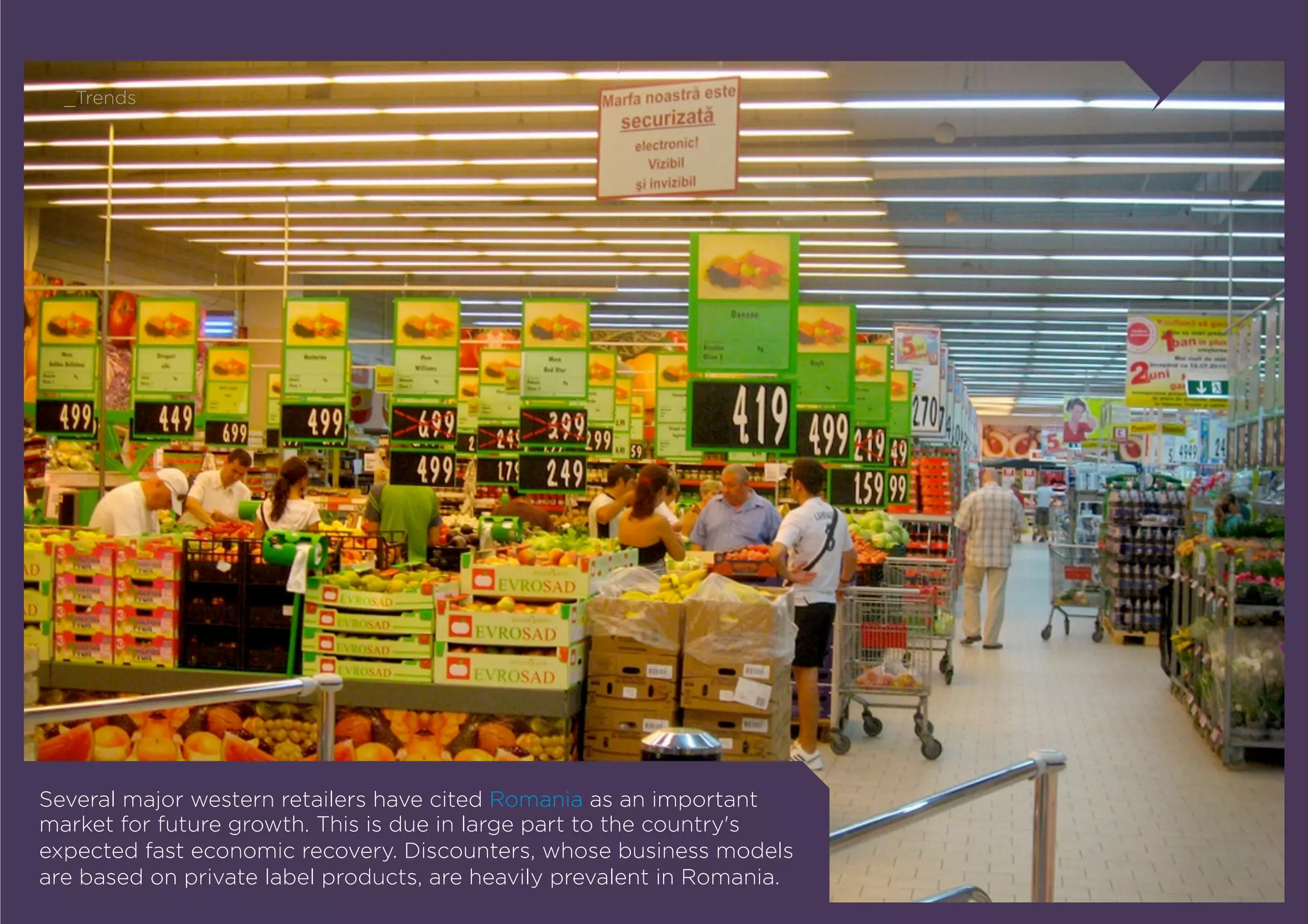
Several major western retailers have cited Romania as an important
market for future growth. This is due in large part to the country's
expected fast economic recovery. Discounters, whose business models
are based on private label products, are heavily prevalent in Romania.
Thank you for your attention!


For more information, please contact:
Cocoon Group
Douglas Kaufman
d.kaufman@cg-eu.com
00420 603 840 287
U Pruhonu 13, Prague, Czech Republic 170 00


www.cg-eu.com
v	
  

Image sources
Slide 1, 2: http://aislingmccoy.com/2011/05/andreasgursky/

Slide 4: http://blogblongdring.blogspot.com/2011_05_01_archive.html

Slide 5: http://www.panoramio.com/photo/23319799

Slide 6: http://www.strefabiznesu.gp24.pl/artykul/w-tesco-teraz-po-polsku-13710.html

Slide 7: http://www.mommybrainreports.com/wp-content/uploads/2010/11/localGrown.jpg

Slide 9: http://popsop.ru/19689

Slide 10: http://www.coop.ch/pb/site/common/get/documents/system/elements/ueber/medien/

_img/_naturaplan/verde/naturaplan_20080908_produkte.jpg

Slide 11: http://popsop.ru/wp-content/uploads/waitrose-herbs_award_winning_lm.jpg

Slide 12: http://www.thedieline.com/blog/2009/6/1/tesco-premium-ice-cream.html

Slide 13: http://laurakristinexo.blogspot.com/2010/06/june-faves.html

Slide 14: http://wafabeauty.blogspot.com/

Slide 15: http://realbeautyreporter.com/wp-content/uploads/2009/07/boots_sensitive-skin.jpg

Slide 16: http://www.fis.com/fis/worldnews/images/29383_350x265_72_DPI_0.jpg

Slide 17: http://www.freshplaza.com/2007/0601/amcor.jpg

Slide 18: http://mypbrand.com/2009/09/17/cold-beer-great-design-private-brand/

Slide 19: http://bolapagi.com/hasil-lengkap-kualifikasi-euro-2012-dan-kualifikasi-piala-dunia-11-12-

oktober-2011/

Slide 20: http://www.flickr.com/photos/mfoord/4939637816/


Additional images provided by Shutterstock.                                                          © Cocoon Group 2011 All Rights Reserved

CEE Private Label Trends

  • 1.
    November 2011 KNOWLEDGE CEE Private Label Trends and opportunities See further, deliver more
  • 2.
    Introduction As the worldstruggles to free itself from global recession, the one silver lining in an otherwise grim scenario is the expected growth of private label brands. Indeed, the continued growth of private labels remains one of the major macro trends affecting FMCG (and other) sectors. In this short round up, Cocoon Group summarizes a few of the trends driving and affecting private label brands - with a particular focus on opportunities for (Central and Eastern) Europe.
  • 3.
    10 Opportunities andtrends Opportunities Trends Our report begins with a round up of six In addition to the 6 PL growth major opportunities for retailers to grow opportunities, we’ve spotted these 4 their private label portfolio, listed other trends which are affecting according to accessibility. retailers around the world and around Europe. While ranking these opportunities, we take into account the cost of entry, consumer trends, retailer credibility, and inherent barriers to entry. 1 Value 7 Collaboration 2 Buy Local 8 Leaving home 3 Bio/Organic 9 Design 4 Premium 10 Foreign leadership 5 Niche and Specialty 6 The Muddled Middle
  • 4.
    _Opportunities 1.Value Value for money remains the strongest driver of private label consumption, as well as the easiest entry-level opportunity for retailers to launch a private label brand.   Value has traditionally been synonymous with 'cheap'- but there are other ways to build a value for money brand, especially since research shows that consumers are less inclined to give up quality (unless forced to). Family sizes and bulk formats can all be used to create a value proposition that will appeal to the consumers’ desire to save money without giving up on the quality they have become accustomed to.
  • 5.
    _Opportunities In Poland, Tescohas taken advantage of the economic uncertainty to launch 700 'value' products, putting pressure on more expensive independent markets and less convenient discounters.
  • 6.
    _Opportunities 2. Buy Local One micro-trend prevalent in the environmental movement is Buy Local. Attractive to consumers as both a way to cut down on carbon emissions as well as supporting local small businesses and farmers, the Buy Local movement makes great sense for retailers who wish to take on a more active role of supporting the community, the environment, or both.
  • 7.
    _Opportunities A retailer’s inherentexpertise in sourcing products and the feet on the ground aspect of the retail business provides relevant credibility for the launch of any locally-focused brand proposition.
  • 8.
    _Opportunities Other factors thatpositively impact the Buy Local trend are health scares and politics. The E.coli scare from the recent ‘cucumber scandal’ has prompted a rise in demand for local vegetables throughout Europe, including 34% in Latvia. In these cases, the demand for local produce far outweighs supply.
  • 9.
    _Opportunities 3. Bio/Organic Another fast growing sector that straddles the environment, health, and wellness macro trend is Organic and Bio. Many retailers are taking advantage of the fact that this new trend is under-represented by manufacturer brands, and that the playing field is basically even in terms of credibility. This has allowed retailers to use the retail environment to really promote these brands as healthy, environmentally friendly alternatives to leading manufacturer brands.
  • 10.
    _Opportunities The global marketfor organic products is expected to grow by 8% by the end of 2011. This is up from 4.7% one year ago.
  • 11.
    _Opportunities 4. Premium Premium private label brands are expected to be one of the major sources of private label growth in the coming few years. This growth mainly comes from consumers who have grown to trust retailer value brands when money is tight. When this kind of relationship exists between the retailer and consumer, the retailer can use a premium PL proposition to retain those consumers when they start looking to upscale.
  • 12.
    _Opportunities To launch apremium brand successfully, a retailer must already have a great deal of credibility with consumers, either in the form of high shopper loyalty or experience with other PL brands.
  • 13.
    _Opportunities 5. Niche and Specialty Whilethe previous four chapters represent the greatest opportunities for overall PL growth, there are individual categories where retailers can compete with their own PL offering. In sectors that have little competition, with few or no well-established brands, retailers can easily step in as the value alternative or even as the front-runner. Horeca, dietary, vitamins/ food supplements, and other niche areas are fertile ground for forward-thinking retailers.
  • 14.
    _Opportunities 6. The Muddled Middle Trying to launch a brand without significant price point advantages in well-developed, saturated sectors is going to prove the most difficult for retailers. This 'middle ground' is fast disappearing, and even manufacturer brands are finding it difficult to survive. Any brands that wish to compete here will need to draw upon vast stores of consumer goodwill, product innovation, and outstanding design (not to mention more than a bit of luck) to survive.
  • 15.
    _Trends 7.Collaboration Retailers seeking to streamline are finding success collaborating with each other rather than competing. In this way, retailers can utilize their expertise or resources while providing new markets or channels for their partners. The collaboration between Carrefour and Boots in the UK is a prime example of erstwhile competitors creating win-win situations out of cooperation.   Carrefour carries Boots’ branded products, while the Boots manufacturing subsidiary creates health and beauty products under the Carrefour brand. Boots benefits from Carrefour's extensive global footprint, while Carrefour gets Boots' expertise in helping to create a name for itself within the health and beauty sectors.
  • 16.
    _Trends Germandiscounter Metro (owner of Makro cash n' carry stores) has worked out a collaboration deal with French retailer Auchen to improve the reach of both brands' products. Metro will gain access to Auchen's private label supply network, while Auchen will benefit from exposure to Metro's small business owners.
  • 17.
    _Trends 8. Leaving home In some exceptional cases where a private label brand has a particularly strong proposition (either in association with the retail brand, or not), we really see them coming to life as they are sought after and offered in different retail channels. Sainsbury’s SO Organic in the UK and the Martha Stewart brand in the USA are two such success stories. As retailers continue to collaborate (see above), we should expect to see more and more private label brands grow out of their own stores and onto the shelves of other retail chains.
  • 18.
    _Trends 9. Design Design remains one of the primary tools for communicating private label brands. In many cases, packaging design is the only way that consumers can be made aware of a private label proposition. As a result, private label pack design is becoming increasingly strategic, i.e. drawing from the same advanced techniques as their A-brand counterparts. A successful private label no longer necessarily means simplistic 2-color design and cheap production material!
  • 19.
    _Trends 10. Foreign leadership The acceptance of private label brands is driven by exposure and loyalty to retailers. Since most private label initiatives in CEE come from foreign retailers, it is logical that consumers in countries with the most penetration from foreign retailers would be the first to try new private label brands. While recent economic activity has added an element of uncertainty to any near-term predictions, we can expect a spike in private label activity in Poland and Ukraine as they are inundated with western Europeans traveling to those countries for the upcoming 2012 UEFA World Cup. These consumers will be looking for familiar environments and familiar brands to stock up on food and other supplies.
  • 20.
    _Trends Several major westernretailers have cited Romania as an important market for future growth. This is due in large part to the country's expected fast economic recovery. Discounters, whose business models are based on private label products, are heavily prevalent in Romania.
  • 21.
    Thank you foryour attention! For more information, please contact: Cocoon Group Douglas Kaufman d.kaufman@cg-eu.com 00420 603 840 287 U Pruhonu 13, Prague, Czech Republic 170 00 www.cg-eu.com
  • 22.
    v   Image sources Slide1, 2: http://aislingmccoy.com/2011/05/andreasgursky/ Slide 4: http://blogblongdring.blogspot.com/2011_05_01_archive.html Slide 5: http://www.panoramio.com/photo/23319799 Slide 6: http://www.strefabiznesu.gp24.pl/artykul/w-tesco-teraz-po-polsku-13710.html Slide 7: http://www.mommybrainreports.com/wp-content/uploads/2010/11/localGrown.jpg Slide 9: http://popsop.ru/19689 Slide 10: http://www.coop.ch/pb/site/common/get/documents/system/elements/ueber/medien/ _img/_naturaplan/verde/naturaplan_20080908_produkte.jpg Slide 11: http://popsop.ru/wp-content/uploads/waitrose-herbs_award_winning_lm.jpg Slide 12: http://www.thedieline.com/blog/2009/6/1/tesco-premium-ice-cream.html Slide 13: http://laurakristinexo.blogspot.com/2010/06/june-faves.html Slide 14: http://wafabeauty.blogspot.com/ Slide 15: http://realbeautyreporter.com/wp-content/uploads/2009/07/boots_sensitive-skin.jpg Slide 16: http://www.fis.com/fis/worldnews/images/29383_350x265_72_DPI_0.jpg Slide 17: http://www.freshplaza.com/2007/0601/amcor.jpg Slide 18: http://mypbrand.com/2009/09/17/cold-beer-great-design-private-brand/ Slide 19: http://bolapagi.com/hasil-lengkap-kualifikasi-euro-2012-dan-kualifikasi-piala-dunia-11-12- oktober-2011/ Slide 20: http://www.flickr.com/photos/mfoord/4939637816/ Additional images provided by Shutterstock. © Cocoon Group 2011 All Rights Reserved