Private Labels
Store Brands as a strategy tool
Introduction
 The increasing popularity of the retail sector in developed
countries in the 19th century saw a tremendous rise in the number
of departmental stores and supermarket chains; that further gave
birth to concept of private-label goods.
 Initially private labels were introduced in the grocery section with
much cheaper prices compared to the branded products.
 The poor economic conditions in many countries in the mid 19th
century made customers more price conscious, and led them go
for these products.
What is private lables ?
 The Private Label Marketing Association defines store brand products as
“all merchandise sold under a retail stores private label. That label can be
the stores own name or a name created exclusively by that store.
 A private label product is manufactured by a contract or third-party
manufacturer and sold under a retailer’s brand name.
 For Ex : Restaurants often decide to private label condiments or mixes
that have become popular with customers. ( like their own mineral water
Bottle )
 largest retailer Future group's Big Bazaar and Bharti Retail's Easy Day
outlets,
Private Label Categories
Almost every consumer product category
has both branded and private label offerings,
including:
Personal care
Beverages
Cosmetics
Paper products
Household cleaners
Condiments and salad dressings
Dairy items
Frozen foods
How does it work?
 Private-label manufacturers secure deals with individuals or brands to sell their
products under the manufacturer's name with no attribution. The products can be
sold independently or in support of other products.
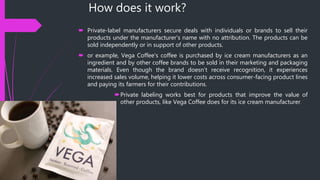
 or example, Vega Coffee's coffee is purchased by ice cream manufacturers as an
ingredient and by other coffee brands to be sold in their marketing and packaging
materials. Even though the brand doesn't receive recognition, it experiences
increased sales volume, helping it lower costs across consumer-facing product lines
and paying its farmers for their contributions.
Private labeling works best for products that improve the value of
other products, like Vega Coffee does for its ice cream manufacturer.
Advantages
 Control over production - Third-party manufacturers work at the retailer’s
direction, offering complete control over product ingredients and quality.
 Control over pricing - Thanks to control over the product, retailers can also
determine product cost and profitable pricing.
 Adaptability - Smaller retailers have the ability to move quickly to get a private
label product in production in response to rising market demand for a new
feature, while larger companies might not be interested in a niche product.
 Control over branding - Private label products bear the brand name and
packaging design created by the retailer.
 Control over profitability - Thanks to control over production costs and pricing,
retailers therefore control the level of profitability its products provide.
Disadvantages
 Manufacturer dependency - Since production of your
product line is in the hands of a third-party manufacturer, it’s
important to partner with well-established companies.
Otherwise, you could miss out on opportunities if your
manufacturer runs into problems.
 Difficulty building loyalty - Established household brands
have the upper hand and can often be found in a variety of
retail outlets. Your product will only be sold in your stores,
limiting customer access to it. Of course, limited availability
could also be an advantage, giving customers a reason to
come back and buy from you.
Types of private lables
 Individual / Quasi-brands, invented controlled labels with no store
association, work most successfully in a limited assortment environment to
create the illusion of selection.
Types of private lables
 Store brands, where all private labels carry the name of the store, have been very
successful at driving high levels of private label penetration in supermarkets. It
carries the retailer’s name, such as Westside, Food World, Big Bazzar,
 An Umbrella Brand / Group Brands: Group brands, where all private labels
carry a common non-store name, are most commonly used by retailers
with more than one store.
Private labels in India.
 Private label in India are coming on their won.
 n Lifestyle segment, private labels form 80% of apparel sales in Pantaloon as well
Big Bazaar (Fashion@Big Bazaar).
 In FMCG and Personal care categories. Some of the key private label brands in this
space include Tasty Treat, Fresh & Pure, Clean Mate, Care Mate etc.
 In case of Food Bazaar, in many categories, private labels are better than branded
products.
Private labels in India.
 According to Mr. Amit Kumar, Retail head, Fashion@bigbazaar on private labeling,
he said that he plans to increase his private labels from 60 percent to 90 percent in
the next three years.
 According to him Private labels provide four key merits:
 Gives the opportunities to stand out from the crowd.
 Helps maintain consistency in stocks. 50
 Outside brands may or may not be available in the future leading to a potential loss of
customers.
 Enables retailers to control margins by improving their bargaining Power.
Thank you
someone@example.com

Private labels

  • 1.
    Private Labels Store Brandsas a strategy tool
  • 2.
    Introduction  The increasingpopularity of the retail sector in developed countries in the 19th century saw a tremendous rise in the number of departmental stores and supermarket chains; that further gave birth to concept of private-label goods.  Initially private labels were introduced in the grocery section with much cheaper prices compared to the branded products.  The poor economic conditions in many countries in the mid 19th century made customers more price conscious, and led them go for these products.
  • 3.
    What is privatelables ?  The Private Label Marketing Association defines store brand products as “all merchandise sold under a retail stores private label. That label can be the stores own name or a name created exclusively by that store.  A private label product is manufactured by a contract or third-party manufacturer and sold under a retailer’s brand name.  For Ex : Restaurants often decide to private label condiments or mixes that have become popular with customers. ( like their own mineral water Bottle )  largest retailer Future group's Big Bazaar and Bharti Retail's Easy Day outlets,
  • 4.
    Private Label Categories Almostevery consumer product category has both branded and private label offerings, including: Personal care Beverages Cosmetics Paper products Household cleaners Condiments and salad dressings Dairy items Frozen foods
  • 5.
    How does itwork?  Private-label manufacturers secure deals with individuals or brands to sell their products under the manufacturer's name with no attribution. The products can be sold independently or in support of other products.  or example, Vega Coffee's coffee is purchased by ice cream manufacturers as an ingredient and by other coffee brands to be sold in their marketing and packaging materials. Even though the brand doesn't receive recognition, it experiences increased sales volume, helping it lower costs across consumer-facing product lines and paying its farmers for their contributions. Private labeling works best for products that improve the value of other products, like Vega Coffee does for its ice cream manufacturer.
  • 6.
    Advantages  Control overproduction - Third-party manufacturers work at the retailer’s direction, offering complete control over product ingredients and quality.  Control over pricing - Thanks to control over the product, retailers can also determine product cost and profitable pricing.  Adaptability - Smaller retailers have the ability to move quickly to get a private label product in production in response to rising market demand for a new feature, while larger companies might not be interested in a niche product.  Control over branding - Private label products bear the brand name and packaging design created by the retailer.  Control over profitability - Thanks to control over production costs and pricing, retailers therefore control the level of profitability its products provide.
  • 7.
    Disadvantages  Manufacturer dependency- Since production of your product line is in the hands of a third-party manufacturer, it’s important to partner with well-established companies. Otherwise, you could miss out on opportunities if your manufacturer runs into problems.  Difficulty building loyalty - Established household brands have the upper hand and can often be found in a variety of retail outlets. Your product will only be sold in your stores, limiting customer access to it. Of course, limited availability could also be an advantage, giving customers a reason to come back and buy from you.
  • 8.
    Types of privatelables  Individual / Quasi-brands, invented controlled labels with no store association, work most successfully in a limited assortment environment to create the illusion of selection.
  • 9.
    Types of privatelables  Store brands, where all private labels carry the name of the store, have been very successful at driving high levels of private label penetration in supermarkets. It carries the retailer’s name, such as Westside, Food World, Big Bazzar,
  • 10.
     An UmbrellaBrand / Group Brands: Group brands, where all private labels carry a common non-store name, are most commonly used by retailers with more than one store.
  • 11.
    Private labels inIndia.  Private label in India are coming on their won.  n Lifestyle segment, private labels form 80% of apparel sales in Pantaloon as well Big Bazaar (Fashion@Big Bazaar).  In FMCG and Personal care categories. Some of the key private label brands in this space include Tasty Treat, Fresh & Pure, Clean Mate, Care Mate etc.  In case of Food Bazaar, in many categories, private labels are better than branded products.
  • 12.
    Private labels inIndia.  According to Mr. Amit Kumar, Retail head, Fashion@bigbazaar on private labeling, he said that he plans to increase his private labels from 60 percent to 90 percent in the next three years.  According to him Private labels provide four key merits:  Gives the opportunities to stand out from the crowd.  Helps maintain consistency in stocks. 50  Outside brands may or may not be available in the future leading to a potential loss of customers.  Enables retailers to control margins by improving their bargaining Power.
  • 14.