Brand Equity
“Brand equity has just as much effect
on stock price as do earnings.”
Brand Equity
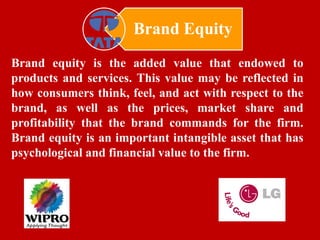
Brand equity is the added value that endowed to
products and services. This value may be reflected in
how consumers think, feel, and act with respect to the
brand, as well as the prices, market share and
profitability that the brand commands for the firm.
Brand equity is an important intangible asset that has
psychological and financial value to the firm.
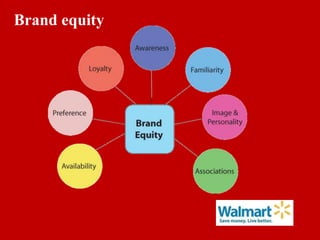
Brand equity
Customer based approaches to brand equity
The brand is viewed from the perspective of the
customer, an individual or an organization.
The power of the brand lies in what customers have
seen, read, heard, learned, thought and thought
about the product over time.
A brand is said to have positive customer brand
equity when consumers react favorably to a
product.
A brand is said to have negative brand equity if
consumers react less favorably to the product.
Brand equity models
Brand Asset Valuator:
Developed by Advertising agency Young and Rubicam(Y&R).
According to BAV there are four pillars of brand equity:-
Differentiation
Relevance
Esteem
Knowledge
Differentiation and relevance point to the brands future value
and Esteem and acknowledge reflects the past performance of
the firms.
Aaker Model:
Viewed by UC-Berkeley professor David Aaker.
There are a set of five categories of brand assets and
liabilities which add value to the product.
They are:
Brand loyalty
Brand awareness
Perceived quality
Brand associations
Other proprietary assets
Brandz:
Developed by marketing research consultants
Millward and WPP.
As per this model brand building involves series of
steps:
The objectives of each steps are the following:
Presence
Relevance
Performance
Advantage
Bonding
Brand resonance:
It also views brand building as an ascending, sequential
series of steps
Ensuring identification of the brand with customers’
minds with a specific product class or customer
need.
Firmly establishing the brand into the mind of the
consumer.
Eliciting proper customer response to in terms of
brand related judgment and feelings.
Converting brand response to create to create an
intense, active loyalty relationship between
customers and the brand.
Measuring Brand Equity:
There are two approaches for measuring brand
equity.
Indirect approach and direct approach.
Brand Audit:
- is a consumer-focused exercise that involves a series
of procedures to access the heath of the brand,
uncover its sources of equity and suggest ways to
improve and leverage its equity.
Brand Audits consist of two steps:
Brand inventory and brand explanatory
The purpose of brand inventory is to provide a
current, comprehensive profile of how all the
products and services sold by a company are
marketed and branded.
The brand explanatory is research activity
conducted to understand what consumers think and
its corresponding product category to identify
sources of brand equity.
Brand tracking:
Tracking studies collect information from the
consumers on a routine basis over time.
Tracking studies employ quantitative study
methods.
It provides a basis for decision making
It provides insights to marketing activities
Brand Valuation
It is concerned of estimating the total
financial value of the brand.
Brand Management
Brand Management needs a long term view of
marketing decisions. Consumer responses to
marketing activity depend on what they know and
remember about a brand.
Brand reinforcement:
Brand equity is reinforced by marketing actions
that consistently convey the meaning of the brands
to consumers in terms of:
The product and
Superiority
Reinforcing brand equity needs innovation
and relevance through out the marketing
program. Marketers must introduce new
products to satisfy the target consumers
Brand Revitalization
A strategy to recapture lost sources of brand
equity and identify and establish new sources of
brand equity. This may include product
modification or brand repositioning.
Doubts and Clarifications
Brand equity

Brand equity

  • 1.
    Brand Equity “Brand equityhas just as much effect on stock price as do earnings.”
  • 2.
    Brand Equity Brand equityis the added value that endowed to products and services. This value may be reflected in how consumers think, feel, and act with respect to the brand, as well as the prices, market share and profitability that the brand commands for the firm. Brand equity is an important intangible asset that has psychological and financial value to the firm.
  • 3.
  • 6.
    Customer based approachesto brand equity The brand is viewed from the perspective of the customer, an individual or an organization. The power of the brand lies in what customers have seen, read, heard, learned, thought and thought about the product over time. A brand is said to have positive customer brand equity when consumers react favorably to a product. A brand is said to have negative brand equity if consumers react less favorably to the product.
  • 7.
    Brand equity models BrandAsset Valuator: Developed by Advertising agency Young and Rubicam(Y&R). According to BAV there are four pillars of brand equity:- Differentiation Relevance Esteem Knowledge Differentiation and relevance point to the brands future value and Esteem and acknowledge reflects the past performance of the firms.
  • 8.
    Aaker Model: Viewed byUC-Berkeley professor David Aaker. There are a set of five categories of brand assets and liabilities which add value to the product. They are: Brand loyalty Brand awareness Perceived quality Brand associations Other proprietary assets
  • 9.
    Brandz: Developed by marketingresearch consultants Millward and WPP. As per this model brand building involves series of steps: The objectives of each steps are the following: Presence Relevance Performance Advantage Bonding
  • 10.
    Brand resonance: It alsoviews brand building as an ascending, sequential series of steps Ensuring identification of the brand with customers’ minds with a specific product class or customer need. Firmly establishing the brand into the mind of the consumer. Eliciting proper customer response to in terms of brand related judgment and feelings. Converting brand response to create to create an intense, active loyalty relationship between customers and the brand.
  • 11.
    Measuring Brand Equity: Thereare two approaches for measuring brand equity. Indirect approach and direct approach. Brand Audit: - is a consumer-focused exercise that involves a series of procedures to access the heath of the brand, uncover its sources of equity and suggest ways to improve and leverage its equity.
  • 12.
    Brand Audits consistof two steps: Brand inventory and brand explanatory The purpose of brand inventory is to provide a current, comprehensive profile of how all the products and services sold by a company are marketed and branded. The brand explanatory is research activity conducted to understand what consumers think and its corresponding product category to identify sources of brand equity.
  • 13.
    Brand tracking: Tracking studiescollect information from the consumers on a routine basis over time. Tracking studies employ quantitative study methods. It provides a basis for decision making It provides insights to marketing activities
  • 14.
    Brand Valuation It isconcerned of estimating the total financial value of the brand.
  • 15.
    Brand Management Brand Managementneeds a long term view of marketing decisions. Consumer responses to marketing activity depend on what they know and remember about a brand. Brand reinforcement: Brand equity is reinforced by marketing actions that consistently convey the meaning of the brands to consumers in terms of: The product and Superiority
  • 16.
    Reinforcing brand equityneeds innovation and relevance through out the marketing program. Marketers must introduce new products to satisfy the target consumers Brand Revitalization A strategy to recapture lost sources of brand equity and identify and establish new sources of brand equity. This may include product modification or brand repositioning.
  • 17.