MEASURING BRAND EQUITY  INTERBRAND DAVIDE DI FAZIO
STRUCTURE INTRODUCTION MEASURING BRAND EQUITY INTERBRAND 2008 BEST GLOBAL BRANDS CONCLUSION
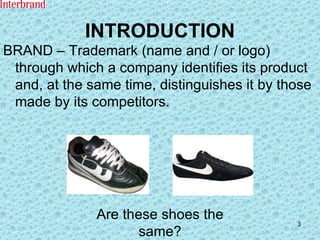
INTRODUCTION BRAND – Trademark (name and / or logo) through which a company identifies its product and, at the same time, distinguishes it by those made by its competitors. Are these shoes the same?
INTRODUCTION “ Customer-based brand equity is the differential effect of brand knowledge on consumer response to the marketing of the brand.” Keller (1993) BRAND EQUITY – refers to the marketing effects or outcomes that accrue to a product with its brand name compared with those that would accrue if the same product did not have the brand name.
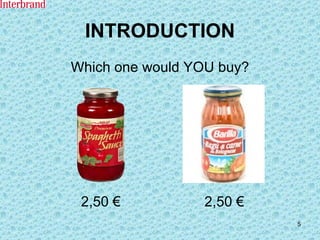
INTRODUCTION Which one would YOU buy? 2,50 € 2,50 €
INTRODUCTION BRAND EQUITY    economic / financial value of the brand. Measuring brand equity. Why? To know the strength, the qualities of the brand. To know the position of the brand (or company) in the market. Take over of the brand (or company) by another company.
MEASURING BRAND EQUITY Two different sets of approaches 1 – Comparative approaches Experiments of comparison between the target brand and a competitive / fictional brand    consumer’s attitudes and behaviour toward a brand. 2 – Holistic approaches Evaluation of some elements regarding the target brand itself    an overall value of the brand.
MEASURING BRAND EQUITY COMPARATIVE APPROACHES Brand-based method Group A    responds to a marketing activity when it’s attributed to the target brand. Group B    responds to the same activity when it’s not attributed to the target brand. Blind testing. PROs – isolation of the value of the target brand CONs – experimental realism    isolating the effects of brand knowledge.
MEASURING BRAND EQUITY Marketing-based method Holding the brand fixed and verifying consumer response based on changes in the marketing program. PROs – ease of implementation; choice of an appropriate advertising campaign. CONs – different results may be due to product knowledge, instead of brand knowledge.
MEASURING BRAND EQUITY HOLISTIC APPROACHES Residual methods Subtracting out consumers’ preferences for the brand based on physical products attributes alone from their overall brand preferences    value of the brand. PROs – useful benchmark to interpret brand equity. CONs – unable to distinguish between different types of non-product related attribute associations.
MEASURING BRAND EQUITY Evaluative methods Mathematic procedures    economic and financial value of the brand. Cost-based The amount of money that would be required to rebuild the brand (including all of the costs for product development, test marketing, advertising, etc.); - historical cost: keeping accountability and summing all of the costs sustained for that brand; - current prices cost: the amount of money that would be required today at current prices to replicate the same activities done for that brand in the past; - prospective cost: the amount of money that would be required today at current prices to execute activities with the same impact, to reach the same level of brand awareness.
MEASURING BRAND EQUITY 2. Market-based The amount of money which would be required for the property  to be exchanged between a willing buyer and seller, with equity to both. Income-based The amount of money that will be earned by the company owner of the brand because of the qualities of that brand.
INTERBRAND HISTORY Interbrand started in 1974, when the world still thought of brands as just another word for logo.  It has changed the world’s view of branding and brand management by creating and managing brands as valuable business assets.  Today: 40 offices    the world’s largest brand consultancy.  Both analytical and creative work. Interbrand creates and manages brand value by making the brand central to the business’s strategic aims. www.interbrand.com
INTERBRAND Interbrand’s method for measuring brand equity is  holistic ,  evaluative  and  income-based . The main idea is that brands create value by generating demand and securing future earnings for the business.
INTERBRAND Phases of the Interbrand-method: Monitoring companies’ incomes of last 3 years; Correction of the incomes; Forecasting future incomes; Bringing up-to-date future incomes by the use of a charge (different for each company): forecast future incomes are divided by this charge.
INTERBRAND How does Interbrand obtain this charge? The charge is inversely proportional to the Brand Strength Score. How does Interbrand obtain the Brand Strength Score? The BSS is an assessment about  the brand's ability to secure ongoing customer demand (loyalty, repurchase and retention) and thus sustain future earnings, translating branded earnings into net present value.
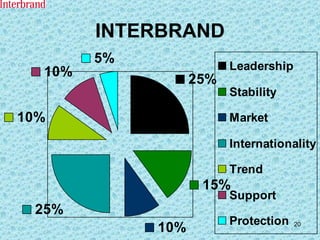
INTERBRAND The Brand Strenght Score is determined by the evaluation of 7 key-factors, with different specific weight: 1 – LEADERSHIP (25%) Market share Awareness Positioning Competitors concentration 2 – STABILITY (15%) Longevity Coherence Cohesion Brand identity Risks
INTERBRAND 3 – MARKET (10%) Market definition Market nature Market dimension Market dynamics Barriers to entry 4 – INTERNATIONALITY (25%) Geographical distribution International positioning International market share Prestige Ambition
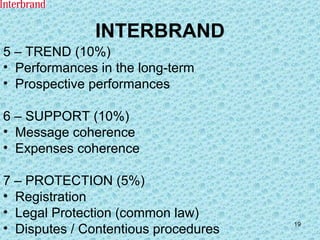
INTERBRAND 5 – TREND (10%) Performances in the long-term Prospective performances 6 – SUPPORT (10%) Message coherence Expenses coherence 7 – PROTECTION (5%) Registration Legal Protection (common law) Disputes / Contentious procedures
INTERBRAND
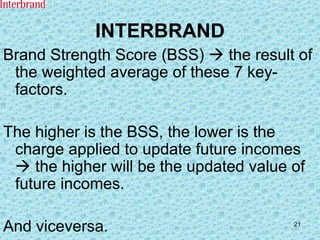
INTERBRAND Brand Strength Score (BSS)    the result of the weighted average of these 7 key-factors. The higher is the BSS, the lower is the charge applied to update future incomes    the higher will be the updated value of future incomes. And viceversa.
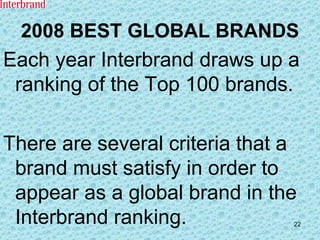
2008 BEST GLOBAL BRANDS Each year Interbrand draws up a ranking of the Top 100 brands. There are several criteria that a brand must satisfy in order to appear as a global brand in the Interbrand ranking.
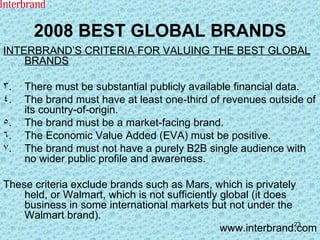
2008 BEST GLOBAL BRANDS INTERBRAND’S CRITERIA FOR VALUING THE BEST GLOBAL BRANDS There must be substantial publicly available financial data. The brand must have at least one-third of revenues outside of its country-of-origin. The brand must be a market-facing brand. The Economic Value Added (EVA) must be positive. The brand must not have a purely B2B single audience with no wider public profile and awareness. These criteria exclude brands such as Mars, which is privately held, or Walmart, which is not sufficiently global (it does business in some international markets but not under the Walmart brand). www.interbrand.com
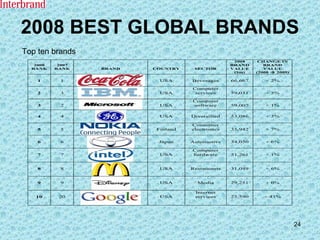
2008 BEST GLOBAL BRANDS Top ten brands
2008 BEST GLOBAL BRANDS Italian brands in the Top 100
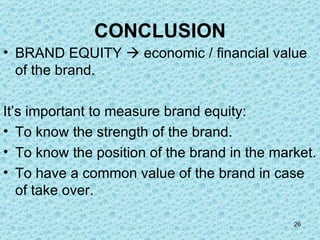
CONCLUSION BRAND EQUITY    economic / financial value of the brand. It’s important to measure brand equity: To know the strength of the brand. To know the position of the brand in the market. To have a common value of the brand in case of take over.
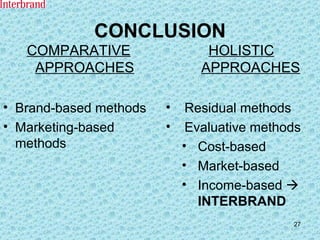
CONCLUSION COMPARATIVE APPROACHES Brand-based methods Marketing-based methods HOLISTIC APPROACHES Residual methods Evaluative methods Cost-based Market-based Income-based     INTERBRAND
CONCLUSION The Interbrand method evaluates brands much like analysts would value any other asset: on the basis of  how much they're likely to earn in the future . This makes Interbrand’s valuation process a uniquely valuable strategy and validation tool – recognized by businesses, academic and regulatory bodies, and accountancy and legal practices. www.interbrand.com

Measuring brand equity - Interbrand

  • 1.
    MEASURING BRAND EQUITY INTERBRAND DAVIDE DI FAZIO
  • 2.
    STRUCTURE INTRODUCTION MEASURINGBRAND EQUITY INTERBRAND 2008 BEST GLOBAL BRANDS CONCLUSION
  • 3.
    INTRODUCTION BRAND –Trademark (name and / or logo) through which a company identifies its product and, at the same time, distinguishes it by those made by its competitors. Are these shoes the same?
  • 4.
    INTRODUCTION “ Customer-basedbrand equity is the differential effect of brand knowledge on consumer response to the marketing of the brand.” Keller (1993) BRAND EQUITY – refers to the marketing effects or outcomes that accrue to a product with its brand name compared with those that would accrue if the same product did not have the brand name.
  • 5.
    INTRODUCTION Which onewould YOU buy? 2,50 € 2,50 €
  • 6.
    INTRODUCTION BRAND EQUITY  economic / financial value of the brand. Measuring brand equity. Why? To know the strength, the qualities of the brand. To know the position of the brand (or company) in the market. Take over of the brand (or company) by another company.
  • 7.
    MEASURING BRAND EQUITYTwo different sets of approaches 1 – Comparative approaches Experiments of comparison between the target brand and a competitive / fictional brand  consumer’s attitudes and behaviour toward a brand. 2 – Holistic approaches Evaluation of some elements regarding the target brand itself  an overall value of the brand.
  • 8.
    MEASURING BRAND EQUITYCOMPARATIVE APPROACHES Brand-based method Group A  responds to a marketing activity when it’s attributed to the target brand. Group B  responds to the same activity when it’s not attributed to the target brand. Blind testing. PROs – isolation of the value of the target brand CONs – experimental realism  isolating the effects of brand knowledge.
  • 9.
    MEASURING BRAND EQUITYMarketing-based method Holding the brand fixed and verifying consumer response based on changes in the marketing program. PROs – ease of implementation; choice of an appropriate advertising campaign. CONs – different results may be due to product knowledge, instead of brand knowledge.
  • 10.
    MEASURING BRAND EQUITYHOLISTIC APPROACHES Residual methods Subtracting out consumers’ preferences for the brand based on physical products attributes alone from their overall brand preferences  value of the brand. PROs – useful benchmark to interpret brand equity. CONs – unable to distinguish between different types of non-product related attribute associations.
  • 11.
    MEASURING BRAND EQUITYEvaluative methods Mathematic procedures  economic and financial value of the brand. Cost-based The amount of money that would be required to rebuild the brand (including all of the costs for product development, test marketing, advertising, etc.); - historical cost: keeping accountability and summing all of the costs sustained for that brand; - current prices cost: the amount of money that would be required today at current prices to replicate the same activities done for that brand in the past; - prospective cost: the amount of money that would be required today at current prices to execute activities with the same impact, to reach the same level of brand awareness.
  • 12.
    MEASURING BRAND EQUITY2. Market-based The amount of money which would be required for the property to be exchanged between a willing buyer and seller, with equity to both. Income-based The amount of money that will be earned by the company owner of the brand because of the qualities of that brand.
  • 13.
    INTERBRAND HISTORY Interbrandstarted in 1974, when the world still thought of brands as just another word for logo. It has changed the world’s view of branding and brand management by creating and managing brands as valuable business assets. Today: 40 offices  the world’s largest brand consultancy. Both analytical and creative work. Interbrand creates and manages brand value by making the brand central to the business’s strategic aims. www.interbrand.com
  • 14.
    INTERBRAND Interbrand’s methodfor measuring brand equity is holistic , evaluative and income-based . The main idea is that brands create value by generating demand and securing future earnings for the business.
  • 15.
    INTERBRAND Phases ofthe Interbrand-method: Monitoring companies’ incomes of last 3 years; Correction of the incomes; Forecasting future incomes; Bringing up-to-date future incomes by the use of a charge (different for each company): forecast future incomes are divided by this charge.
  • 16.
    INTERBRAND How doesInterbrand obtain this charge? The charge is inversely proportional to the Brand Strength Score. How does Interbrand obtain the Brand Strength Score? The BSS is an assessment about the brand's ability to secure ongoing customer demand (loyalty, repurchase and retention) and thus sustain future earnings, translating branded earnings into net present value.
  • 17.
    INTERBRAND The BrandStrenght Score is determined by the evaluation of 7 key-factors, with different specific weight: 1 – LEADERSHIP (25%) Market share Awareness Positioning Competitors concentration 2 – STABILITY (15%) Longevity Coherence Cohesion Brand identity Risks
  • 18.
    INTERBRAND 3 –MARKET (10%) Market definition Market nature Market dimension Market dynamics Barriers to entry 4 – INTERNATIONALITY (25%) Geographical distribution International positioning International market share Prestige Ambition
  • 19.
    INTERBRAND 5 –TREND (10%) Performances in the long-term Prospective performances 6 – SUPPORT (10%) Message coherence Expenses coherence 7 – PROTECTION (5%) Registration Legal Protection (common law) Disputes / Contentious procedures
  • 20.
  • 21.
    INTERBRAND Brand StrengthScore (BSS)  the result of the weighted average of these 7 key-factors. The higher is the BSS, the lower is the charge applied to update future incomes  the higher will be the updated value of future incomes. And viceversa.
  • 22.
    2008 BEST GLOBALBRANDS Each year Interbrand draws up a ranking of the Top 100 brands. There are several criteria that a brand must satisfy in order to appear as a global brand in the Interbrand ranking.
  • 23.
    2008 BEST GLOBALBRANDS INTERBRAND’S CRITERIA FOR VALUING THE BEST GLOBAL BRANDS There must be substantial publicly available financial data. The brand must have at least one-third of revenues outside of its country-of-origin. The brand must be a market-facing brand. The Economic Value Added (EVA) must be positive. The brand must not have a purely B2B single audience with no wider public profile and awareness. These criteria exclude brands such as Mars, which is privately held, or Walmart, which is not sufficiently global (it does business in some international markets but not under the Walmart brand). www.interbrand.com
  • 24.
    2008 BEST GLOBALBRANDS Top ten brands
  • 25.
    2008 BEST GLOBALBRANDS Italian brands in the Top 100
  • 26.
    CONCLUSION BRAND EQUITY  economic / financial value of the brand. It’s important to measure brand equity: To know the strength of the brand. To know the position of the brand in the market. To have a common value of the brand in case of take over.
  • 27.
    CONCLUSION COMPARATIVE APPROACHESBrand-based methods Marketing-based methods HOLISTIC APPROACHES Residual methods Evaluative methods Cost-based Market-based Income-based  INTERBRAND
  • 28.
    CONCLUSION The Interbrandmethod evaluates brands much like analysts would value any other asset: on the basis of how much they're likely to earn in the future . This makes Interbrand’s valuation process a uniquely valuable strategy and validation tool – recognized by businesses, academic and regulatory bodies, and accountancy and legal practices. www.interbrand.com