Defining BRAND EQUITYFG - Brand Management – Chapter 2
1
Learning Objectives
 1. Defining Brand Equity
 2. Measuring Brand Equity
2
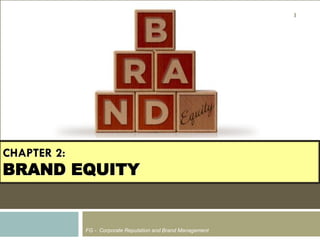
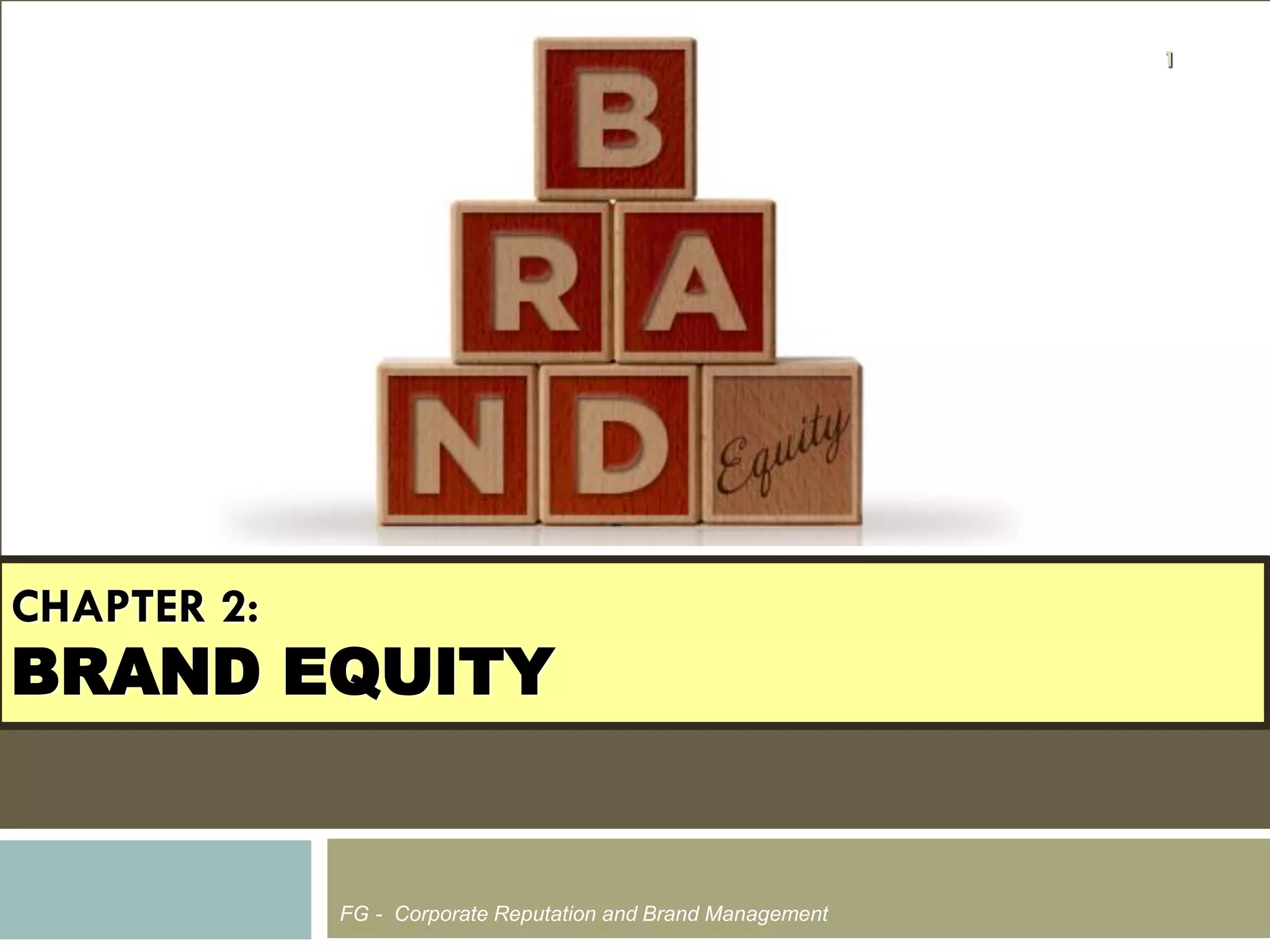
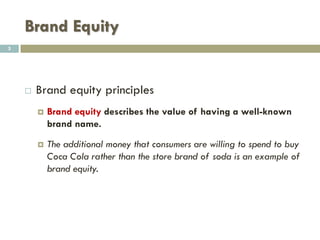
Brand Equity
 Brand equity principles
 Brand equity describes the value of having a well-known
brand name.
3
Brand Equity
 Principles of brand equity
 The value premium that a company realizes from a
product with a recognizable name as compared to its
generic equivalent.
 Companies can create brand equity for their products
 By making them memorable, easily recognizable and superior in
quality and reliability.
 By developing values and emotions attached to their products
 By developing Mass marketing campaigns
4
Brand Equity
 Principles of brand equity
 The value premium that a company realizes from a
product with a recognizable name as compared to its
generic equivalent.
 Companies can create brand equity for their products
 By making them memorable, easily recognizable and superior in
quality and reliability.
 By developing values and emotions attached to their products
 By developing Mass marketing campaigns
5
Brand Equity
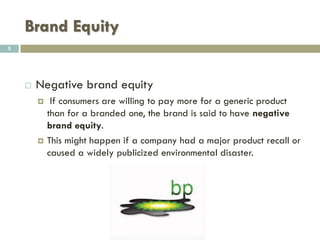
 Negative brand equity
 If consumers are willing to pay more for a generic product
than for a branded one, the brand is said to have negative
brand equity.
6
Brand Equity
 Negative brand equity
 Negative brand equity might
happen if a company had a
major product recall or
caused a widely publicized
environmental disaster.
7
Brand Equity
 Importance of brand equity
 Financial results
 Sales predictability
 Price premium
 Attract investors
 Umbrella effect:
 When a company wants to expand its product line, if the
brand's equity is positive, customers will more likely buy the
new product by associating it with the existing successful
brand.
8
Brand Equity Measurement
 Brand Equity can be measured at the
 Firm level
 Product level
 Consumer level
9
Brand Equity Measurement
 Firm Level Measurement
 Firm level approaches measure the brand as a financial
asset.
 In short, a calculation is made regarding how much the
brand is worth as an intangible asset.
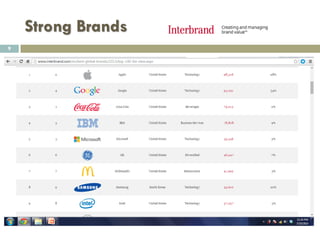
 Cf. Interbrand annual ranking
10
Strong Brands
11
Brand Equity Measurement
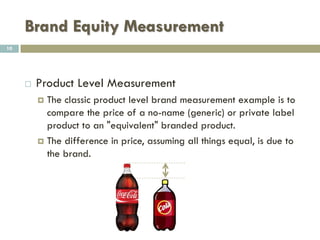
 Product Level Measurement
 The classic product level brand measurement example
is to compare the price of a no-name (generic) or
private label product to an "equivalent" branded
product.
12
Brand Equity Measurement
 Product Level Measurement
 The difference in price, assuming all things equal, is due to
the brand.
13
Brand Equity Measurement
 Consumer Level Measurement
 This approach seeks to measure 3 dimensions of
brand equity:
1. Awareness
2. brand image
3. Customer loyalty
14
Brand Equity Measurement
 Consumer Level Measurement
 Awareness
 the extent to which a brand is recognized by potential
customers, and is correctly associated with a particular
product category.
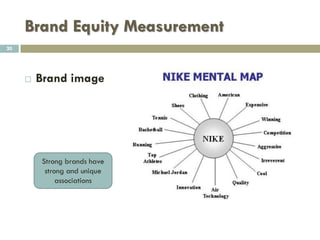
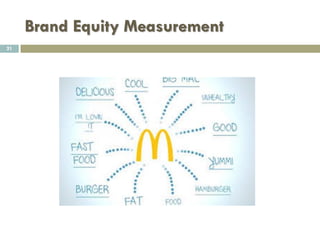
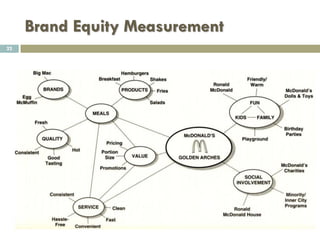
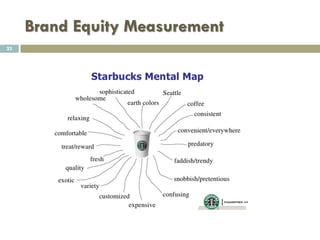
 Brand image
 This approach seeks to map the mind of the consumer to find
out what associations with the brand the consumer has.
 Brand loyalty
 A consumer's commitment to repurchase or otherwise
continue using the brand, or other positive behaviors such as
word of mouth advocacy.
15
Brand Equity Measurement
 Measures of Brand Awareness
 Aided Awareness - When asked about a product category,
if the consumer is aided with a list of company names and
he recognizes the company from the given set it is
categorized as aided awareness.
 Spontaneous awareness - When asked about a product
category, the consumers are asked to list brands they know
without any cues.
 Top of the mind Awareness - It’s the first brand name listed by
the consumers when asked to name brands they know without
any cues.
16
Brand Equity Measurement
 Brand Image
 Brand image is the consumers’ perception about the brand.
 It can be defined as a unique bundle of associations within
the minds of target customers.
 It signifies what the brand presently stands for.
 It is a set of beliefs held about a specific brand.
17
Brand Equity Measurement
 Brand Image
 Definition: A unique set of associations in the minds
of customers concerning what a brand stands for and
the implied promises the brand makes.
18
Brand Equity Measurement
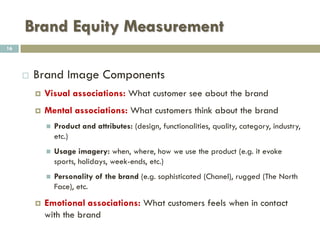
 Brand Image Components
 Visual associations: What customer see about the brand
 Mental associations: What customers think about the brand
 Product and attributes: (design, functionalities, quality, category,
industry, etc.)
 Usage imagery: when, where, how we use the product (e.g. it evoke
sports, holidays, week-ends, etc.)
 Personality of the brand (e.g. sophisticated (Chanel), rugged (The North
Face), etc.
 Emotional associations: What customers feels when in contact
with the brand
19
Brand Equity Measurement
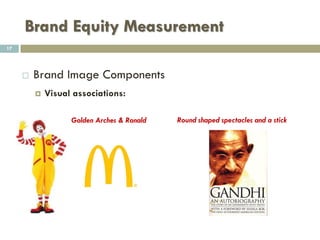
 Brand Image Components
 Visual associations:
20
Round shaped spectacles and a stickGolden Arches & Ronald
Brand Equity Measurement
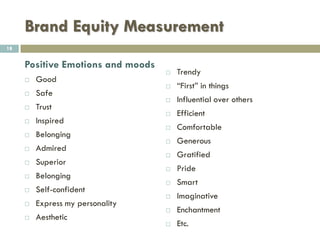
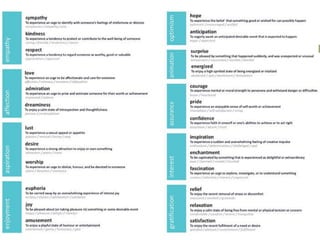
Positive Emotions and moods
 Good
 Safe
 Trust
 Inspired
 Belonging
 Admired
 Superior
 Belonging
 Self-confident
 Express my personality
 Aesthetic
21
 Trendy
 “First” in things
 Influential over others
 Efficient
 Comfortable
 Generous
 Gratified
 Pride
 Smart
 Imaginative
 Enchantment
 Etc.
Brand Equity Measurement
22
Brand Equity Measurement
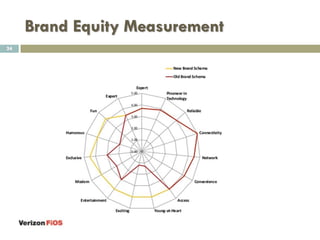
 Brand image
23
Brand Equity Measurement
24
Brand Equity Measurement
25
Brand Equity Measurement
26
Brand Equity Measurement
27
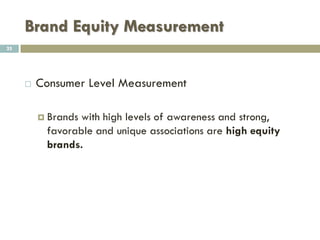
Brand Equity Measurement
 Consumer Level Measurement
 Brands with high levels of awareness and strong,
favorable and unique associations are high equity
brands.
28
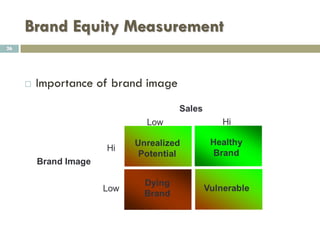
Brand Equity Measurement
 Importance of brand image
29
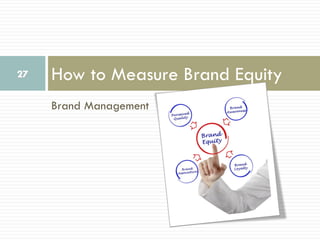
Brand Management
How to Measure Brand Equity30
Brand Equity Measurement
1. Measuring Brand AWARENESS
Can a customer spontaneously recall your brand?
Awareness is measured for a Category of product
 Product category: A product category is all the products offering the
same general functionality
 Unaided Awareness
 Aided Awareness
31
Brand Equity Measurement
 Unaided awareness is captured via an open-ended question.
 Example of unaided awareness:
 Please Name all the brands of [Category of Product] you can
think of.
 E.g. General category: bags; Sub-categories women bags, men bags,
children bags, outdoor bags, city bags, school bags, etc., fashion
clothes, shoes, cars, beverages, etc.
32
Brand Equity Measurement
 Example Top of Mind awareness:
 What is the first brand that comes to your mind when you
think of [Product category] women bags?
33
Brand Equity Measurement
 Aided Awareness
 Aided awareness provides a pick list from which respondents
can choose the brands they are aware of.
 This list must be randomized and be in a multiple response
format where they can select any or all brands they have
awareness of.
34
Brand Equity Measurement
 Example Aided Awareness
Which of the following bottled water brands have you heard of?
(Select all that apply)
 Aquafina
 Dasani
 SmartWater
 My Brand
 Fiji
35
Brand Equity Measurement
 Example Aided Awareness
36
Brand Equity Measurement
2. Measuring Brand ASSOCIATIONS
Example 1- Brand Associations
 The following question can be open or aided (with a list of
attributes proposed to respondent)
37
Brand Equity Measurement
38
 Questions can start with the general perception of the brand:
 When you think of Nike, What comes to your mind?
 What does Nike means to you?
Brand Equity Measurement
39
 …and continue with more focus questions:
Product attributes
 What does the air pocket evoke to you?
Usage imagery
 When would you use Nike? (ask for occasions and moods)
Brand personality
 If Nike were a person, what would its personality be like?
Feelings and experience
 If I say Nike, what kind of feeling does it evoke?
Brand Equity Measurement
 2. Measuring Brand Association
 Example 2 – Brand Associations
 Which of the following attributes do you associate with [brand]?
 Affordable
 Fun
 Safe
 Dependable
 Modern
 Stylish
40
 Easy to Use
 Essential
 Powerful
 Other Popular
 None of these
Brand Equity Measurement
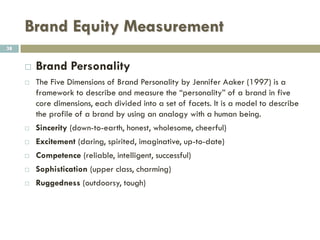
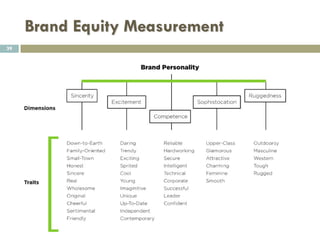
 Brand Personality
 The Five Dimensions of Brand Personality by Jennifer Aaker (1997) is a
framework to describe and measure the “personality” of a brand in five
core dimensions, each divided into a set of facets. It is a model to
describe the profile of a brand by using an analogy with a human being.
 Sincerity (down-to-earth, honest, wholesome, cheerful)
 Excitement (daring, spirited, imaginative, up-to-date)
 Competence (reliable, intelligent, successful)
 Sophistication (upper class, charming)
 Ruggedness (outdoorsy, tough)
41
Brand Equity Measurement
 Brand Personality
42
Brand Equity Measurement
 Example of question used for Brand Personality
Overall, I think that Nike is down to earth
Disagree 1 2 3 4 5 6 7 Agree
43
Brand Equity Measurement
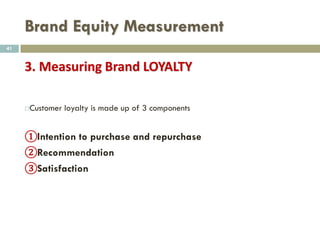
3. Measuring Brand LOYALTY
 Customer loyalty is made up of 3 components
① Intention to purchase and repurchase
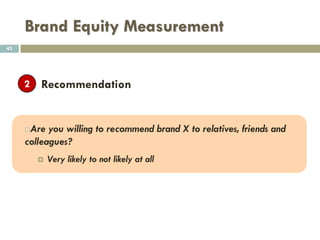
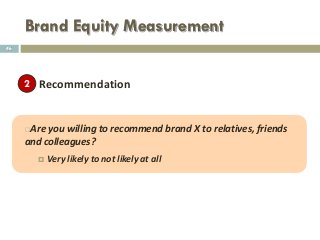
② Recommendation
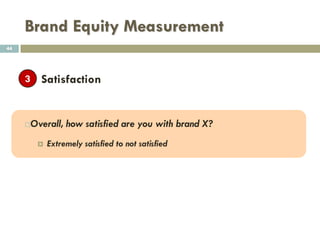
③ Satisfaction
44
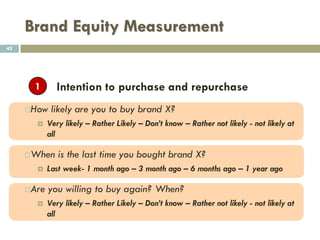
Brand Equity Measurement
Intention to purchase and repurchase
How likely are you to buy brand X?
 Very likely – Rather Likely – Don’t know – Rather not likely - not likely
at all
When is the last time you bought brand X?
 Last week- 1 month ago – 3 month ago – 6 months ago – 1 year ago
Are you willing to buy again? When?
 Very likely – Rather Likely – Don’t know – Rather not likely - not likely
at all
45
1
Brand Equity Measurement
Recommendation
Are you willing to recommend brand X to relatives, friends
and colleagues?
 Very likely to not likely at all
46
2
Brand Equity Measurement
Satisfaction
Overall, how satisfied are you with brand X?
 Extremely satisfied to not satisfied
47
3
Brand Equity Measurement
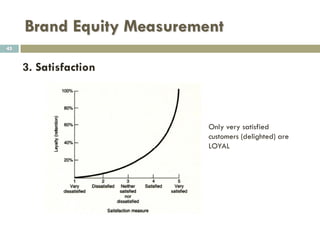
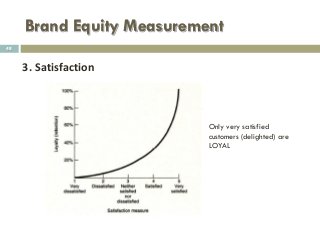
3. Satisfaction
48
Only very satisfied
customers (delighted) are
LOYAL

Defining Brand Equity

  • 1.
    Defining BRAND EQUITYFG- Brand Management – Chapter 2 1
  • 2.
    Learning Objectives  1.Defining Brand Equity  2. Measuring Brand Equity 2
  • 3.
    Brand Equity  Brandequity principles  Brand equity describes the value of having a well-known brand name. 3
  • 4.
    Brand Equity  Principlesof brand equity  The value premium that a company realizes from a product with a recognizable name as compared to its generic equivalent.  Companies can create brand equity for their products  By making them memorable, easily recognizable and superior in quality and reliability.  By developing values and emotions attached to their products  By developing Mass marketing campaigns 4
  • 5.
    Brand Equity  Principlesof brand equity  The value premium that a company realizes from a product with a recognizable name as compared to its generic equivalent.  Companies can create brand equity for their products  By making them memorable, easily recognizable and superior in quality and reliability.  By developing values and emotions attached to their products  By developing Mass marketing campaigns 5
  • 6.
    Brand Equity  Negativebrand equity  If consumers are willing to pay more for a generic product than for a branded one, the brand is said to have negative brand equity. 6
  • 7.
    Brand Equity  Negativebrand equity  Negative brand equity might happen if a company had a major product recall or caused a widely publicized environmental disaster. 7
  • 8.
    Brand Equity  Importanceof brand equity  Financial results  Sales predictability  Price premium  Attract investors  Umbrella effect:  When a company wants to expand its product line, if the brand's equity is positive, customers will more likely buy the new product by associating it with the existing successful brand. 8
  • 9.
    Brand Equity Measurement Brand Equity can be measured at the  Firm level  Product level  Consumer level 9
  • 10.
    Brand Equity Measurement Firm Level Measurement  Firm level approaches measure the brand as a financial asset.  In short, a calculation is made regarding how much the brand is worth as an intangible asset.  Cf. Interbrand annual ranking 10
  • 11.
  • 12.
    Brand Equity Measurement Product Level Measurement  The classic product level brand measurement example is to compare the price of a no-name (generic) or private label product to an "equivalent" branded product. 12
  • 13.
    Brand Equity Measurement Product Level Measurement  The difference in price, assuming all things equal, is due to the brand. 13
  • 14.
    Brand Equity Measurement Consumer Level Measurement  This approach seeks to measure 3 dimensions of brand equity: 1. Awareness 2. brand image 3. Customer loyalty 14
  • 15.
    Brand Equity Measurement Consumer Level Measurement  Awareness  the extent to which a brand is recognized by potential customers, and is correctly associated with a particular product category.  Brand image  This approach seeks to map the mind of the consumer to find out what associations with the brand the consumer has.  Brand loyalty  A consumer's commitment to repurchase or otherwise continue using the brand, or other positive behaviors such as word of mouth advocacy. 15
  • 16.
    Brand Equity Measurement Measures of Brand Awareness  Aided Awareness - When asked about a product category, if the consumer is aided with a list of company names and he recognizes the company from the given set it is categorized as aided awareness.  Spontaneous awareness - When asked about a product category, the consumers are asked to list brands they know without any cues.  Top of the mind Awareness - It’s the first brand name listed by the consumers when asked to name brands they know without any cues. 16
  • 17.
    Brand Equity Measurement Brand Image  Brand image is the consumers’ perception about the brand.  It can be defined as a unique bundle of associations within the minds of target customers.  It signifies what the brand presently stands for.  It is a set of beliefs held about a specific brand. 17
  • 18.
    Brand Equity Measurement Brand Image  Definition: A unique set of associations in the minds of customers concerning what a brand stands for and the implied promises the brand makes. 18
  • 19.
    Brand Equity Measurement Brand Image Components  Visual associations: What customer see about the brand  Mental associations: What customers think about the brand  Product and attributes: (design, functionalities, quality, category, industry, etc.)  Usage imagery: when, where, how we use the product (e.g. it evoke sports, holidays, week-ends, etc.)  Personality of the brand (e.g. sophisticated (Chanel), rugged (The North Face), etc.  Emotional associations: What customers feels when in contact with the brand 19
  • 20.
    Brand Equity Measurement Brand Image Components  Visual associations: 20 Round shaped spectacles and a stickGolden Arches & Ronald
  • 21.
    Brand Equity Measurement PositiveEmotions and moods  Good  Safe  Trust  Inspired  Belonging  Admired  Superior  Belonging  Self-confident  Express my personality  Aesthetic 21  Trendy  “First” in things  Influential over others  Efficient  Comfortable  Generous  Gratified  Pride  Smart  Imaginative  Enchantment  Etc.
  • 22.
  • 23.
  • 24.
  • 25.
  • 26.
  • 27.
  • 28.
    Brand Equity Measurement Consumer Level Measurement  Brands with high levels of awareness and strong, favorable and unique associations are high equity brands. 28
  • 29.
    Brand Equity Measurement Importance of brand image 29
  • 30.
    Brand Management How toMeasure Brand Equity30
  • 31.
    Brand Equity Measurement 1.Measuring Brand AWARENESS Can a customer spontaneously recall your brand? Awareness is measured for a Category of product  Product category: A product category is all the products offering the same general functionality  Unaided Awareness  Aided Awareness 31
  • 32.
    Brand Equity Measurement Unaided awareness is captured via an open-ended question.  Example of unaided awareness:  Please Name all the brands of [Category of Product] you can think of.  E.g. General category: bags; Sub-categories women bags, men bags, children bags, outdoor bags, city bags, school bags, etc., fashion clothes, shoes, cars, beverages, etc. 32
  • 33.
    Brand Equity Measurement Example Top of Mind awareness:  What is the first brand that comes to your mind when you think of [Product category] women bags? 33
  • 34.
    Brand Equity Measurement Aided Awareness  Aided awareness provides a pick list from which respondents can choose the brands they are aware of.  This list must be randomized and be in a multiple response format where they can select any or all brands they have awareness of. 34
  • 35.
    Brand Equity Measurement Example Aided Awareness Which of the following bottled water brands have you heard of? (Select all that apply)  Aquafina  Dasani  SmartWater  My Brand  Fiji 35
  • 36.
    Brand Equity Measurement Example Aided Awareness 36
  • 37.
    Brand Equity Measurement 2.Measuring Brand ASSOCIATIONS Example 1- Brand Associations  The following question can be open or aided (with a list of attributes proposed to respondent) 37
  • 38.
    Brand Equity Measurement 38 Questions can start with the general perception of the brand:  When you think of Nike, What comes to your mind?  What does Nike means to you?
  • 39.
    Brand Equity Measurement 39 …and continue with more focus questions: Product attributes  What does the air pocket evoke to you? Usage imagery  When would you use Nike? (ask for occasions and moods) Brand personality  If Nike were a person, what would its personality be like? Feelings and experience  If I say Nike, what kind of feeling does it evoke?
  • 40.
    Brand Equity Measurement 2. Measuring Brand Association  Example 2 – Brand Associations  Which of the following attributes do you associate with [brand]?  Affordable  Fun  Safe  Dependable  Modern  Stylish 40  Easy to Use  Essential  Powerful  Other Popular  None of these
  • 41.
    Brand Equity Measurement Brand Personality  The Five Dimensions of Brand Personality by Jennifer Aaker (1997) is a framework to describe and measure the “personality” of a brand in five core dimensions, each divided into a set of facets. It is a model to describe the profile of a brand by using an analogy with a human being.  Sincerity (down-to-earth, honest, wholesome, cheerful)  Excitement (daring, spirited, imaginative, up-to-date)  Competence (reliable, intelligent, successful)  Sophistication (upper class, charming)  Ruggedness (outdoorsy, tough) 41
  • 42.
    Brand Equity Measurement Brand Personality 42
  • 43.
    Brand Equity Measurement Example of question used for Brand Personality Overall, I think that Nike is down to earth Disagree 1 2 3 4 5 6 7 Agree 43
  • 44.
    Brand Equity Measurement 3.Measuring Brand LOYALTY  Customer loyalty is made up of 3 components ① Intention to purchase and repurchase ② Recommendation ③ Satisfaction 44
  • 45.
    Brand Equity Measurement Intentionto purchase and repurchase How likely are you to buy brand X?  Very likely – Rather Likely – Don’t know – Rather not likely - not likely at all When is the last time you bought brand X?  Last week- 1 month ago – 3 month ago – 6 months ago – 1 year ago Are you willing to buy again? When?  Very likely – Rather Likely – Don’t know – Rather not likely - not likely at all 45 1
  • 46.
    Brand Equity Measurement Recommendation Areyou willing to recommend brand X to relatives, friends and colleagues?  Very likely to not likely at all 46 2
  • 47.
    Brand Equity Measurement Satisfaction Overall,how satisfied are you with brand X?  Extremely satisfied to not satisfied 47 3
  • 48.
    Brand Equity Measurement 3.Satisfaction 48 Only very satisfied customers (delighted) are LOYAL

Editor's Notes

  • #19 https://myvocabulary.com/word-list/emotions-feelings-mood-vocabulary/ http://www.ijdesign.org/ojs/index.php/IJDesign/article/view/1190/459
  • #20 https://myvocabulary.com/word-list/emotions-feelings-mood-vocabulary/ http://www.ijdesign.org/ojs/index.php/IJDesign/article/view/1190/459