Dynamic Programming 
• Steps. 
View the problem solution as the result of a sequence 
of decisions. 
Obtain a formulation for the problem state. 
Verify that the principle of optimality holds. 
Set up the dynamic programming recurrence 
equations. 
Solve these equations for the value of the optimal 
solution. 
 Perform a traceback to determine the optimal 
solution.
Dynamic Programming 
• When solving the dynamic programming 
recurrence recursively, be sure to avoid the 
recomputation of the optimal value for the 
same problem state. 
• To minimize run time overheads, and hence 
to reduce actual run time, dynamic 
programming recurrences are almost always 
solved iteratively (no recursion).
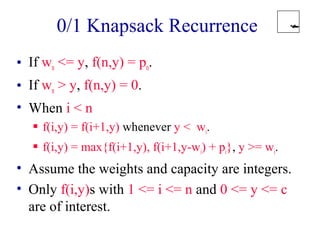
0/1 Knapsack Recurrence 
• If wn <= y, f(n,y) = pn. 
• If wn > y, f(n,y) = 0. 
• When i < n 
 f(i,y) = f(i+1,y) whenever y < wi. 
 f(i,y) = max{f(i+1,y), f(i+1,y-wi) + pi}, y >= wi. 
• Assume the weights and capacity are integers. 
• Only f(i,y)s with 1 <= i <= n and 0 <= y <= c 
are of interest.
Iterative Solution Example 
• n = 5, c = 8, w = [4,3,5,6,2], p = [9,7,10,9,3] 
f[i][y] 0 1 2 3 4 5 6 7 8 
y 
5 
4 
3 
2 
1 
i
Compute f[5][*] 
• n = 5, c = 8, w = [4,3,5,6,2], p = [9,7,10,9,3] 
f[i][y] 0 1 2 3 4 5 6 7 8 
y 
5 
4 
3 
2 
1 
i 
0 0 3 3 3 3 3 3 3
Compute f[4][*] 
• n = 5, c = 8, w = [4,3,5,6,2], p = [9,8,10,9,3] 
f[i][y] 0 1 2 3 4 5 6 7 8 
y 
5 
4 
3 
2 
1 
i 
0 0 3 3 3 3 3 3 3 
0 0 3 3 3 3 9 9 12 
f(i,y) = max{f(i+1,y), f(i+1,y-wi) + pi}, y >= wi
Compute f[3][*] 
• n = 5, c = 8, w = [4,3,5,6,2], p = [9,8,10,9,3] 
f[i][y] 0 1 2 3 4 5 6 7 8 
y 
5 
4 
3 
2 
1 
i 
0 0 3 3 3 3 3 3 3 
0 0 3 3 3 3 9 9 12 
0 0 3 3 3 10 10 13 13 
f(i,y) = max{f(i+1,y), f(i+1,y-wi) + pi}, y >= wi
Compute f[2][*] 
• n = 5, c = 8, w = [4,3,5,6,2], p = [9,8,10,9,3] 
f[i][y] 0 1 2 3 4 5 6 7 8 
y 
5 
4 
3 
2 
1 
i 
0 0 3 3 3 3 3 3 3 
0 0 3 3 3 3 9 9 12 
0 0 3 3 3 10 10 13 13 
0 0 3 8 8 11 11 13 18 
f(i,y) = max{f(i+1,y), f(i+1,y-wi) + pi}, y >= wi
Compute f[1][c] 
• n = 5, c = 8, w = [4,3,5,6,2], p = [9,8,10,9,3] 
f[i][y] 0 1 2 3 4 5 6 7 8 
y 
5 
4 
3 
2 
1 
i 
0 0 3 3 3 3 3 3 3 
0 0 3 3 3 3 9 9 12 
0 0 3 3 3 10 10 13 13 
0 0 3 8 8 11 11 13 18 
18 
f(i,y) = max{f(i+1,y), f(i+1,y-wi) + pi}, y >= wi
Traceback 
• n = 5, c = 8, w = [4,3,5,6,2], p = [9,8,10,9,3] 
f[i][y] 0 1 2 3 4 5 6 7 8 
y 
5 
4 
3 
2 
1 
i 
0 0 3 3 3 3 3 3 3 
0 0 3 3 3 3 9 9 12 
0 0 3 3 3 10 10 13 13 
0 0 3 8 8 11 11 13 18 
18 
f[1][8] = f[2][8] => x1 = 0
Traceback 
• n = 5, c = 8, w = [4,3,5,6,2], p = [9,8,10,9,3] 
f[i][y] 0 1 2 3 4 5 6 7 8 
y 
5 
4 
3 
2 
1 
i 
0 0 3 3 3 3 3 3 3 
0 0 3 3 3 3 9 9 12 
0 0 3 3 3 10 
10 13 13 
0 0 3 8 8 11 11 13 18 
18 
f[2][8] != f[3][8] => x2 = 1
Traceback 
• n = 5, c = 8, w = [4,3,5,6,2], p = [9,8,10,9,3] 
f[i][y] 0 1 2 3 4 5 6 7 8 
y 
5 
4 
3 
2 
1 
i 
0 0 3 3 3 3 3 3 3 
0 
0 3 3 3 3 9 9 12 
0 0 3 3 3 10 10 13 13 
0 0 3 8 8 11 11 13 18 
18 
f[3][5] != f[4][5] => x3 = 1
Traceback 
• n = 5, c = 8, w = [4,3,5,6,2], p = [9,8,10,9,3] 
f[i][y] 0 1 2 3 4 5 6 7 8 
y 
5 
4 
3 
2 
1 
i 
0 3 3 3 3 3 3 3 
0 
0 0 3 3 3 3 9 9 12 
0 0 3 3 3 10 10 13 13 
0 0 3 8 8 11 11 13 18 
18 
f[4][0] = f[5][0] => x4 = 0
Traceback 
• n = 5, c = 8, w = [4,3,5,6,2], p = [9,8,10,9,3] 
f[i][y] 0 1 2 3 4 5 6 7 8 
y 
5 
4 
3 
2 
1 
i 
0 0 3 3 3 3 3 3 3 
0 0 3 3 3 3 9 9 12 
0 0 3 3 3 10 10 13 13 
0 0 3 8 8 11 11 13 18 
18 
f[5][0] = 0 => x5 = 0
Complexity Of Traceback 
• O(n)
Matrix Multiplication Chains 
• Multiply an m x n matrix A and an n x p matrix 
B to get an m x p matrix C. 
n 
C(i,j) = A(i,k) * B(k,j) 
k = 1 
• We shall use the number of multiplications as 
our complexity measure. 
• n multiplications are needed to compute one 
C(i,j). 
• mnp multiplicatons are needed to compute all 
mp terms of C.
Matrix Multiplication Chains 
• Suppose that we are to compute the product X*Y*Z of 
three matrices X, Y and Z. 
• The matrix dimensions are: 
 X:(100 x 1), Y:(1 x 100), Z:(100 x 1) 
• Multiply X and Y to get a 100 x 100 matrix T. 
 100 * 1 * 100 = 10,000 multiplications. 
• Multiply T and Z to get the 100 x 1 answer. 
 100 * 100 * 1 = 10,000 multiplications. 
• Total cost is 20,000 multiplications. 
• 10,000 units of space are needed for T.
Matrix Multiplication Chains 
• The matrix dimensions are: 
 X:(100 x 1) 
 Y:(1 x 100) 
 Z:(100 x 1) 
• Multiply Y and Z to get a 1 x 1 matrix T. 
 1 * 100 * 1 = 100 multiplications. 
• Multiply X and T to get the 100 x 1 answer. 
 100 * 1 * 1 = 100 multiplications. 
• Total cost is 200 multiplications. 
• 1 unit of space is needed for T.
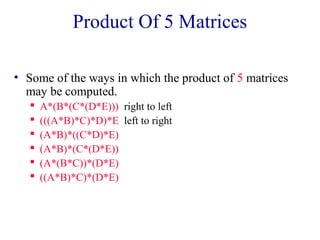
Product Of 5 Matrices 
• Some of the ways in which the product of 5 matrices 
may be computed. 
 A*(B*(C*(D*E))) right to left 
 (((A*B)*C)*D)*E left to right 
 (A*B)*((C*D)*E) 
 (A*B)*(C*(D*E)) 
 (A*(B*C))*(D*E) 
 ((A*B)*C)*(D*E)
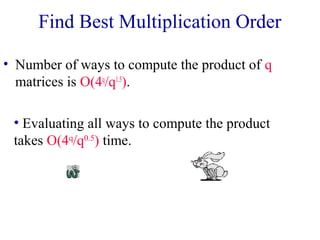
Find Best Multiplication Order 
• Number of ways to compute the product of q 
matrices is O(4q/q1.5). 
• Evaluating all ways to compute the product 
takes O(4q/q0.5) time.
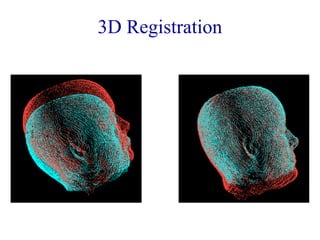
An Application 
• Registration of pre- and post-operative 3D brain 
MRI images to determine volume of removed 
tumor.
3D Registration
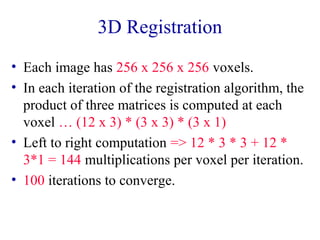
3D Registration 
• Each image has 256 x 256 x 256 voxels. 
• In each iteration of the registration algorithm, the 
product of three matrices is computed at each 
voxel … (12 x 3) * (3 x 3) * (3 x 1) 
• Left to right computation => 12 * 3 * 3 + 12 * 
3*1 = 144 multiplications per voxel per iteration. 
• 100 iterations to converge.
3D Registration 
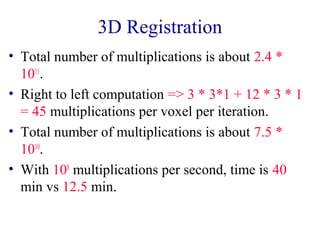
• Total number of multiplications is about 2.4 * 
1011. 
• Right to left computation => 3 * 3*1 + 12 * 3 * 1 
= 45 multiplications per voxel per iteration. 
• Total number of multiplications is about 7.5 * 
1010. 
• With 108 multiplications per second, time is 40 
min vs 12.5 min.

Lec38

  • 1.
    Dynamic Programming •Steps. View the problem solution as the result of a sequence of decisions. Obtain a formulation for the problem state. Verify that the principle of optimality holds. Set up the dynamic programming recurrence equations. Solve these equations for the value of the optimal solution.  Perform a traceback to determine the optimal solution.
  • 2.
    Dynamic Programming •When solving the dynamic programming recurrence recursively, be sure to avoid the recomputation of the optimal value for the same problem state. • To minimize run time overheads, and hence to reduce actual run time, dynamic programming recurrences are almost always solved iteratively (no recursion).
  • 3.
    0/1 Knapsack Recurrence • If wn <= y, f(n,y) = pn. • If wn > y, f(n,y) = 0. • When i < n  f(i,y) = f(i+1,y) whenever y < wi.  f(i,y) = max{f(i+1,y), f(i+1,y-wi) + pi}, y >= wi. • Assume the weights and capacity are integers. • Only f(i,y)s with 1 <= i <= n and 0 <= y <= c are of interest.
  • 4.
    Iterative Solution Example • n = 5, c = 8, w = [4,3,5,6,2], p = [9,7,10,9,3] f[i][y] 0 1 2 3 4 5 6 7 8 y 5 4 3 2 1 i
  • 5.
    Compute f[5][*] •n = 5, c = 8, w = [4,3,5,6,2], p = [9,7,10,9,3] f[i][y] 0 1 2 3 4 5 6 7 8 y 5 4 3 2 1 i 0 0 3 3 3 3 3 3 3
  • 6.
    Compute f[4][*] •n = 5, c = 8, w = [4,3,5,6,2], p = [9,8,10,9,3] f[i][y] 0 1 2 3 4 5 6 7 8 y 5 4 3 2 1 i 0 0 3 3 3 3 3 3 3 0 0 3 3 3 3 9 9 12 f(i,y) = max{f(i+1,y), f(i+1,y-wi) + pi}, y >= wi
  • 7.
    Compute f[3][*] •n = 5, c = 8, w = [4,3,5,6,2], p = [9,8,10,9,3] f[i][y] 0 1 2 3 4 5 6 7 8 y 5 4 3 2 1 i 0 0 3 3 3 3 3 3 3 0 0 3 3 3 3 9 9 12 0 0 3 3 3 10 10 13 13 f(i,y) = max{f(i+1,y), f(i+1,y-wi) + pi}, y >= wi
  • 8.
    Compute f[2][*] •n = 5, c = 8, w = [4,3,5,6,2], p = [9,8,10,9,3] f[i][y] 0 1 2 3 4 5 6 7 8 y 5 4 3 2 1 i 0 0 3 3 3 3 3 3 3 0 0 3 3 3 3 9 9 12 0 0 3 3 3 10 10 13 13 0 0 3 8 8 11 11 13 18 f(i,y) = max{f(i+1,y), f(i+1,y-wi) + pi}, y >= wi
  • 9.
    Compute f[1][c] •n = 5, c = 8, w = [4,3,5,6,2], p = [9,8,10,9,3] f[i][y] 0 1 2 3 4 5 6 7 8 y 5 4 3 2 1 i 0 0 3 3 3 3 3 3 3 0 0 3 3 3 3 9 9 12 0 0 3 3 3 10 10 13 13 0 0 3 8 8 11 11 13 18 18 f(i,y) = max{f(i+1,y), f(i+1,y-wi) + pi}, y >= wi
  • 10.
    Traceback • n= 5, c = 8, w = [4,3,5,6,2], p = [9,8,10,9,3] f[i][y] 0 1 2 3 4 5 6 7 8 y 5 4 3 2 1 i 0 0 3 3 3 3 3 3 3 0 0 3 3 3 3 9 9 12 0 0 3 3 3 10 10 13 13 0 0 3 8 8 11 11 13 18 18 f[1][8] = f[2][8] => x1 = 0
  • 11.
    Traceback • n= 5, c = 8, w = [4,3,5,6,2], p = [9,8,10,9,3] f[i][y] 0 1 2 3 4 5 6 7 8 y 5 4 3 2 1 i 0 0 3 3 3 3 3 3 3 0 0 3 3 3 3 9 9 12 0 0 3 3 3 10 10 13 13 0 0 3 8 8 11 11 13 18 18 f[2][8] != f[3][8] => x2 = 1
  • 12.
    Traceback • n= 5, c = 8, w = [4,3,5,6,2], p = [9,8,10,9,3] f[i][y] 0 1 2 3 4 5 6 7 8 y 5 4 3 2 1 i 0 0 3 3 3 3 3 3 3 0 0 3 3 3 3 9 9 12 0 0 3 3 3 10 10 13 13 0 0 3 8 8 11 11 13 18 18 f[3][5] != f[4][5] => x3 = 1
  • 13.
    Traceback • n= 5, c = 8, w = [4,3,5,6,2], p = [9,8,10,9,3] f[i][y] 0 1 2 3 4 5 6 7 8 y 5 4 3 2 1 i 0 3 3 3 3 3 3 3 0 0 0 3 3 3 3 9 9 12 0 0 3 3 3 10 10 13 13 0 0 3 8 8 11 11 13 18 18 f[4][0] = f[5][0] => x4 = 0
  • 14.
    Traceback • n= 5, c = 8, w = [4,3,5,6,2], p = [9,8,10,9,3] f[i][y] 0 1 2 3 4 5 6 7 8 y 5 4 3 2 1 i 0 0 3 3 3 3 3 3 3 0 0 3 3 3 3 9 9 12 0 0 3 3 3 10 10 13 13 0 0 3 8 8 11 11 13 18 18 f[5][0] = 0 => x5 = 0
  • 15.
  • 16.
    Matrix Multiplication Chains • Multiply an m x n matrix A and an n x p matrix B to get an m x p matrix C. n C(i,j) = A(i,k) * B(k,j) k = 1 • We shall use the number of multiplications as our complexity measure. • n multiplications are needed to compute one C(i,j). • mnp multiplicatons are needed to compute all mp terms of C.
  • 17.
    Matrix Multiplication Chains • Suppose that we are to compute the product X*Y*Z of three matrices X, Y and Z. • The matrix dimensions are:  X:(100 x 1), Y:(1 x 100), Z:(100 x 1) • Multiply X and Y to get a 100 x 100 matrix T.  100 * 1 * 100 = 10,000 multiplications. • Multiply T and Z to get the 100 x 1 answer.  100 * 100 * 1 = 10,000 multiplications. • Total cost is 20,000 multiplications. • 10,000 units of space are needed for T.
  • 18.
    Matrix Multiplication Chains • The matrix dimensions are:  X:(100 x 1)  Y:(1 x 100)  Z:(100 x 1) • Multiply Y and Z to get a 1 x 1 matrix T.  1 * 100 * 1 = 100 multiplications. • Multiply X and T to get the 100 x 1 answer.  100 * 1 * 1 = 100 multiplications. • Total cost is 200 multiplications. • 1 unit of space is needed for T.
  • 19.
    Product Of 5Matrices • Some of the ways in which the product of 5 matrices may be computed.  A*(B*(C*(D*E))) right to left  (((A*B)*C)*D)*E left to right  (A*B)*((C*D)*E)  (A*B)*(C*(D*E))  (A*(B*C))*(D*E)  ((A*B)*C)*(D*E)
  • 20.
    Find Best MultiplicationOrder • Number of ways to compute the product of q matrices is O(4q/q1.5). • Evaluating all ways to compute the product takes O(4q/q0.5) time.
  • 21.
    An Application •Registration of pre- and post-operative 3D brain MRI images to determine volume of removed tumor.
  • 22.
  • 23.
    3D Registration •Each image has 256 x 256 x 256 voxels. • In each iteration of the registration algorithm, the product of three matrices is computed at each voxel … (12 x 3) * (3 x 3) * (3 x 1) • Left to right computation => 12 * 3 * 3 + 12 * 3*1 = 144 multiplications per voxel per iteration. • 100 iterations to converge.
  • 24.
    3D Registration •Total number of multiplications is about 2.4 * 1011. • Right to left computation => 3 * 3*1 + 12 * 3 * 1 = 45 multiplications per voxel per iteration. • Total number of multiplications is about 7.5 * 1010. • With 108 multiplications per second, time is 40 min vs 12.5 min.

Editor's Notes

  • #5 Note: no recomputation recursive version computes f(1,c) and some (maybe even all) f(i,y), i &amp;gt; 1, 0 &amp;lt;= y &amp;lt;= c. Iterative version computes f(1,c) and all f(i,y), i &amp;gt; 1, 0 &amp;lt;= y &amp;lt;= c.