BRAKING SYSTEM
NAME: SYED ASHRAF ALI SHAH
RIZVI
BRAKES:
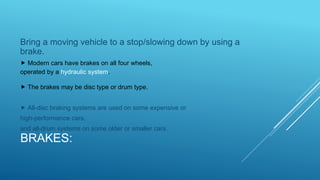
Bring a moving vehicle to a stop/slowing down by using a
brake.
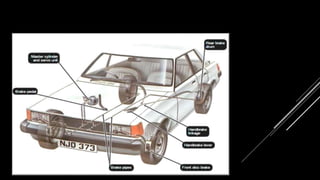
 Modern cars have brakes on all four wheels,
operated by a hydraulic system.
 The brakes may be disc type or drum type.
 All-disc braking systems are used on some expensive or
high-performance cars,
and all-drum systems on some older or smaller cars.
DUAL CIRCUIT BRAKING SYSTEM
BRAKE HYDRAULICS
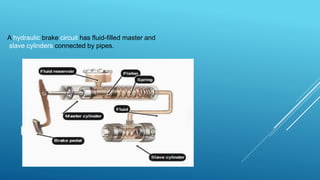
A hydraulic brake circuit has fluid-filled master and
slave cylinders connected by pipes.
 When you push the brake pedal it depresses a piston in the master cylinder,
forcing fluid along the pipe.
 The fluid travels to slave cylinders at each wheel and fills them,
forcing pistons out to apply the brakes.
 Fluid pressure distributes itself evenly around the system.
 The combined surface 'pushing' area of all the slave pistons is
much greater than that of the piston in the master cylinder.
 Consequently, the master piston has to travel several inches to move the slave
pistons the fraction of an inch it takes to apply the brakes.
This arrangement allows great force to be exerted by the brakes, in the same
way that a long-handled lever can easily lift a heavy object a short distance.
Most modern cars are fitted with twin hydraulic circuits, with two master
cylinders, in case one should fail.
Sometimes one circuit works the front brakes and one the rear brakes; or each
circuit works both front brakes and one of the rear brakes; or one circuit works
all four brakes and the other the front ones only.
Under heavy braking, so much weight may come off the rear wheels that they
lock, possibly causing a dangerous skid.
For this reason, the rear brakes are deliberately made less powerful than the
front.
Most cars now also have a load-sensitive pressure-limiting valve. It closes when
heavy braking raises hydraulic pressure to a level that might cause the rear
brakes to lock, and prevents any further movement of fluid to them.
Advanced cars may even have complex anti-lock systems that sense in various
ways how the car is decelerating and whether any wheels are locking.
Such systems apply and release the brakes in rapid succession to stop them
locking.
DISC
BRAKES
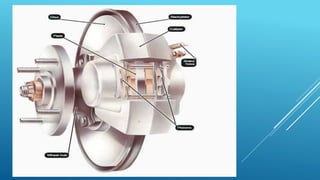
 A disc brake has a disc that turns with the wheel. The disc is straddled(placed) by
a caliper, in which there are small hydraulic pistons worked by pressure from the master
cylinder.
 The pistons press on friction pads that clamp against the disc from each side to slow or
stop it, the pads are shaped to cover a broad sector of the disc.
 There may be more than a single pair of pistons, especially in dual-circuit brakes.
 The pistons move only a tiny distance to apply the brakes,
and the pads barely clear the disc when the brakes are released. They have no return
springs.
 Rubber sealing rings round the pistons are designed to let the pistons slip forward
gradually as the pads wear down, so that the tiny gap remains constant and the brakes
do not need adjustment.
DRUM
BRAKES
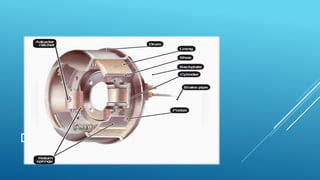
 A drum brake has a hollow drum that turns with the wheel. Its open back is
covered by a stationary back plate on which there are two curved shoes
carrying friction linings.
 The shoes are forced outwards by hydraulic pressure moving pistons in the
brake's wheel cylinder, so pressing the linings against the inside of the
drum to slow or stop it.
 Each brake shoe has a pivot at one end and a piston at the other. A leading
shoe has the piston at the leading edge relative to the direction in which the
drum turns.
 The rotation of the drum tends to pull the leading shoe firmly against it when it makes
contact, improving the braking effect.
 Some drums have twin leading shoes, each with its own hydraulic cylinder; others have
one leading and one trailing shoe - with the pivot at the front.
 This design allows the two shoes to be forced apart from each other by a single cylinder
with a piston in each end.
 It is simpler but less powerful than the two-leading-shoe system, and is usually restricted to
rear brakes.
 In either type, return springs pull the shoes back a short way when the brakes are
released.
 Shoe travel is kept as short as possible by an adjuster. Older systems have manual
adjusters that need to be turned from time to time as the friction linings wear. Later brakes
have automatic adjustment by means of a ratchet.
 Drum brakes may fade if they are applied repeatedly within a short time - they heat up and
lose their efficiency until they cool down again. Discs, with their more open construction,
are much less prone to fading.
DRUM BRAKE FIGURE
THE
HANDBRAKE
Apart from the hydraulic braking system, all cars have a
mechanical handbrake acting on two wheels - usually the
rear ones.
The handbrake gives limited braking if the hydraulic
system fails completely, but its main purpose is as
a parking brake.
The handbrake lever pulls a cable or pair of cables linked
to the brakes by a set of smaller levers, pulleys and
guides whose details vary greatly from car to car.
A ratchet on the handbrake lever keeps the brake on
once it is applied. A push button disengages the ratchet
and frees the lever.
On drum brakes, the handbrake system presses the
brake linings against the drums.
Disc brakes sometimes have a comparable handbrake
arrangement, but because it is difficult to place
the linkage on a compact caliper, there may be a
completely separate set of handbrake pads for each
disc.

Presentation on Braking system

  • 1.
    BRAKING SYSTEM NAME: SYEDASHRAF ALI SHAH RIZVI
  • 2.
    BRAKES: Bring a movingvehicle to a stop/slowing down by using a brake.  Modern cars have brakes on all four wheels, operated by a hydraulic system.  The brakes may be disc type or drum type.  All-disc braking systems are used on some expensive or high-performance cars, and all-drum systems on some older or smaller cars.
  • 3.
  • 4.
    BRAKE HYDRAULICS A hydraulicbrake circuit has fluid-filled master and slave cylinders connected by pipes.
  • 5.
     When youpush the brake pedal it depresses a piston in the master cylinder, forcing fluid along the pipe.  The fluid travels to slave cylinders at each wheel and fills them, forcing pistons out to apply the brakes.  Fluid pressure distributes itself evenly around the system.  The combined surface 'pushing' area of all the slave pistons is much greater than that of the piston in the master cylinder.  Consequently, the master piston has to travel several inches to move the slave pistons the fraction of an inch it takes to apply the brakes.
  • 6.
    This arrangement allowsgreat force to be exerted by the brakes, in the same way that a long-handled lever can easily lift a heavy object a short distance. Most modern cars are fitted with twin hydraulic circuits, with two master cylinders, in case one should fail. Sometimes one circuit works the front brakes and one the rear brakes; or each circuit works both front brakes and one of the rear brakes; or one circuit works all four brakes and the other the front ones only. Under heavy braking, so much weight may come off the rear wheels that they lock, possibly causing a dangerous skid. For this reason, the rear brakes are deliberately made less powerful than the front. Most cars now also have a load-sensitive pressure-limiting valve. It closes when heavy braking raises hydraulic pressure to a level that might cause the rear brakes to lock, and prevents any further movement of fluid to them. Advanced cars may even have complex anti-lock systems that sense in various ways how the car is decelerating and whether any wheels are locking. Such systems apply and release the brakes in rapid succession to stop them locking.
  • 7.
    DISC BRAKES  A discbrake has a disc that turns with the wheel. The disc is straddled(placed) by a caliper, in which there are small hydraulic pistons worked by pressure from the master cylinder.  The pistons press on friction pads that clamp against the disc from each side to slow or stop it, the pads are shaped to cover a broad sector of the disc.  There may be more than a single pair of pistons, especially in dual-circuit brakes.  The pistons move only a tiny distance to apply the brakes, and the pads barely clear the disc when the brakes are released. They have no return springs.  Rubber sealing rings round the pistons are designed to let the pistons slip forward gradually as the pads wear down, so that the tiny gap remains constant and the brakes do not need adjustment.
  • 9.
    DRUM BRAKES  A drumbrake has a hollow drum that turns with the wheel. Its open back is covered by a stationary back plate on which there are two curved shoes carrying friction linings.  The shoes are forced outwards by hydraulic pressure moving pistons in the brake's wheel cylinder, so pressing the linings against the inside of the drum to slow or stop it.  Each brake shoe has a pivot at one end and a piston at the other. A leading shoe has the piston at the leading edge relative to the direction in which the drum turns.
  • 10.
     The rotationof the drum tends to pull the leading shoe firmly against it when it makes contact, improving the braking effect.  Some drums have twin leading shoes, each with its own hydraulic cylinder; others have one leading and one trailing shoe - with the pivot at the front.  This design allows the two shoes to be forced apart from each other by a single cylinder with a piston in each end.  It is simpler but less powerful than the two-leading-shoe system, and is usually restricted to rear brakes.  In either type, return springs pull the shoes back a short way when the brakes are released.  Shoe travel is kept as short as possible by an adjuster. Older systems have manual adjusters that need to be turned from time to time as the friction linings wear. Later brakes have automatic adjustment by means of a ratchet.  Drum brakes may fade if they are applied repeatedly within a short time - they heat up and lose their efficiency until they cool down again. Discs, with their more open construction, are much less prone to fading.
  • 11.
  • 12.
    THE HANDBRAKE Apart from thehydraulic braking system, all cars have a mechanical handbrake acting on two wheels - usually the rear ones. The handbrake gives limited braking if the hydraulic system fails completely, but its main purpose is as a parking brake. The handbrake lever pulls a cable or pair of cables linked to the brakes by a set of smaller levers, pulleys and guides whose details vary greatly from car to car.
  • 13.
    A ratchet onthe handbrake lever keeps the brake on once it is applied. A push button disengages the ratchet and frees the lever. On drum brakes, the handbrake system presses the brake linings against the drums. Disc brakes sometimes have a comparable handbrake arrangement, but because it is difficult to place the linkage on a compact caliper, there may be a completely separate set of handbrake pads for each disc.