NON-LINEAR APPROXIMATION OF
BAYESIAN UPDATE
Alexander Litvinenko1, Hermann G. Matthies2, Elmar Zander2
Center for Uncertainty
Quantification
ntification Logo Lock-up
http://sri-uq.kaust.edu.sa/
1Extreme Computing Research Center, KAUST,
2Institute of Scientific Computing, TU Braunschweig, Brunswick, Germany
4*
KAUST
Figure : KAUST campus, 7 years old, approx. 7000 people (include
1700 kids), 100 nations, 36 km2
.
Center for Uncertainty
Quantification
ation Logo Lock-up
2 / 31
4*
Stochastic Numerics Group at KAUST
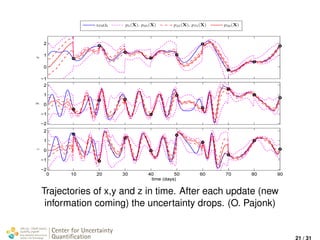
Center for Uncertainty
Quantification
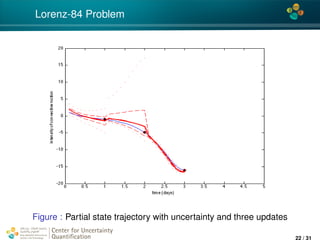
ation Logo Lock-up
3 / 31
Center for Uncertainty
Quantification
ation Logo Lock-up
4 / 31
4*
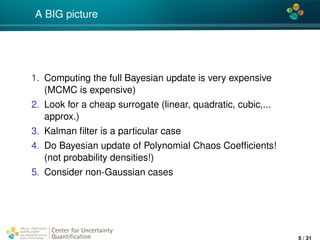
A BIG picture
1. Computing the full Bayesian update is very expensive
(MCMC is expensive)
2. Look for a cheap surrogate (linear, quadratic, cubic,...
approx.)
3. Kalman filter is a particular case
4. Do Bayesian update of Polynomial Chaos Coefficients!
(not probability densities!)
5. Consider non-Gaussian cases
Center for Uncertainty
Quantification
ation Logo Lock-up
5 / 31
4*
History
1. O. Pajonk, B. V. Rosic, A. Litvinenko, and H. G. Matthies, A
Deterministic Filter for Non-Gaussian Bayesian Estimation,
Physica D: Nonlinear Phenomena, Vol. 241(7), pp. 775-788,
2012.
2. B. V. Rosic, A. Litvinenko, O. Pajonk and H. G. Matthies,
Sampling Free Linear Bayesian Update of Polynomial Chaos
Representations, J. of Comput. Physics, Vol. 231(17), 2012 , pp
5761-5787
3. A. Litvinenko and H. G. Matthies, Inverse problems and
uncertainty quantification
http://arxiv.org/abs/1312.5048, 2013
4. H. G. Matthies, E. Zander, B.V. Rosic, A. Litvinenko, Parameter
estimation via conditional expectation - A Bayesian Inversion,
accepted to AMOS-D-16-00015, 2016.
5. H. G. Matthies, E. Zander, B.V. Rosic, A. Litvinenko, Bayesian
parameter estimation via filtering and functional approximation,
Tehnicki vjesnik 23, 1(2016), 1-17.Center for Uncertainty
Quantification
ation Logo Lock-up
6 / 31
4*
Setting for the identification process
General idea:
We observe / measure a system, whose structure we know in
principle.
The system behaviour depends on some quantities
(parameters),
which we do not know ⇒ uncertainty.
We model (uncertainty in) our knowledge in a Bayesian setting:
as a probability distribution on the parameters.
We start with what we know a priori, then perform a
measurement.
This gives new information, to update our knowledge
(identification).
Update in probabilistic setting works with conditional
probabilities
⇒ Bayes’s theorem.
Repeated measurements lead to better identification.
Center for Uncertainty
Quantification
ation Logo Lock-up
7 / 31
4*
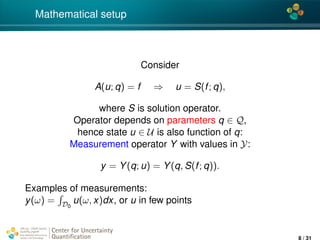
Mathematical setup
Consider
A(u; q) = f ⇒ u = S(f; q),
where S is solution operator.
Operator depends on parameters q ∈ Q,
hence state u ∈ U is also function of q:
Measurement operator Y with values in Y:
y = Y(q; u) = Y(q, S(f; q)).
Examples of measurements:
y(ω) = D0
u(ω, x)dx, or u in few points
Center for Uncertainty
Quantification
ation Logo Lock-up
8 / 31
4*
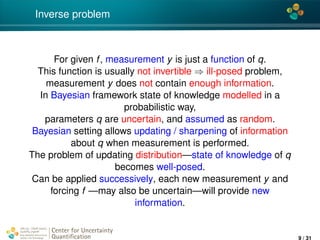
Inverse problem
For given f, measurement y is just a function of q.
This function is usually not invertible ⇒ ill-posed problem,
measurement y does not contain enough information.
In Bayesian framework state of knowledge modelled in a
probabilistic way,
parameters q are uncertain, and assumed as random.
Bayesian setting allows updating / sharpening of information
about q when measurement is performed.
The problem of updating distribution—state of knowledge of q
becomes well-posed.
Can be applied successively, each new measurement y and
forcing f —may also be uncertain—will provide new
information.
Center for Uncertainty
Quantification
ation Logo Lock-up
9 / 31
4*
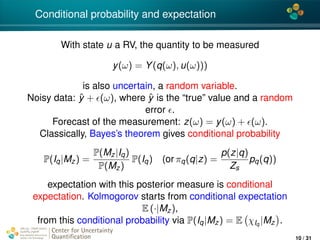
Conditional probability and expectation
With state u a RV, the quantity to be measured
y(ω) = Y(q(ω), u(ω)))
is also uncertain, a random variable.
Noisy data: ˆy + (ω), where ˆy is the “true” value and a random
error .
Forecast of the measurement: z(ω) = y(ω) + (ω).
Classically, Bayes’s theorem gives conditional probability
P(Iq|Mz) =
P(Mz|Iq)
P(Mz)
P(Iq) (or πq(q|z) =
p(z|q)
Zs
pq(q))
expectation with this posterior measure is conditional
expectation. Kolmogorov starts from conditional expectation
E (·|Mz),
from this conditional probability via P(Iq|Mz) = E χIq
|Mz .
Center for Uncertainty
Quantification
ation Logo Lock-up
10 / 31
4*
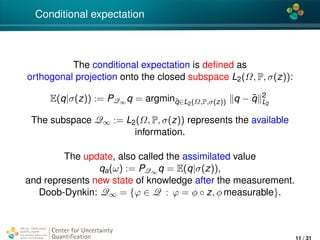
Conditional expectation
The conditional expectation is defined as
orthogonal projection onto the closed subspace L2(Ω, P, σ(z)):
E(q|σ(z)) := PQ∞ q = argmin˜q∈L2(Ω,P,σ(z)) q − ˜q 2
L2
The subspace Q∞ := L2(Ω, P, σ(z)) represents the available
information.
The update, also called the assimilated value
qa(ω) := PQ∞ q = E(q|σ(z)),
and represents new state of knowledge after the measurement.
Doob-Dynkin: Q∞ = {ϕ ∈ Q : ϕ = φ ◦ z, φ measurable}.
Center for Uncertainty
Quantification
ation Logo Lock-up
11 / 31
4*
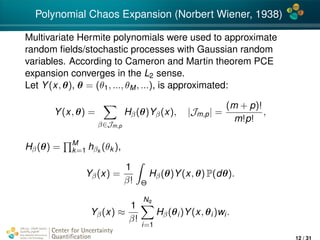
Polynomial Chaos Expansion (Norbert Wiener, 1938)
Multivariate Hermite polynomials were used to approximate
random fields/stochastic processes with Gaussian random
variables. According to Cameron and Martin theorem PCE
expansion converges in the L2 sense.
Let Y(x, θ), θ = (θ1, ..., θM, ...), is approximated:
Y(x, θ) =
β∈Jm,p
Hβ(θ)Yβ(x), |Jm,p| =
(m + p)!
m!p!
,
Hβ(θ) = M
k=1 hβk
(θk ),
Yβ(x) =
1
β! Θ
Hβ(θ)Y(x, θ) P(dθ).
Yβ(x) ≈
1
β!
Nq
i=1
Hβ(θi)Y(x, θi)wi.
Center for Uncertainty
Quantification
ation Logo Lock-up
12 / 31
4*
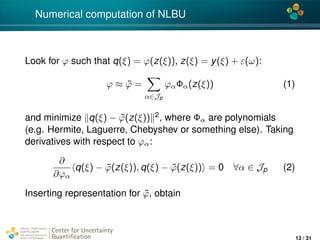
Numerical computation of NLBU
Look for ϕ such that q(ξ) = ϕ(z(ξ)), z(ξ) = y(ξ) + ε(ω):
ϕ ≈ ˜ϕ =
α∈Jp
ϕαΦα(z(ξ)) (1)
and minimize q(ξ) − ˜ϕ(z(ξ)) 2, where Φα are polynomials
(e.g. Hermite, Laguerre, Chebyshev or something else). Taking
derivatives with respect to ϕα:
∂
∂ϕα
q(ξ) − ˜ϕ(z(ξ)), q(ξ) − ˜ϕ(z(ξ)) = 0 ∀α ∈ Jp (2)
Inserting representation for ˜ϕ, obtain
Center for Uncertainty
Quantification
ation Logo Lock-up
13 / 31
4*
Numerical computation of NLBU
∂
∂ϕα
E

q2
(ξ) − 2
β∈J
qϕβΦβ(z) +
β,γ∈J
ϕβϕγΦβ(z)Φγ(z)


= 2E

−qΦα(z) +
β∈J
ϕβΦβ(z)Φα(z)


= 2


β∈J
E [Φβ(z)Φα(z)] ϕβ − E [qΦα(z)]

 = 0 ∀α ∈ J
E [Φβ(z)Φα(z)] ϕβ = E [qΦα(z)]
Center for Uncertainty
Quantification
ation Logo Lock-up
14 / 31
4*
Numerical computation of NLBU
Now, rewriting the last sum in a matrix form, obtain the linear
system of equations (=: A) to compute coefficients ϕβ:



... ... ...
... E [Φα(z(ξ))Φβ(z(ξ))]
...
... ... ...







...
ϕβ
...



 =




...
E [q(ξ)Φα(z(ξ))]
...



 ,
where α, β ∈ J , A is of size |J | × |J |.
Center for Uncertainty
Quantification
ation Logo Lock-up
15 / 31
4*
Numerical computation of NLBU
Using the same quadrature rule of order q for each element of
A, we can write
A = E ΦJα (z(ξ))ΦJβ
(z(ξ))T
≈
NA
i=1
wA
i ΦJα (zi)ΦJβ
(zi)T
, (3)
where (wA
i , ξi) are weights and quadrature points, zi := z(ξi)
and ΦJα (zi) := (...Φα(z(ξi))....)T is a vector of length |Jα|.
b = E [q(ξ)ΦJα (z(ξ))] ≈
Nb
i=1
wb
i q(ξi)ΦJα (zi), (4)
where ΦJα (z(ξi)) := (..., Φα(z(ξi)), ...), α ∈ Jα.
Center for Uncertainty
Quantification
ation Logo Lock-up
16 / 31
4*
Numerical computation of NLBU
We can write the Eq. 15 with the right-hand side in Eq. 4 in the
compact form:
[ΦA] [diag(...wA
i ...)] [ΦA]T




...
ϕβ
...



 = [Φb]


wb
0 q(ξ0)
...
wb
Nb q(ξNb )

 (5)
[ΦA] ∈ RJα×NA
, [diag(...wA
i ...)] ∈ RNA×NA
, [Φb] ∈ RJα×Nb
,
[wb
0 q(ξ0)...wb
Nb q(ξNb )] ∈ RNb
.
Solving Eq. 5, obtain vector of coefficients (...ϕβ...)T for all β.
Finally, the assimilated parameter qa will be
qa = qf + ˜ϕ(ˆy) − ˜ϕ(z), (6)
z(ξ) = y(ξ) + ε(ω), ˜ϕ = β∈Jp
ϕβΦβ(z(ξ))
Center for Uncertainty
Quantification
ation Logo Lock-up
17 / 31
4*
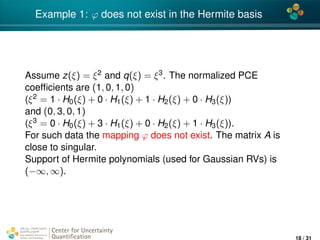
Example 1: ϕ does not exist in the Hermite basis
Assume z(ξ) = ξ2 and q(ξ) = ξ3. The normalized PCE
coefficients are (1, 0, 1, 0)
(ξ2 = 1 · H0(ξ) + 0 · H1(ξ) + 1 · H2(ξ) + 0 · H3(ξ))
and (0, 3, 0, 1)
(ξ3 = 0 · H0(ξ) + 3 · H1(ξ) + 0 · H2(ξ) + 1 · H3(ξ)).
For such data the mapping ϕ does not exist. The matrix A is
close to singular.
Support of Hermite polynomials (used for Gaussian RVs) is
(−∞, ∞).
Center for Uncertainty
Quantification
ation Logo Lock-up
18 / 31
4*
Example 2: ϕ does exist in the Laguerre basis
Assume z(ξ) = ξ2 and q(ξ) = ξ3.
The normalized gPCE coefficients are (2, −4, 2, 0) and
(6, −18, 18, −6).
For such data the mapping mapping ϕ of order 8 and higher
produces a very accurate result.
Support of Laguerre polynomials (used for Gamma RVs) is
[0, ∞).
Center for Uncertainty
Quantification
ation Logo Lock-up
19 / 31
4*
Lorenz 1963
Is a system of ODEs. Has chaotic solutions for certain
parameter values and initial conditions.
˙x = σ(ω)(y − x)
˙y = x(ρ(ω) − z) − y
˙z = xy − β(ω)z
Initial state q0(ω) = (x0(ω), y0(ω), z0(ω)) are uncertain.
Solving in t0, t1, ..., t10, Noisy Measur. → UPDATE, solving in
t11, t12, ..., t20, Noisy Measur. → UPDATE,...
Center for Uncertainty
Quantification
ation Logo Lock-up
20 / 31
Trajectories of x,y and z in time. After each update (new
information coming) the uncertainty drops. (O. Pajonk)
Center for Uncertainty
Quantification
ation Logo Lock-up
21 / 31
4*
Lorenz-84 Problem
Figure : Partial state trajectory with uncertainty and three updates
Center for Uncertainty
Quantification
ation Logo Lock-up
22 / 31
4*
Lorenz-84 Problem
10 0 10
0
0.1
0.2
0.3
0.4
0.5
0.6
0.7
0.8
x
20 0 20
0
0.05
0.1
0.15
0.2
0.25
0.3
0.35
0.4
0.45
y
0 10 20
0
0.1
0.2
0.3
0.4
0.5
0.6
0.7
0.8
0.9
1
z
xf
x
a
yf
y
a
zf
z
a
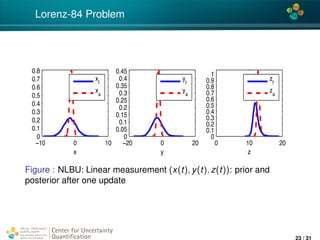
Figure : NLBU: Linear measurement (x(t), y(t), z(t)): prior and
posterior after one update
Center for Uncertainty
Quantification
ation Logo Lock-up
23 / 31
4*
Lorenz-84 Problem
10 5 0
0
0.1
0.2
0.3
0.4
0.5
0.6
0.7
0.8
0.9
x
x1
x2
15 10 5
0
0.05
0.1
0.15
0.2
0.25
0.3
0.35
0.4
0.45
0.5
y
y1
y2
5 10 15
0
0.1
0.2
0.3
0.4
0.5
0.6
z
z1
z2
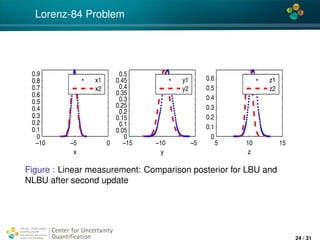
Figure : Linear measurement: Comparison posterior for LBU and
NLBU after second update
Center for Uncertainty
Quantification
ation Logo Lock-up
24 / 31
4*
Lorenz-84 Problem
20 0 20
0
0.02
0.04
0.06
0.08
0.1
0.12
0.14
0.16
x
50 0 50
0
0.01
0.02
0.03
0.04
0.05
0.06
0.07
0.08
0.09
y
0 10 20
0
0.02
0.04
0.06
0.08
0.1
0.12
0.14
0.16
0.18
z
xf
x
a
yf
y
a
zf
z
a
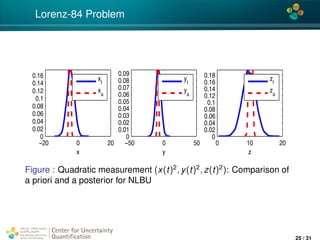
Figure : Quadratic measurement (x(t)2
, y(t)2
, z(t)2
): Comparison of
a priori and a posterior for NLBU
Center for Uncertainty
Quantification
ation Logo Lock-up
25 / 31
4*
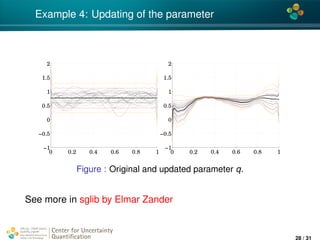
Example 4: 1D elliptic PDE with uncertain coeffs
Taken from Stochastic Galerkin Library (sglib), by Elmar Zander
(TU Braunschweig)
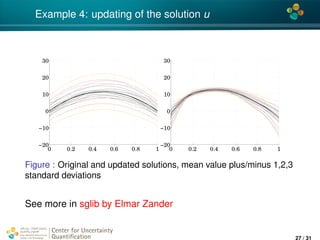
− · (κ(x, ξ) u(x, ξ)) = f(x, ξ), x ∈ [0, 1]
Measurements are taken at x1 = 0.2, and x2 = 0.8. The means
are y(x1) = 10, y(x2) = 5 and the variances are 0.5 and 1.5
correspondingly.
Center for Uncertainty
Quantification
ation Logo Lock-up
26 / 31
4*
Example 4: updating of the solution u
0 0.2 0.4 0.6 0.8 1
−20
−10
0
10
20
30
0 0.2 0.4 0.6 0.8 1
−20
−10
0
10
20
30
Figure : Original and updated solutions, mean value plus/minus 1,2,3
standard deviations
See more in sglib by Elmar Zander
Center for Uncertainty
Quantification
ation Logo Lock-up
27 / 31
4*
Example 4: Updating of the parameter
0 0.2 0.4 0.6 0.8 1
−1
−0.5
0
0.5
1
1.5
2
0 0.2 0.4 0.6 0.8 1
−1
−0.5
0
0.5
1
1.5
2
Figure : Original and updated parameter q.
See more in sglib by Elmar Zander
Center for Uncertainty
Quantification
ation Logo Lock-up
28 / 31
4*
Conclusion about NLBU
+ Step 1. Introduced a way to derive MMSE ϕ (as a linear,
quadratic, cubic etc approximation, i. e. compute
conditional expectation of q, given measurement Y.
Step 2. Apply ϕ to identify parameter q
+ All ingredients can be given as gPC.
+ we apply it to solve inverse problems (ODEs and PDEs).
- Stochastic dimension grows up very fast.
Center for Uncertainty
Quantification
ation Logo Lock-up
29 / 31
4*
Acknowledgment
I used a Matlab toolbox for stochastic Galerkin methods (sglib)
https://github.com/ezander/sglib
Alexander Litvinenko and his research work was supported by
the King Abdullah University of Science and Technology
(KAUST), SRI-UQ and ECRC centers.
Center for Uncertainty
Quantification
ation Logo Lock-up
30 / 31
4*
Literature
1. Bojana Rosic, Jan Sykora, Oliver Pajonk, Anna Kucerova
and Hermann G. Matthies, Comparison of Numerical
Approaches to Bayesian Updating, report on
www.wire.tu-bs.de, 2014
2. A. Litvinenko and H. G. Matthies, Inverse problems and
uncertainty quantification
http://arxiv.org/abs/1312.5048, 2013
3. L. Giraldi, A. Litvinenko, D. Liu, H. G. Matthies, A. Nouy, To
be or not to be intrusive? The solution of parametric and
stochastic equations - the ”plain vanilla” Galerkin case,
http://arxiv.org/abs/1309.1617, 2013
4. O. Pajonk, B. V. Rosic, A. Litvinenko, and H. G. Matthies, A
Deterministic Filter for Non-Gaussian Bayesian Estimation,
Physica D: Nonlinear Phenomena, Vol. 241(7), pp.
775-788, 2012.
5. B. V. Rosic, A. Litvinenko, O. Pajonk and H. G. Matthies,
Sampling Free Linear Bayesian Update of PolynomialCenter for Uncertainty
Quantification
ation Logo Lock-up
31 / 31
4*
Literature
1. PCE of random coefficients and the solution of stochastic partial
differential equations in the Tensor Train format, S. Dolgov, B. N.
Khoromskij, A. Litvinenko, H. G. Matthies, 2015/3/11,
arXiv:1503.03210
2. Efficient analysis of high dimensional data in tensor formats, M.
Espig, W. Hackbusch, A. Litvinenko, H.G. Matthies, E. Zander Sparse
Grids and Applications, 31-56, 40, 2013
3. Application of hierarchical matrices for computing the
Karhunen-Loeve expansion, B.N. Khoromskij, A. Litvinenko, H.G.
Matthies, Computing 84 (1-2), 49-67, 31, 2009
4. Efficient low-rank approximation of the stochastic Galerkin matrix
in tensor formats, M. Espig, W. Hackbusch, A. Litvinenko, H.G.
Matthies, P. Waehnert, Comp. & Math. with Appl. 67 (4), 818-829,
2012
5. Numerical Methods for Uncertainty Quantification and Bayesian
Update in Aerodynamics, A. Litvinenko, H. G. Matthies, Book
”Management and Minimisation of Uncertainties and Errors in
Numerical Aerodynamics” pp 265-282, 2013
Center for Uncertainty
Quantification
ation Logo Lock-up
32 / 31

A nonlinear approximation of the Bayesian Update formula

  • 1.
    NON-LINEAR APPROXIMATION OF BAYESIANUPDATE Alexander Litvinenko1, Hermann G. Matthies2, Elmar Zander2 Center for Uncertainty Quantification ntification Logo Lock-up http://sri-uq.kaust.edu.sa/ 1Extreme Computing Research Center, KAUST, 2Institute of Scientific Computing, TU Braunschweig, Brunswick, Germany
  • 2.
    4* KAUST Figure : KAUSTcampus, 7 years old, approx. 7000 people (include 1700 kids), 100 nations, 36 km2 . Center for Uncertainty Quantification ation Logo Lock-up 2 / 31
  • 3.
    4* Stochastic Numerics Groupat KAUST Center for Uncertainty Quantification ation Logo Lock-up 3 / 31
  • 4.
  • 5.
    4* A BIG picture 1.Computing the full Bayesian update is very expensive (MCMC is expensive) 2. Look for a cheap surrogate (linear, quadratic, cubic,... approx.) 3. Kalman filter is a particular case 4. Do Bayesian update of Polynomial Chaos Coefficients! (not probability densities!) 5. Consider non-Gaussian cases Center for Uncertainty Quantification ation Logo Lock-up 5 / 31
  • 6.
    4* History 1. O. Pajonk,B. V. Rosic, A. Litvinenko, and H. G. Matthies, A Deterministic Filter for Non-Gaussian Bayesian Estimation, Physica D: Nonlinear Phenomena, Vol. 241(7), pp. 775-788, 2012. 2. B. V. Rosic, A. Litvinenko, O. Pajonk and H. G. Matthies, Sampling Free Linear Bayesian Update of Polynomial Chaos Representations, J. of Comput. Physics, Vol. 231(17), 2012 , pp 5761-5787 3. A. Litvinenko and H. G. Matthies, Inverse problems and uncertainty quantification http://arxiv.org/abs/1312.5048, 2013 4. H. G. Matthies, E. Zander, B.V. Rosic, A. Litvinenko, Parameter estimation via conditional expectation - A Bayesian Inversion, accepted to AMOS-D-16-00015, 2016. 5. H. G. Matthies, E. Zander, B.V. Rosic, A. Litvinenko, Bayesian parameter estimation via filtering and functional approximation, Tehnicki vjesnik 23, 1(2016), 1-17.Center for Uncertainty Quantification ation Logo Lock-up 6 / 31
  • 7.
    4* Setting for theidentification process General idea: We observe / measure a system, whose structure we know in principle. The system behaviour depends on some quantities (parameters), which we do not know ⇒ uncertainty. We model (uncertainty in) our knowledge in a Bayesian setting: as a probability distribution on the parameters. We start with what we know a priori, then perform a measurement. This gives new information, to update our knowledge (identification). Update in probabilistic setting works with conditional probabilities ⇒ Bayes’s theorem. Repeated measurements lead to better identification. Center for Uncertainty Quantification ation Logo Lock-up 7 / 31
  • 8.
    4* Mathematical setup Consider A(u; q)= f ⇒ u = S(f; q), where S is solution operator. Operator depends on parameters q ∈ Q, hence state u ∈ U is also function of q: Measurement operator Y with values in Y: y = Y(q; u) = Y(q, S(f; q)). Examples of measurements: y(ω) = D0 u(ω, x)dx, or u in few points Center for Uncertainty Quantification ation Logo Lock-up 8 / 31
  • 9.
    4* Inverse problem For givenf, measurement y is just a function of q. This function is usually not invertible ⇒ ill-posed problem, measurement y does not contain enough information. In Bayesian framework state of knowledge modelled in a probabilistic way, parameters q are uncertain, and assumed as random. Bayesian setting allows updating / sharpening of information about q when measurement is performed. The problem of updating distribution—state of knowledge of q becomes well-posed. Can be applied successively, each new measurement y and forcing f —may also be uncertain—will provide new information. Center for Uncertainty Quantification ation Logo Lock-up 9 / 31
  • 10.
    4* Conditional probability andexpectation With state u a RV, the quantity to be measured y(ω) = Y(q(ω), u(ω))) is also uncertain, a random variable. Noisy data: ˆy + (ω), where ˆy is the “true” value and a random error . Forecast of the measurement: z(ω) = y(ω) + (ω). Classically, Bayes’s theorem gives conditional probability P(Iq|Mz) = P(Mz|Iq) P(Mz) P(Iq) (or πq(q|z) = p(z|q) Zs pq(q)) expectation with this posterior measure is conditional expectation. Kolmogorov starts from conditional expectation E (·|Mz), from this conditional probability via P(Iq|Mz) = E χIq |Mz . Center for Uncertainty Quantification ation Logo Lock-up 10 / 31
  • 11.
    4* Conditional expectation The conditionalexpectation is defined as orthogonal projection onto the closed subspace L2(Ω, P, σ(z)): E(q|σ(z)) := PQ∞ q = argmin˜q∈L2(Ω,P,σ(z)) q − ˜q 2 L2 The subspace Q∞ := L2(Ω, P, σ(z)) represents the available information. The update, also called the assimilated value qa(ω) := PQ∞ q = E(q|σ(z)), and represents new state of knowledge after the measurement. Doob-Dynkin: Q∞ = {ϕ ∈ Q : ϕ = φ ◦ z, φ measurable}. Center for Uncertainty Quantification ation Logo Lock-up 11 / 31
  • 12.
    4* Polynomial Chaos Expansion(Norbert Wiener, 1938) Multivariate Hermite polynomials were used to approximate random fields/stochastic processes with Gaussian random variables. According to Cameron and Martin theorem PCE expansion converges in the L2 sense. Let Y(x, θ), θ = (θ1, ..., θM, ...), is approximated: Y(x, θ) = β∈Jm,p Hβ(θ)Yβ(x), |Jm,p| = (m + p)! m!p! , Hβ(θ) = M k=1 hβk (θk ), Yβ(x) = 1 β! Θ Hβ(θ)Y(x, θ) P(dθ). Yβ(x) ≈ 1 β! Nq i=1 Hβ(θi)Y(x, θi)wi. Center for Uncertainty Quantification ation Logo Lock-up 12 / 31
  • 13.
    4* Numerical computation ofNLBU Look for ϕ such that q(ξ) = ϕ(z(ξ)), z(ξ) = y(ξ) + ε(ω): ϕ ≈ ˜ϕ = α∈Jp ϕαΦα(z(ξ)) (1) and minimize q(ξ) − ˜ϕ(z(ξ)) 2, where Φα are polynomials (e.g. Hermite, Laguerre, Chebyshev or something else). Taking derivatives with respect to ϕα: ∂ ∂ϕα q(ξ) − ˜ϕ(z(ξ)), q(ξ) − ˜ϕ(z(ξ)) = 0 ∀α ∈ Jp (2) Inserting representation for ˜ϕ, obtain Center for Uncertainty Quantification ation Logo Lock-up 13 / 31
  • 14.
    4* Numerical computation ofNLBU ∂ ∂ϕα E  q2 (ξ) − 2 β∈J qϕβΦβ(z) + β,γ∈J ϕβϕγΦβ(z)Φγ(z)   = 2E  −qΦα(z) + β∈J ϕβΦβ(z)Φα(z)   = 2   β∈J E [Φβ(z)Φα(z)] ϕβ − E [qΦα(z)]   = 0 ∀α ∈ J E [Φβ(z)Φα(z)] ϕβ = E [qΦα(z)] Center for Uncertainty Quantification ation Logo Lock-up 14 / 31
  • 15.
    4* Numerical computation ofNLBU Now, rewriting the last sum in a matrix form, obtain the linear system of equations (=: A) to compute coefficients ϕβ:    ... ... ... ... E [Φα(z(ξ))Φβ(z(ξ))] ... ... ... ...        ... ϕβ ...     =     ... E [q(ξ)Φα(z(ξ))] ...     , where α, β ∈ J , A is of size |J | × |J |. Center for Uncertainty Quantification ation Logo Lock-up 15 / 31
  • 16.
    4* Numerical computation ofNLBU Using the same quadrature rule of order q for each element of A, we can write A = E ΦJα (z(ξ))ΦJβ (z(ξ))T ≈ NA i=1 wA i ΦJα (zi)ΦJβ (zi)T , (3) where (wA i , ξi) are weights and quadrature points, zi := z(ξi) and ΦJα (zi) := (...Φα(z(ξi))....)T is a vector of length |Jα|. b = E [q(ξ)ΦJα (z(ξ))] ≈ Nb i=1 wb i q(ξi)ΦJα (zi), (4) where ΦJα (z(ξi)) := (..., Φα(z(ξi)), ...), α ∈ Jα. Center for Uncertainty Quantification ation Logo Lock-up 16 / 31
  • 17.
    4* Numerical computation ofNLBU We can write the Eq. 15 with the right-hand side in Eq. 4 in the compact form: [ΦA] [diag(...wA i ...)] [ΦA]T     ... ϕβ ...     = [Φb]   wb 0 q(ξ0) ... wb Nb q(ξNb )   (5) [ΦA] ∈ RJα×NA , [diag(...wA i ...)] ∈ RNA×NA , [Φb] ∈ RJα×Nb , [wb 0 q(ξ0)...wb Nb q(ξNb )] ∈ RNb . Solving Eq. 5, obtain vector of coefficients (...ϕβ...)T for all β. Finally, the assimilated parameter qa will be qa = qf + ˜ϕ(ˆy) − ˜ϕ(z), (6) z(ξ) = y(ξ) + ε(ω), ˜ϕ = β∈Jp ϕβΦβ(z(ξ)) Center for Uncertainty Quantification ation Logo Lock-up 17 / 31
  • 18.
    4* Example 1: ϕdoes not exist in the Hermite basis Assume z(ξ) = ξ2 and q(ξ) = ξ3. The normalized PCE coefficients are (1, 0, 1, 0) (ξ2 = 1 · H0(ξ) + 0 · H1(ξ) + 1 · H2(ξ) + 0 · H3(ξ)) and (0, 3, 0, 1) (ξ3 = 0 · H0(ξ) + 3 · H1(ξ) + 0 · H2(ξ) + 1 · H3(ξ)). For such data the mapping ϕ does not exist. The matrix A is close to singular. Support of Hermite polynomials (used for Gaussian RVs) is (−∞, ∞). Center for Uncertainty Quantification ation Logo Lock-up 18 / 31
  • 19.
    4* Example 2: ϕdoes exist in the Laguerre basis Assume z(ξ) = ξ2 and q(ξ) = ξ3. The normalized gPCE coefficients are (2, −4, 2, 0) and (6, −18, 18, −6). For such data the mapping mapping ϕ of order 8 and higher produces a very accurate result. Support of Laguerre polynomials (used for Gamma RVs) is [0, ∞). Center for Uncertainty Quantification ation Logo Lock-up 19 / 31
  • 20.
    4* Lorenz 1963 Is asystem of ODEs. Has chaotic solutions for certain parameter values and initial conditions. ˙x = σ(ω)(y − x) ˙y = x(ρ(ω) − z) − y ˙z = xy − β(ω)z Initial state q0(ω) = (x0(ω), y0(ω), z0(ω)) are uncertain. Solving in t0, t1, ..., t10, Noisy Measur. → UPDATE, solving in t11, t12, ..., t20, Noisy Measur. → UPDATE,... Center for Uncertainty Quantification ation Logo Lock-up 20 / 31
  • 21.
    Trajectories of x,yand z in time. After each update (new information coming) the uncertainty drops. (O. Pajonk) Center for Uncertainty Quantification ation Logo Lock-up 21 / 31
  • 22.
    4* Lorenz-84 Problem Figure :Partial state trajectory with uncertainty and three updates Center for Uncertainty Quantification ation Logo Lock-up 22 / 31
  • 23.
    4* Lorenz-84 Problem 10 010 0 0.1 0.2 0.3 0.4 0.5 0.6 0.7 0.8 x 20 0 20 0 0.05 0.1 0.15 0.2 0.25 0.3 0.35 0.4 0.45 y 0 10 20 0 0.1 0.2 0.3 0.4 0.5 0.6 0.7 0.8 0.9 1 z xf x a yf y a zf z a Figure : NLBU: Linear measurement (x(t), y(t), z(t)): prior and posterior after one update Center for Uncertainty Quantification ation Logo Lock-up 23 / 31
  • 24.
    4* Lorenz-84 Problem 10 50 0 0.1 0.2 0.3 0.4 0.5 0.6 0.7 0.8 0.9 x x1 x2 15 10 5 0 0.05 0.1 0.15 0.2 0.25 0.3 0.35 0.4 0.45 0.5 y y1 y2 5 10 15 0 0.1 0.2 0.3 0.4 0.5 0.6 z z1 z2 Figure : Linear measurement: Comparison posterior for LBU and NLBU after second update Center for Uncertainty Quantification ation Logo Lock-up 24 / 31
  • 25.
    4* Lorenz-84 Problem 20 020 0 0.02 0.04 0.06 0.08 0.1 0.12 0.14 0.16 x 50 0 50 0 0.01 0.02 0.03 0.04 0.05 0.06 0.07 0.08 0.09 y 0 10 20 0 0.02 0.04 0.06 0.08 0.1 0.12 0.14 0.16 0.18 z xf x a yf y a zf z a Figure : Quadratic measurement (x(t)2 , y(t)2 , z(t)2 ): Comparison of a priori and a posterior for NLBU Center for Uncertainty Quantification ation Logo Lock-up 25 / 31
  • 26.
    4* Example 4: 1Delliptic PDE with uncertain coeffs Taken from Stochastic Galerkin Library (sglib), by Elmar Zander (TU Braunschweig) − · (κ(x, ξ) u(x, ξ)) = f(x, ξ), x ∈ [0, 1] Measurements are taken at x1 = 0.2, and x2 = 0.8. The means are y(x1) = 10, y(x2) = 5 and the variances are 0.5 and 1.5 correspondingly. Center for Uncertainty Quantification ation Logo Lock-up 26 / 31
  • 27.
    4* Example 4: updatingof the solution u 0 0.2 0.4 0.6 0.8 1 −20 −10 0 10 20 30 0 0.2 0.4 0.6 0.8 1 −20 −10 0 10 20 30 Figure : Original and updated solutions, mean value plus/minus 1,2,3 standard deviations See more in sglib by Elmar Zander Center for Uncertainty Quantification ation Logo Lock-up 27 / 31
  • 28.
    4* Example 4: Updatingof the parameter 0 0.2 0.4 0.6 0.8 1 −1 −0.5 0 0.5 1 1.5 2 0 0.2 0.4 0.6 0.8 1 −1 −0.5 0 0.5 1 1.5 2 Figure : Original and updated parameter q. See more in sglib by Elmar Zander Center for Uncertainty Quantification ation Logo Lock-up 28 / 31
  • 29.
    4* Conclusion about NLBU +Step 1. Introduced a way to derive MMSE ϕ (as a linear, quadratic, cubic etc approximation, i. e. compute conditional expectation of q, given measurement Y. Step 2. Apply ϕ to identify parameter q + All ingredients can be given as gPC. + we apply it to solve inverse problems (ODEs and PDEs). - Stochastic dimension grows up very fast. Center for Uncertainty Quantification ation Logo Lock-up 29 / 31
  • 30.
    4* Acknowledgment I used aMatlab toolbox for stochastic Galerkin methods (sglib) https://github.com/ezander/sglib Alexander Litvinenko and his research work was supported by the King Abdullah University of Science and Technology (KAUST), SRI-UQ and ECRC centers. Center for Uncertainty Quantification ation Logo Lock-up 30 / 31
  • 31.
    4* Literature 1. Bojana Rosic,Jan Sykora, Oliver Pajonk, Anna Kucerova and Hermann G. Matthies, Comparison of Numerical Approaches to Bayesian Updating, report on www.wire.tu-bs.de, 2014 2. A. Litvinenko and H. G. Matthies, Inverse problems and uncertainty quantification http://arxiv.org/abs/1312.5048, 2013 3. L. Giraldi, A. Litvinenko, D. Liu, H. G. Matthies, A. Nouy, To be or not to be intrusive? The solution of parametric and stochastic equations - the ”plain vanilla” Galerkin case, http://arxiv.org/abs/1309.1617, 2013 4. O. Pajonk, B. V. Rosic, A. Litvinenko, and H. G. Matthies, A Deterministic Filter for Non-Gaussian Bayesian Estimation, Physica D: Nonlinear Phenomena, Vol. 241(7), pp. 775-788, 2012. 5. B. V. Rosic, A. Litvinenko, O. Pajonk and H. G. Matthies, Sampling Free Linear Bayesian Update of PolynomialCenter for Uncertainty Quantification ation Logo Lock-up 31 / 31
  • 32.
    4* Literature 1. PCE ofrandom coefficients and the solution of stochastic partial differential equations in the Tensor Train format, S. Dolgov, B. N. Khoromskij, A. Litvinenko, H. G. Matthies, 2015/3/11, arXiv:1503.03210 2. Efficient analysis of high dimensional data in tensor formats, M. Espig, W. Hackbusch, A. Litvinenko, H.G. Matthies, E. Zander Sparse Grids and Applications, 31-56, 40, 2013 3. Application of hierarchical matrices for computing the Karhunen-Loeve expansion, B.N. Khoromskij, A. Litvinenko, H.G. Matthies, Computing 84 (1-2), 49-67, 31, 2009 4. Efficient low-rank approximation of the stochastic Galerkin matrix in tensor formats, M. Espig, W. Hackbusch, A. Litvinenko, H.G. Matthies, P. Waehnert, Comp. & Math. with Appl. 67 (4), 818-829, 2012 5. Numerical Methods for Uncertainty Quantification and Bayesian Update in Aerodynamics, A. Litvinenko, H. G. Matthies, Book ”Management and Minimisation of Uncertainties and Errors in Numerical Aerodynamics” pp 265-282, 2013 Center for Uncertainty Quantification ation Logo Lock-up 32 / 31