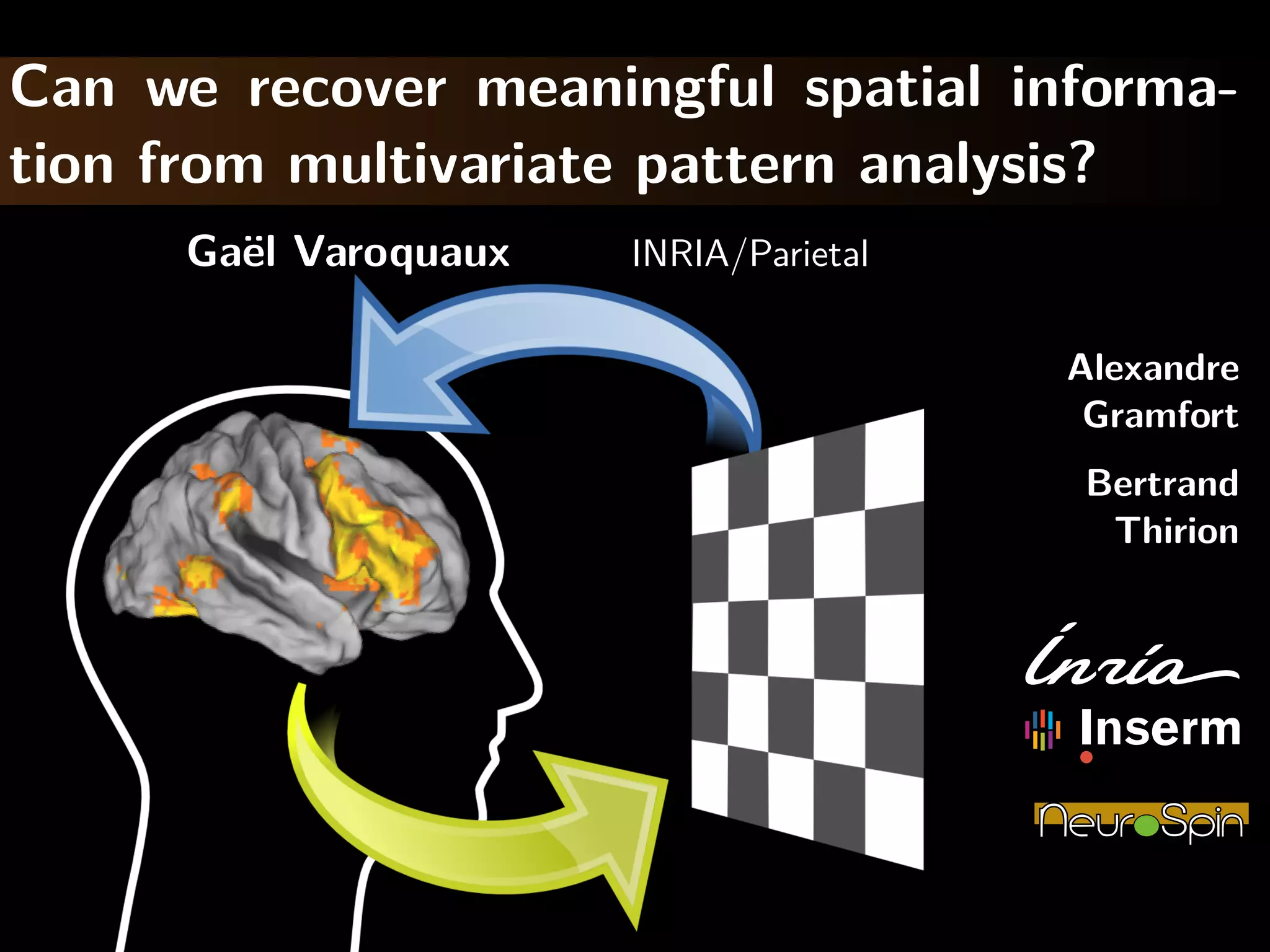
Can we recover meaningful spatial informa-
tion from multivariate pattern analysis?
      Ga¨l Varoquaux
        e              INRIA/Parietal

                                        Alexandre
                                         Gramfort
                                        Bertrand
                                         Thirion
Can we recover meaningful spatial informa-
tion from multivariate pattern analysis?
      Ga¨l Varoquaux
        e              INRIA/Parietal

                                        Alexandre
                                         Gramfort
                                        Bertrand
                                         Thirion
             Yes we can!
Can we recover meaningful spatial informa-
tion from multivariate pattern analysis?
      Ga¨l Varoquaux
        e              INRIA/Parietal

                                        Alexandre
                                         Gramfort
                                        Bertrand
                                         Thirion
1 Prediction versus recovery

   2 Random parcellations and sparsity


G Varoquaux                              2
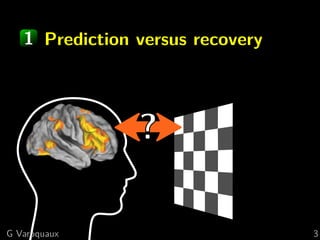
1 Prediction versus recovery


                ?

G Varoquaux                       3
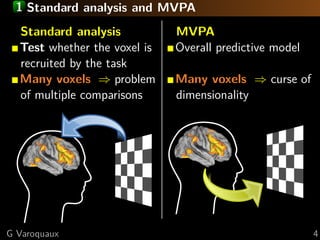
1 Standard analysis and MVPA
  Standard analysis           MVPA
  Test whether the voxel is   Overall predictive model
  recruited by the task
  Many voxels ⇒ problem       Many voxels ⇒ curse of
  of multiple comparisons     dimensionality


G Varoquaux                                              4
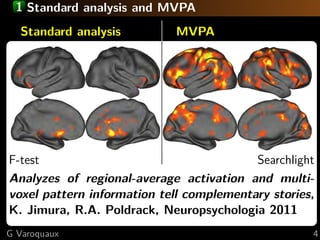
1 Standard analysis and MVPA
  Standard analysis           MVPA
  Test whether the voxel is   Overall predictive model
  recruited by the task
  Many voxels ⇒ problem       Many voxels ⇒ curse of
  of multiple comparisons     dimensionality


F-test                                    Searchlight
Analyzes of regional-average activation and multi-
voxel pattern information tell complementary stories,
K. Jimura, R.A. Poldrack, Neuropsychologia 2011
G Varoquaux                                              4
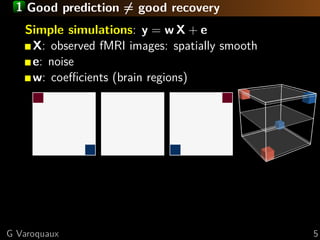
1 Good prediction = good recovery
   Simple simulations: y = w X + e
    X: observed fMRI images: spatially smooth
    e: noise
    w: coefficients (brain regions)
                  Ground truth


G Varoquaux                                     5
1 Good prediction = good recovery
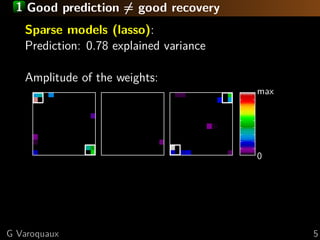
   Sparse models (lasso):
   Prediction: 0.78 explained variance

   Amplitude of the weights:
                                         max


                                         0


G Varoquaux                                    5
1 Good prediction = good recovery
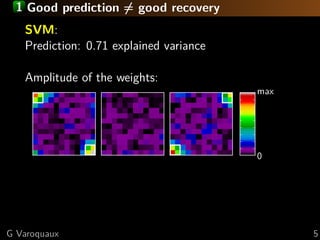
   SVM:
   Prediction: 0.71 explained variance

   Amplitude of the weights:
                                         max


                                         0


G Varoquaux                                    5
1 Good prediction = good recovery
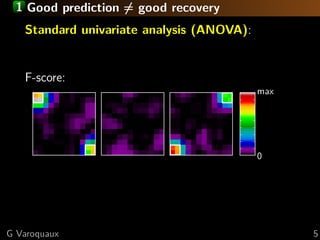
   Standard univariate analysis (ANOVA):


   F-score:
                                           max


                                           0


G Varoquaux                                      5
1 Good prediction = good recovery

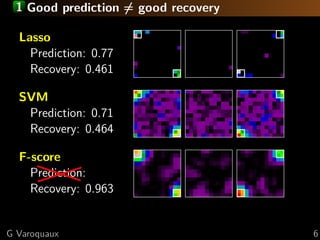
  Lasso
    Prediction: 0.77
    Recovery: 0.461

  SVM
   Prediction: 0.71
   Recovery: 0.464

  F-score
    Prediction:
    Recovery: 0.963


G Varoquaux                          6
1 Multivariate analysis for recovery?

       Considering each voxel separately is
       suboptimal: they share information

     Most often, we know that we are looking for
     a small fraction of the cortex


     A voxel is more likely to be activated
     if its neighbor is


G Varoquaux                                        7
1 Multivariate analysis for recovery?

       Considering each voxel separately is
       suboptimal: they share information

     Most often, we know that we are looking for
     a small fraction of the cortex
                                    Sparse models

     A voxel is more likely to be activated
     if its neighbor is
                                      Spatial models


G Varoquaux                                            7
1 Sparse models
    Compressive sensing:
      detection of k signals out of p (voxels)
      with only n observations ∝ k
                                       Iterpretable
       Selects random subsets in correlated signals


    Face vs house
    discrimination
     Data from [Haxby 2001]


G Varoquaux                                           8
1 Sparse models
    Compressive sensing:
      detection of k signals out of p (voxels)
      with only n observations ∝ k
                                       Iterpretable
       Selects random subsets in correlated signals


    Stability selection:
    Face vsrandom perturbations to the data
    Apply house
    discrimination that are selected often
    Keep voxels
     Data from [Haxby 2001] [Meinhausen 2010]


G Varoquaux                                           8
1 Spatial models
    Brain parcellations:
    Ward clustering to reduce voxel numbers
          Supervised clustering [Michel 2011]


              ...           ...           ...


                    ...            ...


   Clustering blind to experimental conditions
G Varoquaux                                      9
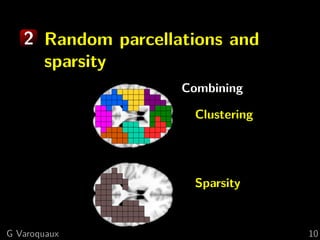
2 Random parcellations and
     sparsity
                    Combining

                     Clustering


                     Sparsity


G Varoquaux                       10
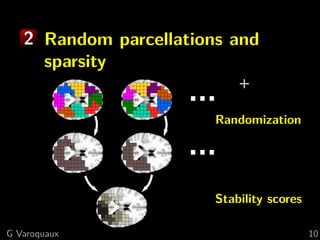
2 Random parcellations and
     sparsity
                            +

                        Randomization


                        Stability scores

G Varoquaux                                10
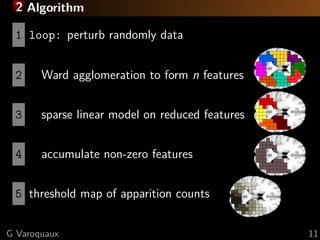
2 Algorithm

 1 loop: perturb randomly data


 2     Ward agglomeration to form n features


 3     sparse linear model on reduced features


 4     accumulate non-zero features


 5 threshold map of apparition counts


G Varoquaux                                      11
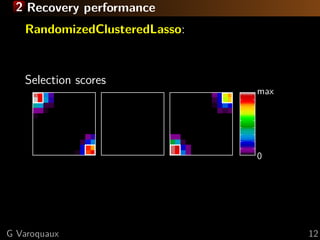
2 Recovery performance
   RandomizedClusteredLasso:


   Selection scores
                               max


                               0


G Varoquaux                          12
2 What is the best method for feature recovery?
   For small brain regions: elastic net
   For large brain regions: randomized-clustered sparsity
   Large regions and very smooth images: F-tests


  [Varoquaux 2012] ICML
G Varoquaux                                                 13
2 fMRI: face vs house discrimination   [Haxby 2001]
        F-scores
                                             L              R
  L                R


y=-31                  x=17
                                        z=-17


  G Varoquaux                                               14
2 fMRI: face vs house discrimination   [Haxby 2001]
        Randomized Clustered Sparsity
                                             L              R
  L               R


y=-31                 x=17
                                         z=-17


        Less background noise
                            (source of false positive)

  G Varoquaux                                               14
2 Predictive power of selected voxels
   Object recognition [Haxby 2001]


      Using recovered voxels improves prediction
G Varoquaux                                        15
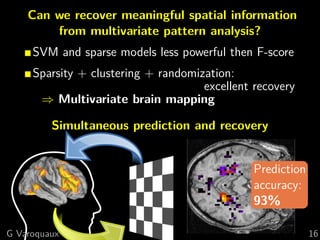
Can we recover meaningful spatial information
        from multivariate pattern analysis?
     SVM and sparse models less powerful then F-score
     Sparsity + clustering + randomization:
                                     excellent recovery
      ⇒ Multivariate brain mapping

         Simultaneous prediction and recovery


                                               Prediction
                                               accuracy:
                                               93%

G Varoquaux                                                 16
For more details
 G. Varoquaux, A. Gramfort, and B. Thirion, Small-sample
 brain mapping: sparse recovery on spatially correlated de-
 signs with randomization and clustering, ICML 2012

        Acknowledgments, for sharing data:
   J. Haxby       R. Poldrack        K. Jimura

                      Software
scikit-learn: machine learning in Python


G Varoquaux                                                   17

Can we recover meaning full spatial information from multivariate pattern analysis

  • 1.
    Can we recovermeaningful spatial informa- tion from multivariate pattern analysis? Ga¨l Varoquaux e INRIA/Parietal Alexandre Gramfort Bertrand Thirion
  • 2.
    Can we recovermeaningful spatial informa- tion from multivariate pattern analysis? Ga¨l Varoquaux e INRIA/Parietal Alexandre Gramfort Bertrand Thirion Yes we can!
  • 3.
    Can we recovermeaningful spatial informa- tion from multivariate pattern analysis? Ga¨l Varoquaux e INRIA/Parietal Alexandre Gramfort Bertrand Thirion
  • 4.
    1 Prediction versusrecovery 2 Random parcellations and sparsity G Varoquaux 2
  • 5.
    1 Prediction versusrecovery ? G Varoquaux 3
  • 6.
    1 Standard analysisand MVPA Standard analysis MVPA Test whether the voxel is Overall predictive model recruited by the task Many voxels ⇒ problem Many voxels ⇒ curse of of multiple comparisons dimensionality G Varoquaux 4
  • 7.
    1 Standard analysisand MVPA Standard analysis MVPA Test whether the voxel is Overall predictive model recruited by the task Many voxels ⇒ problem Many voxels ⇒ curse of of multiple comparisons dimensionality F-test Searchlight Analyzes of regional-average activation and multi- voxel pattern information tell complementary stories, K. Jimura, R.A. Poldrack, Neuropsychologia 2011 G Varoquaux 4
  • 8.
    1 Good prediction= good recovery Simple simulations: y = w X + e X: observed fMRI images: spatially smooth e: noise w: coefficients (brain regions) Ground truth G Varoquaux 5
  • 9.
    1 Good prediction= good recovery Sparse models (lasso): Prediction: 0.78 explained variance Amplitude of the weights: max 0 G Varoquaux 5
  • 10.
    1 Good prediction= good recovery SVM: Prediction: 0.71 explained variance Amplitude of the weights: max 0 G Varoquaux 5
  • 11.
    1 Good prediction= good recovery Standard univariate analysis (ANOVA): F-score: max 0 G Varoquaux 5
  • 12.
    1 Good prediction= good recovery Lasso Prediction: 0.77 Recovery: 0.461 SVM Prediction: 0.71 Recovery: 0.464 F-score Prediction: Recovery: 0.963 G Varoquaux 6
  • 13.
    1 Multivariate analysisfor recovery? Considering each voxel separately is suboptimal: they share information Most often, we know that we are looking for a small fraction of the cortex A voxel is more likely to be activated if its neighbor is G Varoquaux 7
  • 14.
    1 Multivariate analysisfor recovery? Considering each voxel separately is suboptimal: they share information Most often, we know that we are looking for a small fraction of the cortex Sparse models A voxel is more likely to be activated if its neighbor is Spatial models G Varoquaux 7
  • 15.
    1 Sparse models Compressive sensing: detection of k signals out of p (voxels) with only n observations ∝ k Iterpretable Selects random subsets in correlated signals Face vs house discrimination Data from [Haxby 2001] G Varoquaux 8
  • 16.
    1 Sparse models Compressive sensing: detection of k signals out of p (voxels) with only n observations ∝ k Iterpretable Selects random subsets in correlated signals Stability selection: Face vsrandom perturbations to the data Apply house discrimination that are selected often Keep voxels Data from [Haxby 2001] [Meinhausen 2010] G Varoquaux 8
  • 17.
    1 Spatial models Brain parcellations: Ward clustering to reduce voxel numbers Supervised clustering [Michel 2011] ... ... ... ... ... Clustering blind to experimental conditions G Varoquaux 9
  • 18.
    2 Random parcellationsand sparsity Combining Clustering Sparsity G Varoquaux 10
  • 19.
    2 Random parcellationsand sparsity + Randomization Stability scores G Varoquaux 10
  • 20.
    2 Algorithm 1loop: perturb randomly data 2 Ward agglomeration to form n features 3 sparse linear model on reduced features 4 accumulate non-zero features 5 threshold map of apparition counts G Varoquaux 11
  • 21.
    2 Recovery performance RandomizedClusteredLasso: Selection scores max 0 G Varoquaux 12
  • 22.
    2 What isthe best method for feature recovery? For small brain regions: elastic net For large brain regions: randomized-clustered sparsity Large regions and very smooth images: F-tests [Varoquaux 2012] ICML G Varoquaux 13
  • 23.
    2 fMRI: facevs house discrimination [Haxby 2001] F-scores L R L R y=-31 x=17 z=-17 G Varoquaux 14
  • 24.
    2 fMRI: facevs house discrimination [Haxby 2001] Randomized Clustered Sparsity L R L R y=-31 x=17 z=-17 Less background noise (source of false positive) G Varoquaux 14
  • 25.
    2 Predictive powerof selected voxels Object recognition [Haxby 2001] Using recovered voxels improves prediction G Varoquaux 15
  • 26.
    Can we recovermeaningful spatial information from multivariate pattern analysis? SVM and sparse models less powerful then F-score Sparsity + clustering + randomization: excellent recovery ⇒ Multivariate brain mapping Simultaneous prediction and recovery Prediction accuracy: 93% G Varoquaux 16
  • 27.
    For more details G. Varoquaux, A. Gramfort, and B. Thirion, Small-sample brain mapping: sparse recovery on spatially correlated de- signs with randomization and clustering, ICML 2012 Acknowledgments, for sharing data: J. Haxby R. Poldrack K. Jimura Software scikit-learn: machine learning in Python G Varoquaux 17