Quasistatic Fracture using Nonliner-Nonlocal
Elastostatics with an Analytic Tangent Stiffness Matrix
Patrick Diehl
joint work with Robert Lipton
Center of Computation & Technology
patrickdiehl@lsu.edu
July 29, 2021
Patrick Diehl (CCT/LSU) Short title July 29, 2021 1 / 27
Motivation
Observation
Not many quasi-static peridynamic simulations are available due to the
high computational cost in assembling the tangent stiffness matrix using
numerical derivations [1].
Question’s asked
1 Can we use bond softening instead of bond breaking to get some
analytic tangent stiffness matrix?
2 Can we apply hard loading to get stable crack growth?
References
1 Diehl, Patrick, et al. ”A comparative review of peridynamics and phase-field models for engineering fracture
mechanics.” (2021).
Patrick Diehl (CCT/LSU) Short title July 29, 2021 2 / 27
Overview
1 Regularized nonlinear pairwise (RNP) potential
2 Derivation of the analytic tangent stiffness matrix
3 Discretization
4 Algorithms
5 Numerical results
Soft loading
Hard loading
6 Conclusion and Outlook
Patrick Diehl (CCT/LSU) Short title July 29, 2021 3 / 27
Regularized nonlinear pairwise (RNP) potential
Patrick Diehl (CCT/LSU) Short title July 29, 2021 4 / 27
Peridynamic equation of motion
Balance of linear momentum (dynamic)
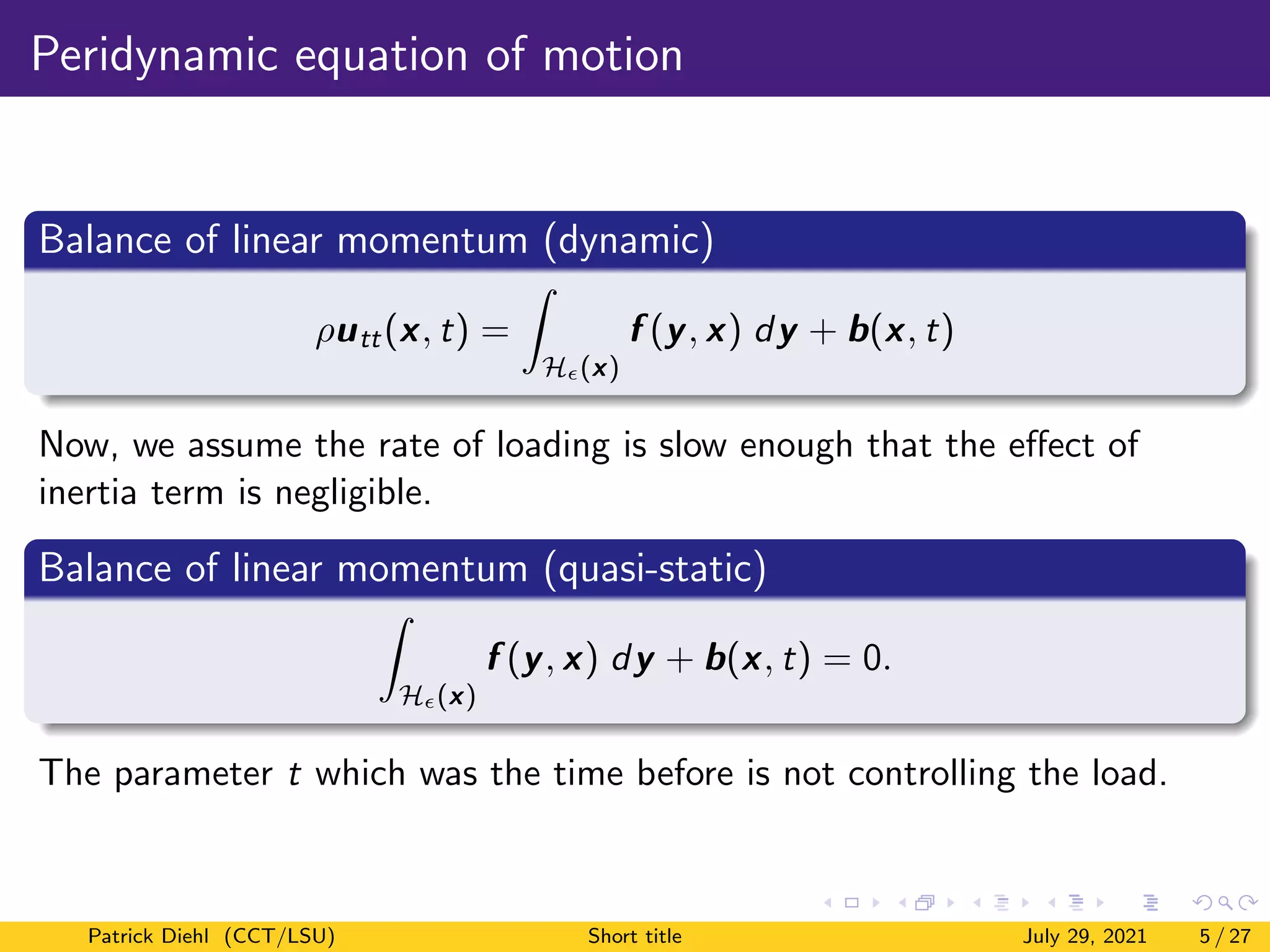
ρutt(x, t) =
Z
H(x)
f (y, x) dy + b(x, t)
Now, we assume the rate of loading is slow enough that the effect of
inertia term is negligible.
Balance of linear momentum (quasi-static)
Z
H(x)
f (y, x) dy + b(x, t) = 0.
The parameter t which was the time before is not controlling the load.
Patrick Diehl (CCT/LSU) Short title July 29, 2021 5 / 27
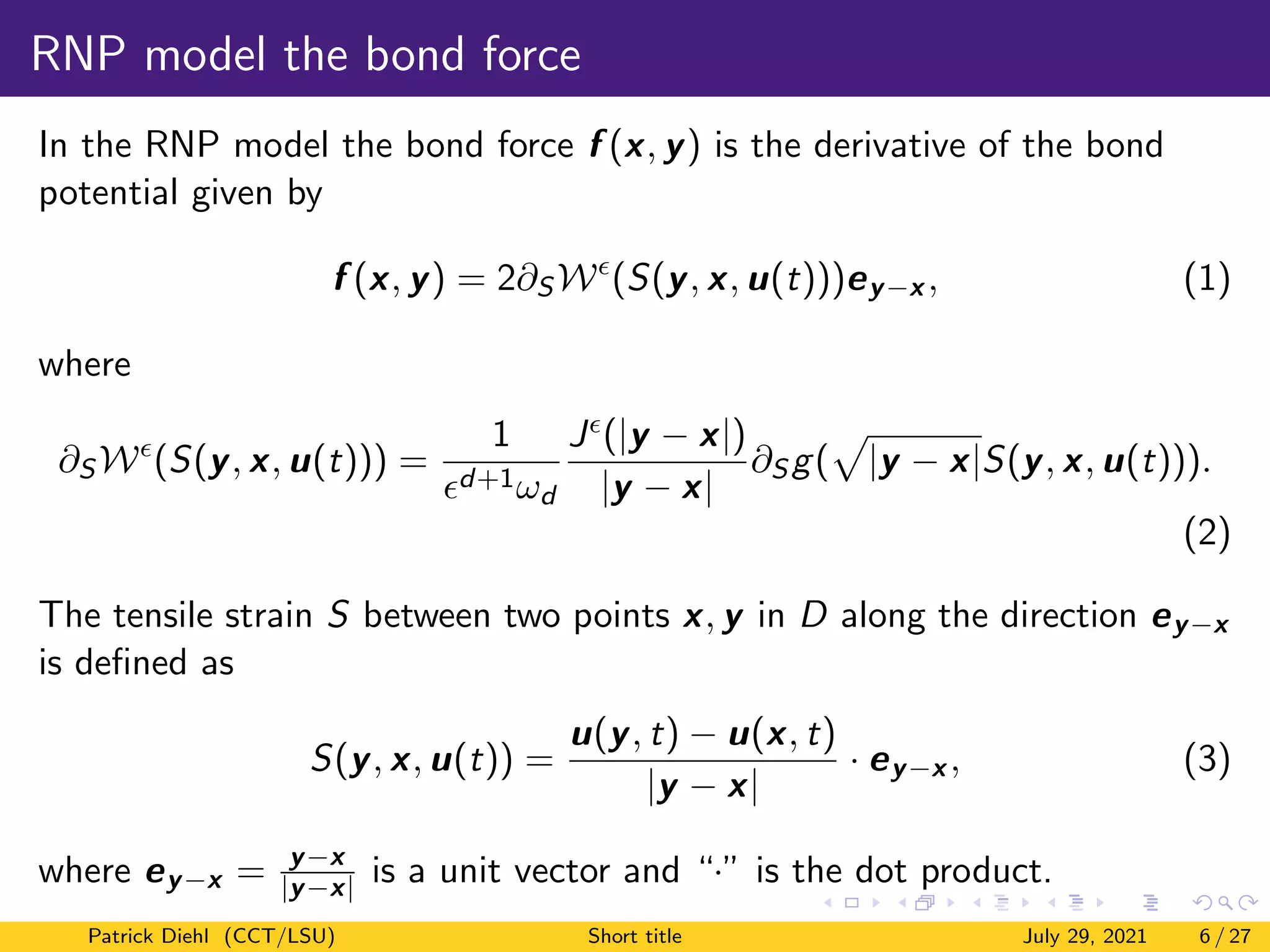
RNP model the bond force
In the RNP model the bond force f (x, y) is the derivative of the bond
potential given by
f (x, y) = 2∂S W
(S(y, x, u(t)))ey−x , (1)
where
∂S W
(S(y, x, u(t))) =
1
d+1ωd
J(|y − x|)
|y − x|
∂S g(
p
|y − x|S(y, x, u(t))).
(2)
The tensile strain S between two points x, y in D along the direction ey−x
is defined as
S(y, x, u(t)) =
u(y, t) − u(x, t)
|y − x|
· ey−x , (3)
where ey−x = y−x
|y−x| is a unit vector and “·” is the dot product.
Patrick Diehl (CCT/LSU) Short title July 29, 2021 6 / 27
RNP potential
rc
−rc
r+
−r+
r
g0
(r)
Figure: Cohesive force. The force goes smoothly to zero at ±r+
.
One of the example of g is:
g(r) = C(1 − exp[−βr]) (4)
where C, β are material dependent parameters.
Patrick Diehl (CCT/LSU) Short title July 29, 2021 7 / 27
Derivation of the analytic tangent stiffness matrix
Patrick Diehl (CCT/LSU) Short title July 29, 2021 8 / 27
Quasi-static formulation
For convenience set
L(u)(x) =
Z
H(x)
f (y, x) dy. (5)
We assume at t = 0 that there exists a displacement u0 = u(x, 0) and
body force b(x, 0) for which the displacement is at equilibrium
L(u0)(x) + b(x, 0) = 0, (6)
and the quasistatic evolution u(x, t) : D × [0, T] → Rd is given by
L(u)(x) + b(x, t) = 0. (7)
for a prescribed load path b(x, t) : D × [0, T] → Rd .
Patrick Diehl (CCT/LSU) Short title July 29, 2021 9 / 27
Derivation of the tangent stiffness matrix I
We next derive the formula for H(u)[w]. Substituting 1 into 5, and taking
u = u0 + w, we have
L(u0 + w)(x)
=
2
d+1ωd
Z
D∩H(x)
J(|y − x|)
p
|y − x|
g0
(
p
|y − x|S(y, x, u0 + w))ey−x dy,
(8)
From the definition of S in 3, we have
S(y, x; u0 + w) = S(y, x; u0) + S(y, x; w). (9)
Let us do a Taylor expansion for the first derivative of the potential h
g0
(
p
|y − x|S(y, x; u0 + w)) = g0
(
p
|y − x|S(y, x; u0))
+ g00
(
p
|y − x|S(y, x; u0))
p
|y − x|S(y, x; w)
+ O(||w||2
). (10)
Patrick Diehl (CCT/LSU) Short title July 29, 2021 10 / 27
Derivation of the tangent stiffness matrix II
Substituting the above in 8, we get
L(u0 + w)(x) = L(u0)(x)
+
2
d+1ωd
Z
D∩H(x)
J(|y − x|)
p
|y − x|
g00
(
p
|y − x|S(y, x; u0))
p
|y − x|S(y, x; w)
+ O(||w||2
). (11)
H(u0)[w](x) =
2
d+1ωd
Z
D∩H(x)
J
(|y − x|)g00
(
p
|y − x|
S(y, x; u0))S(y, x; w)ey−x dy (12)
Note that H(u0)[w] is linear in w.
Patrick Diehl (CCT/LSU) Short title July 29, 2021 11 / 27
Discretization
Patrick Diehl (CCT/LSU) Short title July 29, 2021 12 / 27
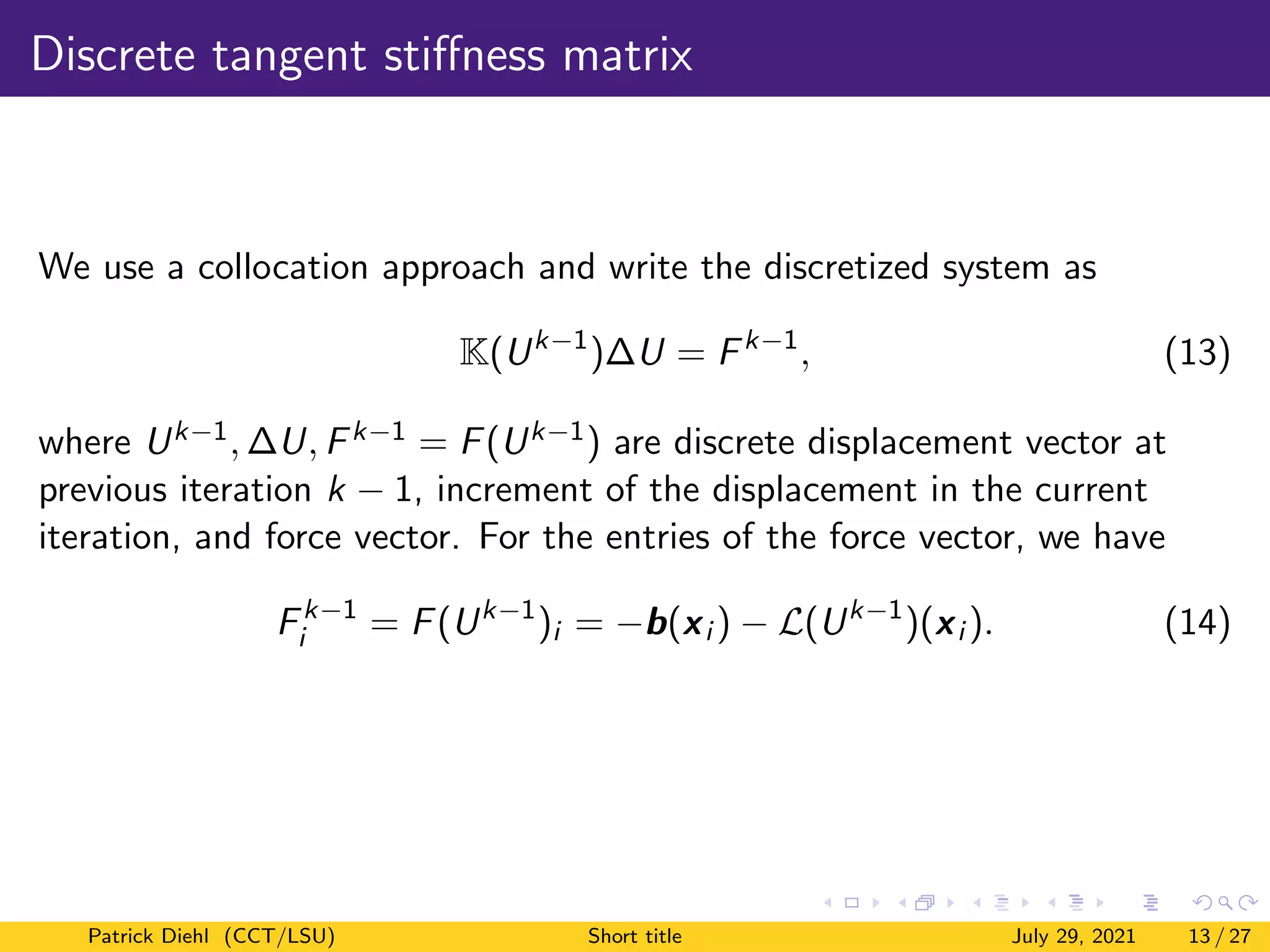
Discrete tangent stiffness matrix
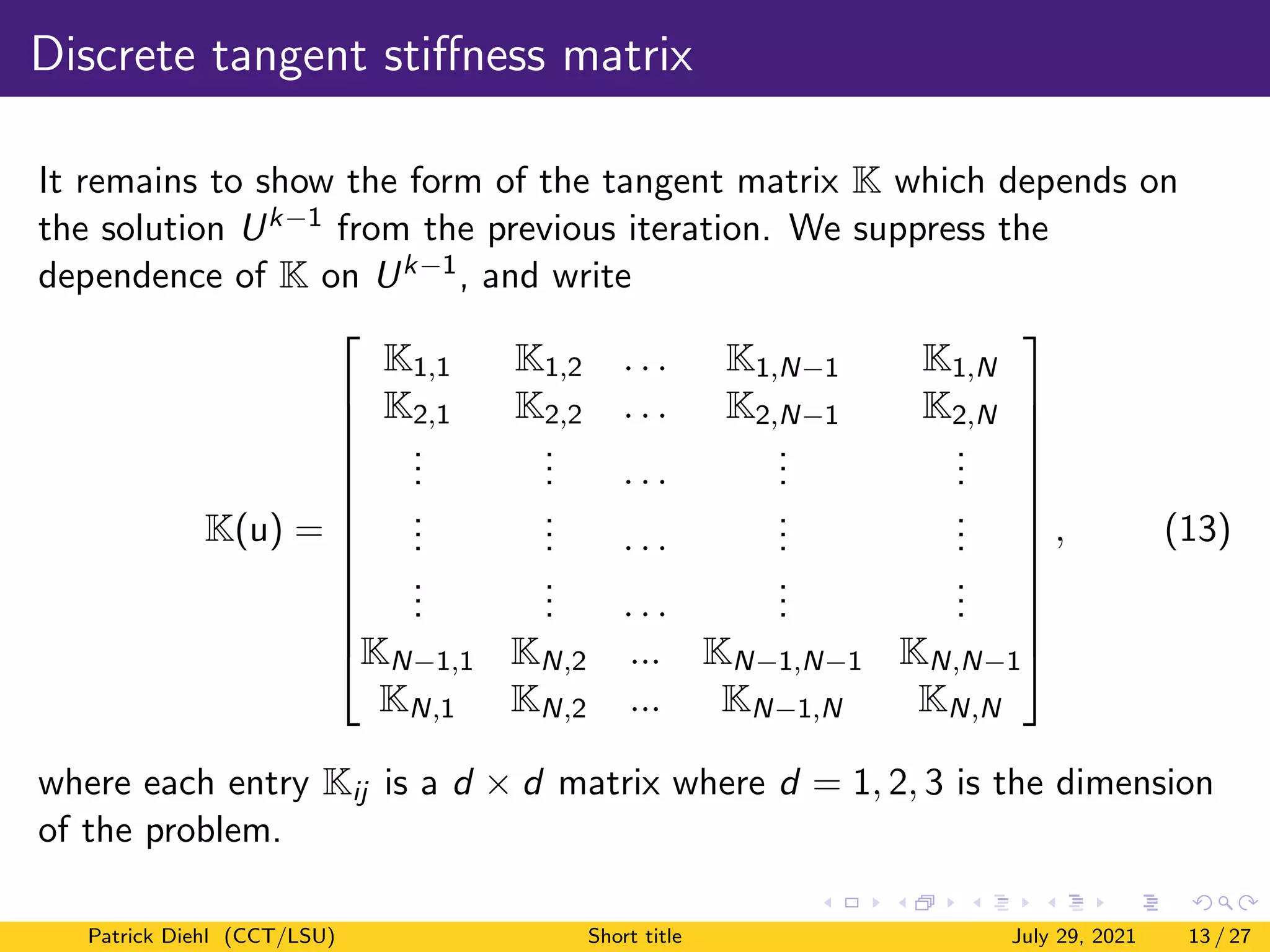
We use a collocation approach and write the discretized system as
K(Uk−1
)∆U = Fk−1
, (13)
where Uk−1, ∆U, Fk−1 = F(Uk−1) are discrete displacement vector at
previous iteration k − 1, increment of the displacement in the current
iteration, and force vector. For the entries of the force vector, we have
Fk−1
i = F(Uk−1
)i = −b(xi ) − L(Uk−1
)(xi ). (14)
Patrick Diehl (CCT/LSU) Short title July 29, 2021 13 / 27
Discrete tangent stiffness matrix
It remains to show the form of the tangent matrix K which depends on
the solution Uk−1 from the previous iteration. We suppress the
dependence of K on Uk−1, and write
K(u) =













K1,1 K1,2 . . . K1,N−1 K1,N
K2,1 K2,2 . . . K2,N−1 K2,N
.
.
.
.
.
. . . .
.
.
.
.
.
.
.
.
.
.
.
. . . .
.
.
.
.
.
.
.
.
.
.
.
. . . .
.
.
.
.
.
.
KN−1,1 KN,2 ... KN−1,N−1 KN,N−1
KN,1 KN,2 ... KN−1,N KN,N













, (13)
where each entry Kij is a d × d matrix where d = 1, 2, 3 is the dimension
of the problem.
Patrick Diehl (CCT/LSU) Short title July 29, 2021 13 / 27
Discrete tangent stiffness matrix
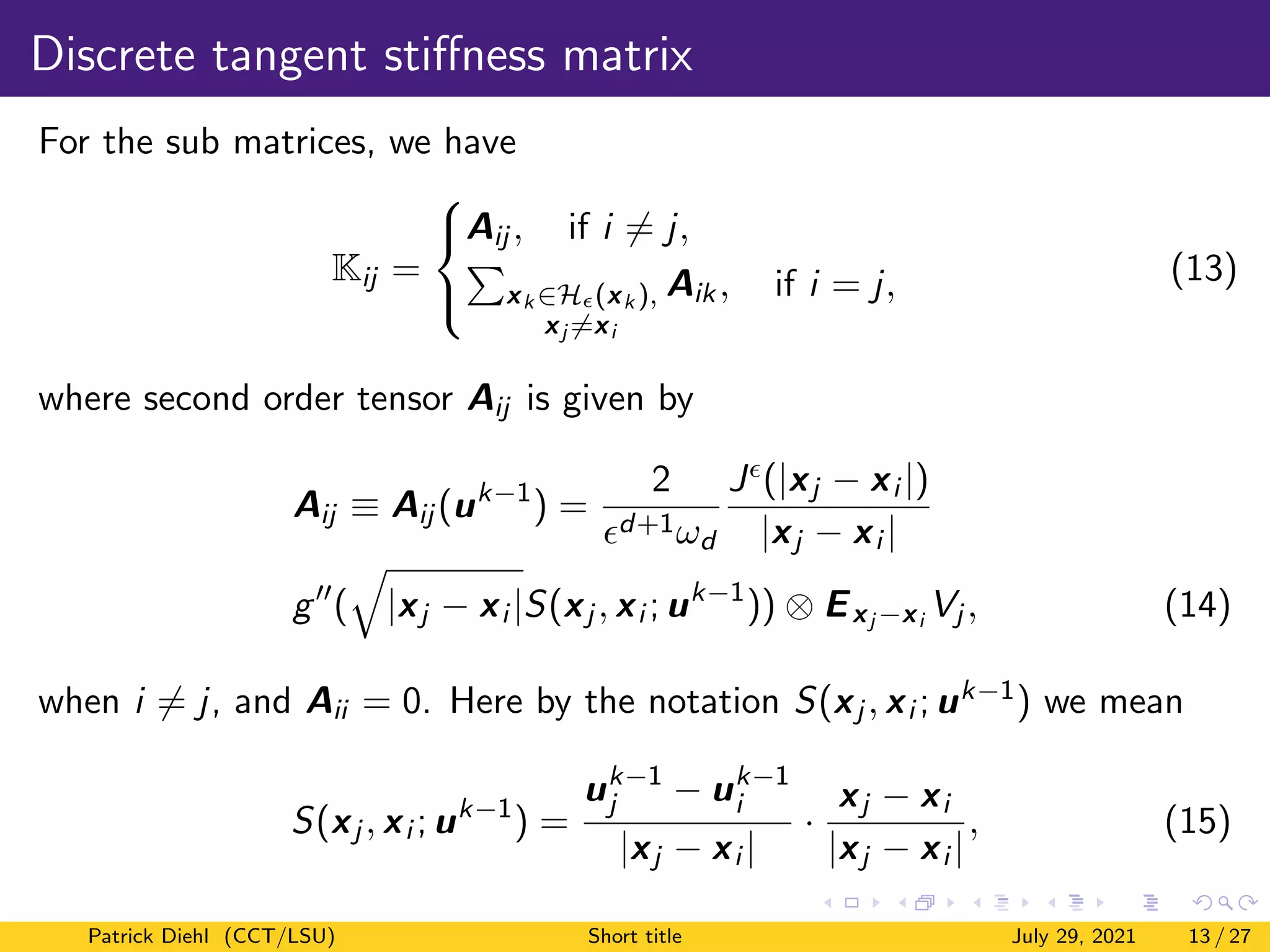
For the sub matrices, we have
Kij =



Aij , if i 6= j,
P
xk ∈H(xk ),
xj 6=xi
Aik, if i = j, (13)
where second order tensor Aij is given by
Aij ≡ Aij (uk−1
) =
2
d+1ωd
J(|xj − xi |)
|xj − xi |
g00
(
q
|xj − xi |S(xj , xi ; uk−1
)) ⊗ Exj −xi Vj , (14)
when i 6= j, and Aii = 0. Here by the notation S(xj , xi ; uk−1) we mean
S(xj , xi ; uk−1
) =
uk−1
j − uk−1
i
|xj − xi |
·
xj − xi
|xj − xi |
, (15)
Patrick Diehl (CCT/LSU) Short title July 29, 2021 13 / 27
Algorithms
Patrick Diehl (CCT/LSU) Short title July 29, 2021 14 / 27
Soft loading
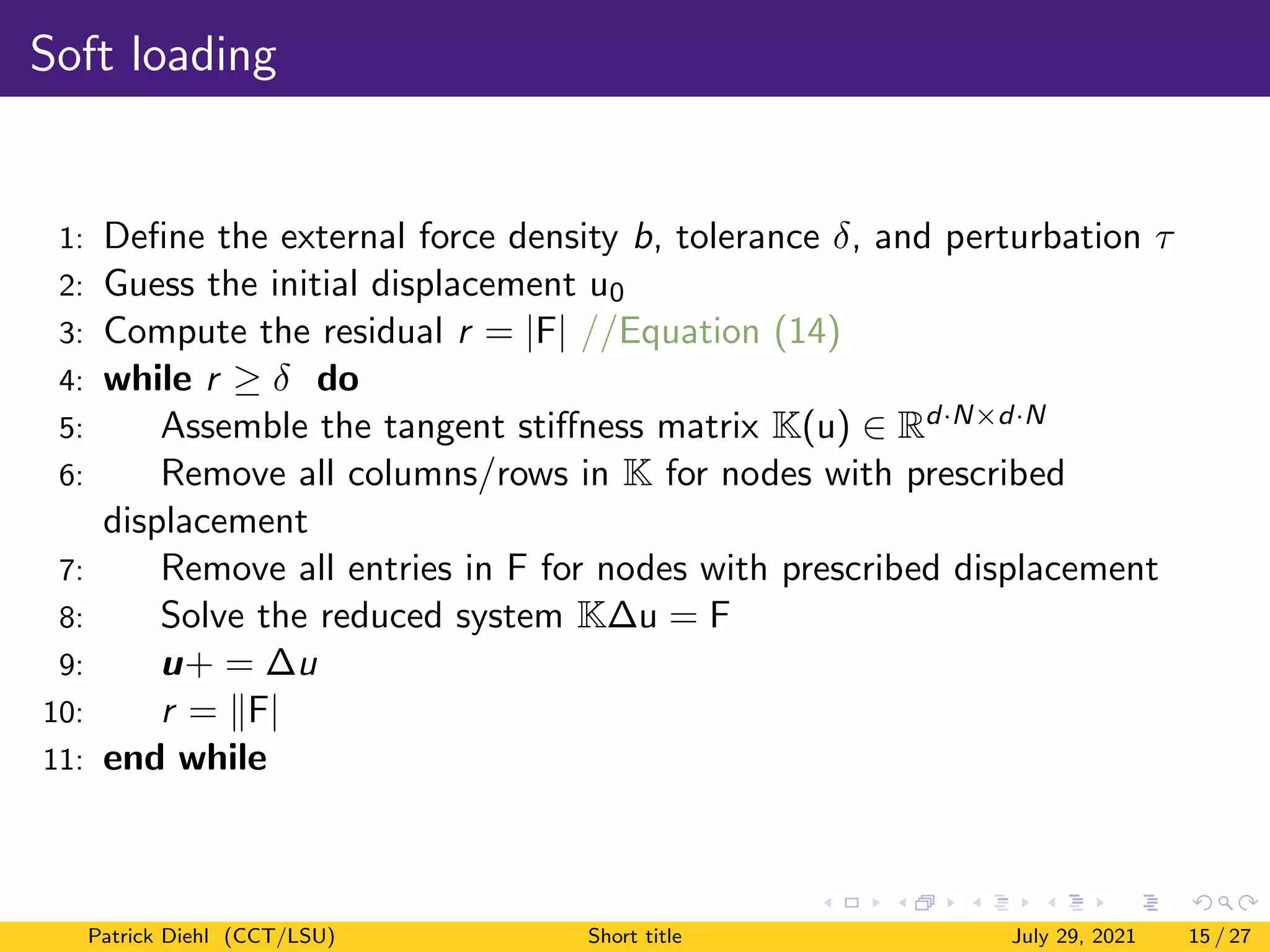
1: Define the external force density b, tolerance δ, and perturbation τ
2: Guess the initial displacement u0
3: Compute the residual r = |F| //Equation (14)
4: while r ≥ δ do
5: Assemble the tangent stiffness matrix K(u) ∈ Rd·N×d·N
6: Remove all columns/rows in K for nodes with prescribed
displacement
7: Remove all entries in F for nodes with prescribed displacement
8: Solve the reduced system K∆u = F
9: u+ = ∆u
10: r = kF|
11: end while
Patrick Diehl (CCT/LSU) Short title July 29, 2021 15 / 27
Hard loading
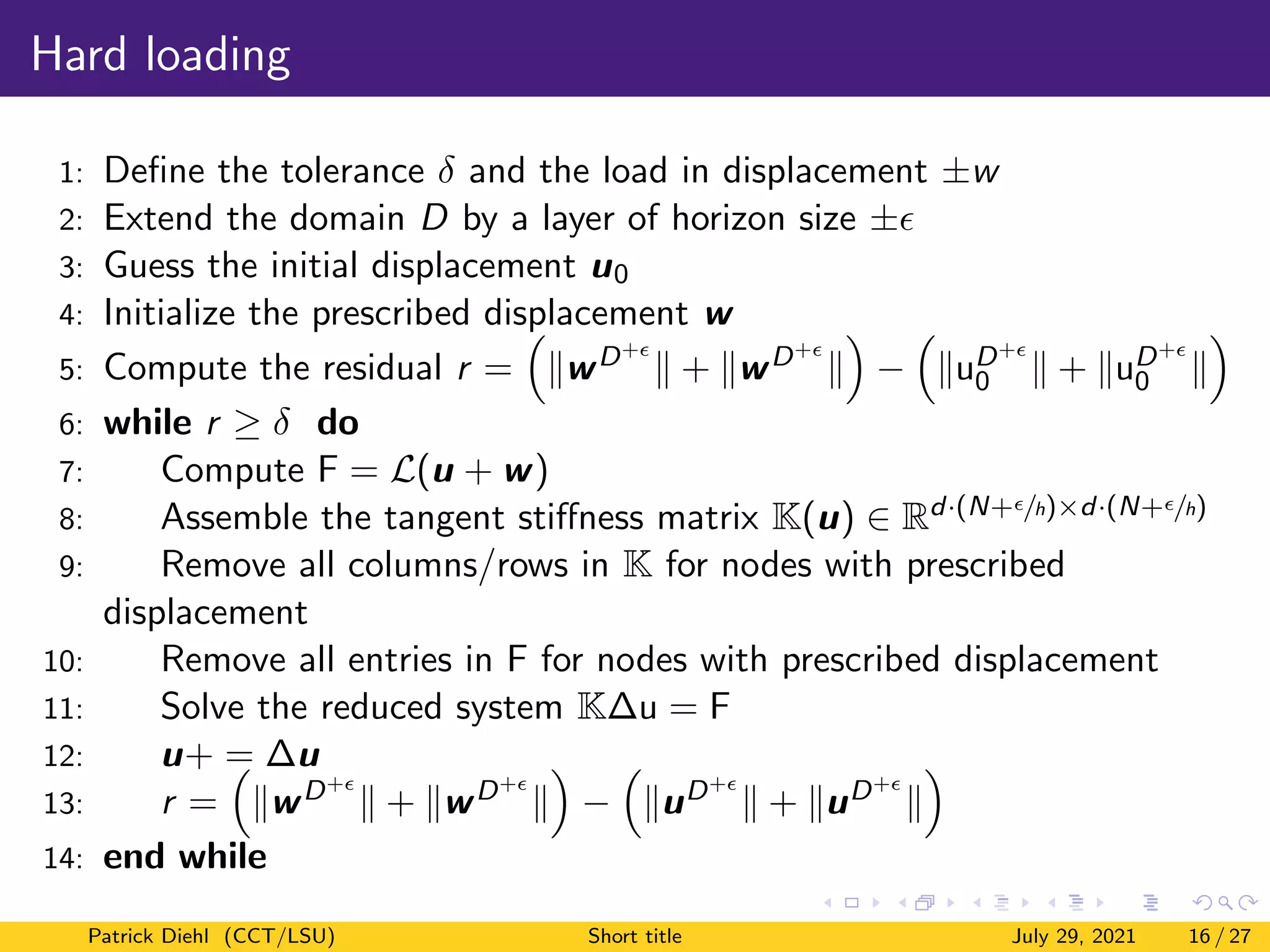
1: Define the tolerance δ and the load in displacement ±w
2: Extend the domain D by a layer of horizon size ±
3: Guess the initial displacement u0
4: Initialize the prescribed displacement w
5: Compute the residual r =

kwD+
k + kwD+
k

−

kuD+
0 k + kuD+
0 k

6: while r ≥ δ do
7: Compute F = L(u + w)
8: Assemble the tangent stiffness matrix K(u) ∈ Rd·(N+/h)×d·(N+/h)
9: Remove all columns/rows in K for nodes with prescribed
displacement
10: Remove all entries in F for nodes with prescribed displacement
11: Solve the reduced system K∆u = F
12: u+ = ∆u
13: r =

kwD+
k + kwD+
k

−

kuD+
k + kuD+
k

14: end while
Patrick Diehl (CCT/LSU) Short title July 29, 2021 16 / 27
Numerical results
Patrick Diehl (CCT/LSU) Short title July 29, 2021 17 / 27
Geometry for soft loading
y
x
15
7.5
δ
δ
−F−F
F F
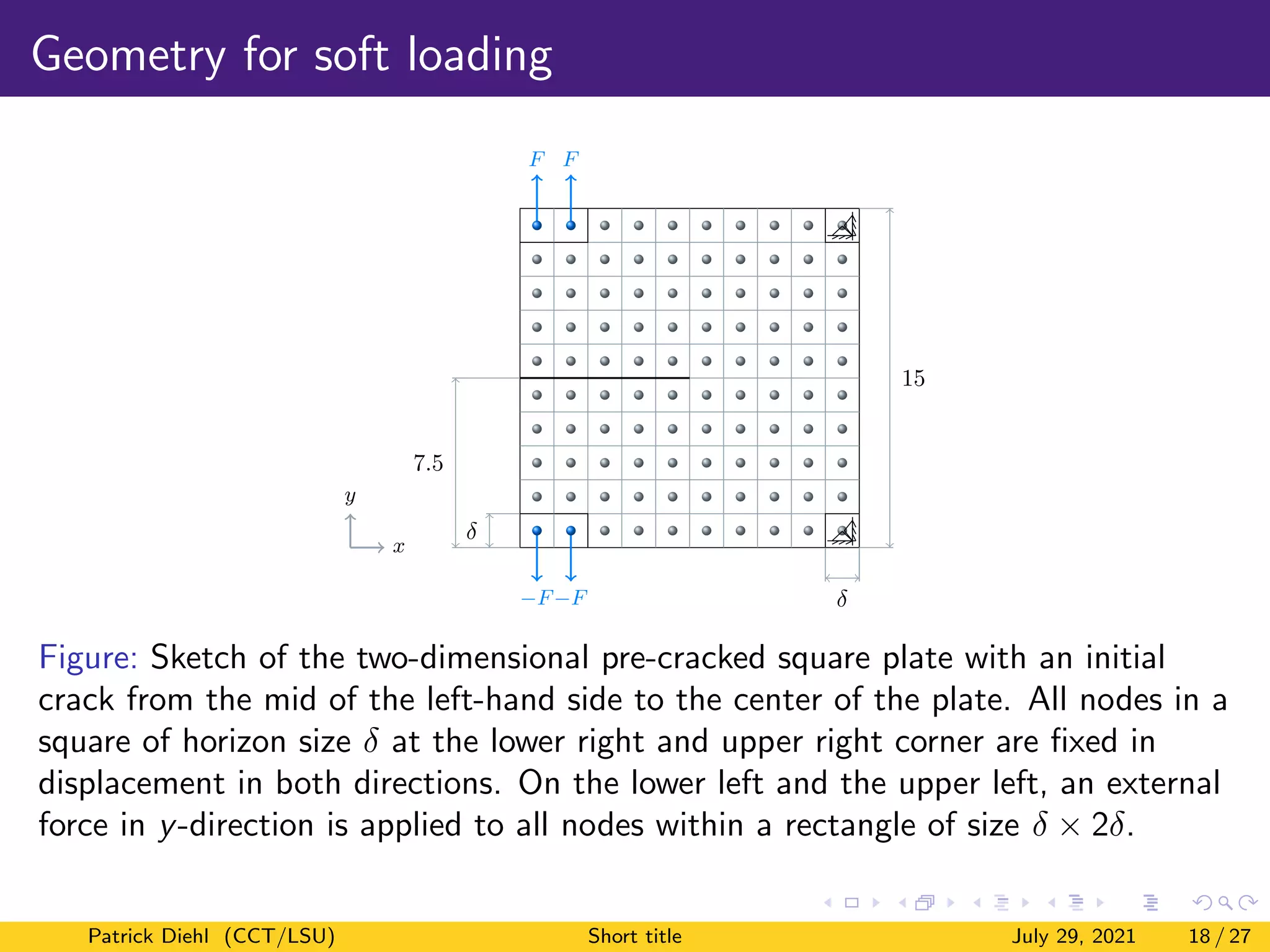
Figure: Sketch of the two-dimensional pre-cracked square plate with an initial
crack from the mid of the left-hand side to the center of the plate. All nodes in a
square of horizon size δ at the lower right and upper right corner are fixed in
displacement in both directions. On the lower left and the upper left, an external
force in y-direction is applied to all nodes within a rectangle of size δ × 2δ.
Patrick Diehl (CCT/LSU) Short title July 29, 2021 18 / 27
Linear regime
0 5 10 15
Position x
0.0
2.5
5.0
7.5
10.0
12.5
15.0
Poistion
y
0.0e+00
1.7e+00
3.3e+00
5.0e+00
6.6e+00
8.3e+00
Damage
(a)
0 5 10 15
Position x
0.0
2.5
5.0
7.5
10.0
12.5
15.0
Poistion
y
0.0e+00
1.7e+00
3.3e+00
5.0e+00
6.6e+00
8.3e+00
Damage
(b)
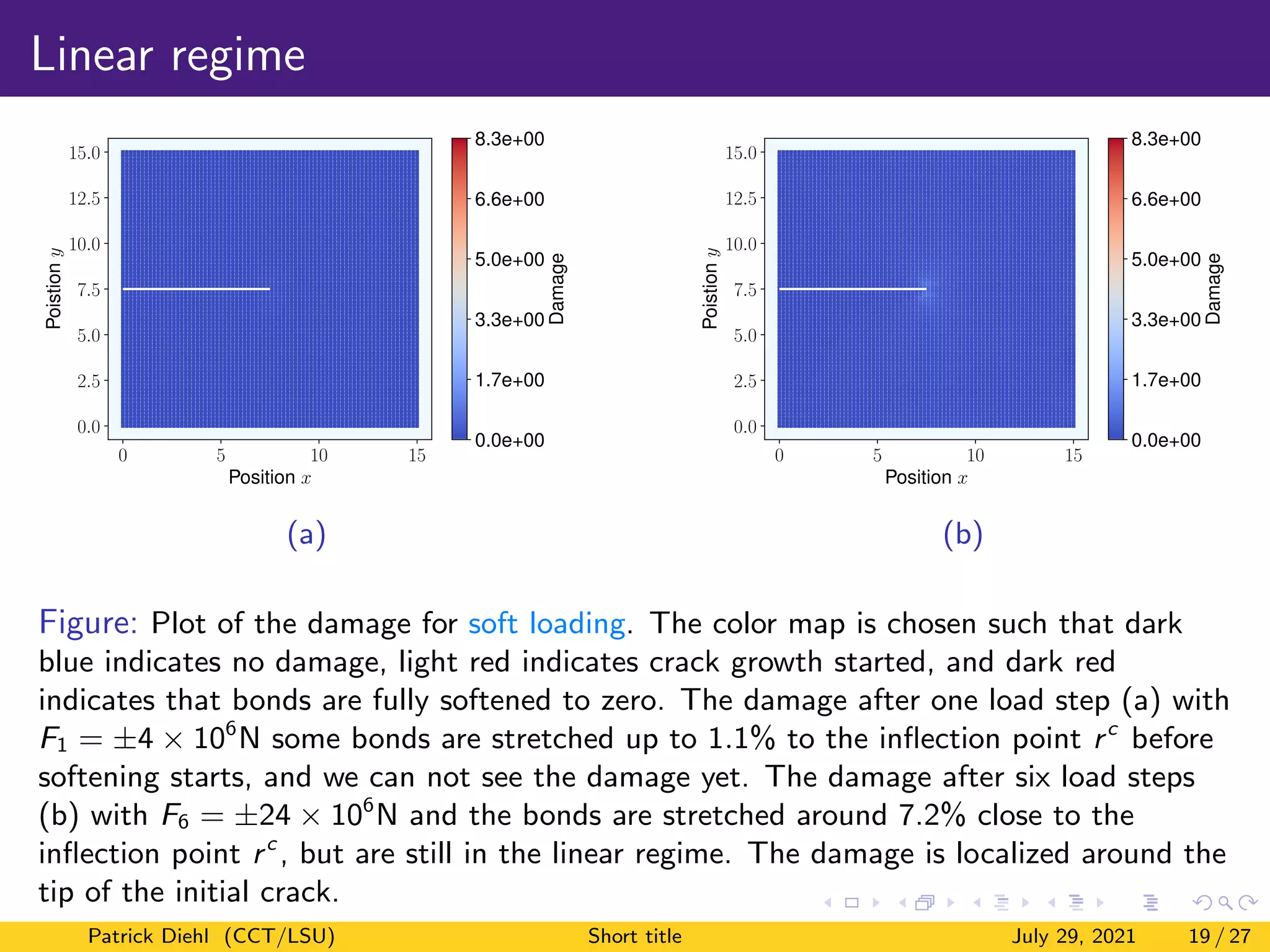
Figure: Plot of the damage for soft loading. The color map is chosen such that dark
blue indicates no damage, light red indicates crack growth started, and dark red
indicates that bonds are fully softened to zero. The damage after one load step (a) with
F1 = ±4 × 10⁶
N some bonds are stretched up to 1.1% to the inflection point rc
before
softening starts, and we can not see the damage yet. The damage after six load steps
(b) with F6 = ±24 × 106
N and the bonds are stretched around 7.2% close to the
inflection point rc
, but are still in the linear regime. The damage is localized around the
tip of the initial crack.
Patrick Diehl (CCT/LSU) Short title July 29, 2021 19 / 27
Softening but no crack growth
0 5 10 15
Position x
0.0
2.5
5.0
7.5
10.0
12.5
15.0
Poistion
y
0.0e+00
1.7e+00
3.3e+00
5.0e+00
6.6e+00
8.3e+00
Damage
(a)
0 5 10 15
Position x
0.0
2.5
5.0
7.5
10.0
12.5
15.0
Poistion
y
0.0e+00
1.7e+00
3.3e+00
5.0e+00
6.6e+00
8.3e+00
Damage
(b)
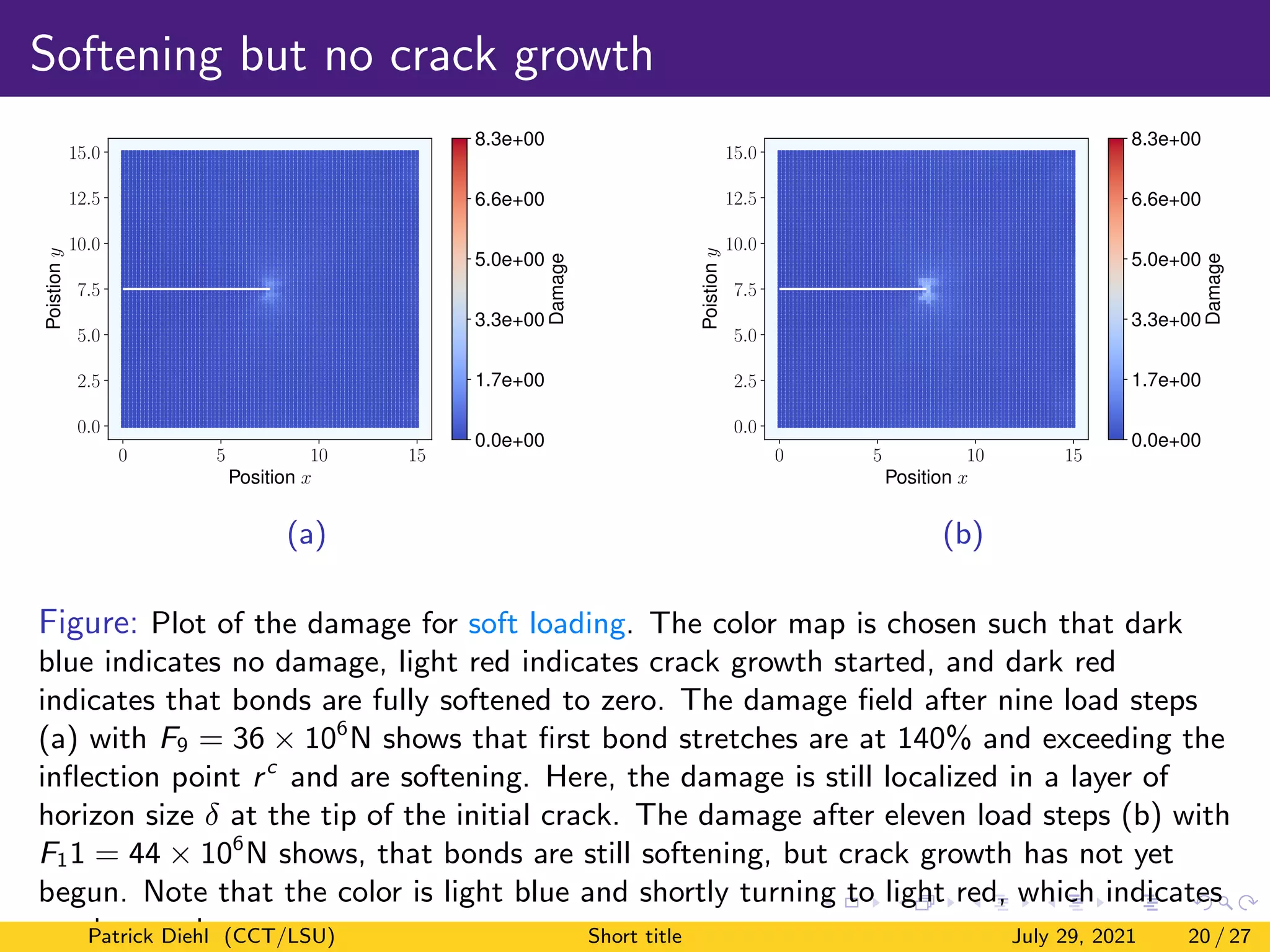
Figure: Plot of the damage for soft loading. The color map is chosen such that dark
blue indicates no damage, light red indicates crack growth started, and dark red
indicates that bonds are fully softened to zero. The damage field after nine load steps
(a) with F9 = 36 × 106
N shows that first bond stretches are at 140% and exceeding the
inflection point rc
and are softening. Here, the damage is still localized in a layer of
horizon size δ at the tip of the initial crack. The damage after eleven load steps (b) with
F11 = 44 × 106
N shows, that bonds are still softening, but crack growth has not yet
begun. Note that the color is light blue and shortly turning to light red, which indicates
crack growth.
Patrick Diehl (CCT/LSU) Short title July 29, 2021 20 / 27
Crack growth
0 5 10 15
Position x
0.0
2.5
5.0
7.5
10.0
12.5
15.0
Poistion
y
0.0e+00
1.7e+00
3.3e+00
5.0e+00
6.6e+00
8.3e+00
Damage
(a)
0 5 10 15
Position x
0.0
2.5
5.0
7.5
10.0
12.5
15.0
Poistion
y
0.0e+00
1.7e+00
3.3e+00
5.0e+00
6.6e+00
8.3e+00
Damage
(b)
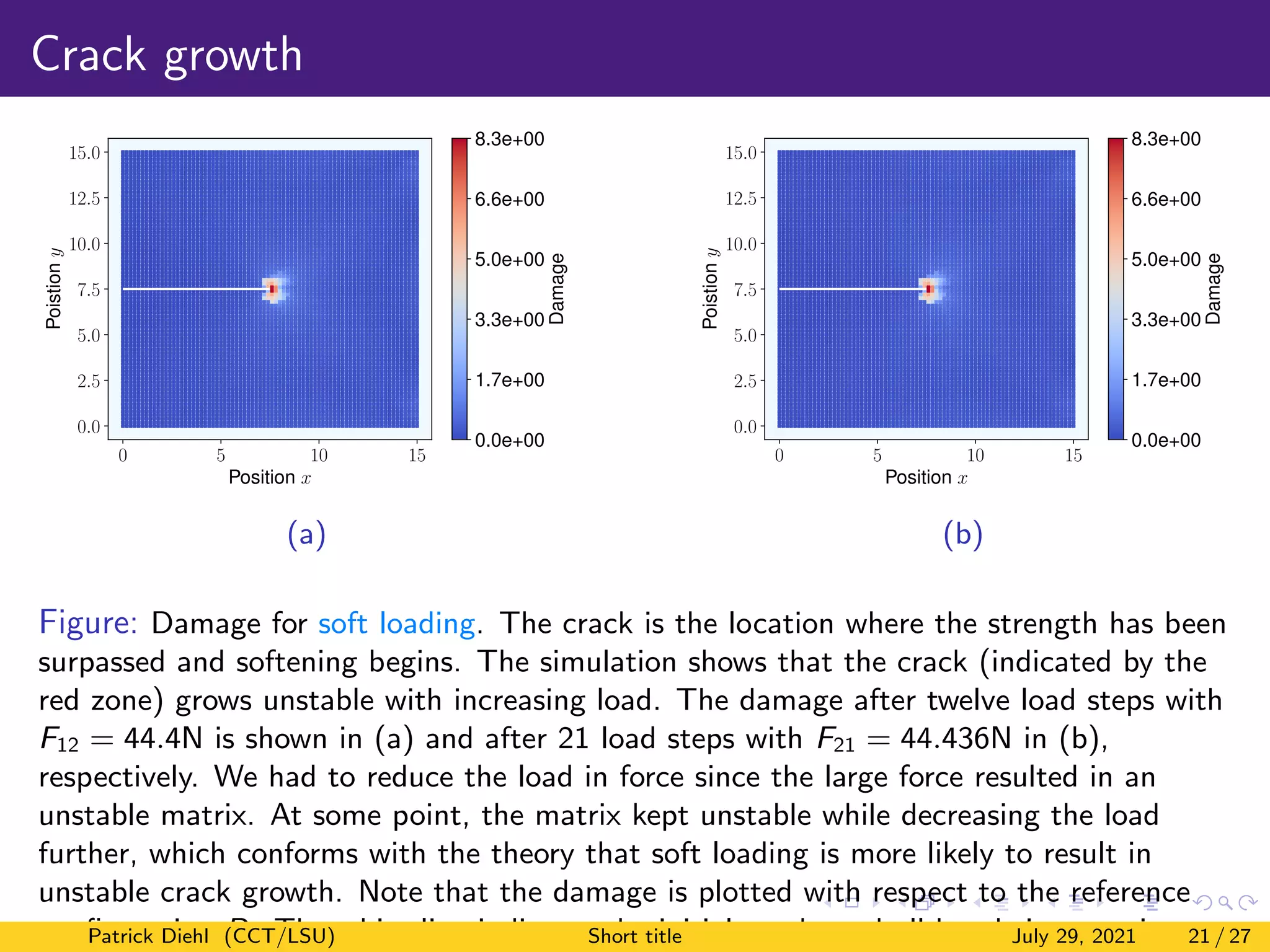
Figure: Damage for soft loading. The crack is the location where the strength has been
surpassed and softening begins. The simulation shows that the crack (indicated by the
red zone) grows unstable with increasing load. The damage after twelve load steps with
F12 = 44.4N is shown in (a) and after 21 load steps with F21 = 44.436N in (b),
respectively. We had to reduce the load in force since the large force resulted in an
unstable matrix. At some point, the matrix kept unstable while decreasing the load
further, which conforms with the theory that soft loading is more likely to result in
unstable crack growth. Note that the damage is plotted with respect to the reference
configuration D. The white line indicates the initial crack, and all bonds intersecting
Patrick Diehl (CCT/LSU) Short title July 29, 2021 21 / 27
Geometry
y
x
15
δ
δ
7.5
(a)
0 5 10 15
Position x
−2.5
0.0
2.5
5.0
7.5
10.0
12.5
15.0
17.5
Poistion
y
-6.9e-02
-4.1e-02
-1.4e-02
1.4e-02
4.1e-02
6.9e-02
Displacement
w
y
(b)
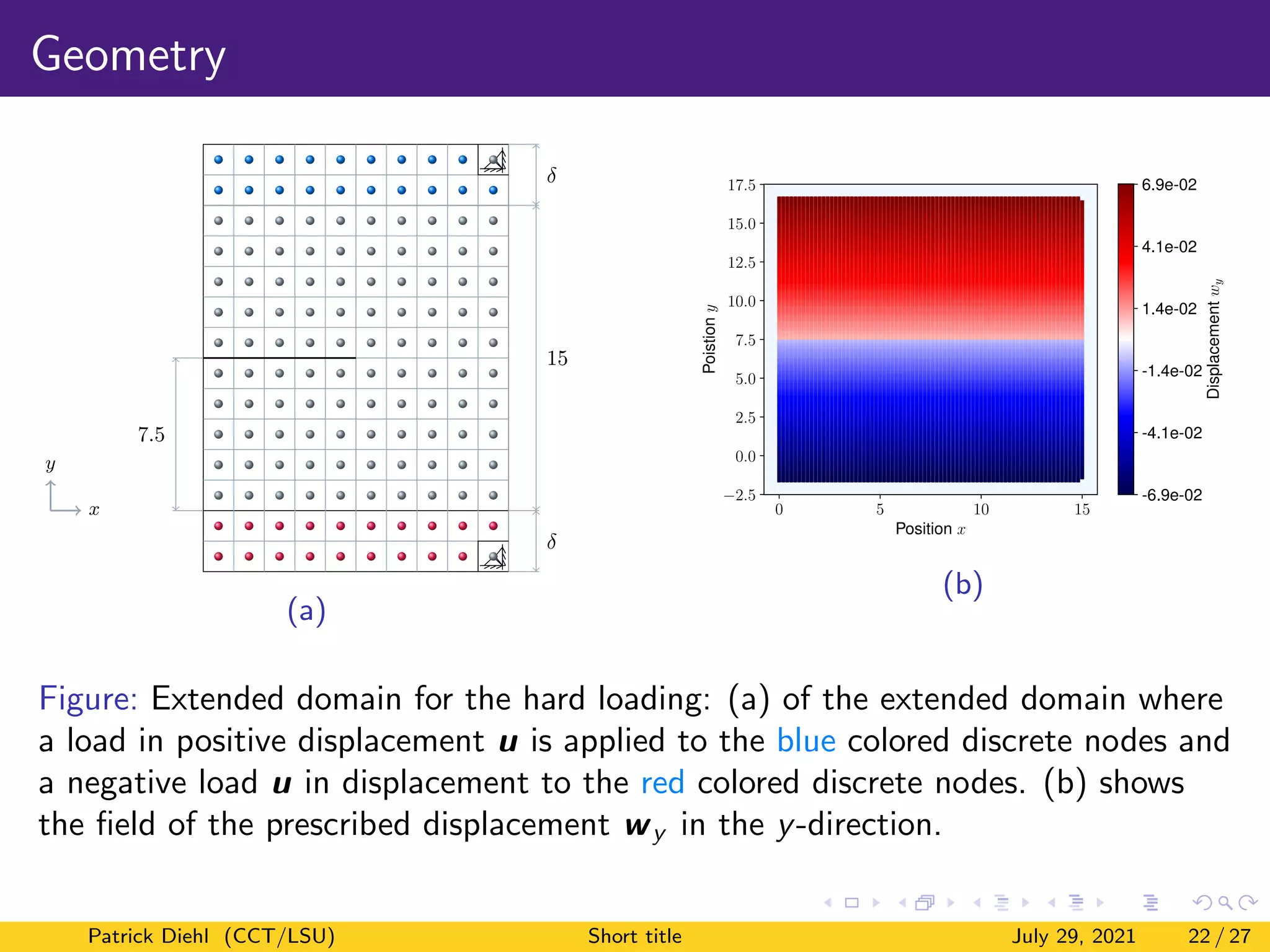
Figure: Extended domain for the hard loading: (a) of the extended domain where
a load in positive displacement u is applied to the blue colored discrete nodes and
a negative load u in displacement to the red colored discrete nodes. (b) shows
the field of the prescribed displacement wy in the y-direction.
Patrick Diehl (CCT/LSU) Short title July 29, 2021 22 / 27
Linear regime
0 5 10 15
Position x
0.0
2.5
5.0
7.5
10.0
12.5
15.0
Poistion
y
0.0e+00
1.3e+00
2.6e+00
3.8e+00
5.1e+00
6.4e+00
Damage
(a)
0 5 10 15
Position x
0.0
2.5
5.0
7.5
10.0
12.5
15.0
Poistion
y
0.0e+00
1.3e+00
2.6e+00
3.8e+00
5.1e+00
6.4e+00
Damage
(b)
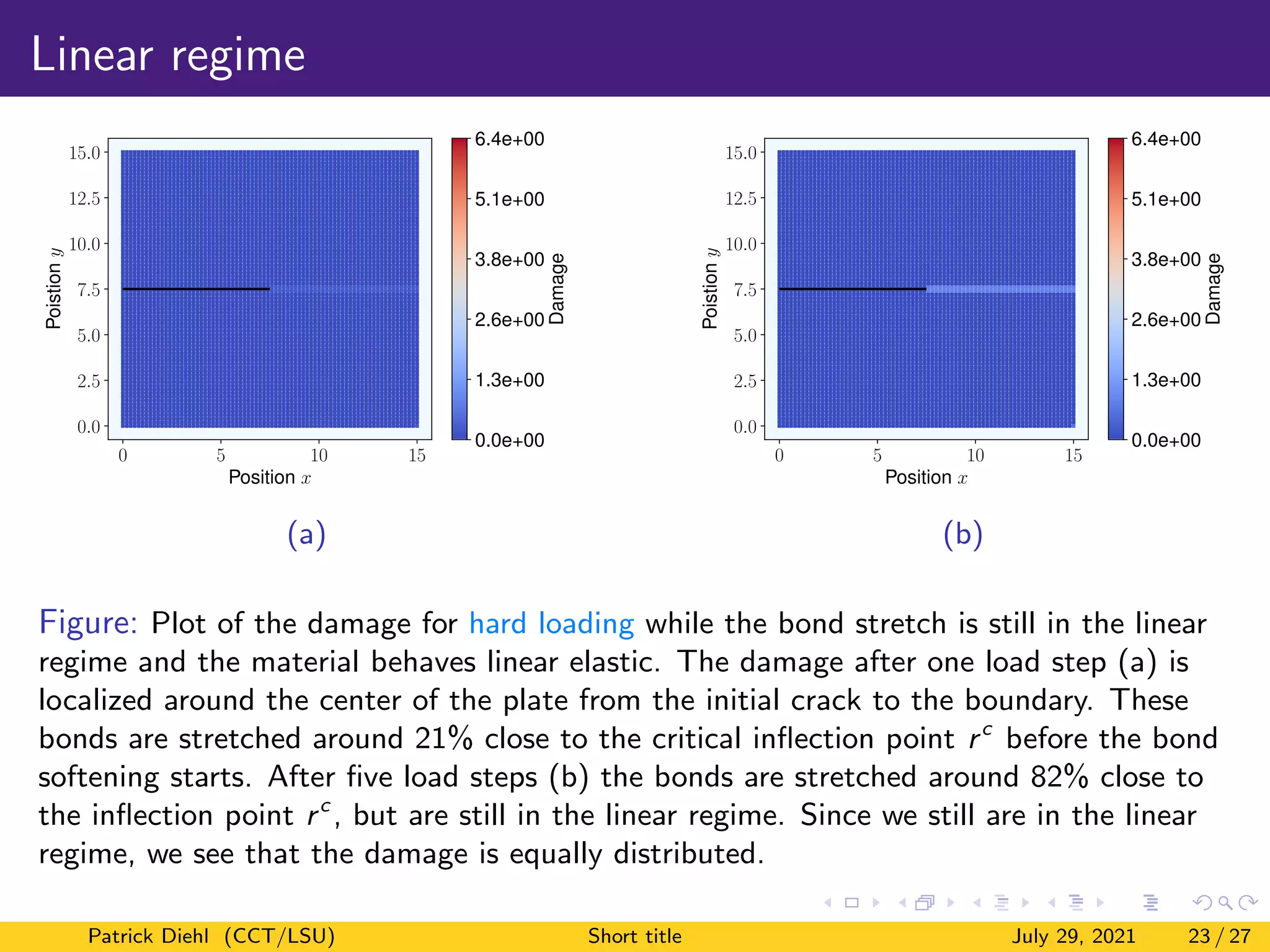
Figure: Plot of the damage for hard loading while the bond stretch is still in the linear
regime and the material behaves linear elastic. The damage after one load step (a) is
localized around the center of the plate from the initial crack to the boundary. These
bonds are stretched around 21% close to the critical inflection point rc
before the bond
softening starts. After five load steps (b) the bonds are stretched around 82% close to
the inflection point rc
, but are still in the linear regime. Since we still are in the linear
regime, we see that the damage is equally distributed.
Patrick Diehl (CCT/LSU) Short title July 29, 2021 23 / 27
Softening but no crack growth
0 5 10 15
Position x
0.0
2.5
5.0
7.5
10.0
12.5
15.0
Poistion
y
0.0e+00
1.3e+00
2.6e+00
3.8e+00
5.1e+00
6.4e+00
Damage
(a)
0 5 10 15
Position x
0.0
2.5
5.0
7.5
10.0
12.5
15.0
Poistion
y
0.0e+00
1.3e+00
2.6e+00
3.8e+00
5.1e+00
6.4e+00
Damage
(b)
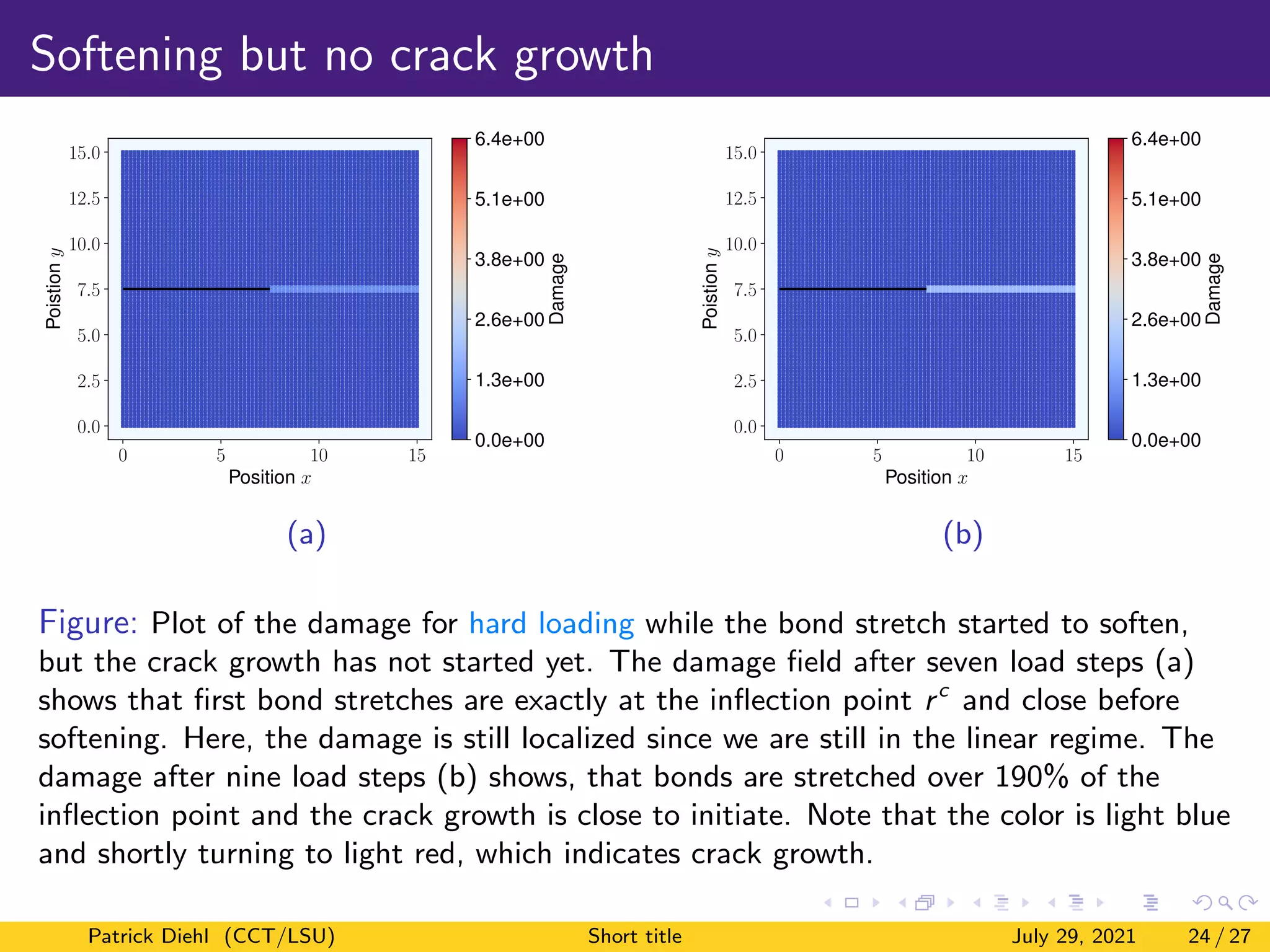
Figure: Plot of the damage for hard loading while the bond stretch started to soften,
but the crack growth has not started yet. The damage field after seven load steps (a)
shows that first bond stretches are exactly at the inflection point rc
and close before
softening. Here, the damage is still localized since we are still in the linear regime. The
damage after nine load steps (b) shows, that bonds are stretched over 190% of the
inflection point and the crack growth is close to initiate. Note that the color is light blue
and shortly turning to light red, which indicates crack growth.
Patrick Diehl (CCT/LSU) Short title July 29, 2021 24 / 27
Crack growth
0 5 10 15
Position x
0.0
2.5
5.0
7.5
10.0
12.5
15.0
Poistion
y
0.0e+00
1.3e+00
2.6e+00
3.8e+00
5.1e+00
6.4e+00
Damage
(a)
0 5 10 15
Position x
0.0
2.5
5.0
7.5
10.0
12.5
15.0
Poistion
y
0.0e+00
1.3e+00
2.6e+00
3.8e+00
5.1e+00
6.4e+00
Damage
(b)
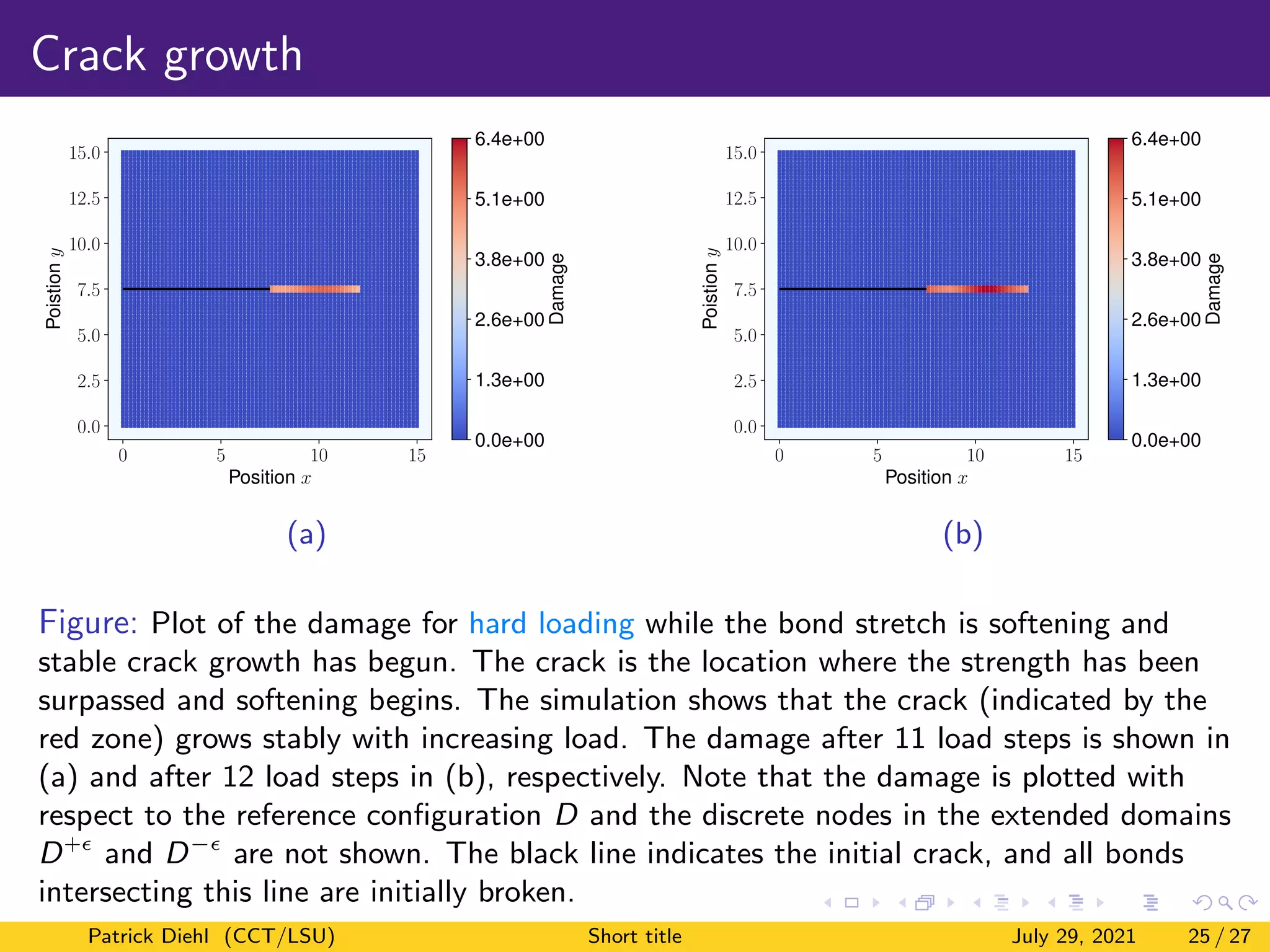
Figure: Plot of the damage for hard loading while the bond stretch is softening and
stable crack growth has begun. The crack is the location where the strength has been
surpassed and softening begins. The simulation shows that the crack (indicated by the
red zone) grows stably with increasing load. The damage after 11 load steps is shown in
(a) and after 12 load steps in (b), respectively. Note that the damage is plotted with
respect to the reference configuration D and the discrete nodes in the extended domains
D+
and D−
are not shown. The black line indicates the initial crack, and all bonds
intersecting this line are initially broken.
Patrick Diehl (CCT/LSU) Short title July 29, 2021 25 / 27
Conclusion and Outlook
Patrick Diehl (CCT/LSU) Short title July 29, 2021 26 / 27
Conclusion and Outlook
Conclusion
1 The analytic derivation of the tangent stiffness matrix using bond
softening instead of bond breaking.
2 Stable crack growth using hard loading and unstable crack growth
using soft loading.
Note that this was just a proof of concept for this approach!
Outlook
1 Get the derivation of the analytic tangent stiffness matrix for the
state-based RNP.
2 Implement the prototype in the massive parallel C++ code.
3 Run complex geometries and compare against experimental results.
Patrick Diehl (CCT/LSU) Short title July 29, 2021 27 / 27

Quasistatic Fracture using Nonliner-Nonlocal Elastostatics with an Analytic Tangent Stiffness Matrix

  • 1.
    Quasistatic Fracture usingNonliner-Nonlocal Elastostatics with an Analytic Tangent Stiffness Matrix Patrick Diehl joint work with Robert Lipton Center of Computation & Technology patrickdiehl@lsu.edu July 29, 2021 Patrick Diehl (CCT/LSU) Short title July 29, 2021 1 / 27
  • 2.
    Motivation Observation Not many quasi-staticperidynamic simulations are available due to the high computational cost in assembling the tangent stiffness matrix using numerical derivations [1]. Question’s asked 1 Can we use bond softening instead of bond breaking to get some analytic tangent stiffness matrix? 2 Can we apply hard loading to get stable crack growth? References 1 Diehl, Patrick, et al. ”A comparative review of peridynamics and phase-field models for engineering fracture mechanics.” (2021). Patrick Diehl (CCT/LSU) Short title July 29, 2021 2 / 27
  • 3.
    Overview 1 Regularized nonlinearpairwise (RNP) potential 2 Derivation of the analytic tangent stiffness matrix 3 Discretization 4 Algorithms 5 Numerical results Soft loading Hard loading 6 Conclusion and Outlook Patrick Diehl (CCT/LSU) Short title July 29, 2021 3 / 27
  • 4.
    Regularized nonlinear pairwise(RNP) potential Patrick Diehl (CCT/LSU) Short title July 29, 2021 4 / 27
  • 5.
    Peridynamic equation ofmotion Balance of linear momentum (dynamic) ρutt(x, t) = Z H(x) f (y, x) dy + b(x, t) Now, we assume the rate of loading is slow enough that the effect of inertia term is negligible. Balance of linear momentum (quasi-static) Z H(x) f (y, x) dy + b(x, t) = 0. The parameter t which was the time before is not controlling the load. Patrick Diehl (CCT/LSU) Short title July 29, 2021 5 / 27
  • 6.
    RNP model thebond force In the RNP model the bond force f (x, y) is the derivative of the bond potential given by f (x, y) = 2∂S W (S(y, x, u(t)))ey−x , (1) where ∂S W (S(y, x, u(t))) = 1 d+1ωd J(|y − x|) |y − x| ∂S g( p |y − x|S(y, x, u(t))). (2) The tensile strain S between two points x, y in D along the direction ey−x is defined as S(y, x, u(t)) = u(y, t) − u(x, t) |y − x| · ey−x , (3) where ey−x = y−x |y−x| is a unit vector and “·” is the dot product. Patrick Diehl (CCT/LSU) Short title July 29, 2021 6 / 27
  • 7.
    RNP potential rc −rc r+ −r+ r g0 (r) Figure: Cohesiveforce. The force goes smoothly to zero at ±r+ . One of the example of g is: g(r) = C(1 − exp[−βr]) (4) where C, β are material dependent parameters. Patrick Diehl (CCT/LSU) Short title July 29, 2021 7 / 27
  • 8.
    Derivation of theanalytic tangent stiffness matrix Patrick Diehl (CCT/LSU) Short title July 29, 2021 8 / 27
  • 9.
    Quasi-static formulation For convenienceset L(u)(x) = Z H(x) f (y, x) dy. (5) We assume at t = 0 that there exists a displacement u0 = u(x, 0) and body force b(x, 0) for which the displacement is at equilibrium L(u0)(x) + b(x, 0) = 0, (6) and the quasistatic evolution u(x, t) : D × [0, T] → Rd is given by L(u)(x) + b(x, t) = 0. (7) for a prescribed load path b(x, t) : D × [0, T] → Rd . Patrick Diehl (CCT/LSU) Short title July 29, 2021 9 / 27
  • 10.
    Derivation of thetangent stiffness matrix I We next derive the formula for H(u)[w]. Substituting 1 into 5, and taking u = u0 + w, we have L(u0 + w)(x) = 2 d+1ωd Z D∩H(x) J(|y − x|) p |y − x| g0 ( p |y − x|S(y, x, u0 + w))ey−x dy, (8) From the definition of S in 3, we have S(y, x; u0 + w) = S(y, x; u0) + S(y, x; w). (9) Let us do a Taylor expansion for the first derivative of the potential h g0 ( p |y − x|S(y, x; u0 + w)) = g0 ( p |y − x|S(y, x; u0)) + g00 ( p |y − x|S(y, x; u0)) p |y − x|S(y, x; w) + O(||w||2 ). (10) Patrick Diehl (CCT/LSU) Short title July 29, 2021 10 / 27
  • 11.
    Derivation of thetangent stiffness matrix II Substituting the above in 8, we get L(u0 + w)(x) = L(u0)(x) + 2 d+1ωd Z D∩H(x) J(|y − x|) p |y − x| g00 ( p |y − x|S(y, x; u0)) p |y − x|S(y, x; w) + O(||w||2 ). (11) H(u0)[w](x) = 2 d+1ωd Z D∩H(x) J (|y − x|)g00 ( p |y − x| S(y, x; u0))S(y, x; w)ey−x dy (12) Note that H(u0)[w] is linear in w. Patrick Diehl (CCT/LSU) Short title July 29, 2021 11 / 27
  • 12.
    Discretization Patrick Diehl (CCT/LSU)Short title July 29, 2021 12 / 27
  • 13.
    Discrete tangent stiffnessmatrix We use a collocation approach and write the discretized system as K(Uk−1 )∆U = Fk−1 , (13) where Uk−1, ∆U, Fk−1 = F(Uk−1) are discrete displacement vector at previous iteration k − 1, increment of the displacement in the current iteration, and force vector. For the entries of the force vector, we have Fk−1 i = F(Uk−1 )i = −b(xi ) − L(Uk−1 )(xi ). (14) Patrick Diehl (CCT/LSU) Short title July 29, 2021 13 / 27
  • 14.
    Discrete tangent stiffnessmatrix It remains to show the form of the tangent matrix K which depends on the solution Uk−1 from the previous iteration. We suppress the dependence of K on Uk−1, and write K(u) =              K1,1 K1,2 . . . K1,N−1 K1,N K2,1 K2,2 . . . K2,N−1 K2,N . . . . . . . . . . . . . . . . . . . . . . . . . . . . . . . . . . . . . . . . . . . . . KN−1,1 KN,2 ... KN−1,N−1 KN,N−1 KN,1 KN,2 ... KN−1,N KN,N              , (13) where each entry Kij is a d × d matrix where d = 1, 2, 3 is the dimension of the problem. Patrick Diehl (CCT/LSU) Short title July 29, 2021 13 / 27
  • 15.
    Discrete tangent stiffnessmatrix For the sub matrices, we have Kij =    Aij , if i 6= j, P xk ∈H(xk ), xj 6=xi Aik, if i = j, (13) where second order tensor Aij is given by Aij ≡ Aij (uk−1 ) = 2 d+1ωd J(|xj − xi |) |xj − xi | g00 ( q |xj − xi |S(xj , xi ; uk−1 )) ⊗ Exj −xi Vj , (14) when i 6= j, and Aii = 0. Here by the notation S(xj , xi ; uk−1) we mean S(xj , xi ; uk−1 ) = uk−1 j − uk−1 i |xj − xi | · xj − xi |xj − xi | , (15) Patrick Diehl (CCT/LSU) Short title July 29, 2021 13 / 27
  • 16.
    Algorithms Patrick Diehl (CCT/LSU)Short title July 29, 2021 14 / 27
  • 17.
    Soft loading 1: Definethe external force density b, tolerance δ, and perturbation τ 2: Guess the initial displacement u0 3: Compute the residual r = |F| //Equation (14) 4: while r ≥ δ do 5: Assemble the tangent stiffness matrix K(u) ∈ Rd·N×d·N 6: Remove all columns/rows in K for nodes with prescribed displacement 7: Remove all entries in F for nodes with prescribed displacement 8: Solve the reduced system K∆u = F 9: u+ = ∆u 10: r = kF| 11: end while Patrick Diehl (CCT/LSU) Short title July 29, 2021 15 / 27
  • 18.
    Hard loading 1: Definethe tolerance δ and the load in displacement ±w 2: Extend the domain D by a layer of horizon size ± 3: Guess the initial displacement u0 4: Initialize the prescribed displacement w 5: Compute the residual r = kwD+ k + kwD+ k − kuD+ 0 k + kuD+ 0 k 6: while r ≥ δ do 7: Compute F = L(u + w) 8: Assemble the tangent stiffness matrix K(u) ∈ Rd·(N+/h)×d·(N+/h) 9: Remove all columns/rows in K for nodes with prescribed displacement 10: Remove all entries in F for nodes with prescribed displacement 11: Solve the reduced system K∆u = F 12: u+ = ∆u 13: r = kwD+ k + kwD+ k − kuD+ k + kuD+ k 14: end while Patrick Diehl (CCT/LSU) Short title July 29, 2021 16 / 27
  • 19.
    Numerical results Patrick Diehl(CCT/LSU) Short title July 29, 2021 17 / 27
  • 20.
    Geometry for softloading y x 15 7.5 δ δ −F−F F F Figure: Sketch of the two-dimensional pre-cracked square plate with an initial crack from the mid of the left-hand side to the center of the plate. All nodes in a square of horizon size δ at the lower right and upper right corner are fixed in displacement in both directions. On the lower left and the upper left, an external force in y-direction is applied to all nodes within a rectangle of size δ × 2δ. Patrick Diehl (CCT/LSU) Short title July 29, 2021 18 / 27
  • 21.
    Linear regime 0 510 15 Position x 0.0 2.5 5.0 7.5 10.0 12.5 15.0 Poistion y 0.0e+00 1.7e+00 3.3e+00 5.0e+00 6.6e+00 8.3e+00 Damage (a) 0 5 10 15 Position x 0.0 2.5 5.0 7.5 10.0 12.5 15.0 Poistion y 0.0e+00 1.7e+00 3.3e+00 5.0e+00 6.6e+00 8.3e+00 Damage (b) Figure: Plot of the damage for soft loading. The color map is chosen such that dark blue indicates no damage, light red indicates crack growth started, and dark red indicates that bonds are fully softened to zero. The damage after one load step (a) with F1 = ±4 × 10⁶ N some bonds are stretched up to 1.1% to the inflection point rc before softening starts, and we can not see the damage yet. The damage after six load steps (b) with F6 = ±24 × 106 N and the bonds are stretched around 7.2% close to the inflection point rc , but are still in the linear regime. The damage is localized around the tip of the initial crack. Patrick Diehl (CCT/LSU) Short title July 29, 2021 19 / 27
  • 22.
    Softening but nocrack growth 0 5 10 15 Position x 0.0 2.5 5.0 7.5 10.0 12.5 15.0 Poistion y 0.0e+00 1.7e+00 3.3e+00 5.0e+00 6.6e+00 8.3e+00 Damage (a) 0 5 10 15 Position x 0.0 2.5 5.0 7.5 10.0 12.5 15.0 Poistion y 0.0e+00 1.7e+00 3.3e+00 5.0e+00 6.6e+00 8.3e+00 Damage (b) Figure: Plot of the damage for soft loading. The color map is chosen such that dark blue indicates no damage, light red indicates crack growth started, and dark red indicates that bonds are fully softened to zero. The damage field after nine load steps (a) with F9 = 36 × 106 N shows that first bond stretches are at 140% and exceeding the inflection point rc and are softening. Here, the damage is still localized in a layer of horizon size δ at the tip of the initial crack. The damage after eleven load steps (b) with F11 = 44 × 106 N shows, that bonds are still softening, but crack growth has not yet begun. Note that the color is light blue and shortly turning to light red, which indicates crack growth. Patrick Diehl (CCT/LSU) Short title July 29, 2021 20 / 27
  • 23.
    Crack growth 0 510 15 Position x 0.0 2.5 5.0 7.5 10.0 12.5 15.0 Poistion y 0.0e+00 1.7e+00 3.3e+00 5.0e+00 6.6e+00 8.3e+00 Damage (a) 0 5 10 15 Position x 0.0 2.5 5.0 7.5 10.0 12.5 15.0 Poistion y 0.0e+00 1.7e+00 3.3e+00 5.0e+00 6.6e+00 8.3e+00 Damage (b) Figure: Damage for soft loading. The crack is the location where the strength has been surpassed and softening begins. The simulation shows that the crack (indicated by the red zone) grows unstable with increasing load. The damage after twelve load steps with F12 = 44.4N is shown in (a) and after 21 load steps with F21 = 44.436N in (b), respectively. We had to reduce the load in force since the large force resulted in an unstable matrix. At some point, the matrix kept unstable while decreasing the load further, which conforms with the theory that soft loading is more likely to result in unstable crack growth. Note that the damage is plotted with respect to the reference configuration D. The white line indicates the initial crack, and all bonds intersecting Patrick Diehl (CCT/LSU) Short title July 29, 2021 21 / 27
  • 24.
    Geometry y x 15 δ δ 7.5 (a) 0 5 1015 Position x −2.5 0.0 2.5 5.0 7.5 10.0 12.5 15.0 17.5 Poistion y -6.9e-02 -4.1e-02 -1.4e-02 1.4e-02 4.1e-02 6.9e-02 Displacement w y (b) Figure: Extended domain for the hard loading: (a) of the extended domain where a load in positive displacement u is applied to the blue colored discrete nodes and a negative load u in displacement to the red colored discrete nodes. (b) shows the field of the prescribed displacement wy in the y-direction. Patrick Diehl (CCT/LSU) Short title July 29, 2021 22 / 27
  • 25.
    Linear regime 0 510 15 Position x 0.0 2.5 5.0 7.5 10.0 12.5 15.0 Poistion y 0.0e+00 1.3e+00 2.6e+00 3.8e+00 5.1e+00 6.4e+00 Damage (a) 0 5 10 15 Position x 0.0 2.5 5.0 7.5 10.0 12.5 15.0 Poistion y 0.0e+00 1.3e+00 2.6e+00 3.8e+00 5.1e+00 6.4e+00 Damage (b) Figure: Plot of the damage for hard loading while the bond stretch is still in the linear regime and the material behaves linear elastic. The damage after one load step (a) is localized around the center of the plate from the initial crack to the boundary. These bonds are stretched around 21% close to the critical inflection point rc before the bond softening starts. After five load steps (b) the bonds are stretched around 82% close to the inflection point rc , but are still in the linear regime. Since we still are in the linear regime, we see that the damage is equally distributed. Patrick Diehl (CCT/LSU) Short title July 29, 2021 23 / 27
  • 26.
    Softening but nocrack growth 0 5 10 15 Position x 0.0 2.5 5.0 7.5 10.0 12.5 15.0 Poistion y 0.0e+00 1.3e+00 2.6e+00 3.8e+00 5.1e+00 6.4e+00 Damage (a) 0 5 10 15 Position x 0.0 2.5 5.0 7.5 10.0 12.5 15.0 Poistion y 0.0e+00 1.3e+00 2.6e+00 3.8e+00 5.1e+00 6.4e+00 Damage (b) Figure: Plot of the damage for hard loading while the bond stretch started to soften, but the crack growth has not started yet. The damage field after seven load steps (a) shows that first bond stretches are exactly at the inflection point rc and close before softening. Here, the damage is still localized since we are still in the linear regime. The damage after nine load steps (b) shows, that bonds are stretched over 190% of the inflection point and the crack growth is close to initiate. Note that the color is light blue and shortly turning to light red, which indicates crack growth. Patrick Diehl (CCT/LSU) Short title July 29, 2021 24 / 27
  • 27.
    Crack growth 0 510 15 Position x 0.0 2.5 5.0 7.5 10.0 12.5 15.0 Poistion y 0.0e+00 1.3e+00 2.6e+00 3.8e+00 5.1e+00 6.4e+00 Damage (a) 0 5 10 15 Position x 0.0 2.5 5.0 7.5 10.0 12.5 15.0 Poistion y 0.0e+00 1.3e+00 2.6e+00 3.8e+00 5.1e+00 6.4e+00 Damage (b) Figure: Plot of the damage for hard loading while the bond stretch is softening and stable crack growth has begun. The crack is the location where the strength has been surpassed and softening begins. The simulation shows that the crack (indicated by the red zone) grows stably with increasing load. The damage after 11 load steps is shown in (a) and after 12 load steps in (b), respectively. Note that the damage is plotted with respect to the reference configuration D and the discrete nodes in the extended domains D+ and D− are not shown. The black line indicates the initial crack, and all bonds intersecting this line are initially broken. Patrick Diehl (CCT/LSU) Short title July 29, 2021 25 / 27
  • 28.
    Conclusion and Outlook PatrickDiehl (CCT/LSU) Short title July 29, 2021 26 / 27
  • 29.
    Conclusion and Outlook Conclusion 1The analytic derivation of the tangent stiffness matrix using bond softening instead of bond breaking. 2 Stable crack growth using hard loading and unstable crack growth using soft loading. Note that this was just a proof of concept for this approach! Outlook 1 Get the derivation of the analytic tangent stiffness matrix for the state-based RNP. 2 Implement the prototype in the massive parallel C++ code. 3 Run complex geometries and compare against experimental results. Patrick Diehl (CCT/LSU) Short title July 29, 2021 27 / 27