Oncologic Emergencies Dr. Jonathan Klein Resident, Radiation Oncology University of Toronto
Outline Spinal Cord Compression Brain Metastases Superior Vena Cava Obstruction Febrile Neutropenia Hypercalcemia Tumour Lysis Syndrome
Spinal Cord Compression Meyering SM.  The Internet Journal of Nuclear Medicine. 5(1); 2008.
Spinal Cord Compression Major emergency requiring radiation treatment Can lead to permanent neurologic dysfunction Ambulatory status is most important prognostic feature 80-90% of patients ambulatory at treatment retain function Usually compression from tumour Can be 1 º  or 2 º Also hematoma, abscess, etc. 1) Quint et al. JAMA. 2000 Feb 16;283(7):853-5.
Spinal Cord Compression 2.5–5.0% of patients have spinal cord compression (SCC) within the last 2 years of illness. Prostate, breast cancer, lung cancer most common each ~15–20% NHL, multiple myeloma, and renal cancer  ~5–10% of patients Men 40-60 years with prostate cancer = 17% incidence Thoracic spine affected in 60-80% of cases 50% present with disease in multiple spinal areas 1.Loblaw et al. Clin Oncol 2003; 15: 211–17 2. Schiff et al. Lancet Oncology. January 2005; 6(1):15-24.
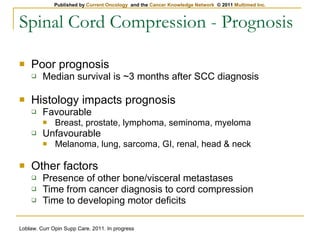
Spinal Cord Compression - Prognosis Poor prognosis Median survival is ~3 months after SCC diagnosis Histology impacts prognosis Favourable Breast, prostate, lymphoma, seminoma, myeloma Unfavourable Melanoma, lung, sarcoma, GI, renal, head & neck Other factors Presence of other bone/visceral metastases Time from cancer diagnosis to cord compression Time to developing motor deficits Loblaw. Curr Opin Supp Care. 2011. In progress
Signs/Symptoms New onset back pain Initially localized, typically increasing in intensity In particular: Pain that worsens when the patient is lying down Pain with percussion of vertebral bodies Weakness  60-85% of patients present with weakness ~2/3 are non-ambulatory at presentation Late neurologic signs are associated with permanent deficits such as paraplegia Urinary retention Loss of sensory function 1. Newton HB. Am Fam Physician 1999;59:878­8. 2. Quint DJ. JAMA 2000;283:853­5 3. Schiff et al. Lancet Oncology. January 2005:6(1);15-24.
Work-Up Non-contrast MRI of whole spine is best test  If MRI not available, can use Myelography/CT MRI is better because Multiplanar imaging No radiation  Contrast/needle not required to delineate lesions Can detect multiple lesion Should get whole spine MRI 97.6% sensitivity; 100.0% specificity Able to detect multi-level disease Biopsy if: metastatic disease not proven/documented  no previous diagnosis of cancer 1) Quint DJ. JAMA 2000;283(7):853­5.
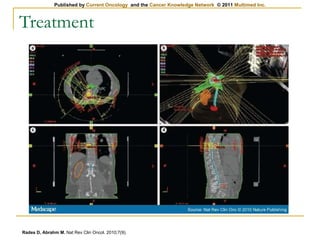
Treatment Rades D, Abrahm M.  Nat Rev Clin Oncol. 2010;7(9).
Treatment Corticosteroids Sorensen et al, 1994 Single blind RCT of high dose (96mg) dexamethasone vs. no steroids Ambulatory after treatment: 81% vs. 63% Ambulatory 6 months later: 59% vs 33% Life table analysis showed better ambulation course w/steroids (p<0.05). Little agreement on dose Vecht et al, 1989  No differences in pain, ambulation or bladder function between low and high dose steroids High dose may be associated with increased toxicity 1.Sorensen et al.  European Journal of Cancer   Volume 30, Issue 1 , 1994, Pages 22-27  2.Vecht et al. Neurology September 1989 39:1255.
Treatment Sample prescription 10mg dexamethasone IV bolus  4 mg IV q6h DO NOT delay while awaiting imaging results. Caveat: If lymphoma is suspected, consider withholding steroids until biopsy May interfere with biopsy results 1.Sorensen et al. Eur J Cancer. 1994; 30(1):22-27  2.Vecht et al. Neurology September 1989 39:1255.
However,… Caveat to the Caveat: Porter, 2008. Retrospective study of 109 patients Concluded that majority of diagnoses are NOT affected by steroids Consider clinical picture and give steroids if needed 1.Porter et al. Annals of Neurology.  May 2008:63(5);662-7.
Treatment Surgery/Radiotherapy If patient has survival expectancy >3 months and single region compression  Debulking/stabilization surgery Post-op radiotherapy If patient has multiple levels or is not a surgical candidate Radiotherapy alone
Patchell, 2005 Prospective trial  Surgery + 30Gy/10# RT  VS  30Gy/10# RT alone
Patchell, 2005 Patchell et al. Lancet,  Volume 366, Issue 9486 , Pages 643 - 648, 20 August 2005.
 
Patchel, 2005 Surgery group also required less pain meds and steroids Surgery  + RT RT alone Percent of patients able to walk after treatment (p=0.001) 84% 57% Time patients retained ambulation from treatment (p=0.003) 122 days 13 days Regained ambulation (pt’s unable to walk at treatment; p=0.01) 62% 19%
Patchell, 2005 Secondary endpoints:  1) Median overall survival:  126 days (Sx) vs 100 days (Sx+RT); p=0.033 2) Maintenance of continence   156 days (Sx) vs 17 days (Sx+RT); p=0.016
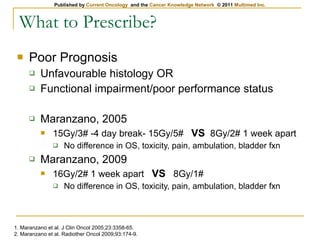
What to Prescribe? Poor Prognosis Unfavourable histology OR Functional impairment/poor performance status Maranzano, 2005 15Gy/3# -4 day break- 15Gy/5#  VS   8Gy/2# 1 week apart No difference in OS, toxicity, pain, ambulation, bladder fxn Maranzano, 2009 16Gy/2# 1 week apart  VS   8Gy/1# No difference in OS, toxicity, pain, ambulation, bladder fxn 1. Maranzano et al. J Clin Oncol 2005;23:3358-65. 2. Maranzano et al. Radiother Oncol 2009;93:174-9.
What to Prescribe? Non-surgical and Good Prognosis Rades (Score-1 study), 2009 231 patients to long vs short course RT Better 12 month progression free survival (72% vs 55%), 12 month local control (77% vs 61%) No improvement in overall survival Rades, 2004.   214 patients to 30Gy/10# in 2 weeks vs 40Gy/20 in 4 weeks Looked at functional outcomes No difference in motor function, ambulation, other outcomes 1. Rades et al. Int J Radiat Oncol Biol Phys 2009;73:228-34. 2. Rades et al. Cancer 2004;101:2687-92.
What to Prescribe? Other studies Sze et al, 2003.  Systematic review of 8Gy/1# vs multifraction RT No difference between treatment protocols Rades et al, 2005.  Retrospective study of 8Gy/1# vs 30Gy/10# Found no difference in symptoms between schedules  Rades et al, 2009.  Prospective study of short course RT (1,5#) vs long course (10,15,20#) Long course showed better 1yr local control (81% vs 61%).  No difference in overall survival or motor function   1.Sze et al. Clin Oncol (R Coll Radiol) 2003; 15: 345–52. 2. Hanson and Roach. Handbook of Evidence-Based Radiation Oncology, 2010. p684
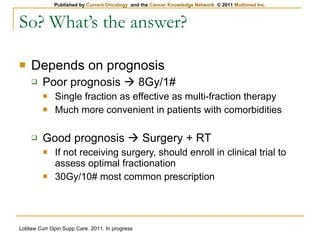
So? What’s the answer? Depends on prognosis Poor prognosis    8Gy/1# Single fraction as effective as multi-fraction therapy Much more convenient in patients with comorbidities Good prognosis    Surgery + RT If not receiving surgery, should enroll in clinical trial to assess optimal fractionation 30Gy/10# most common prescription Loblaw Curr Opin Supp Care. 2011. In progress
Brain Metastases Vallow LA. Nat Rev Clin Onc. July 2009. 6;377-378
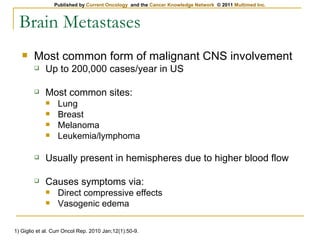
Brain Metastases Most common form of malignant CNS involvement Up to 200,000 cases/year in US Most common sites: Lung Breast Melanoma Leukemia/lymphoma Usually present in hemispheres due to higher blood flow Causes symptoms via: Direct compressive effects Vasogenic edema 1) Giglio et al. Curr Oncol Rep. 2010 Jan;12(1):50-9.
Clinical Presentation and Work Up Signs/symptoms depend on location of mets Common: Headaches Seizures Focal deficits (e.g. weakness) Work up includes Physical Exam delineate neurologic deficits CT head MR head Can show lesions too small for CT Better tissue contrast 1) Giglio et al. Curr Oncol Rep. 2010 Jan;12(1):50-9.
Brain Metastases - Treatment 1) Giglio et al. Curr Oncol Rep. 2010 Jan;12(1):50-9. Symptomatic treatment Anticonvulsants Non-enzyme inducing anticonvulsants are preferred Pregabalin (Lyrica) Levetiracetam Lacosamide Seizure prophylaxis is still performed, but no evidence Hemorrhagic mets more likely cause seizures Prophylaxis may be indicated in these cases Dexamethasone For vasogenic edema If severe edema, midline shift or herniation  consider HIGH DOSE (12-24mg daily)
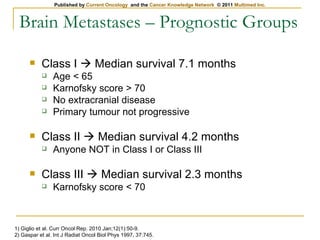
Brain Metastases – Prognostic Groups 1) Giglio et al. Curr Oncol Rep. 2010 Jan;12(1):50-9. 2) Gaspar et al. Int J Radiat Oncol Biol Phys 1997, 37:745. Class I    Median survival 7.1 months Age < 65 Karnofsky score > 70 No extracranial disease Primary tumour not progressive Class II    Median survival 4.2 months Anyone NOT in Class I or Class III Class III    Median survival 2.3 months Karnofsky score < 70
Karnofsky Score 100 – normal, no complaints, no signs of disease 90 – capable of normal activity, few symptoms or signs of disease 80 – normal activity with some difficulty, some symptoms or signs 70 – caring for self, not capable of normal activity or work i.e. independent for ADLs/IADLs 60 – requiring some help, can take care of most personal requirements 50 – requires help often, requires frequent medical care 40 – disabled, requires special care and help 30 – severely disabled, hospital admission indicated but no risk of death 20 – very ill, urgent admission needed, supportive measures or treatment 10 – moribund, rapidly progressive fatal disease processes 0 – death. Karnofsky DA, Burchenal JH. (1949). &quot;The Clinical Evaluation of Chemotherapeutic Agents in Cancer.&quot;  In: MacLeod CM (Ed),  Evaluation of Chemotherapeutic Agents.  Columbia Univ Press. Page 196.
Brain Metastases - Treatment 1) Giglio et al. Curr Oncol Rep. 2010 Jan;12(1):50-9. Definitive Treatment    Surgery and RT Limited role for chemo Radiotherapy options Whole Brain RT Indicated in class I and II with single mets post-surgery Palliative option in class III Stereotactic Radiosurgery
Brain Metastases - Treatment 1) Patchell et al. N Engl J Med 1990; 322:494–500.  2) Patchell et al. JAMA 1998;280(17):1485-9 Stereotactic Radiosurgery Oligometastases Standard Treatment = Surgery + WBRT Patchell, 1990  Surgery+WBRT vs biopsy+WBRT (48 patients) Less locoregional recurrence (20% vs. 520%),  Better overall survival (40 vs. 15 weeks)  Longer maintenance of function (38 vs. 8 weeks) Patchell, 1998 : Surgery vs Surgery+WBRT (95 patients) Less locoregional recurrence Less cause-specific mortality (14% vs. 44%) No difference in overall survival or maintenance of function
Brain Metastases - Treatment 1) Limbrick et al. Surg Neurol. 2009 Mar;71(3):280-8  2) Mintz et al. Cancer. 1996; 78, 1470–1476. Stereotactic Radiosurgery No RCTs comparing SRS vs. surgery head-to-head Oligometastases Mintz, 1996. Evaluated surgery + WBRT vs. WBRT alone No difference in overall survival (5.6 months vs. 6.3 months) Limbrick, 2009. Evaluated WBRT with surgery/SRS;  NOT  head-to-head design Overall median survival 20 months Quoted comparable results for surgery+WBRT and SRS+WBRT WBRT leads to faster onset of cognitive dysfunction Therefore, SRS can be used as first-line RT for 1-2 mets
Brain Metastases - Treatment 1) Chougule et al. Int J Rad Onc Biol Phys. January 2000:48(3),supplement 1; 114.  Stereotactic Radiosurgery Oligometastases Chougule, 2000. SRS vs SRS + WBRT vs WBRT alone ~half of patients also received surgical intervention No difference in overall survival between RT therapies 2 º  end-point: surgical resection provided survival benefit for patients who did not received SRS Local control: 87%, 91%, 62% Better in SRS arms New metastasis appearance: 43%, 19%, 23% Better in WBRT arms
Brain Metastases - Treatment Aoyama et al.  JAMA.  2006 Jun 7;295(21):2483-91 Chang et al. Lancet Oncology. 2009 Nov;10:1037-44.  Stereotactic Radiosurgery Oligometastases Aoyama, 2006. SRS vs WBRT + SRS for patients with 1-4 mets (each <3cm) Better 12 month local control (46.8% recurrence vs 76.4%) Less salvage treatment required (10/65 vs 29/67) No difference in overall survival or cause-specific mortality Chang, 2009  Tested earning and memory function in SRS+WBRT vs SRS alone with 1-3 mets (54 patient) Test stopped early due to unequivocal results SRS+WBRT patient had more cognitive decline (52%) SRS+WBRT had better locoregional control (73% vs 27%)
Brain Metastases - Treatment 1) Chargari et al. Nat Rev Clin Oncol. 2010 Nov;7(11):632-40. 2) Kondziolka et al. Int. J. Radiat. Oncol. Biol. Phys.1999:45;427–434. 3) Andrews et al. Lancet 2004:363;1665–1672. Multiple Metastases Not eligible for SRS and/or surgical intervention Whole Brain Radiotherapy is standard Provides short-term relief of neurologic symptoms in >70% Kondziolka, 1999. WBRT alone vs SRS + WBRT in 27 patients with 2-4 mets Better locoregional control (6 vs 36 months) No improvement in overall survival Andrews, RTOG 9508, 2004 SRS + WBRT vs WBRT alone in 331 patients with 1-3 mets Better locoregional control at 12 month followup (82% vs 71%) Overall survival improved ONLY with 1 metastasis No improvement in overall survival for 2-3 mets
Superior Vena Cava Obstruction http://www.lookfordiagnosis.com/mesh_info.php?term=Superior+Vena+Cava+Syndrome&lang=1
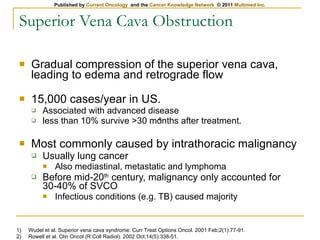
Superior Vena Cava Obstruction Gradual compression of the superior vena cava, leading to edema and retrograde flow 15,000 cases/year in US.  Associated with advanced disease less than 10% survive >30 months after treatment. Most commonly caused by intrathoracic malignancy Usually lung cancer  Also mediastinal, metastatic and lymphoma Before mid-20 th  century, malignancy only accounted for 30-40% of SVCO Infectious conditions (e.g. TB) caused majority º Wudel et al. Superior vena cava syndrome. Curr Treat Options Oncol. 2001 Feb;2(1):77-91. Rowell et al. Clin Oncol (R Coll Radiol). 2002 Oct;14(5):338-51.
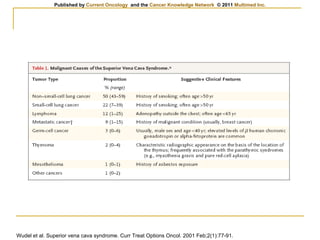
Wudel et al. Superior vena cava syndrome. Curr Treat Options Oncol. 2001 Feb;2(1):77-91.
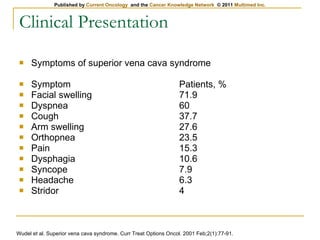
Clinical Presentation Symptoms of superior vena cava syndrome Symptom  Patients, % Facial swelling  71.9 Dyspnea  60 Cough  37.7 Arm swelling  27.6 Orthopnea  23.5 Pain  15.3 Dysphagia  10.6 Syncope  7.9 Headache  6.3 Stridor  4 Wudel et al. Superior vena cava syndrome. Curr Treat Options Oncol. 2001 Feb;2(1):77-91.
Clinical Presentation Physical signs of superior vena cava syndrome Signs  Patients, %  Dialated neck veins  70.1 Facial swelling  68.1 Prominent cutaneous veins  60.1 Arm swelling  41.3 Edema  30.5 Cyanosis  22.7 Vocal cord paralysis  4.7 Obtundation  1 Wudel et al. Superior vena cava syndrome. Curr Treat Options Oncol. 2001 Feb;2(1):77-91.
Clinical Presentation Average symptoms last ~45 days  90% note duration of symptoms less than 8 weeks Symptoms may improve spontaneously due to dilation of collateral circulation Higdon et al. Treatment of Oncologic Emergencies. American Family Physician. Volume 74, Number 11. December 1, 2006
Work Up SVCO is usually diagnosed CLINICALLY imaging (CT, plain XR, venography) can confirm Biopsy should be obtained to evaluate for benign conditions and sensitive tumours 1) Higdon et al. American Family Physician. Volume 74, Number 11. December 1, 2006 2) Wudel et al. Curr Treat Options Oncol. 2001 Feb;2(1):77-91.
Treatment Immediate treatment can consist of Supportive care including head and torso elevation Steroids Diuretics Definitive management Chemotherapy  Radiotherapy based on tumour type causing obstruction Options: 30Gy/10#, 20Gy/5#, 37.5Gy/15# Stent 1.Rowell et al. Clinical Oncology. Volume 14, Issue 5. October 2002, Pages 338-351  2. Higdon et al. Treatment of Oncologic Emergencies. American Family Physician. Volume 74, Number 11. December 1, 2006
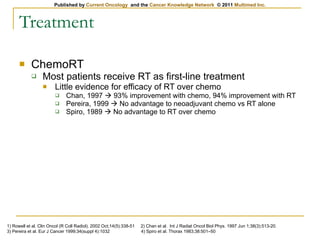
Treatment ChemoRT Most patients receive RT as first-line treatment Little evidence for efficacy of RT over chemo Chan, 1997    93% improvement with chemo, 94% improvement with RT Pereira, 1999    No advantage to neoadjuvant chemo vs RT alone Spiro, 1989    No advantage to RT over chemo 1) Rowell et al. Clin Oncol (R Coll Radiol). 2002 Oct;14(5):338-51  2) Chan et al.  Int J Radiat Oncol Biol Phys. 1997 Jun 1;38(3):513-20. 3) Pereira et al.  Eur J Cancer 1999;34(suppl 4):1032   4)  Spiro et al. Thorax 1983;38:501–50
Treatment Stents increasingly common Seem to be safe and effective No randomized trials yet of stenting vs. chemoRT Wilson, 2008. (PMH) Attempted to set up two head to head trials but failed Rowell, 2002: Systematic review  SVCO relief:  95% stent vs 77% chemoRT SVCO relapse: 11% stent vs 17% chemoRT 1) Spiro et al. Thorax 1983;38:501–50 2) Wilson et al. J Thorac Oncol. 2007 Jun;2(6):514-9. 3) Rowell et al. Clin Oncol (R Coll Radiol). 2002 Oct;14(5):338-51.
Febrile Neutropenia
Febrile Neutropenia Definition: Fever: Oral temperature  ≥ 38.3  without signs of noninfectious causes of increased temperature  OR temperature of  ≥  38.0 C twice, lasting for at least 1 h or measured twice within 12 h Neutropenia Neutrophil count <500/mm 3   OR Neutrophil count <1000/mm 3  with predicted decline to 500/ml within the next 2 days Link et al. Ann Hematol (2003) 82 (Suppl 2):S105–S117.
Febrile Neutropenia Can be bacterial or fungal Common condition At least 20% of patients with neutrophil counts < 100 mm 3  have bacteremia contributes to 50% of deaths associated with leukemia and lymphomas. Hughes et al. Clinical Infectious Diseases. 2002;34:730-51 Viscoli C. J Antimi­crob Chemother 1998;41(suppl D):S65­80.
Febrile Neutropenia Investigations cultures  CBC BUN/Cr transaminase measurements  If respiratory symptoms are present    CXR  may be clear due to lack of inflammatory response Can consider outpatient treatment of low risk patients >16 years old Hughes et al. Clinical Infectious Diseases. 2002;34:730-51
Hughes et al. Clinical Infectious Diseases. 2002;34:730-51. Febrile Neutropenia Assess risk level
Hughes et al. Clinical Infectious Diseases. 2002;34:730-51. Febrile Neutropenia
Hughes et al. Clinical Infectious Diseases. 2002;34:730-51. Febrile Neutropenia Initial treatment algorithm
Hughes et al. Clinical Infectious Diseases. 2002;34:730-51. Febrile Neutropenia Continuing treatment algorithm
Hughes et al. Clinical Infectious Diseases. 2002;34:730-51. Continuing treatment algorithm Febrile Neutropenia
Hypercalcemia
Hypercalcemia Presents in 20-30% of cancer patients Usually presents late, so poor prognosis Median survival of a few months Mechanisms:  ●  bone-resorbing cytokines ●   parathyroid hormone-related peptide  ●   tumor-mediated calcitriol production ●   ectopic parathyroid hormone secretion. 1) Lumachi et al. Curr Med Chem. 2008;15(4):415-21.
Sources of Hypercalcemia Lumachi et al. Curr Med Chem. 2008;15(4):415-21.
Hypercalcemia Symptoms  Bones Stones Grones Moans Bad prognosis Over 50 percent of patients die within 30 days of diagnosis of hypercalcemia Stewart AF. N Engl J Med 2005;352:373­9
Clinical Presentation Bones = MSK  weakness, myopathy, bone pain  Stones = renal/GU nephrolithiasis, renal insufficency, polyuria Groans = GI  constipation, anorexia, N/V Moans = CNS  hypertonia, confusion, obtundation, psychosis, ataxia, depression, coma Lumachi et al. Curr Med Chem. 2008;15(4):415-21.
Management of Hypercalcemia Hydration with normal saline Once hydrated: IV bisphosphonate (30-90mg pamidronate most commonly used) Pamidronate superior to most other bisphosphonates Fatemi, 1992. Vinholes, 1997. Pamidronate 60-90mg tolerated and effective in majority (60-100%). Nussbaum, 1993 4mg zolendronate has been shown to be superior to pamidronate Major, 2001. Bisphosphonates are superior to hydration alone Ralston, 2004.  1) Lumachi et al. Curr Med Chem. 2008;15(4):415-21. 2) Fatemi et al. Calcif. Tissue Int., 1992, 50, 1073) 3)  3)Vinholes et al. J. Clin. Oncol., 1997, 15, 131. 4) Major et al. J. Clin. Oncol., 2001, 19, 558. 5) Nussbaum et al. Am J Med. 1993 Sep;95(3):297-304. 6) Ralston et al. Calcif. Tissue Int., 2004, 74, 1.
Management of Hypercalcemia Other considerations Loop diuretic Only after volume status resolved Steroids May be effective with lymphoma and multiple myeloma due to direct anti-neoplastic activity Calcitonin Mithracin Dialysis if necessary 1) Stewart AF. N Engl J Med 2005;352:373­9 2) Lumachi et al. Curr Med Chem. 2008;15(4):415-21.
Tumour Lysis Syndrome
Tumour Lysis Syndrome Clinical presentation - variable GI: nausea, vomiting  Fluid imbalances: overload, edema, low urine Cardiac: CHF, arrhythmias  MSK: lethargy, cramps, tetany  Neuro: syncope, seizures, and sudden death.   GU: hematuria, flank or back pain Cairo et al. Tumour lysis syndrome: new therapeutic strategies and classification. British Journal of Haematology Volume 127, Issue 1. Pages 3–11, October 2004
Tumour Lysis Syndrome Acute cell lysis  may be caused by chemotherapy and radiation therapy.  Release of intracellular products overwhelms the homeostasis uric acid, phosphate, calcium, potassium More common among hematologic malignancies 3–7% incidence for acute leukemias  4–11% for lymphomas Certain leukemia patients have incidences up to 25% precursor B ALL, Burkitt’s lymphoma Can also occur in large or chemosensitive tumors Low incidence, unpredictable Mughal et al. Cancer Treatment Reviews (April 2010), 36 (2), pg. 164-176.
Tumour Lysis Syndrome - Definition Cairo–Bishop definition of laboratory tumour lysis syndrome: “ Either a 25% change or level above or below normal for  any two   or more serum values of uric acid, potassium, phosphate, and calcium  within  3 d before or 7 d after the initiation of chemotherapy.” Usually occurs 1-5 days after start of therapy Parameter Measurement Uric acid  476 mmol/l  OR 25% increase from baseline Potassium  6.0 mmol/l  OR 25% increase from baseline Phosphorous  1.45 mmol/l OR 25% increase from baseline Calcium  1.75 mmol/l OR 25% decrease from baseline Cairo et al. Tumour lysis syndrome: new therapeutic strategies and classification. British Journal of Haematology Volume 127, Issue 1. Pages 3–11, October 2004
Tumor Lysis Syndrome Definition Cairo-Bishop definition of clinical tumour lysis syndrome: Creatinine 1.5 x ULN Cardiac arrhythmia Seizure Cairo et al. British Journal of Haematology. October 2004:127(1); 3–11.
Tumour Lysis Syndrome - Risk Risk Assessment NHL   ALL  AML  CLL (x10 3  WBC/ μ L)    (x10 3  WBC/ μ L) High   Burkitt ≥ 100 ≥ 50 Lymphoblastic B-ALL Int   DLBCL 50-100 10-50    10-100   Tx w/fludarabine Low   Indolent NHL ≤ 50 ≤ 10   ≤ 10 Abu-Alfa et al. American Journal of Kidney Diseases (May 2010), 55 (5), Supplement 3, pg. S1-S13
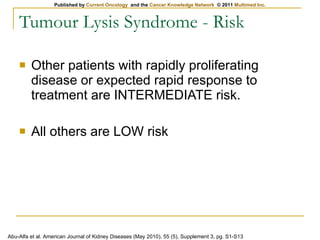
Tumour Lysis Syndrome - Risk Other patients with rapidly proliferating disease or expected rapid response to treatment are INTERMEDIATE risk.  All others are LOW risk Abu-Alfa et al. American Journal of Kidney Diseases (May 2010), 55 (5), Supplement 3, pg. S1-S13
Tumor Lysis Syndrome Preventive measures are critical Monitor electrolytes before and during treatment Fluids to maintain urine output >100 cc/hr Up to 3L/day/m 2  may be required Supplementation with diuretics to keep output high Controversial Should only be considered if adequate volume status confirmed Loop diuretics generally preferred Allopurinol or rasburicase may be used for treatment/prevention inhibits uric acid production and uropathy Hande et al. Am J Med. 1993 Feb;94(2):133-9.
Tumour Lysis Syndrome – Bottom Line Coiffier et al.  J Clin Oncol  , v.26 , p.2767 , 2008 , Coiffier B. et al. 
The End…..Finally!

Oncologic emergencies

  • 1.
    Oncologic Emergencies Dr.Jonathan Klein Resident, Radiation Oncology University of Toronto
  • 2.
    Outline Spinal CordCompression Brain Metastases Superior Vena Cava Obstruction Febrile Neutropenia Hypercalcemia Tumour Lysis Syndrome
  • 3.
    Spinal Cord CompressionMeyering SM. The Internet Journal of Nuclear Medicine. 5(1); 2008.
  • 4.
    Spinal Cord CompressionMajor emergency requiring radiation treatment Can lead to permanent neurologic dysfunction Ambulatory status is most important prognostic feature 80-90% of patients ambulatory at treatment retain function Usually compression from tumour Can be 1 º or 2 º Also hematoma, abscess, etc. 1) Quint et al. JAMA. 2000 Feb 16;283(7):853-5.
  • 5.
    Spinal Cord Compression2.5–5.0% of patients have spinal cord compression (SCC) within the last 2 years of illness. Prostate, breast cancer, lung cancer most common each ~15–20% NHL, multiple myeloma, and renal cancer ~5–10% of patients Men 40-60 years with prostate cancer = 17% incidence Thoracic spine affected in 60-80% of cases 50% present with disease in multiple spinal areas 1.Loblaw et al. Clin Oncol 2003; 15: 211–17 2. Schiff et al. Lancet Oncology. January 2005; 6(1):15-24.
  • 6.
    Spinal Cord Compression- Prognosis Poor prognosis Median survival is ~3 months after SCC diagnosis Histology impacts prognosis Favourable Breast, prostate, lymphoma, seminoma, myeloma Unfavourable Melanoma, lung, sarcoma, GI, renal, head & neck Other factors Presence of other bone/visceral metastases Time from cancer diagnosis to cord compression Time to developing motor deficits Loblaw. Curr Opin Supp Care. 2011. In progress
  • 7.
    Signs/Symptoms New onsetback pain Initially localized, typically increasing in intensity In particular: Pain that worsens when the patient is lying down Pain with percussion of vertebral bodies Weakness 60-85% of patients present with weakness ~2/3 are non-ambulatory at presentation Late neurologic signs are associated with permanent deficits such as paraplegia Urinary retention Loss of sensory function 1. Newton HB. Am Fam Physician 1999;59:878­8. 2. Quint DJ. JAMA 2000;283:853­5 3. Schiff et al. Lancet Oncology. January 2005:6(1);15-24.
  • 8.
    Work-Up Non-contrast MRIof whole spine is best test If MRI not available, can use Myelography/CT MRI is better because Multiplanar imaging No radiation Contrast/needle not required to delineate lesions Can detect multiple lesion Should get whole spine MRI 97.6% sensitivity; 100.0% specificity Able to detect multi-level disease Biopsy if: metastatic disease not proven/documented no previous diagnosis of cancer 1) Quint DJ. JAMA 2000;283(7):853­5.
  • 9.
    Treatment Rades D,Abrahm M. Nat Rev Clin Oncol. 2010;7(9).
  • 10.
    Treatment Corticosteroids Sorensenet al, 1994 Single blind RCT of high dose (96mg) dexamethasone vs. no steroids Ambulatory after treatment: 81% vs. 63% Ambulatory 6 months later: 59% vs 33% Life table analysis showed better ambulation course w/steroids (p<0.05). Little agreement on dose Vecht et al, 1989 No differences in pain, ambulation or bladder function between low and high dose steroids High dose may be associated with increased toxicity 1.Sorensen et al. European Journal of Cancer Volume 30, Issue 1 , 1994, Pages 22-27  2.Vecht et al. Neurology September 1989 39:1255.
  • 11.
    Treatment Sample prescription10mg dexamethasone IV bolus 4 mg IV q6h DO NOT delay while awaiting imaging results. Caveat: If lymphoma is suspected, consider withholding steroids until biopsy May interfere with biopsy results 1.Sorensen et al. Eur J Cancer. 1994; 30(1):22-27  2.Vecht et al. Neurology September 1989 39:1255.
  • 12.
    However,… Caveat tothe Caveat: Porter, 2008. Retrospective study of 109 patients Concluded that majority of diagnoses are NOT affected by steroids Consider clinical picture and give steroids if needed 1.Porter et al. Annals of Neurology. May 2008:63(5);662-7.
  • 13.
    Treatment Surgery/Radiotherapy Ifpatient has survival expectancy >3 months and single region compression Debulking/stabilization surgery Post-op radiotherapy If patient has multiple levels or is not a surgical candidate Radiotherapy alone
  • 14.
    Patchell, 2005 Prospectivetrial Surgery + 30Gy/10# RT VS 30Gy/10# RT alone
  • 15.
    Patchell, 2005 Patchellet al. Lancet,  Volume 366, Issue 9486 , Pages 643 - 648, 20 August 2005.
  • 16.
  • 17.
    Patchel, 2005 Surgerygroup also required less pain meds and steroids Surgery + RT RT alone Percent of patients able to walk after treatment (p=0.001) 84% 57% Time patients retained ambulation from treatment (p=0.003) 122 days 13 days Regained ambulation (pt’s unable to walk at treatment; p=0.01) 62% 19%
  • 18.
    Patchell, 2005 Secondaryendpoints: 1) Median overall survival: 126 days (Sx) vs 100 days (Sx+RT); p=0.033 2) Maintenance of continence 156 days (Sx) vs 17 days (Sx+RT); p=0.016
  • 19.
    What to Prescribe?Poor Prognosis Unfavourable histology OR Functional impairment/poor performance status Maranzano, 2005 15Gy/3# -4 day break- 15Gy/5# VS 8Gy/2# 1 week apart No difference in OS, toxicity, pain, ambulation, bladder fxn Maranzano, 2009 16Gy/2# 1 week apart VS 8Gy/1# No difference in OS, toxicity, pain, ambulation, bladder fxn 1. Maranzano et al. J Clin Oncol 2005;23:3358-65. 2. Maranzano et al. Radiother Oncol 2009;93:174-9.
  • 20.
    What to Prescribe?Non-surgical and Good Prognosis Rades (Score-1 study), 2009 231 patients to long vs short course RT Better 12 month progression free survival (72% vs 55%), 12 month local control (77% vs 61%) No improvement in overall survival Rades, 2004. 214 patients to 30Gy/10# in 2 weeks vs 40Gy/20 in 4 weeks Looked at functional outcomes No difference in motor function, ambulation, other outcomes 1. Rades et al. Int J Radiat Oncol Biol Phys 2009;73:228-34. 2. Rades et al. Cancer 2004;101:2687-92.
  • 21.
    What to Prescribe?Other studies Sze et al, 2003. Systematic review of 8Gy/1# vs multifraction RT No difference between treatment protocols Rades et al, 2005. Retrospective study of 8Gy/1# vs 30Gy/10# Found no difference in symptoms between schedules Rades et al, 2009. Prospective study of short course RT (1,5#) vs long course (10,15,20#) Long course showed better 1yr local control (81% vs 61%). No difference in overall survival or motor function 1.Sze et al. Clin Oncol (R Coll Radiol) 2003; 15: 345–52. 2. Hanson and Roach. Handbook of Evidence-Based Radiation Oncology, 2010. p684
  • 22.
    So? What’s theanswer? Depends on prognosis Poor prognosis  8Gy/1# Single fraction as effective as multi-fraction therapy Much more convenient in patients with comorbidities Good prognosis  Surgery + RT If not receiving surgery, should enroll in clinical trial to assess optimal fractionation 30Gy/10# most common prescription Loblaw Curr Opin Supp Care. 2011. In progress
  • 23.
    Brain Metastases VallowLA. Nat Rev Clin Onc. July 2009. 6;377-378
  • 24.
    Brain Metastases Mostcommon form of malignant CNS involvement Up to 200,000 cases/year in US Most common sites: Lung Breast Melanoma Leukemia/lymphoma Usually present in hemispheres due to higher blood flow Causes symptoms via: Direct compressive effects Vasogenic edema 1) Giglio et al. Curr Oncol Rep. 2010 Jan;12(1):50-9.
  • 25.
    Clinical Presentation andWork Up Signs/symptoms depend on location of mets Common: Headaches Seizures Focal deficits (e.g. weakness) Work up includes Physical Exam delineate neurologic deficits CT head MR head Can show lesions too small for CT Better tissue contrast 1) Giglio et al. Curr Oncol Rep. 2010 Jan;12(1):50-9.
  • 26.
    Brain Metastases -Treatment 1) Giglio et al. Curr Oncol Rep. 2010 Jan;12(1):50-9. Symptomatic treatment Anticonvulsants Non-enzyme inducing anticonvulsants are preferred Pregabalin (Lyrica) Levetiracetam Lacosamide Seizure prophylaxis is still performed, but no evidence Hemorrhagic mets more likely cause seizures Prophylaxis may be indicated in these cases Dexamethasone For vasogenic edema If severe edema, midline shift or herniation consider HIGH DOSE (12-24mg daily)
  • 27.
    Brain Metastases –Prognostic Groups 1) Giglio et al. Curr Oncol Rep. 2010 Jan;12(1):50-9. 2) Gaspar et al. Int J Radiat Oncol Biol Phys 1997, 37:745. Class I  Median survival 7.1 months Age < 65 Karnofsky score > 70 No extracranial disease Primary tumour not progressive Class II  Median survival 4.2 months Anyone NOT in Class I or Class III Class III  Median survival 2.3 months Karnofsky score < 70
  • 28.
    Karnofsky Score 100– normal, no complaints, no signs of disease 90 – capable of normal activity, few symptoms or signs of disease 80 – normal activity with some difficulty, some symptoms or signs 70 – caring for self, not capable of normal activity or work i.e. independent for ADLs/IADLs 60 – requiring some help, can take care of most personal requirements 50 – requires help often, requires frequent medical care 40 – disabled, requires special care and help 30 – severely disabled, hospital admission indicated but no risk of death 20 – very ill, urgent admission needed, supportive measures or treatment 10 – moribund, rapidly progressive fatal disease processes 0 – death. Karnofsky DA, Burchenal JH. (1949). &quot;The Clinical Evaluation of Chemotherapeutic Agents in Cancer.&quot; In: MacLeod CM (Ed),  Evaluation of Chemotherapeutic Agents.  Columbia Univ Press. Page 196.
  • 29.
    Brain Metastases -Treatment 1) Giglio et al. Curr Oncol Rep. 2010 Jan;12(1):50-9. Definitive Treatment  Surgery and RT Limited role for chemo Radiotherapy options Whole Brain RT Indicated in class I and II with single mets post-surgery Palliative option in class III Stereotactic Radiosurgery
  • 30.
    Brain Metastases -Treatment 1) Patchell et al. N Engl J Med 1990; 322:494–500. 2) Patchell et al. JAMA 1998;280(17):1485-9 Stereotactic Radiosurgery Oligometastases Standard Treatment = Surgery + WBRT Patchell, 1990 Surgery+WBRT vs biopsy+WBRT (48 patients) Less locoregional recurrence (20% vs. 520%), Better overall survival (40 vs. 15 weeks) Longer maintenance of function (38 vs. 8 weeks) Patchell, 1998 : Surgery vs Surgery+WBRT (95 patients) Less locoregional recurrence Less cause-specific mortality (14% vs. 44%) No difference in overall survival or maintenance of function
  • 31.
    Brain Metastases -Treatment 1) Limbrick et al. Surg Neurol. 2009 Mar;71(3):280-8 2) Mintz et al. Cancer. 1996; 78, 1470–1476. Stereotactic Radiosurgery No RCTs comparing SRS vs. surgery head-to-head Oligometastases Mintz, 1996. Evaluated surgery + WBRT vs. WBRT alone No difference in overall survival (5.6 months vs. 6.3 months) Limbrick, 2009. Evaluated WBRT with surgery/SRS; NOT head-to-head design Overall median survival 20 months Quoted comparable results for surgery+WBRT and SRS+WBRT WBRT leads to faster onset of cognitive dysfunction Therefore, SRS can be used as first-line RT for 1-2 mets
  • 32.
    Brain Metastases -Treatment 1) Chougule et al. Int J Rad Onc Biol Phys. January 2000:48(3),supplement 1; 114. Stereotactic Radiosurgery Oligometastases Chougule, 2000. SRS vs SRS + WBRT vs WBRT alone ~half of patients also received surgical intervention No difference in overall survival between RT therapies 2 º end-point: surgical resection provided survival benefit for patients who did not received SRS Local control: 87%, 91%, 62% Better in SRS arms New metastasis appearance: 43%, 19%, 23% Better in WBRT arms
  • 33.
    Brain Metastases -Treatment Aoyama et al. JAMA.  2006 Jun 7;295(21):2483-91 Chang et al. Lancet Oncology. 2009 Nov;10:1037-44. Stereotactic Radiosurgery Oligometastases Aoyama, 2006. SRS vs WBRT + SRS for patients with 1-4 mets (each <3cm) Better 12 month local control (46.8% recurrence vs 76.4%) Less salvage treatment required (10/65 vs 29/67) No difference in overall survival or cause-specific mortality Chang, 2009 Tested earning and memory function in SRS+WBRT vs SRS alone with 1-3 mets (54 patient) Test stopped early due to unequivocal results SRS+WBRT patient had more cognitive decline (52%) SRS+WBRT had better locoregional control (73% vs 27%)
  • 34.
    Brain Metastases -Treatment 1) Chargari et al. Nat Rev Clin Oncol. 2010 Nov;7(11):632-40. 2) Kondziolka et al. Int. J. Radiat. Oncol. Biol. Phys.1999:45;427–434. 3) Andrews et al. Lancet 2004:363;1665–1672. Multiple Metastases Not eligible for SRS and/or surgical intervention Whole Brain Radiotherapy is standard Provides short-term relief of neurologic symptoms in >70% Kondziolka, 1999. WBRT alone vs SRS + WBRT in 27 patients with 2-4 mets Better locoregional control (6 vs 36 months) No improvement in overall survival Andrews, RTOG 9508, 2004 SRS + WBRT vs WBRT alone in 331 patients with 1-3 mets Better locoregional control at 12 month followup (82% vs 71%) Overall survival improved ONLY with 1 metastasis No improvement in overall survival for 2-3 mets
  • 35.
    Superior Vena CavaObstruction http://www.lookfordiagnosis.com/mesh_info.php?term=Superior+Vena+Cava+Syndrome&lang=1
  • 36.
    Superior Vena CavaObstruction Gradual compression of the superior vena cava, leading to edema and retrograde flow 15,000 cases/year in US. Associated with advanced disease less than 10% survive >30 months after treatment. Most commonly caused by intrathoracic malignancy Usually lung cancer Also mediastinal, metastatic and lymphoma Before mid-20 th century, malignancy only accounted for 30-40% of SVCO Infectious conditions (e.g. TB) caused majority º Wudel et al. Superior vena cava syndrome. Curr Treat Options Oncol. 2001 Feb;2(1):77-91. Rowell et al. Clin Oncol (R Coll Radiol). 2002 Oct;14(5):338-51.
  • 37.
    Wudel et al.Superior vena cava syndrome. Curr Treat Options Oncol. 2001 Feb;2(1):77-91.
  • 38.
    Clinical Presentation Symptomsof superior vena cava syndrome Symptom Patients, % Facial swelling 71.9 Dyspnea 60 Cough 37.7 Arm swelling 27.6 Orthopnea 23.5 Pain 15.3 Dysphagia 10.6 Syncope 7.9 Headache 6.3 Stridor 4 Wudel et al. Superior vena cava syndrome. Curr Treat Options Oncol. 2001 Feb;2(1):77-91.
  • 39.
    Clinical Presentation Physicalsigns of superior vena cava syndrome Signs Patients, % Dialated neck veins 70.1 Facial swelling 68.1 Prominent cutaneous veins 60.1 Arm swelling 41.3 Edema 30.5 Cyanosis 22.7 Vocal cord paralysis 4.7 Obtundation 1 Wudel et al. Superior vena cava syndrome. Curr Treat Options Oncol. 2001 Feb;2(1):77-91.
  • 40.
    Clinical Presentation Averagesymptoms last ~45 days 90% note duration of symptoms less than 8 weeks Symptoms may improve spontaneously due to dilation of collateral circulation Higdon et al. Treatment of Oncologic Emergencies. American Family Physician. Volume 74, Number 11. December 1, 2006
  • 41.
    Work Up SVCOis usually diagnosed CLINICALLY imaging (CT, plain XR, venography) can confirm Biopsy should be obtained to evaluate for benign conditions and sensitive tumours 1) Higdon et al. American Family Physician. Volume 74, Number 11. December 1, 2006 2) Wudel et al. Curr Treat Options Oncol. 2001 Feb;2(1):77-91.
  • 42.
    Treatment Immediate treatmentcan consist of Supportive care including head and torso elevation Steroids Diuretics Definitive management Chemotherapy Radiotherapy based on tumour type causing obstruction Options: 30Gy/10#, 20Gy/5#, 37.5Gy/15# Stent 1.Rowell et al. Clinical Oncology. Volume 14, Issue 5. October 2002, Pages 338-351  2. Higdon et al. Treatment of Oncologic Emergencies. American Family Physician. Volume 74, Number 11. December 1, 2006
  • 43.
    Treatment ChemoRT Mostpatients receive RT as first-line treatment Little evidence for efficacy of RT over chemo Chan, 1997  93% improvement with chemo, 94% improvement with RT Pereira, 1999  No advantage to neoadjuvant chemo vs RT alone Spiro, 1989  No advantage to RT over chemo 1) Rowell et al. Clin Oncol (R Coll Radiol). 2002 Oct;14(5):338-51 2) Chan et al. Int J Radiat Oncol Biol Phys. 1997 Jun 1;38(3):513-20. 3) Pereira et al. Eur J Cancer 1999;34(suppl 4):1032 4) Spiro et al. Thorax 1983;38:501–50
  • 44.
    Treatment Stents increasinglycommon Seem to be safe and effective No randomized trials yet of stenting vs. chemoRT Wilson, 2008. (PMH) Attempted to set up two head to head trials but failed Rowell, 2002: Systematic review SVCO relief: 95% stent vs 77% chemoRT SVCO relapse: 11% stent vs 17% chemoRT 1) Spiro et al. Thorax 1983;38:501–50 2) Wilson et al. J Thorac Oncol. 2007 Jun;2(6):514-9. 3) Rowell et al. Clin Oncol (R Coll Radiol). 2002 Oct;14(5):338-51.
  • 45.
  • 46.
    Febrile Neutropenia Definition:Fever: Oral temperature ≥ 38.3 without signs of noninfectious causes of increased temperature OR temperature of ≥ 38.0 C twice, lasting for at least 1 h or measured twice within 12 h Neutropenia Neutrophil count <500/mm 3 OR Neutrophil count <1000/mm 3 with predicted decline to 500/ml within the next 2 days Link et al. Ann Hematol (2003) 82 (Suppl 2):S105–S117.
  • 47.
    Febrile Neutropenia Canbe bacterial or fungal Common condition At least 20% of patients with neutrophil counts < 100 mm 3 have bacteremia contributes to 50% of deaths associated with leukemia and lymphomas. Hughes et al. Clinical Infectious Diseases. 2002;34:730-51 Viscoli C. J Antimi­crob Chemother 1998;41(suppl D):S65­80.
  • 48.
    Febrile Neutropenia Investigationscultures CBC BUN/Cr transaminase measurements If respiratory symptoms are present  CXR may be clear due to lack of inflammatory response Can consider outpatient treatment of low risk patients >16 years old Hughes et al. Clinical Infectious Diseases. 2002;34:730-51
  • 49.
    Hughes et al.Clinical Infectious Diseases. 2002;34:730-51. Febrile Neutropenia Assess risk level
  • 50.
    Hughes et al.Clinical Infectious Diseases. 2002;34:730-51. Febrile Neutropenia
  • 51.
    Hughes et al.Clinical Infectious Diseases. 2002;34:730-51. Febrile Neutropenia Initial treatment algorithm
  • 52.
    Hughes et al.Clinical Infectious Diseases. 2002;34:730-51. Febrile Neutropenia Continuing treatment algorithm
  • 53.
    Hughes et al.Clinical Infectious Diseases. 2002;34:730-51. Continuing treatment algorithm Febrile Neutropenia
  • 54.
    Hughes et al.Clinical Infectious Diseases. 2002;34:730-51. Continuing treatment algorithm Febrile Neutropenia
  • 55.
  • 56.
    Hypercalcemia Presents in20-30% of cancer patients Usually presents late, so poor prognosis Median survival of a few months Mechanisms: ● bone-resorbing cytokines ● parathyroid hormone-related peptide ● tumor-mediated calcitriol production ● ectopic parathyroid hormone secretion. 1) Lumachi et al. Curr Med Chem. 2008;15(4):415-21.
  • 57.
    Sources of HypercalcemiaLumachi et al. Curr Med Chem. 2008;15(4):415-21.
  • 58.
    Hypercalcemia Symptoms Bones Stones Grones Moans Bad prognosis Over 50 percent of patients die within 30 days of diagnosis of hypercalcemia Stewart AF. N Engl J Med 2005;352:373­9
  • 59.
    Clinical Presentation Bones= MSK weakness, myopathy, bone pain Stones = renal/GU nephrolithiasis, renal insufficency, polyuria Groans = GI constipation, anorexia, N/V Moans = CNS hypertonia, confusion, obtundation, psychosis, ataxia, depression, coma Lumachi et al. Curr Med Chem. 2008;15(4):415-21.
  • 60.
    Management of HypercalcemiaHydration with normal saline Once hydrated: IV bisphosphonate (30-90mg pamidronate most commonly used) Pamidronate superior to most other bisphosphonates Fatemi, 1992. Vinholes, 1997. Pamidronate 60-90mg tolerated and effective in majority (60-100%). Nussbaum, 1993 4mg zolendronate has been shown to be superior to pamidronate Major, 2001. Bisphosphonates are superior to hydration alone Ralston, 2004. 1) Lumachi et al. Curr Med Chem. 2008;15(4):415-21. 2) Fatemi et al. Calcif. Tissue Int., 1992, 50, 1073) 3) 3)Vinholes et al. J. Clin. Oncol., 1997, 15, 131. 4) Major et al. J. Clin. Oncol., 2001, 19, 558. 5) Nussbaum et al. Am J Med. 1993 Sep;95(3):297-304. 6) Ralston et al. Calcif. Tissue Int., 2004, 74, 1.
  • 61.
    Management of HypercalcemiaOther considerations Loop diuretic Only after volume status resolved Steroids May be effective with lymphoma and multiple myeloma due to direct anti-neoplastic activity Calcitonin Mithracin Dialysis if necessary 1) Stewart AF. N Engl J Med 2005;352:373­9 2) Lumachi et al. Curr Med Chem. 2008;15(4):415-21.
  • 62.
  • 63.
    Tumour Lysis SyndromeClinical presentation - variable GI: nausea, vomiting Fluid imbalances: overload, edema, low urine Cardiac: CHF, arrhythmias MSK: lethargy, cramps, tetany Neuro: syncope, seizures, and sudden death.   GU: hematuria, flank or back pain Cairo et al. Tumour lysis syndrome: new therapeutic strategies and classification. British Journal of Haematology Volume 127, Issue 1. Pages 3–11, October 2004
  • 64.
    Tumour Lysis SyndromeAcute cell lysis may be caused by chemotherapy and radiation therapy. Release of intracellular products overwhelms the homeostasis uric acid, phosphate, calcium, potassium More common among hematologic malignancies 3–7% incidence for acute leukemias  4–11% for lymphomas Certain leukemia patients have incidences up to 25% precursor B ALL, Burkitt’s lymphoma Can also occur in large or chemosensitive tumors Low incidence, unpredictable Mughal et al. Cancer Treatment Reviews (April 2010), 36 (2), pg. 164-176.
  • 65.
    Tumour Lysis Syndrome- Definition Cairo–Bishop definition of laboratory tumour lysis syndrome: “ Either a 25% change or level above or below normal for any two or more serum values of uric acid, potassium, phosphate, and calcium within 3 d before or 7 d after the initiation of chemotherapy.” Usually occurs 1-5 days after start of therapy Parameter Measurement Uric acid 476 mmol/l OR 25% increase from baseline Potassium 6.0 mmol/l OR 25% increase from baseline Phosphorous 1.45 mmol/l OR 25% increase from baseline Calcium 1.75 mmol/l OR 25% decrease from baseline Cairo et al. Tumour lysis syndrome: new therapeutic strategies and classification. British Journal of Haematology Volume 127, Issue 1. Pages 3–11, October 2004
  • 66.
    Tumor Lysis SyndromeDefinition Cairo-Bishop definition of clinical tumour lysis syndrome: Creatinine 1.5 x ULN Cardiac arrhythmia Seizure Cairo et al. British Journal of Haematology. October 2004:127(1); 3–11.
  • 67.
    Tumour Lysis Syndrome- Risk Risk Assessment NHL ALL AML CLL (x10 3 WBC/ μ L) (x10 3 WBC/ μ L) High Burkitt ≥ 100 ≥ 50 Lymphoblastic B-ALL Int DLBCL 50-100 10-50 10-100 Tx w/fludarabine Low Indolent NHL ≤ 50 ≤ 10 ≤ 10 Abu-Alfa et al. American Journal of Kidney Diseases (May 2010), 55 (5), Supplement 3, pg. S1-S13
  • 68.
    Tumour Lysis Syndrome- Risk Other patients with rapidly proliferating disease or expected rapid response to treatment are INTERMEDIATE risk. All others are LOW risk Abu-Alfa et al. American Journal of Kidney Diseases (May 2010), 55 (5), Supplement 3, pg. S1-S13
  • 69.
    Tumor Lysis SyndromePreventive measures are critical Monitor electrolytes before and during treatment Fluids to maintain urine output >100 cc/hr Up to 3L/day/m 2 may be required Supplementation with diuretics to keep output high Controversial Should only be considered if adequate volume status confirmed Loop diuretics generally preferred Allopurinol or rasburicase may be used for treatment/prevention inhibits uric acid production and uropathy Hande et al. Am J Med. 1993 Feb;94(2):133-9.
  • 70.
    Tumour Lysis Syndrome– Bottom Line Coiffier et al. J Clin Oncol  , v.26 , p.2767 , 2008 , Coiffier B. et al. 
  • 71.