Brain Frequency Based
Handicap Wheelchair
Team Details
Mentor:
K DHANUARAVINTH
– 18bee080@mcet.in - +91 6379156972
R VISHNU RAJ
– 18bee087@mcet.in - +91 8220396913
DR K UMAMAHESWARI
– umamaheswari@drmcet.ac.in - +91 8825843655
Sustainable Development Goal
Good Health
& Well being
Problem Statement
❑ People who are using wheelchair require secondary
assistance to carry out their basic and daily activities, this
greatly reduces their esteem and will power.
❑ The main problem of the wheelchair is that cannot be
used by disabled person, so the type of artificial aid
needed by a disabled person in order to move about
depends, to a large extent, on the level of his incapacity.
According to our output algorithm
the control of our wheelchair is achieved
According to our output algorithm
the control of our wheelchair is achieved
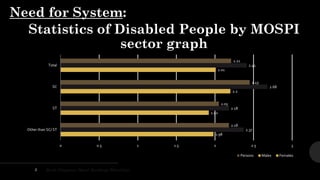
Statistics of Disabled People by MOSPI
sector graph
1.98
1.92
2.2
2.01
2.37
2.18
2.68
2.41
2.18
2.05
2.45
2.21
0 0.5 1 1.5 2 2.5 3
Other than SC/ ST
ST
SC
Total
Persons Males Females
5 Brain Frequency Based Handicap Wheelchair
Need for System:
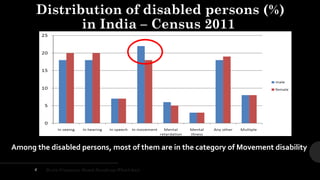
Distribution of disabled persons (%)
in India – Census 2011
6 Brain Frequency Based Handicap Wheelchair
Among the disabled persons, most of them are in the category of Movement disability
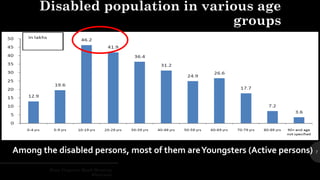
Disabled population in various age
groups
Brain Frequency Based Handicap
Wheelchair
7
Among the disabled persons, most of them areYoungsters (Active persons)
Statistics in India
❑ According to the statistics of the
Ministry of Statistics and Programme
Implementation in 2016, In India out of
the 121 Crore population, 2.68 Crore
persons are 'disabled' which is 2.21% of
the total population which is more than
the entire population of Australia.
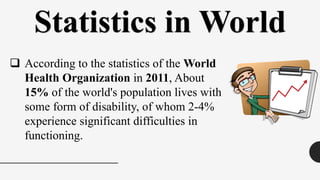
Statistics in World
❑ According to the statistics of the World
Health Organization in 2011, About
15% of the world's population lives with
some form of disability, of whom 2-4%
experience significant difficulties in
functioning.
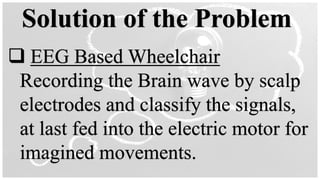
Solution of the Problem
❑ EEG Based Wheelchair
Recording the Brain wave by scalp
electrodes and classify the signals,
at last fed into the electric motor for
imagined movements.
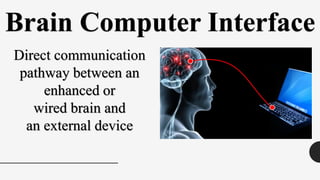
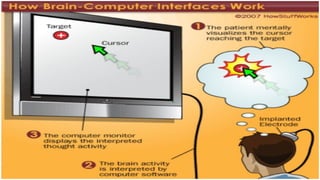
Brain Computer Interface
Direct communication
pathway between an
enhanced or
wired brain and
an external device
Introduction
Brain Computer Interface is a fastest growing
emerging technology, in which researchers
aim to build a direct channel between the
human brain and the computer
Principle Behind BCI
This technology is based on to sense,
transmit, analyze, and apply the
language of neuron
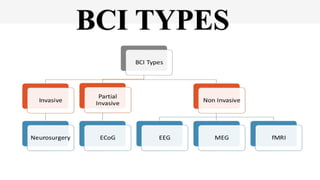
BCI TYPES
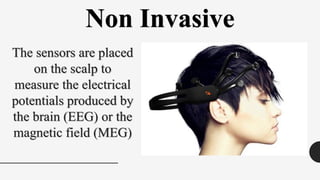
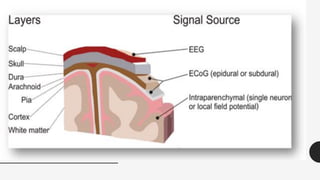
Non Invasive
The sensors are placed
on the scalp to
measure the electrical
potentials produced by
the brain (EEG) or the
magnetic field (MEG)
Used Method – Non Invasive
EEG
Electroencephalography
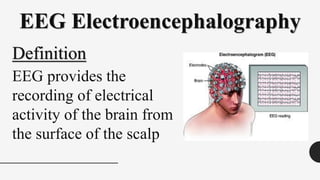
EEG Electroencephalography
Definition
EEG provides the
recording of electrical
activity of the brain from
the surface of the scalp
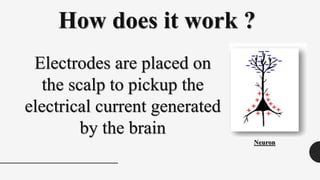
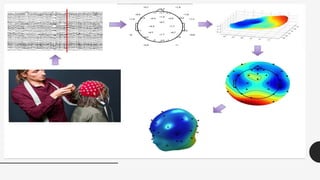
How does it work ?
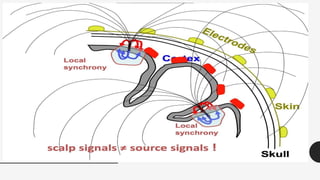
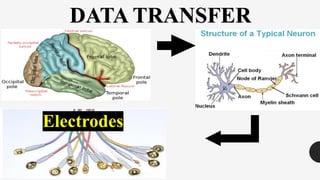
Electrodes are placed on
the scalp to pickup the
electrical current generated
by the brain
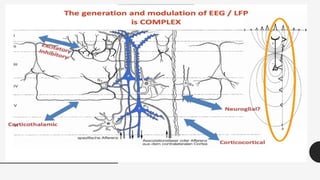
Neuron
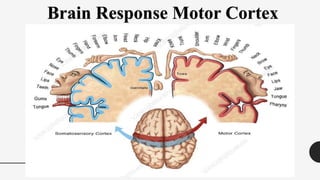
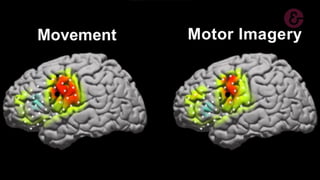
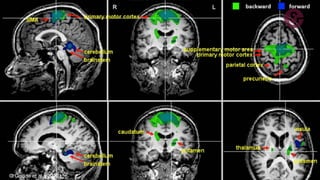
Brain Response Motor Cortex
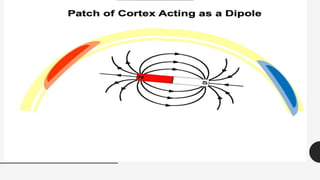
When groups of neurons fire together,
they provide enough
signal for us to measure from the
scalp
How does it work ?
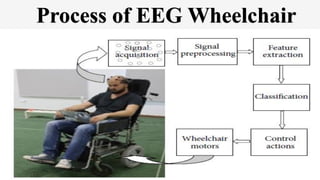
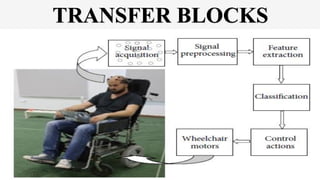
Process of EEG Wheelchair
“
Flow Diagram
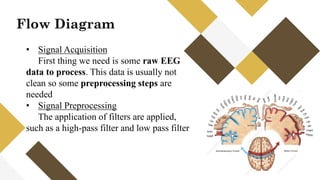
• Signal Acquisition
First thing we need is some raw EEG
data to process. This data is usually not
clean so some preprocessing steps are
needed
• Signal Preprocessing
The application of filters are applied,
such as a high-pass filter and low pass filter
Preprocessing Tool
Brain Frequency Based Handicap Wheelchair
25
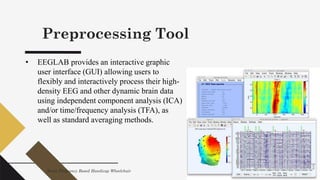
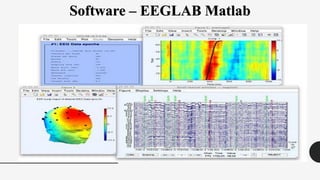
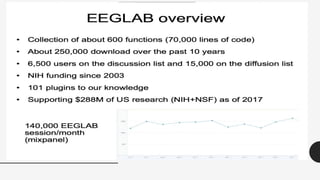
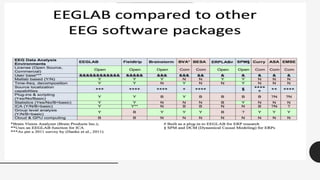
• EEGLAB provides an interactive graphic
user interface (GUI) allowing users to
flexibly and interactively process their high-
density EEG and other dynamic brain data
using independent component analysis (ICA)
and/or time/frequency analysis (TFA), as
well as standard averaging methods.
“
Flow Diagram
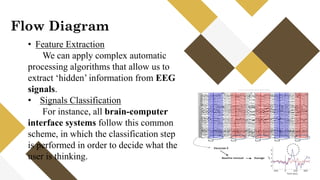
• Feature Extraction
We can apply complex automatic
processing algorithms that allow us to
extract ‘hidden’ information from EEG
signals.
• Signals Classification
For instance, all brain-computer
interface systems follow this common
scheme, in which the classification step
is performed in order to decide what the
user is thinking.
“
Flow Diagram
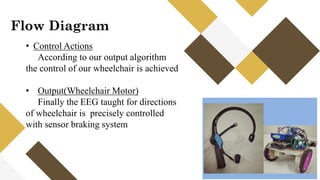
• Control Actions
According to our output algorithm
the control of our wheelchair is achieved
• Output(Wheelchair Motor)
Finally the EEG taught for directions
of wheelchair is precisely controlled
with sensor braking system
Software – EEGLAB Matlab
Technology Used
❑ Internet of Things
The Internet of Things refers to the
billions of physical devices around the
world that are now connected to the
internet, all collecting and sharing data.
What is the Internet of Things?
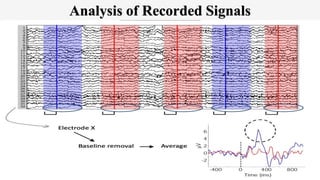
Analysis of Recorded Signals
❑ By collaborating with medical institutes, we can provided our
Brain Interface wheelchairs to person in recrupation.
❑ We can increase the accuracy and efficiency of the device by
collaborating with more detailed neuroscience medical research
team and their works.
❑ We can collaborate with defense and research organization, to
make the wheelchairs free for injured war soldiers to enhance
their quality of life.
Implementation Plan
Current Scenario
Army Injuries
Congenital
Malformation
Accidents
What it is ?
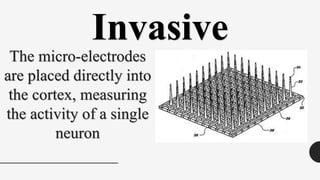
Invasive
The micro-electrodes
are placed directly into
the cortex, measuring
the activity of a single
neuron
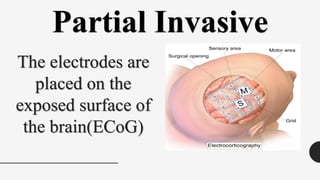
Partial Invasive
The electrodes are
placed on the
exposed surface of
the brain(ECoG)
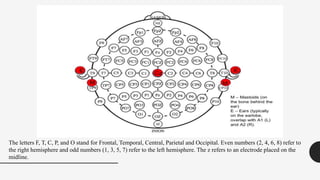
The letters F, T, C, P, and O stand for Frontal, Temporal, Central, Parietal and Occipital. Even numbers (2, 4, 6, 8) refer to
the right hemisphere and odd numbers (1, 3, 5, 7) refer to the left hemisphere. The z refers to an electrode placed on the
midline.
TRANSFER BLOCKS
Famous Projects
Elon Musk
Comparison with Other Methods
EEG has low spatial but high temporal resolution. Currently,
fMRI and MEG rely on expensive, bulky equipment; PET
requires the injection of a radioactive substance into the
bloodstream. Thus, methods relying on NIRS and, in
particular, EEG, are most commonly used
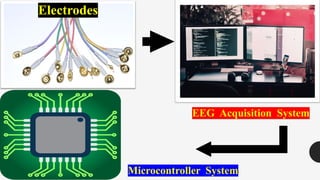
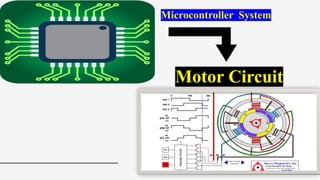
DATA TRANSFER
Electrodes
Electrodes
EEG Acquisition System
Microcontroller System
Motor Circuit
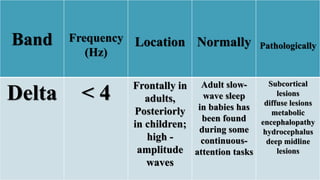
Comparison of
EEG Bands
Band Frequency
(Hz)
Location Normally Pathologically
Delta < 4 Frontally in
adults,
Posteriorly
in children;
high -
amplitude
waves
Adult slow-
wave sleep
in babies has
been found
during some
continuous-
attention tasks
Subcortical
lesions
diffuse lesions
metabolic
encephalopathy
hydrocephalus
deep midline
lesions
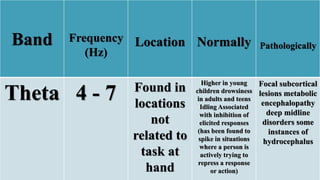
Band Frequency
(Hz)
Location Normally Pathologically
Theta 4 - 7 Found in
locations
not
related to
task at
hand
Higher in young
children drowsiness
in adults and teens
Idling Associated
with inhibition of
elicited responses
(has been found to
spike in situations
where a person is
actively trying to
repress a response
or action)
Focal subcortical
lesions metabolic
encephalopathy
deep midline
disorders some
instances of
hydrocephalus
Band Frequency
(Hz)
Location Normally Pathologically
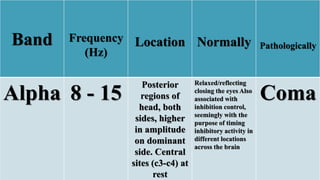
Alpha 8 - 15
Posterior
regions of
head, both
sides, higher
in amplitude
on dominant
side. Central
sites (c3-c4) at
rest
Relaxed/reflecting
closing the eyes Also
associated with
inhibition control,
seemingly with the
purpose of timing
inhibitory activity in
different locations
across the brain
Coma
Band Frequency
(Hz)
Location Normally Pathologically
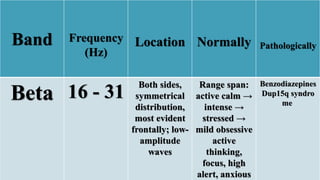
Beta 16 - 31
Both sides,
symmetrical
distribution,
most evident
frontally; low-
amplitude
waves
Range span:
active calm →
intense →
stressed →
mild obsessive
active
thinking,
focus, high
alert, anxious
Benzodiazepines
Dup15q syndro
me
Band Frequency
(Hz)
Location Normally Pathologically
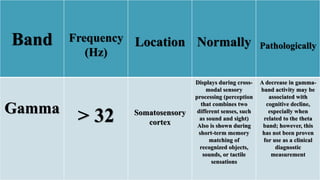
Gamma
> 32 Somatosensory
cortex
Displays during cross-
modal sensory
processing (perception
that combines two
different senses, such
as sound and sight)
Also is shown during
short-term memory
matching of
recognized objects,
sounds, or tactile
sensations
A decrease in gamma-
band activity may be
associated with
cognitive decline,
especially when
related to the theta
band; however, this
has not been proven
for use as a clinical
diagnostic
measurement
Band Frequency
(Hz)
Location Normally Pathologically
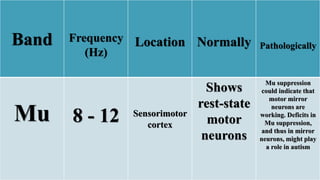
Mu 8 - 12 Sensorimotor
cortex
Shows
rest-state
motor
neurons
Mu suppression
could indicate that
motor mirror
neurons are
working. Deficits in
Mu suppression,
and thus in mirror
neurons, might play
a role in autism
When and Where
it is use ?
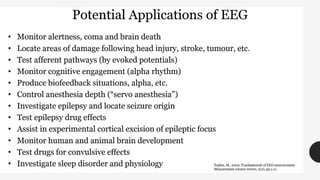
• Brain tumor
• Brain damage from head injury
• Brain dysfunction that can have a variety of causes
(encephalopathy)
• Inflammation of the brain (encephalitis)
• Stroke
• Head Injury
• Sleep disorders and more…
Medical Use
• Teleoperation of an Industrial Manipulator
through a TCP/IP Channel
• Special machines Controls and More…
Engineering Uses
Research Area
• Neuroscience
• Cognitive Science
• Cognitive Psychology
• Neurolinguistics
• Psychophysiological Research
Existing Solutions
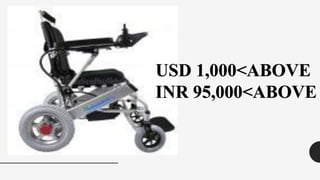
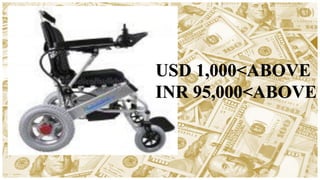
USD 1,000<ABOVE
INR 95,000<ABOVE
❑NeuroScan
❑Brain Products
❑Bio Semi
❑EGI
❑Emotiv
Top 10 EEG Companies
❑ NeuroSky
❑ Advanced Brain Monitoring
❑ g tec
❑ ANT Neuro
❑ Neuroelectrics
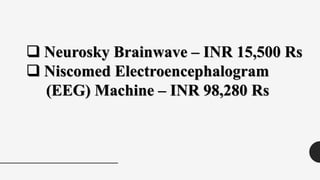
❑ Neurosky Brainwave – INR 15,500 Rs
❑ Niscomed Electroencephalogram
(EEG) Machine – INR 98,280 Rs
Market Values
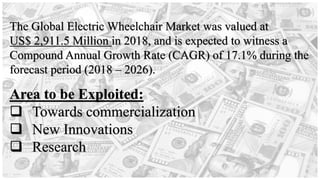
Area to be Exploited:
❑ Towards commercialization
❑ New Innovations
❑ Research
The Global Electric Wheelchair Market was valued at
US$ 2,911.5 Million in 2018, and is expected to witness a
Compound Annual Growth Rate (CAGR) of 17.1% during the
forecast period (2018 – 2026).
USD 1,000<ABOVE
INR 95,000<ABOVE
TARGET
❑ Low Cost
❑ High Features
❑ More Safety
❑ Available for Children and Both genders
❑ Tracking System
❑ Long Lasting Battery
Limitations
❑ Lack of sensor modality that provides safe,
accurate, and robust, access to brain Signals
❑ Very Expensive
❑ Information transformation rate is limited
❑ Difficult to adaptation and learning
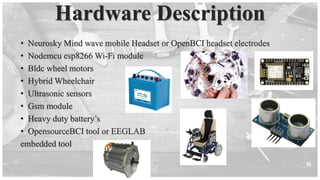
Hardware Description
• Neurosky Mind wave mobile Headset or OpenBCI headset electrodes
• Nodemcu esp8266 Wi-Fi module
• Bldc wheel motors
• Hybrid Wheelchair
• Ultrasonic sensors
• Gsm module
• Heavy duty battery’s
• OpensourceBCI tool or EEGLAB
embedded tool
Other EEG
Applications
NeuroEntertainment
❑ Neurogaming
❑ Virtual Reality
❑ Neuro Toys
❑ Art
Security
❑ Brain based authentication
Biofeedback Therapy
❑ Anxiety
❑ Sleep Improvement
❑ ADHD and PTSD
Cognitive Training
❑ Performance Optimization
❑ Brain Ageing
❑ Early Development
❑ Mindfulness
❑ Accelerated Learning
❑ Enhanced Creativity
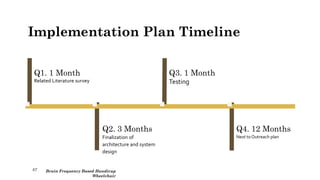
Implementation Plan Timeline
Q1. 1 Month
Related Literature survey
Q2. 3 Months
Finalization of
architecture and system
design
Q3. 1 Month
Testing
Q4. 12 Months
Next to Outreach plan
87 Brain Frequency Based Handicap
Wheelchair
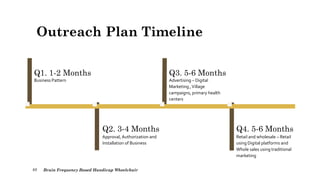
Outreach Plan Timeline
Q1. 1-2 Months
Business Pattern
Q2. 3-4 Months
Approval, Authorization and
Installation of Business
Q3. 5-6 Months
Advertising – Digital
Marketing ,Village
campaigns, primary health
centers
Q4. 5-6 Months
Retail and wholesale – Retail
using Digital platforms and
Whole sales using traditional
marketing
88 Brain Frequency Based Handicap Wheelchair
“
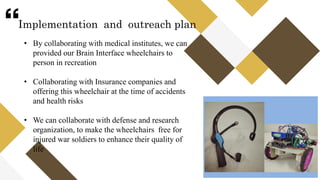
• By collaborating with medical institutes, we can
provided our Brain Interface wheelchairs to
person in recreation
• Collaborating with Insurance companies and
offering this wheelchair at the time of accidents
and health risks
• We can collaborate with defense and research
organization, to make the wheelchairs free for
injured war soldiers to enhance their quality of
life
Implementation and outreach plan
Business & Employee Goals
Business priorities
▪ Increase customer satisfaction
▪ Maintain growth
▪ Diversify investment
▪ Initiative partnership with 3rd party organizations
Employee opportunities
▪ Multi-disciplinary employment
▪ Worker can Improve their skillsets
90 Brain Frequency Based Handicap Wheelchair
Summary
Our business is good
High level Profit
We’re getting our work done
We finished the consolidation project
Our customers relationship
We increased customer retention
91 Brain Frequency Based Handicap
Wheelchair
Projects
❑ BrainGate
❑ BCI2000
❑ Australian Bionic Eye
❑ Honda Asimo Control
❑ Kevin Warwick-
The first human Cyborg
References
1) Fast fourier analysis and EEG classification brainwave controlled wheelchair – DOI -
10.1109/CCSSE.2016.7784344
2) An Internet of Things (IoT) application to control a wheelchair through EEG signal processing – DOI -
10.1109/WEROB.2017.8383877
3) Design of a Brain Controlled Wheelchair – DOI - 10.1109/CCSSE.2018.8724794
4) Design of an EEG-Based Brain Controlled Wheelchair for Quadriplegic Patients – DOI -
10.1109/I2CT.2018.8529751
5) EEG Wheelchair for People of Determination – DOI - 10.1109/ASET48392.2020.9118340
6) Wheelchair Neuro Fuzzy Control Using Brain Computer Interface – DOI - 10.1109/DeSE.2019.00120
Thank You

Brain frequency based handicap wheelchair

  • 1.
  • 2.
    Team Details Mentor: K DHANUARAVINTH –18bee080@mcet.in - +91 6379156972 R VISHNU RAJ – 18bee087@mcet.in - +91 8220396913 DR K UMAMAHESWARI – umamaheswari@drmcet.ac.in - +91 8825843655
  • 3.
  • 4.
    Problem Statement ❑ Peoplewho are using wheelchair require secondary assistance to carry out their basic and daily activities, this greatly reduces their esteem and will power. ❑ The main problem of the wheelchair is that cannot be used by disabled person, so the type of artificial aid needed by a disabled person in order to move about depends, to a large extent, on the level of his incapacity. According to our output algorithm the control of our wheelchair is achieved According to our output algorithm the control of our wheelchair is achieved
  • 5.

    Statistics of DisabledPeople by MOSPI sector graph 1.98 1.92 2.2 2.01 2.37 2.18 2.68 2.41 2.18 2.05 2.45 2.21 0 0.5 1 1.5 2 2.5 3 Other than SC/ ST ST SC Total Persons Males Females 5 Brain Frequency Based Handicap Wheelchair Need for System:
  • 6.
    Distribution of disabledpersons (%) in India – Census 2011 6 Brain Frequency Based Handicap Wheelchair Among the disabled persons, most of them are in the category of Movement disability
  • 7.
    Disabled population invarious age groups Brain Frequency Based Handicap Wheelchair 7 Among the disabled persons, most of them areYoungsters (Active persons)
  • 8.
    Statistics in India ❑According to the statistics of the Ministry of Statistics and Programme Implementation in 2016, In India out of the 121 Crore population, 2.68 Crore persons are 'disabled' which is 2.21% of the total population which is more than the entire population of Australia.
  • 9.
    Statistics in World ❑According to the statistics of the World Health Organization in 2011, About 15% of the world's population lives with some form of disability, of whom 2-4% experience significant difficulties in functioning.
  • 10.
    Solution of theProblem ❑ EEG Based Wheelchair Recording the Brain wave by scalp electrodes and classify the signals, at last fed into the electric motor for imagined movements.
  • 11.
    Brain Computer Interface Directcommunication pathway between an enhanced or wired brain and an external device
  • 13.
    Introduction Brain Computer Interfaceis a fastest growing emerging technology, in which researchers aim to build a direct channel between the human brain and the computer
  • 14.
    Principle Behind BCI Thistechnology is based on to sense, transmit, analyze, and apply the language of neuron
  • 15.
  • 16.
    Non Invasive The sensorsare placed on the scalp to measure the electrical potentials produced by the brain (EEG) or the magnetic field (MEG)
  • 17.
    Used Method –Non Invasive EEG Electroencephalography
  • 18.
    EEG Electroencephalography Definition EEG providesthe recording of electrical activity of the brain from the surface of the scalp
  • 19.
    How does itwork ? Electrodes are placed on the scalp to pickup the electrical current generated by the brain Neuron
  • 20.
  • 21.
    When groups ofneurons fire together, they provide enough signal for us to measure from the scalp How does it work ?
  • 23.
    Process of EEGWheelchair
  • 24.
    “ Flow Diagram • SignalAcquisition First thing we need is some raw EEG data to process. This data is usually not clean so some preprocessing steps are needed • Signal Preprocessing The application of filters are applied, such as a high-pass filter and low pass filter
  • 25.
    Preprocessing Tool Brain FrequencyBased Handicap Wheelchair 25 • EEGLAB provides an interactive graphic user interface (GUI) allowing users to flexibly and interactively process their high- density EEG and other dynamic brain data using independent component analysis (ICA) and/or time/frequency analysis (TFA), as well as standard averaging methods.
  • 26.
    “ Flow Diagram • FeatureExtraction We can apply complex automatic processing algorithms that allow us to extract ‘hidden’ information from EEG signals. • Signals Classification For instance, all brain-computer interface systems follow this common scheme, in which the classification step is performed in order to decide what the user is thinking.
  • 27.
    “ Flow Diagram • ControlActions According to our output algorithm the control of our wheelchair is achieved • Output(Wheelchair Motor) Finally the EEG taught for directions of wheelchair is precisely controlled with sensor braking system
  • 28.
  • 29.
  • 30.
    The Internet ofThings refers to the billions of physical devices around the world that are now connected to the internet, all collecting and sharing data. What is the Internet of Things?
  • 31.
  • 36.
    ❑ By collaboratingwith medical institutes, we can provided our Brain Interface wheelchairs to person in recrupation. ❑ We can increase the accuracy and efficiency of the device by collaborating with more detailed neuroscience medical research team and their works. ❑ We can collaborate with defense and research organization, to make the wheelchairs free for injured war soldiers to enhance their quality of life. Implementation Plan
  • 37.
  • 38.
  • 39.
  • 40.
  • 41.
  • 42.
    Invasive The micro-electrodes are placeddirectly into the cortex, measuring the activity of a single neuron
  • 43.
    Partial Invasive The electrodesare placed on the exposed surface of the brain(ECoG)
  • 46.
    The letters F,T, C, P, and O stand for Frontal, Temporal, Central, Parietal and Occipital. Even numbers (2, 4, 6, 8) refer to the right hemisphere and odd numbers (1, 3, 5, 7) refer to the left hemisphere. The z refers to an electrode placed on the midline.
  • 54.
  • 55.
  • 56.
    Comparison with OtherMethods EEG has low spatial but high temporal resolution. Currently, fMRI and MEG rely on expensive, bulky equipment; PET requires the injection of a radioactive substance into the bloodstream. Thus, methods relying on NIRS and, in particular, EEG, are most commonly used
  • 57.
  • 58.
  • 59.
  • 60.
  • 61.
    Band Frequency (Hz) Location NormallyPathologically Delta < 4 Frontally in adults, Posteriorly in children; high - amplitude waves Adult slow- wave sleep in babies has been found during some continuous- attention tasks Subcortical lesions diffuse lesions metabolic encephalopathy hydrocephalus deep midline lesions
  • 62.
    Band Frequency (Hz) Location NormallyPathologically Theta 4 - 7 Found in locations not related to task at hand Higher in young children drowsiness in adults and teens Idling Associated with inhibition of elicited responses (has been found to spike in situations where a person is actively trying to repress a response or action) Focal subcortical lesions metabolic encephalopathy deep midline disorders some instances of hydrocephalus
  • 63.
    Band Frequency (Hz) Location NormallyPathologically Alpha 8 - 15 Posterior regions of head, both sides, higher in amplitude on dominant side. Central sites (c3-c4) at rest Relaxed/reflecting closing the eyes Also associated with inhibition control, seemingly with the purpose of timing inhibitory activity in different locations across the brain Coma
  • 64.
    Band Frequency (Hz) Location NormallyPathologically Beta 16 - 31 Both sides, symmetrical distribution, most evident frontally; low- amplitude waves Range span: active calm → intense → stressed → mild obsessive active thinking, focus, high alert, anxious Benzodiazepines Dup15q syndro me
  • 65.
    Band Frequency (Hz) Location NormallyPathologically Gamma > 32 Somatosensory cortex Displays during cross- modal sensory processing (perception that combines two different senses, such as sound and sight) Also is shown during short-term memory matching of recognized objects, sounds, or tactile sensations A decrease in gamma- band activity may be associated with cognitive decline, especially when related to the theta band; however, this has not been proven for use as a clinical diagnostic measurement
  • 66.
    Band Frequency (Hz) Location NormallyPathologically Mu 8 - 12 Sensorimotor cortex Shows rest-state motor neurons Mu suppression could indicate that motor mirror neurons are working. Deficits in Mu suppression, and thus in mirror neurons, might play a role in autism
  • 67.
  • 68.
    • Brain tumor •Brain damage from head injury • Brain dysfunction that can have a variety of causes (encephalopathy) • Inflammation of the brain (encephalitis) • Stroke • Head Injury • Sleep disorders and more… Medical Use
  • 69.
    • Teleoperation ofan Industrial Manipulator through a TCP/IP Channel • Special machines Controls and More… Engineering Uses
  • 70.
    Research Area • Neuroscience •Cognitive Science • Cognitive Psychology • Neurolinguistics • Psychophysiological Research
  • 71.
  • 72.
  • 73.
    ❑NeuroScan ❑Brain Products ❑Bio Semi ❑EGI ❑Emotiv Top10 EEG Companies ❑ NeuroSky ❑ Advanced Brain Monitoring ❑ g tec ❑ ANT Neuro ❑ Neuroelectrics
  • 74.
    ❑ Neurosky Brainwave– INR 15,500 Rs ❑ Niscomed Electroencephalogram (EEG) Machine – INR 98,280 Rs
  • 75.
  • 76.
    Area to beExploited: ❑ Towards commercialization ❑ New Innovations ❑ Research The Global Electric Wheelchair Market was valued at US$ 2,911.5 Million in 2018, and is expected to witness a Compound Annual Growth Rate (CAGR) of 17.1% during the forecast period (2018 – 2026).
  • 77.
  • 78.
    TARGET ❑ Low Cost ❑High Features ❑ More Safety ❑ Available for Children and Both genders ❑ Tracking System ❑ Long Lasting Battery
  • 79.
  • 80.
    ❑ Lack ofsensor modality that provides safe, accurate, and robust, access to brain Signals ❑ Very Expensive ❑ Information transformation rate is limited ❑ Difficult to adaptation and learning
  • 81.
    Hardware Description • NeuroskyMind wave mobile Headset or OpenBCI headset electrodes • Nodemcu esp8266 Wi-Fi module • Bldc wheel motors • Hybrid Wheelchair • Ultrasonic sensors • Gsm module • Heavy duty battery’s • OpensourceBCI tool or EEGLAB embedded tool
  • 82.
  • 83.
    NeuroEntertainment ❑ Neurogaming ❑ VirtualReality ❑ Neuro Toys ❑ Art
  • 84.
  • 85.
    Biofeedback Therapy ❑ Anxiety ❑Sleep Improvement ❑ ADHD and PTSD
  • 86.
    Cognitive Training ❑ PerformanceOptimization ❑ Brain Ageing ❑ Early Development ❑ Mindfulness ❑ Accelerated Learning ❑ Enhanced Creativity
  • 87.
    Implementation Plan Timeline Q1.1 Month Related Literature survey Q2. 3 Months Finalization of architecture and system design Q3. 1 Month Testing Q4. 12 Months Next to Outreach plan 87 Brain Frequency Based Handicap Wheelchair
  • 88.
    Outreach Plan Timeline Q1.1-2 Months Business Pattern Q2. 3-4 Months Approval, Authorization and Installation of Business Q3. 5-6 Months Advertising – Digital Marketing ,Village campaigns, primary health centers Q4. 5-6 Months Retail and wholesale – Retail using Digital platforms and Whole sales using traditional marketing 88 Brain Frequency Based Handicap Wheelchair
  • 89.
    “ • By collaboratingwith medical institutes, we can provided our Brain Interface wheelchairs to person in recreation • Collaborating with Insurance companies and offering this wheelchair at the time of accidents and health risks • We can collaborate with defense and research organization, to make the wheelchairs free for injured war soldiers to enhance their quality of life Implementation and outreach plan
  • 90.
    Business & EmployeeGoals Business priorities ▪ Increase customer satisfaction ▪ Maintain growth ▪ Diversify investment ▪ Initiative partnership with 3rd party organizations Employee opportunities ▪ Multi-disciplinary employment ▪ Worker can Improve their skillsets 90 Brain Frequency Based Handicap Wheelchair
  • 91.
    Summary Our business isgood High level Profit We’re getting our work done We finished the consolidation project Our customers relationship We increased customer retention 91 Brain Frequency Based Handicap Wheelchair
  • 92.
    Projects ❑ BrainGate ❑ BCI2000 ❑Australian Bionic Eye ❑ Honda Asimo Control ❑ Kevin Warwick- The first human Cyborg
  • 94.
    References 1) Fast fourieranalysis and EEG classification brainwave controlled wheelchair – DOI - 10.1109/CCSSE.2016.7784344 2) An Internet of Things (IoT) application to control a wheelchair through EEG signal processing – DOI - 10.1109/WEROB.2017.8383877 3) Design of a Brain Controlled Wheelchair – DOI - 10.1109/CCSSE.2018.8724794 4) Design of an EEG-Based Brain Controlled Wheelchair for Quadriplegic Patients – DOI - 10.1109/I2CT.2018.8529751 5) EEG Wheelchair for People of Determination – DOI - 10.1109/ASET48392.2020.9118340 6) Wheelchair Neuro Fuzzy Control Using Brain Computer Interface – DOI - 10.1109/DeSE.2019.00120
  • 95.