S. Sindhuri et al Int. Journal of Engineering Research and Applications www.ijera.com
ISSN : 2248-9622, Vol. 4, Issue 4( Version 1), April 2014, pp.426-429
www.ijera.com 426 | P a g e
Implementation of an Efficient Ripple Carry Adder by Low
Power Techniques for Ultra Applications
S. Sindhuri1
, R. Sravani2
, S. Rambabu3
Dept of ECE, SREC, Nandyal.
Dept of ECE, SREC, NANDYAL
Asst professor, SREC, Nandyal
ABSTRACT
The main goal of this paper is to provide new low power solutions for very large scale integration. Designers
especially focus on the reduction of the power dissipation which shows increasing growth with the scaling down
of the technologies. In this paper various technologies at the different levels of the design process have been
implemented to reduce the power dissipation at the circuit, architecture and system levels. Previous technologies
are summarized and compared with our new approach is presented in this paper.
The main objective of this project is the reduction of power dissipation by eliminating the PMOS tree
and also by utilizing energy stored at the output can be retrieved by the reversing the current source direction
discharging process instead of dissipation in NMOS network with SDCVSL, ADIABATIC LOGIC. It also
increases the performance of circuits.
Here for this project, I am using MICRO WINDOW TOOL. By using this tool we can develop schematic for all
above techniques and also find out the power dissipation.
Key words: Low power, CMOS, SDCVSL, Adiabatic logic.
I. INTRODUCTION:
Much of the research efforts of the past
years in the area of digital electronics has been
directed towards increasing the speed of digital
systems. Recently, the requirement of portability and
the moderate improvement in battery performance
indicate that the power dissipation is one of the most
critical design parameters.
The three most widely accepted metrics to
measure the quality of a circuit or to compare various
circuit styles are area, delay and power dissipation.
Portability imposes a strict limitation on power
dissipation while still demands high computational
speeds. Hence, in recent VLSI systems the power-
delay product becomes the most essential metric of
performance. The reduction of the power dissipation
and the improvement of the speed require
optimizations at all levels of the design procedure. In
this chapter, the proper circuit style and methodology
is considered. Since, most digital
Circuitry is composed of simple and/or complex
gates, we study the best way to implement adders in
order to achieve low power dissipation and high
speed.
Several circuit design techniques are
compared in order to find their efficiency in terms of
speed and power dissipation. A review of the existing
CMOS circuit design styles is given, describing their
advantages and their limitations. Furthermore, a four-
bit ripple carry adder for use as a benchmark circuit
was designed in a full-custom manner by using the
different design styles, and detailed transistor-level
simulations using HSPICE [2] were performed. Also,
various designs and implementations of four
multipliers are analysed in the terms of delay and
power consumption. Two ways of power
measurements are used.
In this chapter we study two different
CMOS logic styles, they are
i. STATIC DIFFERENTIAL CASCODE
VOLTAGE SWITCH(SDCVSL)
ii. ADIABATIC LOGIC
Here we are comparing the parameters like
power, delay and area of the above mentioned
techniques with the CONVENTIONAL CMOS
technique.
II. Power and Delay in Conventional
CMOS Circuits:
Since the objective is to investigate the
tradeoffs that are possible at the circuit level in order
to reduce power dissipation while maintaining the
overall system throughput, we must first study the
parameters that affect the power dissipation and the
speed of a circuit. It is well known that one of the
major advantage of CMOS circuits over single
polarity MOS circuits, is that the static power
dissipation is very small and limited to leakage.
RESEARCH ARTICLE OPEN ACCESS
S. Sindhuri et al Int. Journal of Engineering Research and Applications www.ijera.com
ISSN : 2248-9622, Vol. 4, Issue 4( Version 1), April 2014, pp.426-429
www.ijera.com 427 | P a g e
However, in some cases such as bias circuitry and
pseudo-nMOS logic, static power is dissipated.
Considering that in CMOS circuits the leakage
current between the diffusion regions and the
substrate is negligible, the two major sources of
power dissipation are the switching and the short-
circuit power dissipation
Where f is the node transition activity factor,
is the load capacitance, is the supply
voltage, f is the switching frequency, is the
current which arises when a direct path from power
supply to ground is caused, for a short period of time
during low to high or high to low node transitions .
The switching component of power arises when
energy is drawn from the power supply to charge
parasitic capacitors. It is the dominant power
component in a well designed circuit and it can be
lowered by reducing one or more of pf , CL, Vdd and
f, while retaining the required speed and
functionality.
Even though the exact analysis of circuit
delay is quite complex, a simple first-order derivation
can be used in order to show its dependency of the
circuit parameters
III. Static Differential Cascode Voltage
Switch :
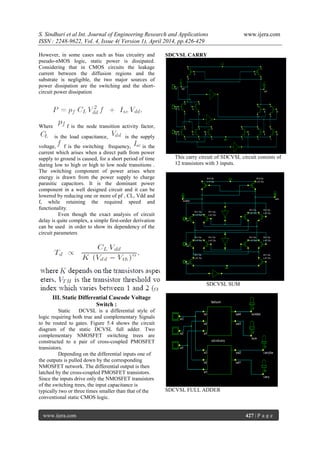
Static DCVSL is a differential style of
logic requiring both true and complementary Signals
to be routed to gates. Figure 5.4 shows the circuit
diagram of the static DCVSL full adder. Two
complementary NMOSFET switching trees are
constructed to a pair of cross-coupled PMOSFET
transistors.
Depending on the differential inputs one of
the outputs is pulled down by the corresponding
NMOSFET network. The differential output is then
latched by the cross-coupled PMOSFET transistors.
Since the inputs drive only the NMOSFET transistors
of the switching trees, the input capacitance is
typically two or three times smaller than that of the
conventional static CMOS logic.
SDCVSL CARRY
This carry circuit of SDCVSL circuit consists of
12 transistors with 3 inputs.
SDCVSL SUM
SDCVSL FULL ADDER
S. Sindhuri et al Int. Journal of Engineering Research and Applications www.ijera.com
ISSN : 2248-9622, Vol. 4, Issue 4( Version 1), April 2014, pp.426-429
www.ijera.com 428 | P a g e
IV.ADIABATIC LOGIC:
The operation of adiabatic logic gate is
divided into two distinct stages: one stage is
used for logic evaluation; the other stage is used to
reset the gate output logic value.
1. Conventional Switching
There are three major sources of power
dissipation in digital CMOS circuits those are
dynamic, short circuit and leakage power dissipation.
The dominant component is dynamic
power dissipation and is due to charging, discharging
of load capacitance.
2. Adiabatic Switching
Adiabatic switching can be achieved by
ensuring that the potential across the switching
devices is kept arbitrarily small. This can be achieved
by charging the capacitor from time varying voltage
source or constant current source.
In literature, adiabatic logic circuits
classified into two types: full adiabatic and quasi or
partial adiabatic circuits. Full-adiabatic circuits have
no non-adiabatic loss, but they are much more
complex than quasi-adiabatic circuits. Quasi-
adiabatic circuits have simple architecture and power
clock system. There are two types of energy loss in
quasi-adiabatic circuits, adiabatic loss and
nonadiabatic loss. The adiabatic loss occurs when
current flows through non-ideal switch, which is
proportional to the frequency of the power-clock.
If any voltage difference between the two
terminals of a switch exists when it is turned on, non-
adiabatic loss occurs. The non-adiabatic loss, which
is independent of the frequency of the power-clock, is
proportional to the node capacitance and the square
of the voltage difference. Several quasi-adiabatic
logic architectures have been reported, such as
ECRL, 2N-2N-2P, PFAL.
ADIABATIC FULL ADDER
USING PASS TRANSISTOR
Technique power Area Delay
CMOS 16.969uw 62*12um 18ps
SDCVSL 0.164mw 42*13um 0.94ns
Adiabatic 7.037uw 16*13um 8.88ns
From the above analysis, we came to know
that adiabatic logic is the best technique. So we
design ripple carry adder using the adiabatic
technique because it consumes less power.
Ripple carry adder by using adiabatic logic:
Above ripple carry adder is designed by
using adiabatic full adder. It consists of four full
adders. This ripple carry adder consumes less power
as adiabatic logic technique is the efficient in
S. Sindhuri et al Int. Journal of Engineering Research and Applications www.ijera.com
ISSN : 2248-9622, Vol. 4, Issue 4( Version 1), April 2014, pp.426-429
www.ijera.com 429 | P a g e
consuming less power and reducing power
dissipation.
V. CONCLUSION
In this chapter, the most common kinds of
adders have been characterized in terms of power,
using either a traditional low-level design flow
paradigm, which is rather tedious and incompatible
with modern design flows, but provides the most
accurate results, or a high-level design flow
paradigm, which is commonly used.
In this paper we compared the performance
of SDCVSL and adiabatic logic adder circuits with
traditional CMOS adder circuits. The analysis shows
that designs based on adiabatic principle gives
superior performance when compared to traditional
approaches in terms of power even though their
transistor count is high in some circuits so for low
power and ultra low power requirements adiabatic
logic is an effective alternative for traditional CMOS
logic circuit design.
A four-bit ripple carry adder was designed
using adiabatic logic here is used as the benchmark
circuit. All the circuits have been designed in a full-
custom manner.
REFERENCES
[1] A. Chandrakasan, R. Brodersen, Low Power
Digital Design, Kluwer Academic
Publishers, 1995.
[2] Meta-Software, HSPICE User’s Manual -
Version 96.1,1996.
[3] K. Yano, Y. Sasaki, K. Rikino, K. Seki,
“Top-Down Pass-Transistor Logic Design”.
IEEE Journal of Solid-State Circuits, vol.31,
pp. 792-803. 1996
[4] MIPS Technologies, “R4200
Microprocessor Product Information”, MIPS
Technologies Inc., 1994
[5] R K. Navi, Md.Reza Saatchi and O. Daei,
(2009) “A High-Speed Hybrid Full Adder,”
European Journal of Scientific Research,Vol
26 No.1,pp 29-33.
[6] D. Sourdis, C. Piguet and C. Goutis,(2002) “
Designing CMOS Circuits for Low Power,
European Low-Power Initiative for
Electronic System Design”, Reading pp 71-
96, Kluwer Academic Publishers.

Br044426429

  • 1.
    S. Sindhuri etal Int. Journal of Engineering Research and Applications www.ijera.com ISSN : 2248-9622, Vol. 4, Issue 4( Version 1), April 2014, pp.426-429 www.ijera.com 426 | P a g e Implementation of an Efficient Ripple Carry Adder by Low Power Techniques for Ultra Applications S. Sindhuri1 , R. Sravani2 , S. Rambabu3 Dept of ECE, SREC, Nandyal. Dept of ECE, SREC, NANDYAL Asst professor, SREC, Nandyal ABSTRACT The main goal of this paper is to provide new low power solutions for very large scale integration. Designers especially focus on the reduction of the power dissipation which shows increasing growth with the scaling down of the technologies. In this paper various technologies at the different levels of the design process have been implemented to reduce the power dissipation at the circuit, architecture and system levels. Previous technologies are summarized and compared with our new approach is presented in this paper. The main objective of this project is the reduction of power dissipation by eliminating the PMOS tree and also by utilizing energy stored at the output can be retrieved by the reversing the current source direction discharging process instead of dissipation in NMOS network with SDCVSL, ADIABATIC LOGIC. It also increases the performance of circuits. Here for this project, I am using MICRO WINDOW TOOL. By using this tool we can develop schematic for all above techniques and also find out the power dissipation. Key words: Low power, CMOS, SDCVSL, Adiabatic logic. I. INTRODUCTION: Much of the research efforts of the past years in the area of digital electronics has been directed towards increasing the speed of digital systems. Recently, the requirement of portability and the moderate improvement in battery performance indicate that the power dissipation is one of the most critical design parameters. The three most widely accepted metrics to measure the quality of a circuit or to compare various circuit styles are area, delay and power dissipation. Portability imposes a strict limitation on power dissipation while still demands high computational speeds. Hence, in recent VLSI systems the power- delay product becomes the most essential metric of performance. The reduction of the power dissipation and the improvement of the speed require optimizations at all levels of the design procedure. In this chapter, the proper circuit style and methodology is considered. Since, most digital Circuitry is composed of simple and/or complex gates, we study the best way to implement adders in order to achieve low power dissipation and high speed. Several circuit design techniques are compared in order to find their efficiency in terms of speed and power dissipation. A review of the existing CMOS circuit design styles is given, describing their advantages and their limitations. Furthermore, a four- bit ripple carry adder for use as a benchmark circuit was designed in a full-custom manner by using the different design styles, and detailed transistor-level simulations using HSPICE [2] were performed. Also, various designs and implementations of four multipliers are analysed in the terms of delay and power consumption. Two ways of power measurements are used. In this chapter we study two different CMOS logic styles, they are i. STATIC DIFFERENTIAL CASCODE VOLTAGE SWITCH(SDCVSL) ii. ADIABATIC LOGIC Here we are comparing the parameters like power, delay and area of the above mentioned techniques with the CONVENTIONAL CMOS technique. II. Power and Delay in Conventional CMOS Circuits: Since the objective is to investigate the tradeoffs that are possible at the circuit level in order to reduce power dissipation while maintaining the overall system throughput, we must first study the parameters that affect the power dissipation and the speed of a circuit. It is well known that one of the major advantage of CMOS circuits over single polarity MOS circuits, is that the static power dissipation is very small and limited to leakage. RESEARCH ARTICLE OPEN ACCESS
  • 2.
    S. Sindhuri etal Int. Journal of Engineering Research and Applications www.ijera.com ISSN : 2248-9622, Vol. 4, Issue 4( Version 1), April 2014, pp.426-429 www.ijera.com 427 | P a g e However, in some cases such as bias circuitry and pseudo-nMOS logic, static power is dissipated. Considering that in CMOS circuits the leakage current between the diffusion regions and the substrate is negligible, the two major sources of power dissipation are the switching and the short- circuit power dissipation Where f is the node transition activity factor, is the load capacitance, is the supply voltage, f is the switching frequency, is the current which arises when a direct path from power supply to ground is caused, for a short period of time during low to high or high to low node transitions . The switching component of power arises when energy is drawn from the power supply to charge parasitic capacitors. It is the dominant power component in a well designed circuit and it can be lowered by reducing one or more of pf , CL, Vdd and f, while retaining the required speed and functionality. Even though the exact analysis of circuit delay is quite complex, a simple first-order derivation can be used in order to show its dependency of the circuit parameters III. Static Differential Cascode Voltage Switch : Static DCVSL is a differential style of logic requiring both true and complementary Signals to be routed to gates. Figure 5.4 shows the circuit diagram of the static DCVSL full adder. Two complementary NMOSFET switching trees are constructed to a pair of cross-coupled PMOSFET transistors. Depending on the differential inputs one of the outputs is pulled down by the corresponding NMOSFET network. The differential output is then latched by the cross-coupled PMOSFET transistors. Since the inputs drive only the NMOSFET transistors of the switching trees, the input capacitance is typically two or three times smaller than that of the conventional static CMOS logic. SDCVSL CARRY This carry circuit of SDCVSL circuit consists of 12 transistors with 3 inputs. SDCVSL SUM SDCVSL FULL ADDER
  • 3.
    S. Sindhuri etal Int. Journal of Engineering Research and Applications www.ijera.com ISSN : 2248-9622, Vol. 4, Issue 4( Version 1), April 2014, pp.426-429 www.ijera.com 428 | P a g e IV.ADIABATIC LOGIC: The operation of adiabatic logic gate is divided into two distinct stages: one stage is used for logic evaluation; the other stage is used to reset the gate output logic value. 1. Conventional Switching There are three major sources of power dissipation in digital CMOS circuits those are dynamic, short circuit and leakage power dissipation. The dominant component is dynamic power dissipation and is due to charging, discharging of load capacitance. 2. Adiabatic Switching Adiabatic switching can be achieved by ensuring that the potential across the switching devices is kept arbitrarily small. This can be achieved by charging the capacitor from time varying voltage source or constant current source. In literature, adiabatic logic circuits classified into two types: full adiabatic and quasi or partial adiabatic circuits. Full-adiabatic circuits have no non-adiabatic loss, but they are much more complex than quasi-adiabatic circuits. Quasi- adiabatic circuits have simple architecture and power clock system. There are two types of energy loss in quasi-adiabatic circuits, adiabatic loss and nonadiabatic loss. The adiabatic loss occurs when current flows through non-ideal switch, which is proportional to the frequency of the power-clock. If any voltage difference between the two terminals of a switch exists when it is turned on, non- adiabatic loss occurs. The non-adiabatic loss, which is independent of the frequency of the power-clock, is proportional to the node capacitance and the square of the voltage difference. Several quasi-adiabatic logic architectures have been reported, such as ECRL, 2N-2N-2P, PFAL. ADIABATIC FULL ADDER USING PASS TRANSISTOR Technique power Area Delay CMOS 16.969uw 62*12um 18ps SDCVSL 0.164mw 42*13um 0.94ns Adiabatic 7.037uw 16*13um 8.88ns From the above analysis, we came to know that adiabatic logic is the best technique. So we design ripple carry adder using the adiabatic technique because it consumes less power. Ripple carry adder by using adiabatic logic: Above ripple carry adder is designed by using adiabatic full adder. It consists of four full adders. This ripple carry adder consumes less power as adiabatic logic technique is the efficient in
  • 4.
    S. Sindhuri etal Int. Journal of Engineering Research and Applications www.ijera.com ISSN : 2248-9622, Vol. 4, Issue 4( Version 1), April 2014, pp.426-429 www.ijera.com 429 | P a g e consuming less power and reducing power dissipation. V. CONCLUSION In this chapter, the most common kinds of adders have been characterized in terms of power, using either a traditional low-level design flow paradigm, which is rather tedious and incompatible with modern design flows, but provides the most accurate results, or a high-level design flow paradigm, which is commonly used. In this paper we compared the performance of SDCVSL and adiabatic logic adder circuits with traditional CMOS adder circuits. The analysis shows that designs based on adiabatic principle gives superior performance when compared to traditional approaches in terms of power even though their transistor count is high in some circuits so for low power and ultra low power requirements adiabatic logic is an effective alternative for traditional CMOS logic circuit design. A four-bit ripple carry adder was designed using adiabatic logic here is used as the benchmark circuit. All the circuits have been designed in a full- custom manner. REFERENCES [1] A. Chandrakasan, R. Brodersen, Low Power Digital Design, Kluwer Academic Publishers, 1995. [2] Meta-Software, HSPICE User’s Manual - Version 96.1,1996. [3] K. Yano, Y. Sasaki, K. Rikino, K. Seki, “Top-Down Pass-Transistor Logic Design”. IEEE Journal of Solid-State Circuits, vol.31, pp. 792-803. 1996 [4] MIPS Technologies, “R4200 Microprocessor Product Information”, MIPS Technologies Inc., 1994 [5] R K. Navi, Md.Reza Saatchi and O. Daei, (2009) “A High-Speed Hybrid Full Adder,” European Journal of Scientific Research,Vol 26 No.1,pp 29-33. [6] D. Sourdis, C. Piguet and C. Goutis,(2002) “ Designing CMOS Circuits for Low Power, European Low-Power Initiative for Electronic System Design”, Reading pp 71- 96, Kluwer Academic Publishers.