Chiranjeevi. M et al. Int. Journal of Engineering Research and Applications www.ijera.com 
ISSN : 2248-9622, Vol. 4, Issue 9( Version 6), September 2014, pp.82-86 
www.ijera.com 82 | P a g e 
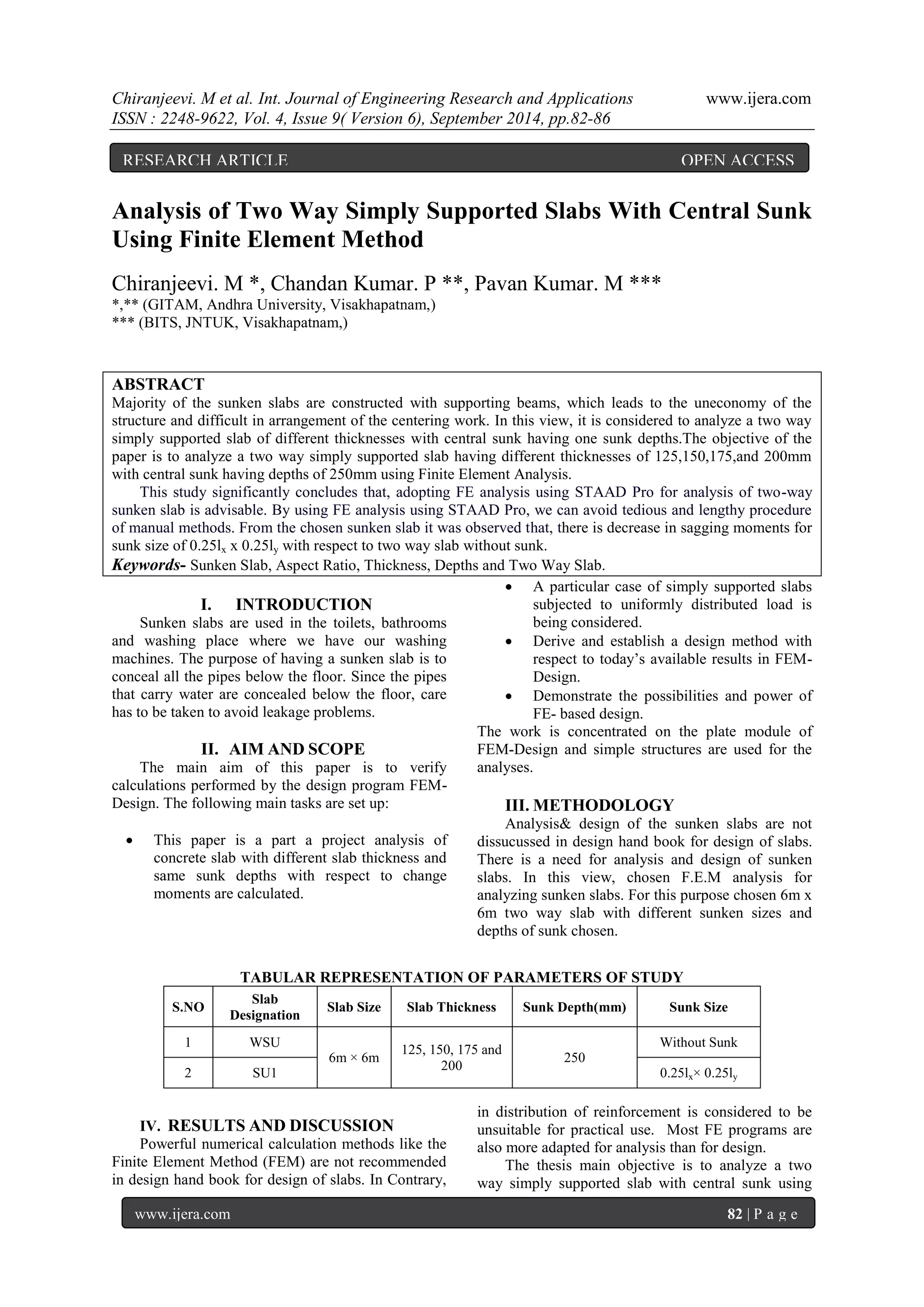
Analysis of Two Way Simply Supported Slabs With Central Sunk Using Finite Element Method Chiranjeevi. M *, Chandan Kumar. P **, Pavan Kumar. M *** *,** (GITAM, Andhra University, Visakhapatnam,) *** (BITS, JNTUK, Visakhapatnam,) ABSTRACT Majority of the sunken slabs are constructed with supporting beams, which leads to the uneconomy of the structure and difficult in arrangement of the centering work. In this view, it is considered to analyze a two way simply supported slab of different thicknesses with central sunk having one sunk depths.The objective of the paper is to analyze a two way simply supported slab having different thicknesses of 125,150,175,and 200mm with central sunk having depths of 250mm using Finite Element Analysis. This study significantly concludes that, adopting FE analysis using STAAD Pro for analysis of two-way sunken slab is advisable. By using FE analysis using STAAD Pro, we can avoid tedious and lengthy procedure of manual methods. From the chosen sunken slab it was observed that, there is decrease in sagging moments for sunk size of 0.25lx x 0.25ly with respect to two way slab without sunk. 
Keywords- Sunken Slab, Aspect Ratio, Thickness, Depths and Two Way Slab. 
I. INTRODUCTION 
Sunken slabs are used in the toilets, bathrooms and washing place where we have our washing machines. The purpose of having a sunken slab is to conceal all the pipes below the floor. Since the pipes that carry water are concealed below the floor, care has to be taken to avoid leakage problems. 
II. AIM AND SCOPE 
The main aim of this paper is to verify calculations performed by the design program FEM- Design. The following main tasks are set up: 
 This paper is a part a project analysis of concrete slab with different slab thickness and same sunk depths with respect to change moments are calculated. 
 A particular case of simply supported slabs subjected to uniformly distributed load is being considered. 
 Derive and establish a design method with respect to today‟s available results in FEM- Design. 
 Demonstrate the possibilities and power of FE- based design. 
The work is concentrated on the plate module of FEM-Design and simple structures are used for the analyses. 
III. METHODOLOGY 
Analysis& design of the sunken slabs are not dissucussed in design hand book for design of slabs. There is a need for analysis and design of sunken slabs. In this view, chosen F.E.M analysis for analyzing sunken slabs. For this purpose chosen 6m x 6m two way slab with different sunken sizes and depths of sunk chosen. TABULAR REPRESENTATION OF PARAMETERS OF STUDY 
S.NO 
Slab Designation 
Slab Size 
Slab Thickness 
Sunk Depth(mm) 
Sunk Size 
1 
WSU 
6m × 6m 
125, 150, 175 and 200 
250 
Without Sunk 
2 
SU1 
0.25lx× 0.25ly 
IV. RESULTS AND DISCUSSION 
Powerful numerical calculation methods like the Finite Element Method (FEM) are not recommended in design hand book for design of slabs. In Contrary, in distribution of reinforcement is considered to be unsuitable for practical use. Most FE programs are also more adapted for analysis than for design. 
The thesis main objective is to analyze a two way simply supported slab with central sunk using 
RESEARCH ARTICLE OPEN ACCESS
Chiranjeevi. M et al. Int. Journal of Engineering Research and Applications www.ijera.com 
ISSN : 2248-9622, Vol. 4, Issue 9( Version 6), September 2014, pp.82-86 
www.ijera.com 83 | P a g e 
Finite Element Analysis. For this purpose chosen 6m x 6m two way slab with different sunken sizes and depths of sunk. 
A. Two Way Slab Without Sunk 
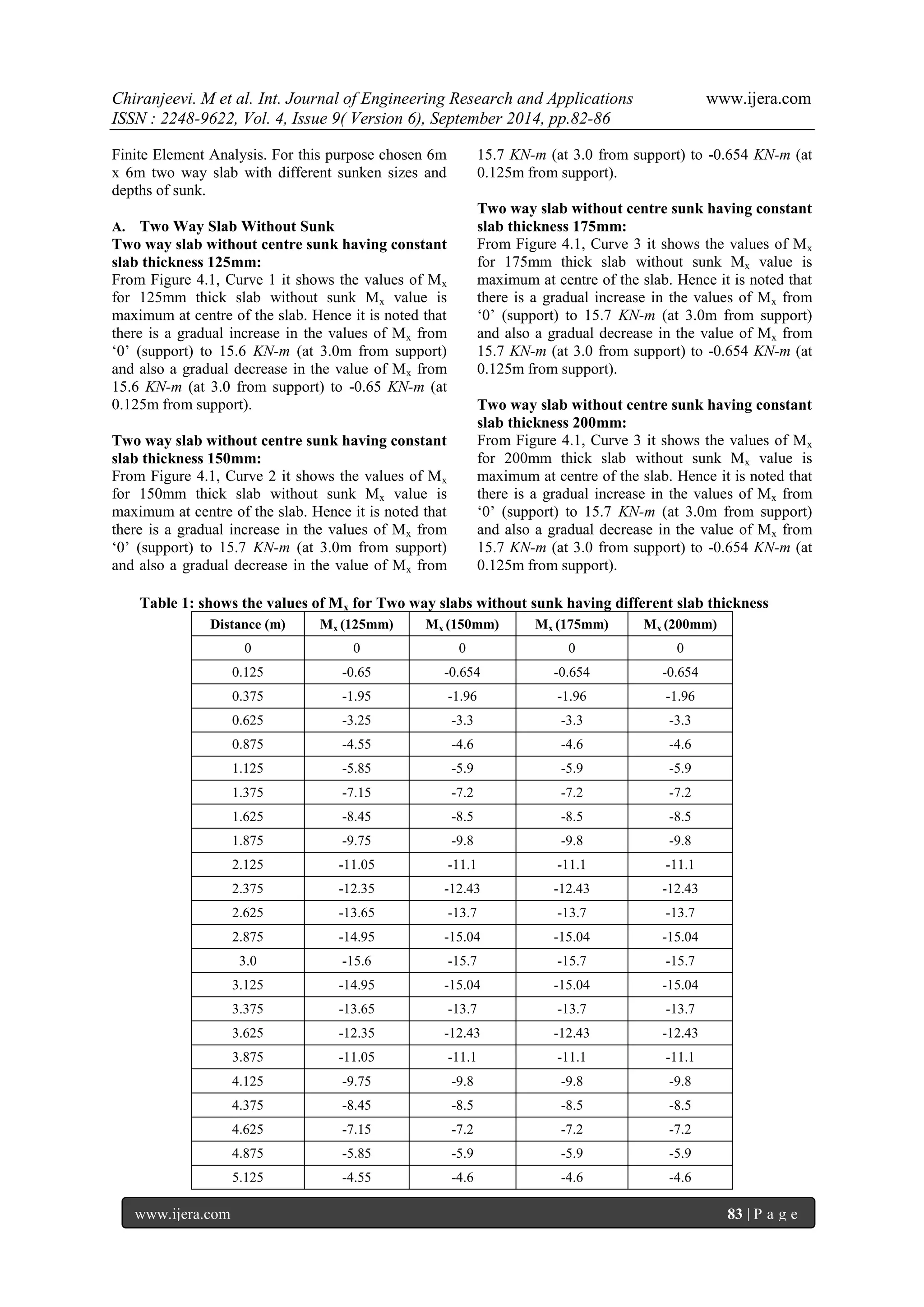
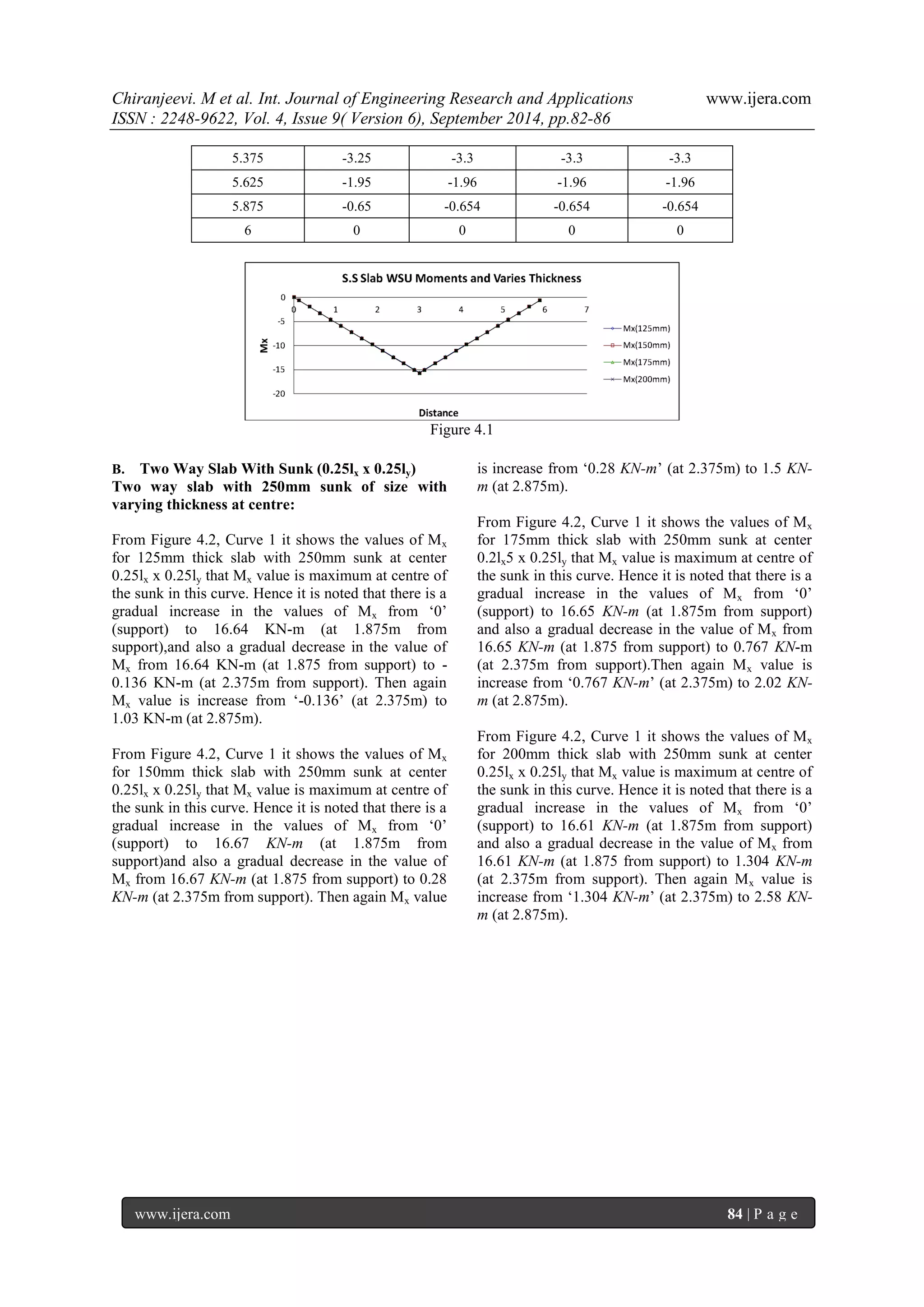
Two way slab without centre sunk having constant slab thickness 125mm: From Figure 4.1, Curve 1 it shows the values of Mx for 125mm thick slab without sunk Mx value is maximum at centre of the slab. Hence it is noted that there is a gradual increase in the values of Mx from „0‟ (support) to 15.6 KN-m (at 3.0m from support) and also a gradual decrease in the value of Mx from 15.6 KN-m (at 3.0 from support) to -0.65 KN-m (at 0.125m from support). Two way slab without centre sunk having constant slab thickness 150mm: 
From Figure 4.1, Curve 2 it shows the values of Mx for 150mm thick slab without sunk Mx value is maximum at centre of the slab. Hence it is noted that there is a gradual increase in the values of Mx from „0‟ (support) to 15.7 KN-m (at 3.0m from support) and also a gradual decrease in the value of Mx from 15.7 KN-m (at 3.0 from support) to -0.654 KN-m (at 0.125m from support). Two way slab without centre sunk having constant slab thickness 175mm: From Figure 4.1, Curve 3 it shows the values of Mx for 175mm thick slab without sunk Mx value is maximum at centre of the slab. Hence it is noted that there is a gradual increase in the values of Mx from „0‟ (support) to 15.7 KN-m (at 3.0m from support) and also a gradual decrease in the value of Mx from 15.7 KN-m (at 3.0 from support) to -0.654 KN-m (at 0.125m from support). Two way slab without centre sunk having constant slab thickness 200mm: From Figure 4.1, Curve 3 it shows the values of Mx for 200mm thick slab without sunk Mx value is maximum at centre of the slab. Hence it is noted that there is a gradual increase in the values of Mx from „0‟ (support) to 15.7 KN-m (at 3.0m from support) and also a gradual decrease in the value of Mx from 15.7 KN-m (at 3.0 from support) to -0.654 KN-m (at 0.125m from support). 
Table 1: shows the values of Mx for Two way slabs without sunk having different slab thickness 
Distance (m) 
Mx (125mm) 
Mx (150mm) 
Mx (175mm) 
Mx (200mm) 
0 
0 
0 
0 
0 
0.125 
-0.65 
-0.654 
-0.654 
-0.654 
0.375 
-1.95 
-1.96 
-1.96 
-1.96 
0.625 
-3.25 
-3.3 
-3.3 
-3.3 
0.875 
-4.55 
-4.6 
-4.6 
-4.6 
1.125 
-5.85 
-5.9 
-5.9 
-5.9 
1.375 
-7.15 
-7.2 
-7.2 
-7.2 
1.625 
-8.45 
-8.5 
-8.5 
-8.5 
1.875 
-9.75 
-9.8 
-9.8 
-9.8 
2.125 
-11.05 
-11.1 
-11.1 
-11.1 
2.375 
-12.35 
-12.43 
-12.43 
-12.43 
2.625 
-13.65 
-13.7 
-13.7 
-13.7 
2.875 
-14.95 
-15.04 
-15.04 
-15.04 
3.0 
-15.6 
-15.7 
-15.7 
-15.7 
3.125 
-14.95 
-15.04 
-15.04 
-15.04 
3.375 
-13.65 
-13.7 
-13.7 
-13.7 
3.625 
-12.35 
-12.43 
-12.43 
-12.43 
3.875 
-11.05 
-11.1 
-11.1 
-11.1 
4.125 
-9.75 
-9.8 
-9.8 
-9.8 
4.375 
-8.45 
-8.5 
-8.5 
-8.5 
4.625 
-7.15 
-7.2 
-7.2 
-7.2 
4.875 
-5.85 
-5.9 
-5.9 
-5.9 
5.125 
-4.55 
-4.6 
-4.6 
-4.6
Chiranjeevi. M et al. Int. Journal of Engineering Research and Applications www.ijera.com 
ISSN : 2248-9622, Vol. 4, Issue 9( Version 6), September 2014, pp.82-86 
www.ijera.com 84 | P a g e 
5.375 
-3.25 
-3.3 
-3.3 
-3.3 
5.625 
-1.95 
-1.96 
-1.96 
-1.96 
5.875 
-0.65 
-0.654 
-0.654 
-0.654 
6 
0 
0 
0 
0 
Figure 4.1 
B. Two Way Slab With Sunk (0.25lx x 0.25ly) 
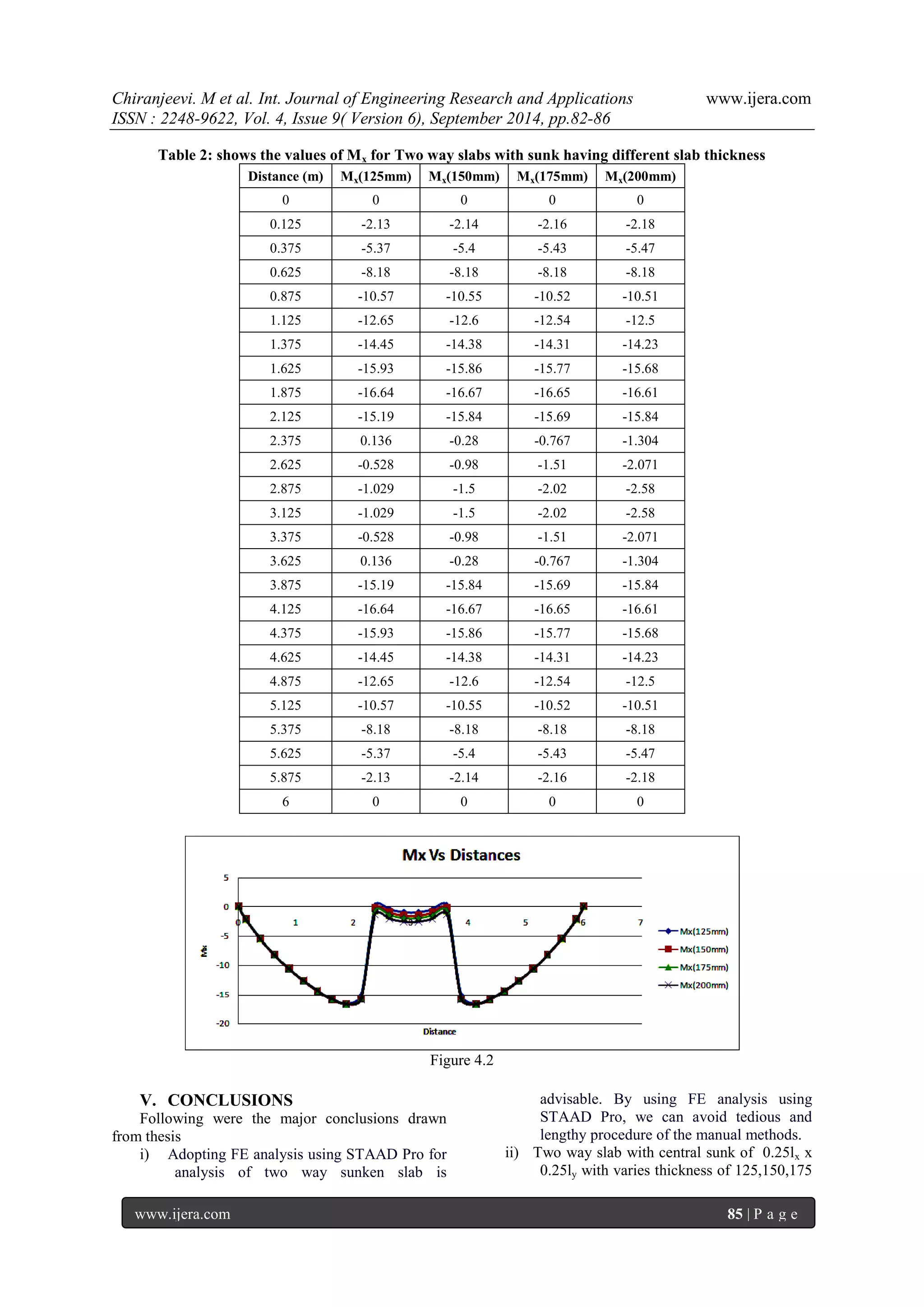
Two way slab with 250mm sunk of size with varying thickness at centre: From Figure 4.2, Curve 1 it shows the values of Mx for 125mm thick slab with 250mm sunk at center 0.25lx x 0.25ly that Mx value is maximum at centre of the sunk in this curve. Hence it is noted that there is a gradual increase in the values of Mx from „0‟ (support) to 16.64 KN-m (at 1.875m from support),and also a gradual decrease in the value of Mx from 16.64 KN-m (at 1.875 from support) to - 0.136 KN-m (at 2.375m from support). Then again Mx value is increase from „-0.136‟ (at 2.375m) to 1.03 KN-m (at 2.875m). 
From Figure 4.2, Curve 1 it shows the values of Mx for 150mm thick slab with 250mm sunk at center 0.25lx x 0.25ly that Mx value is maximum at centre of the sunk in this curve. Hence it is noted that there is a gradual increase in the values of Mx from „0‟ (support) to 16.67 KN-m (at 1.875m from support)and also a gradual decrease in the value of Mx from 16.67 KN-m (at 1.875 from support) to 0.28 KN-m (at 2.375m from support). Then again Mx value is increase from „0.28 KN-m‟ (at 2.375m) to 1.5 KN- m (at 2.875m). From Figure 4.2, Curve 1 it shows the values of Mx for 175mm thick slab with 250mm sunk at center 0.2lx5 x 0.25ly that Mx value is maximum at centre of the sunk in this curve. Hence it is noted that there is a gradual increase in the values of Mx from „0‟ (support) to 16.65 KN-m (at 1.875m from support) and also a gradual decrease in the value of Mx from 16.65 KN-m (at 1.875 from support) to 0.767 KN-m (at 2.375m from support).Then again Mx value is increase from „0.767 KN-m‟ (at 2.375m) to 2.02 KN- m (at 2.875m). 
From Figure 4.2, Curve 1 it shows the values of Mx for 200mm thick slab with 250mm sunk at center 0.25lx x 0.25ly that Mx value is maximum at centre of the sunk in this curve. Hence it is noted that there is a gradual increase in the values of Mx from „0‟ (support) to 16.61 KN-m (at 1.875m from support) and also a gradual decrease in the value of Mx from 16.61 KN-m (at 1.875 from support) to 1.304 KN-m (at 2.375m from support). Then again Mx value is increase from „1.304 KN-m‟ (at 2.375m) to 2.58 KN- m (at 2.875m).
Chiranjeevi. M et al. Int. Journal of Engineering Research and Applications www.ijera.com 
ISSN : 2248-9622, Vol. 4, Issue 9( Version 6), September 2014, pp.82-86 
www.ijera.com 85 | P a g e 
Table 2: shows the values of Mx for Two way slabs with sunk having different slab thickness 
Distance (m) 
Mx(125mm) 
Mx(150mm) 
Mx(175mm) 
Mx(200mm) 
0 
0 
0 
0 
0 
0.125 
-2.13 
-2.14 
-2.16 
-2.18 
0.375 
-5.37 
-5.4 
-5.43 
-5.47 
0.625 
-8.18 
-8.18 
-8.18 
-8.18 
0.875 
-10.57 
-10.55 
-10.52 
-10.51 
1.125 
-12.65 
-12.6 
-12.54 
-12.5 
1.375 
-14.45 
-14.38 
-14.31 
-14.23 
1.625 
-15.93 
-15.86 
-15.77 
-15.68 
1.875 
-16.64 
-16.67 
-16.65 
-16.61 
2.125 
-15.19 
-15.84 
-15.69 
-15.84 
2.375 
0.136 
-0.28 
-0.767 
-1.304 
2.625 
-0.528 
-0.98 
-1.51 
-2.071 
2.875 
-1.029 
-1.5 
-2.02 
-2.58 
3.125 
-1.029 
-1.5 
-2.02 
-2.58 
3.375 
-0.528 
-0.98 
-1.51 
-2.071 
3.625 
0.136 
-0.28 
-0.767 
-1.304 
3.875 
-15.19 
-15.84 
-15.69 
-15.84 
4.125 
-16.64 
-16.67 
-16.65 
-16.61 
4.375 
-15.93 
-15.86 
-15.77 
-15.68 
4.625 
-14.45 
-14.38 
-14.31 
-14.23 
4.875 
-12.65 
-12.6 
-12.54 
-12.5 
5.125 
-10.57 
-10.55 
-10.52 
-10.51 
5.375 
-8.18 
-8.18 
-8.18 
-8.18 
5.625 
-5.37 
-5.4 
-5.43 
-5.47 
5.875 
-2.13 
-2.14 
-2.16 
-2.18 
6 
0 
0 
0 
0 
Figure 4.2 
V. CONCLUSIONS 
Following were the major conclusions drawn from thesis 
i) Adopting FE analysis using STAAD Pro for analysis of two way sunken slab is 
advisable. By using FE analysis using STAAD Pro, we can avoid tedious and lengthy procedure of the manual methods. 
ii) Two way slab with central sunk of 0.25lx x 0.25ly with varies thickness of 125,150,175
Chiranjeevi. M et al. Int. Journal of Engineering Research and Applications www.ijera.com 
ISSN : 2248-9622, Vol. 4, Issue 9( Version 6), September 2014, pp.82-86 
www.ijera.com 86 | P a g e 
and 200mm,no considerable variations in the moments with respect to the sunk depth of 250mm. But there is a small increase in the values of moments with the increase in thickness of slab. 
REFERENCES 
[1]. A.M. Mont‟Alverne 2012 “Determination of the reinforced concrete slabs ultimate load using finite element method and mathematical programming” Latin American Journal of solids structures Vol.9, No.1, Rio de janeiro 2012. 
[2]. K. M. A. Hossain 2005 “Design optimization of simply supported concrete slabs by finite element modeling” Struct. Multidisc Optim 30, 76–88(2005). 
[3]. M. M. Smadi and K. A. Belakhdar 2007 “Development of Finite Element Code for Analysis of Reinforced Concrete Slabs” Jordan Journal of Civil engineering Vol.1, No.2, 2007. 
[4]. Johansen K.W., 1962, “Yield-Line Theory “, Cement and Concrete Association, London,.pp 181. 
[5]. Sudhakar, K.J., 1998, “Moment Coefficients for the design of Irregular slabs by yield line theory.” M.E, Thesis, Submitted to Andhra University, Andhra Pradesh, Visakhapatnam, India, pp.150. 
[6]. Zaslavsky.Aron. Dec 1967, “Yield line analysis of rectangular slabs with central opening” ACI journal, No 64-74,.pp 838-844. 
[7]. Rambabu,K. and Goli, H B. “Simplified approach to design orthogonal slabs using affine theorem” Journal of Structural Engineering, Chennai, India.

Analysis of Two Way Simply Supported Slabs With Central Sunk Using Finite Element Method

  • 1.
    Chiranjeevi. M etal. Int. Journal of Engineering Research and Applications www.ijera.com ISSN : 2248-9622, Vol. 4, Issue 9( Version 6), September 2014, pp.82-86 www.ijera.com 82 | P a g e Analysis of Two Way Simply Supported Slabs With Central Sunk Using Finite Element Method Chiranjeevi. M *, Chandan Kumar. P **, Pavan Kumar. M *** *,** (GITAM, Andhra University, Visakhapatnam,) *** (BITS, JNTUK, Visakhapatnam,) ABSTRACT Majority of the sunken slabs are constructed with supporting beams, which leads to the uneconomy of the structure and difficult in arrangement of the centering work. In this view, it is considered to analyze a two way simply supported slab of different thicknesses with central sunk having one sunk depths.The objective of the paper is to analyze a two way simply supported slab having different thicknesses of 125,150,175,and 200mm with central sunk having depths of 250mm using Finite Element Analysis. This study significantly concludes that, adopting FE analysis using STAAD Pro for analysis of two-way sunken slab is advisable. By using FE analysis using STAAD Pro, we can avoid tedious and lengthy procedure of manual methods. From the chosen sunken slab it was observed that, there is decrease in sagging moments for sunk size of 0.25lx x 0.25ly with respect to two way slab without sunk. Keywords- Sunken Slab, Aspect Ratio, Thickness, Depths and Two Way Slab. I. INTRODUCTION Sunken slabs are used in the toilets, bathrooms and washing place where we have our washing machines. The purpose of having a sunken slab is to conceal all the pipes below the floor. Since the pipes that carry water are concealed below the floor, care has to be taken to avoid leakage problems. II. AIM AND SCOPE The main aim of this paper is to verify calculations performed by the design program FEM- Design. The following main tasks are set up:  This paper is a part a project analysis of concrete slab with different slab thickness and same sunk depths with respect to change moments are calculated.  A particular case of simply supported slabs subjected to uniformly distributed load is being considered.  Derive and establish a design method with respect to today‟s available results in FEM- Design.  Demonstrate the possibilities and power of FE- based design. The work is concentrated on the plate module of FEM-Design and simple structures are used for the analyses. III. METHODOLOGY Analysis& design of the sunken slabs are not dissucussed in design hand book for design of slabs. There is a need for analysis and design of sunken slabs. In this view, chosen F.E.M analysis for analyzing sunken slabs. For this purpose chosen 6m x 6m two way slab with different sunken sizes and depths of sunk chosen. TABULAR REPRESENTATION OF PARAMETERS OF STUDY S.NO Slab Designation Slab Size Slab Thickness Sunk Depth(mm) Sunk Size 1 WSU 6m × 6m 125, 150, 175 and 200 250 Without Sunk 2 SU1 0.25lx× 0.25ly IV. RESULTS AND DISCUSSION Powerful numerical calculation methods like the Finite Element Method (FEM) are not recommended in design hand book for design of slabs. In Contrary, in distribution of reinforcement is considered to be unsuitable for practical use. Most FE programs are also more adapted for analysis than for design. The thesis main objective is to analyze a two way simply supported slab with central sunk using RESEARCH ARTICLE OPEN ACCESS
  • 2.
    Chiranjeevi. M etal. Int. Journal of Engineering Research and Applications www.ijera.com ISSN : 2248-9622, Vol. 4, Issue 9( Version 6), September 2014, pp.82-86 www.ijera.com 83 | P a g e Finite Element Analysis. For this purpose chosen 6m x 6m two way slab with different sunken sizes and depths of sunk. A. Two Way Slab Without Sunk Two way slab without centre sunk having constant slab thickness 125mm: From Figure 4.1, Curve 1 it shows the values of Mx for 125mm thick slab without sunk Mx value is maximum at centre of the slab. Hence it is noted that there is a gradual increase in the values of Mx from „0‟ (support) to 15.6 KN-m (at 3.0m from support) and also a gradual decrease in the value of Mx from 15.6 KN-m (at 3.0 from support) to -0.65 KN-m (at 0.125m from support). Two way slab without centre sunk having constant slab thickness 150mm: From Figure 4.1, Curve 2 it shows the values of Mx for 150mm thick slab without sunk Mx value is maximum at centre of the slab. Hence it is noted that there is a gradual increase in the values of Mx from „0‟ (support) to 15.7 KN-m (at 3.0m from support) and also a gradual decrease in the value of Mx from 15.7 KN-m (at 3.0 from support) to -0.654 KN-m (at 0.125m from support). Two way slab without centre sunk having constant slab thickness 175mm: From Figure 4.1, Curve 3 it shows the values of Mx for 175mm thick slab without sunk Mx value is maximum at centre of the slab. Hence it is noted that there is a gradual increase in the values of Mx from „0‟ (support) to 15.7 KN-m (at 3.0m from support) and also a gradual decrease in the value of Mx from 15.7 KN-m (at 3.0 from support) to -0.654 KN-m (at 0.125m from support). Two way slab without centre sunk having constant slab thickness 200mm: From Figure 4.1, Curve 3 it shows the values of Mx for 200mm thick slab without sunk Mx value is maximum at centre of the slab. Hence it is noted that there is a gradual increase in the values of Mx from „0‟ (support) to 15.7 KN-m (at 3.0m from support) and also a gradual decrease in the value of Mx from 15.7 KN-m (at 3.0 from support) to -0.654 KN-m (at 0.125m from support). Table 1: shows the values of Mx for Two way slabs without sunk having different slab thickness Distance (m) Mx (125mm) Mx (150mm) Mx (175mm) Mx (200mm) 0 0 0 0 0 0.125 -0.65 -0.654 -0.654 -0.654 0.375 -1.95 -1.96 -1.96 -1.96 0.625 -3.25 -3.3 -3.3 -3.3 0.875 -4.55 -4.6 -4.6 -4.6 1.125 -5.85 -5.9 -5.9 -5.9 1.375 -7.15 -7.2 -7.2 -7.2 1.625 -8.45 -8.5 -8.5 -8.5 1.875 -9.75 -9.8 -9.8 -9.8 2.125 -11.05 -11.1 -11.1 -11.1 2.375 -12.35 -12.43 -12.43 -12.43 2.625 -13.65 -13.7 -13.7 -13.7 2.875 -14.95 -15.04 -15.04 -15.04 3.0 -15.6 -15.7 -15.7 -15.7 3.125 -14.95 -15.04 -15.04 -15.04 3.375 -13.65 -13.7 -13.7 -13.7 3.625 -12.35 -12.43 -12.43 -12.43 3.875 -11.05 -11.1 -11.1 -11.1 4.125 -9.75 -9.8 -9.8 -9.8 4.375 -8.45 -8.5 -8.5 -8.5 4.625 -7.15 -7.2 -7.2 -7.2 4.875 -5.85 -5.9 -5.9 -5.9 5.125 -4.55 -4.6 -4.6 -4.6
  • 3.
    Chiranjeevi. M etal. Int. Journal of Engineering Research and Applications www.ijera.com ISSN : 2248-9622, Vol. 4, Issue 9( Version 6), September 2014, pp.82-86 www.ijera.com 84 | P a g e 5.375 -3.25 -3.3 -3.3 -3.3 5.625 -1.95 -1.96 -1.96 -1.96 5.875 -0.65 -0.654 -0.654 -0.654 6 0 0 0 0 Figure 4.1 B. Two Way Slab With Sunk (0.25lx x 0.25ly) Two way slab with 250mm sunk of size with varying thickness at centre: From Figure 4.2, Curve 1 it shows the values of Mx for 125mm thick slab with 250mm sunk at center 0.25lx x 0.25ly that Mx value is maximum at centre of the sunk in this curve. Hence it is noted that there is a gradual increase in the values of Mx from „0‟ (support) to 16.64 KN-m (at 1.875m from support),and also a gradual decrease in the value of Mx from 16.64 KN-m (at 1.875 from support) to - 0.136 KN-m (at 2.375m from support). Then again Mx value is increase from „-0.136‟ (at 2.375m) to 1.03 KN-m (at 2.875m). From Figure 4.2, Curve 1 it shows the values of Mx for 150mm thick slab with 250mm sunk at center 0.25lx x 0.25ly that Mx value is maximum at centre of the sunk in this curve. Hence it is noted that there is a gradual increase in the values of Mx from „0‟ (support) to 16.67 KN-m (at 1.875m from support)and also a gradual decrease in the value of Mx from 16.67 KN-m (at 1.875 from support) to 0.28 KN-m (at 2.375m from support). Then again Mx value is increase from „0.28 KN-m‟ (at 2.375m) to 1.5 KN- m (at 2.875m). From Figure 4.2, Curve 1 it shows the values of Mx for 175mm thick slab with 250mm sunk at center 0.2lx5 x 0.25ly that Mx value is maximum at centre of the sunk in this curve. Hence it is noted that there is a gradual increase in the values of Mx from „0‟ (support) to 16.65 KN-m (at 1.875m from support) and also a gradual decrease in the value of Mx from 16.65 KN-m (at 1.875 from support) to 0.767 KN-m (at 2.375m from support).Then again Mx value is increase from „0.767 KN-m‟ (at 2.375m) to 2.02 KN- m (at 2.875m). From Figure 4.2, Curve 1 it shows the values of Mx for 200mm thick slab with 250mm sunk at center 0.25lx x 0.25ly that Mx value is maximum at centre of the sunk in this curve. Hence it is noted that there is a gradual increase in the values of Mx from „0‟ (support) to 16.61 KN-m (at 1.875m from support) and also a gradual decrease in the value of Mx from 16.61 KN-m (at 1.875 from support) to 1.304 KN-m (at 2.375m from support). Then again Mx value is increase from „1.304 KN-m‟ (at 2.375m) to 2.58 KN- m (at 2.875m).
  • 4.
    Chiranjeevi. M etal. Int. Journal of Engineering Research and Applications www.ijera.com ISSN : 2248-9622, Vol. 4, Issue 9( Version 6), September 2014, pp.82-86 www.ijera.com 85 | P a g e Table 2: shows the values of Mx for Two way slabs with sunk having different slab thickness Distance (m) Mx(125mm) Mx(150mm) Mx(175mm) Mx(200mm) 0 0 0 0 0 0.125 -2.13 -2.14 -2.16 -2.18 0.375 -5.37 -5.4 -5.43 -5.47 0.625 -8.18 -8.18 -8.18 -8.18 0.875 -10.57 -10.55 -10.52 -10.51 1.125 -12.65 -12.6 -12.54 -12.5 1.375 -14.45 -14.38 -14.31 -14.23 1.625 -15.93 -15.86 -15.77 -15.68 1.875 -16.64 -16.67 -16.65 -16.61 2.125 -15.19 -15.84 -15.69 -15.84 2.375 0.136 -0.28 -0.767 -1.304 2.625 -0.528 -0.98 -1.51 -2.071 2.875 -1.029 -1.5 -2.02 -2.58 3.125 -1.029 -1.5 -2.02 -2.58 3.375 -0.528 -0.98 -1.51 -2.071 3.625 0.136 -0.28 -0.767 -1.304 3.875 -15.19 -15.84 -15.69 -15.84 4.125 -16.64 -16.67 -16.65 -16.61 4.375 -15.93 -15.86 -15.77 -15.68 4.625 -14.45 -14.38 -14.31 -14.23 4.875 -12.65 -12.6 -12.54 -12.5 5.125 -10.57 -10.55 -10.52 -10.51 5.375 -8.18 -8.18 -8.18 -8.18 5.625 -5.37 -5.4 -5.43 -5.47 5.875 -2.13 -2.14 -2.16 -2.18 6 0 0 0 0 Figure 4.2 V. CONCLUSIONS Following were the major conclusions drawn from thesis i) Adopting FE analysis using STAAD Pro for analysis of two way sunken slab is advisable. By using FE analysis using STAAD Pro, we can avoid tedious and lengthy procedure of the manual methods. ii) Two way slab with central sunk of 0.25lx x 0.25ly with varies thickness of 125,150,175
  • 5.
    Chiranjeevi. M etal. Int. Journal of Engineering Research and Applications www.ijera.com ISSN : 2248-9622, Vol. 4, Issue 9( Version 6), September 2014, pp.82-86 www.ijera.com 86 | P a g e and 200mm,no considerable variations in the moments with respect to the sunk depth of 250mm. But there is a small increase in the values of moments with the increase in thickness of slab. REFERENCES [1]. A.M. Mont‟Alverne 2012 “Determination of the reinforced concrete slabs ultimate load using finite element method and mathematical programming” Latin American Journal of solids structures Vol.9, No.1, Rio de janeiro 2012. [2]. K. M. A. Hossain 2005 “Design optimization of simply supported concrete slabs by finite element modeling” Struct. Multidisc Optim 30, 76–88(2005). [3]. M. M. Smadi and K. A. Belakhdar 2007 “Development of Finite Element Code for Analysis of Reinforced Concrete Slabs” Jordan Journal of Civil engineering Vol.1, No.2, 2007. [4]. Johansen K.W., 1962, “Yield-Line Theory “, Cement and Concrete Association, London,.pp 181. [5]. Sudhakar, K.J., 1998, “Moment Coefficients for the design of Irregular slabs by yield line theory.” M.E, Thesis, Submitted to Andhra University, Andhra Pradesh, Visakhapatnam, India, pp.150. [6]. Zaslavsky.Aron. Dec 1967, “Yield line analysis of rectangular slabs with central opening” ACI journal, No 64-74,.pp 838-844. [7]. Rambabu,K. and Goli, H B. “Simplified approach to design orthogonal slabs using affine theorem” Journal of Structural Engineering, Chennai, India.