WHAT IS THE MEANING OF THIS?
UNDERSTANDING THE CONTENTIOUS(?) RELATIONSHIP BETWEEN
VIDEOGAME PLAY AND VIDEOGAME NARRATIVE

ND Bowman
Indiana University
24 Jan 2014
Media and
Interaction Lab
ABSTRACT
Video games have enjoyed sustained economic and cultural success for
nearly four decades, with their success often attributed to their interactive
nature: passive audiences become active users with a vested stake in the
on-screen experience. However, as games continue their evolution from
singular challenge/skill puzzles to narrative-rich virtual worlds, the manner
in which we play and are affected by this play has been called into
question. Specifically, given that users do not have an unlimited ability
to process stimuli, one might challenge the implicit assumption that
gamers interact with and are influenced by all on-screen content in a
similar fashion. The following presentation outlines emerging theory and
research into the ways in which gamers attend to different on-screen
content, and how this implicit and explicit attention can impact the overall
entertainment experience.
Research Rant

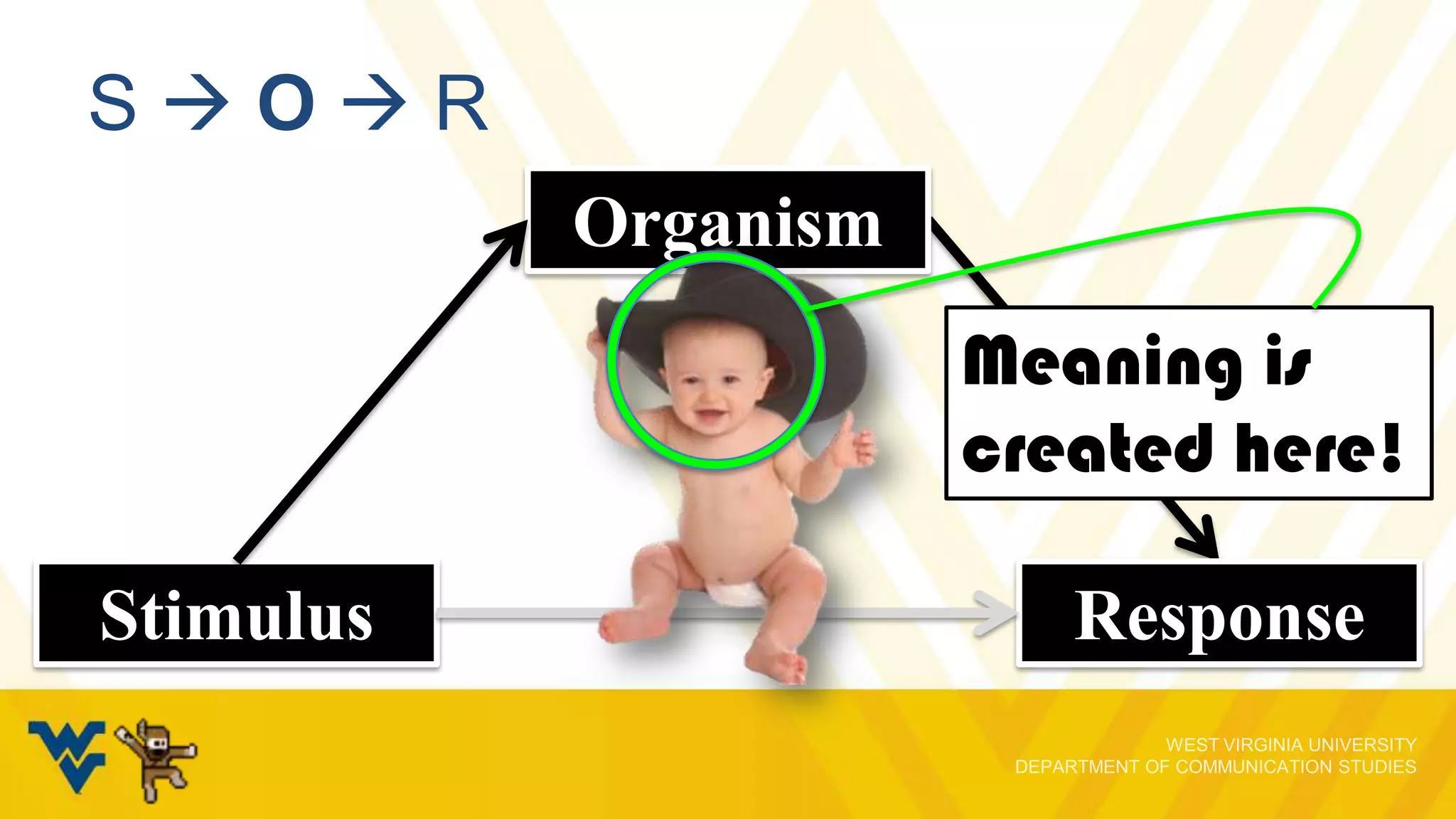
PREAMBLE: S  O  R
SOR
Organism
Meaning is
created here!
Stimulus

Response
SOR
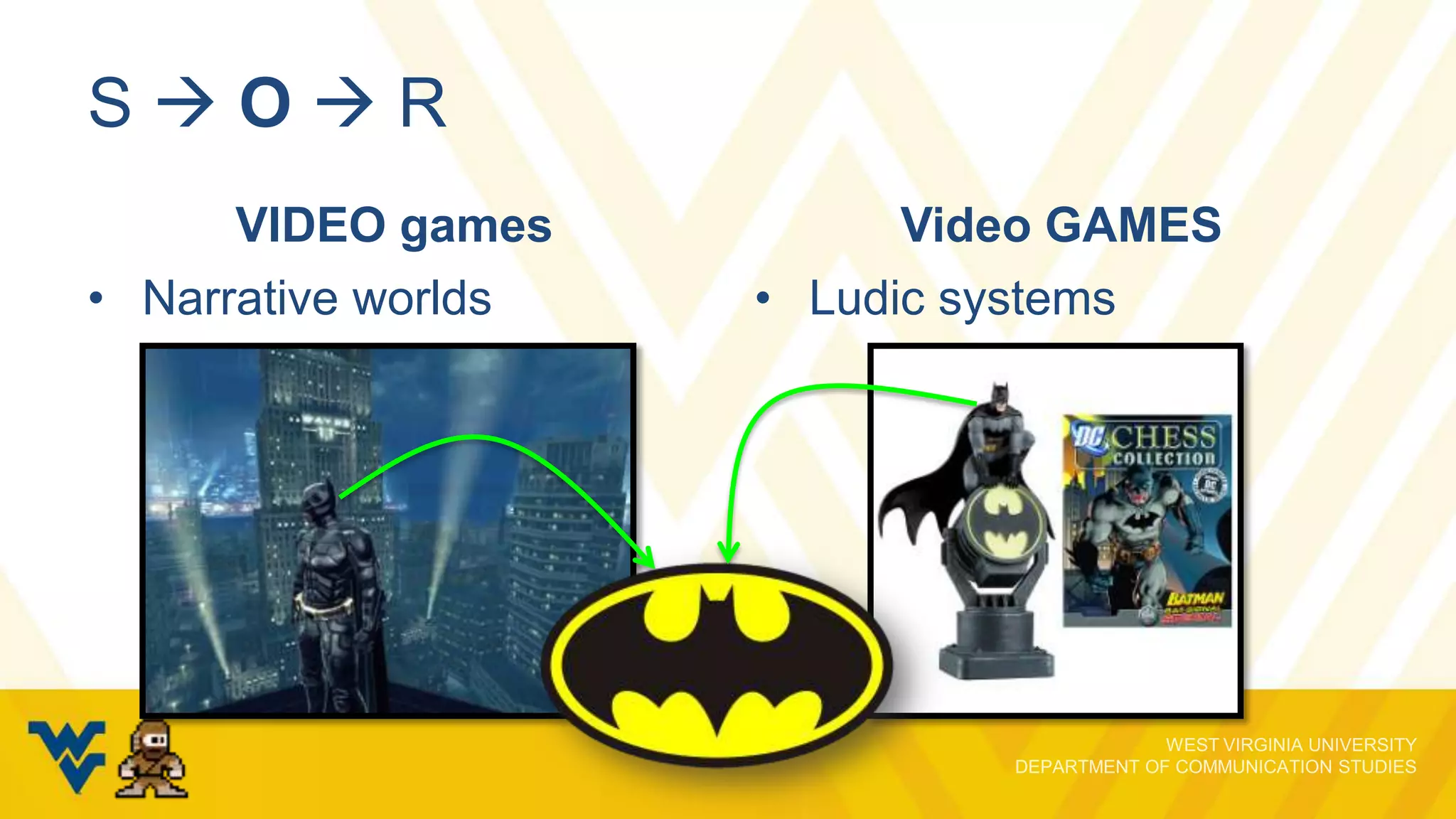
VIDEO games
• Narrative worlds

Video GAMES
• Ludic systems
SOR
• So, do we get to BE Batman, or do we get to
PLAY Batman? Can’t we do BOTH? [NO]
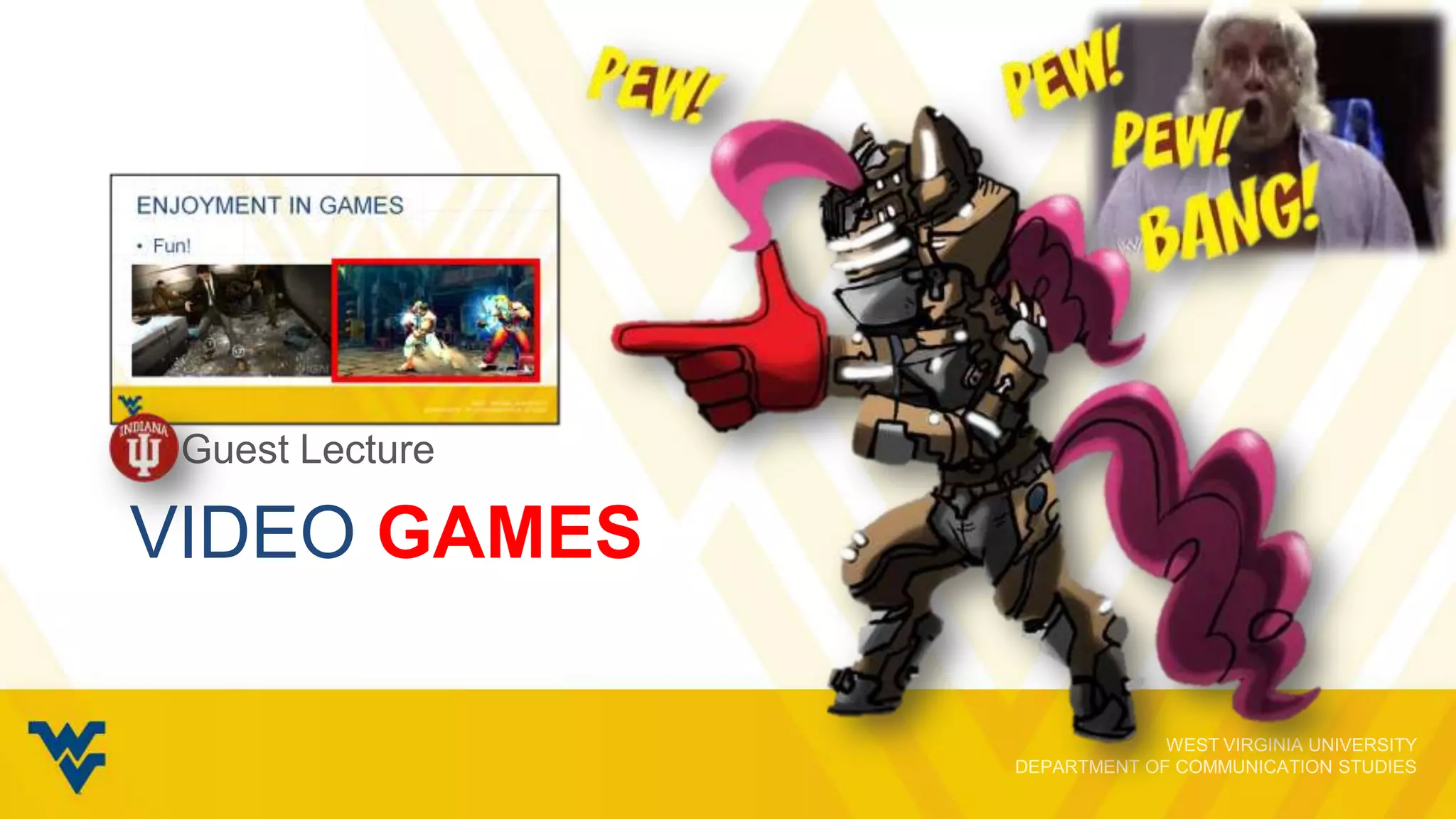
IU Guest Lecture

VIDEO GAMES
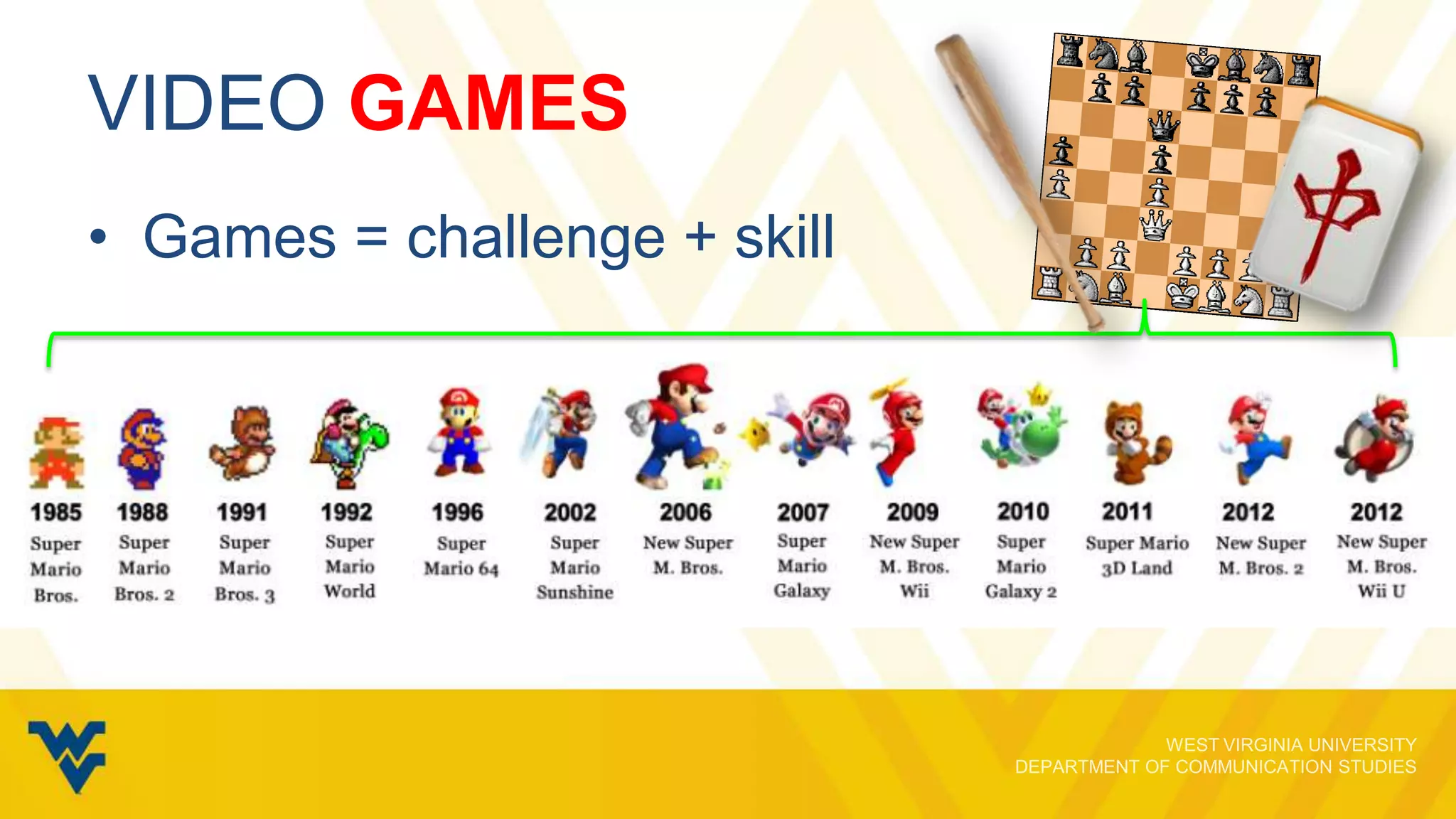
VIDEO GAMES
• Games = challenge + skill
VIDEO GAMES
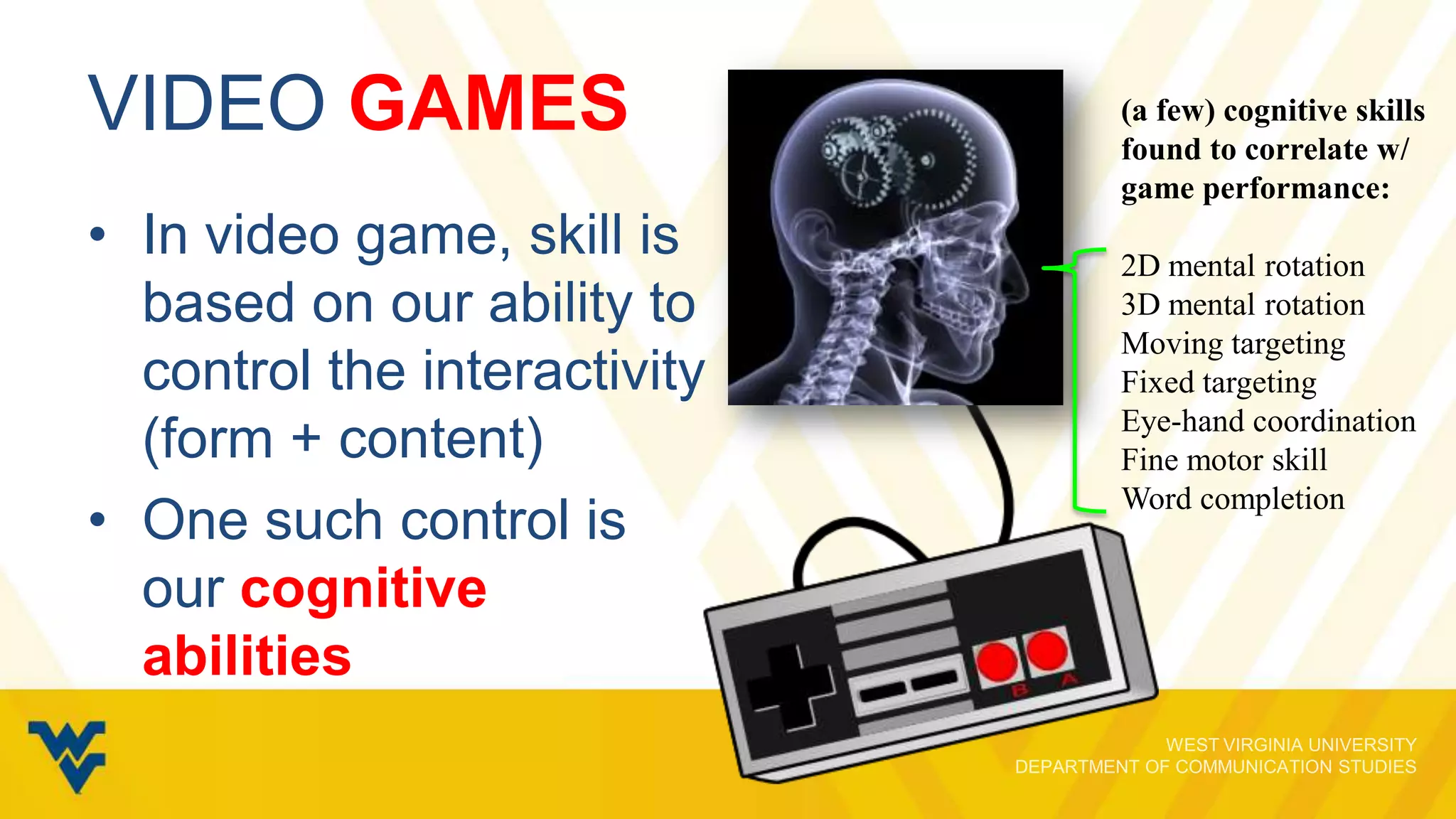
• In video game, skill is
based on our ability to
control the interactivity
(form + content)
• One such control is
our cognitive
abilities

(a few) cognitive skills
found to correlate w/
game performance:
2D mental rotation
3D mental rotation
Moving targeting
Fixed targeting
Eye-hand coordination
Fine motor skill
Word completion
VIDEO GAMES
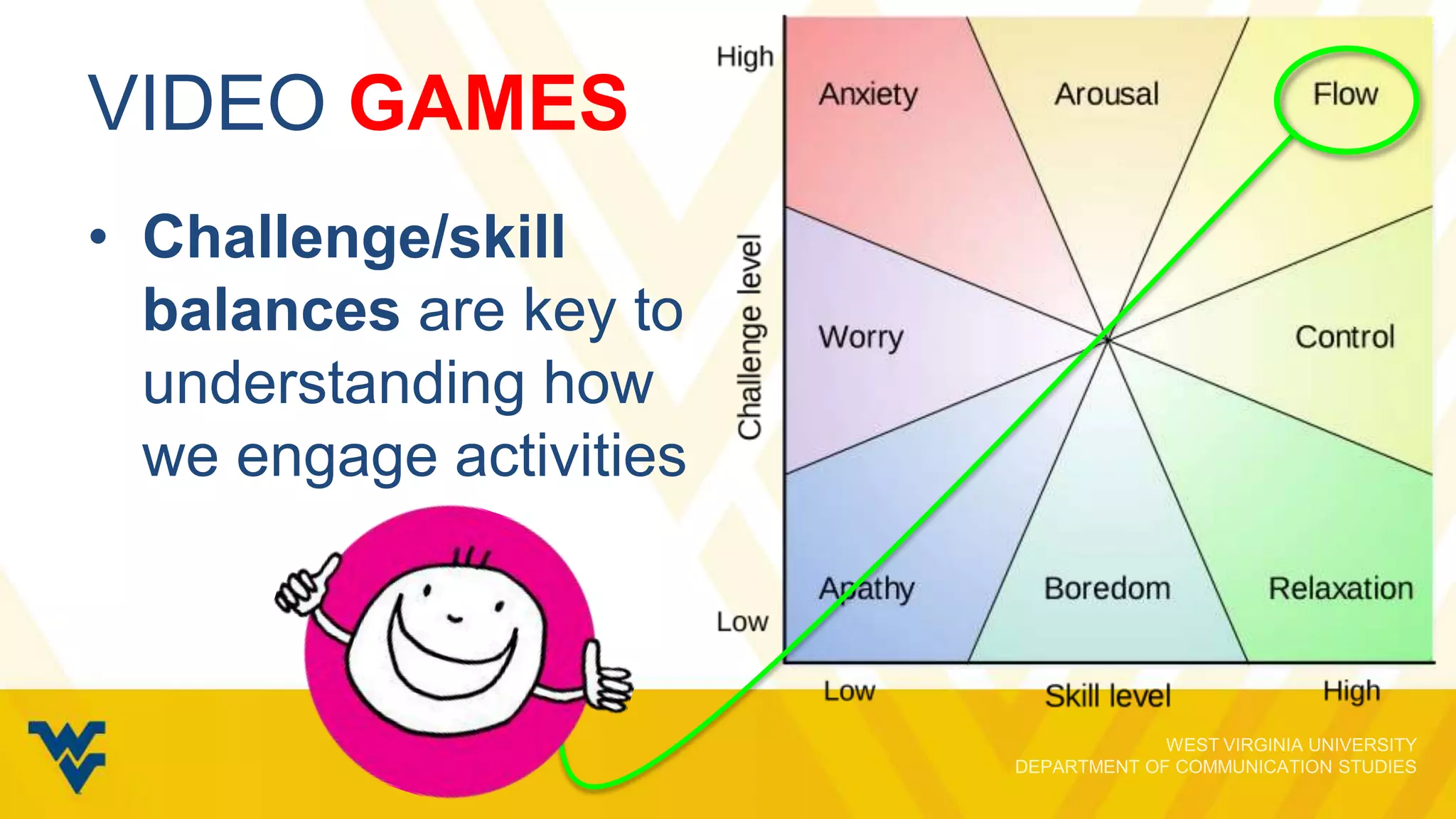
• Challenge/skill
balances are key to
understanding how
we engage activities
VIDEO GAMES

@JenovaChen

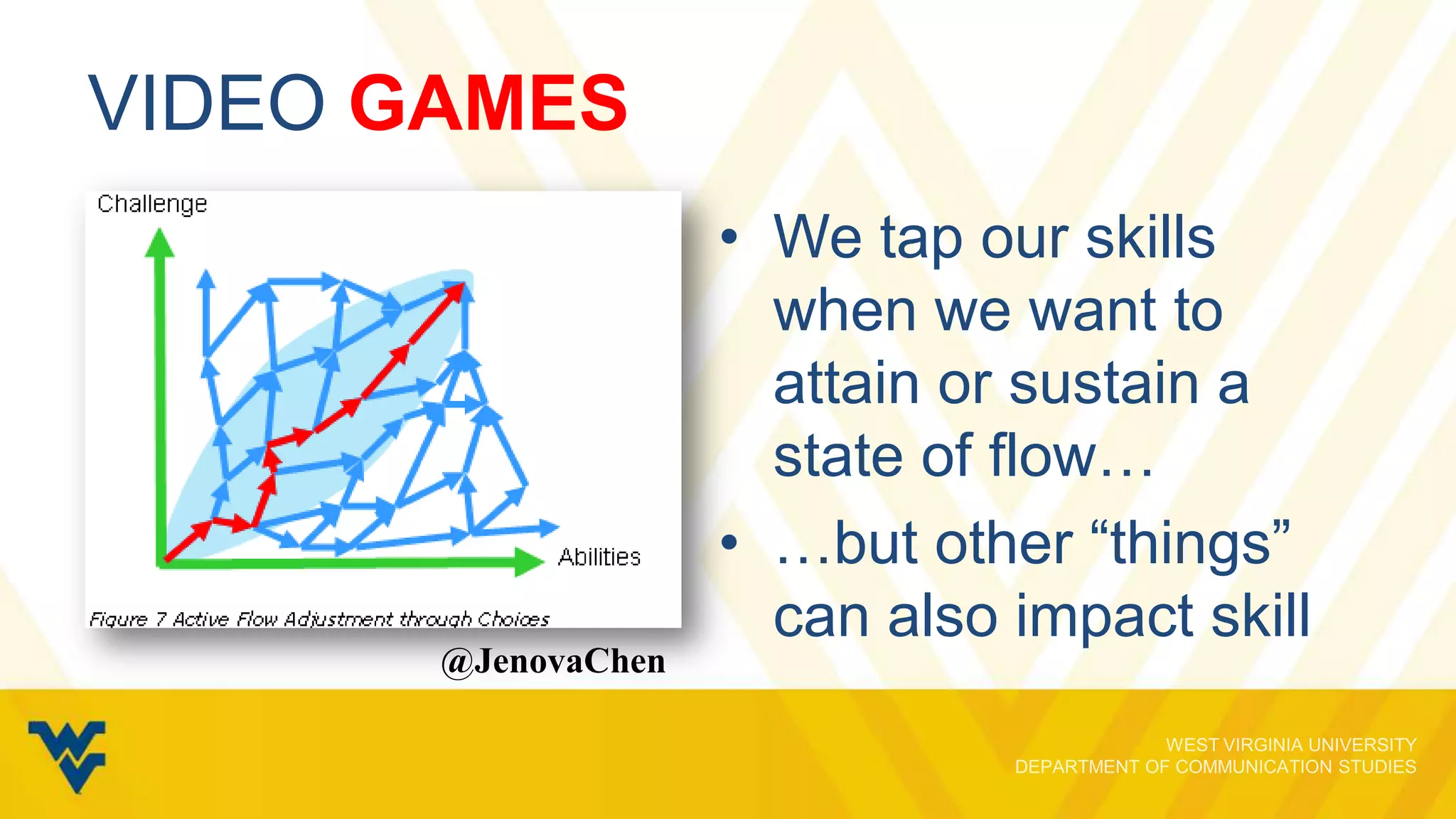
• We tap our skills
when we want to
attain or sustain a
state of flow…
• …but other “things”
can also impact skill
VIDEO GAMES
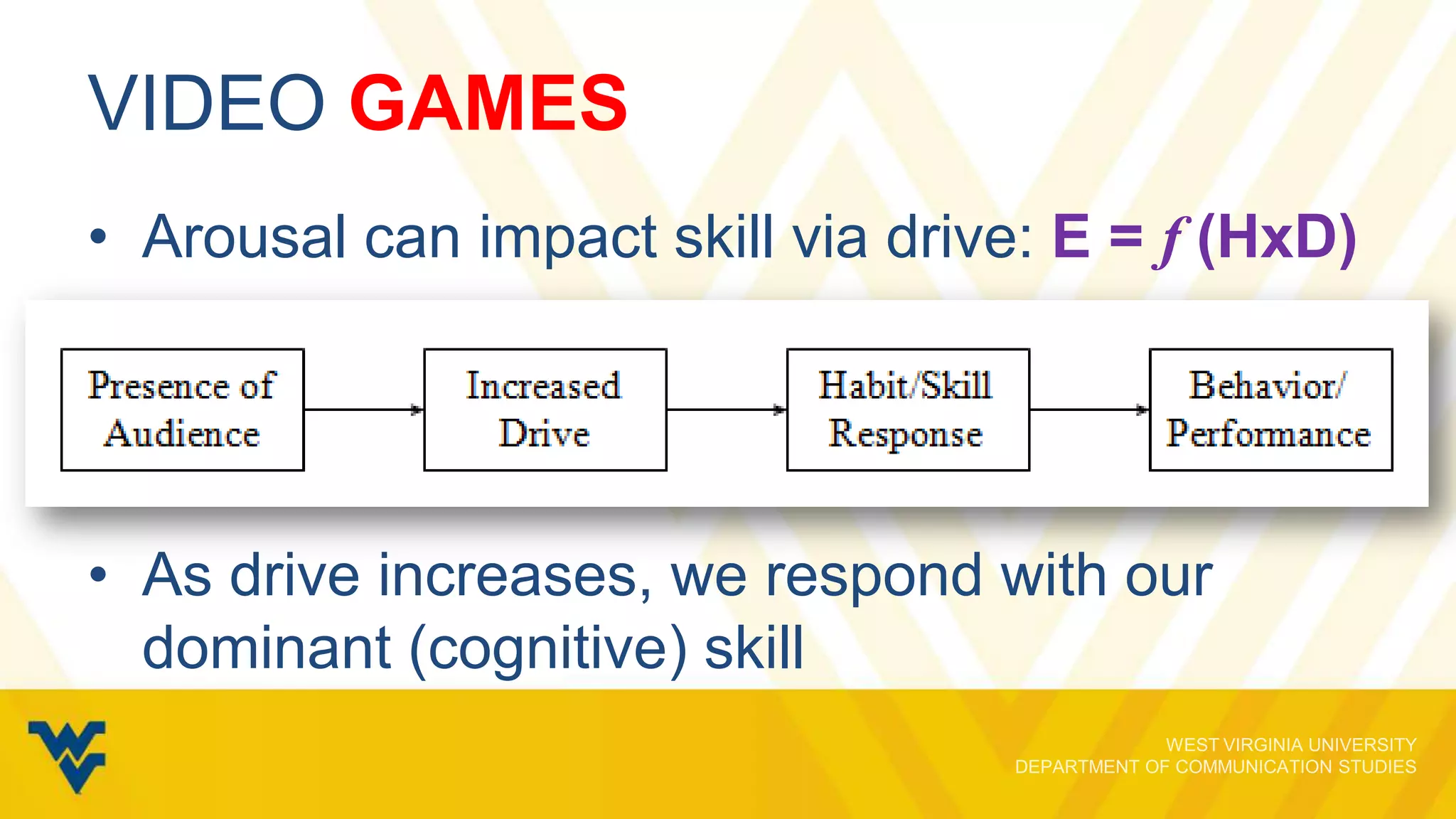
• Arousal can impact skill via drive: E = f (HxD)

• As drive increases, we respond with our
dominant (cognitive) skill
VIDEO GAMES
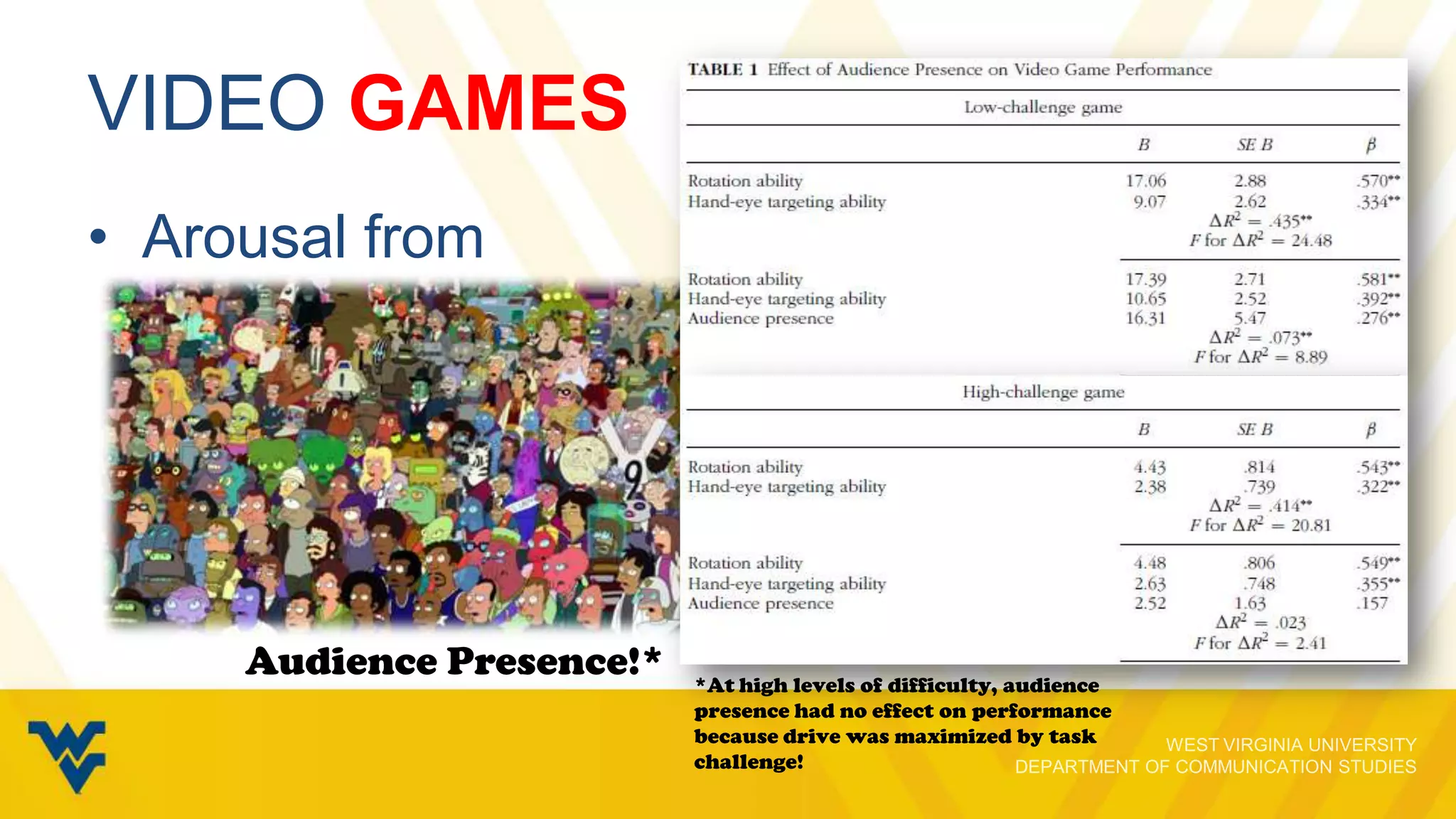
• Arousal from

Audience Presence!*

*At high levels of difficulty, audience
presence had no effect on performance
because drive was maximized by task
challenge!
VIDEO GAMES
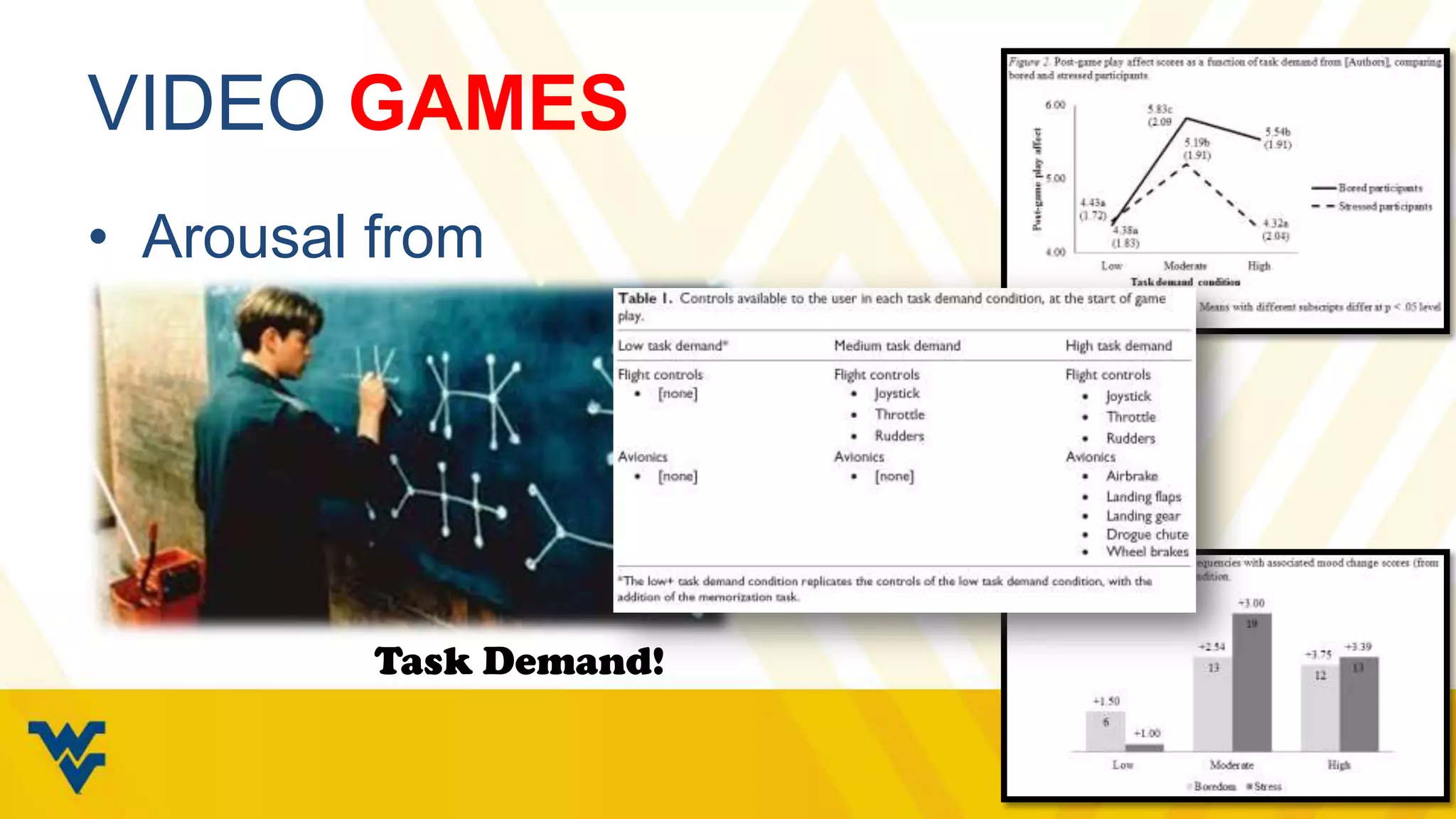
• Arousal from

Task Demand!
VIDEO GAMES
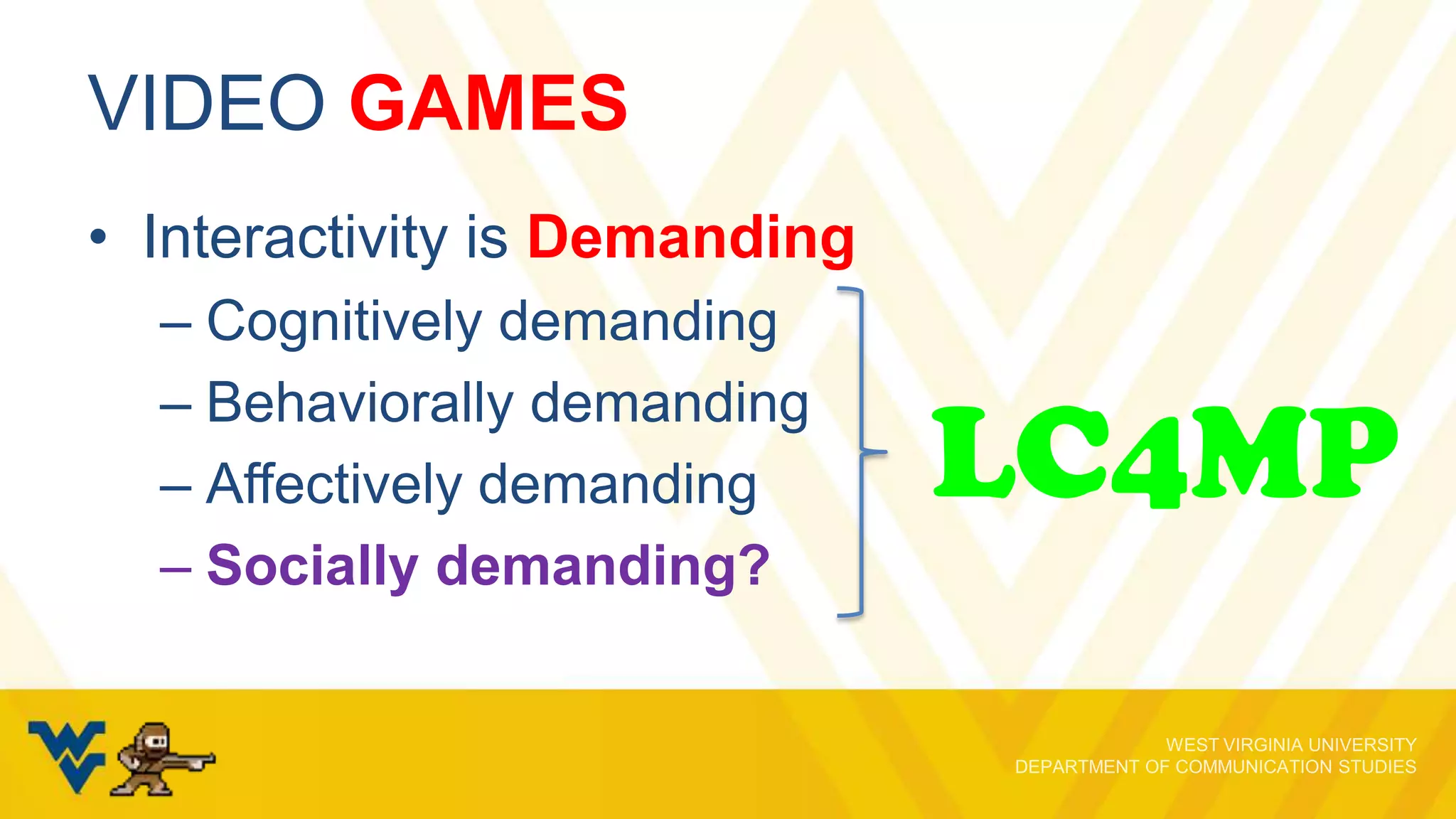
• Interactivity is Demanding
– Cognitively demanding
– Behaviorally demanding
– Affectively demanding
– Socially demanding?

LC4MP
IU Guest Lecture

VIDEO GAMES
VIDEO GAMES
“…games have said goodbye to the tired
alien invasions and over-the-top fantasy
stories so often found in video games.
Instead, they peer into the dark reaches
of the very real human heart to deliver
stories that are thrilling, chilling and
utterly absorbing” ~ Winda Benedetti

@WindaBenedetti
VIDEO GAMES

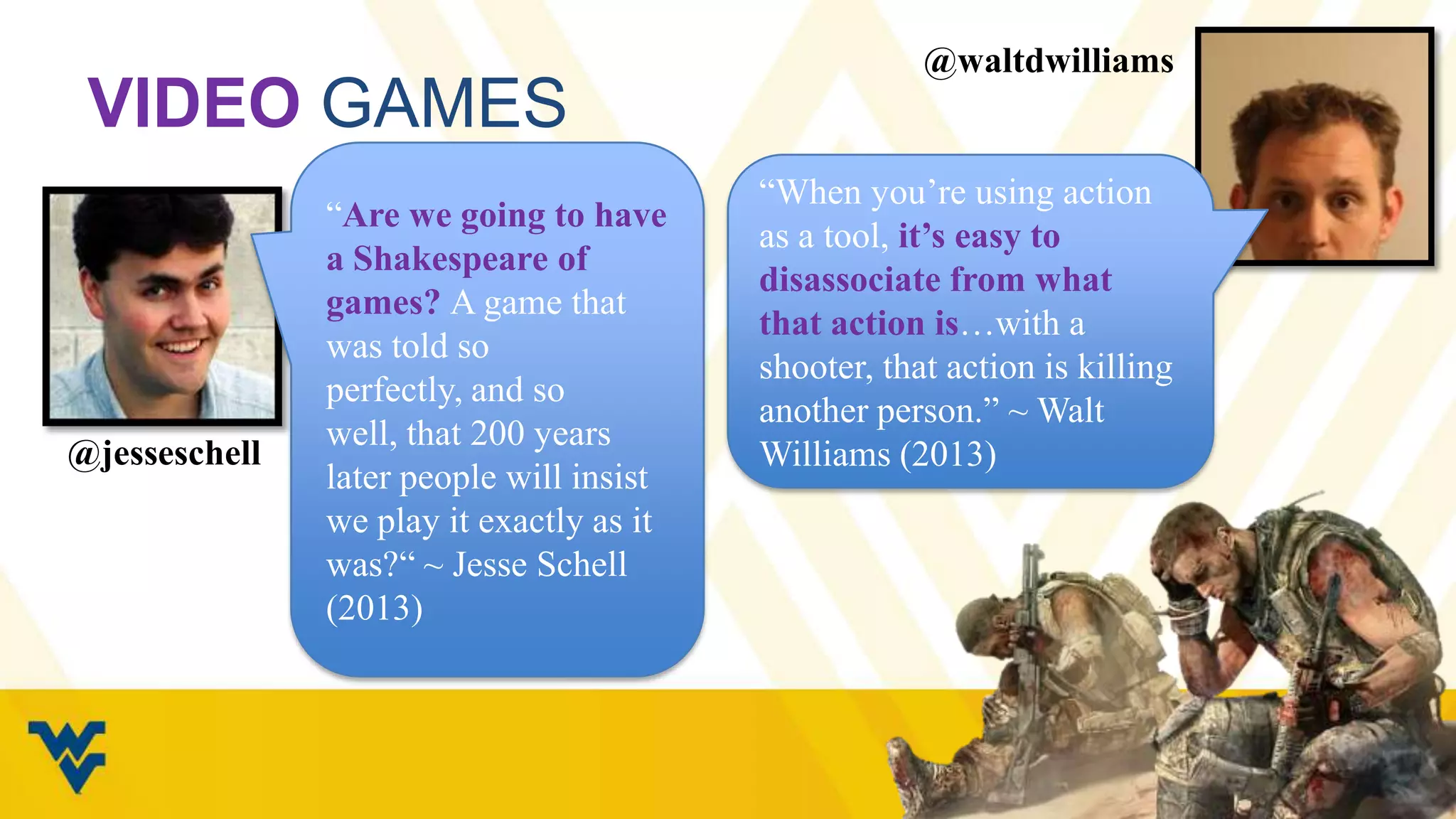
@jesseschell

“Are we going to have
a Shakespeare of
games? A game that
was told so perfectly,
and so well, that 200
years later people will
insist we play it
exactly as it was?“ ~
Jesse Schell (2013)

@waltdwilliams

“When you‟re using action
as a tool, it’s easy to
disassociate from what
that action is…with a
shooter, that action is killing
another person.” ~ Walt
Williams (2013)
VIDEO GAMES

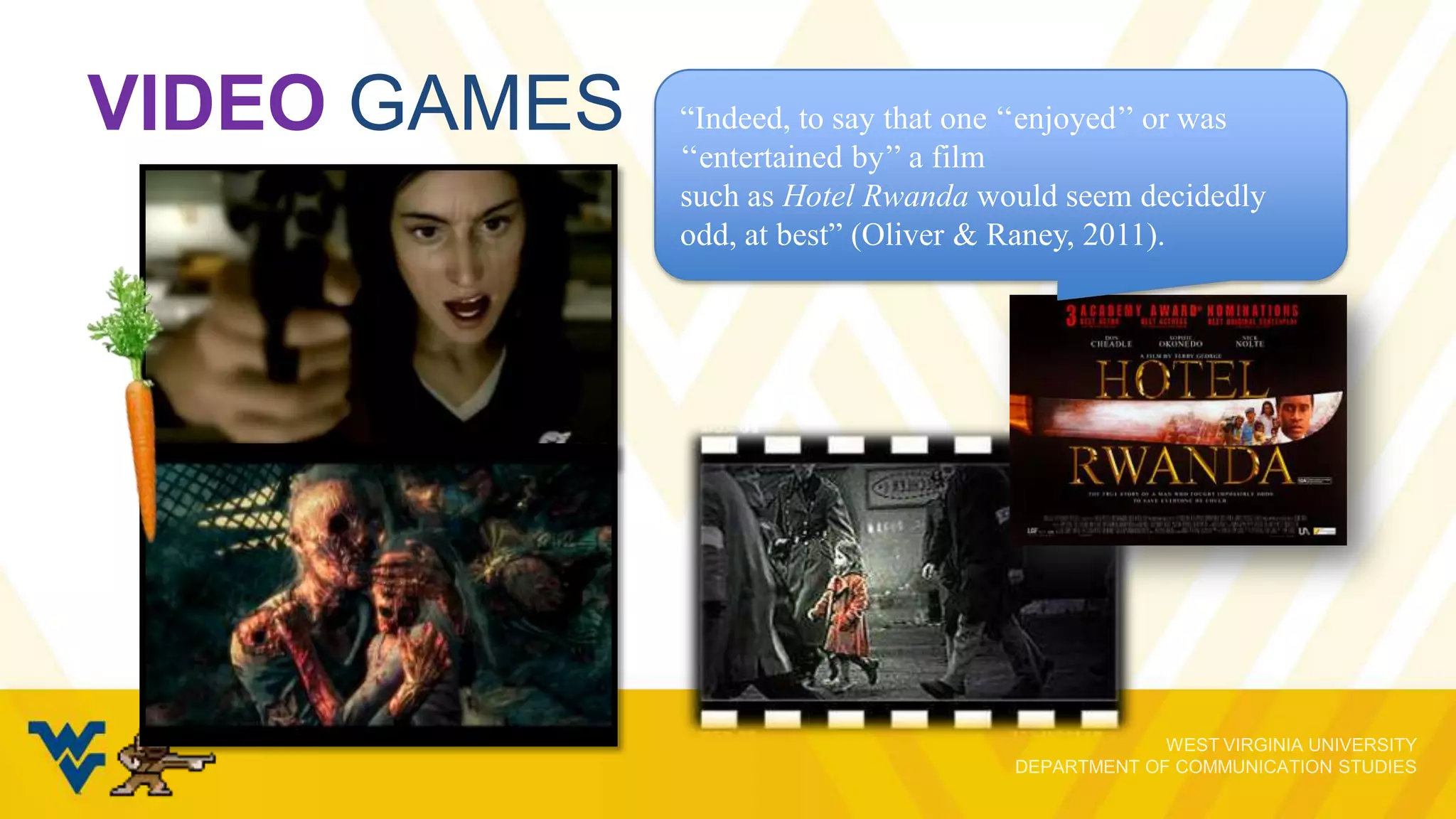
“Indeed, to say that one „„enjoyed‟‟ or was
„„entertained by‟‟ a film
such as Hotel Rwanda would seem decidedly
odd, at best” (Oliver & Raney, 2011).
VIDEO GAMES
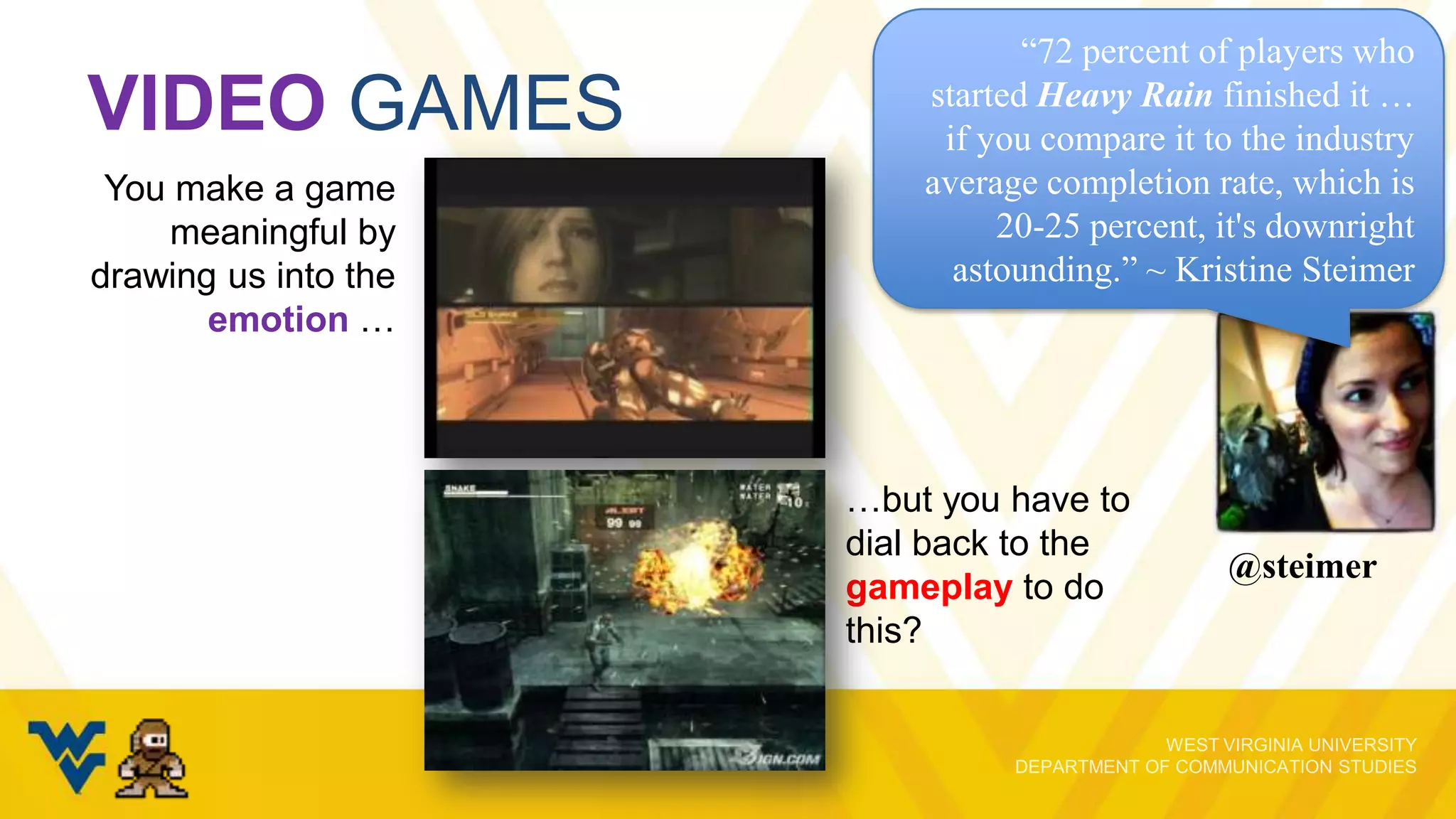
You make a game
meaningful by
drawing us into the
emotion …

“72 percent of players who
started Heavy Rain finished it …
if you compare it to the industry
average completion rate, which is
20-25 percent, it's downright
astounding.” ~ Kristine Steimer

…but you have to
dial back to the
gameplay to do
this?

@steimer
VIDEO GAMES
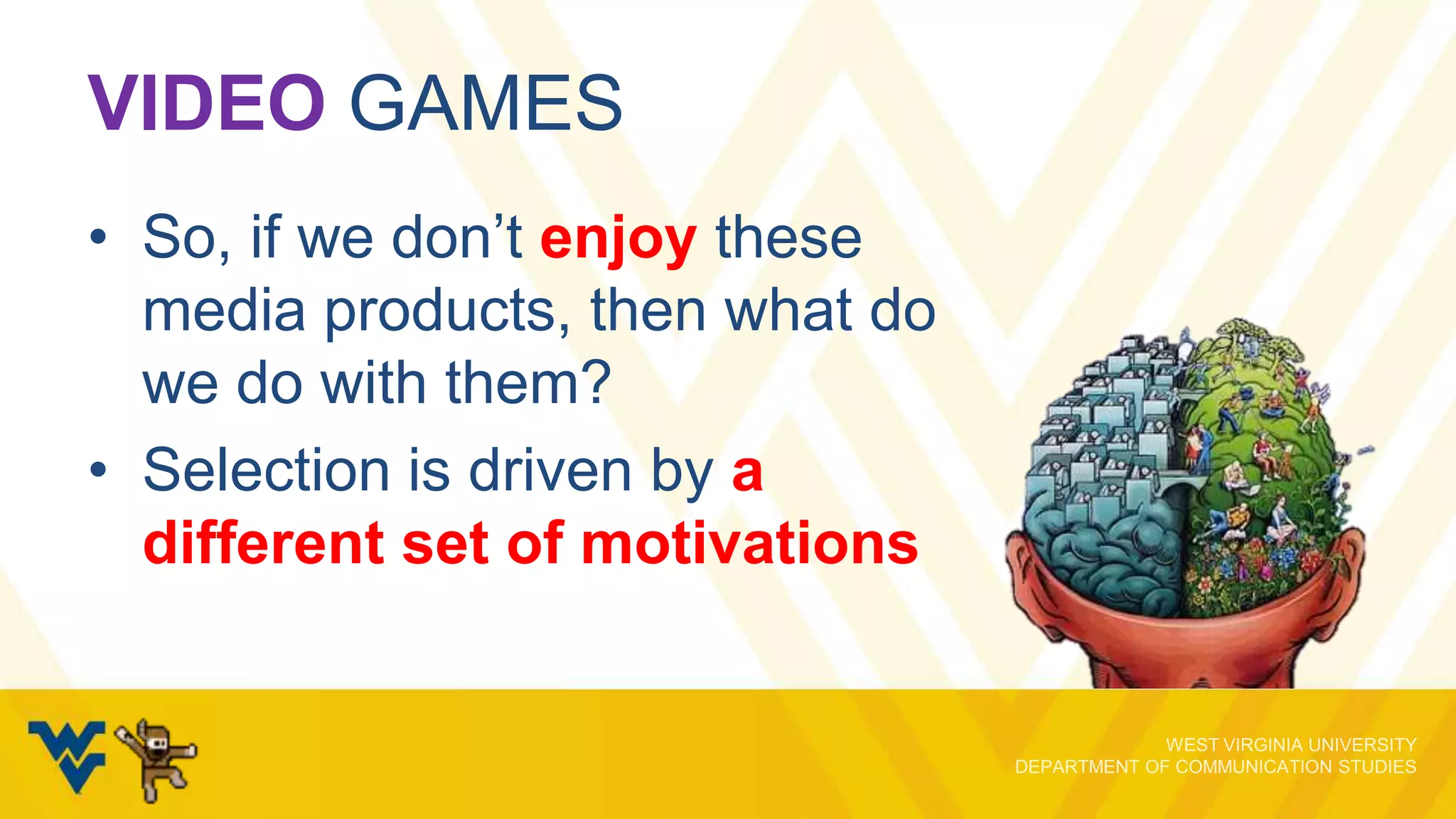
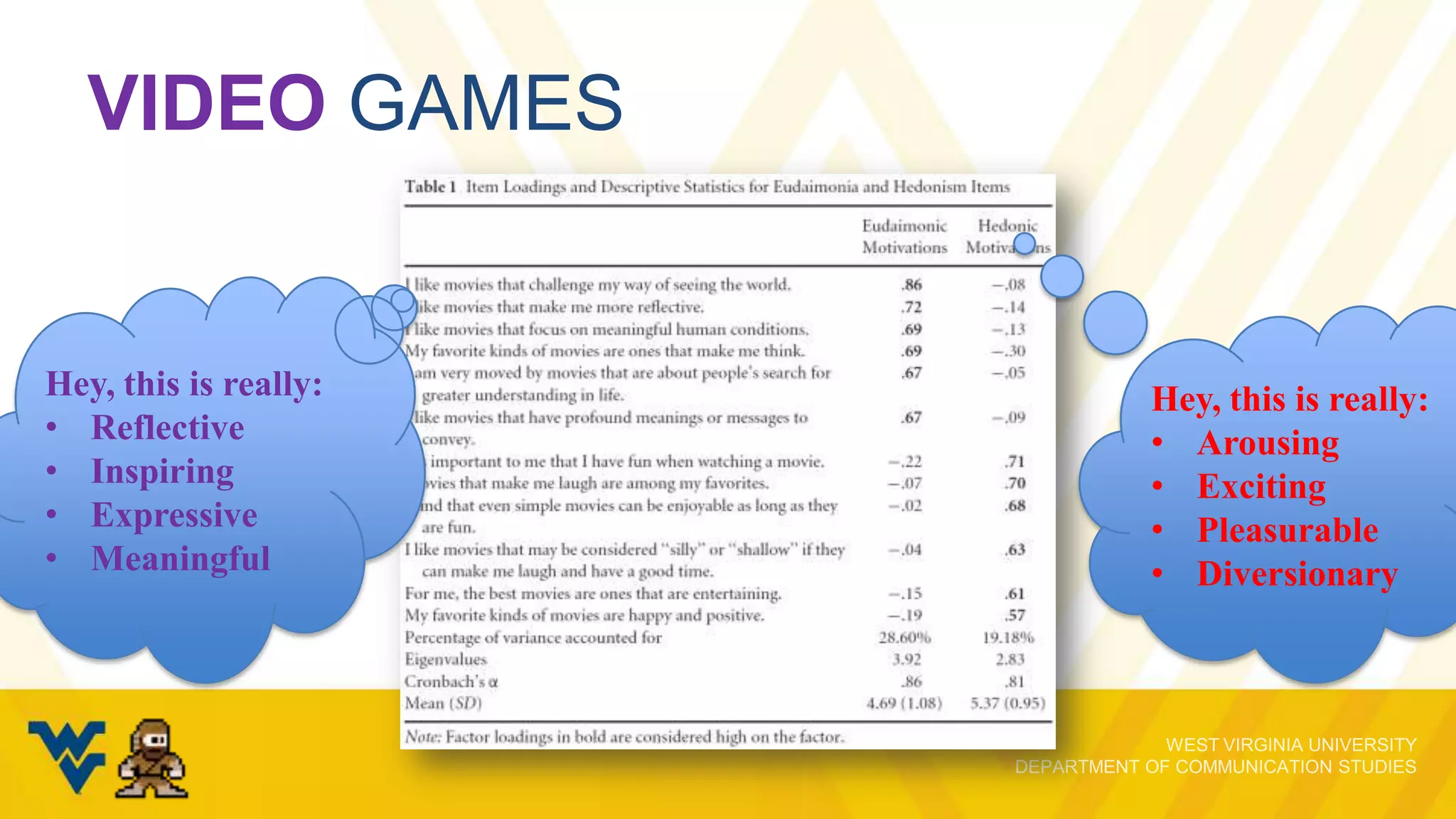
• So, if we don’t enjoy these
media products, then what do
we do with them?
• Selection is driven by a
different set of motivations
VIDEO GAMES

Hey, this is really:
• Reflective
• Inspiring
• Expressive
• Meaningful

Hey, this is really:
• Arousing
• Exciting
• Pleasurable
• Diversionary
VIDEO GAMES
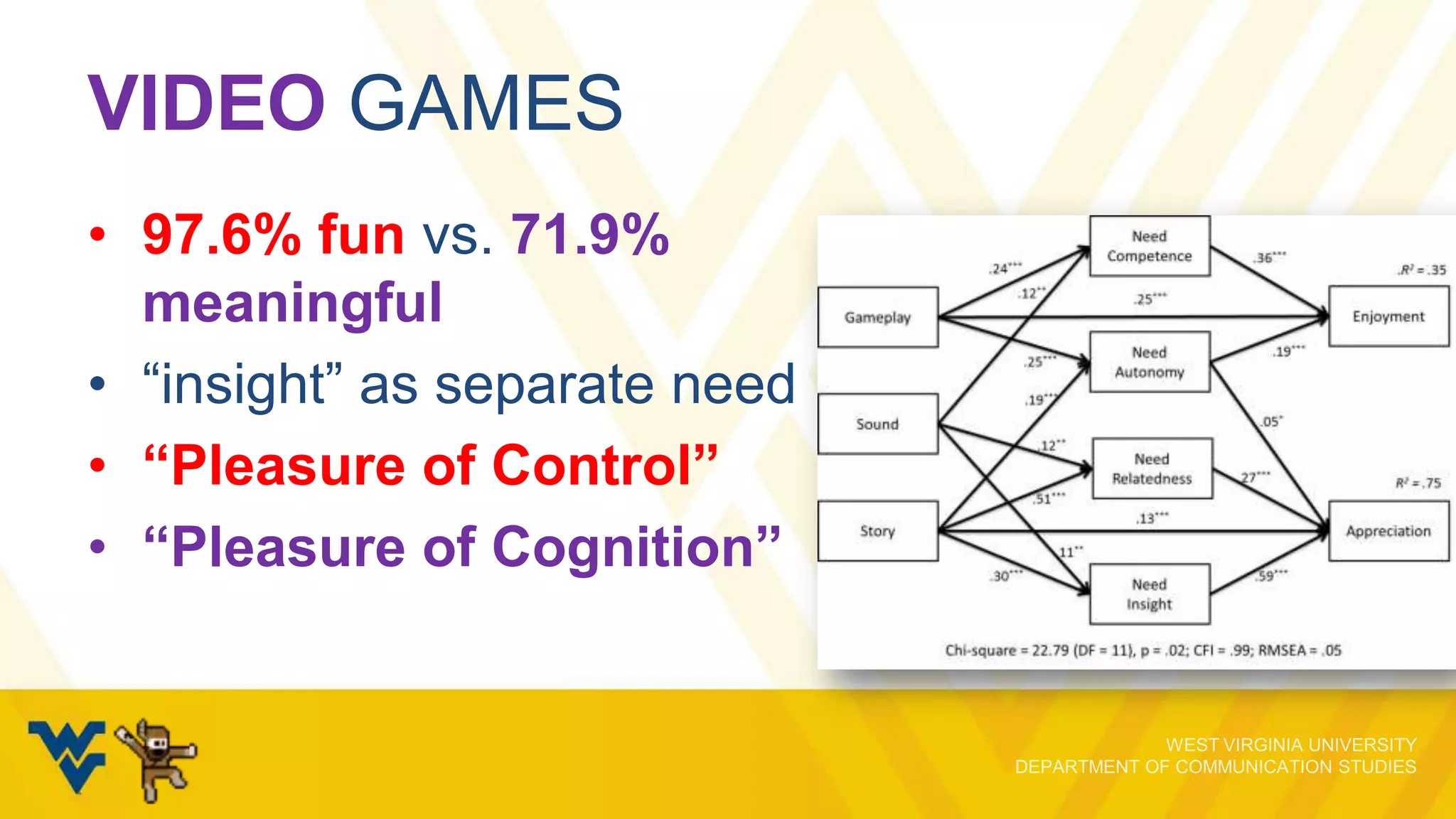
• 97.6% fun vs. 71.9%
meaningful
• “insight” as separate need
• “Pleasure of Control”
• “Pleasure of Cognition”
VIDEO GAMES
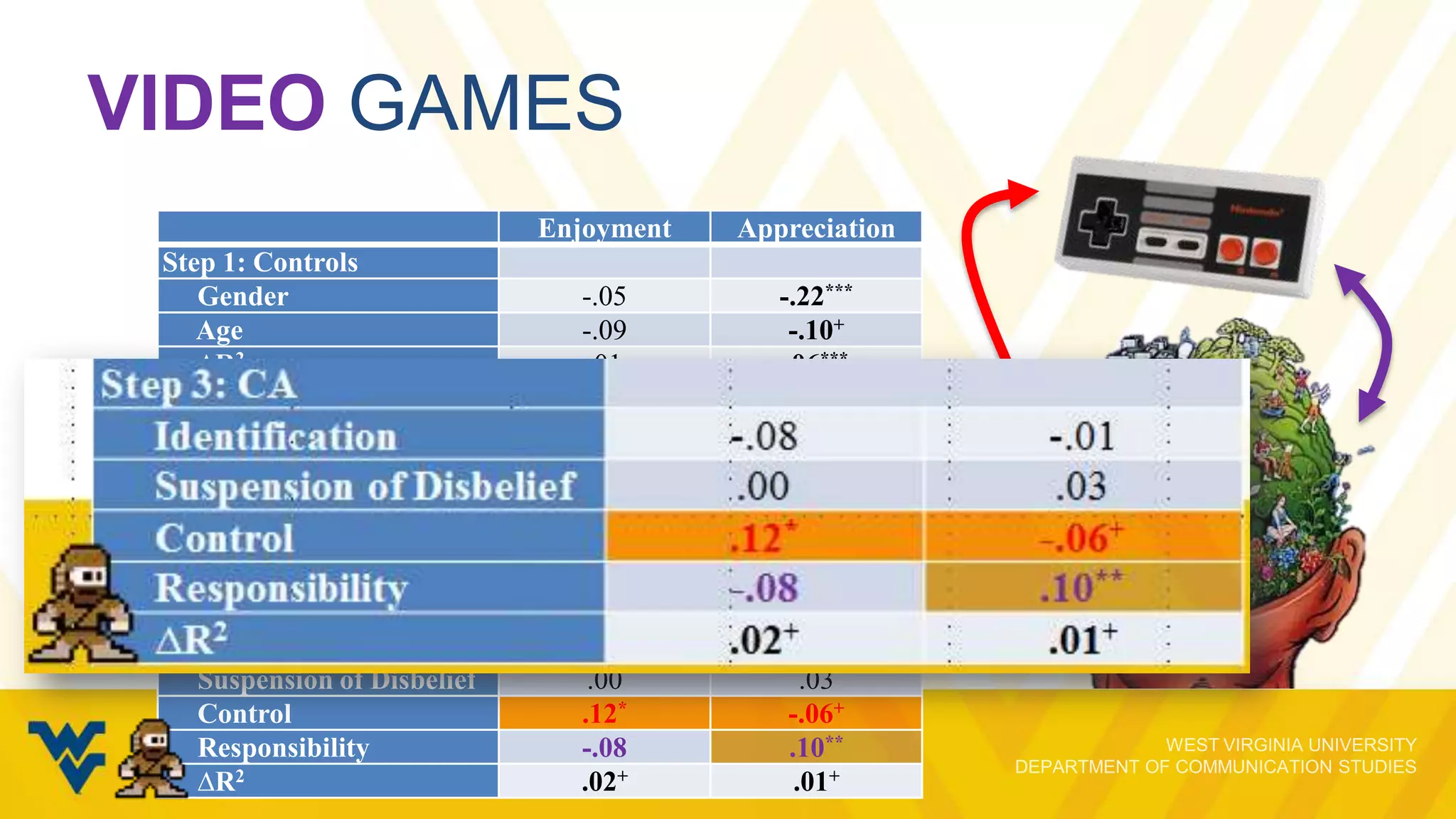
Enjoyment
Step 1: Controls
Gender
Age
∆R2
Step 2: Intrinsic Needs
Competence
Autonomy
Relatedness
Insight
∆R2
Step 3: CA
Identification
Suspension of Disbelief
Control
Responsibility
∆R2

Appreciation

-.05
-.09
.01

-.22***
-.10+
.06***

.47***
.13*
.01
-.05
.28***

-.02
.02
.36***
.58***
.69***

-.08
.00
.12*
-.08
.02+

-.01
.03
-.06+
.10**
.01+
VIDEO GAMES
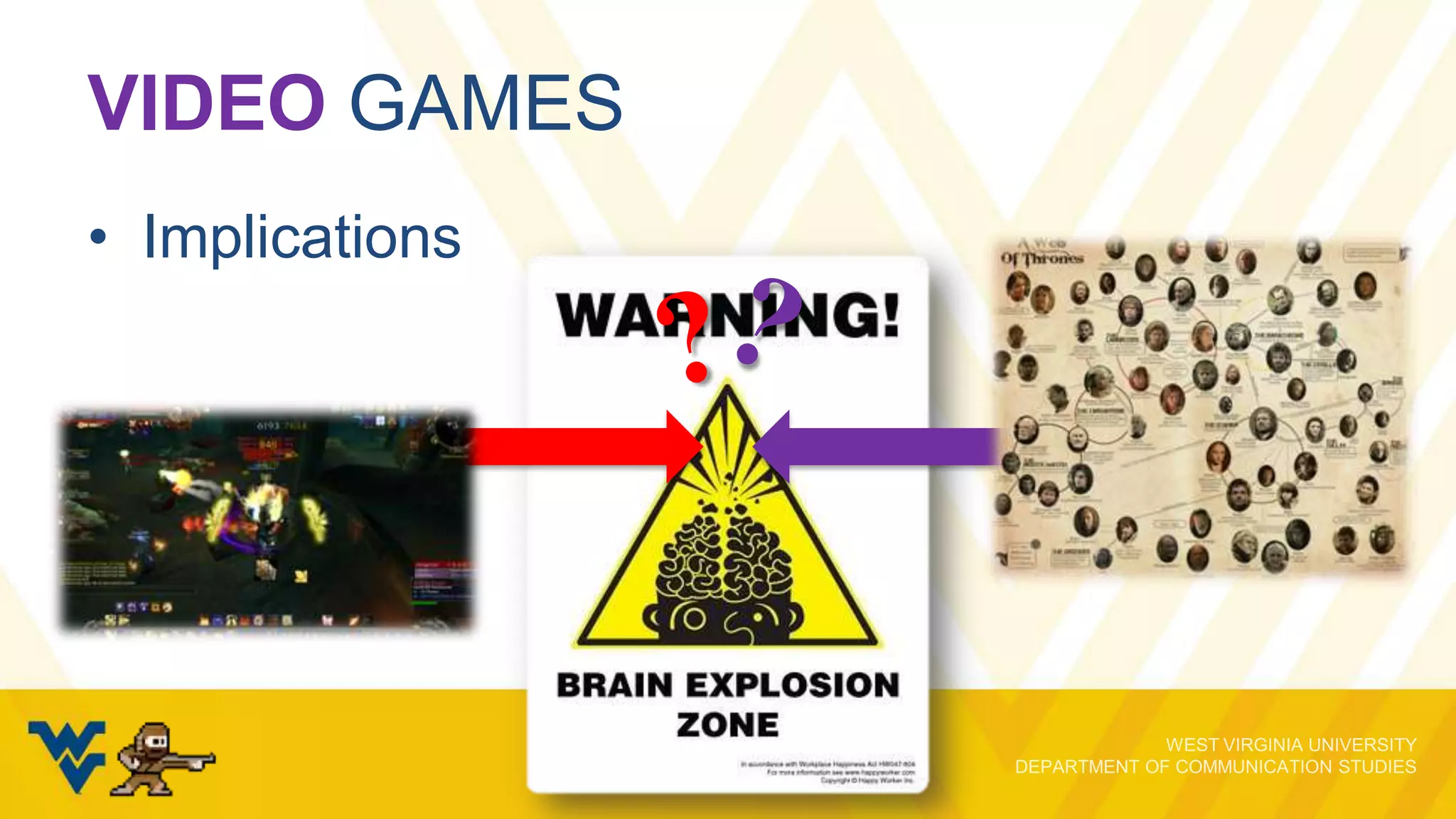
• Implications
IU Guest Lecture

MOVING FORWARD
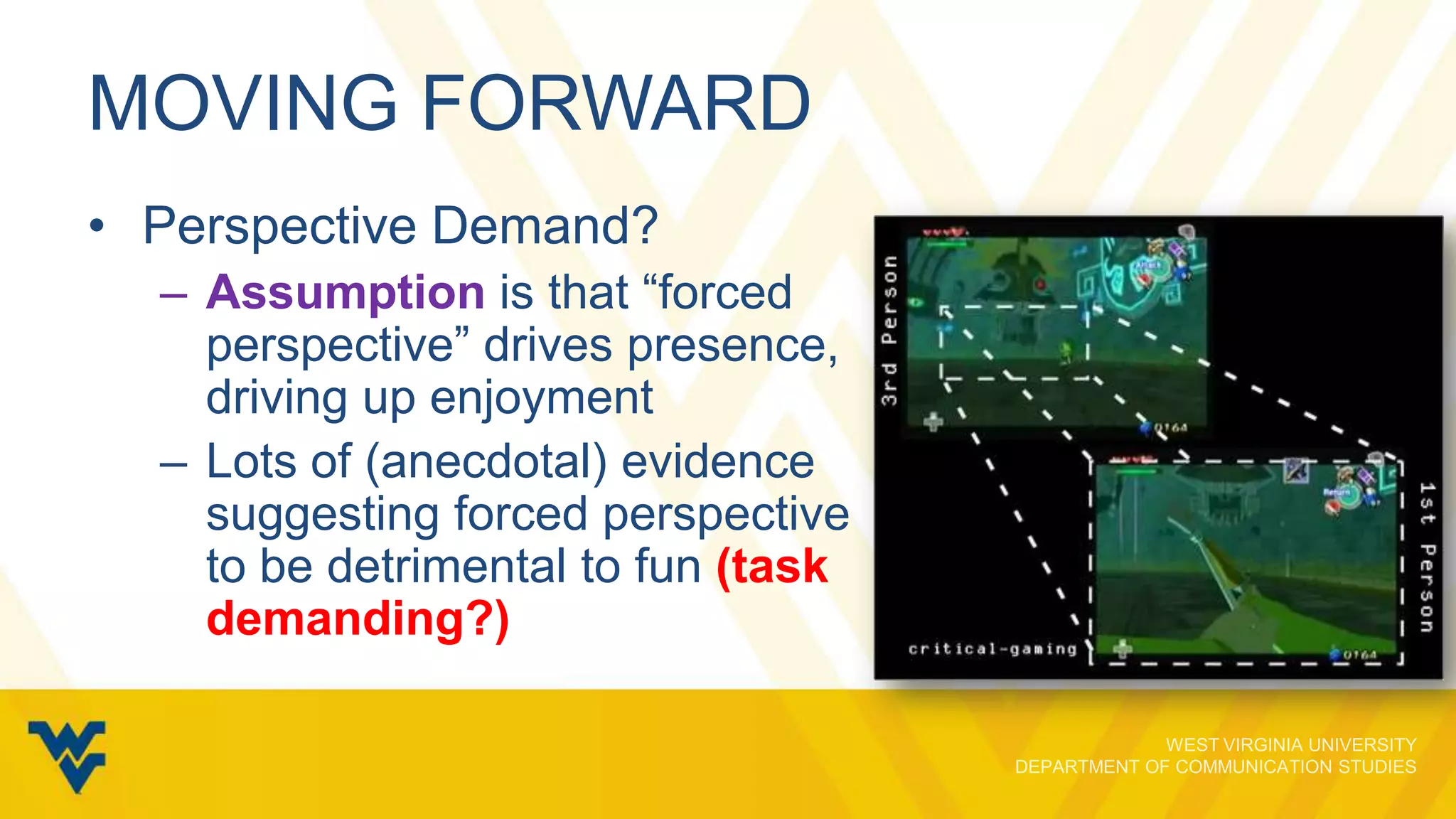
MOVING FORWARD
• Perspective Demand?
– Assumption is that “forced
perspective” drives presence,
driving up enjoyment
– Lots of (anecdotal) evidence
suggesting forced perspective
to be detrimental to fun (task
demanding?)
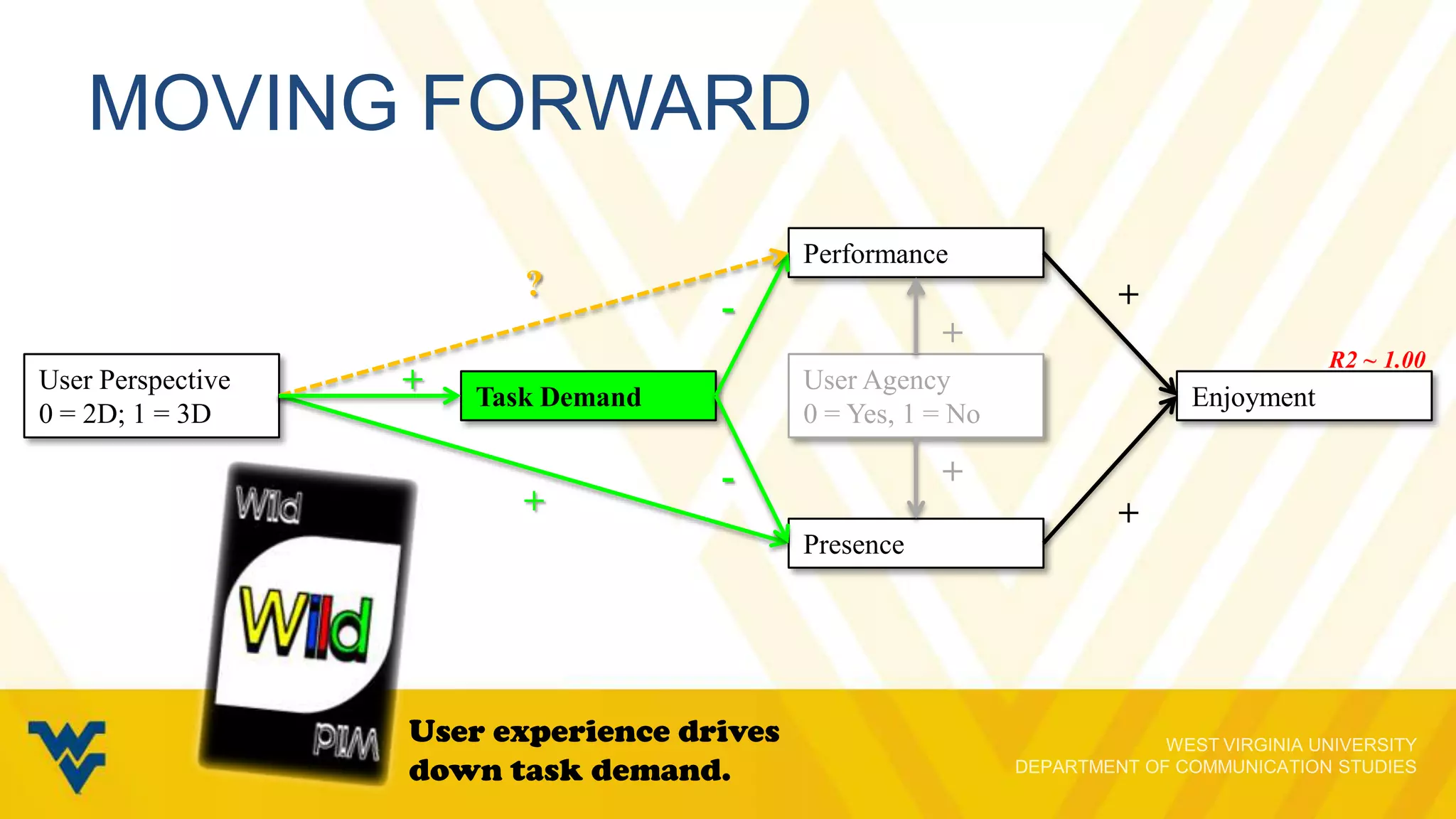
MOVING FORWARD
Performance

?
User Perspective
0 = 2D; 1 = 3D

+

+

R2 ~ 1.00

User Agency
0 = Yes, 1 = No

Task Demand

-

+

-

+

-

+
Presence

User experience drives
down task demand.

Enjoyment
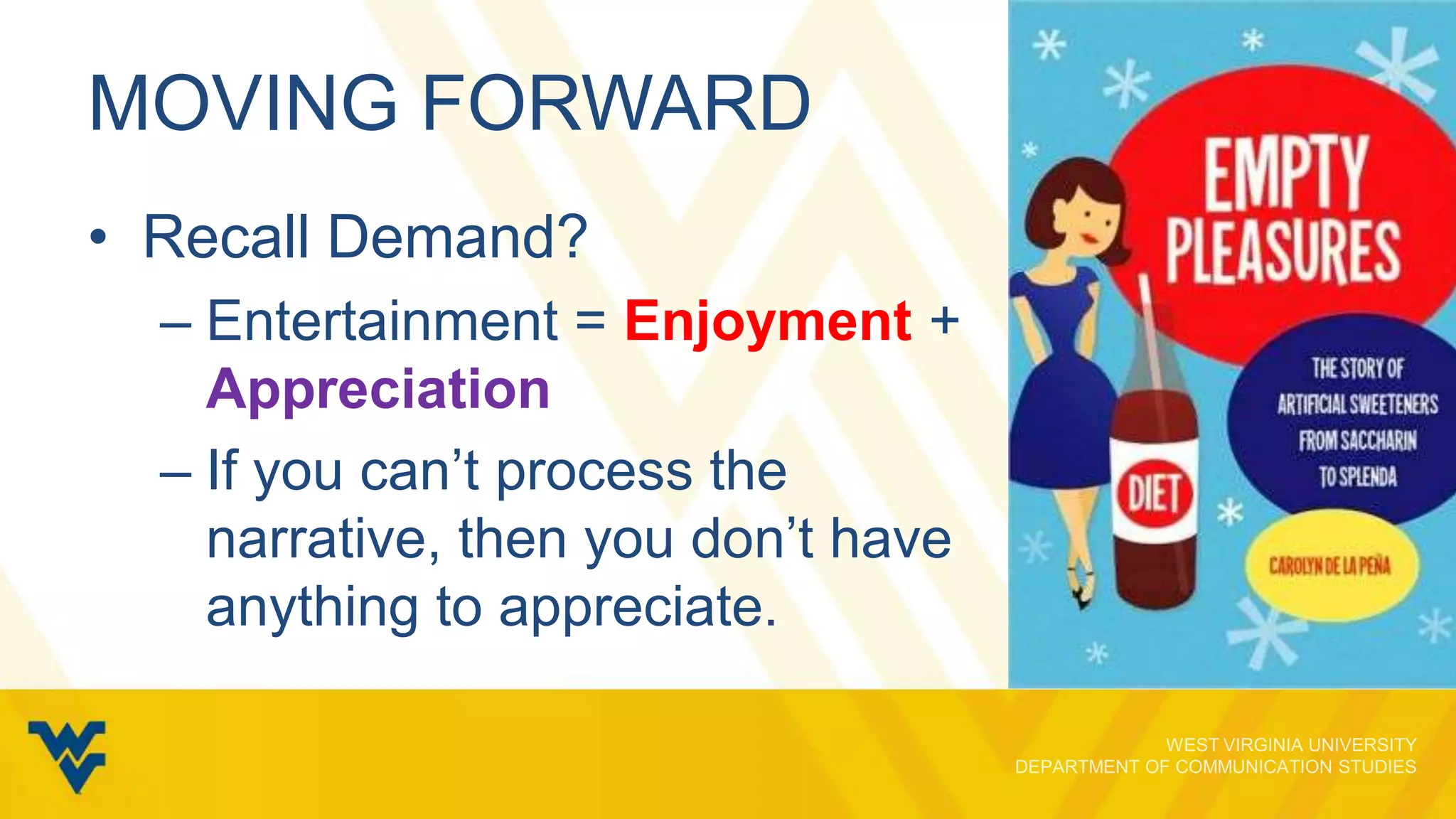
MOVING FORWARD
• Recall Demand?
– Entertainment = Enjoyment +
Appreciation
– If you can’t process the
narrative, then you don’t have
anything to appreciate.
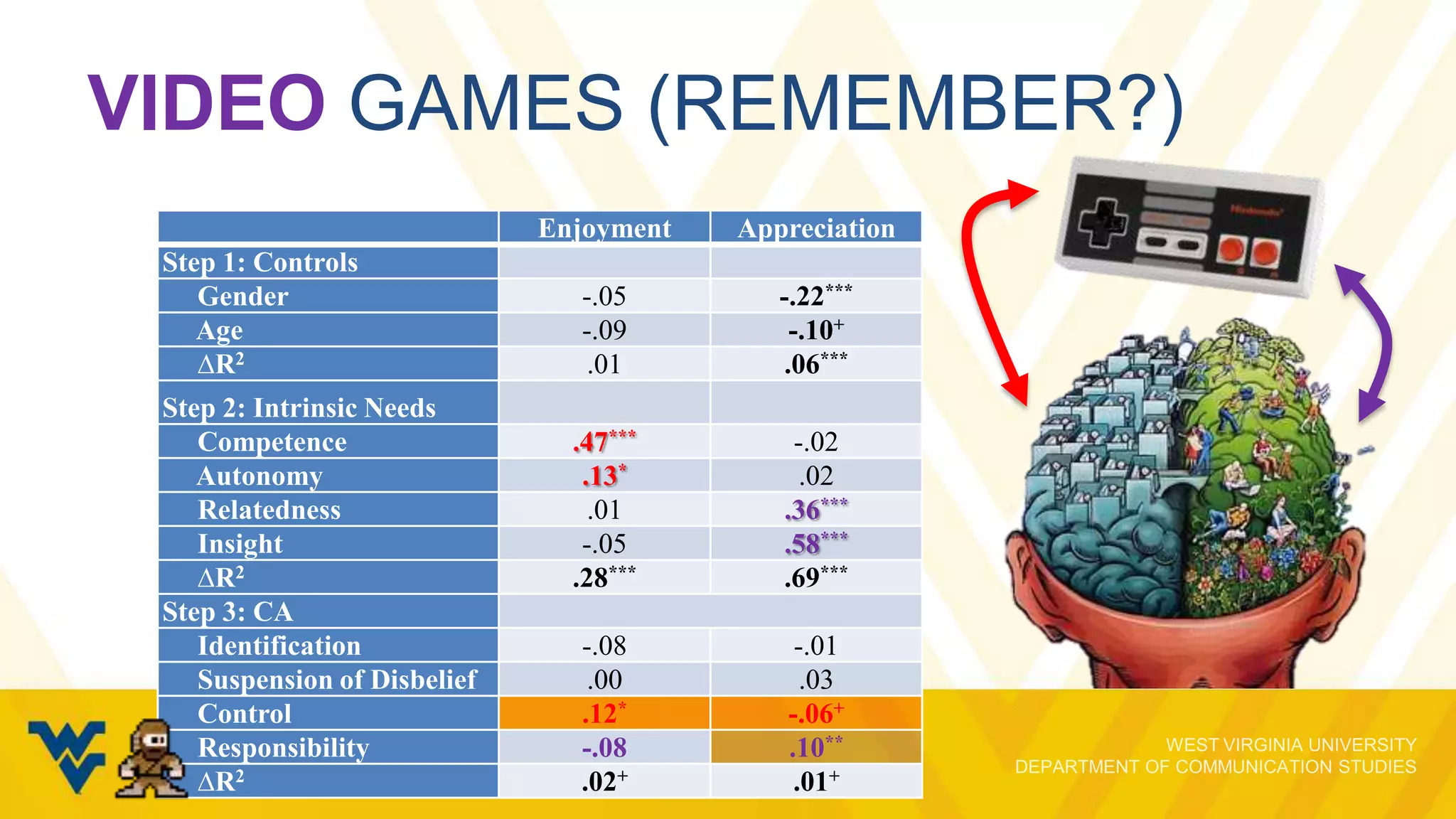
VIDEO GAMES (REMEMBER?)
Enjoyment
Step 1: Controls
Gender
Age
∆R2
Step 2: Intrinsic Needs
Competence
Autonomy
Relatedness
Insight
∆R2
Step 3: CA
Identification
Suspension of Disbelief
Control
Responsibility
∆R2

Appreciation

-.05
-.09
.01

-.22***
-.10+
.06***

.47***
.13*
.01
-.05
.28***

-.02
.02
.36***
.58***
.69***

-.08
.00
.12*
-.08
.02+

-.01
.03
-.06+
.10**
.01+
MOVING FORWARD
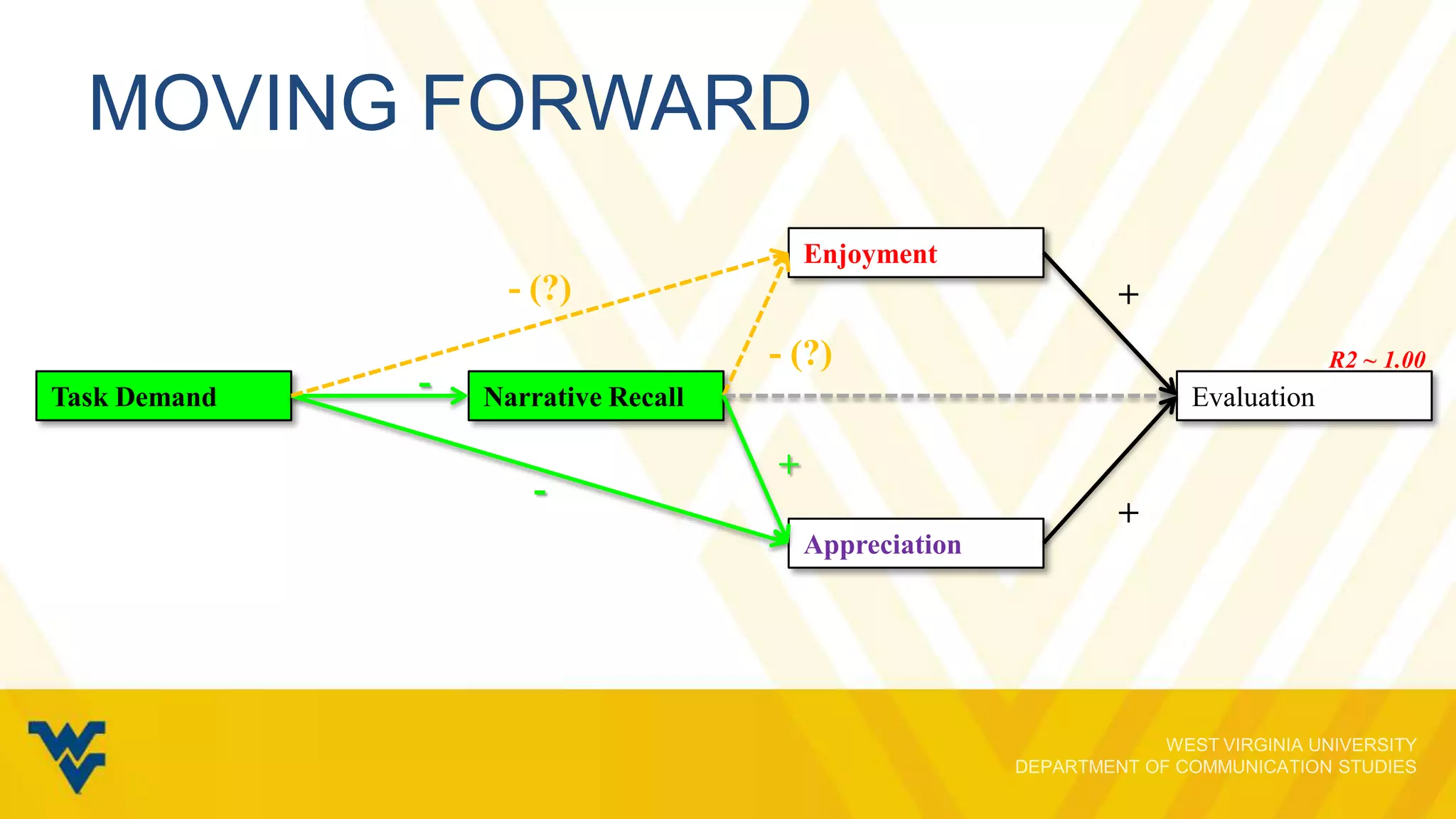
Enjoyment

- (?)
Task Demand

-

+
- (?)

R2 ~ 1.00

Narrative Recall

-

Evaluation

+

+
Appreciation
IU Guest Lecture

EPILOGUE
WHAT IS THE MEANING OF THIS?
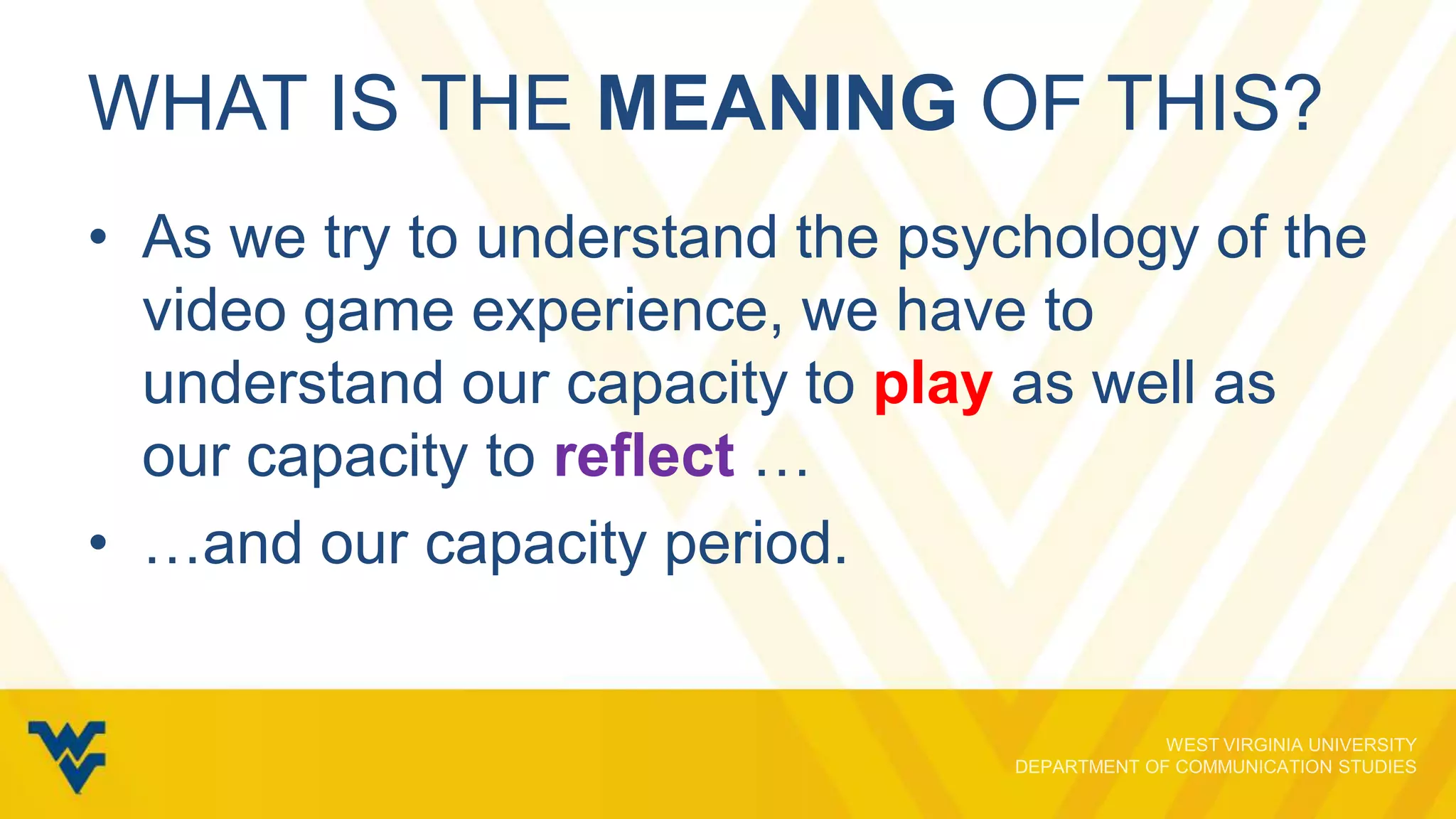
• As we try to understand the psychology of the
video game experience, we have to
understand our capacity to play as well as
our capacity to reflect …
• …and our capacity period.
WHAT IS THE MEANING OF THIS?
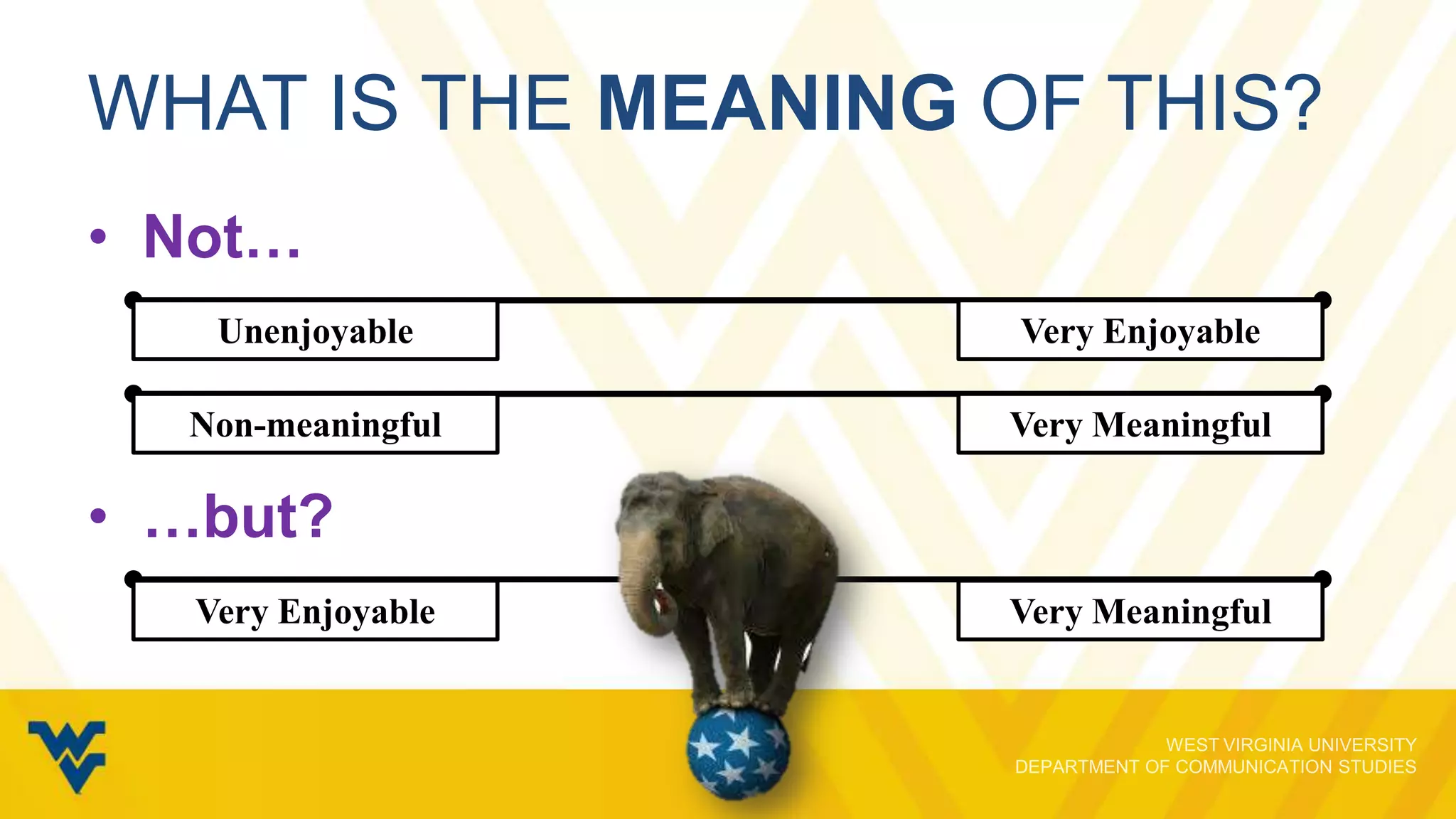
• Not…
Unenjoyable

Very Enjoyable

Non-meaningful

Very Meaningful

• …but?
Very Enjoyable

Very Meaningful
FOR MORE INFORMATION
• Nick Bowman, Ph.D. [CV]
Twitter (@bowmanspartan)
Skype (nicholasdbowman)
nicholas.bowman@mail.wvu.edu

Media and
Interaction Lab

Need references
for cited materials?
Contact me!
COLLABORATORS AND
INSPIRATIONS
•
•
•
•
•
•
•

Andrew Billings
Frank Biocca
Jennings Bryant
Mun-Yun Chung
Mary Beth Oliver
Art Raney
Ryan Rogers

•
•
•
•
•
•

John Sherry
Brett Sherrick
Ron Tamborini
Rene Weber
Julia Woolley
[everyone mentioned
via Twitter!]

What is the Meaning of this? Understanding the contentious(?) relationship between videogame play and videogame narrative

  • 1.
    WHAT IS THEMEANING OF THIS? UNDERSTANDING THE CONTENTIOUS(?) RELATIONSHIP BETWEEN VIDEOGAME PLAY AND VIDEOGAME NARRATIVE ND Bowman Indiana University 24 Jan 2014 Media and Interaction Lab
  • 2.
    ABSTRACT Video games haveenjoyed sustained economic and cultural success for nearly four decades, with their success often attributed to their interactive nature: passive audiences become active users with a vested stake in the on-screen experience. However, as games continue their evolution from singular challenge/skill puzzles to narrative-rich virtual worlds, the manner in which we play and are affected by this play has been called into question. Specifically, given that users do not have an unlimited ability to process stimuli, one might challenge the implicit assumption that gamers interact with and are influenced by all on-screen content in a similar fashion. The following presentation outlines emerging theory and research into the ways in which gamers attend to different on-screen content, and how this implicit and explicit attention can impact the overall entertainment experience.
  • 3.
  • 4.
  • 5.
    SOR VIDEO games • Narrativeworlds Video GAMES • Ludic systems
  • 6.
    SOR • So, dowe get to BE Batman, or do we get to PLAY Batman? Can’t we do BOTH? [NO]
  • 7.
  • 8.
    VIDEO GAMES • Games= challenge + skill
  • 9.
    VIDEO GAMES • Invideo game, skill is based on our ability to control the interactivity (form + content) • One such control is our cognitive abilities (a few) cognitive skills found to correlate w/ game performance: 2D mental rotation 3D mental rotation Moving targeting Fixed targeting Eye-hand coordination Fine motor skill Word completion
  • 10.
    VIDEO GAMES • Challenge/skill balancesare key to understanding how we engage activities
  • 11.
    VIDEO GAMES @JenovaChen • Wetap our skills when we want to attain or sustain a state of flow… • …but other “things” can also impact skill
  • 12.
    VIDEO GAMES • Arousalcan impact skill via drive: E = f (HxD) • As drive increases, we respond with our dominant (cognitive) skill
  • 13.
    VIDEO GAMES • Arousalfrom Audience Presence!* *At high levels of difficulty, audience presence had no effect on performance because drive was maximized by task challenge!
  • 14.
    VIDEO GAMES • Arousalfrom Task Demand!
  • 15.
    VIDEO GAMES • Interactivityis Demanding – Cognitively demanding – Behaviorally demanding – Affectively demanding – Socially demanding? LC4MP
  • 16.
  • 17.
    VIDEO GAMES “…games havesaid goodbye to the tired alien invasions and over-the-top fantasy stories so often found in video games. Instead, they peer into the dark reaches of the very real human heart to deliver stories that are thrilling, chilling and utterly absorbing” ~ Winda Benedetti @WindaBenedetti
  • 18.
    VIDEO GAMES @jesseschell “Are wegoing to have a Shakespeare of games? A game that was told so perfectly, and so well, that 200 years later people will insist we play it exactly as it was?“ ~ Jesse Schell (2013) @waltdwilliams “When you‟re using action as a tool, it’s easy to disassociate from what that action is…with a shooter, that action is killing another person.” ~ Walt Williams (2013)
  • 19.
    VIDEO GAMES “Indeed, tosay that one „„enjoyed‟‟ or was „„entertained by‟‟ a film such as Hotel Rwanda would seem decidedly odd, at best” (Oliver & Raney, 2011).
  • 20.
    VIDEO GAMES You makea game meaningful by drawing us into the emotion … “72 percent of players who started Heavy Rain finished it … if you compare it to the industry average completion rate, which is 20-25 percent, it's downright astounding.” ~ Kristine Steimer …but you have to dial back to the gameplay to do this? @steimer
  • 21.
    VIDEO GAMES • So,if we don’t enjoy these media products, then what do we do with them? • Selection is driven by a different set of motivations
  • 22.
    VIDEO GAMES Hey, thisis really: • Reflective • Inspiring • Expressive • Meaningful Hey, this is really: • Arousing • Exciting • Pleasurable • Diversionary
  • 23.
    VIDEO GAMES • 97.6%fun vs. 71.9% meaningful • “insight” as separate need • “Pleasure of Control” • “Pleasure of Cognition”
  • 24.
    VIDEO GAMES Enjoyment Step 1:Controls Gender Age ∆R2 Step 2: Intrinsic Needs Competence Autonomy Relatedness Insight ∆R2 Step 3: CA Identification Suspension of Disbelief Control Responsibility ∆R2 Appreciation -.05 -.09 .01 -.22*** -.10+ .06*** .47*** .13* .01 -.05 .28*** -.02 .02 .36*** .58*** .69*** -.08 .00 .12* -.08 .02+ -.01 .03 -.06+ .10** .01+
  • 25.
  • 26.
  • 27.
    MOVING FORWARD • PerspectiveDemand? – Assumption is that “forced perspective” drives presence, driving up enjoyment – Lots of (anecdotal) evidence suggesting forced perspective to be detrimental to fun (task demanding?)
  • 28.
    MOVING FORWARD Performance ? User Perspective 0= 2D; 1 = 3D + + R2 ~ 1.00 User Agency 0 = Yes, 1 = No Task Demand - + - + - + Presence User experience drives down task demand. Enjoyment
  • 29.
    MOVING FORWARD • RecallDemand? – Entertainment = Enjoyment + Appreciation – If you can’t process the narrative, then you don’t have anything to appreciate.
  • 30.
    VIDEO GAMES (REMEMBER?) Enjoyment Step1: Controls Gender Age ∆R2 Step 2: Intrinsic Needs Competence Autonomy Relatedness Insight ∆R2 Step 3: CA Identification Suspension of Disbelief Control Responsibility ∆R2 Appreciation -.05 -.09 .01 -.22*** -.10+ .06*** .47*** .13* .01 -.05 .28*** -.02 .02 .36*** .58*** .69*** -.08 .00 .12* -.08 .02+ -.01 .03 -.06+ .10** .01+
  • 31.
    MOVING FORWARD Enjoyment - (?) TaskDemand - + - (?) R2 ~ 1.00 Narrative Recall - Evaluation + + Appreciation
  • 32.
  • 33.
    WHAT IS THEMEANING OF THIS? • As we try to understand the psychology of the video game experience, we have to understand our capacity to play as well as our capacity to reflect … • …and our capacity period.
  • 34.
    WHAT IS THEMEANING OF THIS? • Not… Unenjoyable Very Enjoyable Non-meaningful Very Meaningful • …but? Very Enjoyable Very Meaningful
  • 35.
    FOR MORE INFORMATION •Nick Bowman, Ph.D. [CV] Twitter (@bowmanspartan) Skype (nicholasdbowman) nicholas.bowman@mail.wvu.edu Media and Interaction Lab Need references for cited materials? Contact me!
  • 36.
    COLLABORATORS AND INSPIRATIONS • • • • • • • Andrew Billings FrankBiocca Jennings Bryant Mun-Yun Chung Mary Beth Oliver Art Raney Ryan Rogers • • • • • • John Sherry Brett Sherrick Ron Tamborini Rene Weber Julia Woolley [everyone mentioned via Twitter!]