My Ideal Professor: Examining College Students’ 
Preferences for Effective Teaching Practices 
Zachary W. GoldmanA, Gregory A. CranmerA, Michael SollittoB, 
Sara LaBelleC, & Alexander LancasterA 
West Virginia UniversityA, Texas A&M - Corpus ChristiB, & Chapman UniversityC 
The instructional communication literature has a rich history of examining 
effective teaching practices. Guided by Rhetorical and Relational Goals Theory, 
this study attempted to further this literature by exploring the qualities and 
behaviors that today’s students prefer from their college instructors. Following 
the design put forth by Senko, Belmonte, and Yakhkind (2012), undergraduate 
students were asked to rank order certain instructional qualities and behaviors 
(i.e., assertiveness, responsiveness, clarity, relevance, competence, 
trustworthiness, caring, immediacy, humor, disclosure) as an attempt to 
develop their “ideal instructor”. Academic beliefs (i.e., entitlement, learning and 
grade orientation) were thought to influence students’ choices. 
Method 
Rationale 
Research Questions 
RQ1: Which effective teaching behaviors and characteristics (i.e., clarity, 
credibility, content relevance, socio-communicative style, 
immediacy, self-disclosure, and humor) do college students find 
most desirable in their ideal instructors? 
RQ2: Which effective teaching behaviors (i.e., clarity, credibility, content 
relevance, socio-communicative style, immediacy, self-disclosure, 
and humor), if any, are considered to be a luxury rather than a 
necessity for ideal instructors? 
RQ3: To what extent do academic beliefs (i.e., learning orientation, 
grade orientation and academic entitlement) relate to students’ 
preferences for effective teaching behaviors? 
Participants (N = 209: 118 men, 91 women) were solicited from 
undergraduate communication courses at a large Mid-Atlantic university. The 
age of the respondents ranged from 18 to 31 (M = 20.37, SD = 2.20). 
Participants represented 16 different majors and 31% were first-year 
students, 23% were sophomores, 21% were juniors, and 25% were seniors. 
Results 
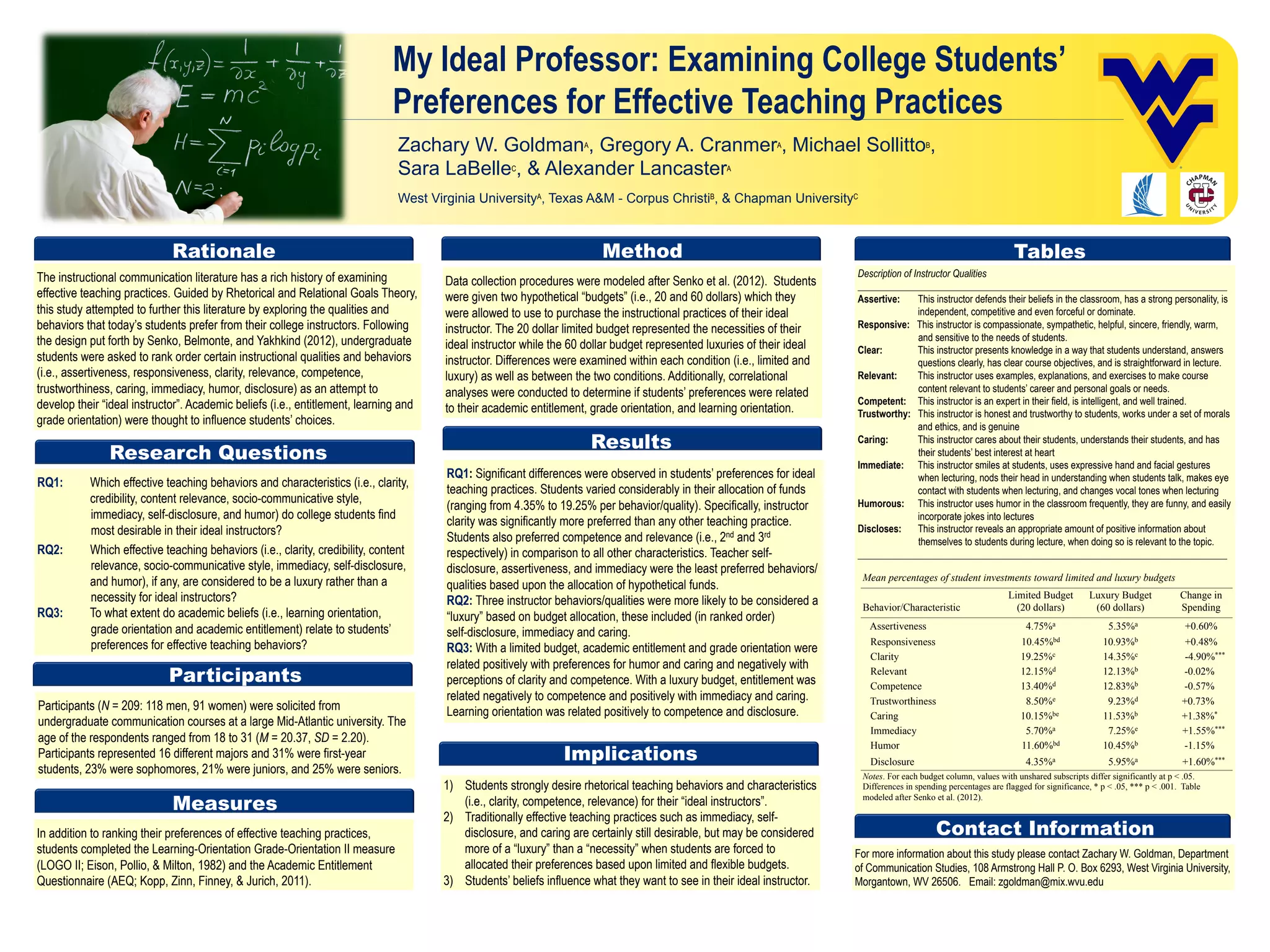
RQ1: Significant differences were observed in students’ preferences for ideal 
teaching practices. Students varied considerably in their allocation of funds 
(ranging from 4.35% to 19.25% per behavior/quality). Specifically, instructor 
clarity was significantly more preferred than any other teaching practice. 
Students also preferred competence and relevance (i.e., 2nd and 3rd 
respectively) in comparison to all other characteristics. Teacher self-disclosure, 
assertiveness, and immediacy were the least preferred behaviors/ 
qualities based upon the allocation of hypothetical funds. 
RQ2: Three instructor behaviors/qualities were more likely to be considered a 
“luxury” based on budget allocation, these included (in ranked order) 
self-disclosure, immediacy and caring. 
RQ3: With a limited budget, academic entitlement and grade orientation were 
related positively with preferences for humor and caring and negatively with 
perceptions of clarity and competence. With a luxury budget, entitlement was 
related negatively to competence and positively with immediacy and caring. 
Learning orientation was related positively to competence and disclosure. 
For more information about this study please contact Zachary W. Goldman, Department 
of Communication Studies, 108 Armstrong Hall P. O. Box 6293, West Virginia University, 
Morgantown, WV 26506. Email: zgoldman@mix.wvu.edu 
Rationale 
Participants 
Description of Instructor Qualities 
____________________________________________________________________________ 
Assertive: This instructor defends their beliefs in the classroom, has a strong personality, is 
independent, competitive and even forceful or dominate. 
Responsive: This instructor is compassionate, sympathetic, helpful, sincere, friendly, warm, 
and sensitive to the needs of students. 
Clear: This instructor presents knowledge in a way that students understand, answers 
questions clearly, has clear course objectives, and is straightforward in lecture. 
Relevant: This instructor uses examples, explanations, and exercises to make course 
content relevant to students’ career and personal goals or needs. 
Competent: This instructor is an expert in their field, is intelligent, and well trained. 
Trustworthy: This instructor is honest and trustworthy to students, works under a set of morals 
and ethics, and is genuine 
Caring: This instructor cares about their students, understands their students, and has 
their students’ best interest at heart 
Immediate: This instructor smiles at students, uses expressive hand and facial gestures 
when lecturing, nods their head in understanding when students talk, makes eye 
contact with students when lecturing, and changes vocal tones when lecturing 
Humorous: This instructor uses humor in the classroom frequently, they are funny, and easily 
incorporate jokes into lectures 
Discloses: This instructor reveals an appropriate amount of positive information about 
themselves to students during lecture, when doing so is relevant to the topic. 
____________________________________________________________________________ 
Implications 
1) Students strongly desire rhetorical teaching behaviors and characteristics 
(i.e., clarity, competence, relevance) for their “ideal instructors”. 
2) Traditionally effective teaching practices such as immediacy, self-disclosure, 
and caring are certainly still desirable, but may be considered 
more of a “luxury” than a “necessity” when students are forced to 
allocated their preferences based upon limited and flexible budgets. 
3) Students’ beliefs influence what they want to see in their ideal instructor. 
Tables 
Measures 
In addition to ranking their preferences of effective teaching practices, 
students completed the Learning-Orientation Grade-Orientation II measure 
(LOGO II; Eison, Pollio, & Milton, 1982) and the Academic Entitlement 
Questionnaire (AEQ; Kopp, Zinn, Finney, & Jurich, 2011). 
Data collection procedures were modeled after Senko et al. (2012). Students 
were given two hypothetical “budgets” (i.e., 20 and 60 dollars) which they 
were allowed to use to purchase the instructional practices of their ideal 
instructor. The 20 dollar limited budget represented the necessities of their 
ideal instructor while the 60 dollar budget represented luxuries of their ideal 
instructor. Differences were examined within each condition (i.e., limited and 
luxury) as well as between the two conditions. Additionally, correlational 
analyses were conducted to determine if students’ preferences were related 
to their academic entitlement, grade orientation, and learning orientation. 
Mean percentages of student investments toward limited and luxury budgets 
Behavior/Characteristic 
Limited Budget 
(20 dollars) 
Luxury Budget 
(60 dollars) 
Change in 
Spending 
Assertiveness 
4.75%a 
5.35%a 
+0.60% 
Responsiveness 
10.45%bd 
10.93%b 
+0.48% 
Clarity 
19.25%c 
14.35%c 
-4.90%*** 
Relevant 
12.15%d 
12.13%b 
-0.02% 
Competence 
13.40%d 
12.83%b 
-0.57% 
Trustworthiness 
8.50%e 
9.23%d 
+0.73% 
Caring 
10.15%be 
11.53%b 
+1.38%* 
Immediacy 
5.70%a 
7.25%e 
+1.55%*** 
Humor 
11.60%bd 
10.45%b 
-1.15% 
Disclosure 
4.35%a 
5.95%a 
+1.60%*** 
Notes. For each budget column, values with unshared subscripts differ significantly at p < .05. 
Differences in spending percentages are flagged for significance, * p < .05, *** p < .001. Table 
modeled after Senko et al. (2012). 
Contact Information

My Ideal Professor: Examining College Students' Preferences for Effective Teaching Practices

  • 1.
    My Ideal Professor:Examining College Students’ Preferences for Effective Teaching Practices Zachary W. GoldmanA, Gregory A. CranmerA, Michael SollittoB, Sara LaBelleC, & Alexander LancasterA West Virginia UniversityA, Texas A&M - Corpus ChristiB, & Chapman UniversityC The instructional communication literature has a rich history of examining effective teaching practices. Guided by Rhetorical and Relational Goals Theory, this study attempted to further this literature by exploring the qualities and behaviors that today’s students prefer from their college instructors. Following the design put forth by Senko, Belmonte, and Yakhkind (2012), undergraduate students were asked to rank order certain instructional qualities and behaviors (i.e., assertiveness, responsiveness, clarity, relevance, competence, trustworthiness, caring, immediacy, humor, disclosure) as an attempt to develop their “ideal instructor”. Academic beliefs (i.e., entitlement, learning and grade orientation) were thought to influence students’ choices. Method Rationale Research Questions RQ1: Which effective teaching behaviors and characteristics (i.e., clarity, credibility, content relevance, socio-communicative style, immediacy, self-disclosure, and humor) do college students find most desirable in their ideal instructors? RQ2: Which effective teaching behaviors (i.e., clarity, credibility, content relevance, socio-communicative style, immediacy, self-disclosure, and humor), if any, are considered to be a luxury rather than a necessity for ideal instructors? RQ3: To what extent do academic beliefs (i.e., learning orientation, grade orientation and academic entitlement) relate to students’ preferences for effective teaching behaviors? Participants (N = 209: 118 men, 91 women) were solicited from undergraduate communication courses at a large Mid-Atlantic university. The age of the respondents ranged from 18 to 31 (M = 20.37, SD = 2.20). Participants represented 16 different majors and 31% were first-year students, 23% were sophomores, 21% were juniors, and 25% were seniors. Results RQ1: Significant differences were observed in students’ preferences for ideal teaching practices. Students varied considerably in their allocation of funds (ranging from 4.35% to 19.25% per behavior/quality). Specifically, instructor clarity was significantly more preferred than any other teaching practice. Students also preferred competence and relevance (i.e., 2nd and 3rd respectively) in comparison to all other characteristics. Teacher self-disclosure, assertiveness, and immediacy were the least preferred behaviors/ qualities based upon the allocation of hypothetical funds. RQ2: Three instructor behaviors/qualities were more likely to be considered a “luxury” based on budget allocation, these included (in ranked order) self-disclosure, immediacy and caring. RQ3: With a limited budget, academic entitlement and grade orientation were related positively with preferences for humor and caring and negatively with perceptions of clarity and competence. With a luxury budget, entitlement was related negatively to competence and positively with immediacy and caring. Learning orientation was related positively to competence and disclosure. For more information about this study please contact Zachary W. Goldman, Department of Communication Studies, 108 Armstrong Hall P. O. Box 6293, West Virginia University, Morgantown, WV 26506. Email: zgoldman@mix.wvu.edu Rationale Participants Description of Instructor Qualities ____________________________________________________________________________ Assertive: This instructor defends their beliefs in the classroom, has a strong personality, is independent, competitive and even forceful or dominate. Responsive: This instructor is compassionate, sympathetic, helpful, sincere, friendly, warm, and sensitive to the needs of students. Clear: This instructor presents knowledge in a way that students understand, answers questions clearly, has clear course objectives, and is straightforward in lecture. Relevant: This instructor uses examples, explanations, and exercises to make course content relevant to students’ career and personal goals or needs. Competent: This instructor is an expert in their field, is intelligent, and well trained. Trustworthy: This instructor is honest and trustworthy to students, works under a set of morals and ethics, and is genuine Caring: This instructor cares about their students, understands their students, and has their students’ best interest at heart Immediate: This instructor smiles at students, uses expressive hand and facial gestures when lecturing, nods their head in understanding when students talk, makes eye contact with students when lecturing, and changes vocal tones when lecturing Humorous: This instructor uses humor in the classroom frequently, they are funny, and easily incorporate jokes into lectures Discloses: This instructor reveals an appropriate amount of positive information about themselves to students during lecture, when doing so is relevant to the topic. ____________________________________________________________________________ Implications 1) Students strongly desire rhetorical teaching behaviors and characteristics (i.e., clarity, competence, relevance) for their “ideal instructors”. 2) Traditionally effective teaching practices such as immediacy, self-disclosure, and caring are certainly still desirable, but may be considered more of a “luxury” than a “necessity” when students are forced to allocated their preferences based upon limited and flexible budgets. 3) Students’ beliefs influence what they want to see in their ideal instructor. Tables Measures In addition to ranking their preferences of effective teaching practices, students completed the Learning-Orientation Grade-Orientation II measure (LOGO II; Eison, Pollio, & Milton, 1982) and the Academic Entitlement Questionnaire (AEQ; Kopp, Zinn, Finney, & Jurich, 2011). Data collection procedures were modeled after Senko et al. (2012). Students were given two hypothetical “budgets” (i.e., 20 and 60 dollars) which they were allowed to use to purchase the instructional practices of their ideal instructor. The 20 dollar limited budget represented the necessities of their ideal instructor while the 60 dollar budget represented luxuries of their ideal instructor. Differences were examined within each condition (i.e., limited and luxury) as well as between the two conditions. Additionally, correlational analyses were conducted to determine if students’ preferences were related to their academic entitlement, grade orientation, and learning orientation. Mean percentages of student investments toward limited and luxury budgets Behavior/Characteristic Limited Budget (20 dollars) Luxury Budget (60 dollars) Change in Spending Assertiveness 4.75%a 5.35%a +0.60% Responsiveness 10.45%bd 10.93%b +0.48% Clarity 19.25%c 14.35%c -4.90%*** Relevant 12.15%d 12.13%b -0.02% Competence 13.40%d 12.83%b -0.57% Trustworthiness 8.50%e 9.23%d +0.73% Caring 10.15%be 11.53%b +1.38%* Immediacy 5.70%a 7.25%e +1.55%*** Humor 11.60%bd 10.45%b -1.15% Disclosure 4.35%a 5.95%a +1.60%*** Notes. For each budget column, values with unshared subscripts differ significantly at p < .05. Differences in spending percentages are flagged for significance, * p < .05, *** p < .001. Table modeled after Senko et al. (2012). Contact Information