BONE
SCINTIGRAPHY
JUNAID UL ISLAM
TABLE OF CONTENTS
• INTRODUCTION.
• INDICATIONS AND CONTRAINDICATIONS.
• RADIOPHARMACEUTICALS.
• PATIENT PREPARATION.
• TECHNIQUE.
• UPTAKE AND PHARMACOKINETICS.
• PATHOPHYSIOLOGY.
• IMAGE ACQUISITION.
• CLINICALAPPLICATIONS.
• ADVANTAGES VS DISADVANTAGES.
INTRODUCTION
• Bone scintigraphy(bone scan) is a nuclear medicine study that makes use of
Tc-99m MDP(technetium 99m methylene diphosphonate) as the active
agent to detect the areas of increased or decreased bone activity.
• The technique employs the use of gamma camera to detect the
metabolism(functional imaging) which alters with the diseased state of the
bone.
• This may indicate bone injury or disease.
ANATOMY
AXIAL SKELETON(Head and
trunk)
 Skull.
 Thorax(ribs and sternum).
 Spine(includes sacrum and
coccyx).
APPENDICULAR SKELETON
 Shoulder girdle : clavicle and
scapula.
 Upper extremities.
 Pelvic girdle.
 Lower extremities.
INDICATIONS
• Neoplastic disease: primary bone tumors and bone metastasis-staging for malignancies
that have high incidence of bone metastasis eg, cancers of prostate, breast lung,
neuroblastoma.
-Unexplained bone pain in patient with malignancies.
-Unexplained bone pain in a patient with no history of malignancy.
• Trauma: fracture/stress injuries.
• infection: osteomyelitis.
• Avascular necrosis.
• Arthritis.
• Bone marrow diseases: sickle cell diseases.
CONTRA-INDICATIONS
• Patient recently had contrast media for a different study.
• Patient recently(24-48 hrs.) had a tc99m- based study.
• A patient with history of pregnancy/breastfeeding.
• Patient with renal disease.
• Patient with spinal cord compression and pathological fractures.
• Renal failure.
RADIOPHARMACEUTICAL
• A combination of technetium-99m with the members of phosphate family is used like
Tc-99m hydroxymethylene diphosphonate(Tc-99m HMDP or HDP) and Tc-99m
methylene diphosphonate(Tc-99m MDP).
• Tc-99m MDP is most widely used.
• Tc-99m MDP is used within 4 hrs. after its preparation.
• The injecting vial should not contain any air as oxidation of Tc results in poor tagging
of the phosphates.
• Higher target ratio within 2-3 hrs. with 50-60% of injected activity localizing in bone.
• This has a rapid renal clearance.
PATIENT PREPARATION
• The patient should be well hydrated and is asked to take 2 or more glasses
of water between the time of injection and the time of delayed imaging.
• The patient should be asked to urinate immediately before delayed imaging
and is advised to take plenty of water for at least 24 hrs after the injection of
radionuclide.
TECHNIQUE
• The Tc-99m MDP is injected intravenously as an
active agent at a dose of 740Mbq(20mCi) using an
intravenous catheter.
• For children the dose is 240 uCi/Kg with a good
hydration and frequent voiding afterwards.
• After the injection of the radiopharmaceutical wait
for 2-3 hrs. to start the imaging.
• Before beginning the scan empty the bladder such
that any radiotracer present in the bladder does not
block the view of the pelvic bone.
• The patient should be provided with a gown and all
the objects should be removed that can cause
artifacts.
UPTAKE AND PHARMACOKINETICS.
• After the intravenous injection TC-99m MDP rapidly dilutes in the extracellular
fluid and is quickly taken up into the bone.
• The uptake of the tracer is dependent on the osteogenic activity of the bone, being
much higher in areas of active bone formation or repair compared with mature bone.
• Tc-99m MDP binding occurs by chemisorption in the hydroxyapatite mineral
component of the osseous matrix.
• Phosphonates concentrate in the mineral phase of bone: nearly two-third in
hydroxyapatite crystals and one third in the calcium phosphate.
• Uptake in areas of amorphous calcium phosphate may account for Tc-99m MDP
uptake in sites outside the bone, such as dystrophic soft tissue ossification.
CONTD.
• Decreased activity is seen in areas of reduced or absent blood flow or
infarction.
• Diminished uptake or cold areas are also seen in regions of severe
destruction occurring in some very aggressive metastases
• Approximately 50% of the dose is localized to the bone, with the remainder
excreted by the kidneys.
• Although peak bone uptake occurs approximately 1 hour after injection, the
highest target-to-background ratios are seen after 6 to 12 hours.
• Images are typically taken at 2 to 4 hours to balance the need for
background clearance with the relatively short 6hr half life of Tc-99m and
patient convenience.
PATHOPHYSIOLOGY
Tc-99m MDP uptake depends on the osteoblastic and osteoclastic activity.
• Increased uptake: osteoblastic
activity.
• Decreased activity : osteoclastic
activity.
IMAGING ACQUISITION
Routine whole body scan.
Three phase bone scan imaging
SPECT imaging.
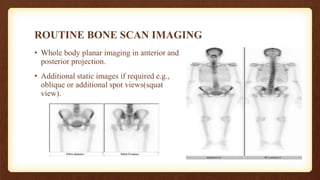
ROUTINE BONE SCAN IMAGING
• Whole body planar imaging in anterior and
posterior projection.
• Additional static images if required e.g.,
oblique or additional spot views(squat
view).
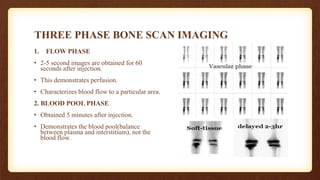
THREE PHASE BONE SCAN IMAGING
1. FLOW PHASE
• 2-5 second images are obtained for 60
seconds after injection.
• This demonstrates perfusion.
• Characterizes blood flow to a particular area.
2. BLOOD POOL PHASE
• Obtained 5 minutes after injection.
• Demonstrates the blood pool(balance
between plasma and interstitium), not the
blood flow.
CONTD.
3. DELAYED PHASE
• Obtained 2-4 hrs. later.
• Urinary excretion has decreased the amount of radionuclide in the soft
tissue.
• Mechanism of uptake is not known with certainty, although it has been
proposed that the radiotracer attaches to hydroxyapatite
crystals(chemisorption).
• Degree of uptake depends on blood flow and rate of new bone formation.
4.DELAYED…..
Obtained 24hrs after injection as a static image.
FALSE NEGATIVE BONE SCAN
• Multiple myeloma.
• Renal cell carcinoma.
• Neuroblastoma.
• Highly aggressive anaplastic tumors.
FALSE POSITIVE BONE SCAN
• Contamination.
• Physiological activity. E.g., urine along urinary tract.
• Patients with known malignancy and no radiographic explanation for a bone
scan lesion.
• Single lesion: in case of a spinal lesion 10-20% chances are of having a
metastatic focus whereas in case a rib lesion there is a 10% chance of
representing a metastatic focus. Lesions in consecutive ribs are almost
always traumatic in origin while as lesions in non consecutive ribs have a
high chance of representing metastatic disease.
• A sternal lesion in a patient with breast cancer has an 80% chance of
representing a metastatic focus
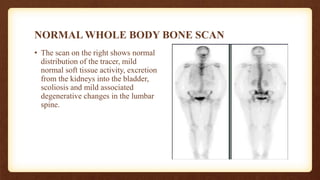
NORMAL WHOLE BODY BONE SCAN
• The scan on the right shows normal
distribution of the tracer, mild
normal soft tissue activity, excretion
from the kidneys into the bladder,
scoliosis and mild associated
degenerative changes in the lumbar
spine.
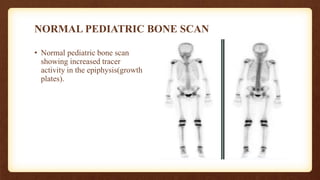
NORMAL PEDIATRIC BONE SCAN
• Normal pediatric bone scan
showing increased tracer
activity in the epiphysis(growth
plates).
BONE METASTASIS
• Disseminated bone metastasis
from breast cancer.
• Lesions in the vertebral bodies
and the femur neck, which are at
the risk of pathological fracture
should be mentioned separately.
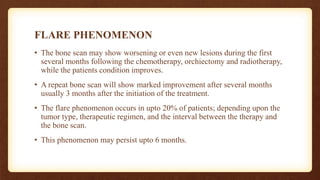
FLARE PHENOMENON
• The bone scan may show worsening or even new lesions during the first
several months following the chemotherapy, orchiectomy and radiotherapy,
while the patients condition improves.
• A repeat bone scan will show marked improvement after several months
usually 3 months after the initiation of the treatment.
• The flare phenomenon occurs in upto 20% of patients; depending upon the
tumor type, therapeutic regimen, and the interval between the therapy and
the bone scan.
• This phenomenon may persist upto 6 months.
DEGENERATIVE CHANGES
• Joints: Arthritis
-knees and ankle.
• Spine: Spondylosis and
disc prolapse
-dorsal spine
-lumbar spine
STRESS FRACTURE
• More than 80% of the stress
fractures will not be evident on the
initial radiographs, where the
sensitivity of the bone scan is
100%.
• Delayed images from a bone scan
of a runner showing stress fracture
at the right distal medial tibial
cortex.
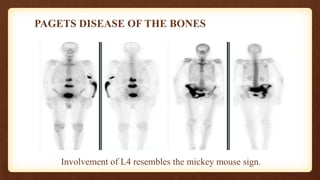
PAGETS DISEASE OF THE BONES
Involvement of L4 resembles the mickey mouse sign.
SICKLE CELL DISEASE
• Bone marrow expansion from
anemia (increased bone vs soft
tissue activity), splenic uptake
from repeated infarctions and
calcifications. Increased uptake
can be seen in the kidneys
from iron overload, multiple
transfusions.
ADVANTAGES AND DISADVANTAGES
ADVANTAGES
• Whole body evaluation in a single test
with the same radiation exposure.
• Exposure to low radiation.
• Sensitive evaluation.
• Bone scan helps monitor the effects of
treatment on bone abnormalities.
• The procedure is free from acute or long-
term side effects
DISADVANTAGES
• Needs radiopharmaceutical and gamma
camera that are not widely available.
• Low specificity.
• Higher cost.
• Slight risk of damage to cells or tissue
from being exposed to any radiation,
including the low level of radiation of the
radiotracer used in this test.
BONE SCINTIGRAPHY.pptx

BONE SCINTIGRAPHY.pptx

  • 1.
  • 2.
    TABLE OF CONTENTS •INTRODUCTION. • INDICATIONS AND CONTRAINDICATIONS. • RADIOPHARMACEUTICALS. • PATIENT PREPARATION. • TECHNIQUE. • UPTAKE AND PHARMACOKINETICS. • PATHOPHYSIOLOGY. • IMAGE ACQUISITION. • CLINICALAPPLICATIONS. • ADVANTAGES VS DISADVANTAGES.
  • 3.
    INTRODUCTION • Bone scintigraphy(bonescan) is a nuclear medicine study that makes use of Tc-99m MDP(technetium 99m methylene diphosphonate) as the active agent to detect the areas of increased or decreased bone activity. • The technique employs the use of gamma camera to detect the metabolism(functional imaging) which alters with the diseased state of the bone. • This may indicate bone injury or disease.
  • 4.
    ANATOMY AXIAL SKELETON(Head and trunk) Skull.  Thorax(ribs and sternum).  Spine(includes sacrum and coccyx). APPENDICULAR SKELETON  Shoulder girdle : clavicle and scapula.  Upper extremities.  Pelvic girdle.  Lower extremities.
  • 5.
    INDICATIONS • Neoplastic disease:primary bone tumors and bone metastasis-staging for malignancies that have high incidence of bone metastasis eg, cancers of prostate, breast lung, neuroblastoma. -Unexplained bone pain in patient with malignancies. -Unexplained bone pain in a patient with no history of malignancy. • Trauma: fracture/stress injuries. • infection: osteomyelitis. • Avascular necrosis. • Arthritis. • Bone marrow diseases: sickle cell diseases.
  • 6.
    CONTRA-INDICATIONS • Patient recentlyhad contrast media for a different study. • Patient recently(24-48 hrs.) had a tc99m- based study. • A patient with history of pregnancy/breastfeeding. • Patient with renal disease. • Patient with spinal cord compression and pathological fractures. • Renal failure.
  • 7.
    RADIOPHARMACEUTICAL • A combinationof technetium-99m with the members of phosphate family is used like Tc-99m hydroxymethylene diphosphonate(Tc-99m HMDP or HDP) and Tc-99m methylene diphosphonate(Tc-99m MDP). • Tc-99m MDP is most widely used. • Tc-99m MDP is used within 4 hrs. after its preparation. • The injecting vial should not contain any air as oxidation of Tc results in poor tagging of the phosphates. • Higher target ratio within 2-3 hrs. with 50-60% of injected activity localizing in bone. • This has a rapid renal clearance.
  • 8.
    PATIENT PREPARATION • Thepatient should be well hydrated and is asked to take 2 or more glasses of water between the time of injection and the time of delayed imaging. • The patient should be asked to urinate immediately before delayed imaging and is advised to take plenty of water for at least 24 hrs after the injection of radionuclide.
  • 9.
    TECHNIQUE • The Tc-99mMDP is injected intravenously as an active agent at a dose of 740Mbq(20mCi) using an intravenous catheter. • For children the dose is 240 uCi/Kg with a good hydration and frequent voiding afterwards. • After the injection of the radiopharmaceutical wait for 2-3 hrs. to start the imaging. • Before beginning the scan empty the bladder such that any radiotracer present in the bladder does not block the view of the pelvic bone. • The patient should be provided with a gown and all the objects should be removed that can cause artifacts.
  • 10.
    UPTAKE AND PHARMACOKINETICS. •After the intravenous injection TC-99m MDP rapidly dilutes in the extracellular fluid and is quickly taken up into the bone. • The uptake of the tracer is dependent on the osteogenic activity of the bone, being much higher in areas of active bone formation or repair compared with mature bone. • Tc-99m MDP binding occurs by chemisorption in the hydroxyapatite mineral component of the osseous matrix. • Phosphonates concentrate in the mineral phase of bone: nearly two-third in hydroxyapatite crystals and one third in the calcium phosphate. • Uptake in areas of amorphous calcium phosphate may account for Tc-99m MDP uptake in sites outside the bone, such as dystrophic soft tissue ossification.
  • 11.
    CONTD. • Decreased activityis seen in areas of reduced or absent blood flow or infarction. • Diminished uptake or cold areas are also seen in regions of severe destruction occurring in some very aggressive metastases • Approximately 50% of the dose is localized to the bone, with the remainder excreted by the kidneys. • Although peak bone uptake occurs approximately 1 hour after injection, the highest target-to-background ratios are seen after 6 to 12 hours. • Images are typically taken at 2 to 4 hours to balance the need for background clearance with the relatively short 6hr half life of Tc-99m and patient convenience.
  • 12.
    PATHOPHYSIOLOGY Tc-99m MDP uptakedepends on the osteoblastic and osteoclastic activity. • Increased uptake: osteoblastic activity. • Decreased activity : osteoclastic activity.
  • 13.
    IMAGING ACQUISITION Routine wholebody scan. Three phase bone scan imaging SPECT imaging.
  • 14.
    ROUTINE BONE SCANIMAGING • Whole body planar imaging in anterior and posterior projection. • Additional static images if required e.g., oblique or additional spot views(squat view).
  • 15.
    THREE PHASE BONESCAN IMAGING 1. FLOW PHASE • 2-5 second images are obtained for 60 seconds after injection. • This demonstrates perfusion. • Characterizes blood flow to a particular area. 2. BLOOD POOL PHASE • Obtained 5 minutes after injection. • Demonstrates the blood pool(balance between plasma and interstitium), not the blood flow.
  • 16.
    CONTD. 3. DELAYED PHASE •Obtained 2-4 hrs. later. • Urinary excretion has decreased the amount of radionuclide in the soft tissue. • Mechanism of uptake is not known with certainty, although it has been proposed that the radiotracer attaches to hydroxyapatite crystals(chemisorption). • Degree of uptake depends on blood flow and rate of new bone formation. 4.DELAYED….. Obtained 24hrs after injection as a static image.
  • 17.
    FALSE NEGATIVE BONESCAN • Multiple myeloma. • Renal cell carcinoma. • Neuroblastoma. • Highly aggressive anaplastic tumors.
  • 18.
    FALSE POSITIVE BONESCAN • Contamination. • Physiological activity. E.g., urine along urinary tract. • Patients with known malignancy and no radiographic explanation for a bone scan lesion. • Single lesion: in case of a spinal lesion 10-20% chances are of having a metastatic focus whereas in case a rib lesion there is a 10% chance of representing a metastatic focus. Lesions in consecutive ribs are almost always traumatic in origin while as lesions in non consecutive ribs have a high chance of representing metastatic disease. • A sternal lesion in a patient with breast cancer has an 80% chance of representing a metastatic focus
  • 19.
    NORMAL WHOLE BODYBONE SCAN • The scan on the right shows normal distribution of the tracer, mild normal soft tissue activity, excretion from the kidneys into the bladder, scoliosis and mild associated degenerative changes in the lumbar spine.
  • 20.
    NORMAL PEDIATRIC BONESCAN • Normal pediatric bone scan showing increased tracer activity in the epiphysis(growth plates).
  • 21.
    BONE METASTASIS • Disseminatedbone metastasis from breast cancer. • Lesions in the vertebral bodies and the femur neck, which are at the risk of pathological fracture should be mentioned separately.
  • 22.
    FLARE PHENOMENON • Thebone scan may show worsening or even new lesions during the first several months following the chemotherapy, orchiectomy and radiotherapy, while the patients condition improves. • A repeat bone scan will show marked improvement after several months usually 3 months after the initiation of the treatment. • The flare phenomenon occurs in upto 20% of patients; depending upon the tumor type, therapeutic regimen, and the interval between the therapy and the bone scan. • This phenomenon may persist upto 6 months.
  • 23.
    DEGENERATIVE CHANGES • Joints:Arthritis -knees and ankle. • Spine: Spondylosis and disc prolapse -dorsal spine -lumbar spine
  • 24.
    STRESS FRACTURE • Morethan 80% of the stress fractures will not be evident on the initial radiographs, where the sensitivity of the bone scan is 100%. • Delayed images from a bone scan of a runner showing stress fracture at the right distal medial tibial cortex.
  • 25.
    PAGETS DISEASE OFTHE BONES Involvement of L4 resembles the mickey mouse sign.
  • 26.
    SICKLE CELL DISEASE •Bone marrow expansion from anemia (increased bone vs soft tissue activity), splenic uptake from repeated infarctions and calcifications. Increased uptake can be seen in the kidneys from iron overload, multiple transfusions.
  • 27.
    ADVANTAGES AND DISADVANTAGES ADVANTAGES •Whole body evaluation in a single test with the same radiation exposure. • Exposure to low radiation. • Sensitive evaluation. • Bone scan helps monitor the effects of treatment on bone abnormalities. • The procedure is free from acute or long- term side effects DISADVANTAGES • Needs radiopharmaceutical and gamma camera that are not widely available. • Low specificity. • Higher cost. • Slight risk of damage to cells or tissue from being exposed to any radiation, including the low level of radiation of the radiotracer used in this test.